ICTERUS
NEONATARUM
SUBMITTED TO
MRS PUSHPA KERKETTA
CLINICAL TUTOR
COLLEGE OF NURSING
RIMS RANCHI
Submitted by
Purnima Kumari
Basic BSC Nursing 4th year
(2017-2021)
Roll no – 25
College of Nursing
RIMS Ranchi.
CONTENTS
 Introduction
 Definition
 Metabolism and excretion of
bilirubin
 Causes
 Symptoms
 Types
 Physiological jaundice
 Pathological jaundice
 Breast milk jaundice
 Risk factors
 Laboratory evaluation
 Treatment
 Complication
 Prevention
 Summary
 Evaluation
 Bibliography
Jaundice in the newborn/ neonatal
jaundice
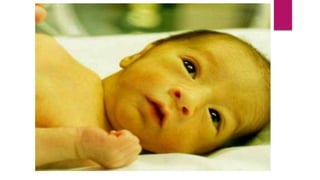
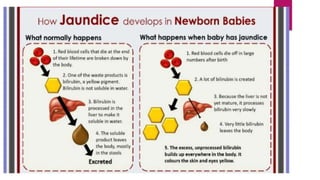
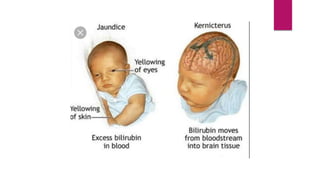
 Neo natal jaundice is a yellow discoloration of the
white part of the eyes and skin in a newborn baby
due to high bilirubin level.
 Neo natal jaundice becomes apparent at serum
bilirubin concentration of 5-7mg / dL.
1. Shoulder and trunk 8-10mg/dl
2. Lower body – 10-12mg/dl.
3. Entire body 12-15 mg /DL
Definition
Neonatal jaundice is the yellow discoloration of skin
and the mucosa is caused by accumulation of excess
of bilIrubin in the tissue and plasma.
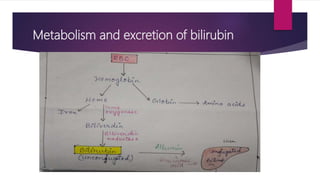
Metabolism and excretion of bilirubin
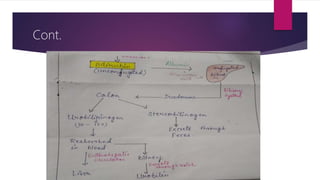
Cont.
Causes of neonatal jaundice
Predisposing factor
 ABO and Rh incompatibility
 Maternal diabetes
 Race
 Poor breast feeding
SYMPTOMS /CLINICAL MANIFESTATION
1. Yellow skin and sclera
2. Poor feeding
3. Brown urine
4. Fever
5. High pitch cry
6. Without treatment can progress to acute bilirubin
encephalopathy (kernicterus)
Types of neonatal jaundice
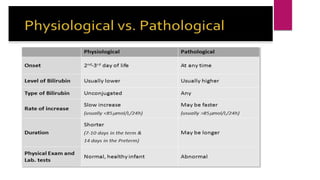
1. Physiological jaundice/Icterus neonatorum
2. Pathological jaundice
3. Breast milk jaundice
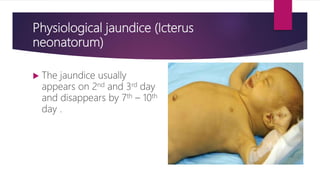
Physiological jaundice (Icterus
neonatorum)
 The jaundice usually
appears on 2nd and 3rd day
and disappears by 7th – 10th
day .
Characteristics
 The clinical pattern of physiologic jaundice in term
infants including a peak indirect – reacting bilirubin
level of no more than 12mg/dl on day 3 of life
 It’s disappers by one week in full term infants and 2
week in preterm infants
 Healthy baby
Causes
 Increased red cells breakdown
 Decreased albumin binding capacity
 Enzyme deficiency
 Increased enterohepatic capacity
 Infection
 Bruising
 Polycythaemia
 Dehydration
Management of physiological jaundice
 Adequate feeding
 Careful observation of newborn will help
distinguish between healthy babies with abnormal
 In premature babies rising bilirubin level to critical
level require use of phototherapy or
phenobarbitone administration.
Pathological jaundice
 Pathological jaundice usually appears within 24
hours of birth and its characterized by a rapid rise
in serum bilirubin and prolonged jaundice.
Features of pathological jaundice
 Clinical jaundice appears within the first 24 hours of life.
 Increase in bilirubin more than 5 mg /dl per day
 Total bilirubin more than 13 mg / dl.
 Persistence of clinical jaundice for 7 to 10 days in full term
infants and 2 week in preterm infants
Causes of pathological jaundice
 Increased bilirubin production due to excessive red cell
hemolysis.
- hemolytic disease of the new born
- deficient red cell enzyme glucose -6- phosphate
dehydrogenase.
 Defective Conjugation
 Transport and excretion Failure.
Breast milk jaundice
 It is caused by prolonged increase enterohepatic circulation of
bilirubin.
 Bilirubin peaks at 10-15 days of age
 The level of unconjugated bilirubin is at 10-30mg/dL.
 If breasts feeding is interrupted for 24 hours the bilirubin level
falls quickly.
Breast milk jaundice is commonest cause of prolonged jaundice
in term infants.
Beta glucuronidase present in the breast milk of some mother.
Risk factor of neonatal jaundice
1. Birth trauma or evident bruising
2. Prematurity
3. Family history of jaundiced sibling aur hemolytic disease
4. Delayed feeding or meconium passage
5. Jaundice within the first 24 hours suggests hemolysis
Laboratory evaluation
1. Serum bilirubin
2. Direct Coombs test
3. Indirect coombs test
4. Hemoglobin estimation
5. Reticulocyte count
6. ABO blood group and Rh type
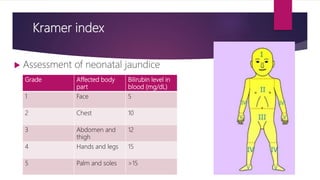
Kramer index
 Assessment of neonatal jaundice
Grade Affected body
part
Bilirubin level in
blood (mg/dL)
1 Face 5
2 Chest 10
3 Abdomen and
thigh
12
4 Hands and legs 15
5 Palm and soles >15
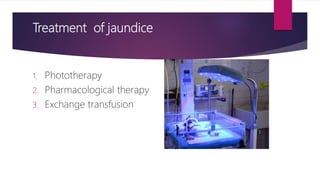
Treatment of jaundice
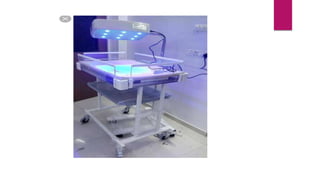
1. Phototherapy
2. Pharmacological therapy
3. Exchange transfusion
1. Phototherapy
 Phototherapy can be used to prevent concentration of
unconjugated bilirubin in blood from reaching level where
neurotoxicity may occur.
 Bilirubin levels indicating phototherapy are:
1. for term infants who become jaundiced after 48 hours: 17-
22mg/ dl.
2. For preterm infants more than 1,500 g weight : 8-10mg/dl
3. For preterm babies Less than 1,500g weight : 5-8mg/dl.
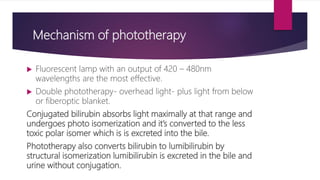
Mechanism of phototherapy
 Fluorescent lamp with an output of 420 – 480nm
wavelengths are the most effective.
 Double phototherapy- overhead light- plus light from below
or fiberoptic blanket.
Conjugated bilirubin absorbs light maximally at that range and
undergoes photo isomerization and it’s converted to the less
toxic polar isomer which is is excreted into the bile.
Phototherapy also converts bilirubin to lumibilirubin by
structural isomerization lumibilirubin is excreted in the bile and
urine without conjugation.
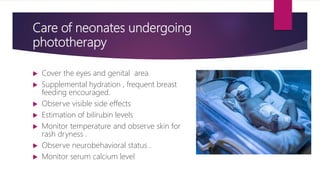
Care of neonates undergoing
phototherapy
 Cover the eyes and genital area
 Supplemental hydration , frequent breast
feeding encouraged.
 Observe visible side effects
 Estimation of bilirubin levels
 Monitor temperature and observe skin for
rash dryness .
 Observe neurobehavioral status .
 Monitor serum calcium level
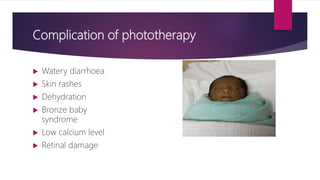
Complication of phototherapy
 Watery diarrhoea
 Skin rashes
 Dehydration
 Bronze baby
syndrome
 Low calcium level
 Retinal damage
Pharmacological therapy
 Phenobarbital therapy – phenobarbitone induces hepatic
microsomal enzyme and increase bilirubin conjugation and
excretion .
Loading dose of 10 mg /kg on day 1
Maintenance dose of 5-8mg/kg/day for next 4 day given .
 Antibiotic are administered for 3-5 days .
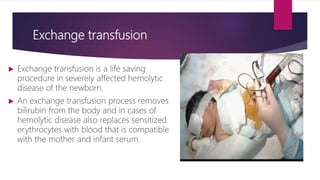
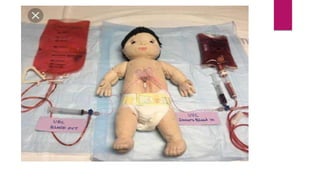
Exchange transfusion
 Exchange transfusion is a life saving
procedure in severely affected hemolytic
disease of the newborn.
 An exchange transfusion process removes
bilirubin from the body and in cases of
hemolytic disease also replaces sensitized
erythrocytes with blood that is compatible
with the mother and infant serum.
Indications of exchange transfusion
 When there is progressive rise of bilirubin( >1mg/dL/hour) inspite of
phototherapy.
 Rate of bilirubin rise >0.5mg/dL/hour despite phototherapy when Hn is
between 11-13g/dL.
 To improve anaemia in congestive cardiac failure of neonate.
 The serum bilirubin level of the infant is >12mg/dL in first 24 hours and
>20mg/dL in neonatal period .
 Progressive anaemia of the neonate
 When phototherapy fails to prevent the rise of Bilirubin to be in toxic
levels
 Cord blood hemoglobin is <11g/dL and bilirubin level is >5 mg /dL.
Objective of exchange transfusion
 To stop haemolysis and Bilirubin production
 To correct Anemia and to improve congestive cardiac failure
of the neonate
 To remove the the circulatory antibodies
 To remove sensitized RBC
 To eliminate the circulatory bilirubin.
 To stop hemolysis and bilirubin double production
Nature and amount of blood transfused
 Blood for exchange should be RH negative whole blood
with the same blood ABO grouping to that of the baby
otherwise group o.
 The blood should be collected relatively fresh
 The amount is about 160 ml/kg body weight of the baby.
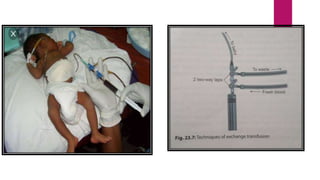
Procedure of exchange transfusion
 The procedure is best to be carried out under a servo
control radiant warmer.
 The route of transfusion should preferably be through the
umbilical vein. A plastic catheter of 1 mm diameter is passed
about 7 cm beyond the umbilicus so as place it in the
inferior vena cava.
 In late transfusion femoral root through saphenous vein is
the choice.
 Entire set should be Air tight and to be periodically flushed
with heparinized saline to prevent clotting
Cont .
 Blood should be warmed to 37 degree Celsius
 15 ml of fetal blood is withdrawn first followed by 10 ml to
be pushed in return slowly .
 For every 100 ml of blood transfused, 1 Milli equivalents of
sodium bicarbonate is given to to combat metabolic acidosis
and 1 ml of 10% calcium gluconate to prevent tetany due to
transfusion of citrated blood.
 To estimate the hemoglobin and Bilirubin concentration prior
to and after the exchange transfusion.
 The procedures should be supervised by an expert team
work.
Post transfusion care to baby
1. The baby is placed under a radiant warmer.
2. The umbilicus is to be inspected frequently for any
evidence of bleeding.
3. Serum bilirubin is to be estimated 4 hours after transfusion
and to be repeated as required.
4. Hypoglycemia is to be checked by blood glucose estimation
post transfusion 4. hourly
Complication of exchange transfusion.
 Cardiac failure due to raised Venous pressure and overloading of the
heart
 Air embolism
 Clotting and massive embolism
 Hyperkalemia
 Tetany
 Acidosis
 Sepsis
 Hypocalcaemia
 Hypoglycemia
Complication of hyperbilirubinemia
Kernicterus
 Kernicterus is a pathological condition characterized by yellow staining of
the brain by unconjugated bilirubin resulting in neuronal injury.
 The critical level of bilirubin causing Kernicterus in a term infant is more
than 20 mg/dL.
Clinically characterized by – Lethargy, hypotonia, poor feeding and loss of
neonatal reflexes.
Severe illness is manifested by respiratory distress , prostration, opisthotonus,
nystagmus , hyperpyrexia , convulsions, enlarged liver and spleen.
Prevention and management
 Regular and periodic estimation of serum bilirubin level in susceptible
babies.
 Exchange transfusion and phototherapy are used to effectively treat the
condition.
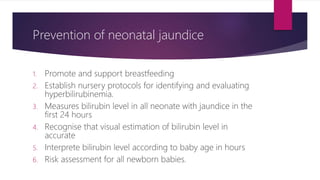
Prevention of neonatal jaundice
1. Promote and support breastfeeding
2. Establish nursery protocols for identifying and evaluating
hyperbilirubinemia.
3. Measures bilirubin level in all neonate with jaundice in the
first 24 hours
4. Recognise that visual estimation of bilirubin level in
accurate
5. Interprete bilirubin level according to baby age in hours
6. Risk assessment for all newborn babies.
Summary
Evaluation
1. Define Icterus neonatorum
2. How many types of neonatal jaundice.
3. What is physiological jaundice
4. What is physiological jaundice
5. What are the methods of treatment of jaundice
6. What are the preventive methods of neonatal jaundice
Bibliography
1. Bhaskar nima ” textbook of midwifery and obstetrical
nursing” 3rd edition , EMMESS publication page
no 598-603.
2. Jacob annamma , “ a comprehensive textbook of
Midwifery and gynecological nursing,
4th edition , Jaypee publication Ltd Page no 631-637.
3. Konar hiralal ,” DC Dutta’s textbook of obstetrics”,9th edition Jaypee publication, page no 446- ,449
4. www.slideshare.net
Icterus neonatorum presentation for students

Icterus neonatorum presentation for students

  • 1.
    ICTERUS NEONATARUM SUBMITTED TO MRS PUSHPAKERKETTA CLINICAL TUTOR COLLEGE OF NURSING RIMS RANCHI Submitted by Purnima Kumari Basic BSC Nursing 4th year (2017-2021) Roll no – 25 College of Nursing RIMS Ranchi.
  • 3.
    CONTENTS  Introduction  Definition Metabolism and excretion of bilirubin  Causes  Symptoms  Types  Physiological jaundice  Pathological jaundice  Breast milk jaundice  Risk factors  Laboratory evaluation  Treatment  Complication  Prevention  Summary  Evaluation  Bibliography
  • 4.
    Jaundice in thenewborn/ neonatal jaundice  Neo natal jaundice is a yellow discoloration of the white part of the eyes and skin in a newborn baby due to high bilirubin level.  Neo natal jaundice becomes apparent at serum bilirubin concentration of 5-7mg / dL. 1. Shoulder and trunk 8-10mg/dl 2. Lower body – 10-12mg/dl. 3. Entire body 12-15 mg /DL
  • 5.
    Definition Neonatal jaundice isthe yellow discoloration of skin and the mucosa is caused by accumulation of excess of bilIrubin in the tissue and plasma.
  • 6.
  • 7.
  • 9.
    Causes of neonataljaundice Predisposing factor  ABO and Rh incompatibility  Maternal diabetes  Race  Poor breast feeding
  • 10.
    SYMPTOMS /CLINICAL MANIFESTATION 1.Yellow skin and sclera 2. Poor feeding 3. Brown urine 4. Fever 5. High pitch cry 6. Without treatment can progress to acute bilirubin encephalopathy (kernicterus)
  • 11.
    Types of neonataljaundice 1. Physiological jaundice/Icterus neonatorum 2. Pathological jaundice 3. Breast milk jaundice
  • 12.
    Physiological jaundice (Icterus neonatorum) The jaundice usually appears on 2nd and 3rd day and disappears by 7th – 10th day .
  • 13.
    Characteristics  The clinicalpattern of physiologic jaundice in term infants including a peak indirect – reacting bilirubin level of no more than 12mg/dl on day 3 of life  It’s disappers by one week in full term infants and 2 week in preterm infants  Healthy baby
  • 14.
    Causes  Increased redcells breakdown  Decreased albumin binding capacity  Enzyme deficiency  Increased enterohepatic capacity  Infection  Bruising  Polycythaemia  Dehydration
  • 15.
    Management of physiologicaljaundice  Adequate feeding  Careful observation of newborn will help distinguish between healthy babies with abnormal  In premature babies rising bilirubin level to critical level require use of phototherapy or phenobarbitone administration.
  • 16.
    Pathological jaundice  Pathologicaljaundice usually appears within 24 hours of birth and its characterized by a rapid rise in serum bilirubin and prolonged jaundice.
  • 17.
    Features of pathologicaljaundice  Clinical jaundice appears within the first 24 hours of life.  Increase in bilirubin more than 5 mg /dl per day  Total bilirubin more than 13 mg / dl.  Persistence of clinical jaundice for 7 to 10 days in full term infants and 2 week in preterm infants
  • 18.
    Causes of pathologicaljaundice  Increased bilirubin production due to excessive red cell hemolysis. - hemolytic disease of the new born - deficient red cell enzyme glucose -6- phosphate dehydrogenase.  Defective Conjugation  Transport and excretion Failure.
  • 19.
    Breast milk jaundice It is caused by prolonged increase enterohepatic circulation of bilirubin.  Bilirubin peaks at 10-15 days of age  The level of unconjugated bilirubin is at 10-30mg/dL.  If breasts feeding is interrupted for 24 hours the bilirubin level falls quickly. Breast milk jaundice is commonest cause of prolonged jaundice in term infants. Beta glucuronidase present in the breast milk of some mother.
  • 20.
    Risk factor ofneonatal jaundice 1. Birth trauma or evident bruising 2. Prematurity 3. Family history of jaundiced sibling aur hemolytic disease 4. Delayed feeding or meconium passage 5. Jaundice within the first 24 hours suggests hemolysis
  • 21.
    Laboratory evaluation 1. Serumbilirubin 2. Direct Coombs test 3. Indirect coombs test 4. Hemoglobin estimation 5. Reticulocyte count 6. ABO blood group and Rh type
  • 22.
    Kramer index  Assessmentof neonatal jaundice Grade Affected body part Bilirubin level in blood (mg/dL) 1 Face 5 2 Chest 10 3 Abdomen and thigh 12 4 Hands and legs 15 5 Palm and soles >15
  • 23.
    Treatment of jaundice 1.Phototherapy 2. Pharmacological therapy 3. Exchange transfusion
  • 24.
    1. Phototherapy  Phototherapycan be used to prevent concentration of unconjugated bilirubin in blood from reaching level where neurotoxicity may occur.  Bilirubin levels indicating phototherapy are: 1. for term infants who become jaundiced after 48 hours: 17- 22mg/ dl. 2. For preterm infants more than 1,500 g weight : 8-10mg/dl 3. For preterm babies Less than 1,500g weight : 5-8mg/dl.
  • 26.
    Mechanism of phototherapy Fluorescent lamp with an output of 420 – 480nm wavelengths are the most effective.  Double phototherapy- overhead light- plus light from below or fiberoptic blanket. Conjugated bilirubin absorbs light maximally at that range and undergoes photo isomerization and it’s converted to the less toxic polar isomer which is is excreted into the bile. Phototherapy also converts bilirubin to lumibilirubin by structural isomerization lumibilirubin is excreted in the bile and urine without conjugation.
  • 27.
    Care of neonatesundergoing phototherapy  Cover the eyes and genital area  Supplemental hydration , frequent breast feeding encouraged.  Observe visible side effects  Estimation of bilirubin levels  Monitor temperature and observe skin for rash dryness .  Observe neurobehavioral status .  Monitor serum calcium level
  • 28.
    Complication of phototherapy Watery diarrhoea  Skin rashes  Dehydration  Bronze baby syndrome  Low calcium level  Retinal damage
  • 29.
    Pharmacological therapy  Phenobarbitaltherapy – phenobarbitone induces hepatic microsomal enzyme and increase bilirubin conjugation and excretion . Loading dose of 10 mg /kg on day 1 Maintenance dose of 5-8mg/kg/day for next 4 day given .  Antibiotic are administered for 3-5 days .
  • 30.
    Exchange transfusion  Exchangetransfusion is a life saving procedure in severely affected hemolytic disease of the newborn.  An exchange transfusion process removes bilirubin from the body and in cases of hemolytic disease also replaces sensitized erythrocytes with blood that is compatible with the mother and infant serum.
  • 31.
    Indications of exchangetransfusion  When there is progressive rise of bilirubin( >1mg/dL/hour) inspite of phototherapy.  Rate of bilirubin rise >0.5mg/dL/hour despite phototherapy when Hn is between 11-13g/dL.  To improve anaemia in congestive cardiac failure of neonate.  The serum bilirubin level of the infant is >12mg/dL in first 24 hours and >20mg/dL in neonatal period .  Progressive anaemia of the neonate  When phototherapy fails to prevent the rise of Bilirubin to be in toxic levels  Cord blood hemoglobin is <11g/dL and bilirubin level is >5 mg /dL.
  • 32.
    Objective of exchangetransfusion  To stop haemolysis and Bilirubin production  To correct Anemia and to improve congestive cardiac failure of the neonate  To remove the the circulatory antibodies  To remove sensitized RBC  To eliminate the circulatory bilirubin.  To stop hemolysis and bilirubin double production
  • 33.
    Nature and amountof blood transfused  Blood for exchange should be RH negative whole blood with the same blood ABO grouping to that of the baby otherwise group o.  The blood should be collected relatively fresh  The amount is about 160 ml/kg body weight of the baby.
  • 34.
    Procedure of exchangetransfusion  The procedure is best to be carried out under a servo control radiant warmer.  The route of transfusion should preferably be through the umbilical vein. A plastic catheter of 1 mm diameter is passed about 7 cm beyond the umbilicus so as place it in the inferior vena cava.  In late transfusion femoral root through saphenous vein is the choice.  Entire set should be Air tight and to be periodically flushed with heparinized saline to prevent clotting
  • 36.
    Cont .  Bloodshould be warmed to 37 degree Celsius  15 ml of fetal blood is withdrawn first followed by 10 ml to be pushed in return slowly .  For every 100 ml of blood transfused, 1 Milli equivalents of sodium bicarbonate is given to to combat metabolic acidosis and 1 ml of 10% calcium gluconate to prevent tetany due to transfusion of citrated blood.  To estimate the hemoglobin and Bilirubin concentration prior to and after the exchange transfusion.  The procedures should be supervised by an expert team work.
  • 38.
    Post transfusion careto baby 1. The baby is placed under a radiant warmer. 2. The umbilicus is to be inspected frequently for any evidence of bleeding. 3. Serum bilirubin is to be estimated 4 hours after transfusion and to be repeated as required. 4. Hypoglycemia is to be checked by blood glucose estimation post transfusion 4. hourly
  • 39.
    Complication of exchangetransfusion.  Cardiac failure due to raised Venous pressure and overloading of the heart  Air embolism  Clotting and massive embolism  Hyperkalemia  Tetany  Acidosis  Sepsis  Hypocalcaemia  Hypoglycemia
  • 40.
    Complication of hyperbilirubinemia Kernicterus Kernicterus is a pathological condition characterized by yellow staining of the brain by unconjugated bilirubin resulting in neuronal injury.  The critical level of bilirubin causing Kernicterus in a term infant is more than 20 mg/dL. Clinically characterized by – Lethargy, hypotonia, poor feeding and loss of neonatal reflexes. Severe illness is manifested by respiratory distress , prostration, opisthotonus, nystagmus , hyperpyrexia , convulsions, enlarged liver and spleen.
  • 42.
    Prevention and management Regular and periodic estimation of serum bilirubin level in susceptible babies.  Exchange transfusion and phototherapy are used to effectively treat the condition.
  • 43.
    Prevention of neonataljaundice 1. Promote and support breastfeeding 2. Establish nursery protocols for identifying and evaluating hyperbilirubinemia. 3. Measures bilirubin level in all neonate with jaundice in the first 24 hours 4. Recognise that visual estimation of bilirubin level in accurate 5. Interprete bilirubin level according to baby age in hours 6. Risk assessment for all newborn babies.
  • 44.
  • 46.
    Evaluation 1. Define Icterusneonatorum 2. How many types of neonatal jaundice. 3. What is physiological jaundice 4. What is physiological jaundice 5. What are the methods of treatment of jaundice 6. What are the preventive methods of neonatal jaundice
  • 47.
    Bibliography 1. Bhaskar nima” textbook of midwifery and obstetrical nursing” 3rd edition , EMMESS publication page no 598-603. 2. Jacob annamma , “ a comprehensive textbook of Midwifery and gynecological nursing, 4th edition , Jaypee publication Ltd Page no 631-637. 3. Konar hiralal ,” DC Dutta’s textbook of obstetrics”,9th edition Jaypee publication, page no 446- ,449 4. www.slideshare.net