HUMAN RELATIONS
UMA KOLE
Definition
• Human relation is an area of management practice which is
concerned with the integration of people into a work situation in a
way that motivate them to work productively, cooperatively & with
economic, psychological & social satisfaction. (Keith Davis)
• Human relations are the relations between human being that are
affected by many other factors & helps in the accomplishment of
goals of an organization.
• Human relation in nursing refer to the relationship of nurses with
colleagues & other department personnel & of nurses with patient. •
It is interdepartmental, interdepartmental & interpersonal relationship
to provide the quality care to their patients.
Purpose of human relations
• To remove conflict between individual and organization
• To remove individual differences
• To achieve the goals of institution
• To make a coordination between different sections
• To increase quality & quantity of products & services
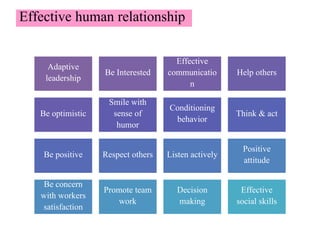
Effective human relationship
Adaptive
leadership
Be Interested
Effective
communicatio
n
Help others
Be optimistic
Smile with
sense of
humor
Conditioning
behavior
Think & act
Be positive Respect others Listen actively
Positive
attitude
Be concern
with workers
satisfaction
Promote team
work
Decision
making
Effective
social skills
ADVANTAGES
• Help to:
Contribute to peoples skill building
Understand people
Predict about people
Motivate for effective work
Promote adjustment mechanism
Understand individual differences
Improve inter personal skill
Develop positive attitude
Access needs & desire
LIMITATIONS
• Undue emphasis
• Over dependency
• Manipulation of people
• Lack of confidence but linking people
• Unrealistic removal of conflicts
• A case of introversion & shortsightedness
UNDERSTANDING OF SELF
• DEFINITION
Self concept consists of the physical self or body
image, the personal self or personal identity, & the
self esteem.
DIMENSIONS OF SELF
Physical self-image Personal body image
Self esteem Psychological self-image
DIMENSIONS OF
SELF
Self concept
Self concept is the composite of beliefs & feelings that
one holds about oneself at a given time, formed from
perceptions particularly of others, reactions & directing
one’s behavior
Factors affecting self concept
1. Early bonding experience
2. Physical, cognitive & interpersonal development & maturation
3. Personality characteristic
4. Culture
5. Environment
6. Socio economic status
7. The persons sense of a place in time
8. Physical attributes & capabilities, including present health status
9. Interpersonal relationships
10. Professional & personal roles
Self Esteem
Self esteem refers to a complete subjective emotional
appraisal of one’s own worth.
• Parenting in childhood
• Academic achievements
Motivation
• Motivation –motive-active form of desire, craving or
need that must be satisfied
• Motivation is the desire within an individual that
stimulates him or her to action
• Motivation is the willingness to exert high levels of
effort toward organizational goals, conditioned by the
efforts ability to satisfy some individual needs.
Nature of motivation
Motivation is a
Psychological concept-intrinsic force
Dynamic & continuous process
Complex & difficult-need satisfaction
Circular process-unsatisfied need-tension-action to reduce
tension
Different from satisfaction-process of stimulating to take
desired action
Theories of motivation
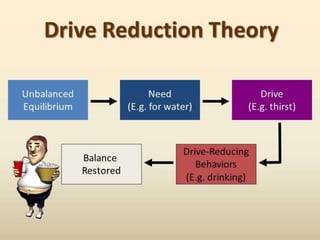
1. Drive reduction theory
2. Optimum level of arousal theory
3. Cognitive theories
4. Cognitive dissonance theory
5. Expectancy theory
6. Psychoanalytic theory of modification
7. Maslow’s hierarchy of needs
8. Hertzberg’s two factor theory
9. MC Clelland's needs theory
10. Carrot & stick approach of motivation
Optimum level of arousal theory
• The law was first described in 1908 by psychologists Robert
Yerkes and John Dillingham Dodson.
• They discovered that mild electrical shocks could be used to
motivate rats to complete a maze, but when the electrical shocks
became too strong, the rats would scurry around in random
directions to escape.
• The experiment demonstrated that increasing stress and arousal
levels could help focus motivation and attention on the task at hand,
but only up to a certain point.
Cognitive theories
• Theory emphasizes on some sort of understanding or
anticipation of events through perception or thought or
judgment as in the estimation of probabilities or in
making a choice on the basis of relative value
• According to cognitive theory, motivated goal seeking
behavior comes to be regulated by these conditions,
which are based on the past, modified by circumstances
of the present & includes expectations about the future
Expectancy theory
• This theory emphasizes the importance of rewards & goals as
well as how persons expectations of consequences can influence
his behavior
• This theory stresses ‘pull’ rather than ‘push’
• According to theory, the hunger drive is only part of the reason a
hungry rat is motivated to find its way through a maze.
• It is also motivated because of previous learning experiences in
which it has come to expect a bit of food at the end
• Motivation is composed of two major features: the valence or
attractiveness of the goal & the expectancy or the likelihood that
its behavior will lead to the goal
Motive
motive Force
Motive
works
Creates
tension
Engages in
activity
Definitions
• Caroll, a need give rise to one or more motives. A motive
is a rather specific process which has been learned. It
directed towards a goal.
• Fisher, a motive is an inclination or impulsion to action
plus some degree of orientation or direction.
• Rosen, Fox & Gregory, a motive may be defined as a
readiness or disposition to respond in some ways & not
others to a variety of situations
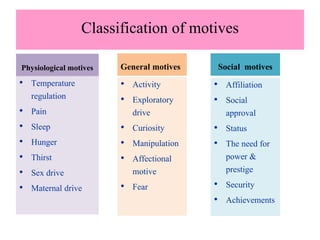
Classification of motives
Physiological motives
• Temperature
regulation
• Pain
• Sleep
• Hunger
• Thirst
• Sex drive
• Maternal drive
General motives
• Activity
• Exploratory
drive
• Curiosity
• Manipulation
• Affectional
motive
• Fear
Social motives
• Affiliation
• Social
approval
• Status
• The need for
power &
prestige
• Security
• Achievements
Classification of motives
Unconscious motives
Instinctive & motives
Hierarchy of motives
Frustration
• Frustration is defined as the blocking of a desire or need.
It also refers to failure to satisfy a basic need because of
conditions, either in the individual or external obstacles
Sources of Frustration
Environmental forces-contagious disease, death of a
friend or beloved relative, rains & storms or floods
Personal inadequacies-poor ability or skill, any physical
handicap
Conflict of motives-sexual behavior in society
Conflict
It is a state when two or more incompatible motivations or
behavioral impulses compete for expression .
In other words, the individual is faced with more than two
incompatible demands, opportunities, goals or needs
Types of conflict
1. Approach-approach conflict
2. Avoidance-avoidance conflict
3. Approach-avoidance conflict
4. Resolution of conflicts-conflict

Human relations

  • 1.
  • 2.
    Definition • Human relationis an area of management practice which is concerned with the integration of people into a work situation in a way that motivate them to work productively, cooperatively & with economic, psychological & social satisfaction. (Keith Davis) • Human relations are the relations between human being that are affected by many other factors & helps in the accomplishment of goals of an organization. • Human relation in nursing refer to the relationship of nurses with colleagues & other department personnel & of nurses with patient. • It is interdepartmental, interdepartmental & interpersonal relationship to provide the quality care to their patients.
  • 3.
    Purpose of humanrelations • To remove conflict between individual and organization • To remove individual differences • To achieve the goals of institution • To make a coordination between different sections • To increase quality & quantity of products & services
  • 4.
    Effective human relationship Adaptive leadership BeInterested Effective communicatio n Help others Be optimistic Smile with sense of humor Conditioning behavior Think & act Be positive Respect others Listen actively Positive attitude Be concern with workers satisfaction Promote team work Decision making Effective social skills
  • 5.
    ADVANTAGES • Help to: Contributeto peoples skill building Understand people Predict about people Motivate for effective work Promote adjustment mechanism Understand individual differences Improve inter personal skill Develop positive attitude Access needs & desire
  • 6.
    LIMITATIONS • Undue emphasis •Over dependency • Manipulation of people • Lack of confidence but linking people • Unrealistic removal of conflicts • A case of introversion & shortsightedness
  • 7.
    UNDERSTANDING OF SELF •DEFINITION Self concept consists of the physical self or body image, the personal self or personal identity, & the self esteem.
  • 8.
    DIMENSIONS OF SELF Physicalself-image Personal body image Self esteem Psychological self-image DIMENSIONS OF SELF
  • 9.
    Self concept Self conceptis the composite of beliefs & feelings that one holds about oneself at a given time, formed from perceptions particularly of others, reactions & directing one’s behavior
  • 10.
    Factors affecting selfconcept 1. Early bonding experience 2. Physical, cognitive & interpersonal development & maturation 3. Personality characteristic 4. Culture 5. Environment 6. Socio economic status 7. The persons sense of a place in time 8. Physical attributes & capabilities, including present health status 9. Interpersonal relationships 10. Professional & personal roles
  • 11.
    Self Esteem Self esteemrefers to a complete subjective emotional appraisal of one’s own worth. • Parenting in childhood • Academic achievements
  • 12.
    Motivation • Motivation –motive-activeform of desire, craving or need that must be satisfied • Motivation is the desire within an individual that stimulates him or her to action • Motivation is the willingness to exert high levels of effort toward organizational goals, conditioned by the efforts ability to satisfy some individual needs.
  • 13.
    Nature of motivation Motivationis a Psychological concept-intrinsic force Dynamic & continuous process Complex & difficult-need satisfaction Circular process-unsatisfied need-tension-action to reduce tension Different from satisfaction-process of stimulating to take desired action
  • 14.
    Theories of motivation 1.Drive reduction theory 2. Optimum level of arousal theory 3. Cognitive theories 4. Cognitive dissonance theory 5. Expectancy theory 6. Psychoanalytic theory of modification 7. Maslow’s hierarchy of needs 8. Hertzberg’s two factor theory 9. MC Clelland's needs theory 10. Carrot & stick approach of motivation
  • 16.
    Optimum level ofarousal theory • The law was first described in 1908 by psychologists Robert Yerkes and John Dillingham Dodson. • They discovered that mild electrical shocks could be used to motivate rats to complete a maze, but when the electrical shocks became too strong, the rats would scurry around in random directions to escape. • The experiment demonstrated that increasing stress and arousal levels could help focus motivation and attention on the task at hand, but only up to a certain point.
  • 17.
    Cognitive theories • Theoryemphasizes on some sort of understanding or anticipation of events through perception or thought or judgment as in the estimation of probabilities or in making a choice on the basis of relative value • According to cognitive theory, motivated goal seeking behavior comes to be regulated by these conditions, which are based on the past, modified by circumstances of the present & includes expectations about the future
  • 18.
    Expectancy theory • Thistheory emphasizes the importance of rewards & goals as well as how persons expectations of consequences can influence his behavior • This theory stresses ‘pull’ rather than ‘push’ • According to theory, the hunger drive is only part of the reason a hungry rat is motivated to find its way through a maze. • It is also motivated because of previous learning experiences in which it has come to expect a bit of food at the end • Motivation is composed of two major features: the valence or attractiveness of the goal & the expectancy or the likelihood that its behavior will lead to the goal
  • 20.
  • 21.
    Definitions • Caroll, aneed give rise to one or more motives. A motive is a rather specific process which has been learned. It directed towards a goal. • Fisher, a motive is an inclination or impulsion to action plus some degree of orientation or direction. • Rosen, Fox & Gregory, a motive may be defined as a readiness or disposition to respond in some ways & not others to a variety of situations
  • 22.
    Classification of motives Physiologicalmotives • Temperature regulation • Pain • Sleep • Hunger • Thirst • Sex drive • Maternal drive General motives • Activity • Exploratory drive • Curiosity • Manipulation • Affectional motive • Fear Social motives • Affiliation • Social approval • Status • The need for power & prestige • Security • Achievements
  • 23.
    Classification of motives Unconsciousmotives Instinctive & motives Hierarchy of motives
  • 24.
    Frustration • Frustration isdefined as the blocking of a desire or need. It also refers to failure to satisfy a basic need because of conditions, either in the individual or external obstacles
  • 25.
    Sources of Frustration Environmentalforces-contagious disease, death of a friend or beloved relative, rains & storms or floods Personal inadequacies-poor ability or skill, any physical handicap Conflict of motives-sexual behavior in society
  • 26.
    Conflict It is astate when two or more incompatible motivations or behavioral impulses compete for expression . In other words, the individual is faced with more than two incompatible demands, opportunities, goals or needs
  • 27.
    Types of conflict 1.Approach-approach conflict 2. Avoidance-avoidance conflict 3. Approach-avoidance conflict 4. Resolution of conflicts-conflict