Test of personality
presented by –
Neha Sahni
Content
• introduction
• meaning
• .definition
• Factors
• Classification
• Methods of personality assessment
INTRODUCTION
The term “personality” is derived from
the word persona or the mask.
MEANING
A personality test is a standardized tool or questionnaire
which reveals different aspects of an individual’s
character for psychological make-up.
Personality means once inner or outer circumstances
suitable which his environment
-Duan
Personality = inner + outer circumstances environment
DEFINITION
‘the aggregate of the
physical and mental
qualities of an
individual which will
interact &function in
characteristics fashion
which the
environment.
-Taylor(1982)
FACTORS TO BE CONSIDERED
WHEN DEFINING PERSONALITY
Mainly three factors to be considered:
• Individuals are unique
• Individuals behave difficulty in different situations
• Although individuals are unique &behave according to the
situation, there is considerable commonality in human
behavior.
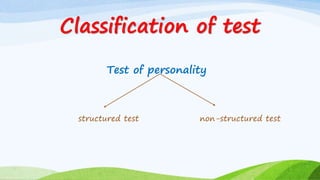
Classification of test
Test of personality
structured test non-structured test
Contd.
• Structured test =
In these test the subject are
exposed to a limited no. of
situation which are planned
.the subject has to respond
only as per the alternatives
given.
• Non-structured test =
In this the participant is free
to respond as per his/her
choice.
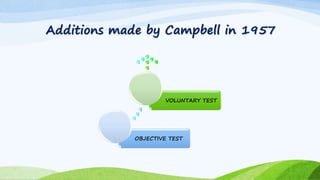
Additions made by Campbell in 1957
OBJECTIVE TEST
VOLUNTARY TEST
Contd.
• Voluntary test –
subjects respond that whether something describe
them or not as well as whether they like or dislike anything.
Ex. – personality inventory.
Contd.
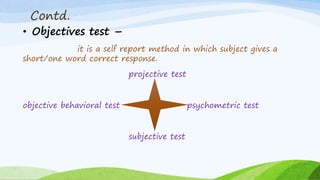
• Objectives test –
it is a self report method in which subject gives a
short/one word correct response.
projective test
objective behavioral test psychometric test
subjective test
Contd.
1. projective test: - non-structured type
- associated with theories
- e.g.= research ink blot test
2. psychometric test: – structured voluntary type of test
- associated with empirical theories
- e.g. = questionnaires.
Contd.
Subjective test – nonstructured type of test
- associated with clinically oriented theories
- e.g. interview technique
Objective behavioral test– structured & objective type of test
-associated with empirical theories
related to behavioral data
Method of personality assessment
interview method
Observation method
Rating scales
Personalities
inventories
Case study
Projective technique
Situational test
Contd.
1. The interview method –
• Most common method
• May be structured or nonstructured
• used to collect information about an individual’s
characteristics, behavior, interest , weakness
Contd.
2. Observation method –
• It can be participatory & nonparticipatory
• It may be concealed or revealed.
• Give information about personality characteristics
Contd.
3. Rating scales –
• Involved qualitative description of some aspects of
personality.
• Traits can be set up in 5 or 7 categories – excellent, good,
average, below average &poor.
Contd.
4. Personality inventories-
• Also called as objective test
• Used in job recruitment, counselling & career planning.
• Some personality que. Are – MMPI
NEO-PI-R
THE 16 PF
EPQ
MBTI
Contd.
5. Case study –
• It provides information about individuals’-
- parents,
- Grandparents
- Home background
- Medical history
- Educational career friendships
- Marital life
- Professional details.
Contd.
6. Projective technique –
• Some projective technique are-
- Research ink blot test
- Thematic apperception test
- The word association test
- Sentence completion test
- Drawing & painting
Contd.
7. Situational test –
• Situational tests have been used to study how a person
reacts when placed in a situation closely resembling real life
or simulates one.
• The subject behavior is evaluated, usually by panel of trained
judges.

Test of personality.pptx

  • 1.
  • 2.
    Content • introduction • meaning •.definition • Factors • Classification • Methods of personality assessment
  • 3.
    INTRODUCTION The term “personality”is derived from the word persona or the mask.
  • 4.
    MEANING A personality testis a standardized tool or questionnaire which reveals different aspects of an individual’s character for psychological make-up. Personality means once inner or outer circumstances suitable which his environment -Duan Personality = inner + outer circumstances environment
  • 5.
    DEFINITION ‘the aggregate ofthe physical and mental qualities of an individual which will interact &function in characteristics fashion which the environment. -Taylor(1982)
  • 6.
    FACTORS TO BECONSIDERED WHEN DEFINING PERSONALITY Mainly three factors to be considered: • Individuals are unique • Individuals behave difficulty in different situations • Although individuals are unique &behave according to the situation, there is considerable commonality in human behavior.
  • 7.
    Classification of test Testof personality structured test non-structured test
  • 8.
    Contd. • Structured test= In these test the subject are exposed to a limited no. of situation which are planned .the subject has to respond only as per the alternatives given. • Non-structured test = In this the participant is free to respond as per his/her choice.
  • 9.
    Additions made byCampbell in 1957 OBJECTIVE TEST VOLUNTARY TEST
  • 10.
    Contd. • Voluntary test– subjects respond that whether something describe them or not as well as whether they like or dislike anything. Ex. – personality inventory.
  • 11.
    Contd. • Objectives test– it is a self report method in which subject gives a short/one word correct response. projective test objective behavioral test psychometric test subjective test
  • 12.
    Contd. 1. projective test:- non-structured type - associated with theories - e.g.= research ink blot test 2. psychometric test: – structured voluntary type of test - associated with empirical theories - e.g. = questionnaires.
  • 13.
    Contd. Subjective test –nonstructured type of test - associated with clinically oriented theories - e.g. interview technique Objective behavioral test– structured & objective type of test -associated with empirical theories related to behavioral data
  • 14.
    Method of personalityassessment interview method Observation method Rating scales Personalities inventories Case study Projective technique Situational test
  • 15.
    Contd. 1. The interviewmethod – • Most common method • May be structured or nonstructured • used to collect information about an individual’s characteristics, behavior, interest , weakness
  • 16.
    Contd. 2. Observation method– • It can be participatory & nonparticipatory • It may be concealed or revealed. • Give information about personality characteristics
  • 17.
    Contd. 3. Rating scales– • Involved qualitative description of some aspects of personality. • Traits can be set up in 5 or 7 categories – excellent, good, average, below average &poor.
  • 18.
    Contd. 4. Personality inventories- •Also called as objective test • Used in job recruitment, counselling & career planning. • Some personality que. Are – MMPI NEO-PI-R THE 16 PF EPQ MBTI
  • 19.
    Contd. 5. Case study– • It provides information about individuals’- - parents, - Grandparents - Home background - Medical history - Educational career friendships - Marital life - Professional details.
  • 20.
    Contd. 6. Projective technique– • Some projective technique are- - Research ink blot test - Thematic apperception test - The word association test - Sentence completion test - Drawing & painting
  • 21.
    Contd. 7. Situational test– • Situational tests have been used to study how a person reacts when placed in a situation closely resembling real life or simulates one. • The subject behavior is evaluated, usually by panel of trained judges.