MOTIVATION
MR. KULTHE VIKRANT RATNAKAR.
M SC NURSING IN MENTAL HEALTH.
INTRODUCTION:
• Human behaviour is controlled, directed and
modified through certain motives. When person
is hungry and is searching for food, or
constructing a house, or mating, or learning new
skills, we will always be able to trace a motive to
guides is activities and behaviour to success or
failure.
MOTIVE:
• Motive is a force that determine the activity of an individual.
It energizes and direct his behaviour along this or that channels.
When a motive is at work, it creates tension and this arouses the
individuals towards an activity that will relieve the tension.
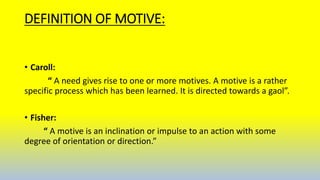
DEFINITION OF MOTIVE:
• Caroll:
“ A need gives rise to one or more motives. A motive is a rather
specific process which has been learned. It is directed towards a gaol”.
• Fisher:
“ A motive is an inclination or impulse to an action with some
degree of orientation or direction.”
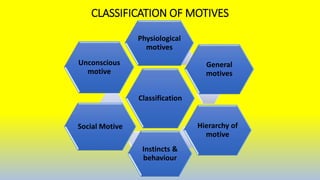
CLASSIFICATION OF MOTIVES
Classification
Physiological
motives
General
motives
Hierarchy of
motive
Instincts &
behaviour
Social Motive
Unconscious
motive
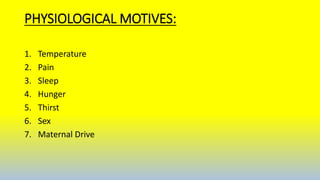
PHYSIOLOGICAL MOTIVES:
1. Temperature
2. Pain
3. Sleep
4. Hunger
5. Thirst
6. Sex
7. Maternal Drive
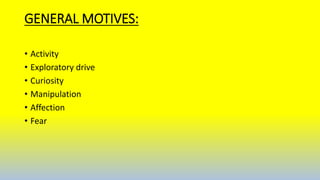
GENERAL MOTIVES:
• Activity
• Exploratory drive
• Curiosity
• Manipulation
• Affection
• Fear
SOCIAL MOTIVES:
• Affiliation
• Social approval
• Status and power and prestige
• Security and achievement
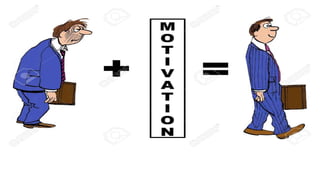
MOTIVATION
MEANING:
Motivation is a need or desire that energizes and direct
behaviour. It means inspiring other to do work for the
accomplishment of the objectives of the organization.
DEFINITIONS OF MOTIVATION
• “Motivation is the process of arousing the action, sustaining the
activity in process and regulating the pattern of activity”.
-YOUNG
“Motivation refers to the states within a person or animal that drives
behaviour toward some goals”
-MORGAN AND KING
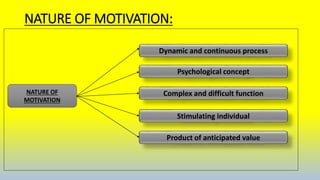
NATURE OF MOTIVATION:
NATURE OF
MOTIVATION
Dynamic and continuous process
Psychological concept
Complex and difficult function
Stimulating individual
Product of anticipated value
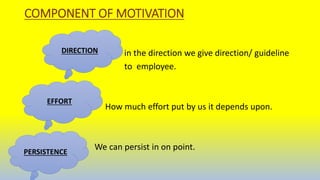
COMPONENT OF MOTIVATION
in the direction we give direction/ guideline
to employee.
How much effort put by us it depends upon.
We can persist in on point.
DIRECTION
EFFORT
PERSISTENCE
IMPORTANT OF MOTIVATION:
• Employees are motivated to perform allotted task, look for better ways.
• Motivated employee-more quality oriented.
• Highly motivated- more productive than adaptive workers
• Creative, spontaneous and innovative behaviours at work.
• Comprehensive understanding of the way in which organisation functions.
• Developing employees as future resource.
• Reduced labour turnover.
• Decreased absenteeism.
• Maximum utilization of production factors.
• Workers co-operation.
SOURCES OF MOTIVATION:
I) INTERNAL OR PUSH FORCES:
Needs:
- For security and come out from fear.
- For self-esteem / self-respect.
- From achievement/ strong will power.
Attitude:
- About self/ positive attitude toward self.
- About job/ positive attitude toward job.
- Good supervisor.
- Organization positive attitude towards the organization.
Gaols:
- Achieve the task.
- Performance level/ evaluation.
- Career advancement/ career opportunity
II) EXTERNAL OR PULL FORCE
Characteristic of the job:
- Evaluate according to the task or the workload, and the
employee,
- How to job/ responsibilities is performed.
-How much time spend on it.
Characteristic of the work satisfaction:
-Immediate social environment: Co-ordination between the work
group members and under supervision by supervision.
-Organizational actions:
-Should provide reward/ compensation to the employee.
-It is availability of training.
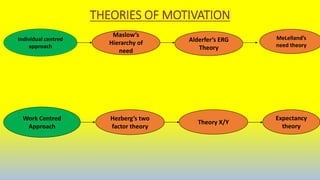
THEORIES OF MOTIVATION
Individual centred
approach
Maslow’s
Hierarchy of
need
Work Centred
Approach
MeLelland’s
need theory
Alderfer’s ERG
Theory
Hezberg’s two
factor theory
Theory X/Y
Expectancy
theory
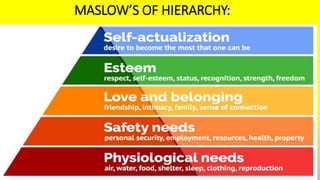
MASLOW’S OF HIERARCHY:
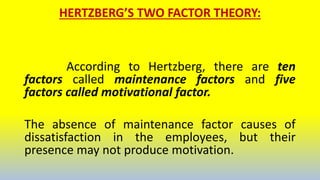
HERTZBERG’S TWO FACTOR THEORY:
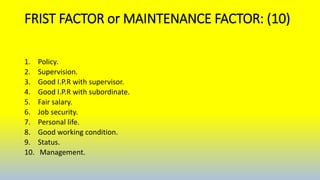
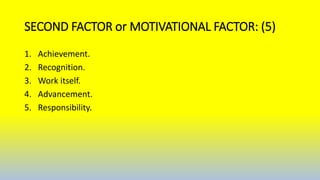
According to Hertzberg, there are ten
factors called maintenance factors and five
factors called motivational factor.
The absence of maintenance factor causes of
dissatisfaction in the employees, but their
presence may not produce motivation.
FRIST FACTOR or MAINTENANCE FACTOR: (10)
1. Policy.
2. Supervision.
3. Good I.P.R with supervisor.
4. Good I.P.R with subordinate.
5. Fair salary.
6. Job security.
7. Personal life.
8. Good working condition.
9. Status.
10. Management.
SECOND FACTOR or MOTIVATIONAL FACTOR: (5)
1. Achievement.
2. Recognition.
3. Work itself.
4. Advancement.
5. Responsibility.
Motivation
Motivation

Motivation

  • 1.
    MOTIVATION MR. KULTHE VIKRANTRATNAKAR. M SC NURSING IN MENTAL HEALTH.
  • 3.
    INTRODUCTION: • Human behaviouris controlled, directed and modified through certain motives. When person is hungry and is searching for food, or constructing a house, or mating, or learning new skills, we will always be able to trace a motive to guides is activities and behaviour to success or failure.
  • 5.
    MOTIVE: • Motive isa force that determine the activity of an individual. It energizes and direct his behaviour along this or that channels. When a motive is at work, it creates tension and this arouses the individuals towards an activity that will relieve the tension.
  • 6.
    DEFINITION OF MOTIVE: •Caroll: “ A need gives rise to one or more motives. A motive is a rather specific process which has been learned. It is directed towards a gaol”. • Fisher: “ A motive is an inclination or impulse to an action with some degree of orientation or direction.”
  • 8.
    CLASSIFICATION OF MOTIVES Classification Physiological motives General motives Hierarchyof motive Instincts & behaviour Social Motive Unconscious motive
  • 9.
    PHYSIOLOGICAL MOTIVES: 1. Temperature 2.Pain 3. Sleep 4. Hunger 5. Thirst 6. Sex 7. Maternal Drive
  • 10.
    GENERAL MOTIVES: • Activity •Exploratory drive • Curiosity • Manipulation • Affection • Fear
  • 11.
    SOCIAL MOTIVES: • Affiliation •Social approval • Status and power and prestige • Security and achievement
  • 12.
    MOTIVATION MEANING: Motivation is aneed or desire that energizes and direct behaviour. It means inspiring other to do work for the accomplishment of the objectives of the organization.
  • 13.
    DEFINITIONS OF MOTIVATION •“Motivation is the process of arousing the action, sustaining the activity in process and regulating the pattern of activity”. -YOUNG “Motivation refers to the states within a person or animal that drives behaviour toward some goals” -MORGAN AND KING
  • 14.
    NATURE OF MOTIVATION: NATUREOF MOTIVATION Dynamic and continuous process Psychological concept Complex and difficult function Stimulating individual Product of anticipated value
  • 16.
    COMPONENT OF MOTIVATION inthe direction we give direction/ guideline to employee. How much effort put by us it depends upon. We can persist in on point. DIRECTION EFFORT PERSISTENCE
  • 17.
    IMPORTANT OF MOTIVATION: •Employees are motivated to perform allotted task, look for better ways. • Motivated employee-more quality oriented. • Highly motivated- more productive than adaptive workers • Creative, spontaneous and innovative behaviours at work. • Comprehensive understanding of the way in which organisation functions. • Developing employees as future resource. • Reduced labour turnover. • Decreased absenteeism. • Maximum utilization of production factors. • Workers co-operation.
  • 18.
    SOURCES OF MOTIVATION: I)INTERNAL OR PUSH FORCES: Needs: - For security and come out from fear. - For self-esteem / self-respect. - From achievement/ strong will power. Attitude: - About self/ positive attitude toward self. - About job/ positive attitude toward job. - Good supervisor. - Organization positive attitude towards the organization. Gaols: - Achieve the task. - Performance level/ evaluation. - Career advancement/ career opportunity
  • 19.
    II) EXTERNAL ORPULL FORCE Characteristic of the job: - Evaluate according to the task or the workload, and the employee, - How to job/ responsibilities is performed. -How much time spend on it. Characteristic of the work satisfaction: -Immediate social environment: Co-ordination between the work group members and under supervision by supervision. -Organizational actions: -Should provide reward/ compensation to the employee. -It is availability of training.
  • 21.
    THEORIES OF MOTIVATION Individualcentred approach Maslow’s Hierarchy of need Work Centred Approach MeLelland’s need theory Alderfer’s ERG Theory Hezberg’s two factor theory Theory X/Y Expectancy theory
  • 22.
  • 23.
    HERTZBERG’S TWO FACTORTHEORY: According to Hertzberg, there are ten factors called maintenance factors and five factors called motivational factor. The absence of maintenance factor causes of dissatisfaction in the employees, but their presence may not produce motivation.
  • 24.
    FRIST FACTOR orMAINTENANCE FACTOR: (10) 1. Policy. 2. Supervision. 3. Good I.P.R with supervisor. 4. Good I.P.R with subordinate. 5. Fair salary. 6. Job security. 7. Personal life. 8. Good working condition. 9. Status. 10. Management.
  • 25.
    SECOND FACTOR orMOTIVATIONAL FACTOR: (5) 1. Achievement. 2. Recognition. 3. Work itself. 4. Advancement. 5. Responsibility.