1
2
•plot and interpret displacement- time and velocity-time graphs
•deduce from the shape of a displacement-time graph when
a body is:
i. at rest
ii. moving with uniform velocity
iii. moving with non-uniform velocity
•determine distance, displacement and velocity from a
displacement –time graph
•deduce from the shape of velocity- time graph when a body is:
i. at rest
ii. moving with uniform velocity
iii. moving with uniform acceleration
•determine distance, displacement velocity and acceleration
from a velocity–time graph
•solve problems on linear motion with uniform
.
A student is able to:
Learning OutcomesLearning Outcomes
3
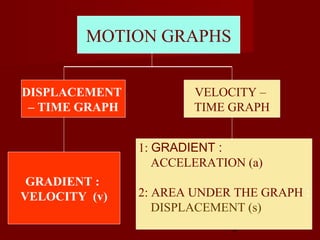
MOTION GRAPHS
DISPLACEMENT
– TIME GRAPH
VELOCITY –
TIME GRAPH
GRADIENT :
VELOCITY (v)
1: GRADIENT :
ACCELERATION (a)
2: AREA UNDER THE GRAPH :
DISPLACEMENT (s)
4
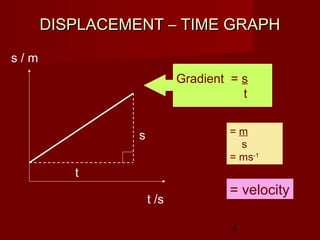
DISPLACEMENT – TIME GRAPHDISPLACEMENT – TIME GRAPH
s / m
t /s
Gradient = s
t
s
t
= velocity
= m
s
= ms-1
55
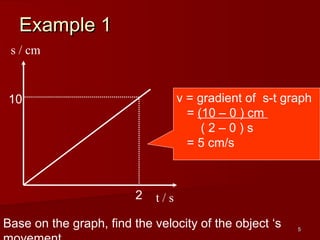
s / cm
t / s
10
2
v = gradient of s-t graph
= (10 – 0 ) cm
( 2 – 0 ) s
= 5 cm/s
Base on the graph, find the velocity of the object ‘s
Example 1Example 1
6
77
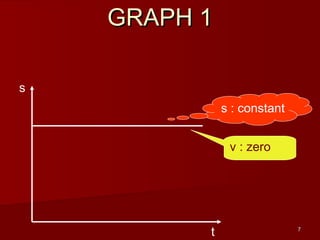
s : constant
v : zero
s
t
GRAPH 1GRAPH 1
88
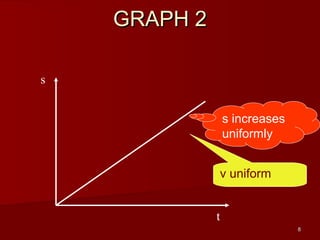
GRAPH 2GRAPH 2
s
t
s increases
uniformly
v uniform
99
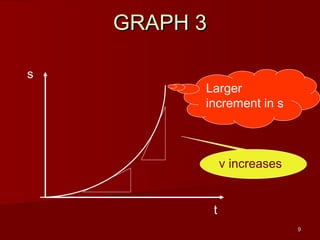
GRAPH 3GRAPH 3
Larger
increment in s
v increases
s
t
1010
s
t
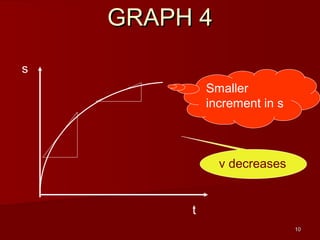
GRAPH 4GRAPH 4
Smaller
increment in s
v decreases
11
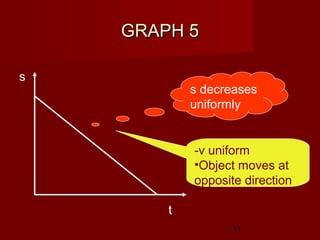
GRAPH 5GRAPH 5
s
t
-v uniform
•Object moves at
opposite direction
s decreases
uniformly
12
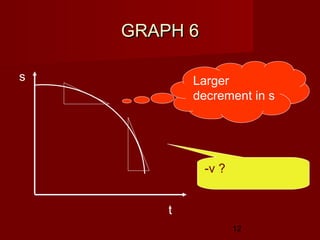
GRAPH 6GRAPH 6
s
t
Larger
decrement in s
-v ?
1313
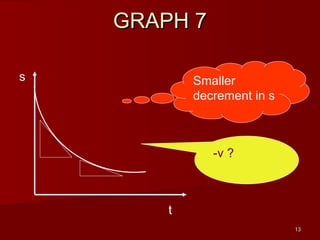
GRAPH 7GRAPH 7
s
t
-v ?
Smaller
decrement in s
14
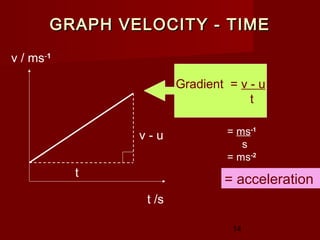
GRAPH VELOCITY - TIMEGRAPH VELOCITY - TIME
Gradient = v - u
t
v / ms-1
t /s
v - u
t
= ms-1
s
= ms-2
= acceleration
1515
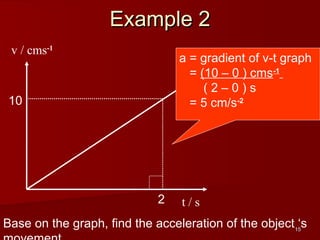
Example 2Example 2
v / cms-1
t / s
10
2
a = gradient of v-t graph
= (10 – 0 ) cms-1
( 2 – 0 ) s
= 5 cm/s-2
Base on the graph, find the acceleration of the object ‘s
16
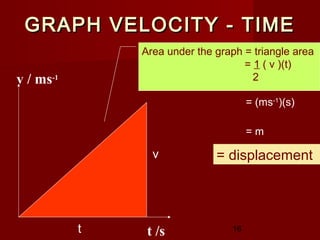
Area under the graph = triangle area
= 1 ( v )(t)
2
= (ms-1
)(s)
v / ms-1
t /s
v
t
= displacement
= m
GRAPH VELOCITY - TIMEGRAPH VELOCITY - TIME
17
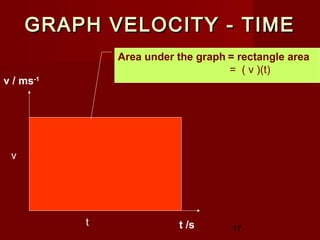
v / ms-1
t /st
v
Area under the graph = rectangle area
= ( v )(t)
GRAPH VELOCITY - TIMEGRAPH VELOCITY - TIME
18
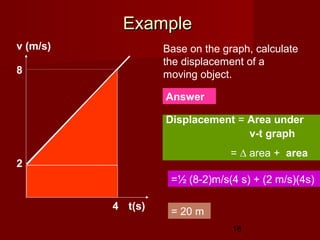
ExampleExample
v (m/s)
t(s)
2
4
8
Base on the graph, calculate
the displacement of a
moving object.
Answer
Displacement = Area under
v-t graph
= ∆ area + area
=½ (8-2)m/s(4 s) + (2 m/s)(4s)
= 20 m
19
2020
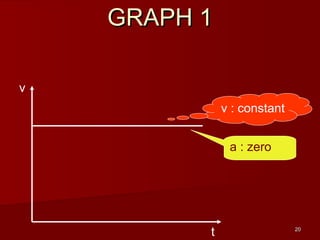
v : constant
a : zero
v
t
GRAPH 1GRAPH 1
2121
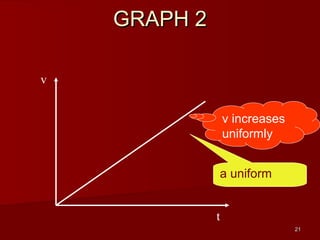
GRAPH 2GRAPH 2
v
t
v increases
uniformly
a uniform
2222
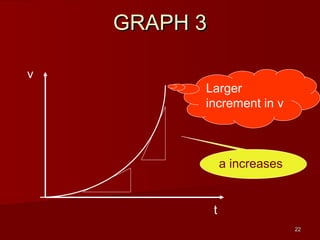
GRAPH 3GRAPH 3
Larger
increment in v
a increases
v
t
2323
v
t
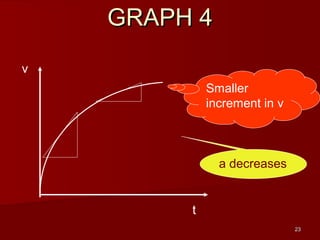
GRAPH 4GRAPH 4
Smaller
increment in v
a decreases
24
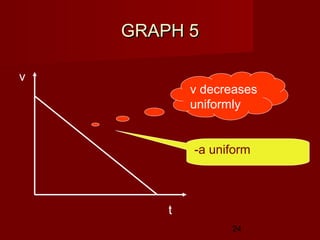
GRAPH 5GRAPH 5
v
t
-a uniform
v decreases
uniformly
25
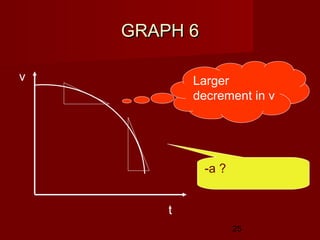
GRAPH 6GRAPH 6
v
t
Larger
decrement in v
-a ?
2626
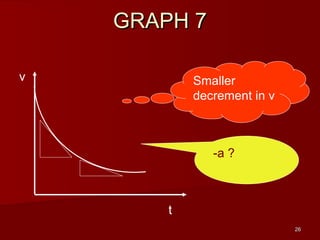
GRAPH 7GRAPH 7
v
t
-a ?
Smaller
decrement in v
27
Equations of Linear MotionEquations of Linear Motion
Derived the equations
Problem solving
28
Derived the equations
Acceleration = Gradient of
v-t graph
Rearrange [1]
Final velocity v = u+at …….[1a]
Displacement, s = area under v-t
graph
s = ½ ( u+v) t ……..[2]
Substitute [1a] into [2]
velocity
time
u
t
v
s = ½ ( u+ u+at) t
s = ut +½ at2
……...[3]
Substitute [1b] into [2]
Rearrange [1] again
s = ½ ( u+v) (v – u)
a
v2
= u2
+ 2as …….[4]
t = (v – u) ……..[1b]
a
a = (v – u) ……..[1]
t
v = (v + u) ……..[5]
2
29
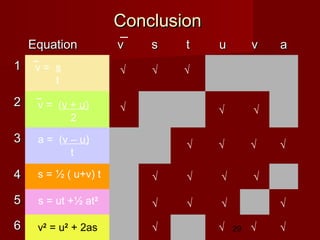
ConclusionConclusion
EquationEquation vv ss tt uu vv aa
11
22
33
44
55
66
a = (v – u)
t
v = s
t
s = ut +½ at2
v2
= u2
+ 2as
v = (v + u)
2
s = ½ ( u+v) t
√ √ √
√ √ √
√ √ √ √
√ √ √ √
√ √ √ √
√ √ √ √
30
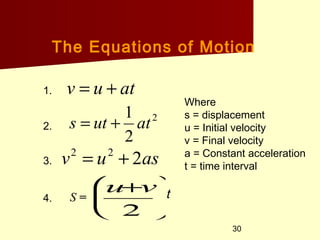
Where
s = displacement
u = Initial velocity
v = Final velocity
a = Constant acceleration
t = time interval
The Equations of Motion
atuv +=1.
u+v
2





S = t4.
asuv 222
+=3.
2
2
1
atuts +=2.
31
Example 1Example 1
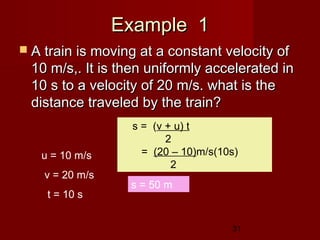
 A train is moving at a constant velocity ofA train is moving at a constant velocity of
10 m/s,. It is then uniformly accelerated in10 m/s,. It is then uniformly accelerated in
10 s to a velocity of 20 m/s. what is the10 s to a velocity of 20 m/s. what is the
distance traveled by the train?distance traveled by the train?
u = 10 m/s
v = 20 m/s
t = 10 s
s = (v + u) t
2
= (20 – 10)m/s(10s)
2
s = 50 m
32
Example 2Example 2
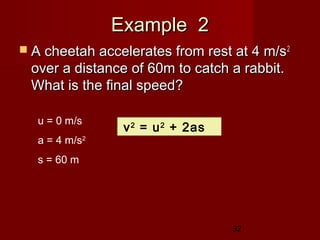
 A cheetah accelerates from rest at 4 m/sA cheetah accelerates from rest at 4 m/s22
over a distance of 60m to catch a rabbit.over a distance of 60m to catch a rabbit.
What is the final speed?What is the final speed?
u = 0 m/s
a = 4 m/s2
s = 60 m
v2
= u2
+ 2as
33
Example 3Example 3
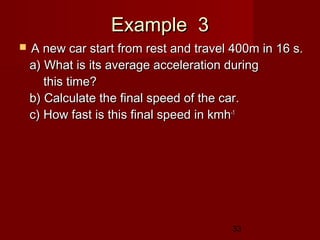
 A new car start from rest and travel 400m in 16 s.A new car start from rest and travel 400m in 16 s.
a) What is its average acceleration duringa) What is its average acceleration during
this time?this time?
b) Calculate the final speed of the car.b) Calculate the final speed of the car.
c) How fast is this final speed in kmhc) How fast is this final speed in kmh-1-1
34

Motion Graph & equations

  • 1.
  • 2.
    2 •plot and interpretdisplacement- time and velocity-time graphs •deduce from the shape of a displacement-time graph when a body is: i. at rest ii. moving with uniform velocity iii. moving with non-uniform velocity •determine distance, displacement and velocity from a displacement –time graph •deduce from the shape of velocity- time graph when a body is: i. at rest ii. moving with uniform velocity iii. moving with uniform acceleration •determine distance, displacement velocity and acceleration from a velocity–time graph •solve problems on linear motion with uniform . A student is able to: Learning OutcomesLearning Outcomes
  • 3.
    3 MOTION GRAPHS DISPLACEMENT – TIMEGRAPH VELOCITY – TIME GRAPH GRADIENT : VELOCITY (v) 1: GRADIENT : ACCELERATION (a) 2: AREA UNDER THE GRAPH : DISPLACEMENT (s)
  • 4.
    4 DISPLACEMENT – TIMEGRAPHDISPLACEMENT – TIME GRAPH s / m t /s Gradient = s t s t = velocity = m s = ms-1
  • 5.
    55 s / cm t/ s 10 2 v = gradient of s-t graph = (10 – 0 ) cm ( 2 – 0 ) s = 5 cm/s Base on the graph, find the velocity of the object ‘s Example 1Example 1
  • 6.
  • 7.
    77 s : constant v: zero s t GRAPH 1GRAPH 1
  • 8.
    88 GRAPH 2GRAPH 2 s t sincreases uniformly v uniform
  • 9.
  • 10.
  • 11.
    11 GRAPH 5GRAPH 5 s t -vuniform •Object moves at opposite direction s decreases uniformly
  • 12.
  • 13.
    1313 GRAPH 7GRAPH 7 s t -v? Smaller decrement in s
  • 14.
    14 GRAPH VELOCITY -TIMEGRAPH VELOCITY - TIME Gradient = v - u t v / ms-1 t /s v - u t = ms-1 s = ms-2 = acceleration
  • 15.
    1515 Example 2Example 2 v/ cms-1 t / s 10 2 a = gradient of v-t graph = (10 – 0 ) cms-1 ( 2 – 0 ) s = 5 cm/s-2 Base on the graph, find the acceleration of the object ‘s
  • 16.
    16 Area under thegraph = triangle area = 1 ( v )(t) 2 = (ms-1 )(s) v / ms-1 t /s v t = displacement = m GRAPH VELOCITY - TIMEGRAPH VELOCITY - TIME
  • 17.
    17 v / ms-1 t/st v Area under the graph = rectangle area = ( v )(t) GRAPH VELOCITY - TIMEGRAPH VELOCITY - TIME
  • 18.
    18 ExampleExample v (m/s) t(s) 2 4 8 Base onthe graph, calculate the displacement of a moving object. Answer Displacement = Area under v-t graph = ∆ area + area =½ (8-2)m/s(4 s) + (2 m/s)(4s) = 20 m
  • 19.
  • 20.
    2020 v : constant a: zero v t GRAPH 1GRAPH 1
  • 21.
    2121 GRAPH 2GRAPH 2 v t vincreases uniformly a uniform
  • 22.
  • 23.
  • 24.
    24 GRAPH 5GRAPH 5 v t -auniform v decreases uniformly
  • 25.
  • 26.
    2626 GRAPH 7GRAPH 7 v t -a? Smaller decrement in v
  • 27.
    27 Equations of LinearMotionEquations of Linear Motion Derived the equations Problem solving
  • 28.
    28 Derived the equations Acceleration= Gradient of v-t graph Rearrange [1] Final velocity v = u+at …….[1a] Displacement, s = area under v-t graph s = ½ ( u+v) t ……..[2] Substitute [1a] into [2] velocity time u t v s = ½ ( u+ u+at) t s = ut +½ at2 ……...[3] Substitute [1b] into [2] Rearrange [1] again s = ½ ( u+v) (v – u) a v2 = u2 + 2as …….[4] t = (v – u) ……..[1b] a a = (v – u) ……..[1] t v = (v + u) ……..[5] 2
  • 29.
    29 ConclusionConclusion EquationEquation vv sstt uu vv aa 11 22 33 44 55 66 a = (v – u) t v = s t s = ut +½ at2 v2 = u2 + 2as v = (v + u) 2 s = ½ ( u+v) t √ √ √ √ √ √ √ √ √ √ √ √ √ √ √ √ √ √ √ √ √ √
  • 30.
    30 Where s = displacement u= Initial velocity v = Final velocity a = Constant acceleration t = time interval The Equations of Motion atuv +=1. u+v 2      S = t4. asuv 222 +=3. 2 2 1 atuts +=2.
  • 31.
    31 Example 1Example 1 A train is moving at a constant velocity ofA train is moving at a constant velocity of 10 m/s,. It is then uniformly accelerated in10 m/s,. It is then uniformly accelerated in 10 s to a velocity of 20 m/s. what is the10 s to a velocity of 20 m/s. what is the distance traveled by the train?distance traveled by the train? u = 10 m/s v = 20 m/s t = 10 s s = (v + u) t 2 = (20 – 10)m/s(10s) 2 s = 50 m
  • 32.
    32 Example 2Example 2 A cheetah accelerates from rest at 4 m/sA cheetah accelerates from rest at 4 m/s22 over a distance of 60m to catch a rabbit.over a distance of 60m to catch a rabbit. What is the final speed?What is the final speed? u = 0 m/s a = 4 m/s2 s = 60 m v2 = u2 + 2as
  • 33.
    33 Example 3Example 3 A new car start from rest and travel 400m in 16 s.A new car start from rest and travel 400m in 16 s. a) What is its average acceleration duringa) What is its average acceleration during this time?this time? b) Calculate the final speed of the car.b) Calculate the final speed of the car. c) How fast is this final speed in kmhc) How fast is this final speed in kmh-1-1
  • 34.