THE SPEED
Chapter 1
Grade 9
The speed
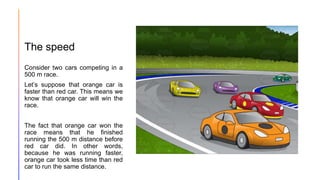
Consider two cars competing in a
500 m race.
Let’s suppose that orange car is
faster than red car. This means we
know that orange car will win the
race.
The fact that orange car won the
race means that he finished
running the 500 m distance before
red car did. In other words,
because he was running faster,
orange car took less time than red
car to run the same distance.
•Definition: Speed
• The speed of an object is a measure of the distance
traveled by the object per a second that it travels.
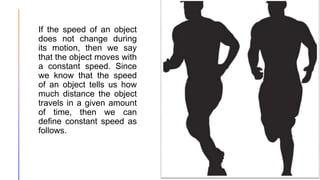
If the speed of an object
does not change during
its motion, then we say
that the object moves with
a constant speed. Since
we know that the speed
of an object tells us how
much distance the object
travels in a given amount
of time, then we can
define constant speed as
follows.
Definition: Constant Speed
• An object that travels at a constant speed covers equal
distances in equal intervals of time.
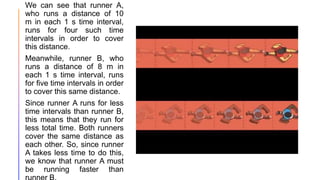
We can see that runner A,
who runs a distance of 10
m in each 1 s time interval,
runs for four such time
intervals in order to cover
this distance.
Meanwhile, runner B, who
runs a distance of 8 m in
each 1 s time interval, runs
for five time intervals in order
to cover this same distance.
Since runner A runs for less
time intervals than runner B,
this means that they run for
less total time. Both runners
cover the same distance as
each other. So, since runner
A takes less time to do this,
we know that runner A must
be running faster than
Equation: Speed
If an object moving at a constant speed of 𝑣 travels a
distance of 𝑑 in a time of 𝑡,then the speed 𝑣 is given
v = d/t
• We often measure distance in units of metres (m) and
time in units of seconds (s). Then, the units on the right-
hand side of the speed equation are units
of metres divided by units of seconds.We write these
units as “m/s,” and we read this out loud as “metres per
second.”
• Since the units on both sides of the equation must
agree, then our speed must also have units
of m/s (metres per second).
Key Points
• The speed of an object is a measure of the distance moved by the object in a unit
time.
• An object moving at a constant speed travels equal distances in equal intervals of
time.
• Mathematically, if we label the distance traveled by an object as 𝑑 and the time the
object travels for as 𝑡,then the speed, 𝑣,of that object is given by 𝑣=𝑑/𝑡.
• This equation for speed can also be rearranged to make 𝑑 or 𝑡 the subject.
• Since units on each side of an equation must agree with each other, the units of
speed must be units of distance divided by units of time. Common units for speed
are metres per second (m/s) or kilometres per hour (km/h).

The speed

  • 1.
  • 2.
    The speed Consider twocars competing in a 500 m race. Let’s suppose that orange car is faster than red car. This means we know that orange car will win the race. The fact that orange car won the race means that he finished running the 500 m distance before red car did. In other words, because he was running faster, orange car took less time than red car to run the same distance.
  • 3.
    •Definition: Speed • Thespeed of an object is a measure of the distance traveled by the object per a second that it travels.
  • 4.
    If the speedof an object does not change during its motion, then we say that the object moves with a constant speed. Since we know that the speed of an object tells us how much distance the object travels in a given amount of time, then we can define constant speed as follows.
  • 5.
    Definition: Constant Speed •An object that travels at a constant speed covers equal distances in equal intervals of time.
  • 6.
    We can seethat runner A, who runs a distance of 10 m in each 1 s time interval, runs for four such time intervals in order to cover this distance. Meanwhile, runner B, who runs a distance of 8 m in each 1 s time interval, runs for five time intervals in order to cover this same distance. Since runner A runs for less time intervals than runner B, this means that they run for less total time. Both runners cover the same distance as each other. So, since runner A takes less time to do this, we know that runner A must be running faster than
  • 7.
    Equation: Speed If anobject moving at a constant speed of 𝑣 travels a distance of 𝑑 in a time of 𝑡,then the speed 𝑣 is given v = d/t
  • 8.
    • We oftenmeasure distance in units of metres (m) and time in units of seconds (s). Then, the units on the right- hand side of the speed equation are units of metres divided by units of seconds.We write these units as “m/s,” and we read this out loud as “metres per second.” • Since the units on both sides of the equation must agree, then our speed must also have units of m/s (metres per second).
  • 9.
    Key Points • Thespeed of an object is a measure of the distance moved by the object in a unit time. • An object moving at a constant speed travels equal distances in equal intervals of time. • Mathematically, if we label the distance traveled by an object as 𝑑 and the time the object travels for as 𝑡,then the speed, 𝑣,of that object is given by 𝑣=𝑑/𝑡. • This equation for speed can also be rearranged to make 𝑑 or 𝑡 the subject. • Since units on each side of an equation must agree with each other, the units of speed must be units of distance divided by units of time. Common units for speed are metres per second (m/s) or kilometres per hour (km/h).