A
Seminar
on
Motion
Capture
Presented by: Mr. Raviraj
Contents
 Introduction.
 What is Motion capture
(Mocap)?
 History of Mocap.
 What is ROTOSCOPING?
 Types of Mocap.
 Software's used in Mocap
 Applications of the Mocap
 Conclusion
Introduction
 The use of motion capture to animate characters on
computers is relatively recent, it started in the 1970s,
and now just beginning to spread.
 Motion Capture is an expensive process that captures
the motion of human actors and translates it into digital
formso that artists can create more realistic animations
of humans on the move.
What is Motion Capture?
 Motion capture is the process of recording
human movement through specialized
cameras and mapping them onto
charactermodel.
 Motion capture technology involves
sensing ,digitalizing, and recording that
object in motion.
 also known as Mo-Cap, Virtual theatre,
Real time animation or performance
capture.
 In filmmaking and video game
development, it refers to recording actions
of human actors, and using that
information to animate digital character
History
 Motion capture was first developed in the late 1970’s but it
wasn’t recognized as a revolutionary animation technique until
the mid 1980′s when it was eventually used for entertainment
purposes.
 The technique of “ROTOSCOPING” was invented by
MaxFleischer, dressed in a clown outfit as the live-film
reference for the character Koko the Clown.
 Walt Disney and his animators employed it in Snow White and
the Seven Dwarfs in 1937. From Snow White onwards, the
rotoscope was used mainly forstudying human and animal
motion, ratherthan actual tracing.
History…
 Later loony toons, movies like Wizards (1977), The Lord of
theRings (1978), American pop etc were created.
 Video games often use motion capture to animate athletes,
martial artists, and other in-game characters. This has been
done since the Sega Model 2 arcade game, Virtual Fighter 2 in
1994.
 By mid-1995 the use of motion capture in video game
development had become routine.
 and developer to have its own in-house motion capture studio
built into its headquarters.
Rotoscoping
 A rotoscoping is a device that enables animators to
trace live action movement, frame by frame, for use
in animation.
Motion Capture
TYPES OFMOTION CAPTURE
 Generally motion capture can be classified into
three categories:
1. MECHANICAL MOTION CAPTURE
2. THE MAGNETIC MOTION CAPTURE
3. THE OPTICAL MOTION CAPTURE
MECHANICALMOTION
CAPTURE
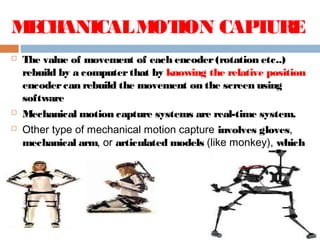
 Mechanical motion capture systems directly track
body joint angles and are often referred to as exo-
skeleton motion capture systems.
 The sensors are attached to the body of performer
and each joints are connected to the angular
encoder.
MECHANICALMOTION CAPTURE
 The value of movement of each encoder(rotation etc..)
rebuild by a computerthat by knowing the relative position
encodercan rebuild the movement on the screen using
software
 Mechanical motion capture systems are real-time system.
 Other type of mechanical motion capture involves gloves,
mechanical arm, or articulated models (like monkey), which
are used forkey framing.
Gypsy 7 Torso MECHANICAL Capture
System
Pros of MMC
 Offer high accuracy.
 Do not depend on external factors
such as no. of cameras.
 Computes rotations directly.
 Portable, unlimited range.
 Less expensive.
 Can capture multiple
performances simultaneously.
Cons of MMC
 No realistic motion.
 Sensors makes noise.
 The technology has no
awareness of ground, so
there can be no jumping,
plus feet data tends to slide.
 Absolute positions are not
known but are calculated
from the rotations.
MAGNETIC MOTION CAPTURE
 Electromagnetic Motion Capture is one of the more
technical types of Motion Capture relying on
transmitters and receivers to trackmovement.
 Performer would wearseveral magnetic receivers in
which transmitters would tract and calculate
movement.
 Performer wears an array of magnetic receivers
which track location with respect to transmitter.
 12-20 tracking sensors are placed on a captured
subject.
 Tracking sensors output their translation and
PROS OF MAGNETIC MOTION
CAPTURE
 Real time
 smaller workspace
 positions are absolute
 rotations are measure
absolutely
 relatively cheaper than
optical
CONS OF MAGNETIC MOTION
CAPTURE
 Heavier sponsors.
 difficult to move.
 wires on body.
 Costly.
 Limited Range.
 Can’t perform with
multiple actors.
 Capture volume is
limited.
Optical Motion Capture
 Optical motion capture is most
commonly used technology.
 Optical motion capture is
capturing data digitally which is
capable of turning real life
motion into digital form.
 Optical motion capture is widely
used many fields like animation,
special effects, gaming.
 This technique brings a better
feeling of life in character.
Types of optical capture
 There are two types of optical motion capture
Active and Passive optical capture.
 Active optical capture uses LEDlights used as
markers.
 In passive optical capture Reflectors are placed on
the body.
HOWOMC WORKS?
 It uses number of special cameras from different
angle.
 Basically using two or more camera angles brings a
sense of a 3d world.
 This technique has reflective markers which are
placed on actor’s body. Because these are reflective
markers, it becomes easy forsoftware to identify
the position in 3d world.
 When the same markergets tracked from more than
one camera it gives details of all the three axis.
 Markerbase capture can give more accuracy over
HOWOMC WORKS?
1.
2.
3.
4. 5. 7.
automated by most mocap systems
Motion Capture Workflow
6.
Motion Capture Workflow
PROS OF OPTICAL MOTION
CAPTURE
 Freedom of movement.
 High quality capture.
 Can capture fast
motions.
 large capture space.
 Can capture many
markers.
CONS OF OPTICAL MOTION
CAPTURE
 Occlusion, markers are can be hidden from the
camera.
 additional performers will increase occlusion.
 may be able to add redundant cameras.
 Marker crossover, which markerare you looking
at?
 It is more expensive
MOTION CAPTURE LAB
Motion Capture Lab
SOFTWARE’S USEDIN MOTION
CAPTURE
 Luxology Modo (model design, e.g. the Scorpion)
 Lightwave (low-res realtime environments)
 Houdini (Hell’s Gate scenes, interiors)
 ZBrush (creature design)
 Autodesk3d design max (space shots, control roomscreens
and HUDrenderings)
 AutodeskMotionBuilder(forreal-time 3d visualisations)
 Eyeon Fusion (image compositing)
 AutodeskSmoke (colorcorrection)
 Mudbox (floating mountains)
 Avid(video editing)
APPLICATIONS
 Movies/Animations
 Motion capture is being used more and more in
films nowadays
 Some film characters require the use of motion
capture, otherwise their animation seems fake.
 Films that used motion capture technologies
are..
 Avatar, The adventures of tintin, The avangers,
Hulk, Iron man, Kochadaiiyaan etc…
Movies/Animations…
 AvatarIs The One Of The Best Film Ever Used The Motion
Capture Technology.
 To achieve the face expressions, actors wore individually made
skull caps fitted with a tiny camera positioned in front of the
actors' faces
 This method allows the filmmakers to transfer100% of the
actors' physical performances to theirdigital counterparts
Motion Capture in Cinema
VIDEO GAMES
 Used to improve gameplay.
 Takes the game to the new heights and make
more attractive.
 Very close to real life characters.
MILLITARY
 Tracking head movements of pilots in military.
MEDICINE
 Eg: walkanalysis, treatment
 Sports medicine(eg: injury prevention,
performance analysis, enhancement)
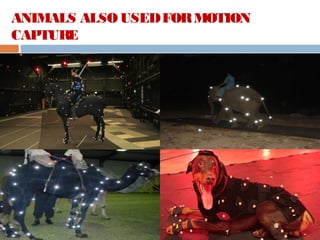
ANIMALS ALSO USEDFORMOTION
CAPTURE
CONCLUSION
 MoCap has been proven an effective way to
generate expressive character animation. MoCap
technique has been widely recognized by
animators. Handy toolkits for MoCaphandling
have been integrated within animation software
by the developers.
Motion capture by Rj

Motion capture by Rj

  • 2.
  • 3.
    Contents  Introduction.  Whatis Motion capture (Mocap)?  History of Mocap.  What is ROTOSCOPING?  Types of Mocap.  Software's used in Mocap  Applications of the Mocap  Conclusion
  • 4.
    Introduction  The useof motion capture to animate characters on computers is relatively recent, it started in the 1970s, and now just beginning to spread.  Motion Capture is an expensive process that captures the motion of human actors and translates it into digital formso that artists can create more realistic animations of humans on the move.
  • 5.
    What is MotionCapture?  Motion capture is the process of recording human movement through specialized cameras and mapping them onto charactermodel.  Motion capture technology involves sensing ,digitalizing, and recording that object in motion.  also known as Mo-Cap, Virtual theatre, Real time animation or performance capture.  In filmmaking and video game development, it refers to recording actions of human actors, and using that information to animate digital character
  • 6.
    History  Motion capturewas first developed in the late 1970’s but it wasn’t recognized as a revolutionary animation technique until the mid 1980′s when it was eventually used for entertainment purposes.  The technique of “ROTOSCOPING” was invented by MaxFleischer, dressed in a clown outfit as the live-film reference for the character Koko the Clown.  Walt Disney and his animators employed it in Snow White and the Seven Dwarfs in 1937. From Snow White onwards, the rotoscope was used mainly forstudying human and animal motion, ratherthan actual tracing.
  • 7.
    History…  Later loonytoons, movies like Wizards (1977), The Lord of theRings (1978), American pop etc were created.  Video games often use motion capture to animate athletes, martial artists, and other in-game characters. This has been done since the Sega Model 2 arcade game, Virtual Fighter 2 in 1994.  By mid-1995 the use of motion capture in video game development had become routine.  and developer to have its own in-house motion capture studio built into its headquarters.
  • 8.
    Rotoscoping  A rotoscopingis a device that enables animators to trace live action movement, frame by frame, for use in animation.
  • 9.
  • 10.
    TYPES OFMOTION CAPTURE Generally motion capture can be classified into three categories: 1. MECHANICAL MOTION CAPTURE 2. THE MAGNETIC MOTION CAPTURE 3. THE OPTICAL MOTION CAPTURE
  • 11.
    MECHANICALMOTION CAPTURE  Mechanical motioncapture systems directly track body joint angles and are often referred to as exo- skeleton motion capture systems.  The sensors are attached to the body of performer and each joints are connected to the angular encoder.
  • 12.
    MECHANICALMOTION CAPTURE  Thevalue of movement of each encoder(rotation etc..) rebuild by a computerthat by knowing the relative position encodercan rebuild the movement on the screen using software  Mechanical motion capture systems are real-time system.  Other type of mechanical motion capture involves gloves, mechanical arm, or articulated models (like monkey), which are used forkey framing.
  • 13.
    Gypsy 7 TorsoMECHANICAL Capture System
  • 14.
    Pros of MMC Offer high accuracy.  Do not depend on external factors such as no. of cameras.  Computes rotations directly.  Portable, unlimited range.  Less expensive.  Can capture multiple performances simultaneously.
  • 15.
    Cons of MMC No realistic motion.  Sensors makes noise.  The technology has no awareness of ground, so there can be no jumping, plus feet data tends to slide.  Absolute positions are not known but are calculated from the rotations.
  • 16.
    MAGNETIC MOTION CAPTURE Electromagnetic Motion Capture is one of the more technical types of Motion Capture relying on transmitters and receivers to trackmovement.  Performer would wearseveral magnetic receivers in which transmitters would tract and calculate movement.  Performer wears an array of magnetic receivers which track location with respect to transmitter.  12-20 tracking sensors are placed on a captured subject.  Tracking sensors output their translation and
  • 19.
    PROS OF MAGNETICMOTION CAPTURE  Real time  smaller workspace  positions are absolute  rotations are measure absolutely  relatively cheaper than optical
  • 20.
    CONS OF MAGNETICMOTION CAPTURE  Heavier sponsors.  difficult to move.  wires on body.  Costly.  Limited Range.  Can’t perform with multiple actors.  Capture volume is limited.
  • 21.
    Optical Motion Capture Optical motion capture is most commonly used technology.  Optical motion capture is capturing data digitally which is capable of turning real life motion into digital form.  Optical motion capture is widely used many fields like animation, special effects, gaming.  This technique brings a better feeling of life in character.
  • 22.
    Types of opticalcapture  There are two types of optical motion capture Active and Passive optical capture.  Active optical capture uses LEDlights used as markers.  In passive optical capture Reflectors are placed on the body.
  • 23.
    HOWOMC WORKS?  Ituses number of special cameras from different angle.  Basically using two or more camera angles brings a sense of a 3d world.  This technique has reflective markers which are placed on actor’s body. Because these are reflective markers, it becomes easy forsoftware to identify the position in 3d world.  When the same markergets tracked from more than one camera it gives details of all the three axis.  Markerbase capture can give more accuracy over
  • 24.
  • 25.
    1. 2. 3. 4. 5. 7. automatedby most mocap systems Motion Capture Workflow 6.
  • 26.
  • 27.
    PROS OF OPTICALMOTION CAPTURE  Freedom of movement.  High quality capture.  Can capture fast motions.  large capture space.  Can capture many markers.
  • 28.
    CONS OF OPTICALMOTION CAPTURE  Occlusion, markers are can be hidden from the camera.  additional performers will increase occlusion.  may be able to add redundant cameras.  Marker crossover, which markerare you looking at?  It is more expensive
  • 29.
  • 30.
  • 31.
    SOFTWARE’S USEDIN MOTION CAPTURE Luxology Modo (model design, e.g. the Scorpion)  Lightwave (low-res realtime environments)  Houdini (Hell’s Gate scenes, interiors)  ZBrush (creature design)  Autodesk3d design max (space shots, control roomscreens and HUDrenderings)  AutodeskMotionBuilder(forreal-time 3d visualisations)  Eyeon Fusion (image compositing)  AutodeskSmoke (colorcorrection)  Mudbox (floating mountains)  Avid(video editing)
  • 32.
    APPLICATIONS  Movies/Animations  Motioncapture is being used more and more in films nowadays  Some film characters require the use of motion capture, otherwise their animation seems fake.  Films that used motion capture technologies are..  Avatar, The adventures of tintin, The avangers, Hulk, Iron man, Kochadaiiyaan etc…
  • 33.
    Movies/Animations…  AvatarIs TheOne Of The Best Film Ever Used The Motion Capture Technology.  To achieve the face expressions, actors wore individually made skull caps fitted with a tiny camera positioned in front of the actors' faces  This method allows the filmmakers to transfer100% of the actors' physical performances to theirdigital counterparts
  • 35.
  • 36.
    VIDEO GAMES  Usedto improve gameplay.  Takes the game to the new heights and make more attractive.  Very close to real life characters.
  • 38.
    MILLITARY  Tracking headmovements of pilots in military.
  • 39.
    MEDICINE  Eg: walkanalysis,treatment  Sports medicine(eg: injury prevention, performance analysis, enhancement)
  • 40.
  • 41.
    CONCLUSION  MoCap hasbeen proven an effective way to generate expressive character animation. MoCap technique has been widely recognized by animators. Handy toolkits for MoCaphandling have been integrated within animation software by the developers.