2012
ANIMATION [An imaginary world]


                     Deeksha Trivedi
                     D.B.S.College, Kanpur
                     10/10/2012
A
        nimation deals with generation,
        sequencing, and display of a set of
        images to create an effect of
        visual change or motion, similar to
        a movie film. It creates an illusion
of movement. Animation is an important
component of multimedia, because just as
a picture is a powerful way to illustrate
information, a small animation clip is even
more powerful and useful for illustrating
concepts involving movement.


Many of the early inventions designed to
animate images were meant as novelties
for private amusement of children or small
parties. Animation devices which fall into this category include the zoetrope,
magic lantern, praxinoscope, thaumatrope, phenakistoscope, and flip book
zoetrope.


Computer animation -
Computer animation encompasses a variety of techniques, the unifying factor
being that the animation is created digitally on a computer.
   Steps of a simple computer animation are following-

   1. Creating animation sequences


         –         object definition
         –         path specification (for an object or a camera)
         –         key frames
         –         in-betweening

   2. Displaying the sequences

         –         raster animation
         –         colour-table animation
Types of animation -
2D animation:
2D animation figures are created and/or edited on the computer using 2D bitmap
graphics or created and edited using 2D Vector graphics. This includes automated
computerized versions of traditional animation techniques such as of twining,
morphing, onion skinning and interpolated rot scoping.
Example - power point animation.

3D animation:
Digitally modeled and manipulated by an animator. To manipulate a mesh, it is
given a digital skeletal structure that can be used to control the mesh. Other
techniques can be applied such as mathematical functions, simulated fur or hair,
fire/water effect and the use of Motion Capture. Many 3D animations are very
believable and are commonly used as Visual Effects for recent movies.
     Beowulf, Polar Express and Avatar are recent examples of 3D Animation.


Why animation works?
   • The eye cannot register images faster than approximately 50 frames per
     second

      (30 is just about adequate)

   • If a gap in the projection occurs, the eye seems to perform spatial
     interpolation over the gap

Rules of Animation-
The three basic rules to give a realistic appearance to the animation sequence.

1. Squash and stretch

2. Slow-in and slow-out

3. Maintaining 3d affects
Problems in Animation-
1. Temporal aliasing-It occurs when the view of a moving object is repre-
sented by a series of short samples as distinct from a continuous view.
2. Ray tracing- Ray tracing is a technique for generating an image by tracing the
path of light through pixels in an image plane.


Confusion between video &
animation
   • An animation is an animated drawing, cartoon,
     etc.
   • "Video" is often used to refer to any kind of
     audio/visual recording; an animation is never
     referred to a live recording.
   • In animation we are giving some effects to
     particular object, but in video we can’t.
   • A video is recorded from actual footage where
     as an animation is made digitally.

Difference between video and
animation:
Techniques of         Morphing         Hardware               Software requirement
Animation                              requirements
Interpolation and     The              Hardware requir-       Animation creation
transformation is     transformation   ements Image ge-       software allow user to
the basic technique   of an object’s   neration tools and     create animation
used in animation     shape from one devices such as          sequences from scratch.
which are used for    form to another scanners, digital       Screen capture software
in-between the key    is called        cameras for creat-     used to capture computer
frames.               morphing. It can ing images. Graph-     screen as graphic images.
1. Linear             be applied to    ics accelerator        Animation clips is a library
interpolation         any motion or    board used for         used for directly importing
2. Translation        transition       controlling            images. Animation
3. Rotation           involving a      resolution and         software import animation
4. Scaling            change in shape. number of color of     files like .FLI and .FLC.
                                       display.
Applications-
Applications In medical- Computer Animation used for presenting result of
biomechanical analyses and simulation.

In education – By using visual effects in educations students can easy grasp and
attract by the students.

In entertainment –Animation is used for creating cartoons or other visual effects
like movies, video games for entertaining the user.


Advantages-
   •   The animator has total control of animation.
   •   Interactions are automatically realistic.
   •   System with complex inter-relationship is possible.
   •   To visualize the event that can’t be catch by the camera.


Disadvantages-
   • Difficult to specify large and dynamic images.
   • It consumes a lot of memory space for storing data.
   • Special software and programs are required to obtain and process the data.

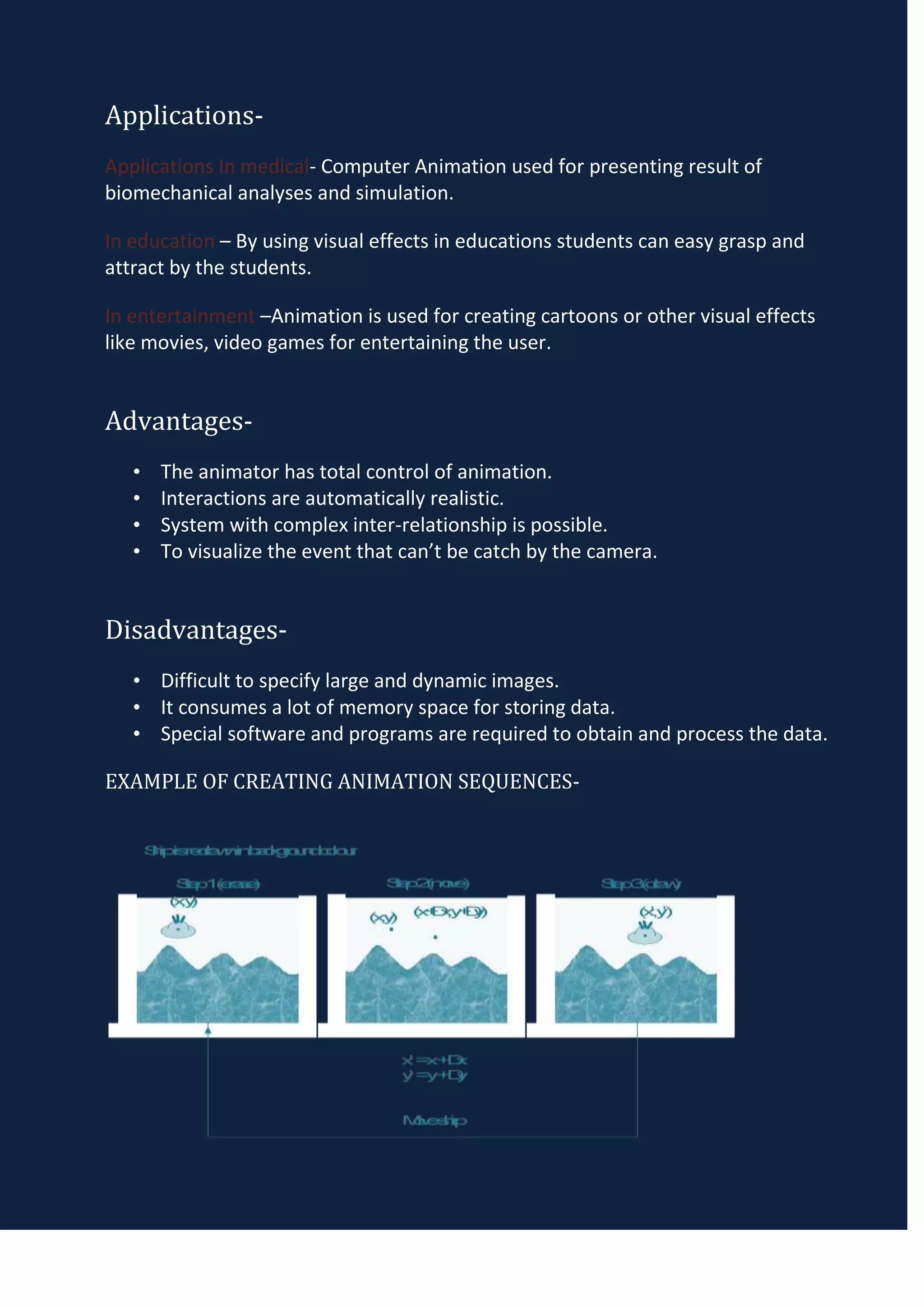
EXAMPLE OF CREATING ANIMATION SEQUENCES-
Animation

Animation

  • 1.
    2012 ANIMATION [An imaginaryworld] Deeksha Trivedi D.B.S.College, Kanpur 10/10/2012
  • 2.
    A nimation deals with generation, sequencing, and display of a set of images to create an effect of visual change or motion, similar to a movie film. It creates an illusion of movement. Animation is an important component of multimedia, because just as a picture is a powerful way to illustrate information, a small animation clip is even more powerful and useful for illustrating concepts involving movement. Many of the early inventions designed to animate images were meant as novelties for private amusement of children or small parties. Animation devices which fall into this category include the zoetrope, magic lantern, praxinoscope, thaumatrope, phenakistoscope, and flip book zoetrope. Computer animation - Computer animation encompasses a variety of techniques, the unifying factor being that the animation is created digitally on a computer. Steps of a simple computer animation are following- 1. Creating animation sequences – object definition – path specification (for an object or a camera) – key frames – in-betweening 2. Displaying the sequences – raster animation – colour-table animation
  • 3.
    Types of animation- 2D animation: 2D animation figures are created and/or edited on the computer using 2D bitmap graphics or created and edited using 2D Vector graphics. This includes automated computerized versions of traditional animation techniques such as of twining, morphing, onion skinning and interpolated rot scoping. Example - power point animation. 3D animation: Digitally modeled and manipulated by an animator. To manipulate a mesh, it is given a digital skeletal structure that can be used to control the mesh. Other techniques can be applied such as mathematical functions, simulated fur or hair, fire/water effect and the use of Motion Capture. Many 3D animations are very believable and are commonly used as Visual Effects for recent movies. Beowulf, Polar Express and Avatar are recent examples of 3D Animation. Why animation works? • The eye cannot register images faster than approximately 50 frames per second (30 is just about adequate) • If a gap in the projection occurs, the eye seems to perform spatial interpolation over the gap Rules of Animation- The three basic rules to give a realistic appearance to the animation sequence. 1. Squash and stretch 2. Slow-in and slow-out 3. Maintaining 3d affects
  • 4.
    Problems in Animation- 1.Temporal aliasing-It occurs when the view of a moving object is repre- sented by a series of short samples as distinct from a continuous view. 2. Ray tracing- Ray tracing is a technique for generating an image by tracing the path of light through pixels in an image plane. Confusion between video & animation • An animation is an animated drawing, cartoon, etc. • "Video" is often used to refer to any kind of audio/visual recording; an animation is never referred to a live recording. • In animation we are giving some effects to particular object, but in video we can’t. • A video is recorded from actual footage where as an animation is made digitally. Difference between video and animation: Techniques of Morphing Hardware Software requirement Animation requirements Interpolation and The Hardware requir- Animation creation transformation is transformation ements Image ge- software allow user to the basic technique of an object’s neration tools and create animation used in animation shape from one devices such as sequences from scratch. which are used for form to another scanners, digital Screen capture software in-between the key is called cameras for creat- used to capture computer frames. morphing. It can ing images. Graph- screen as graphic images. 1. Linear be applied to ics accelerator Animation clips is a library interpolation any motion or board used for used for directly importing 2. Translation transition controlling images. Animation 3. Rotation involving a resolution and software import animation 4. Scaling change in shape. number of color of files like .FLI and .FLC. display.
  • 5.
    Applications- Applications In medical-Computer Animation used for presenting result of biomechanical analyses and simulation. In education – By using visual effects in educations students can easy grasp and attract by the students. In entertainment –Animation is used for creating cartoons or other visual effects like movies, video games for entertaining the user. Advantages- • The animator has total control of animation. • Interactions are automatically realistic. • System with complex inter-relationship is possible. • To visualize the event that can’t be catch by the camera. Disadvantages- • Difficult to specify large and dynamic images. • It consumes a lot of memory space for storing data. • Special software and programs are required to obtain and process the data. EXAMPLE OF CREATING ANIMATION SEQUENCES-