BY:
ALPANA A. INGALE
ROLL NO. 7114
1 • WHAT IS ANIMATRONICS?
2 • HISTORY
3 • INTRODUCTION
4 • FORMATION OF ANIMATRONICS
5 • CONCLUSION
6 • APPLICATIONS
7 • REFERENCES
1. WHAT IS ANIMATRONICS?
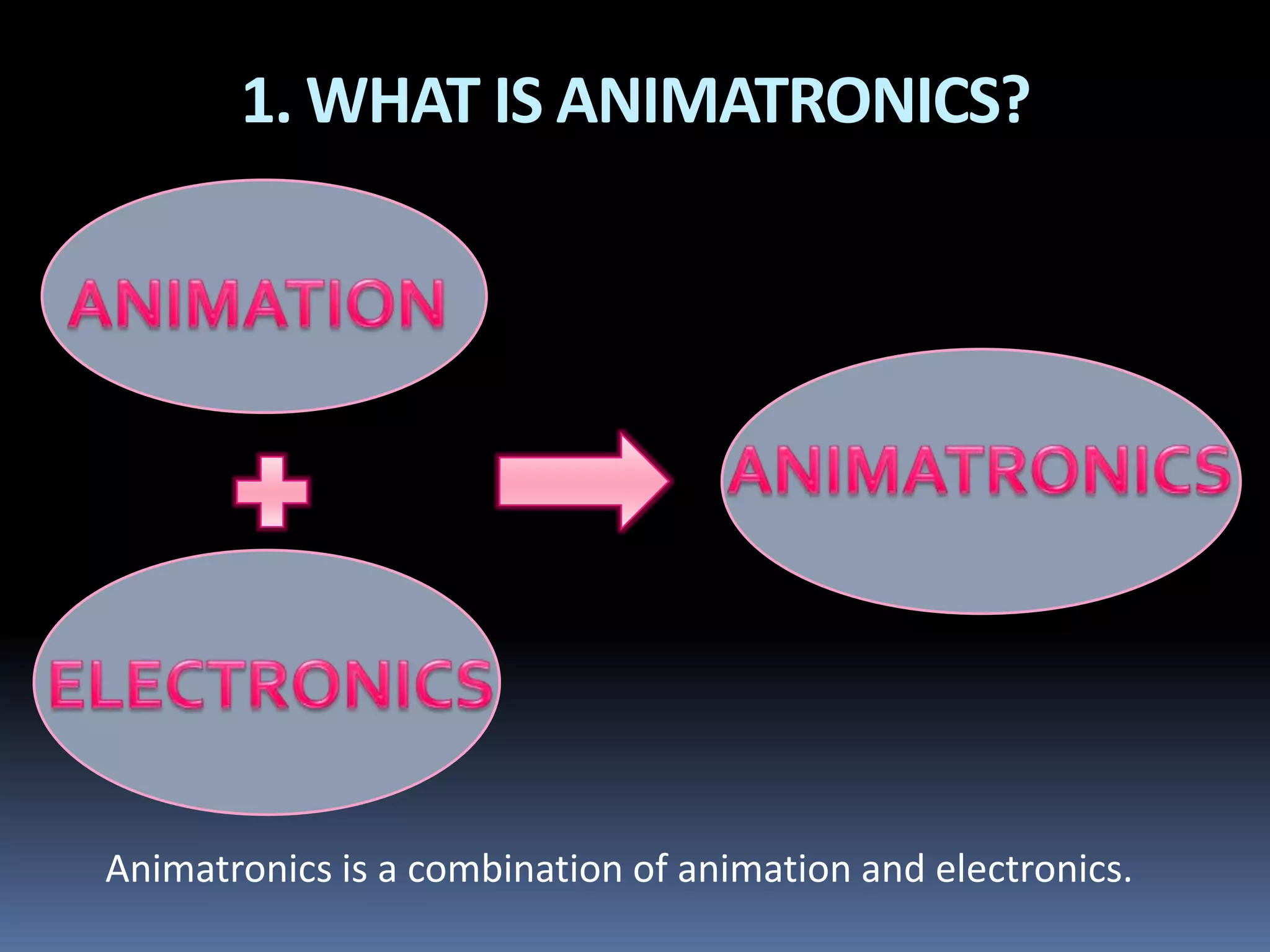
Animatronics is a combination of animation and electronics.
1. WHAT IS ANIMATRONICS?
 Basically, animatronic is a mechanized puppet.
 It may be pre-programmed or remotely
controlled.
 This puppet may look similar to human beings or
like a different species.
 Animatronic creations include animals, plants,
mythical creatures, etc.
 In other words, we can say that
“it is illusion of life with electronic creatures.”
2. HISTORY
Although true animatronic characters didn't really exist till the late
20th century, the real history of the technique begins with 17th
century clock makers.
German clock makers created a more affordable form of
animatronics that were purchased for homes.
These were cuckoo clocks which included at least one
mechanical character, such as a bird, which performed a
show or popped out upon specific set times.
The modern era of animatronics began in 1961, when
Walt Disney started developing animatronics for
entertainment and film which was later copyrighted as
“Audio-Animatronics” .
 Disney saw animatronics as a novelty that would
attract visitors to his World's Fair displays and later his
movies and theme parks.
 Walt Disney pushed the limits of technology in order
to achieve his vision.
The Enchanted TIKI Birds were the first ever animatronics
robots & positioned at Disneyland.
Abraham Lincoln was the first
ever human animatronic figure &
was displayed at the world’s fair.
The first animatronic
to feature in a movie
was a bird in the film
MARY POPPINS
BEN FRANKLIN became the first ever
animatronic robot to walk upstairs,
climbing the steps to loft in the
American adventure.
The wicked witch of the west became the
first A-100 animatronics robot in the world.
She was capable of moving like a human
with flexible joints and variable speeds.
The full size T-REX
became the last
largest head to
tail animatronic
to be produced
for film.
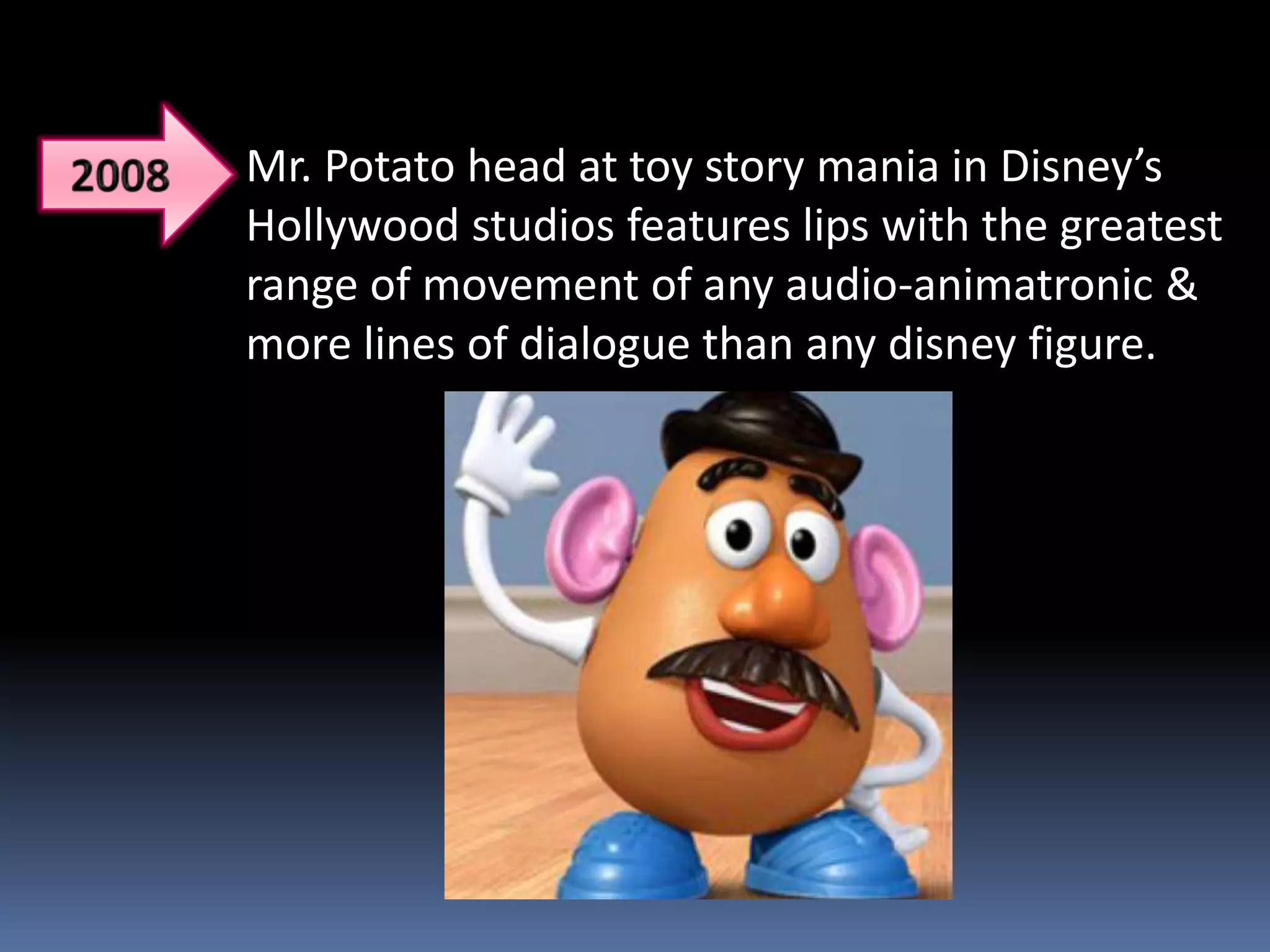
Mr. Potato head at toy story mania in Disney’s
Hollywood studios features lips with the greatest
range of movement of any audio-animatronic &
more lines of dialogue than any disney figure.
3. INTRODUCTION
 Animatronics is a multi-disciplinary field which
integrates anatomy, robots, mechatronics, and
puppetry resulting in lifelike animation.
 Animatronic figures are often powered by pneumatics,
hydraulics, or by electrical means, and can be
implemented using both computer control and human
control, including tele-operation.
 Motion actuators are often used to imitate muscle
movements & create realistic motions in limbs.
3. INTRODUCTION
 The every part included in the sculpture are designed
with the scanners and lasers.
 The scale model that are designed and exposed with
the Computer Aided Design(CAD) software packages.
 Figures are covered with body shells and flexible skins
made of hard and soft plastic materials,
and finished with details like colors, hair and feathers &
other components to make the figure more realistic.
4. FORMATION OF ANIMATRONICS
 STEP 1 : DESIGN PROCESS
 STEP 2 : SCULPTING
 STEP 3 : MOLDMAKING
 STEP 4 : ARMATURE FABRICATION
 STEP 5 : COSTUMING
 STEP 6 : PROGRAMMING & TESTING
STEP 1 : DESIGN PROCESS
 Client and the company developing the animatronics
decides:
1. what the character will be (appearance),
2. MOVES
a. Total number of moves,
b. quality of moves,
c. what each specific move will be.
 First the desired figure of creation is put on paper.
 The figure can be of mythical creatures, animals,
plants, birds, any mischievous character, etc.
STEP 1 : DESIGN PROCESS
The scale model that are designed and exposed with the Computer
Aided Design(CAD) software packages. The figures are built using
mechanism with animated look.
STEP 2 : SCULPTING
 Converting two-dimensional ideas into three-
dimensional forms.
 Work progresses from photos, artwork, videos,
models, statuettes, etc.
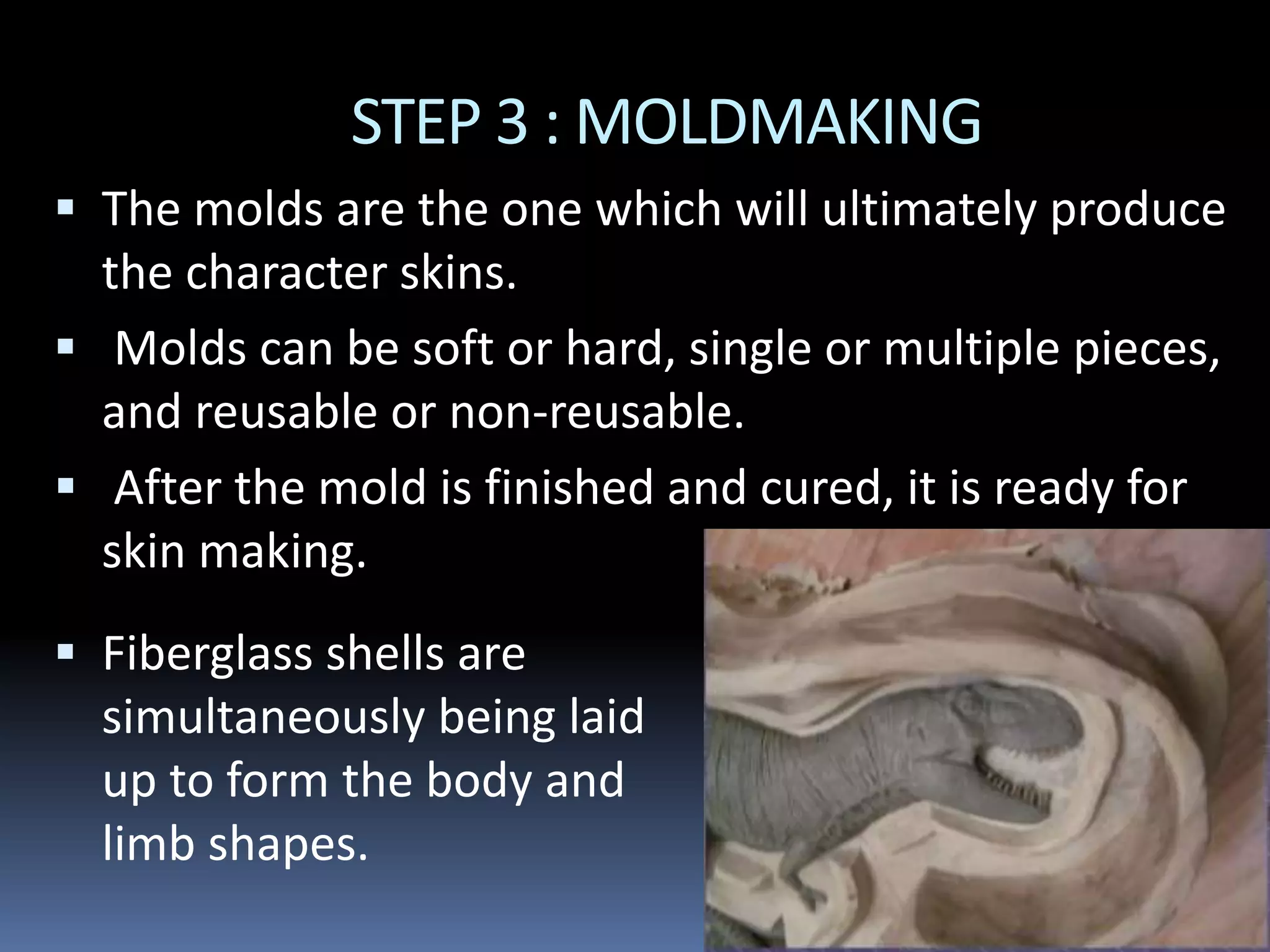
STEP 3 : MOLDMAKING
 The molds are the one which will ultimately produce
the character skins.
 Molds can be soft or hard, single or multiple pieces,
and reusable or non-reusable.
 After the mold is finished and cured, it is ready for
skin making.
 Fiberglass shells are
simultaneously being laid
up to form the body and
limb shapes.
STEP 4 : ARMATURE FABRICATION
 Each individual part requires a custom design
and fabrication.
 Each of the robot’s movement axis point must
have an industrial rated bearing to provide action
and long life.
 The technicians select those components
carefully in order to ensure the durability and
long life.
STEP 5 : COSTUMING
 The outfit has to allow for easy access to the
character’s operating mechanisms. It must
also “look” normal after movement has taken
place.
 The costume must be designed to provide
hundreds or thousands of operations without
wearing out and without causing the skin
areas(i.e. around the necks or wrists) to
breakdown as well.
STEP 6 : PROGRAMMING
 Programming is the final step, and for some
animations it is the most rewarding.
 Programming can be done either at the
manufacturing facility or at the final
installation site.
 In programming, all the individual moves are
coordinated into complex animated actions
and it bring “life.”
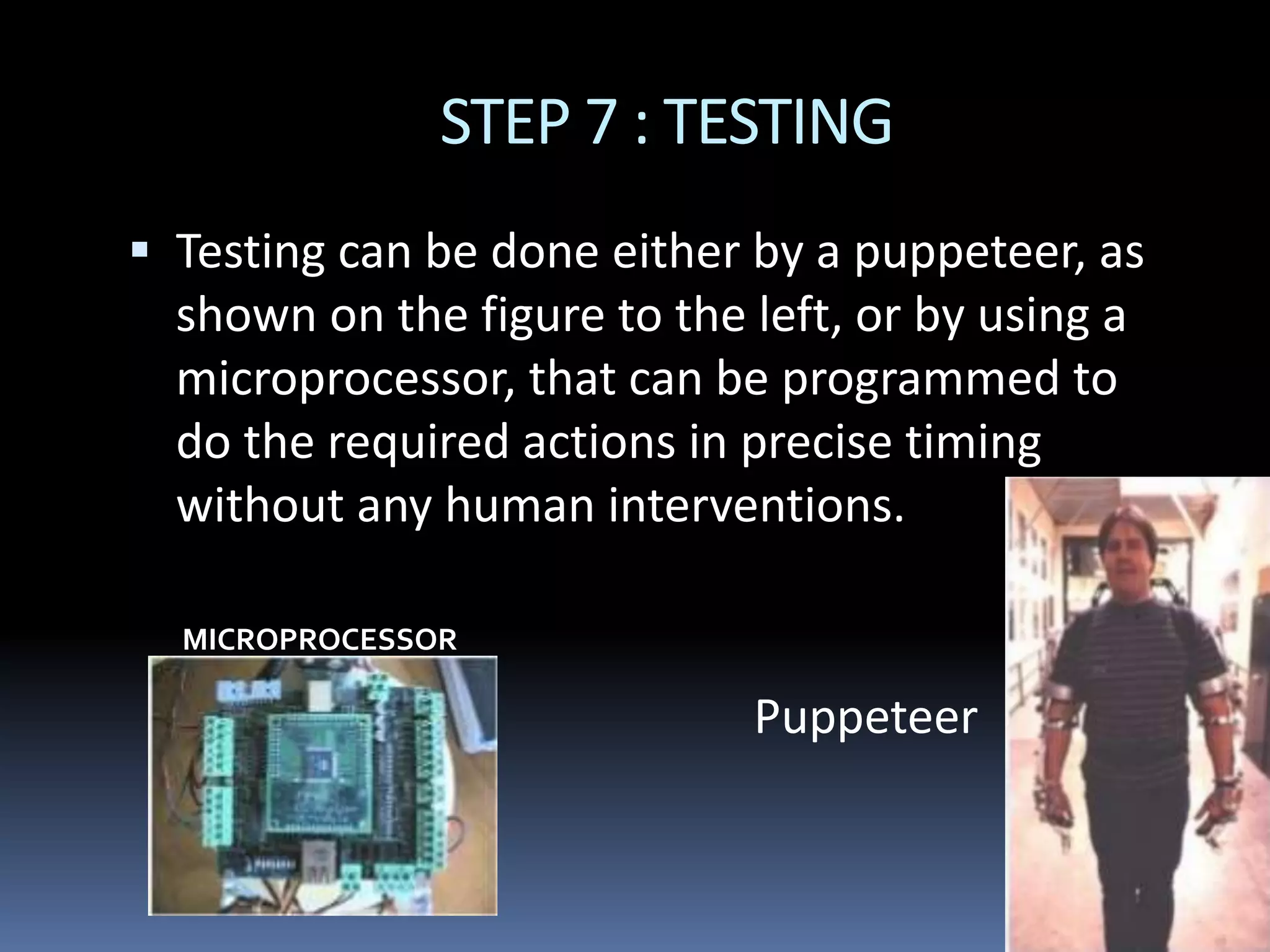
STEP 7 : TESTING
 Testing can be done either by a puppeteer, as
shown on the figure to the left, or by using a
microprocessor, that can be programmed to
do the required actions in precise timing
without any human interventions.
MICROPROCESSOR
Puppeteer
 Electronics & software provides synchronization
of sound & motion.
 Electronics is used in doing programming of
these animated creatures.
 It is done by controlling the voltage regulation.
 It is also done by embedded microcontroller.
ROLE OF ELECTRONICS
5. CONCLUSIONS
 Needs Good technical knowhow,
 Very close to reality,
 Individuality to the robots,
 Very good attraction,
 Power usage is more,
 Dangerous if uncontrolled,
 Willing to spend a pretty penny on equipment
& materials,
 Definitely has room for improvement.
• Some of the applications
are listed below:6.APPLICATIONS
For use in Chemical industries for safety point of
view to human hand.
As a part of Humanoid robot to perform various
tasks.
DEFENSE SYSTEM
ENTERTAINMENT
ICHTHYLOGY
MEDICAL
DEFENSE SYSTEM
 Animatronics could be employed in field of
surveillance by creating an animatronic animal,
which could be equipped with camera or sensor
eyes for monitoring certain hotspots.
 For Military use in bomb diffusing.
 The main purpose of animatronic is for display &
films for grabbing the attention of the audience.
 The film industry has been a driving force
revolutionizing the technology used to develop
animatronics.
 Disney Research teamed up with researchers from
Columbia University to develop a method for 3D
printing animatronic models with realistic
movements, using as few as a single, movable
joint.
ENTERTAINMENT
ENTERTAINMENT - FILMS
 It is used:
1. For making films of bizarre and extinct animals
like dinosaurs and monsters in horror movies.
2. To replace live animals in films by animatronics
to reduce the risk of getting hurt in some action
sequences.
3. To create toys using animatronic methodology,
which are life like & are programmed to respond
like a real living animal.
ENTERTAINMENT - DISPLAY
 Life like animatronics of former Presidents &
great Scientists are used along with speech
synthesizers to make us re-live their histories.
 One of the biggest ideas of the century involving
animatronics is that to create an entire zoology
of diverse animals and birds with their
corresponding realistic behavior and instinct.
This creates an artificial zoo, which does not
imprison wildlife & it is also relatively easy for
maintenance & putting as show as the
management desires.
 The "Jurassic park" series is known for the
realism of its creatures, both the animatronic &
digital versions.
ENTERTAINMENT - DISPLAY
 Animatronics could also be employed in field of
ichthyology, in which an artificial fish is designed
that is visually similar to the fish under study.
 Using underwater propellers and thrusters or a
flexible body and tail lined with servomotors,
this artificial fish could easily mingle with the
corresponding species and attaching a small
camera inside of it will enable corresponding
species and attaching a small camera inside of it
will enable the researchers to study &
understand the behavior of fish underwater.
ICHTHYOLOGY
MEDICAL
 Animatronics could be employed in field of
medicine to simulate real time surgeries on live
patients.
 They can also be used for creating artificial limbs
that are controlled by microcontrollers, which
requires a significant advancement and
contribution in the field of ANNs(Artificial Neural
Networks) and CNS-Processor’s Bus interfaces.
Animatronic Shader Lamps Avatars
 It is comprised of a camera, a tracking system, a
digital projector, and a life-sized styrofoam(a
kind of expanded polystyrene) head mounted on
a pan-tilt unit.
 The system captures imagery of a moving,
talking user and maps the appearance & motion
onto the animatronic SLA, delivering a dynamic,
real-time representation of the user to multiple
viewers.
 The upper images conceptually illustrate one possible
use of animatronic Shader Lamps Avatars (SLA): full-
duplex telepresence for medical consultation.
 The physician in (a) interacts with a remote patient
and therapist in (b) by means of a camera-equipped
SLA.
 The SLA allows the physician to both see and be seen
by the patient and therapist.
 Animatronic Shader Lamps Avatars
 Ichthyology design
 A fluid-suspension, electromagnetically driven
eye with video capability for animatronic
applications
 HEFES (Hybrid Engine for Facial Expressions
Synthesis), an engine for generating and
controlling facial expressions both on physical
androids and 3D avatars.
Further Literature survey topics
REFERENCES
 B. Uma Maheswari, ”Animatronics and Multi-
Disciplinary Technologies” Volume 5, Issue 3,
March 2015, www.ijarcsse.com.
 Y.D.Kapse,P. R. Sarangpure, J. Mohurle,
“Animatronic” Vol. 5, Issue 4, April 2016,
www.ijarcsse.com.
 http://roborobotics.com/Animatronics/Animatro
nics.html
ANIMATRONICS

ANIMATRONICS

  • 1.
  • 2.
    1 • WHATIS ANIMATRONICS? 2 • HISTORY 3 • INTRODUCTION 4 • FORMATION OF ANIMATRONICS 5 • CONCLUSION 6 • APPLICATIONS 7 • REFERENCES
  • 3.
    1. WHAT ISANIMATRONICS? Animatronics is a combination of animation and electronics.
  • 4.
    1. WHAT ISANIMATRONICS?  Basically, animatronic is a mechanized puppet.  It may be pre-programmed or remotely controlled.  This puppet may look similar to human beings or like a different species.  Animatronic creations include animals, plants, mythical creatures, etc.  In other words, we can say that “it is illusion of life with electronic creatures.”
  • 5.
    2. HISTORY Although trueanimatronic characters didn't really exist till the late 20th century, the real history of the technique begins with 17th century clock makers. German clock makers created a more affordable form of animatronics that were purchased for homes. These were cuckoo clocks which included at least one mechanical character, such as a bird, which performed a show or popped out upon specific set times. The modern era of animatronics began in 1961, when Walt Disney started developing animatronics for entertainment and film which was later copyrighted as “Audio-Animatronics” .
  • 6.
     Disney sawanimatronics as a novelty that would attract visitors to his World's Fair displays and later his movies and theme parks.  Walt Disney pushed the limits of technology in order to achieve his vision.
  • 7.
    The Enchanted TIKIBirds were the first ever animatronics robots & positioned at Disneyland.
  • 8.
    Abraham Lincoln wasthe first ever human animatronic figure & was displayed at the world’s fair. The first animatronic to feature in a movie was a bird in the film MARY POPPINS BEN FRANKLIN became the first ever animatronic robot to walk upstairs, climbing the steps to loft in the American adventure.
  • 9.
    The wicked witchof the west became the first A-100 animatronics robot in the world. She was capable of moving like a human with flexible joints and variable speeds. The full size T-REX became the last largest head to tail animatronic to be produced for film.
  • 10.
    Mr. Potato headat toy story mania in Disney’s Hollywood studios features lips with the greatest range of movement of any audio-animatronic & more lines of dialogue than any disney figure.
  • 11.
    3. INTRODUCTION  Animatronicsis a multi-disciplinary field which integrates anatomy, robots, mechatronics, and puppetry resulting in lifelike animation.  Animatronic figures are often powered by pneumatics, hydraulics, or by electrical means, and can be implemented using both computer control and human control, including tele-operation.  Motion actuators are often used to imitate muscle movements & create realistic motions in limbs.
  • 12.
    3. INTRODUCTION  Theevery part included in the sculpture are designed with the scanners and lasers.  The scale model that are designed and exposed with the Computer Aided Design(CAD) software packages.  Figures are covered with body shells and flexible skins made of hard and soft plastic materials, and finished with details like colors, hair and feathers & other components to make the figure more realistic.
  • 13.
    4. FORMATION OFANIMATRONICS  STEP 1 : DESIGN PROCESS  STEP 2 : SCULPTING  STEP 3 : MOLDMAKING  STEP 4 : ARMATURE FABRICATION  STEP 5 : COSTUMING  STEP 6 : PROGRAMMING & TESTING
  • 14.
    STEP 1 :DESIGN PROCESS  Client and the company developing the animatronics decides: 1. what the character will be (appearance), 2. MOVES a. Total number of moves, b. quality of moves, c. what each specific move will be.
  • 15.
     First thedesired figure of creation is put on paper.  The figure can be of mythical creatures, animals, plants, birds, any mischievous character, etc. STEP 1 : DESIGN PROCESS
  • 16.
    STEP 1 :DESIGN PROCESS The scale model that are designed and exposed with the Computer Aided Design(CAD) software packages. The figures are built using mechanism with animated look.
  • 17.
    STEP 2 :SCULPTING  Converting two-dimensional ideas into three- dimensional forms.  Work progresses from photos, artwork, videos, models, statuettes, etc.
  • 18.
    STEP 3 :MOLDMAKING  The molds are the one which will ultimately produce the character skins.  Molds can be soft or hard, single or multiple pieces, and reusable or non-reusable.  After the mold is finished and cured, it is ready for skin making.  Fiberglass shells are simultaneously being laid up to form the body and limb shapes.
  • 19.
    STEP 4 :ARMATURE FABRICATION  Each individual part requires a custom design and fabrication.  Each of the robot’s movement axis point must have an industrial rated bearing to provide action and long life.  The technicians select those components carefully in order to ensure the durability and long life.
  • 20.
    STEP 5 :COSTUMING  The outfit has to allow for easy access to the character’s operating mechanisms. It must also “look” normal after movement has taken place.  The costume must be designed to provide hundreds or thousands of operations without wearing out and without causing the skin areas(i.e. around the necks or wrists) to breakdown as well.
  • 21.
    STEP 6 :PROGRAMMING  Programming is the final step, and for some animations it is the most rewarding.  Programming can be done either at the manufacturing facility or at the final installation site.  In programming, all the individual moves are coordinated into complex animated actions and it bring “life.”
  • 22.
    STEP 7 :TESTING  Testing can be done either by a puppeteer, as shown on the figure to the left, or by using a microprocessor, that can be programmed to do the required actions in precise timing without any human interventions. MICROPROCESSOR Puppeteer
  • 23.
     Electronics &software provides synchronization of sound & motion.  Electronics is used in doing programming of these animated creatures.  It is done by controlling the voltage regulation.  It is also done by embedded microcontroller. ROLE OF ELECTRONICS
  • 24.
    5. CONCLUSIONS  NeedsGood technical knowhow,  Very close to reality,  Individuality to the robots,  Very good attraction,  Power usage is more,  Dangerous if uncontrolled,  Willing to spend a pretty penny on equipment & materials,  Definitely has room for improvement.
  • 25.
    • Some ofthe applications are listed below:6.APPLICATIONS For use in Chemical industries for safety point of view to human hand. As a part of Humanoid robot to perform various tasks. DEFENSE SYSTEM ENTERTAINMENT ICHTHYLOGY MEDICAL
  • 26.
    DEFENSE SYSTEM  Animatronicscould be employed in field of surveillance by creating an animatronic animal, which could be equipped with camera or sensor eyes for monitoring certain hotspots.  For Military use in bomb diffusing.
  • 27.
     The mainpurpose of animatronic is for display & films for grabbing the attention of the audience.  The film industry has been a driving force revolutionizing the technology used to develop animatronics.  Disney Research teamed up with researchers from Columbia University to develop a method for 3D printing animatronic models with realistic movements, using as few as a single, movable joint. ENTERTAINMENT
  • 28.
    ENTERTAINMENT - FILMS It is used: 1. For making films of bizarre and extinct animals like dinosaurs and monsters in horror movies. 2. To replace live animals in films by animatronics to reduce the risk of getting hurt in some action sequences. 3. To create toys using animatronic methodology, which are life like & are programmed to respond like a real living animal.
  • 29.
    ENTERTAINMENT - DISPLAY Life like animatronics of former Presidents & great Scientists are used along with speech synthesizers to make us re-live their histories.
  • 30.
     One ofthe biggest ideas of the century involving animatronics is that to create an entire zoology of diverse animals and birds with their corresponding realistic behavior and instinct. This creates an artificial zoo, which does not imprison wildlife & it is also relatively easy for maintenance & putting as show as the management desires.  The "Jurassic park" series is known for the realism of its creatures, both the animatronic & digital versions. ENTERTAINMENT - DISPLAY
  • 31.
     Animatronics couldalso be employed in field of ichthyology, in which an artificial fish is designed that is visually similar to the fish under study.  Using underwater propellers and thrusters or a flexible body and tail lined with servomotors, this artificial fish could easily mingle with the corresponding species and attaching a small camera inside of it will enable corresponding species and attaching a small camera inside of it will enable the researchers to study & understand the behavior of fish underwater. ICHTHYOLOGY
  • 32.
    MEDICAL  Animatronics couldbe employed in field of medicine to simulate real time surgeries on live patients.  They can also be used for creating artificial limbs that are controlled by microcontrollers, which requires a significant advancement and contribution in the field of ANNs(Artificial Neural Networks) and CNS-Processor’s Bus interfaces.
  • 33.
    Animatronic Shader LampsAvatars  It is comprised of a camera, a tracking system, a digital projector, and a life-sized styrofoam(a kind of expanded polystyrene) head mounted on a pan-tilt unit.  The system captures imagery of a moving, talking user and maps the appearance & motion onto the animatronic SLA, delivering a dynamic, real-time representation of the user to multiple viewers.
  • 34.
     The upperimages conceptually illustrate one possible use of animatronic Shader Lamps Avatars (SLA): full- duplex telepresence for medical consultation.  The physician in (a) interacts with a remote patient and therapist in (b) by means of a camera-equipped SLA.  The SLA allows the physician to both see and be seen by the patient and therapist.
  • 35.
     Animatronic ShaderLamps Avatars  Ichthyology design  A fluid-suspension, electromagnetically driven eye with video capability for animatronic applications  HEFES (Hybrid Engine for Facial Expressions Synthesis), an engine for generating and controlling facial expressions both on physical androids and 3D avatars. Further Literature survey topics
  • 36.
    REFERENCES  B. UmaMaheswari, ”Animatronics and Multi- Disciplinary Technologies” Volume 5, Issue 3, March 2015, www.ijarcsse.com.  Y.D.Kapse,P. R. Sarangpure, J. Mohurle, “Animatronic” Vol. 5, Issue 4, April 2016, www.ijarcsse.com.  http://roborobotics.com/Animatronics/Animatro nics.html