Animated Movies Presented By:-Pooja Goswami B.C.A III Year
 
Introduction What is Animation? History of Animation. Techniques which are use in Animation. Current Vision of Animation. What is Animated Movies? Advantages of Animation. Problems of Animation. Future of Animated Movies. Contents
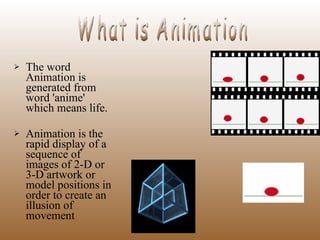
The word Animation is generated from word 'anime' which means life. Animation is the rapid display of a sequence of images of 2-D or 3-D artwork or model positions in order to create an illusion of movement What is Animation
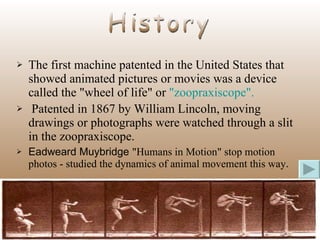
The first machine patented in the United States that showed animated pictures or movies was a device called the "wheel of life" or  "zoopraxiscope". Patented in 1867 by William Lincoln, moving drawings or photographs were watched through a slit in the zoopraxiscope.  Eadweard Muybridge  "Humans in Motion" stop motion photos - studied the dynamics of animal movement this way .   History
Zoetrope:--  (series of sequential images in a revolving drum). Technology for recording of sequential images on a flexible film base. (1895). most of the first films were French and released in America. History(contd..) Thaumatrope:-   (disk with one image on each side)
Current Vision of Animation In Scientific Visualisation In Medical
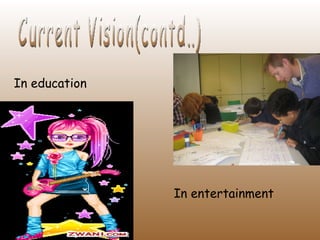
In education In entertainment Current Vision(contd..)
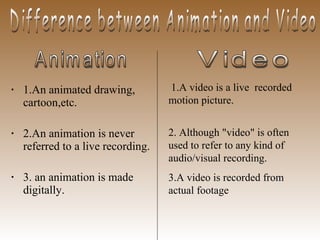
1.An animated drawing, cartoon,etc. 2.An animation is never referred to a live recording. 3. an animation is made digitally. 1.A video is a live  recorded  motion picture. 2. Although "video" is often used to refer to any kind of audio/visual recording. 3.A video is recorded from actual footage   Animation Video Difference between Animation and Video
Animated Films  are ones in which individual drawings, paintings, or illustrations are photographed frame by frame (stop-frame cinematography).  The earliest cinema animation was composed of frame-by-frame, hand-drawn images .  What is Animated Movies
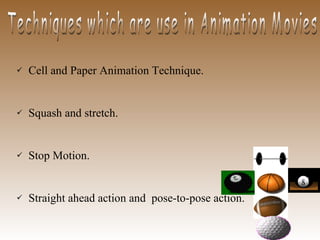
Cell and Paper Animation Technique. Squash and stretch. Stop Motion. Straight ahead action and  pose-to-pose action. Techniques which are use in Animation Movies
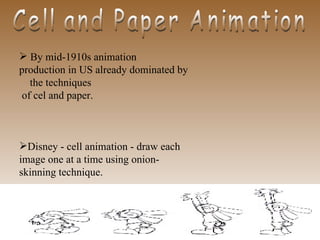
By mid-1910s animation  production in US already dominated by  the techniques of cel and paper. Disney - cell animation - draw each image one at a time using onion-skinning technique. Cell and Paper Animation
Cell Animation Process
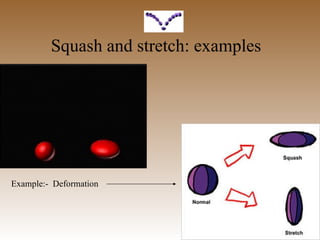
Slow Motion No Stobing Fast Motion:-Strobing No Strobing Squash and Stretch Squash and stretch helps avoid strobing effects  (But adding motion blur is better)
Squash and stretch: examples Example:-  Deformation
Stop motion  (also known as  stop action  or  frame-by-frame ). Stop Motion Motion animation using clay is called clay animation or clay-motion.
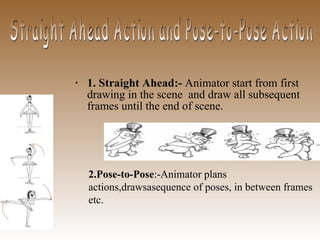
1. Straight Ahead:-  Animator start from first drawing in the scene  and draw all subsequent frames until the end of scene. 2.Pose-to-Pose :-Animator plans actions,drawsasequence of poses, in between frames etc.  Straight Ahead Action and Pose-to-Pose Action
Silhouette
Slow In and Out Follow Through and Overlapping Action Exaggeration Other techniques
Marketing. Medical Science. Mechanical Industry. Movies or Video Games. Geographical Simulation. Advantages
Future of Animation Advanced 3D Movies. Low Costing and Better animation Techniques
Future of Animation Advanced Virtual Reality Create 3D Model of a person who doesnot exist.
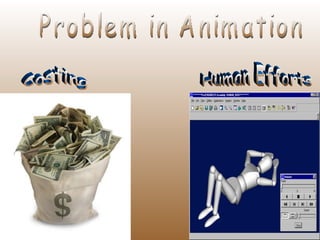
Human Efforts Problem in Animation Costing
Time Consuming Job Problem in Animation
www.google.com . www.authostream.com. www.3dlabz.com. Sir Rajesh. Sir Prakash Sharma. Refrences
 

Animation

  • 1.
    Animated Movies PresentedBy:-Pooja Goswami B.C.A III Year
  • 2.
  • 3.
    Introduction What isAnimation? History of Animation. Techniques which are use in Animation. Current Vision of Animation. What is Animated Movies? Advantages of Animation. Problems of Animation. Future of Animated Movies. Contents
  • 4.
    The word Animationis generated from word 'anime' which means life. Animation is the rapid display of a sequence of images of 2-D or 3-D artwork or model positions in order to create an illusion of movement What is Animation
  • 5.
    The first machinepatented in the United States that showed animated pictures or movies was a device called the "wheel of life" or "zoopraxiscope". Patented in 1867 by William Lincoln, moving drawings or photographs were watched through a slit in the zoopraxiscope. Eadweard Muybridge "Humans in Motion" stop motion photos - studied the dynamics of animal movement this way . History
  • 6.
    Zoetrope:-- (seriesof sequential images in a revolving drum). Technology for recording of sequential images on a flexible film base. (1895). most of the first films were French and released in America. History(contd..) Thaumatrope:- (disk with one image on each side)
  • 7.
    Current Vision ofAnimation In Scientific Visualisation In Medical
  • 8.
    In education Inentertainment Current Vision(contd..)
  • 9.
    1.An animated drawing,cartoon,etc. 2.An animation is never referred to a live recording. 3. an animation is made digitally. 1.A video is a live recorded motion picture. 2. Although "video" is often used to refer to any kind of audio/visual recording. 3.A video is recorded from actual footage Animation Video Difference between Animation and Video
  • 10.
    Animated Films are ones in which individual drawings, paintings, or illustrations are photographed frame by frame (stop-frame cinematography). The earliest cinema animation was composed of frame-by-frame, hand-drawn images . What is Animated Movies
  • 11.
    Cell and PaperAnimation Technique. Squash and stretch. Stop Motion. Straight ahead action and pose-to-pose action. Techniques which are use in Animation Movies
  • 12.
    By mid-1910s animation production in US already dominated by the techniques of cel and paper. Disney - cell animation - draw each image one at a time using onion-skinning technique. Cell and Paper Animation
  • 13.
  • 14.
    Slow Motion NoStobing Fast Motion:-Strobing No Strobing Squash and Stretch Squash and stretch helps avoid strobing effects (But adding motion blur is better)
  • 15.
    Squash and stretch:examples Example:- Deformation
  • 16.
    Stop motion (also known as stop action or frame-by-frame ). Stop Motion Motion animation using clay is called clay animation or clay-motion.
  • 17.
    1. Straight Ahead:- Animator start from first drawing in the scene and draw all subsequent frames until the end of scene. 2.Pose-to-Pose :-Animator plans actions,drawsasequence of poses, in between frames etc. Straight Ahead Action and Pose-to-Pose Action
  • 18.
  • 19.
    Slow In andOut Follow Through and Overlapping Action Exaggeration Other techniques
  • 20.
    Marketing. Medical Science.Mechanical Industry. Movies or Video Games. Geographical Simulation. Advantages
  • 21.
    Future of AnimationAdvanced 3D Movies. Low Costing and Better animation Techniques
  • 22.
    Future of AnimationAdvanced Virtual Reality Create 3D Model of a person who doesnot exist.
  • 23.
    Human Efforts Problemin Animation Costing
  • 24.
    Time Consuming JobProblem in Animation
  • 25.
    www.google.com . www.authostream.com.www.3dlabz.com. Sir Rajesh. Sir Prakash Sharma. Refrences
  • 26.

Editor's Notes

  • #7 Thaumatrope:- (disk with ). one image on each side
  • #9 By using visual effects in educations students can easy grasp and attract by the students . :-Animation is used for creating cartoons or other visual effects like movies ,video games for entertaining the user.
  • #15 Drastic stretches = more pliable Volume remains constant.
  • #17 is an animation technique to make a physically manipulated object appear to move on its own. The object is moved in small increments between individually photographed frames, creating the illusion of movement when the series of frames is played as a continuous sequence. Clay figures are often used in stop motion for their ease of repositioning
  • #18 Used when scene requires more thought and poses and timing are important.