MOTION CAPTURE PRODUCTION
DFA 4334
Motion capture (Mocap) is sampling and
recording motion of humans, animals, and
inanimate objects as 3D data.
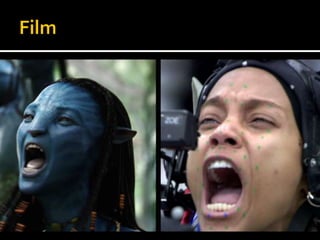
   Film / Animation
   Video Games
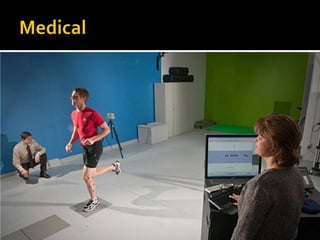
   Medical
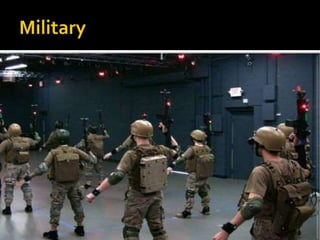
   Military etc…
   Film / Animation
   Video Games
   Medical
   Military etc…
   Film / Animation
   Video Games
   Medical
   Military etc…
   Film / Animation
   Video Games
   Medical
   Military etc…
   Film / Animation
   Video Games
   Medical
   Military etc…
   Film / Animation
   Video Games
   Medical
   Military etc…
   Film / Animation
   Video Games
   Medical
   Military etc…
   Film / Animation
   Video Games
   Medical
   Military etc…
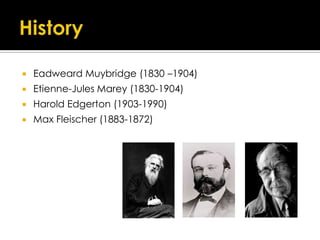
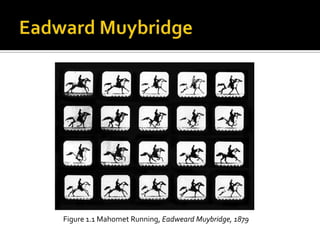
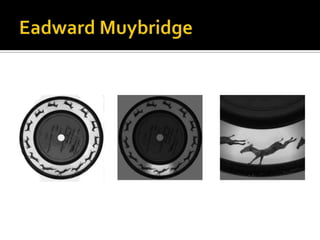
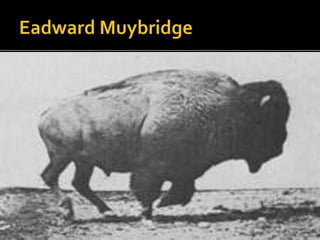
   Eadweard Muybridge (1830 –1904)
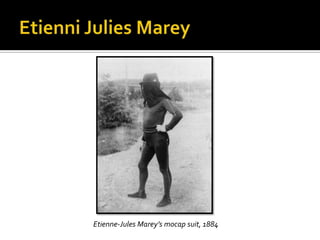
   Etienne-Jules Marey (1830-1904)
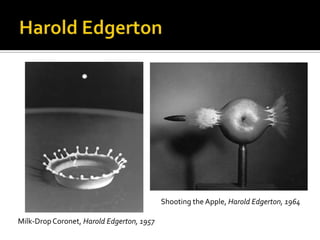
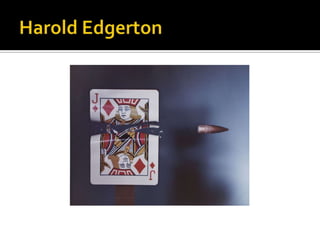
   Harold Edgerton (1903-1990)
   Max Fleischer (1883-1872)
Figure 1.1 Mahomet Running, Eadweard Muybridge, 1879
Etienne-Jules Marey’s mocap suit, 1884
Shooting the Apple, Harold Edgerton, 1964

Milk-Drop Coronet, Harold Edgerton, 1957
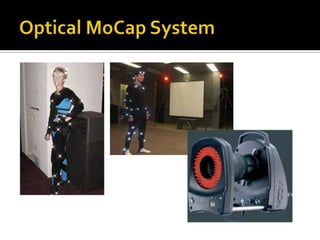
1.   Optical Mocap Systems
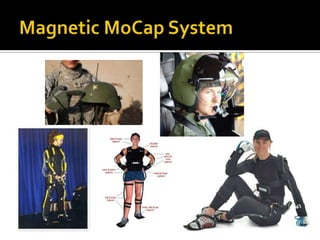
2.   Magnetic Mocap Systems
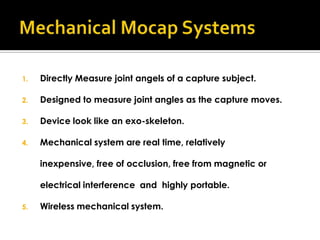
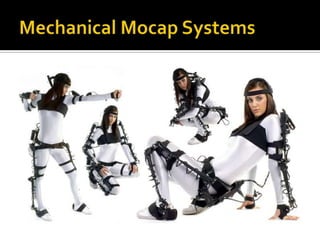
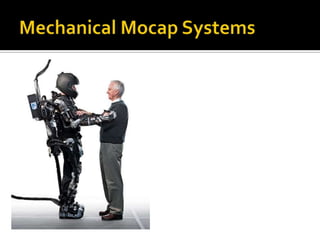
3.   Mechanical Mocap Systems
1.   Designed for medical application

2.   Developed with CGI application – Vicon 8 system.

3.   4 to 32 cameras controls by computer.

4.   Subject wears markers (Active & Passive).
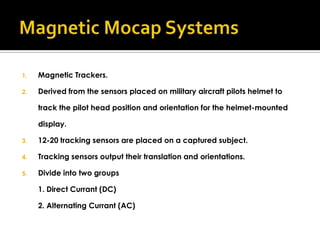
1.   Magnetic Trackers.

2.   Derived from the sensors placed on military aircraft pilots helmet to

     track the pilot head position and orientation for the helmet-mounted

     display.

3.   12-20 tracking sensors are placed on a captured subject.

4.   Tracking sensors output their translation and orientations.

5.   Divide into two groups

     1. Direct Currant (DC)

     2. Alternating Currant (AC)
1.   Directly Measure joint angels of a capture subject.

2.   Designed to measure joint angles as the capture moves.

3.   Device look like an exo-skeleton.

4.   Mechanical system are real time, relatively

     inexpensive, free of occlusion, free from magnetic or

     electrical interference and highly portable.

5.   Wireless mechanical system.
Introduction to motion capture

Introduction to motion capture

  • 1.
  • 2.
    Motion capture (Mocap)is sampling and recording motion of humans, animals, and inanimate objects as 3D data.
  • 3.
    Film / Animation  Video Games  Medical  Military etc…
  • 8.
    Film / Animation  Video Games  Medical  Military etc…
  • 9.
    Film / Animation  Video Games  Medical  Military etc…
  • 10.
    Film / Animation  Video Games  Medical  Military etc…
  • 11.
    Film / Animation  Video Games  Medical  Military etc…
  • 12.
    Film / Animation  Video Games  Medical  Military etc…
  • 13.
    Film / Animation  Video Games  Medical  Military etc…
  • 14.
    Film / Animation  Video Games  Medical  Military etc…
  • 15.
    Eadweard Muybridge (1830 –1904)  Etienne-Jules Marey (1830-1904)  Harold Edgerton (1903-1990)  Max Fleischer (1883-1872)
  • 16.
    Figure 1.1 MahometRunning, Eadweard Muybridge, 1879
  • 19.
  • 20.
    Shooting the Apple,Harold Edgerton, 1964 Milk-Drop Coronet, Harold Edgerton, 1957
  • 22.
    1. Optical Mocap Systems 2. Magnetic Mocap Systems 3. Mechanical Mocap Systems
  • 23.
    1. Designed for medical application 2. Developed with CGI application – Vicon 8 system. 3. 4 to 32 cameras controls by computer. 4. Subject wears markers (Active & Passive).
  • 25.
    1. Magnetic Trackers. 2. Derived from the sensors placed on military aircraft pilots helmet to track the pilot head position and orientation for the helmet-mounted display. 3. 12-20 tracking sensors are placed on a captured subject. 4. Tracking sensors output their translation and orientations. 5. Divide into two groups 1. Direct Currant (DC) 2. Alternating Currant (AC)
  • 27.
    1. Directly Measure joint angels of a capture subject. 2. Designed to measure joint angles as the capture moves. 3. Device look like an exo-skeleton. 4. Mechanical system are real time, relatively inexpensive, free of occlusion, free from magnetic or electrical interference and highly portable. 5. Wireless mechanical system.