MECHANICS OF THE GAME:
1. All students should participate in the game.
2. Half of the participants should be seated on the chairs provided,
while the other half will be moving around the circle when the music
starts to play.
3. The people who are seated on the chairs will be bringing a piece
of paper which contains the answer to the given questions.
4. The teacher will read a question before the start of each round.
5. When the music player suddenly stops the music, the people
outside the circle should sit on the seats provided. If the player
would sit on the chair which contains the correct answer, he/she will
be eliminated from the game.
- Greek "morphe" (form) + logy (science/study)
Prepared by:
Juvenalyn Luab
Karen Gail Amoin
Ma. Angelica Dungog
Outline
- It is the study of word formation and of the
structure of words.
- It analyzes the structure of words and
parts of words, such as:
* stems
* root words
* prefixes
* suffixes
Morphology
STRUCTURE of WORDS
*Simple Words
- no internal structure; consist
of a single morpheme.
Examples: love, farm, live , etc.
* Complex Words
- do have internal structure;
consist of more than one
morpheme.
Examples: lover, farmer , lives ,
etc.
MORPHEME
~ is the smallest grammatical unit that carries
meaning and or a grammatical function.
* Morphemes aare in a sense atomic signs:
they can't be split up further.
* A word consists of one or more morphemes.
* Words consisting of morphemes that cannot
be reanalyzed into smaller chunks are root
morphemes.
* When the root morpheme combines with
another morpheme, it forms a stem.
EXAMPLES of MORPHEMES:
* pre-, dis-, in-, un-, -ful, -able, -
ment, -ly, -ise
* test, comfort, assign , interpret
, common, real
Allomorphs
~ are different realizations or versions of
one morpheme, such as the plural endings
( -s ) :
/s/ - as in bats, cats, pets, etc.
/z/ - as in bugs, boys, girls, dogs, etc.
/ɪz/ - as in buses, ladies, watches,
etc.
cats , dogs , buses
*The pluralizing morphemes (-s and -es)
have 3 different potential pronunciations -
/s/, /z/ and /iz/.
We call these allomorphs because they
represent different pronunciation potentials
of the same morphemes, the plural
morphemes.
The plural morphemes
(-s and -es)
* cats , dogs = /-s/ is plural morpheme
with one morph (-s)
* buses , watches = /-es/ is plural
morpheme with two morphs (-es)
Morphology
~ is the study of the formation
of words and their structure.
Morpheme
~ is the smallest unit of a word
that has a meaning.
Morph
~ is the phonetic realization of
that morpheme, or in plain
English, the way it is formed.
An allomorph is the way or ways a morph can
potentially sound. It describes the actual realization of
a morph's sound.
For example:
[-s] as in [-s] 'hats'
[-z] as in [-z] 'dogs'
[-ez] as in [-ez] 'boxes'
According to
Occurrence
Free Morphemes – morphemes that can stand alone
Example:
Simple words: the, farm, run, duck
Compound words: keyboard, greenhouse, bloodshed
Bound Morphemes – require the presence of another
morpheme to make up a word
- can’t occur independently
Examples: -er, -s, and –ling, pre-, dis-, -ful
pretest, discontent, beautiful
Affixes
Affixes are bound morphemes.
Prefixes – occur before the morpheme
Examples: unhappy, impatient, malnutrition
Suffixes – occur after a morpheme
Examples: friendly, priceless, cheerful
Infix – goes inside another morpheme
Examples: absofreakinglutely
According to Function
Lexical Morphemes
– words that have meaning by
themselves
- convey the major content of a
message
Examples: farm, happy, beauty
Bound Roots
– words carry no meaning apart from
the word in which they are found
Example:
cranberry
- There are other roots which are bound in
the in certain contexts and free in others
Example:
blackboard
Derivational Affixes
– affixes that are attach to a lexical root
and result in a new word
- change the meaning and part-of-speech of
the morpheme they are attached to
Examples:
bake – baker
boil - boiler
Examples of Derivational
Affixes
Noun – Adjective Verb - Noun
boy + ish sing + er
Noun – Verb Adjective - Noun
vapor + ize free + dom
Adjective – Adverb Verb - Adjective
exact + ly read + able
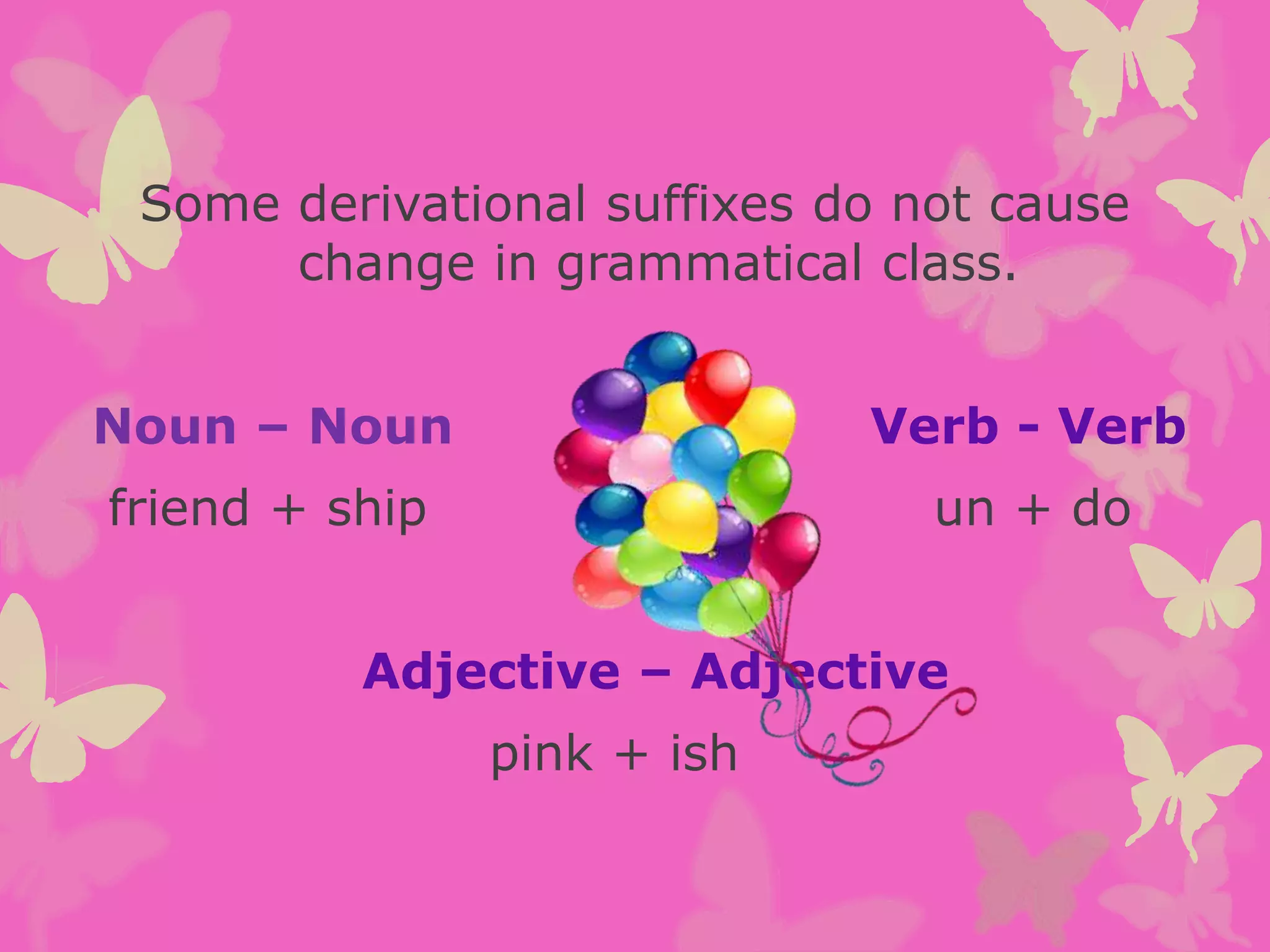
Some derivational suffixes do not cause
change in grammatical class.
Noun – Noun Verb - Verb
friend + ship un + do
Adjective – Adjective
pink + ish
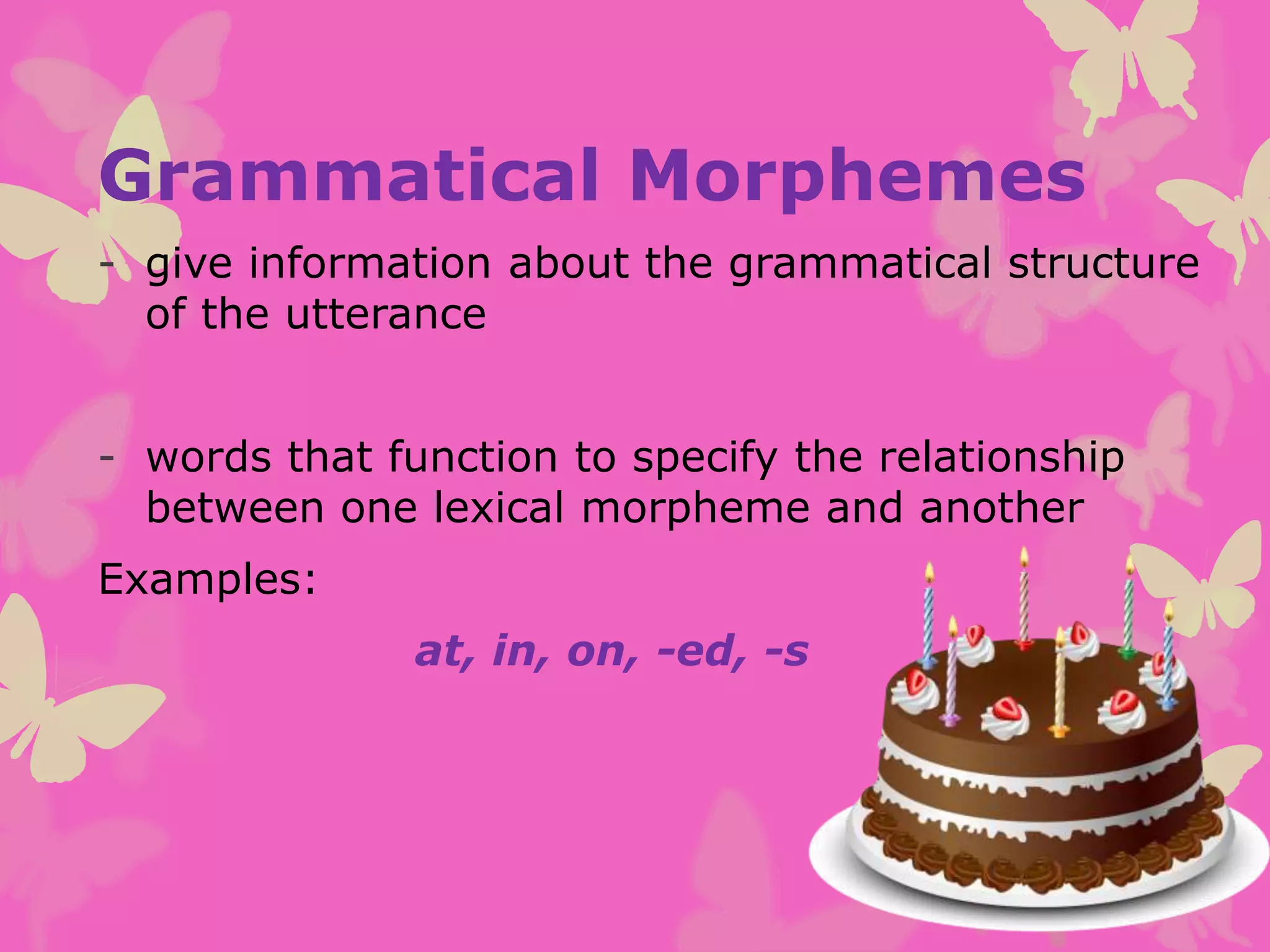
Grammatical Morphemes
- give information about the grammatical structure
of the utterance
- words that function to specify the relationship
between one lexical morpheme and another
Examples:
at, in, on, -ed, -s
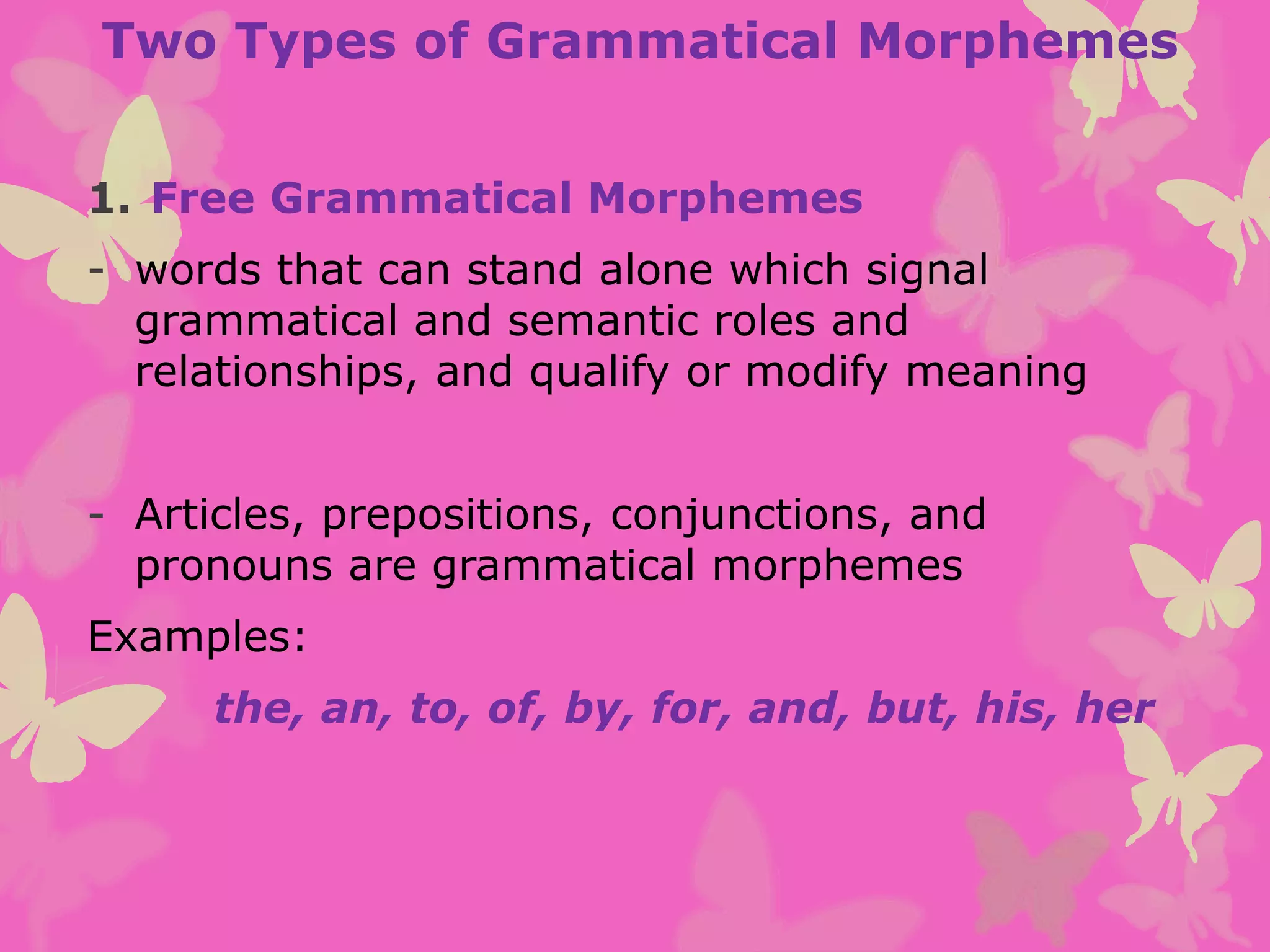
Two Types of Grammatical Morphemes
1. Free Grammatical Morphemes
- words that can stand alone which signal
grammatical and semantic roles and
relationships, and qualify or modify meaning
- Articles, prepositions, conjunctions, and
pronouns are grammatical morphemes
Examples:
the, an, to, of, by, for, and, but, his, her
2. Bound Grammatical Morphemes
- suffixes that indicate grammatical
and semantic roles and relationships
and qualify or modify meaning
Examples:
(-pl ) plural morpheme – girls
(-er) comparative – higher
(-est) superlative – highest
(past participle) - taken
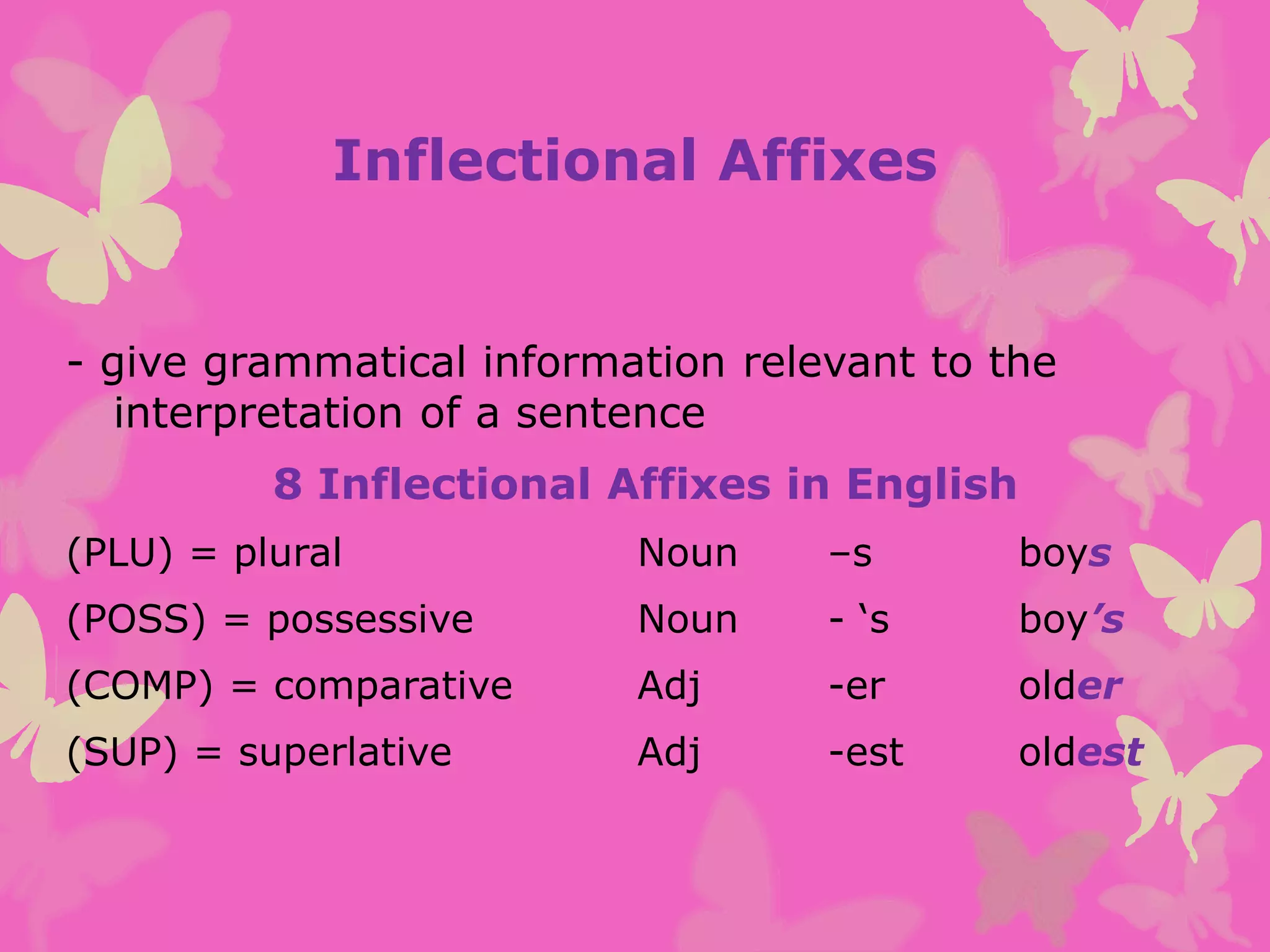
Inflectional Affixes
- give grammatical information relevant to the
interpretation of a sentence
8 Inflectional Affixes in English
(PLU) = plural Noun –s boys
(POSS) = possessive Noun - ‘s boy’s
(COMP) = comparative Adj -er older
(SUP) = superlative Adj -est oldest
(PRES) = present Verb -s walks
(PAST) = past Verb -ed walked
(PAST PART) = past participle Verb -en driven
(PRES PART) = present participle Verb -ing driving
Clitics
- a word or part of a word that is structurally
dependent on a neighboring word (its host) and
cannot stand on its own
Enclitics – appears after its host
Examples: they’ve (they have, she’s (she is),
don’t (do not)
Proclitics – appears before its host
Examples: d’you (do you), ‘tis (it is)
Read Me!
Weeks Webs Watches
Bits Beds Bridges
Backs Bags Juices
Briefs Bells Slices
Jars Blazes
Straws
Limbs
Fans
Doves
Delays
Linguistic Micro-Lectures- Allomorphs.mp4
Allomorph
- One of two or more complementary morphs which
manifest a morpheme in its different phonological
or morphological environments
- A variant form of a morpheme, that is, when a unit
of meaning varies in sound without changing the
meaning
Types of Allomorphs
1. Additive Allomorphs
Popped
Talked
Frothed
Lauged
Kissed
Brushed
Reached
Listen and Repeat
Bobbed
Begged
Breathed
Loved
Raised
Bridged
Claimed
Banned
Banged
Cleared
rolled
Visited
Edited
Ended
breaded
The past tense form of hurt is
formed by adding the zero
allomorph to this word
Hurt = Hurt
2. Zero Allomorphs
The /I/ in Drink is replaced by
the /ae/ in Drank to signal
the simple past
3. Replacive Allomorphs
Morphemes that are quite different
phonologically
Example: Good-Better-Best
(The derived comparative and
superlative forms of good with the
regular derivational suffixes –er and
–e(st)
4. Suppletive Allomorphs
Let’s Try!
Bad
Badly
Far (distance)
Far (extent)
Ill
Late
Little (amount)
Many
Much
Well
Conditioning Factors
Morphology
Morphology

Morphology

  • 7.
    MECHANICS OF THEGAME: 1. All students should participate in the game. 2. Half of the participants should be seated on the chairs provided, while the other half will be moving around the circle when the music starts to play. 3. The people who are seated on the chairs will be bringing a piece of paper which contains the answer to the given questions. 4. The teacher will read a question before the start of each round. 5. When the music player suddenly stops the music, the people outside the circle should sit on the seats provided. If the player would sit on the chair which contains the correct answer, he/she will be eliminated from the game.
  • 8.
    - Greek "morphe"(form) + logy (science/study) Prepared by: Juvenalyn Luab Karen Gail Amoin Ma. Angelica Dungog
  • 9.
  • 10.
    - It isthe study of word formation and of the structure of words. - It analyzes the structure of words and parts of words, such as: * stems * root words * prefixes * suffixes Morphology
  • 11.
    STRUCTURE of WORDS *SimpleWords - no internal structure; consist of a single morpheme. Examples: love, farm, live , etc.
  • 12.
    * Complex Words -do have internal structure; consist of more than one morpheme. Examples: lover, farmer , lives , etc.
  • 13.
    MORPHEME ~ is thesmallest grammatical unit that carries meaning and or a grammatical function. * Morphemes aare in a sense atomic signs: they can't be split up further.
  • 14.
    * A wordconsists of one or more morphemes. * Words consisting of morphemes that cannot be reanalyzed into smaller chunks are root morphemes. * When the root morpheme combines with another morpheme, it forms a stem.
  • 16.
    EXAMPLES of MORPHEMES: *pre-, dis-, in-, un-, -ful, -able, - ment, -ly, -ise * test, comfort, assign , interpret , common, real
  • 17.
    Allomorphs ~ are differentrealizations or versions of one morpheme, such as the plural endings ( -s ) : /s/ - as in bats, cats, pets, etc. /z/ - as in bugs, boys, girls, dogs, etc. /ɪz/ - as in buses, ladies, watches, etc.
  • 18.
    cats , dogs, buses *The pluralizing morphemes (-s and -es) have 3 different potential pronunciations - /s/, /z/ and /iz/. We call these allomorphs because they represent different pronunciation potentials of the same morphemes, the plural morphemes.
  • 19.
    The plural morphemes (-sand -es) * cats , dogs = /-s/ is plural morpheme with one morph (-s) * buses , watches = /-es/ is plural morpheme with two morphs (-es)
  • 21.
    Morphology ~ is thestudy of the formation of words and their structure.
  • 22.
    Morpheme ~ is thesmallest unit of a word that has a meaning.
  • 23.
    Morph ~ is thephonetic realization of that morpheme, or in plain English, the way it is formed.
  • 24.
    An allomorph isthe way or ways a morph can potentially sound. It describes the actual realization of a morph's sound. For example: [-s] as in [-s] 'hats' [-z] as in [-z] 'dogs' [-ez] as in [-ez] 'boxes'
  • 26.
    According to Occurrence Free Morphemes– morphemes that can stand alone Example: Simple words: the, farm, run, duck Compound words: keyboard, greenhouse, bloodshed Bound Morphemes – require the presence of another morpheme to make up a word - can’t occur independently Examples: -er, -s, and –ling, pre-, dis-, -ful pretest, discontent, beautiful
  • 27.
    Affixes Affixes are boundmorphemes. Prefixes – occur before the morpheme Examples: unhappy, impatient, malnutrition Suffixes – occur after a morpheme Examples: friendly, priceless, cheerful Infix – goes inside another morpheme Examples: absofreakinglutely
  • 28.
    According to Function LexicalMorphemes – words that have meaning by themselves - convey the major content of a message Examples: farm, happy, beauty
  • 29.
    Bound Roots – wordscarry no meaning apart from the word in which they are found Example: cranberry - There are other roots which are bound in the in certain contexts and free in others Example: blackboard
  • 30.
    Derivational Affixes – affixesthat are attach to a lexical root and result in a new word - change the meaning and part-of-speech of the morpheme they are attached to Examples: bake – baker boil - boiler
  • 31.
    Examples of Derivational Affixes Noun– Adjective Verb - Noun boy + ish sing + er Noun – Verb Adjective - Noun vapor + ize free + dom Adjective – Adverb Verb - Adjective exact + ly read + able
  • 32.
    Some derivational suffixesdo not cause change in grammatical class. Noun – Noun Verb - Verb friend + ship un + do Adjective – Adjective pink + ish
  • 33.
    Grammatical Morphemes - giveinformation about the grammatical structure of the utterance - words that function to specify the relationship between one lexical morpheme and another Examples: at, in, on, -ed, -s
  • 34.
    Two Types ofGrammatical Morphemes 1. Free Grammatical Morphemes - words that can stand alone which signal grammatical and semantic roles and relationships, and qualify or modify meaning - Articles, prepositions, conjunctions, and pronouns are grammatical morphemes Examples: the, an, to, of, by, for, and, but, his, her
  • 35.
    2. Bound GrammaticalMorphemes - suffixes that indicate grammatical and semantic roles and relationships and qualify or modify meaning Examples: (-pl ) plural morpheme – girls (-er) comparative – higher (-est) superlative – highest (past participle) - taken
  • 36.
    Inflectional Affixes - givegrammatical information relevant to the interpretation of a sentence 8 Inflectional Affixes in English (PLU) = plural Noun –s boys (POSS) = possessive Noun - ‘s boy’s (COMP) = comparative Adj -er older (SUP) = superlative Adj -est oldest
  • 37.
    (PRES) = presentVerb -s walks (PAST) = past Verb -ed walked (PAST PART) = past participle Verb -en driven (PRES PART) = present participle Verb -ing driving
  • 38.
    Clitics - a wordor part of a word that is structurally dependent on a neighboring word (its host) and cannot stand on its own Enclitics – appears after its host Examples: they’ve (they have, she’s (she is), don’t (do not) Proclitics – appears before its host Examples: d’you (do you), ‘tis (it is)
  • 40.
    Read Me! Weeks WebsWatches Bits Beds Bridges Backs Bags Juices Briefs Bells Slices Jars Blazes Straws Limbs Fans Doves Delays
  • 41.
  • 42.
    Allomorph - One oftwo or more complementary morphs which manifest a morpheme in its different phonological or morphological environments - A variant form of a morpheme, that is, when a unit of meaning varies in sound without changing the meaning
  • 43.
  • 44.
  • 45.
  • 46.
    The past tenseform of hurt is formed by adding the zero allomorph to this word Hurt = Hurt 2. Zero Allomorphs
  • 47.
    The /I/ inDrink is replaced by the /ae/ in Drank to signal the simple past 3. Replacive Allomorphs
  • 48.
    Morphemes that arequite different phonologically Example: Good-Better-Best (The derived comparative and superlative forms of good with the regular derivational suffixes –er and –e(st) 4. Suppletive Allomorphs
  • 49.
    Let’s Try! Bad Badly Far (distance) Far(extent) Ill Late Little (amount) Many Much Well
  • 50.

Editor's Notes

  • #43 Explains the comprehension of phonological variations for specific morphemes