English Parts of Speechby Arief FirdausJuly/2/2009arief firdaus for Britzoners
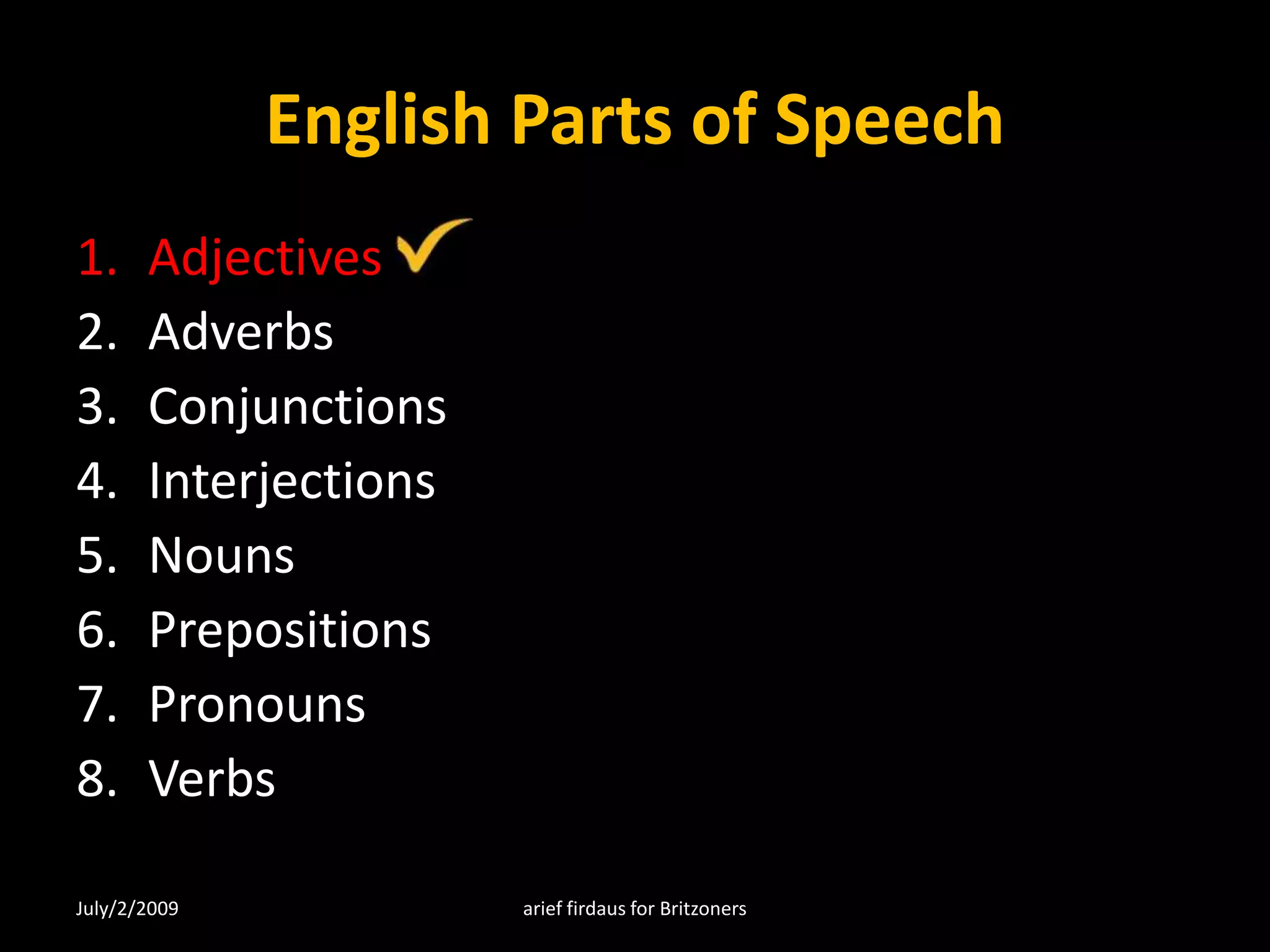
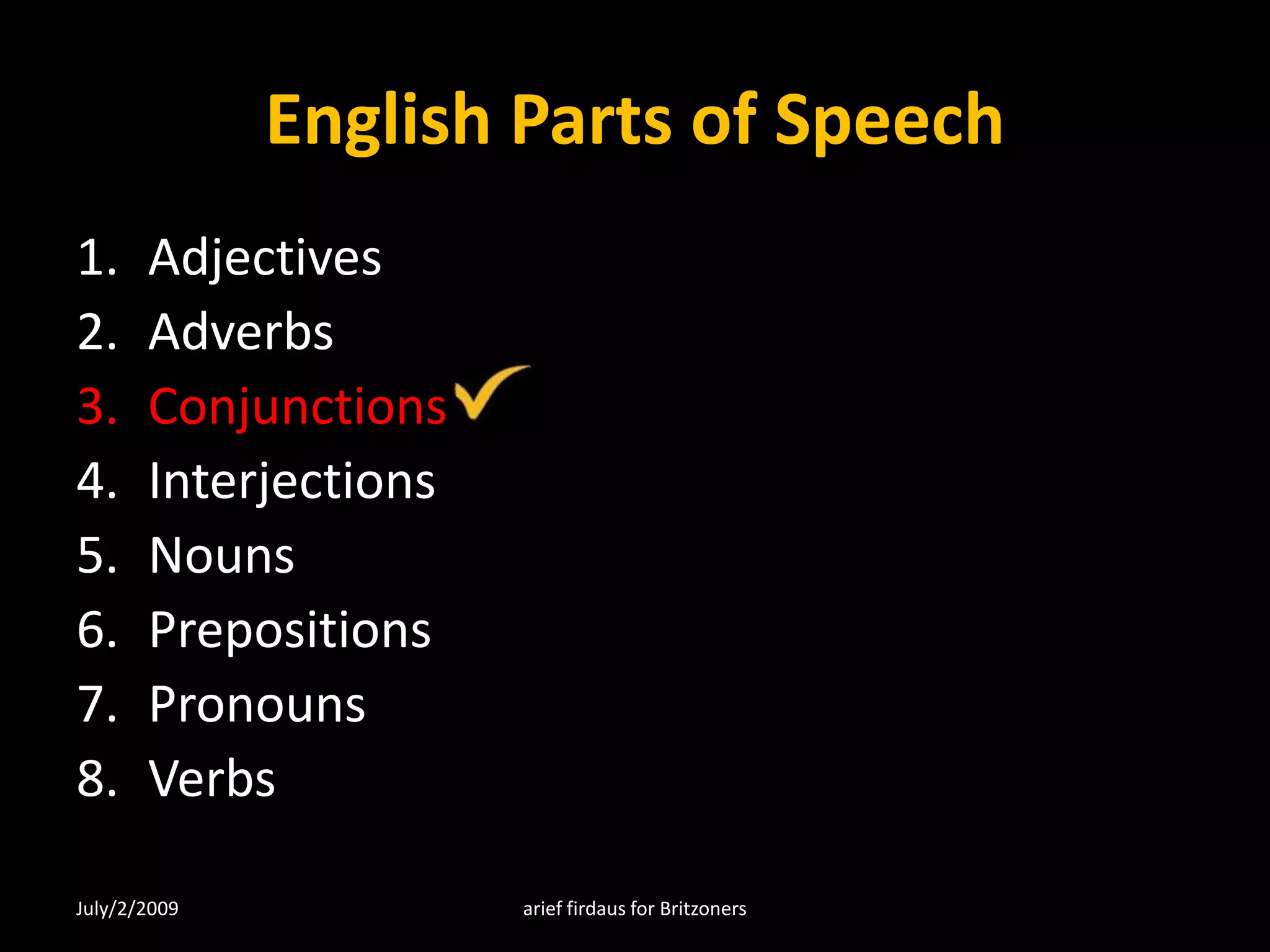
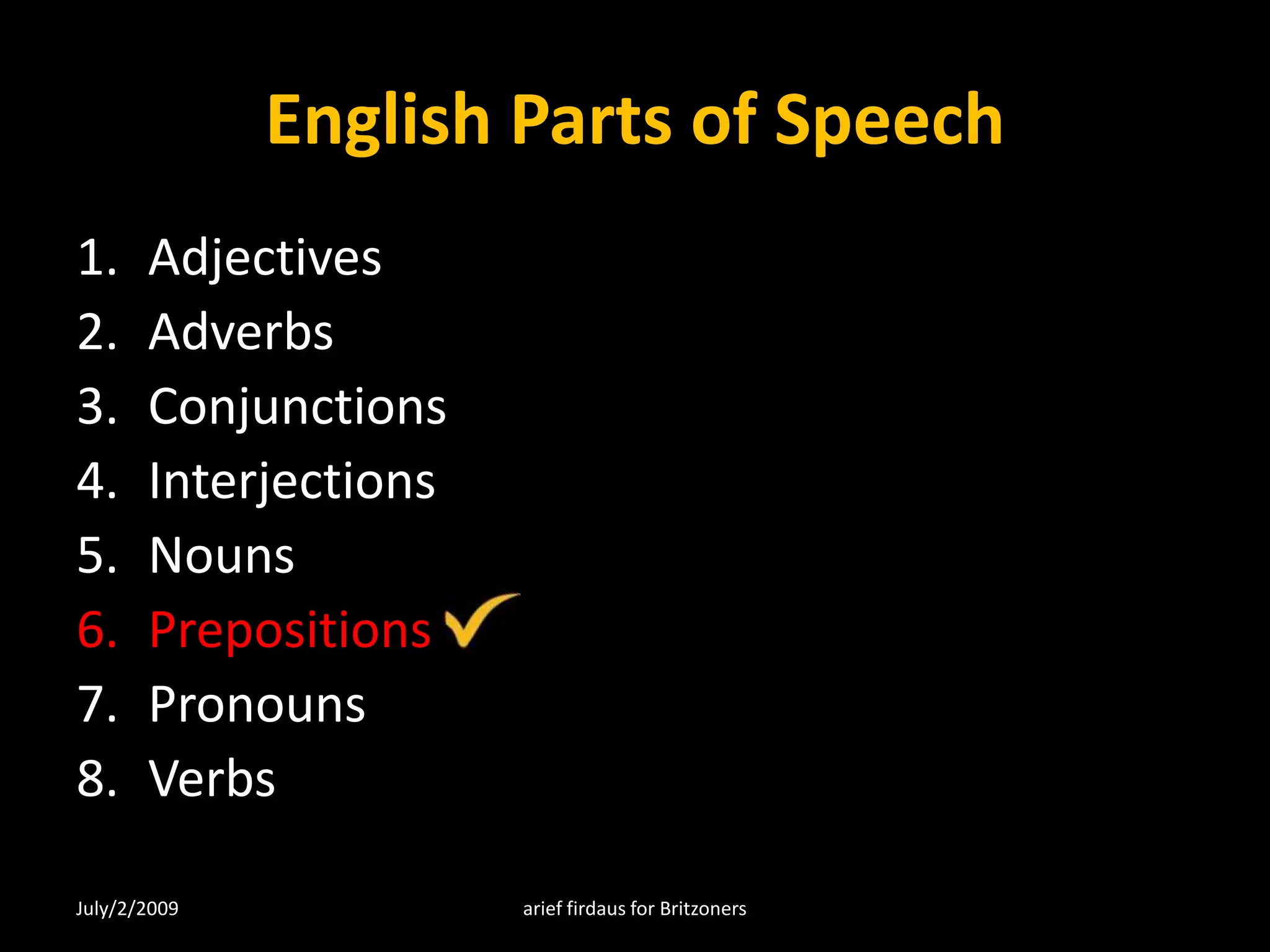
English Parts of SpeechAdjectivesAdverbsConjunctionsInterjectionsNounsPrepositionsPronounsVerbsJuly/2/2009arief firdaus for Britzoners
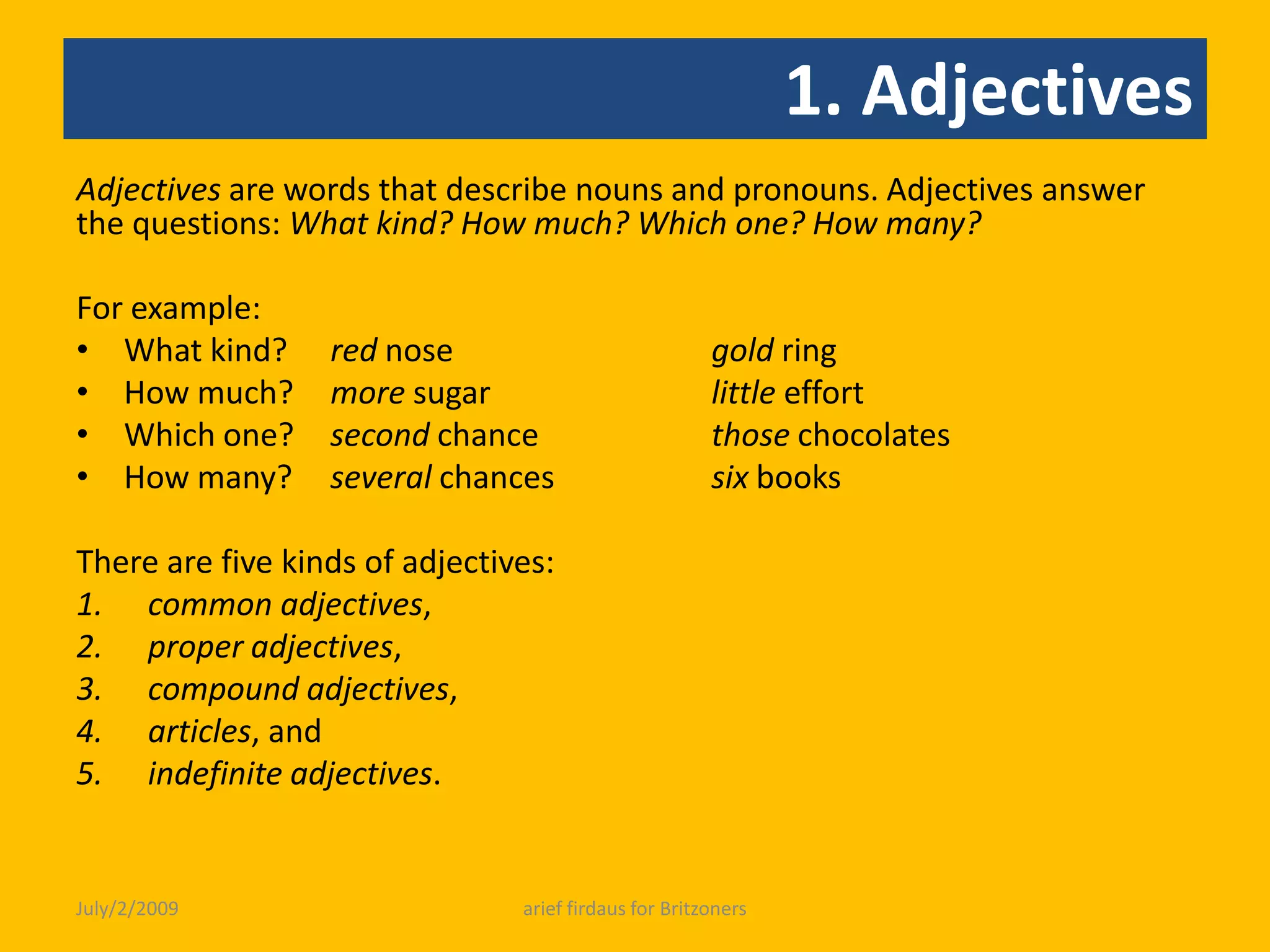
1. AdjectivesAdjectives are words that describe nouns and pronouns. Adjectives answer the questions: What kind? How much? Which one? How many?  For example:What kind? 	red nose 		gold ringHow much?	more sugar 		little effortWhich one? 	second chance 	those chocolatesHow many? 	several chances 	six books There are five kinds of adjectives: common adjectives, proper adjectives, compound adjectives,articles, and indefinite adjectives.July/2/2009arief firdaus for Britzoners
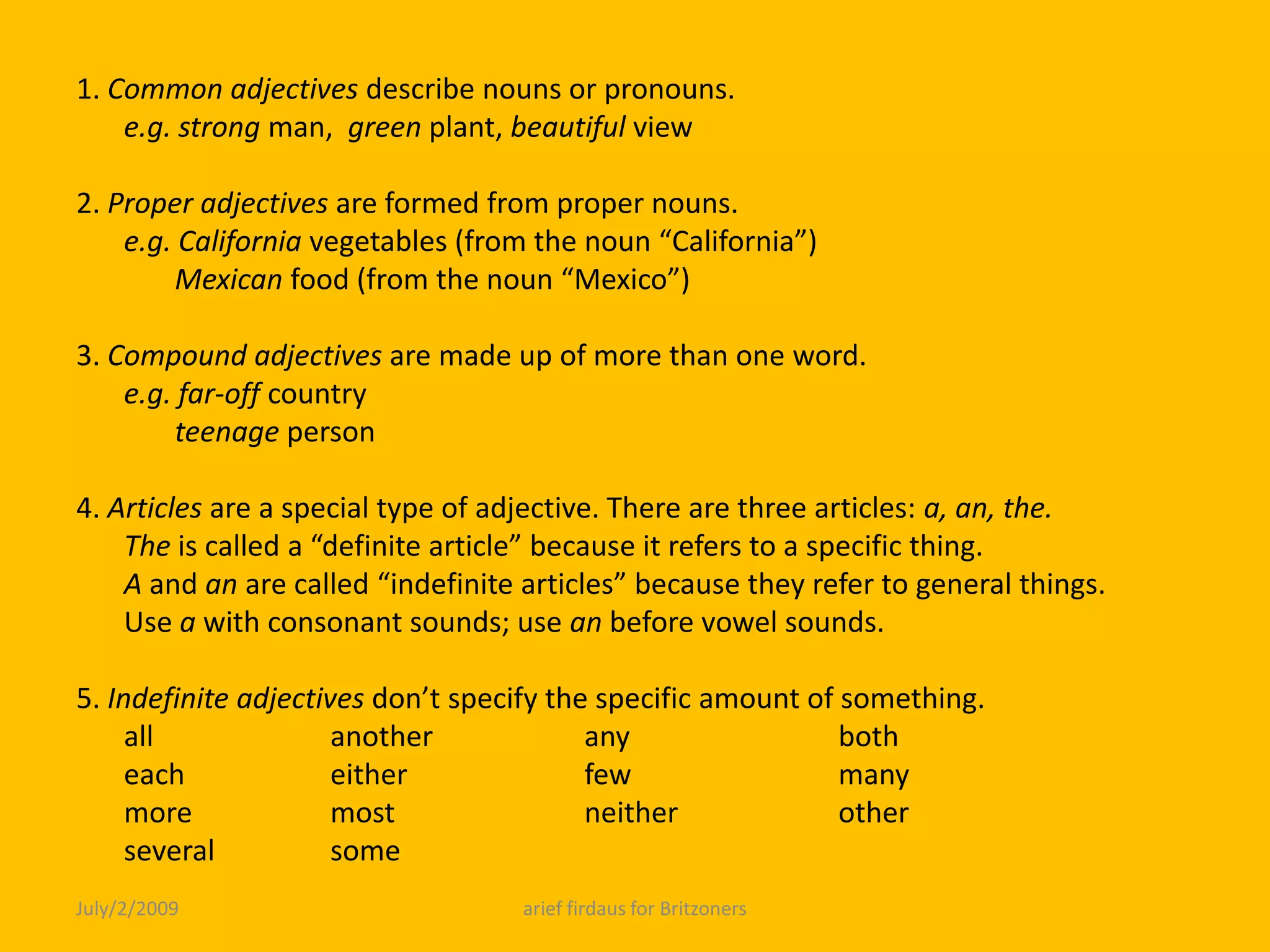
1. Common adjectives describe nouns or pronouns.	e.g. strong man,  green plant, beautiful view 2. Proper adjectives are formed from proper nouns.	e.g. California vegetables (from the noun “California”)Mexican food (from the noun “Mexico”) 3. Compound adjectives are made up of more than one word.	e.g. far-off countryteenage person4. Articles are a special type of adjective. There are three articles: a, an, the.	The is called a “definite article” because it refers to a specific thing.	A and an are called “indefinite articles” because they refer to general things. 	Use a with consonant sounds; use an before vowel sounds. 5. Indefinite adjectives don’t specify the specific amount of something.	all 		another 		any 	both	each 	either		few	many	more 	most 	neither 	other	several 	someJuly/2/2009arief firdaus for Britzoners
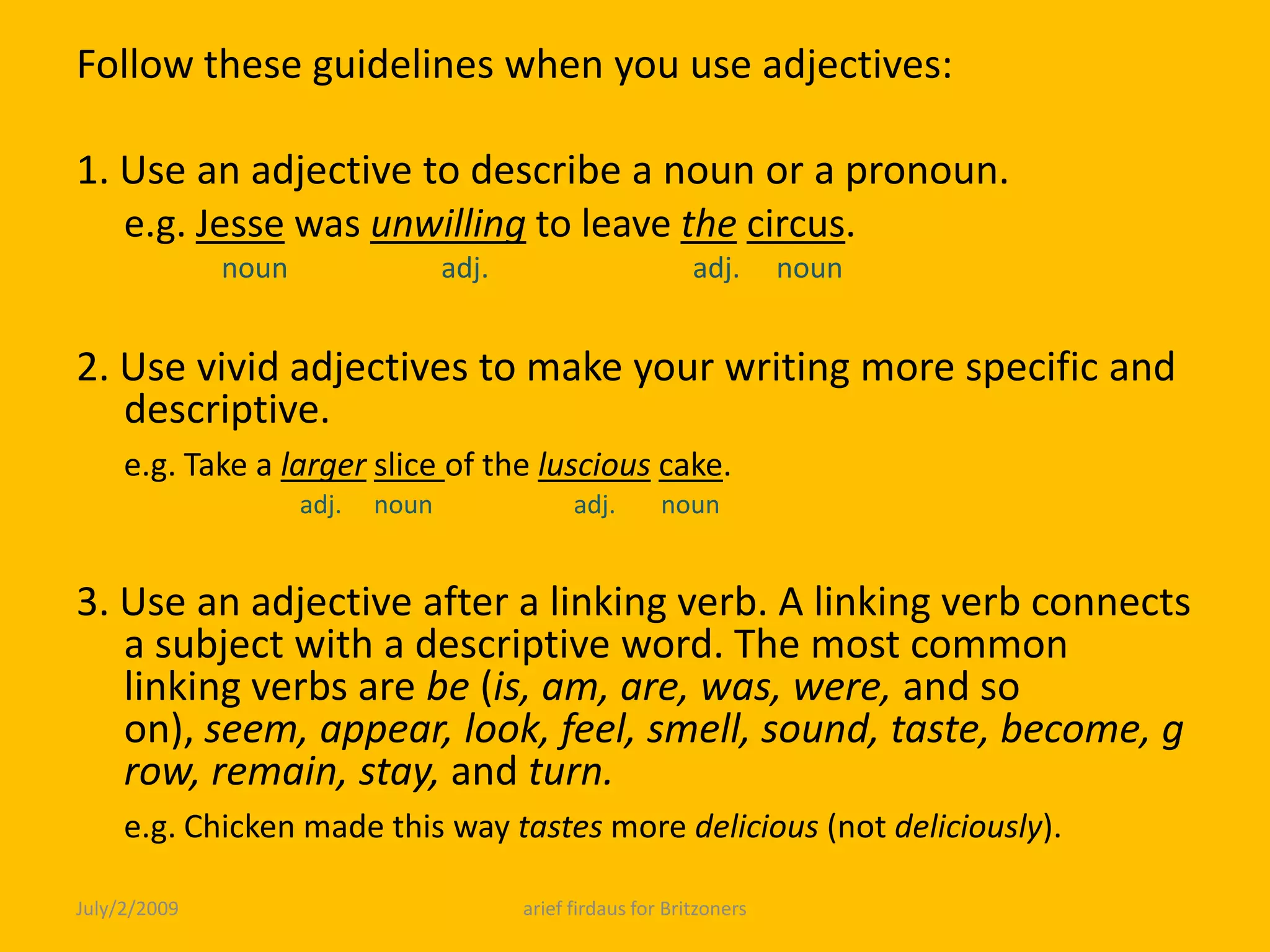
Follow these guidelines when you use adjectives: 1. Use an adjective to describe a noun or a pronoun.e.g. Jesse was unwillingto leave thecircus.      noun                     adj.                            adj.     noun 2. Use vivid adjectives to make your writing more specific and descriptive.e.g. Take a largerslice of the lusciouscake.                                   adj.     noun                      adj.       noun 3. Use an adjective after a linking verb. A linking verb connects a subject with a descriptive word. The most common linking verbs are be (is, am, are, was, were, and so on), seem, appear, look, feel, smell, sound, taste, become, grow, remain, stay, and turn. e.g. Chicken made this way tastes more delicious (not deliciously).July/2/2009arief firdaus for Britzoners
Quick Tip	Predicate adjectives are adjectives separated from the noun or pronoun by a linking verb. Predicate adjectives describe the subject of the sentence.	e.g. The weather was cold all week.July/2/2009arief firdaus for Britzoners
English Parts of SpeechAdjectivesAdverbsConjunctionsInterjectionsNounsPrepositionsPronounsVerbsJuly/2/2009arief firdaus for Britzoners
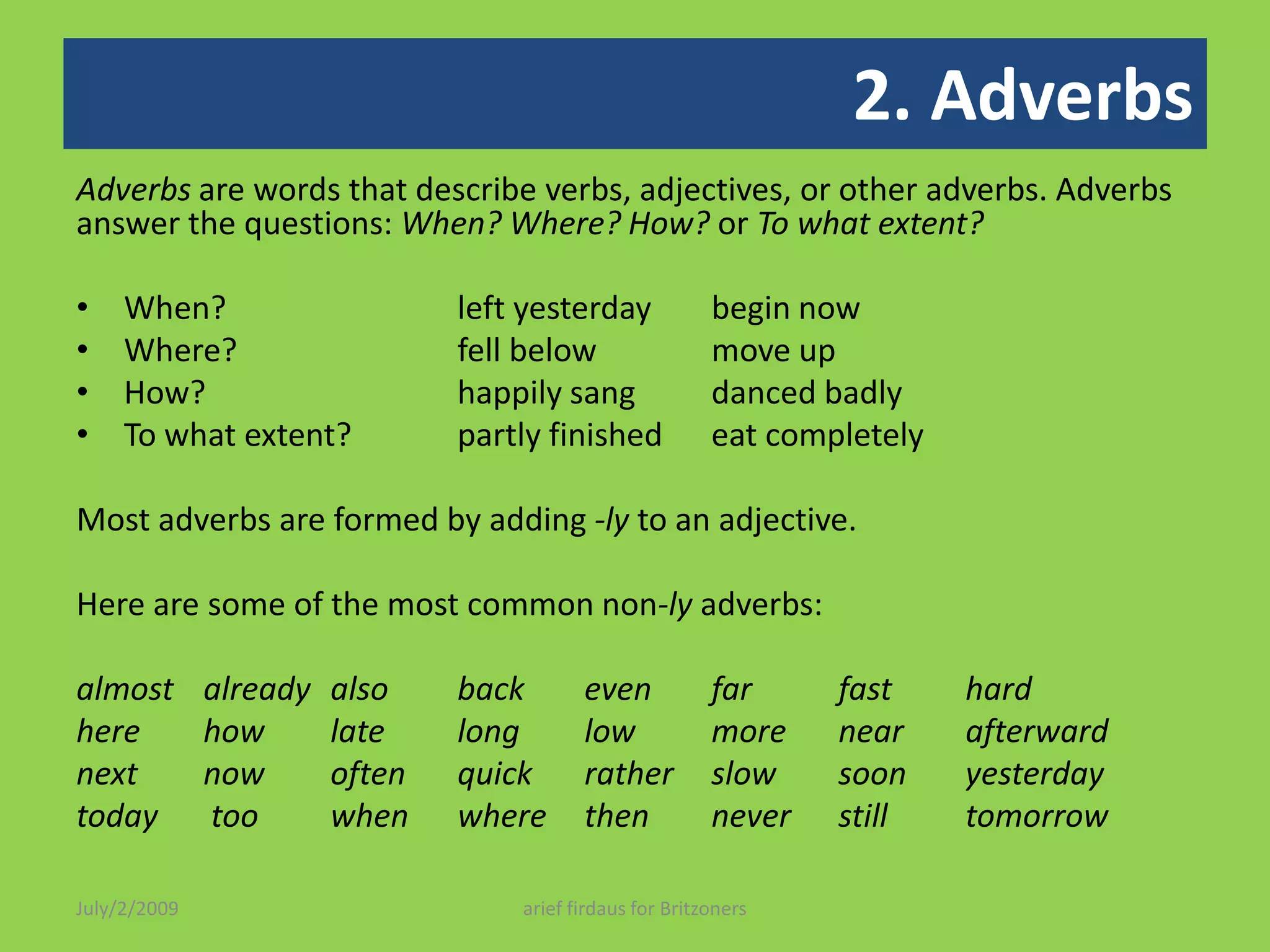
2. AdverbsAdverbs are words that describe verbs, adjectives, or other adverbs. Adverbs answer the questions: When? Where? How? or To what extent?When? 		left yesterday 	begin nowWhere? 		fell below 	move upHow? 		happily sang 	danced badlyTo what extent? 	partly finished 	eat completely Most adverbs are formed by adding -lyto an adjective. Here are some of the most common non-lyadverbs: almost already 	also 	back even	far 	fast	hard 	here 	howlate	long low more near afterwardnext	now 	often quickrather slow soon	yesterday today	 too 	when	where then	never	still	tomorrowJuly/2/2009arief firdaus for Britzoners
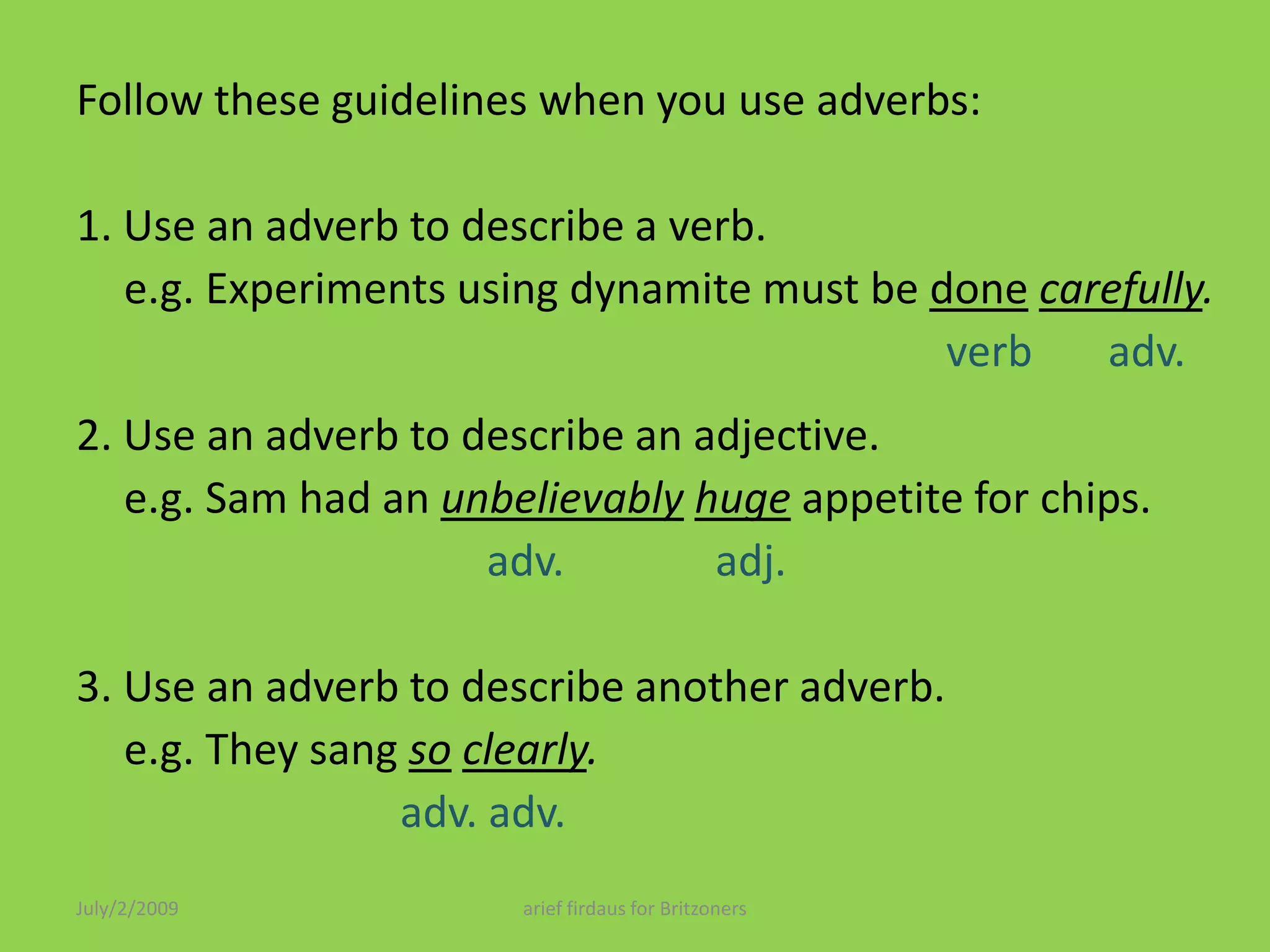
Follow these guidelines when you use adverbs: 1. Use an adverb to describe a verb.	e.g. Experiments using dynamite must be donecarefully.verb       adv.2. Use an adverb to describe an adjective.	e.g. Sam had an unbelievablyhugeappetite for chips.adv.             adj. 3. Use an adverb to describe another adverb.	e.g. They sang soclearly.adv. adv.July/2/2009arief firdaus for Britzoners
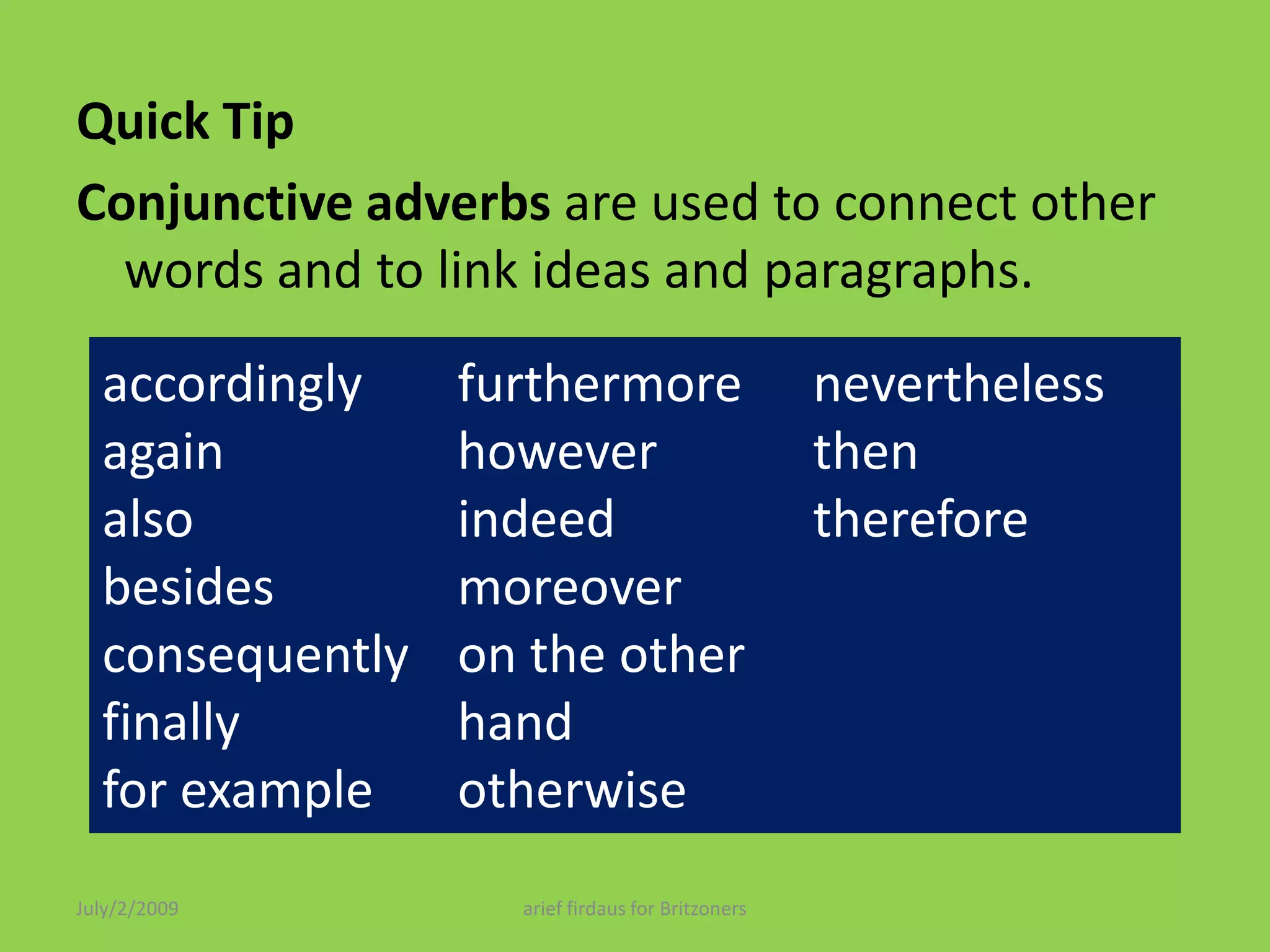
Quick TipConjunctive adverbs are used to connect other words and to link ideas and paragraphs.accordingly again                       also                      besidesconsequently                  finally                      for example        furthermorehowever       indeed                    moreover            on the other handotherwise                         nevertheless         then                      thereforeJuly/2/2009arief firdaus for Britzoners
English Parts of SpeechAdjectivesAdverbsConjunctionsInterjectionsNounsPrepositionsPronounsVerbsJuly/2/2009arief firdaus for Britzoners
3. Conjunctions	Conjunctions connect words or groups of words and show how the words are related. There are three kinds of conjunctions: coordinating conjunctionscorrelative conjunctionssubordinating conjunctions.1. Coordinating conjunctions link similar words or word groups. There are seven coordinating conjunctions: for 	and 	nor 	but 	or 	yet 	so (FANBOYS)July/2/2009arief firdaus for Britzoners
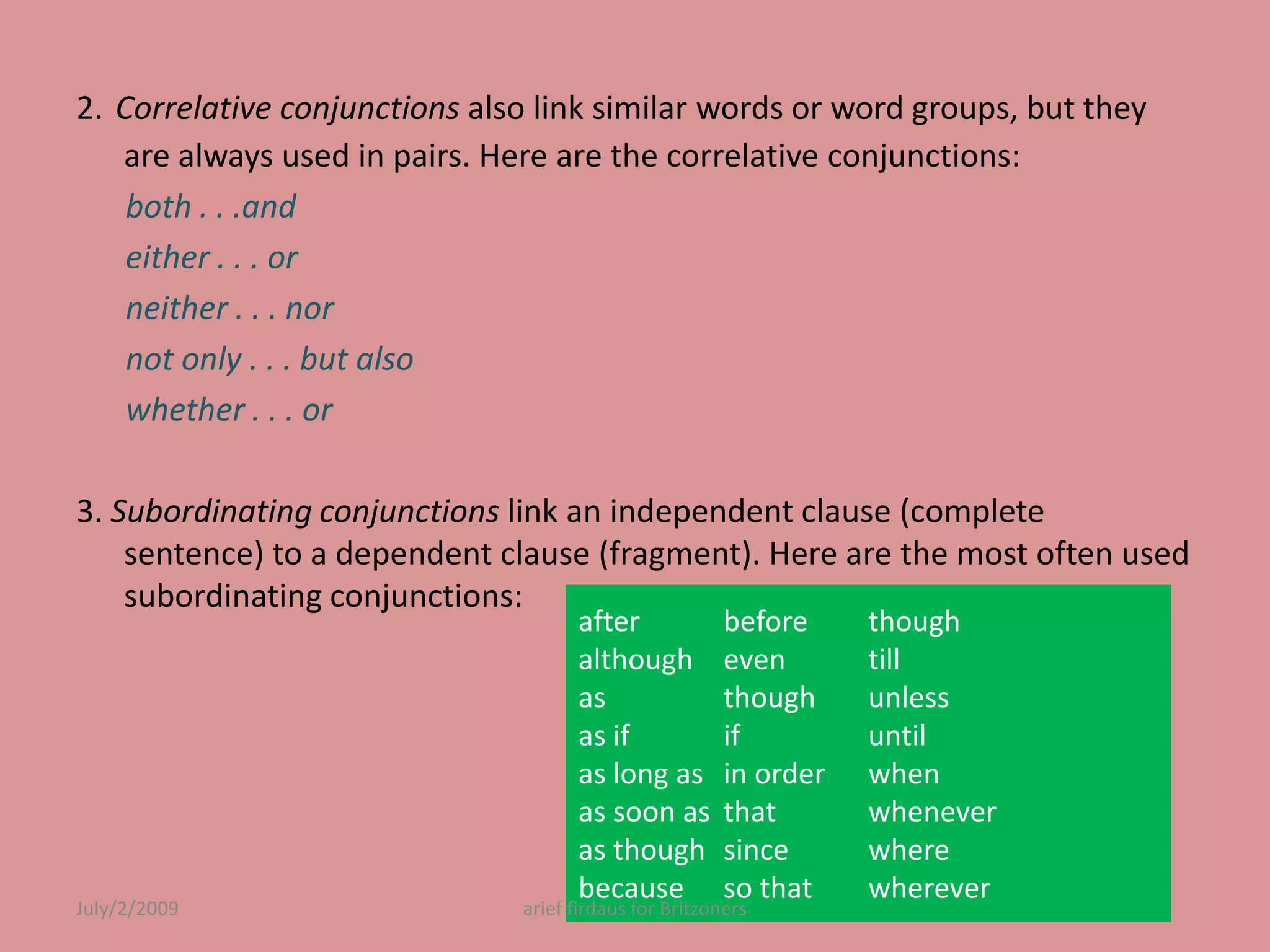
2.Correlative conjunctions also link similar words or word groups, but they are always used in pairs. Here are the correlative conjunctions:both . . .and either . . . orneither . . . nor not only . . . but also whether . . . or3. Subordinating conjunctions link an independent clause (complete sentence) to a dependent clause (fragment). Here are the most often used subordinating conjunctions:after 	although asas ifas long as as soon as as though becausebefore 	even though if in order thatsince 	so that though tillunless until when wheneverwhere whereverJuly/2/2009arief firdaus for Britzoners
English Parts of SpeechAdjectivesAdverbsConjunctionsInterjectionsNounsPrepositionsPronounsVerbsJuly/2/2009arief firdaus for Britzoners
4. Interjections	Interjections show strong emotion. Since interjections are not linked grammatically to other words in the sentence, they are set off from the rest of the sentence with a comma or an exclamation mark. For example:Oh! What a shock you gave me with that gorilla suit.Wow! That’s not a gorilla suit!July/2/2009arief firdaus for Britzoners
English Parts of SpeechAdjectivesAdverbsConjunctionsInterjectionsNounsPrepositionsPronounsVerbsJuly/2/2009arief firdaus for Britzoners
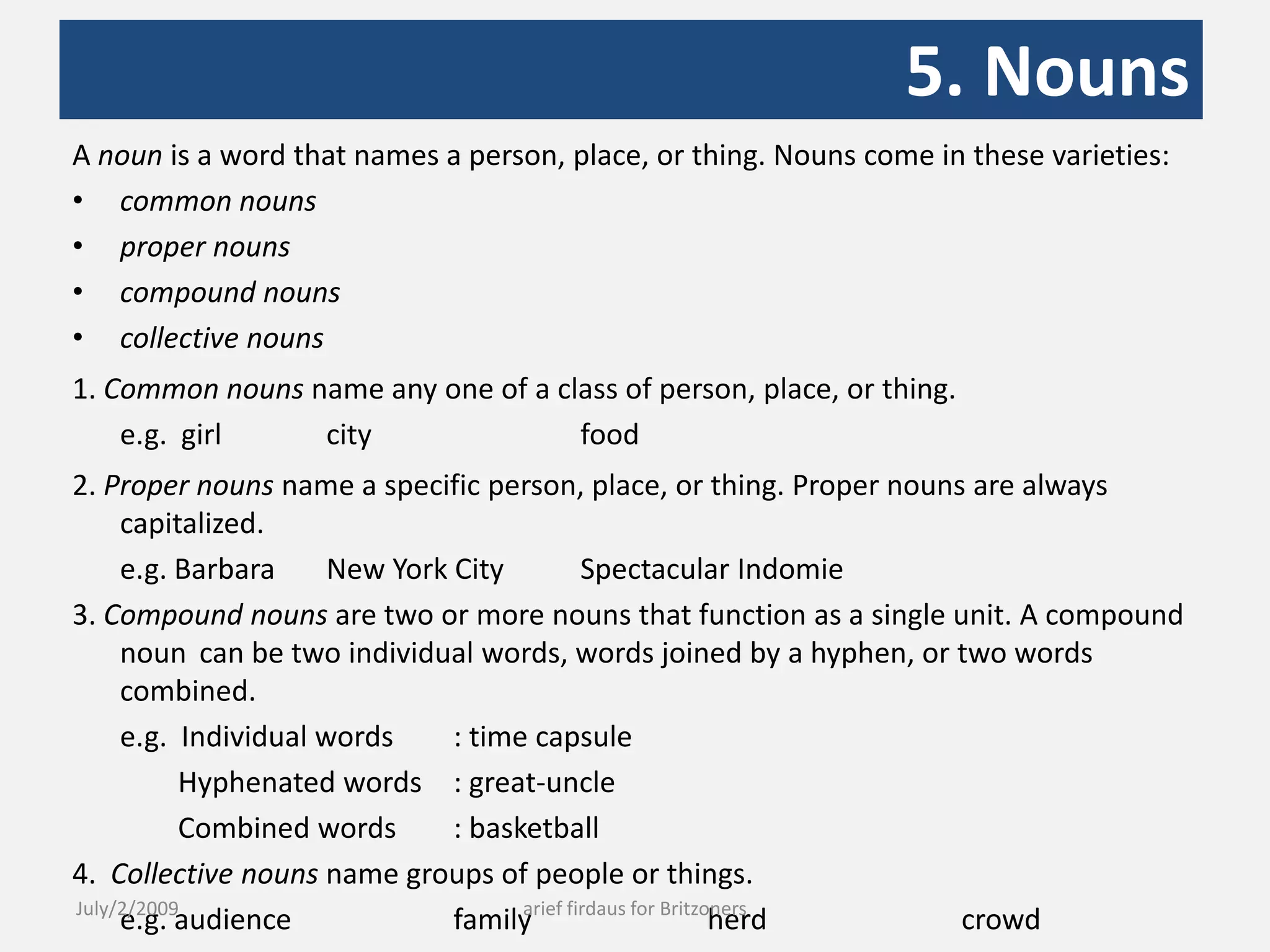
5. NounsA noun is a word that names a person, place, or thing. Nouns come in these varieties: common nounsproper nounscompound nounscollective nouns1. Common nouns name any one of a class of person, place, or thing.	e.g.  girl 	city 		food 2. Proper nouns name a specific person, place, or thing. Proper nouns are always capitalized.	e.g. Barbara 	New York City 	Spectacular Indomie3. Compound nouns are two or more nouns that function as a single unit. A compound noun 	can be two individual words, words joined by a hyphen, or two words combined.	e.g.  Individual words	: time capsule	        Hyphenated words	: great-uncle	        Combined words	: basketball4.  Collective nouns name groups of people or things.	e.g. audience 		family 		herd 		crowdJuly/2/2009arief firdaus for Britzoners
A. Possessive NounsIn grammar, possession shows ownership. Follow these rules to create possessive nouns.1. With singular nouns, add an apostrophe and an s.	e.g. 	dog 	-> dog’s bone		singer 	-> singer’s voice 2. With plural nouns ending in s, add an apostrophe after the s.	e.g. 	dogs 	-> dogs’ bones		singers 	-> singers’ voices 3. With plural nouns not ending in s, add an apostrophe and an s.	e.g. 	men	-> men’s books		mice 	-> mice’s tailsJuly/2/2009arief firdaus for Britzoners
B. Plural Nouns Here are the guidelines for creating plural nouns.1. Add s to form the plural of most nouns.	e.g. 	cat -> cats 	computer -> computers 2. Add esif the noun ends in s, sh, ch, or x.	e.g. 	wish-> wishes 	inch -> inches 	box -> boxes 3. If a noun ends in consonant -y, change the y to iand add es.	e.g. 	city -> cities	 lady -> ladies 4. If a noun ends in vowel -y, add s. Words ending in -quydon’t follow this rule (as in soliloquies).	e.g. 	essay -> essays 	monkey -> monkeysJuly/2/2009arief firdaus for Britzoners
English Parts of SpeechAdjectivesAdverbsConjunctionsInterjectionsNounsPrepositionsPronounsVerbsJuly/2/2009arief firdaus for Britzoners
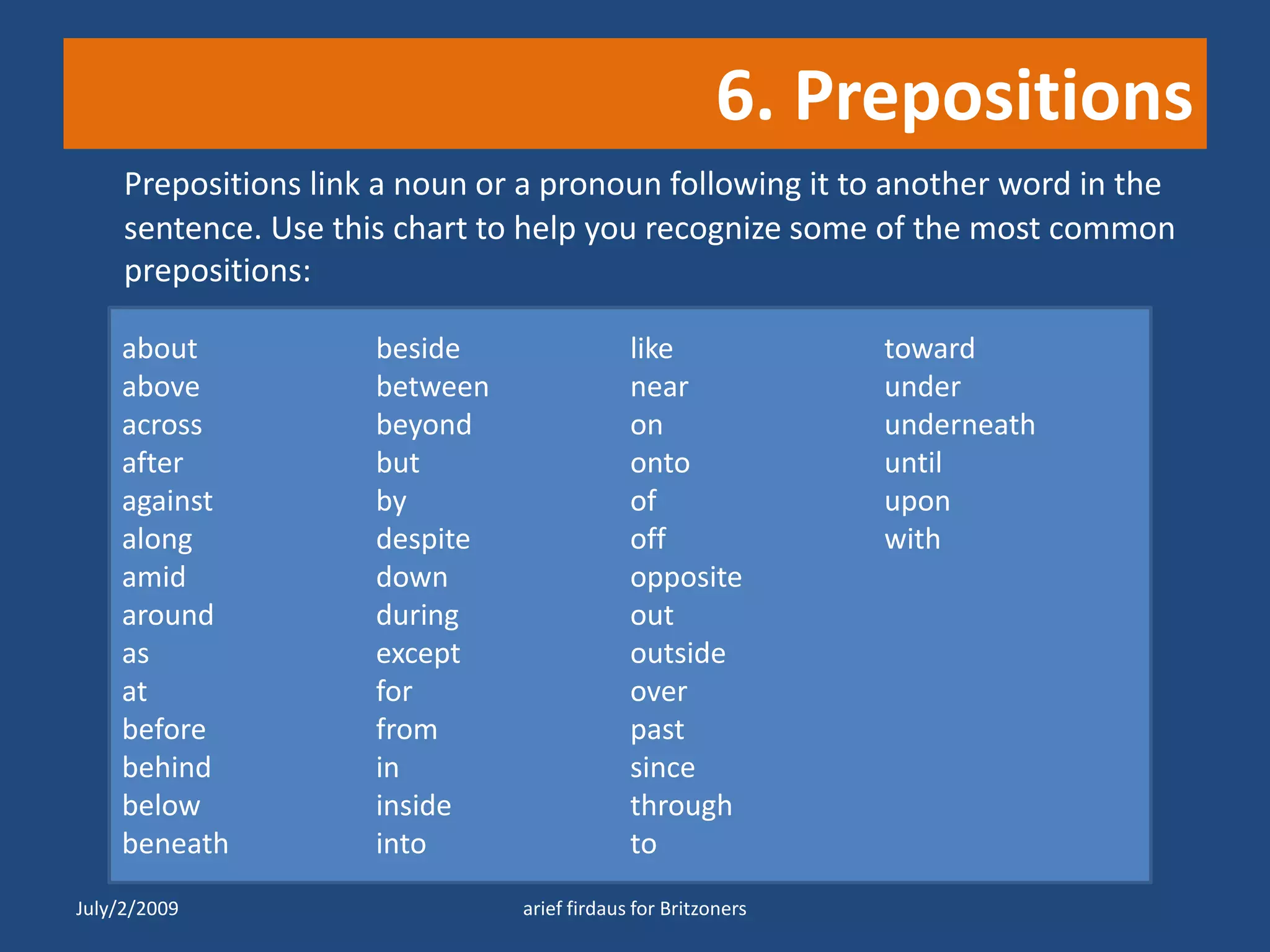
6. PrepositionsPrepositions link a noun or a pronoun following it to another word in the sentence. Use this chart to help you recognize some of the most common prepositions:about 	above across after against alongamid around 	as at before behindbelow beneath beside  between beyond butby despite down during except forfrom in inside into like nearon onto of off opposite outoutside over past  since through totoward under underneath until upon withJuly/2/2009arief firdaus for Britzoners
A noun or pronoun always follows a preposition. A prepositional phrase is a preposition and its object. A prepositional phrase can be two or three words long.e.g. on the wing 	in the door However, prepositional phrases also can be much longer, depending on the length of the preposition and the number of words that describe the object of the preposition.e.g. near the violently swaying oak trees		on account of his nearly depleted bank accountJuly/2/2009arief firdaus for Britzoners
English Parts of SpeechAdjectivesAdverbsConjunctionsInterjectionsNounsPrepositionsPronouns VerbsJuly/2/2009arief firdaus for Britzoners
7. PronounsA pronoun is a word used in place of a noun or another pronoun. Pronouns help you avoid unnecessary repetition in your writing and speech. A pronoun gets its meaning from the noun it stands for. The noun is called the antecedent.e.g. Although Seattleis damp, itis my favorite city.antecedent                  pronoun 	There are different kinds of pronouns. Most of them have antecedents, but a few do not.July/2/2009arief firdaus for Britzoners
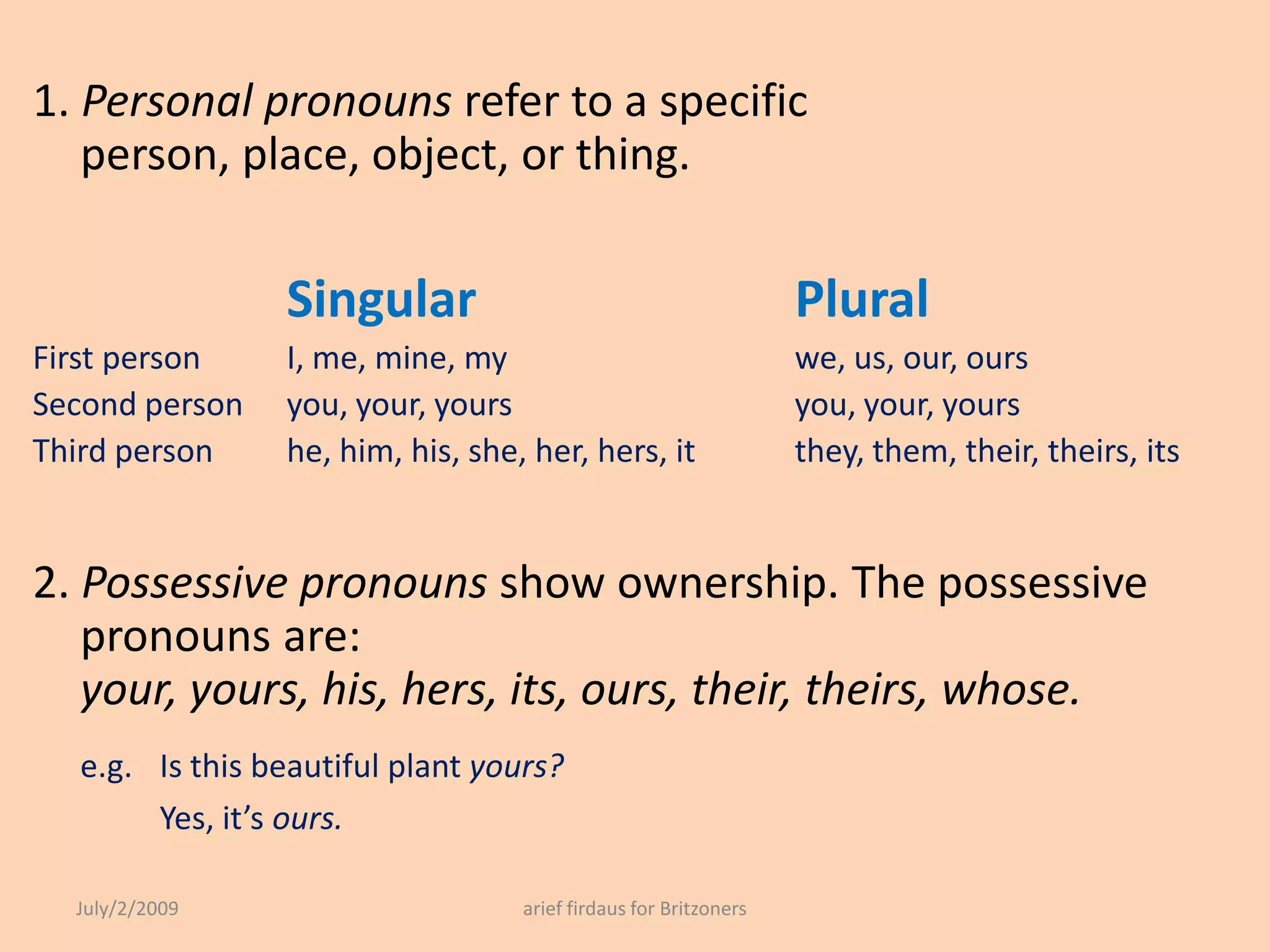
1. Personal pronouns refer to a specific person, place, object, or thing.Singular 			PluralFirst person	I, me, mine, my 			we, us, our, oursSecond person 	you, your, yours 			you, your, yoursThird person 	he, him, his, she, her, hers, it 	they, them, their, theirs, its  2. Possessive pronouns show ownership. The possessive pronouns are: your, yours, his, hers, its, ours, their, theirs, whose. 	e.g. 	Is this beautiful plant yours?		Yes, it’s ours.July/2/2009arief firdaus for Britzoners
Quick Tip	Don’t confuse personal pronouns with contractions. Personal pronouns never have an apostrophe, while contractions always have an apostrophe. Use this chart:Pronoun                            	Contractionyours                                    	you’re (you are)	its                                         	it’s (it is)	their                                     	they’re (they are)	whose                                  	who’s (who is)July/2/2009arief firdaus for Britzoners
3. Reflexive pronouns add information to a sentence by pointing back to a noun or pronoun near the beginning of the sentence. Reflexive pronouns end in -self or -selves.e.g. 	Tricia bought herself a new car.		All her friends enjoyed themselves riding in the beautiful car.4. Intensive pronouns also end in -self or -selves but just add emphasis to the noun or pronoun.e.g. 	Tricia herself picked out the car. 5. Demonstrative pronouns direct attention to a specific person, place, or thing. There are only four demonstrative pronouns: this, that, these, those.e.g. 	This is my favorite movie.		That was a fierce rain storm.July/2/2009arief firdaus for Britzoners
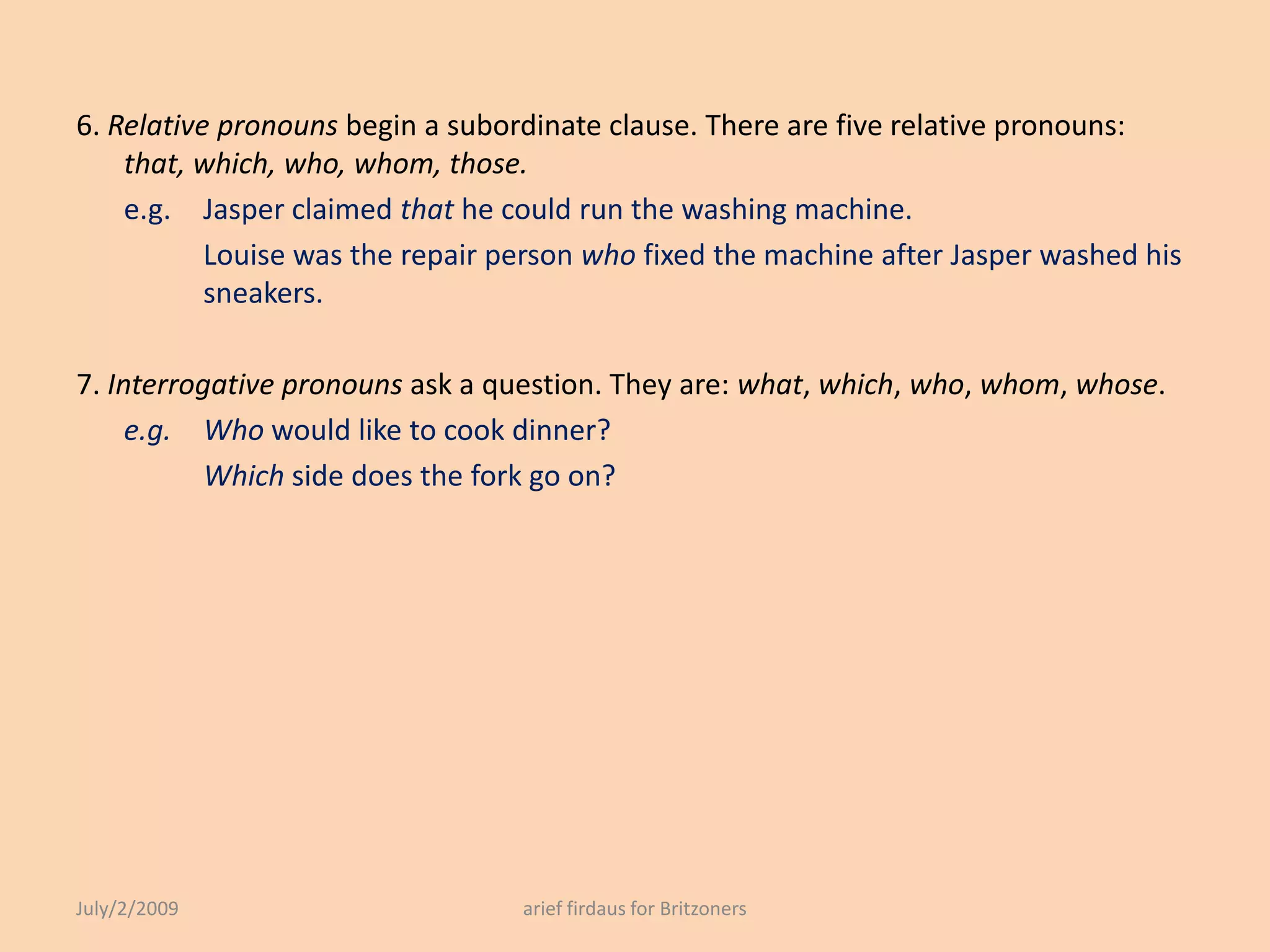
6. Relative pronouns begin a subordinate clause. There are five relative pronouns: that, which, who, whom, those.e.g. 	Jasper claimed that he could run the washing machine.		Louise was the repair person who fixed the machine after Jasper washed his 	sneakers.7. Interrogative pronouns ask a question. They are: what, which, who, whom, whose.e.g. 	Who would like to cook dinner?		Which side does the fork go on?July/2/2009arief firdaus for Britzoners
8. Indefinite pronouns refer to people, places, objects, or things without pointing to a specific one. The most common indefinite pronouns are listed in the following chart.Singular 		Plural 			Singular or Pluralanother 		both 			allanyone 		few 			anyeach 		many 			moreeveryone 		others 			mosteverybody 		several 			noneeverything 					somemuchnobodynothingothersomeoneanybodyanythingeitherlittleneitherno oneonesomebodysomethingJuly/2/2009arief firdaus for Britzoners
English Parts of SpeechAdjectivesAdverbsConjunctionsInterjectionsNounsPrepositionsPronounsVerbsJuly/2/2009arief firdaus for Britzoners
8. Verbs	Verbs name an action or describe a state of being. Every sentence must have a verb. There are three basic types of verbs: action verbslinking verbshelping verbs.July/2/2009arief firdaus for Britzoners
1.  Action Verbs	Action verbs tell what the subject does. The action can be visible (jump, kiss, laugh) or mental (think, learn, study).e.g. The cat broke Louise’s china.		Louise considered buying a new china cabinet. 	An action verb can be transitive or intransitive. Transitive verbs need a direct object.e.g. The boss dropped the ball.		The workers picked it up. 	Intransitive verbs do not need a direct object.e.g.	Who called?		The temperature fell over night.July/2/2009arief firdaus for Britzoners
2. Linking VerbsLinking verbs join the subject and the predicate. They do not show action. Instead, they help the words at the end of the sentence name or describe the subject. As you read earlier in this chapter, the most common linking verbs include: be, feel, grow, seem, smell, remain, appear, sound, stay, look, taste, turn, become. Look for forms of to be, such as am, are, is, was, were, am being, can be, have been, and so on.e.g.	The manager was happy about the job change.		He is a good worker. 		Many linking verbs can also be used as action verbs.e.g. Linking	: The kids looked sad.		Action	:  I looked for the dog in the pouring rain.July/2/2009arief firdaus for Britzoners
3. Helping Verbs	Helping verbs are added to another verb to make the meaning clearer. Helping verbs include any form of to be, do, does, did, have, has, had, shall, should, will, would, can, could, may, might, must. Verb phrases are made up of one main verb and one or more helping	verbs.e.g. They will run before dawn.		They still have not yet found a smooth track.July/2/2009arief firdaus for Britzoners

English Parts Of Speech

  • 1.
    English Parts ofSpeechby Arief FirdausJuly/2/2009arief firdaus for Britzoners
  • 2.
    English Parts ofSpeechAdjectivesAdverbsConjunctionsInterjectionsNounsPrepositionsPronounsVerbsJuly/2/2009arief firdaus for Britzoners
  • 3.
    1. AdjectivesAdjectives arewords that describe nouns and pronouns. Adjectives answer the questions: What kind? How much? Which one? How many?  For example:What kind? red nose gold ringHow much? more sugar little effortWhich one? second chance those chocolatesHow many? several chances six books There are five kinds of adjectives: common adjectives, proper adjectives, compound adjectives,articles, and indefinite adjectives.July/2/2009arief firdaus for Britzoners
  • 4.
    1. Common adjectivesdescribe nouns or pronouns. e.g. strong man, green plant, beautiful view 2. Proper adjectives are formed from proper nouns. e.g. California vegetables (from the noun “California”)Mexican food (from the noun “Mexico”) 3. Compound adjectives are made up of more than one word. e.g. far-off countryteenage person4. Articles are a special type of adjective. There are three articles: a, an, the. The is called a “definite article” because it refers to a specific thing. A and an are called “indefinite articles” because they refer to general things. Use a with consonant sounds; use an before vowel sounds. 5. Indefinite adjectives don’t specify the specific amount of something. all another any both each either few many more most neither other several someJuly/2/2009arief firdaus for Britzoners
  • 5.
    Follow these guidelineswhen you use adjectives: 1. Use an adjective to describe a noun or a pronoun.e.g. Jesse was unwillingto leave thecircus. noun adj. adj. noun 2. Use vivid adjectives to make your writing more specific and descriptive.e.g. Take a largerslice of the lusciouscake. adj. noun adj. noun 3. Use an adjective after a linking verb. A linking verb connects a subject with a descriptive word. The most common linking verbs are be (is, am, are, was, were, and so on), seem, appear, look, feel, smell, sound, taste, become, grow, remain, stay, and turn. e.g. Chicken made this way tastes more delicious (not deliciously).July/2/2009arief firdaus for Britzoners
  • 6.
    Quick Tip Predicate adjectivesare adjectives separated from the noun or pronoun by a linking verb. Predicate adjectives describe the subject of the sentence. e.g. The weather was cold all week.July/2/2009arief firdaus for Britzoners
  • 7.
    English Parts ofSpeechAdjectivesAdverbsConjunctionsInterjectionsNounsPrepositionsPronounsVerbsJuly/2/2009arief firdaus for Britzoners
  • 8.
    2. AdverbsAdverbs arewords that describe verbs, adjectives, or other adverbs. Adverbs answer the questions: When? Where? How? or To what extent?When? left yesterday begin nowWhere? fell below move upHow? happily sang danced badlyTo what extent? partly finished eat completely Most adverbs are formed by adding -lyto an adjective. Here are some of the most common non-lyadverbs: almost already also back even far fast hard here howlate long low more near afterwardnext now often quickrather slow soon yesterday today too when where then never still tomorrowJuly/2/2009arief firdaus for Britzoners
  • 9.
    Follow these guidelineswhen you use adverbs: 1. Use an adverb to describe a verb. e.g. Experiments using dynamite must be donecarefully.verb adv.2. Use an adverb to describe an adjective. e.g. Sam had an unbelievablyhugeappetite for chips.adv. adj. 3. Use an adverb to describe another adverb. e.g. They sang soclearly.adv. adv.July/2/2009arief firdaus for Britzoners
  • 10.
    Quick TipConjunctive adverbsare used to connect other words and to link ideas and paragraphs.accordingly again also besidesconsequently finally for example furthermorehowever indeed moreover on the other handotherwise nevertheless then thereforeJuly/2/2009arief firdaus for Britzoners
  • 11.
    English Parts ofSpeechAdjectivesAdverbsConjunctionsInterjectionsNounsPrepositionsPronounsVerbsJuly/2/2009arief firdaus for Britzoners
  • 12.
    3. Conjunctions Conjunctions connectwords or groups of words and show how the words are related. There are three kinds of conjunctions: coordinating conjunctionscorrelative conjunctionssubordinating conjunctions.1. Coordinating conjunctions link similar words or word groups. There are seven coordinating conjunctions: for and nor but or yet so (FANBOYS)July/2/2009arief firdaus for Britzoners
  • 13.
    2.Correlative conjunctions alsolink similar words or word groups, but they are always used in pairs. Here are the correlative conjunctions:both . . .and either . . . orneither . . . nor not only . . . but also whether . . . or3. Subordinating conjunctions link an independent clause (complete sentence) to a dependent clause (fragment). Here are the most often used subordinating conjunctions:after although asas ifas long as as soon as as though becausebefore even though if in order thatsince so that though tillunless until when wheneverwhere whereverJuly/2/2009arief firdaus for Britzoners
  • 14.
    English Parts ofSpeechAdjectivesAdverbsConjunctionsInterjectionsNounsPrepositionsPronounsVerbsJuly/2/2009arief firdaus for Britzoners
  • 15.
    4. Interjections Interjections showstrong emotion. Since interjections are not linked grammatically to other words in the sentence, they are set off from the rest of the sentence with a comma or an exclamation mark. For example:Oh! What a shock you gave me with that gorilla suit.Wow! That’s not a gorilla suit!July/2/2009arief firdaus for Britzoners
  • 16.
    English Parts ofSpeechAdjectivesAdverbsConjunctionsInterjectionsNounsPrepositionsPronounsVerbsJuly/2/2009arief firdaus for Britzoners
  • 17.
    5. NounsA nounis a word that names a person, place, or thing. Nouns come in these varieties: common nounsproper nounscompound nounscollective nouns1. Common nouns name any one of a class of person, place, or thing. e.g. girl city food 2. Proper nouns name a specific person, place, or thing. Proper nouns are always capitalized. e.g. Barbara New York City Spectacular Indomie3. Compound nouns are two or more nouns that function as a single unit. A compound noun can be two individual words, words joined by a hyphen, or two words combined. e.g. Individual words : time capsule Hyphenated words : great-uncle Combined words : basketball4. Collective nouns name groups of people or things. e.g. audience family herd crowdJuly/2/2009arief firdaus for Britzoners
  • 18.
    A. Possessive NounsIngrammar, possession shows ownership. Follow these rules to create possessive nouns.1. With singular nouns, add an apostrophe and an s. e.g. dog -> dog’s bone singer -> singer’s voice 2. With plural nouns ending in s, add an apostrophe after the s. e.g. dogs -> dogs’ bones singers -> singers’ voices 3. With plural nouns not ending in s, add an apostrophe and an s. e.g. men -> men’s books mice -> mice’s tailsJuly/2/2009arief firdaus for Britzoners
  • 19.
    B. Plural Nouns Hereare the guidelines for creating plural nouns.1. Add s to form the plural of most nouns. e.g. cat -> cats computer -> computers 2. Add esif the noun ends in s, sh, ch, or x. e.g. wish-> wishes inch -> inches box -> boxes 3. If a noun ends in consonant -y, change the y to iand add es. e.g. city -> cities lady -> ladies 4. If a noun ends in vowel -y, add s. Words ending in -quydon’t follow this rule (as in soliloquies). e.g. essay -> essays monkey -> monkeysJuly/2/2009arief firdaus for Britzoners
  • 20.
    English Parts ofSpeechAdjectivesAdverbsConjunctionsInterjectionsNounsPrepositionsPronounsVerbsJuly/2/2009arief firdaus for Britzoners
  • 21.
    6. PrepositionsPrepositions linka noun or a pronoun following it to another word in the sentence. Use this chart to help you recognize some of the most common prepositions:about above across after against alongamid around as at before behindbelow beneath beside between beyond butby despite down during except forfrom in inside into like nearon onto of off opposite outoutside over past since through totoward under underneath until upon withJuly/2/2009arief firdaus for Britzoners
  • 22.
    A noun orpronoun always follows a preposition. A prepositional phrase is a preposition and its object. A prepositional phrase can be two or three words long.e.g. on the wing in the door However, prepositional phrases also can be much longer, depending on the length of the preposition and the number of words that describe the object of the preposition.e.g. near the violently swaying oak trees on account of his nearly depleted bank accountJuly/2/2009arief firdaus for Britzoners
  • 23.
    English Parts ofSpeechAdjectivesAdverbsConjunctionsInterjectionsNounsPrepositionsPronouns VerbsJuly/2/2009arief firdaus for Britzoners
  • 24.
    7. PronounsA pronounis a word used in place of a noun or another pronoun. Pronouns help you avoid unnecessary repetition in your writing and speech. A pronoun gets its meaning from the noun it stands for. The noun is called the antecedent.e.g. Although Seattleis damp, itis my favorite city.antecedent pronoun  There are different kinds of pronouns. Most of them have antecedents, but a few do not.July/2/2009arief firdaus for Britzoners
  • 25.
    1. Personal pronounsrefer to a specific person, place, object, or thing.Singular PluralFirst person I, me, mine, my we, us, our, oursSecond person you, your, yours you, your, yoursThird person he, him, his, she, her, hers, it they, them, their, theirs, its  2. Possessive pronouns show ownership. The possessive pronouns are: your, yours, his, hers, its, ours, their, theirs, whose.  e.g. Is this beautiful plant yours? Yes, it’s ours.July/2/2009arief firdaus for Britzoners
  • 26.
    Quick Tip Don’t confusepersonal pronouns with contractions. Personal pronouns never have an apostrophe, while contractions always have an apostrophe. Use this chart:Pronoun Contractionyours you’re (you are) its it’s (it is) their they’re (they are) whose who’s (who is)July/2/2009arief firdaus for Britzoners
  • 27.
    3. Reflexive pronounsadd information to a sentence by pointing back to a noun or pronoun near the beginning of the sentence. Reflexive pronouns end in -self or -selves.e.g. Tricia bought herself a new car. All her friends enjoyed themselves riding in the beautiful car.4. Intensive pronouns also end in -self or -selves but just add emphasis to the noun or pronoun.e.g. Tricia herself picked out the car. 5. Demonstrative pronouns direct attention to a specific person, place, or thing. There are only four demonstrative pronouns: this, that, these, those.e.g. This is my favorite movie. That was a fierce rain storm.July/2/2009arief firdaus for Britzoners
  • 28.
    6. Relative pronounsbegin a subordinate clause. There are five relative pronouns: that, which, who, whom, those.e.g. Jasper claimed that he could run the washing machine. Louise was the repair person who fixed the machine after Jasper washed his sneakers.7. Interrogative pronouns ask a question. They are: what, which, who, whom, whose.e.g. Who would like to cook dinner? Which side does the fork go on?July/2/2009arief firdaus for Britzoners
  • 29.
    8. Indefinite pronounsrefer to people, places, objects, or things without pointing to a specific one. The most common indefinite pronouns are listed in the following chart.Singular Plural Singular or Pluralanother both allanyone few anyeach many moreeveryone others mosteverybody several noneeverything somemuchnobodynothingothersomeoneanybodyanythingeitherlittleneitherno oneonesomebodysomethingJuly/2/2009arief firdaus for Britzoners
  • 30.
    English Parts ofSpeechAdjectivesAdverbsConjunctionsInterjectionsNounsPrepositionsPronounsVerbsJuly/2/2009arief firdaus for Britzoners
  • 31.
    8. Verbs Verbs namean action or describe a state of being. Every sentence must have a verb. There are three basic types of verbs: action verbslinking verbshelping verbs.July/2/2009arief firdaus for Britzoners
  • 32.
    1. ActionVerbs Action verbs tell what the subject does. The action can be visible (jump, kiss, laugh) or mental (think, learn, study).e.g. The cat broke Louise’s china. Louise considered buying a new china cabinet.  An action verb can be transitive or intransitive. Transitive verbs need a direct object.e.g. The boss dropped the ball. The workers picked it up.  Intransitive verbs do not need a direct object.e.g. Who called? The temperature fell over night.July/2/2009arief firdaus for Britzoners
  • 33.
    2. Linking VerbsLinkingverbs join the subject and the predicate. They do not show action. Instead, they help the words at the end of the sentence name or describe the subject. As you read earlier in this chapter, the most common linking verbs include: be, feel, grow, seem, smell, remain, appear, sound, stay, look, taste, turn, become. Look for forms of to be, such as am, are, is, was, were, am being, can be, have been, and so on.e.g. The manager was happy about the job change. He is a good worker.  Many linking verbs can also be used as action verbs.e.g. Linking : The kids looked sad. Action : I looked for the dog in the pouring rain.July/2/2009arief firdaus for Britzoners
  • 34.
    3. Helping Verbs Helpingverbs are added to another verb to make the meaning clearer. Helping verbs include any form of to be, do, does, did, have, has, had, shall, should, will, would, can, could, may, might, must. Verb phrases are made up of one main verb and one or more helping verbs.e.g. They will run before dawn. They still have not yet found a smooth track.July/2/2009arief firdaus for Britzoners