



Loading, please wait....
INTRODUCTION
ENGLISH MORPHOLOGY
ENGLISH literature Departement
DZAKI JABBAR MAHDI (16211144004)
It’s a scientific study of language.
Linguistics is a comparatively new science, or
new, at least, in the form it has taken in recent
years.
Describe the varieties of languages and
explain the unconscious knowledge all
speakers have of their language
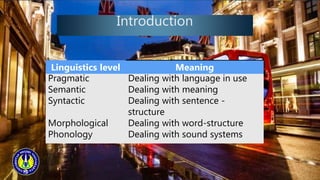
Introduction
Linguistics level Meaning
Pragmatic
Semantic
Syntactic
Morphological
Phonology
Dealing with language in use
Dealing with meaning
Dealing with sentence -
structure
Dealing with word-structure
Dealing with sound systems
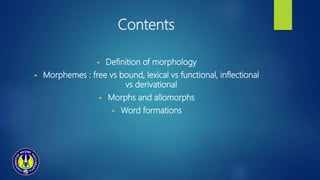
Contents
 Definition of morphology
 Morphemes : free vs bound, lexical vs functional, inflectional
vs derivational
 Morphs and allomorphs
 Word formations
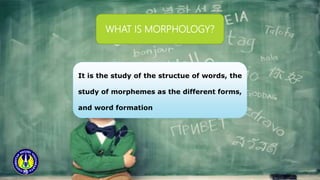
WHAT IS MORPHOLOGY?
It is the study of the structue of words, the
study of morphemes as the different forms,
and word formation
MORPHEMES
Morphemes are the minimal unit of world
building in a language; they cannot be
broken down any further into
recognizable or meaningful parts.
Morpheme Definitions
It is the linguistic terms for the most elemental unit of
grammatical form (2003 : 76), it means that morphemes are
the minimal units of linguistic form and meaning and how
they make up word.
• Ingo Plag (2003) says, “Morpheme is the smallest meaningful
unit.”
• Hanafi (2003) states that morpheme is the smallest meaningful
unit of an utterance.
• Morpheme is the smallest difference in the shape of a word
that correlates with the smallest difference in a word or
sentence meaning or in grammatical structure. (Katamba: 1993)
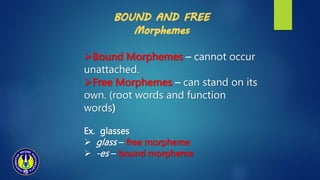
Bound Morphemes – cannot occur
unattached.
Free Morphemes – can stand on its
own. (root words and function
words)
Ex. glasses
 glass – free morpheme
 -es – bound morpheme
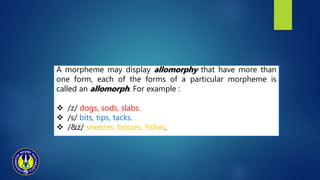
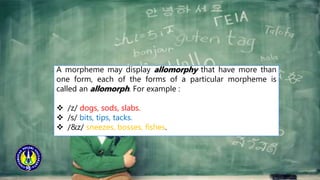
A morpheme may display allomorphy that have more than
one form, each of the forms of a particular morpheme is
called an allomorph. For example :
 /z/ dogs, sods, slabs.
 /s/ bits, tips, tacks.
 /&z/ sneezes, bosses, fishes.
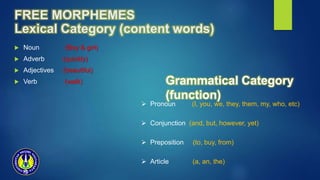
FREE MORPHEMES
Lexical Category (content words)
 Noun (Boy & girl)
 Adverb (quickly)
 Adjectives (beautiful)
 Verb (walk) Grammatical Category
(function)
 Pronoun (I, you, we, they, them, my, who, etc)
 Conjunction (and, but, however, yet)
 Preposition (to, buy, from)
 Article (a, an, the)
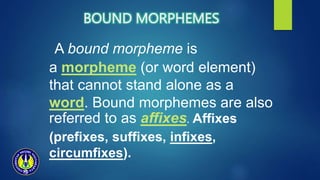
BOUND MORPHEMES
A bound morpheme is
a morpheme (or word element)
that cannot stand alone as a
word. Bound morphemes are also
referred to as affixes. Affixes
(prefixes, suffixes, infixes,
circumfixes).
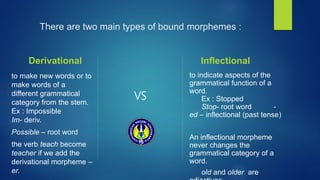
There are two main types of bound morphemes :
Derivational
to make new words or to
make words of a
different grammatical
category from the stem.
Ex : Impossible
Im- deriv.
Possible – root word
the verb teach become
teacher if we add the
derivational morpheme –
er.
VS
Inflectional
to indicate aspects of the
grammatical function of a
word.
Ex : Stopped
Stop- root word -
ed – inflectional (past tense)
An inflectional morpheme
never changes the
grammatical category of a
word.
old and older are
BOUND MORPHEMES
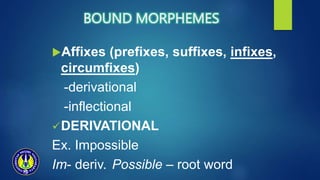
Affixes (prefixes, suffixes, infixes,
circumfixes)
-derivational
-inflectional
DERIVATIONAL
Ex. Impossible
Im- deriv. Possible – root word
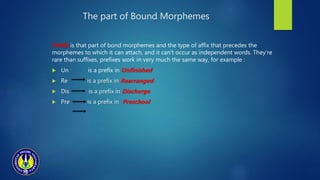
The part of Bound Morphemes
Prefix is that part of bond morphemes and the type of affix that precedes the
morphemes to which it can attach, and it can’t occur as independent words. They’re
rare than suffixes, prefixes work in very much the same way, for example :
 Un is a prefix in Unfinished
 Re is a prefix in Rearranged
 Dis is a prefix in Discharge
 Pre is a prefix in Preschool
Morphs & Allomorphs
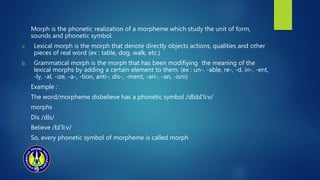
Morph is the phonetic realization of a morpheme which study the unit of form,
sounds and phonetic symbol.
a. Lexical morph is the morph that denote directly objects actions, qualities and other
pieces of real word (ex : table, dog, walk, etc.)
b. Grammatical morph is the morph that has been modifiying the meaning of the
lexical morphs by adding a certain element to them. (ex : un-, -able, re-, -d, in-, -ent,
-ly, -al, -ize, -a-, -tion, anti-, dis-, -ment, -ari-, -an, -ism)
Example :
The word/morpheme disbelieve has a phonetic symbol /dIsbI’li:v/
morphs
Dis /dIs/
Believe /bI’li:v/
So, every phonetic symbol of morpheme is called morph
A morpheme may display allomorphy that have more than
one form, each of the forms of a particular morpheme is
called an allomorph. For example :
 /z/ dogs, sods, slabs.
 /s/ bits, tips, tacks.
 /&z/ sneezes, bosses, fishes.
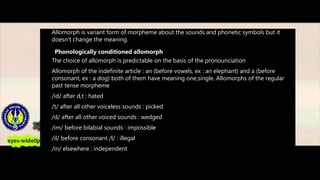
Allomorph is variant form of morpheme about the sounds and phonetic symbols but it
doesn’t change the meaning.
Phonologically conditioned allomorph
The choice of allomorph is predictable on the basis of the pronounciation
Allomorph of the indefinite article : an (before vowels, ex : an elephant) and a (before
consonant, ex : a dog) both of them have meaning one,single. Allomorphs of the regular
past tense morpheme
/id/ after d,t : hated
/t/ after all other voiceless sounds : picked
/d/ after all other voiced sounds : wedged
/im/ before bilabial sounds : impossible
/il/ before consonant /l/ : illegal
/in/ elsewhere : independent
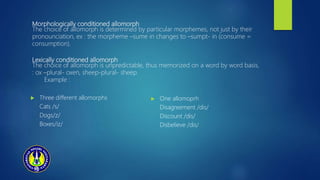
Morphologically conditioned allomorph
The choice of allomorph is determined by particular morphemes, not just by their
pronounciation, ex : the morpheme –sume in changes to –sumpt- in (consume =
consumption).
Lexically conditioned allomorph
The choice of allomorph is unpredictable, thus memorized on a word by word basis,
: ox –plural- oxen, sheep-plural- sheep.
Example :
 Three different allomorphs
Cats /s/
Dogs/z/
Boxes/iz/
 One allomoprh
Disagreement /dis/
Discount /dis/
Disbelieve /dis/
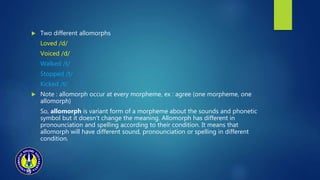
 Two different allomorphs
Loved /d/
Voiced /d/
Walked /t/
Stopped /t/
Kicked /t/
 Note : allomorph occur at every morpheme, ex : agree (one morpheme, one
allomorph)
So, allomorph is variant form of a morpheme about the sounds and phonetic
symbol but it doesn’t change the meaning. Allomorph has different in
pronounciation and spelling according to their condition. It means that
allomorph will have different sound, pronounciation or spelling in different
condition.
Introduction English Morphology

Introduction English Morphology

  • 1.
  • 2.
    INTRODUCTION ENGLISH MORPHOLOGY ENGLISH literatureDepartement DZAKI JABBAR MAHDI (16211144004)
  • 3.
    It’s a scientificstudy of language. Linguistics is a comparatively new science, or new, at least, in the form it has taken in recent years. Describe the varieties of languages and explain the unconscious knowledge all speakers have of their language
  • 4.
    Introduction Linguistics level Meaning Pragmatic Semantic Syntactic Morphological Phonology Dealingwith language in use Dealing with meaning Dealing with sentence - structure Dealing with word-structure Dealing with sound systems
  • 5.
    Contents  Definition ofmorphology  Morphemes : free vs bound, lexical vs functional, inflectional vs derivational  Morphs and allomorphs  Word formations
  • 6.
    WHAT IS MORPHOLOGY? Itis the study of the structue of words, the study of morphemes as the different forms, and word formation
  • 7.
    MORPHEMES Morphemes are theminimal unit of world building in a language; they cannot be broken down any further into recognizable or meaningful parts.
  • 8.
    Morpheme Definitions It isthe linguistic terms for the most elemental unit of grammatical form (2003 : 76), it means that morphemes are the minimal units of linguistic form and meaning and how they make up word. • Ingo Plag (2003) says, “Morpheme is the smallest meaningful unit.” • Hanafi (2003) states that morpheme is the smallest meaningful unit of an utterance. • Morpheme is the smallest difference in the shape of a word that correlates with the smallest difference in a word or sentence meaning or in grammatical structure. (Katamba: 1993)
  • 9.
    Bound Morphemes –cannot occur unattached. Free Morphemes – can stand on its own. (root words and function words) Ex. glasses  glass – free morpheme  -es – bound morpheme
  • 10.
    A morpheme maydisplay allomorphy that have more than one form, each of the forms of a particular morpheme is called an allomorph. For example :  /z/ dogs, sods, slabs.  /s/ bits, tips, tacks.  /&z/ sneezes, bosses, fishes.
  • 11.
    FREE MORPHEMES Lexical Category(content words)  Noun (Boy & girl)  Adverb (quickly)  Adjectives (beautiful)  Verb (walk) Grammatical Category (function)  Pronoun (I, you, we, they, them, my, who, etc)  Conjunction (and, but, however, yet)  Preposition (to, buy, from)  Article (a, an, the)
  • 12.
    BOUND MORPHEMES A boundmorpheme is a morpheme (or word element) that cannot stand alone as a word. Bound morphemes are also referred to as affixes. Affixes (prefixes, suffixes, infixes, circumfixes).
  • 13.
    There are twomain types of bound morphemes : Derivational to make new words or to make words of a different grammatical category from the stem. Ex : Impossible Im- deriv. Possible – root word the verb teach become teacher if we add the derivational morpheme – er. VS Inflectional to indicate aspects of the grammatical function of a word. Ex : Stopped Stop- root word - ed – inflectional (past tense) An inflectional morpheme never changes the grammatical category of a word. old and older are
  • 14.
    BOUND MORPHEMES Affixes (prefixes,suffixes, infixes, circumfixes) -derivational -inflectional DERIVATIONAL Ex. Impossible Im- deriv. Possible – root word
  • 15.
    The part ofBound Morphemes Prefix is that part of bond morphemes and the type of affix that precedes the morphemes to which it can attach, and it can’t occur as independent words. They’re rare than suffixes, prefixes work in very much the same way, for example :  Un is a prefix in Unfinished  Re is a prefix in Rearranged  Dis is a prefix in Discharge  Pre is a prefix in Preschool
  • 16.
  • 18.
    Morph is thephonetic realization of a morpheme which study the unit of form, sounds and phonetic symbol. a. Lexical morph is the morph that denote directly objects actions, qualities and other pieces of real word (ex : table, dog, walk, etc.) b. Grammatical morph is the morph that has been modifiying the meaning of the lexical morphs by adding a certain element to them. (ex : un-, -able, re-, -d, in-, -ent, -ly, -al, -ize, -a-, -tion, anti-, dis-, -ment, -ari-, -an, -ism) Example : The word/morpheme disbelieve has a phonetic symbol /dIsbI’li:v/ morphs Dis /dIs/ Believe /bI’li:v/ So, every phonetic symbol of morpheme is called morph
  • 20.
    A morpheme maydisplay allomorphy that have more than one form, each of the forms of a particular morpheme is called an allomorph. For example :  /z/ dogs, sods, slabs.  /s/ bits, tips, tacks.  /&z/ sneezes, bosses, fishes.
  • 21.
    Allomorph is variantform of morpheme about the sounds and phonetic symbols but it doesn’t change the meaning. Phonologically conditioned allomorph The choice of allomorph is predictable on the basis of the pronounciation Allomorph of the indefinite article : an (before vowels, ex : an elephant) and a (before consonant, ex : a dog) both of them have meaning one,single. Allomorphs of the regular past tense morpheme /id/ after d,t : hated /t/ after all other voiceless sounds : picked /d/ after all other voiced sounds : wedged /im/ before bilabial sounds : impossible /il/ before consonant /l/ : illegal /in/ elsewhere : independent
  • 22.
    Morphologically conditioned allomorph Thechoice of allomorph is determined by particular morphemes, not just by their pronounciation, ex : the morpheme –sume in changes to –sumpt- in (consume = consumption). Lexically conditioned allomorph The choice of allomorph is unpredictable, thus memorized on a word by word basis, : ox –plural- oxen, sheep-plural- sheep. Example :  Three different allomorphs Cats /s/ Dogs/z/ Boxes/iz/  One allomoprh Disagreement /dis/ Discount /dis/ Disbelieve /dis/
  • 23.
     Two differentallomorphs Loved /d/ Voiced /d/ Walked /t/ Stopped /t/ Kicked /t/  Note : allomorph occur at every morpheme, ex : agree (one morpheme, one allomorph) So, allomorph is variant form of a morpheme about the sounds and phonetic symbol but it doesn’t change the meaning. Allomorph has different in pronounciation and spelling according to their condition. It means that allomorph will have different sound, pronounciation or spelling in different condition.