
BASIC ENGLISH
GRAMMAR
By
BASAVARAJ GANGANAVAR
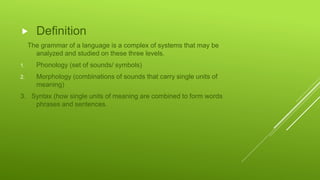
 Definition
The grammar of a language is a complex of systems that may be
analyzed and studied on these three levels.
1. Phonology (set of sounds/ symbols)
2. Morphology (combinations of sounds that carry single units of
meaning)
3. Syntax (how single units of meaning are combined to form words
phrases and sentences.
PARTS OF SPEECH (NOUNS)
Nouns
1. Definition
2. Proper / common
3. Singular / plural (annex)
4. Count / non-count
/abstract (annex)
(how much –how many)
5. Collectible (group nouns)
6. Units of measurement
DEFINITION
(PROPER AND COMMON NOUNS)
 Nouns – words used to name a person,
place, thing, object, quality, idea, concept,
or an action.
Ref. (American Heritage Dictionary, 2001)
 Proper Nouns- special or particular name
given to common nouns to distinguish them
from others of the same kind.
Example: common- woman
proper Martha
Proper
Nouns
A person
Carlos
a place
Ryder
Hospital
a day
Monday
a monument
The Statue
of
Liberty
many
others
a pet
Puppy
a country
Puerto Rico
PROPER AND COMMON NOUNS
COMMON PROPER COMMON PROPER
day Saturday associations Members Club
month October movies Titanic
mountain El Yunque planets Neptune
river The Amazon city San Juan
ocean Pacific Ocean historical periods Middle Ages
book Applied
Linguistic
language Spanish
newspaper New York Times nationality Puerto Rican
religion Catholic School course English 101
brand of product Cadillac institutions University of
Puerto Rico
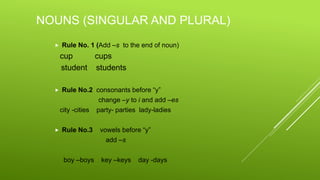
NOUNS (SINGULAR AND PLURAL)
 Rule No. 1 (Add –s to the end of noun)
cup cups
student students
 Rule No.2 consonants before “y”
change –y to i and add –es
city -cities party- parties lady-ladies
 Rule No.3 vowels before “y”
add –s
boy –boys key –keys day -days
SINGULAR AND PLURAL (CONT.)
 Rule No. 4 (–f and –fe endings)
change the –f or –fe to v and –es
life –lives wife –wives thief –thieves
 Rule No. 5 (sh, ch, x, ss endings) add –es
bush –bushes
match –matches
box -boxes
kiss -kisses
 Rule No. 6 (consonant + o) add –es (vowel +o) –s
tomato –tomatoes radio radios
PRACTICE EXERCISES
USE THE PLURAL FORM TO FILL IN THE BLANKS.
(PROVIDED LIST)
Baby
Boy
City
Country
Lady
Party
Tray
Key
Dictionary
cowboy
 They have one girl and two ______.
 I visited many _______ last year.
 Women give birth to _______.
 She lost the _____ of the car and the house!
 _____ rides horses in Texas.
 Madrid and Paris are beautiful _______.
 We must bring ______ to the English class.
 Good evening _____ and gentleman.
 On Saturday nights, I like to go to _______.
 People carry their food on _____ at the cafeteria.
PRONUNCIATION OF PLURALS (S / ES)
 Group A Final –s is pronounced /z/ after voiced sounds
(taxicabs, beds, dogs, balls, years, days, boys, trees, etc.)
 Group B Final –s is pronounced /s/ after voiceless sounds
(books, cups, groups, cats, students, desks, etc.)
 Group C Final –s, es is pronounced /ez/
after “s” sounds (classes, horses, boxes, faces)
after “z” sounds (sizes, roses, noises)
after “sh” sounds (dishes, bushes)
after “ch” sounds (matches, sandwiches)
after “ge/dge” sounds (pages, ages, bridges, edges)
IRREGULAR PLURAL FORMS (EXCEPTIONS)
 Child children
 Foot feet
 Man men
 Woman women
 Mouse mice
 Tooth teeth
 Fish fish
 _____ people
(is always plural) (no s)
COUNT AND NONCOUNT NOUNS
 Count nouns
a book books
one book two books
some books
a lot of books
many books
a few books
 Non-count nouns
money
some money
a lot of money
much money
a little money
 Common non-count nouns
advice, furniture, love, peace,
homework, luck information, food,
mail, music, traffic, weather, work,
bread, cheese, coffee, rice, sand,
meat, milk, water, sugar, money, oil,
liquids materials (paper)
abstracts general
food
gases
What is a Pronoun?
Here’s the Idea
Why It Matters
Practice and Apply
Pronouns
Pronoun
A pronoun is a word that is
used in place of a noun or
another pronoun.
Here’s the Idea
A pronoun can refer to a person,
place, thing, or idea.
Here’s the Idea
The word that a pronoun refers
to is called its antecedent.
Ramon visited Death Valley, and he
was impressed.
Here’s the Idea
Pronouns such as we, I, he,
them and it are called
personal pronouns.
Personal pronouns
have a variety of
forms to indicate
different persons,
numbers, and
cases.
Here’s the Idea
There are first-person,
second-person, and
third-person personal
pronouns, each having both
singular and plural forms.
Here’s the Idea
Singular Plural
FIRST PERSON FIRST PERSON
SECOND PERSON SECOND PERSON
THIRD PERSON THIRD PERSON
I went out. We left early.
You left too. You are leaving.
He came by bus. They came by car.
Here’s the Idea
Each personal pronoun
forms three cases:
subject, object, and
possessive.
Here’s the Idea
POSSESSIVE
OBJECT
SUBJECT
He read about Death Valley.
Julie asked him about the rocks.
Ramon bought his book.
Choose the pronoun form depending on
the pronoun’s function in the sentence.
Here’s the Idea
Pronouns help you talk about people concisely
when you’re telling a story.
Why It Matters
Pronoun Agreement
Here’s the Idea
Why It Matters
Practice and Apply
Pronouns
Antecedent
The antecedent is the noun or
pronoun that a pronoun
replaces or refers to.
Here’s the Idea
Use a singular pronoun to refer to a
singular antecedent.
One story has its setting in Egypt.story its
Here’s the Idea
Use a plural pronoun to refer to a
plural antecedent.
The characters have their motives for murder.characters their
Here’s the Idea
The pronoun must agree in person
with the antecedent.
Louis likes his mysteries to
have surprise endings.
Louis his
Here’s the Idea
The gender of the pronoun must be the
same as the gender of its antecedent.
Here’s the Idea
Personal pronouns have three gender forms:
• masculine he, his, him
• feminine she, her, hers
• neuter it, its
Here’s the Idea
The hero has to use all his
wits to solve the crime.
Agatha Christie sets many of her
stories in England.
Agatha Christie her
hero his
Here’s the Idea
In your writing, you will
sometimes refer to several
people or groups of people.
Correct pronoun-antecedent
agreement will help your
readers keep track of who is
who in your writing.
Why It Matters
DETERMINERS
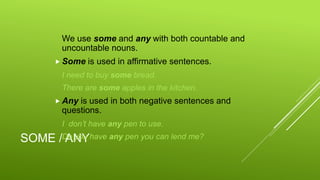
SOME / ANY
We use some and any with both countable and
uncountable nouns.
 Some is used in affirmative sentences.
I need to buy some bread.
There are some apples in the kitchen.
 Any is used in both negative sentences and
questions.
I don’t have any pen to use.
Do you have any pen you can lend me?
 We can use some in questions which are offers
or requests.
Would you like some coffee?
NO / ANY
 We use no after an affirmative verb and any after
a negative verb.
There is no milk left.
There isn’t any milk left.
SOMEBODY / ANYBODY / NOBODY /
EVERYBODY
PEOPLE THINGS PLACES
+ somebody
someone
something somewhere
- not anybody
not anyone
nobody
no one
not anything
nothing
not anywhere
nowhere
? anybody
anyone
anything anywhere
MUCH / MANY / A LOT OF /
A FEW / A LITTLE
 We use a lot of / lots of with both countable and
uncountable nouns.
I have lots of good movies to see.
I spend a lot of time watching TV.
 We use much and a little only with uncountable
nouns.
I don’t have much money to go out today.
I think I need a little help.
 We use many and a few only with countable nouns.
She has many nice color pens.
There are a few students who didn’t do the homework.
VERB
• Action Verbs
• Linking Verbs
• Helping/Main Verbs
There are different
types of verbs.
Some show action,
and some don’t.
An action verb
shows action. It
tells what the
subject of the
sentence does.
Action Verbs
Bill hit the ball.
The cat purred softly.
I walk to school.
Susan spoke to me.
A linking verb
links, or connects,
the subject to the
predicate. It does
not show action.
Common Linking
Verbs
am is are was
were be been
seems feels tastes
Linking Verbs
We are hungry.
He was late to school.
The winner is Johnny.
The rose smells good.
A helping verb
helps a main verb.
The helping verb
comes before the
main verb.
Helping/Main
Verbs
I am eating my lunch.
Ed has taken the test.
We were talking.
Practice Time
In the following
sentences, see if
you can identify
the verb.
Ready?
Let’s get started!
They are watching
television.
They are watching
television.
Verb: are watching
They are watching
television.
Verb: are watching
Type: helping/main
Frank was tired
after work.
Frank was tired
after work.
Verb: was
Frank was tired
after work.
Verb: was
Type: linking verb
My dad drove his
car to the store.
My dad drove his
car to the store.
Verb: drove
My dad drove his
car to the store.
Verb: drove
Type: action verb
Finding Nemo is her
favorite movie.
Finding Nemo is her
favorite movie.
Verb: is
Finding Nemo is her
favorite movie.
Verb: is
Type: linking verb
I did my homework
right after school.
I did my homework
right after school.
Verb: did
I did my homework
right after school.
Verb: did
Type: action verb
Ann was cooking
dinner in the
kitchen.
Ann was cooking
dinner in the
kitchen.
Verb: was cooking
Ann was cooking
dinner in the
kitchen.
Verb: was cooking
Type: helping/main
The boys were
playing in the park.
The boys were
playing in the park.
Verb: were playing
The boys were
playing in the park.
Verb: were playing
Type: helping/main
Sarah competed in
the track meet.
Sarah competed in
the track meet.
Verb: competed
Sarah competed in
the track meet.
Verb: competed
Type: action verb
The ocean water
tastes salty.
The ocean water
tastes salty.
Verb: tastes
The ocean water
tastes salty.
Verb: tastes
Type: linking verb
Thomas raised his
hand.
Thomas raised his
hand.
Verb: raised
Thomas raised his
hand.
Verb: raised
Type: action verb
The teacher
answered his
question.
The teacher
answered his
question.
Verb: answered
The teacher
answered his
question.
Verb: answered
Type: action verb
Randy is studying
for his grammar
test.
Randy is studying
for his grammar
test.
Verb: is studying
Randy is studying
for his grammar
test.
Verb: is studying
Type: helping/main
They will be late to
the party.
They will be late to
the party.
Verb: will be
They will be late to
the party.
Verb: will be
Type: linking verb
I am thirsty after all
that running.
I am thirsty after all
that running.
Verb: am
I am thirsty after all
that running.
Verb: am
Type: linking verb
We have learned a
lot about verbs.
We have learned a
lot about verbs.
Verb: have learned
We have learned a
lot about verbs.
Verb: have learned
Type: helping/main
THE TENSES
CONTENTS
 Introduction
 Classification based on Time Frame
 Classification based on Aspect
 Block diagram of Tenses
 List of Rules
 Present Tense
 Past Tense
 Future Tense
 List of Examples
INTRODUCTION
The word Tense is derived from
latin word “tempus” which means
time. A verb indicates the time of an
action, event or condition by
changing its form.
BASED ON TIME FRAME
The verb tenses may be categorized
according to the time frame:
Present Tense
Past Tense
Future Tense
Present Tense :---
Present tense expresses an unchanging,
repeated, or reoccurring action or situation that
exists only now. It can also represent a
widespread truth.
Past Tense :---
Past tense expresses an action or situation
that was started and finished in the past.
Future Tense :---
Future tense expresses an action or situation
that will occur in the future.
CONTENTS
BASED ON ASPECT
Verb tenses may also be categorized
according to aspect. Aspect refers to the
nature of the action described by the verb.
There are four aspects:
 Indefinite or Simple
 Continuous or Progressive
 Perfect or Complete
 Perfect Continuous
Indefinite Tense
The three indefinite tenses, or simple tenses, describe an action but do
not state whether the action is finished.
Continuous Tense
The three continuous tenses, incomplete tenses, or progressive
tenses, describe an unfinished action.
Perfect Tense
The three complete tenses, or perfect tenses, describe a finished
action.
Perfect Continuous Tense
To combine the complete tenses and the incomplete tenses, to describe
an action which was in progress and then finished
CONTENTS
THERE ARE TWELVE POSSIBLE VERB
TENSES.
Verb Tenses
Present
Present Indefinite
Present Continuous
Present Perfect
Present Perfect Cont.
Past
Past Indefinite
Past Continuous
Past Perfect
Past Perfect Cont.
Future
Future Indefinite
Future Continuous
Future Perfect
Future Perfect Cont.
CONTENTS
HERE IS A LIST OF RULES OF THESE
TENSES:
Simple
Forms
Progressive
Forms
Perfect
Forms
Perfect
Progressive
Forms
Present
Ist form +
s / es
am/is/are +
Ist form +
ing
have/ha
s + IIIrd
form
have/has
been + Ist
form + ing
Past IInd form
was/were +
Ist form +
ing
had +
IIIrd
form
had been +
Ist form +
ing
Future
will/shall
+ Ist form
will be + Ist
form + ing
will have
+ IIIrd
form
will have
been + Ist
form + ing
CONTENTS
PRESENT TENSE
Present
Present
Indefinite
Tense
Present
Continuous
Tense
Present Perfect
Tense
Present Perfect
Cont.Tense
PRESENT INDEFINITE TENSE
The simple present is used to describe an action, an event, or
condition that is occurring in the present, at the moment of speaking or
writing.
For Example—
I play.
He / She plays.
PRESENT CONTINUOUS TENSE
The present continuous emphasizes the continuing nature of an
act, event, or condition.
For Example—
I am playing.
He / She is playing.
They are playing.
PRESENT PERFECT TENSE
The present perfect tense is used to describe action that began
in the past and continues into the present or has just been completed.
For Example—
I have played.
He / She has played.
PRESENT PERFECT CONT.TENSE
The present perfect continuous is used to describe an action,
event, or condition that has begun in the past and continues into the
present.
For Example—
I / You have been playing.
He / She has been playing.
CONTENTS
PAST TENSE
Past
Past Indefinite
Tense
Past
Continuous
Tense
Past Perfect
Tense
Past Perfect
Cont.Tense
PAST INDEFINITE TENSE
The simple past is used to describe an action, an event, or
condition that occurred in the past.
For Example—
I played.
He / She played.
PAST CONTINUOUS TENSE
The past continuous tense is used to describe
actions ongoing in the past.
For Example—
I was playing.
He / She was playing.
You were playing.
PAST PERFECT TENSE
The past perfect tense is used to refer to actions that took place
and were completed in the past.
For Example—
I had played.
He / She had played.
PAST PERFECT CONT.TENSE
The past perfect continuous is used to indicate that a continuing
action in the past began before another past action began or interrupted
the first action.
For Example—
I had been playing.
He / She had been playing.
FUTURE TENSE
Future
Future
Indefinite
Tense
Future
Continuous
Tense
Future Perfect
Tense
Future Perfect
Cont.Tense
FUTURE INDEFINITE TENSE
The simple future is used to refer to actions that will take place
after the act of speaking or writing.
For Example—
I shall play.
He / She will play.
FUTURE CONTINUOUS TENSE
The future continuous tense is used to describe actions ongoing
in the future. The future progressive is used to refer to continuing action
that will occur in the future.
For Example—
I shall be playing.
He / She will be playing.
FUTURE PERFECT TENSE
The future perfect is used to refer to an action that will be
completed sometime in the future before another action takes place.
For Example—
I shall have played.
He / She will have played.
FUTURE PERFECT CONTINUOUS
TENSE
The future perfect continuous tense is used to
indicate a continuing action that will be completed at
some specified time in the future.
For Example—
I shall have been playing.
He / She will have been playing.
HERE IS A LIST OF EXAMPLES OF THESE TENSES AND THEIR
DEFINITIONS:
Simple
Forms
Progressive
Forms
Perfect
Forms
Perfect
Progressive
Forms
Present I play I am playing
I have
played
I have been
playing
Past I played
I was
playing
I had
played
I had been
playing
Future
I shall
play
I shall be
playing
I shall
have
played
I shall have
been
playing
Now Lets See How Modals Is
Used In Above Slide! ?And
Why It Is Used!?
MODAL VERBS
I. DEFINITION
II. STRUCTURE
III. HOW TO
USE !
I. DEFINITION
MODAL VERBS
A modal verb is a type of auxiliary verb
that is used to indicate modality-that is
likelihood, ability, permission, possiblity,...
Two of my friends
can play guitar
(ability)
MODAL VERBS
LIST OF MODAL VERBS
Can
Could
May
Might
Will
Would
Shall
Should
Ought to
Must
Subject Modal verb Main verb Complement
I
We
They
You
He
She
It
must
can
should
may
will
go to sleep.
drink some water.
eat some food.
do some exercise.
Use the basic form or INFINITIVE of
the main verbs after the modal verbs.
II. STRUCTURE
MODAL VERBS
a. Modal verbs do not add s or es to the
third person singular.
He can swim. He cans swim.
MODAL VERBS
 Simple
I could work
He could work
It could work
They could work
• Perfect
I could have worked
He could have worked
It could have worked
They could have worked
 Continuous
I could be working
He could be working
It could be working
They could be working
• Perfect continuous
I could have been working
He could have been working
It could have been working
They could have been working
MODAL VERBS
b. Modal verbs don’t need auxiliaries to form
negative and question.
Exp : She should stay.
She doesn’t should stay.→ She shouldn’t stay.
→ Why should she stay?Why does she stay?
c. Modal verbs don’t have infinitives or –ing
forms
Exp: canning to might
MODAL VERBS
HOW TO USE
CAN
Use Example
Ability / Possibility  They can control their own work.
Impossibility  We can’t fix it.
Asking for permission  Can I bring here?
Request  Can you help me?
MODAL VERBS
COULD
Use Example
permission  Could I borrow your dictionary?
Request  Could you say it again more slowly?
possibility  I think we could have another tea.
Future  I wish Cndrll could meet me next
week.Ability  He gave up his old job so he could
work for us.
MODAL VERBS
MAY
Use Example
permission  May I have another cup of coffee?
possibility  I may finish my homework
MODAL VERBS
MIGHT
Use Example
possibility  We'd better phone tomorrow, they
might be eating their dinner now.
.
THANK YOU

Grammar class

  • 1.
  • 2.
     Definition The grammarof a language is a complex of systems that may be analyzed and studied on these three levels. 1. Phonology (set of sounds/ symbols) 2. Morphology (combinations of sounds that carry single units of meaning) 3. Syntax (how single units of meaning are combined to form words phrases and sentences.
  • 3.
    PARTS OF SPEECH(NOUNS) Nouns 1. Definition 2. Proper / common 3. Singular / plural (annex) 4. Count / non-count /abstract (annex) (how much –how many) 5. Collectible (group nouns) 6. Units of measurement
  • 4.
    DEFINITION (PROPER AND COMMONNOUNS)  Nouns – words used to name a person, place, thing, object, quality, idea, concept, or an action. Ref. (American Heritage Dictionary, 2001)  Proper Nouns- special or particular name given to common nouns to distinguish them from others of the same kind. Example: common- woman proper Martha Proper Nouns A person Carlos a place Ryder Hospital a day Monday a monument The Statue of Liberty many others a pet Puppy a country Puerto Rico
  • 5.
    PROPER AND COMMONNOUNS COMMON PROPER COMMON PROPER day Saturday associations Members Club month October movies Titanic mountain El Yunque planets Neptune river The Amazon city San Juan ocean Pacific Ocean historical periods Middle Ages book Applied Linguistic language Spanish newspaper New York Times nationality Puerto Rican religion Catholic School course English 101 brand of product Cadillac institutions University of Puerto Rico
  • 6.
    NOUNS (SINGULAR ANDPLURAL)  Rule No. 1 (Add –s to the end of noun) cup cups student students  Rule No.2 consonants before “y” change –y to i and add –es city -cities party- parties lady-ladies  Rule No.3 vowels before “y” add –s boy –boys key –keys day -days
  • 7.
    SINGULAR AND PLURAL(CONT.)  Rule No. 4 (–f and –fe endings) change the –f or –fe to v and –es life –lives wife –wives thief –thieves  Rule No. 5 (sh, ch, x, ss endings) add –es bush –bushes match –matches box -boxes kiss -kisses  Rule No. 6 (consonant + o) add –es (vowel +o) –s tomato –tomatoes radio radios
  • 8.
    PRACTICE EXERCISES USE THEPLURAL FORM TO FILL IN THE BLANKS. (PROVIDED LIST) Baby Boy City Country Lady Party Tray Key Dictionary cowboy  They have one girl and two ______.  I visited many _______ last year.  Women give birth to _______.  She lost the _____ of the car and the house!  _____ rides horses in Texas.  Madrid and Paris are beautiful _______.  We must bring ______ to the English class.  Good evening _____ and gentleman.  On Saturday nights, I like to go to _______.  People carry their food on _____ at the cafeteria.
  • 9.
    PRONUNCIATION OF PLURALS(S / ES)  Group A Final –s is pronounced /z/ after voiced sounds (taxicabs, beds, dogs, balls, years, days, boys, trees, etc.)  Group B Final –s is pronounced /s/ after voiceless sounds (books, cups, groups, cats, students, desks, etc.)  Group C Final –s, es is pronounced /ez/ after “s” sounds (classes, horses, boxes, faces) after “z” sounds (sizes, roses, noises) after “sh” sounds (dishes, bushes) after “ch” sounds (matches, sandwiches) after “ge/dge” sounds (pages, ages, bridges, edges)
  • 10.
    IRREGULAR PLURAL FORMS(EXCEPTIONS)  Child children  Foot feet  Man men  Woman women  Mouse mice  Tooth teeth  Fish fish  _____ people (is always plural) (no s)
  • 11.
    COUNT AND NONCOUNTNOUNS  Count nouns a book books one book two books some books a lot of books many books a few books  Non-count nouns money some money a lot of money much money a little money  Common non-count nouns advice, furniture, love, peace, homework, luck information, food, mail, music, traffic, weather, work, bread, cheese, coffee, rice, sand, meat, milk, water, sugar, money, oil, liquids materials (paper) abstracts general food gases
  • 12.
    What is aPronoun? Here’s the Idea Why It Matters Practice and Apply Pronouns
  • 13.
    Pronoun A pronoun isa word that is used in place of a noun or another pronoun. Here’s the Idea
  • 14.
    A pronoun canrefer to a person, place, thing, or idea. Here’s the Idea
  • 15.
    The word thata pronoun refers to is called its antecedent. Ramon visited Death Valley, and he was impressed. Here’s the Idea
  • 16.
    Pronouns such aswe, I, he, them and it are called personal pronouns. Personal pronouns have a variety of forms to indicate different persons, numbers, and cases. Here’s the Idea
  • 17.
    There are first-person, second-person,and third-person personal pronouns, each having both singular and plural forms. Here’s the Idea
  • 18.
    Singular Plural FIRST PERSONFIRST PERSON SECOND PERSON SECOND PERSON THIRD PERSON THIRD PERSON I went out. We left early. You left too. You are leaving. He came by bus. They came by car. Here’s the Idea
  • 19.
    Each personal pronoun formsthree cases: subject, object, and possessive. Here’s the Idea
  • 20.
    POSSESSIVE OBJECT SUBJECT He read aboutDeath Valley. Julie asked him about the rocks. Ramon bought his book. Choose the pronoun form depending on the pronoun’s function in the sentence. Here’s the Idea
  • 21.
    Pronouns help youtalk about people concisely when you’re telling a story. Why It Matters
  • 22.
    Pronoun Agreement Here’s theIdea Why It Matters Practice and Apply Pronouns
  • 23.
    Antecedent The antecedent isthe noun or pronoun that a pronoun replaces or refers to. Here’s the Idea
  • 24.
    Use a singularpronoun to refer to a singular antecedent. One story has its setting in Egypt.story its Here’s the Idea
  • 25.
    Use a pluralpronoun to refer to a plural antecedent. The characters have their motives for murder.characters their Here’s the Idea
  • 26.
    The pronoun mustagree in person with the antecedent. Louis likes his mysteries to have surprise endings. Louis his Here’s the Idea
  • 27.
    The gender ofthe pronoun must be the same as the gender of its antecedent. Here’s the Idea
  • 28.
    Personal pronouns havethree gender forms: • masculine he, his, him • feminine she, her, hers • neuter it, its Here’s the Idea
  • 29.
    The hero hasto use all his wits to solve the crime. Agatha Christie sets many of her stories in England. Agatha Christie her hero his Here’s the Idea
  • 30.
    In your writing,you will sometimes refer to several people or groups of people. Correct pronoun-antecedent agreement will help your readers keep track of who is who in your writing. Why It Matters
  • 31.
  • 32.
    SOME / ANY Weuse some and any with both countable and uncountable nouns.  Some is used in affirmative sentences. I need to buy some bread. There are some apples in the kitchen.  Any is used in both negative sentences and questions. I don’t have any pen to use. Do you have any pen you can lend me?
  • 33.
     We canuse some in questions which are offers or requests. Would you like some coffee? NO / ANY  We use no after an affirmative verb and any after a negative verb. There is no milk left. There isn’t any milk left.
  • 34.
    SOMEBODY / ANYBODY/ NOBODY / EVERYBODY PEOPLE THINGS PLACES + somebody someone something somewhere - not anybody not anyone nobody no one not anything nothing not anywhere nowhere ? anybody anyone anything anywhere
  • 35.
    MUCH / MANY/ A LOT OF / A FEW / A LITTLE  We use a lot of / lots of with both countable and uncountable nouns. I have lots of good movies to see. I spend a lot of time watching TV.
  • 36.
     We usemuch and a little only with uncountable nouns. I don’t have much money to go out today. I think I need a little help.  We use many and a few only with countable nouns. She has many nice color pens. There are a few students who didn’t do the homework.
  • 37.
    VERB • Action Verbs •Linking Verbs • Helping/Main Verbs
  • 38.
    There are different typesof verbs. Some show action, and some don’t.
  • 39.
    An action verb showsaction. It tells what the subject of the sentence does.
  • 40.
    Action Verbs Bill hitthe ball. The cat purred softly. I walk to school. Susan spoke to me.
  • 41.
    A linking verb links,or connects, the subject to the predicate. It does not show action.
  • 42.
    Common Linking Verbs am isare was were be been seems feels tastes
  • 43.
    Linking Verbs We arehungry. He was late to school. The winner is Johnny. The rose smells good.
  • 44.
    A helping verb helpsa main verb. The helping verb comes before the main verb.
  • 45.
    Helping/Main Verbs I am eatingmy lunch. Ed has taken the test. We were talking.
  • 46.
    Practice Time In thefollowing sentences, see if you can identify the verb.
  • 47.
  • 48.
  • 49.
  • 50.
    They are watching television. Verb:are watching Type: helping/main
  • 51.
  • 52.
    Frank was tired afterwork. Verb: was
  • 53.
    Frank was tired afterwork. Verb: was Type: linking verb
  • 54.
    My dad drovehis car to the store.
  • 55.
    My dad drovehis car to the store. Verb: drove
  • 56.
    My dad drovehis car to the store. Verb: drove Type: action verb
  • 57.
    Finding Nemo isher favorite movie.
  • 58.
    Finding Nemo isher favorite movie. Verb: is
  • 59.
    Finding Nemo isher favorite movie. Verb: is Type: linking verb
  • 60.
    I did myhomework right after school.
  • 61.
    I did myhomework right after school. Verb: did
  • 62.
    I did myhomework right after school. Verb: did Type: action verb
  • 63.
    Ann was cooking dinnerin the kitchen.
  • 64.
    Ann was cooking dinnerin the kitchen. Verb: was cooking
  • 65.
    Ann was cooking dinnerin the kitchen. Verb: was cooking Type: helping/main
  • 66.
  • 67.
    The boys were playingin the park. Verb: were playing
  • 68.
    The boys were playingin the park. Verb: were playing Type: helping/main
  • 69.
  • 70.
    Sarah competed in thetrack meet. Verb: competed
  • 71.
    Sarah competed in thetrack meet. Verb: competed Type: action verb
  • 72.
  • 73.
    The ocean water tastessalty. Verb: tastes
  • 74.
    The ocean water tastessalty. Verb: tastes Type: linking verb
  • 75.
  • 76.
  • 77.
    Thomas raised his hand. Verb:raised Type: action verb
  • 78.
  • 79.
  • 80.
    The teacher answered his question. Verb:answered Type: action verb
  • 81.
    Randy is studying forhis grammar test.
  • 82.
    Randy is studying forhis grammar test. Verb: is studying
  • 83.
    Randy is studying forhis grammar test. Verb: is studying Type: helping/main
  • 84.
    They will belate to the party.
  • 85.
    They will belate to the party. Verb: will be
  • 86.
    They will belate to the party. Verb: will be Type: linking verb
  • 87.
    I am thirstyafter all that running.
  • 88.
    I am thirstyafter all that running. Verb: am
  • 89.
    I am thirstyafter all that running. Verb: am Type: linking verb
  • 90.
    We have learneda lot about verbs.
  • 91.
    We have learneda lot about verbs. Verb: have learned
  • 92.
    We have learneda lot about verbs. Verb: have learned Type: helping/main
  • 93.
  • 94.
    CONTENTS  Introduction  Classificationbased on Time Frame  Classification based on Aspect  Block diagram of Tenses  List of Rules  Present Tense  Past Tense  Future Tense  List of Examples
  • 95.
    INTRODUCTION The word Tenseis derived from latin word “tempus” which means time. A verb indicates the time of an action, event or condition by changing its form.
  • 96.
    BASED ON TIMEFRAME The verb tenses may be categorized according to the time frame: Present Tense Past Tense Future Tense
  • 97.
    Present Tense :--- Presenttense expresses an unchanging, repeated, or reoccurring action or situation that exists only now. It can also represent a widespread truth. Past Tense :--- Past tense expresses an action or situation that was started and finished in the past. Future Tense :--- Future tense expresses an action or situation that will occur in the future. CONTENTS
  • 98.
    BASED ON ASPECT Verbtenses may also be categorized according to aspect. Aspect refers to the nature of the action described by the verb. There are four aspects:  Indefinite or Simple  Continuous or Progressive  Perfect or Complete  Perfect Continuous
  • 99.
    Indefinite Tense The threeindefinite tenses, or simple tenses, describe an action but do not state whether the action is finished. Continuous Tense The three continuous tenses, incomplete tenses, or progressive tenses, describe an unfinished action. Perfect Tense The three complete tenses, or perfect tenses, describe a finished action. Perfect Continuous Tense To combine the complete tenses and the incomplete tenses, to describe an action which was in progress and then finished CONTENTS
  • 100.
    THERE ARE TWELVEPOSSIBLE VERB TENSES. Verb Tenses Present Present Indefinite Present Continuous Present Perfect Present Perfect Cont. Past Past Indefinite Past Continuous Past Perfect Past Perfect Cont. Future Future Indefinite Future Continuous Future Perfect Future Perfect Cont. CONTENTS
  • 101.
    HERE IS ALIST OF RULES OF THESE TENSES: Simple Forms Progressive Forms Perfect Forms Perfect Progressive Forms Present Ist form + s / es am/is/are + Ist form + ing have/ha s + IIIrd form have/has been + Ist form + ing Past IInd form was/were + Ist form + ing had + IIIrd form had been + Ist form + ing Future will/shall + Ist form will be + Ist form + ing will have + IIIrd form will have been + Ist form + ing CONTENTS
  • 102.
  • 103.
    PRESENT INDEFINITE TENSE Thesimple present is used to describe an action, an event, or condition that is occurring in the present, at the moment of speaking or writing. For Example— I play. He / She plays.
  • 104.
    PRESENT CONTINUOUS TENSE Thepresent continuous emphasizes the continuing nature of an act, event, or condition. For Example— I am playing. He / She is playing. They are playing.
  • 105.
    PRESENT PERFECT TENSE Thepresent perfect tense is used to describe action that began in the past and continues into the present or has just been completed. For Example— I have played. He / She has played.
  • 106.
    PRESENT PERFECT CONT.TENSE Thepresent perfect continuous is used to describe an action, event, or condition that has begun in the past and continues into the present. For Example— I / You have been playing. He / She has been playing. CONTENTS
  • 107.
  • 108.
    PAST INDEFINITE TENSE Thesimple past is used to describe an action, an event, or condition that occurred in the past. For Example— I played. He / She played.
  • 109.
    PAST CONTINUOUS TENSE Thepast continuous tense is used to describe actions ongoing in the past. For Example— I was playing. He / She was playing. You were playing.
  • 110.
    PAST PERFECT TENSE Thepast perfect tense is used to refer to actions that took place and were completed in the past. For Example— I had played. He / She had played.
  • 111.
    PAST PERFECT CONT.TENSE Thepast perfect continuous is used to indicate that a continuing action in the past began before another past action began or interrupted the first action. For Example— I had been playing. He / She had been playing.
  • 112.
  • 113.
    FUTURE INDEFINITE TENSE Thesimple future is used to refer to actions that will take place after the act of speaking or writing. For Example— I shall play. He / She will play.
  • 114.
    FUTURE CONTINUOUS TENSE Thefuture continuous tense is used to describe actions ongoing in the future. The future progressive is used to refer to continuing action that will occur in the future. For Example— I shall be playing. He / She will be playing.
  • 115.
    FUTURE PERFECT TENSE Thefuture perfect is used to refer to an action that will be completed sometime in the future before another action takes place. For Example— I shall have played. He / She will have played.
  • 116.
    FUTURE PERFECT CONTINUOUS TENSE Thefuture perfect continuous tense is used to indicate a continuing action that will be completed at some specified time in the future. For Example— I shall have been playing. He / She will have been playing.
  • 117.
    HERE IS ALIST OF EXAMPLES OF THESE TENSES AND THEIR DEFINITIONS: Simple Forms Progressive Forms Perfect Forms Perfect Progressive Forms Present I play I am playing I have played I have been playing Past I played I was playing I had played I had been playing Future I shall play I shall be playing I shall have played I shall have been playing
  • 120.
    Now Lets SeeHow Modals Is Used In Above Slide! ?And Why It Is Used!?
  • 121.
    MODAL VERBS I. DEFINITION II.STRUCTURE III. HOW TO USE !
  • 122.
    I. DEFINITION MODAL VERBS Amodal verb is a type of auxiliary verb that is used to indicate modality-that is likelihood, ability, permission, possiblity,... Two of my friends can play guitar (ability)
  • 123.
    MODAL VERBS LIST OFMODAL VERBS Can Could May Might Will Would Shall Should Ought to Must
  • 124.
    Subject Modal verbMain verb Complement I We They You He She It must can should may will go to sleep. drink some water. eat some food. do some exercise. Use the basic form or INFINITIVE of the main verbs after the modal verbs. II. STRUCTURE
  • 125.
    MODAL VERBS a. Modalverbs do not add s or es to the third person singular. He can swim. He cans swim.
  • 126.
    MODAL VERBS  Simple Icould work He could work It could work They could work • Perfect I could have worked He could have worked It could have worked They could have worked  Continuous I could be working He could be working It could be working They could be working • Perfect continuous I could have been working He could have been working It could have been working They could have been working
  • 127.
    MODAL VERBS b. Modalverbs don’t need auxiliaries to form negative and question. Exp : She should stay. She doesn’t should stay.→ She shouldn’t stay. → Why should she stay?Why does she stay? c. Modal verbs don’t have infinitives or –ing forms Exp: canning to might
  • 128.
    MODAL VERBS HOW TOUSE CAN Use Example Ability / Possibility  They can control their own work. Impossibility  We can’t fix it. Asking for permission  Can I bring here? Request  Can you help me?
  • 129.
    MODAL VERBS COULD Use Example permission Could I borrow your dictionary? Request  Could you say it again more slowly? possibility  I think we could have another tea. Future  I wish Cndrll could meet me next week.Ability  He gave up his old job so he could work for us.
  • 130.
    MODAL VERBS MAY Use Example permission May I have another cup of coffee? possibility  I may finish my homework
  • 131.
    MODAL VERBS MIGHT Use Example possibility We'd better phone tomorrow, they might be eating their dinner now. .
  • 132.