LANE 333 -
                                            MORPHOLOGY
                                            2012 – Term 1


ALLOMORPHS                                            6

        By:            http://SBANJAR.kau.edu.sa/
Dr. Shadia Y. Banjar   http://wwwdrshadiabanjar.blogspot.com
             1                               Dr. Shadia Yousef Banjar
Morphemes and Allomorphs

    PAST TENSE: called [d], talked [t], glided [ǝd]


               MORPHEME:

                                             [-d]


ALLOMORPHS:
                       /-d/                  /-t/     /-ǝd/


2                                                      Dr. Shadia Yousef Banjar
Morphemes and Allomorphs

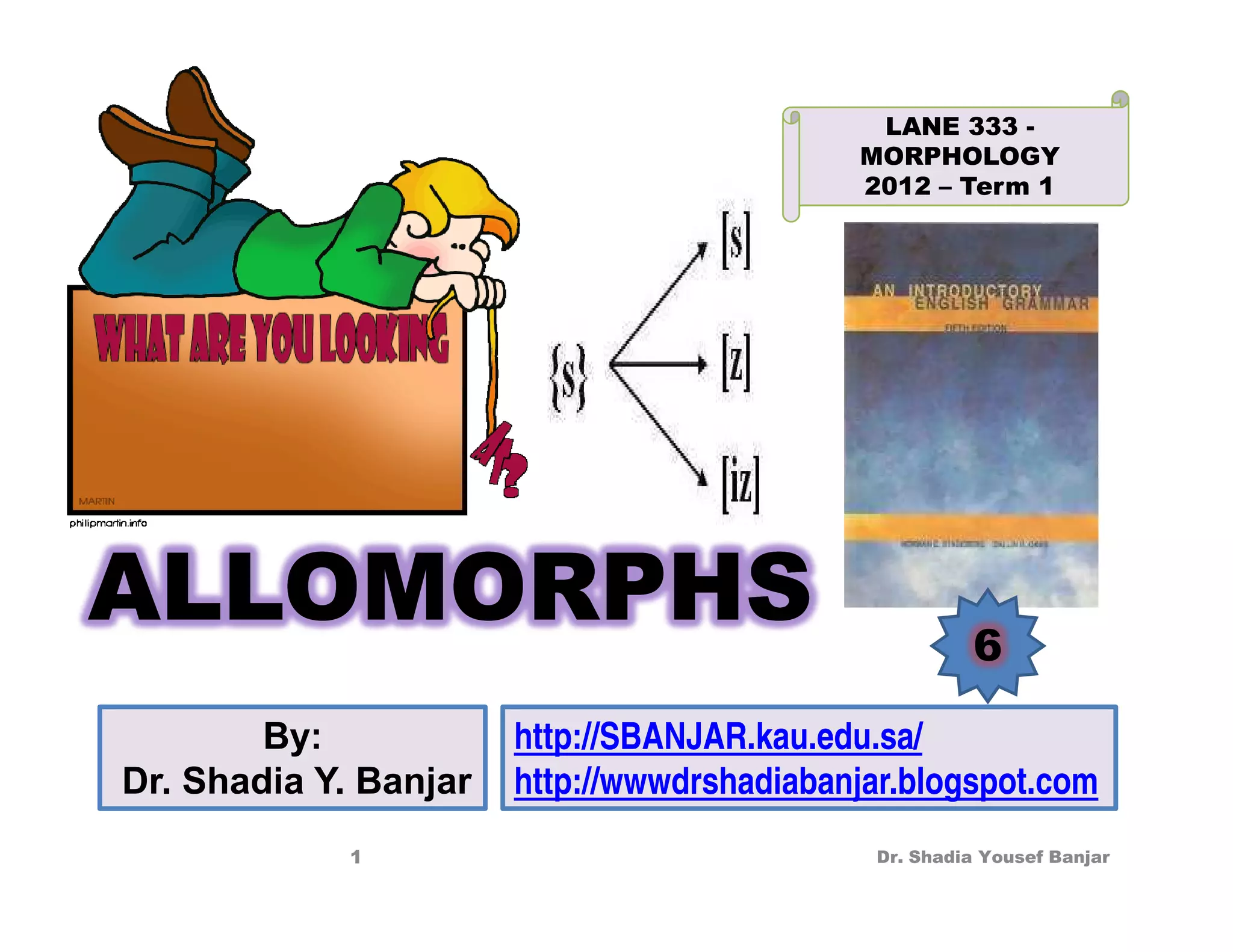
    Plural formation: desks [s], cars [z], buses [ǝz]


                    MORPHEME:
                                                   [-s]


ALLOMORPHS:
                          /-s/                    /-z/    /-ǝz/


3                                                          Dr. Shadia Yousef Banjar
Morphemes and Allomorphs

    The negative [in-]: insane [in] , incomplete [iŋ], impossible [im], illegal [il],
                    [in-                         [iŋ
                                                  iŋ],            [im
                                                                   im],         [il
                                                                                 il],
                [ir
                 ir].
    irrevocable [ir].


        MORPHEME:
                                                  [in-]


                      /in-/         /iŋ-/        /im-/         /il-/          /ir-/
ALLOMORPHS:


4                                                                        Dr. Shadia Yousef Banjar
ALLOMORPHS:
VARIATIONS OF MORPHEMES
DEFINITION:
An allomorph is ‘any of the different forms of a
morpheme’.
                          [Richards, Platt & Weber, 1987: 9]
EXAMPLE: long, length
MORPHEME      FREE ALLOMORPH   BOUND ALLOMORPH
     {long}       /lƆŋ/              /lɛŋ-/
                                       ɛŋ-
                                       ɛŋ

 NOTE: a morpheme may have more than
       one phonemic form.
 5                                                Dr. Shadia Yousef Banjar
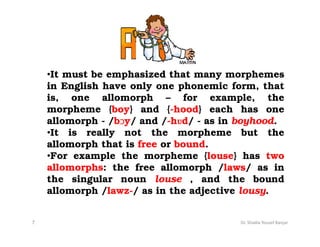
SELECTION OF ALLOMORPHS:
                               •The past-tense ending , the morpheme {-D pt}, has
                               three phonemic forms.
    {-D pt}                    •The choice depends on the preceding sound.
                                                                                     ǝd/
                               •After an alveolar stop /t/ or /d/, the allomorph /-ǝd/
    /-ǝd/ as in parted
      ǝd/                      takes place as in parted /partǝd/.
                                                           partǝd/
    /partǝd/
     partǝd/                   •After a voiceless consonant other than /t/, the
                                After
                                                                            ӕft/.
                               allomorph /-t/takes place as in laughed/lӕft/.
                                              takes
                      ӕst/
    /-t/as in passed/pӕst/     •After a voiced consonant other than /d/, the
                                After
                               allomorph /-d/ takes place as in begged/bɛgd/.ɛ d
    /-d/ as in seemed /simd/   •The occurrence of one or another of them
                                The
                               depends on its phonological environment.
                                                               environment.
                                This
                               •This    pattern     of    occurrence       is     called
                               complementary distribution.
                                                distribution.

NOTE: These three phonemic forms of {-Dpt} are not
      interchangeable. They are positional variants. They
      are allomorphs belong to the same morpheme.
6                                                                    Dr. Shadia Yousef Banjar
•It must be emphasized that many morphemes
    in English have only one phonemic form, that
    is, one allomorph – for example, the
    morpheme {boy} and {-hood} each has one
    allomorph - /bŦy/ and /-hUd/ - as in boyhood.
    •It is really not the morpheme but the
    allomorph that is free or bound.
    •For example the morpheme {louse} has two
    allomorphs: the free allomorph /laws/ as in
    the singular noun louse , and the bound
    allomorph /lawz-/ as in the adjective lousy.


7                                       Dr. Shadia Yousef Banjar
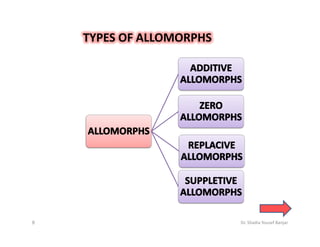
TYPES OF ALLOMORPHS


8                         Dr. Shadia Yousef Banjar
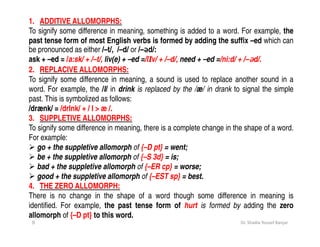
1. ADDITIVE ALLOMORPHS:
To signify some difference in meaning, something is added to a word. For example, the
past tense form of most English verbs is formed by adding the suffix –ed which can
                                         ƽ
be pronounced as either /–t/, /–d/ or /–ƽd/:
ask + –ed = /a:sk/ + /–t/, liv(e) + –ed =/lΙv/ + /–d/, need + –ed =/ni:d/ + /–ƽd/.
2. REPLACIVE ALLOMORPHS:
To signify some difference in meaning, a sound is used to replace another sound in a
word. For example, the /Ι/ in drink is replaced by the /æ/ in drank to signal the simple
past. This is symbolized as follows:
/drænk/ = /drΙnk/ + / Ι > æ /.
3. SUPPLETIVE ALLOMORPHS:
To signify some difference in meaning, there is a complete change in the shape of a word.
For example:
   go + the suppletive allomorph of {–D pt} = went;
   be + the suppletive allomorph of {–S 3d} = is;
   bad + the suppletive allomorph of {–ER cp} = worse;
   good + the suppletive allomorph of {–EST sp} = best.
4. THE ZERO ALLOMORPH:
There is no change in the shape of a word though some difference in meaning is
identified. For example, the past tense form of hurt is formed by adding the zero
allomorph of {–D pt} to this word.
 9                                                                     Dr. Shadia Yousef Banjar
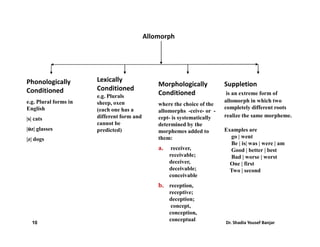
Allomorph


Phonologically         Lexically
                                                Morphologically           Suppletion
Conditioned            Conditioned
                       e.g. Plurals
                                                Conditioned                is an extreme form of
e.g. Plural forms in   sheep, oxen                                        allomorph in which two
                                                where the choice of the
English                (each one has a                                    completely different roots
                                                allomorphs -ceive- or -
                       different form and       cept- is systematically   realize the same morpheme.
|s| cats
                       cannot be                determined by the
 ǝ
|ǝz| glasses           predicted)               morphemes added to        Examples are
|z| dogs                                        them:                       go | went
                                                                            Be | is| was | were | am
                                                a.    receiver,             Good | better | best
                                                     receivable;            Bad | worse | worst
                                                     deceiver,              One | first
                                                     deceivable;            Two | second
                                                     conceivable
                                                b. reception,
                                                     receptive;
                                                     deception;
                                                      concept,
                                                     conception,
                                                     conceptual
  10                                                                      Dr. Shadia Yousef Banjar
Sing

                                   /siŋ/
                                    siŋ/
               Walk
                                             Sang
                /wƆk/
                  Ɔk/
                  Ɔk
                                             /sӕŋ/
                                             /sӕ
                           [past]
                            /d/

     A schematic representation of the lexicon as the irregular allomorphs are
     stored as distinct lexical entries, while the regular past tense form is
     derived by combining the stored stem and the stored past tense
     morpheme according to the regular rule. (Linnaea C. Stockall, 1999).

11                                                                Dr. Shadia Yousef Banjar
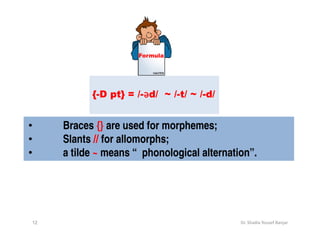
Formula


                       ƽ
           {-D pt} = /-ƽd/ ~ /-t/ ~ /-d/


•    Braces {} are used for morphemes;
•    Slants // for allomorphs;
•    a tilde ~ means “ phonological alternation”.


12                                           Dr. Shadia Yousef Banjar
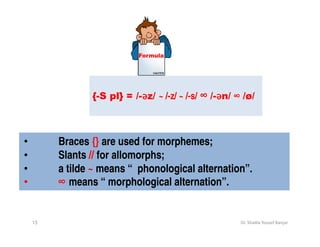
Formula


                {-S pl} = /-ƽz/ ~ /-z/ ~ /-s/ ∞ /-ƽn/ ∞ /ø/
                            ƽ                     ƽ


•        Braces {} are used for morphemes;
•        Slants // for allomorphs;
•        a tilde ~ means “ phonological alternation”.
•        ∞ means “ morphological alternation”.


    13                                                 Dr. Shadia Yousef Banjar
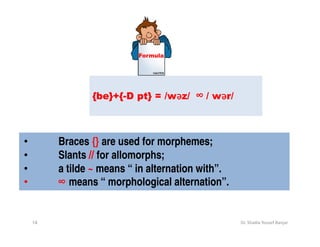
Formula


                {be}+{-D pt} = /wƽz/ ∞ / wƽr/
                                 ƽ        ƽ


•        Braces {} are used for morphemes;
•        Slants // for allomorphs;
•        a tilde ~ means “ in alternation with”.
•        ∞ means “ morphological alternation”.


    14                                             Dr. Shadia Yousef Banjar
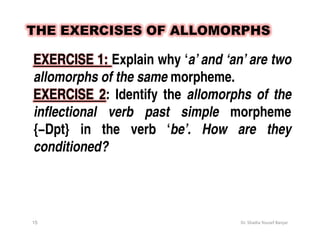
THE EXERCISES OF ALLOMORPHS

EXERCISE 1: Explain why ‘a’ and ‘an’ are two
allomorphs of the same morpheme.
EXERCISE 2: Identify the allomorphs of the
inflectional verb past simple morpheme
{−Dpt} in the verb ‘be’. How are they
conditioned?


15                                 Dr. Shadia Yousef Banjar
16   Dr. Shadia Yousef Banjar

Allomorphs - Dr. Shadia Yousef Banjar

  • 1.
    LANE 333 - MORPHOLOGY 2012 – Term 1 ALLOMORPHS 6 By: http://SBANJAR.kau.edu.sa/ Dr. Shadia Y. Banjar http://wwwdrshadiabanjar.blogspot.com 1 Dr. Shadia Yousef Banjar
  • 2.
    Morphemes and Allomorphs PAST TENSE: called [d], talked [t], glided [ǝd] MORPHEME: [-d] ALLOMORPHS: /-d/ /-t/ /-ǝd/ 2 Dr. Shadia Yousef Banjar
  • 3.
    Morphemes and Allomorphs Plural formation: desks [s], cars [z], buses [ǝz] MORPHEME: [-s] ALLOMORPHS: /-s/ /-z/ /-ǝz/ 3 Dr. Shadia Yousef Banjar
  • 4.
    Morphemes and Allomorphs The negative [in-]: insane [in] , incomplete [iŋ], impossible [im], illegal [il], [in- [iŋ iŋ], [im im], [il il], [ir ir]. irrevocable [ir]. MORPHEME: [in-] /in-/ /iŋ-/ /im-/ /il-/ /ir-/ ALLOMORPHS: 4 Dr. Shadia Yousef Banjar
  • 5.
    ALLOMORPHS: VARIATIONS OF MORPHEMES DEFINITION: Anallomorph is ‘any of the different forms of a morpheme’. [Richards, Platt & Weber, 1987: 9] EXAMPLE: long, length MORPHEME FREE ALLOMORPH BOUND ALLOMORPH {long} /lƆŋ/ /lɛŋ-/ ɛŋ- ɛŋ NOTE: a morpheme may have more than one phonemic form. 5 Dr. Shadia Yousef Banjar
  • 6.
    SELECTION OF ALLOMORPHS: •The past-tense ending , the morpheme {-D pt}, has three phonemic forms. {-D pt} •The choice depends on the preceding sound. ǝd/ •After an alveolar stop /t/ or /d/, the allomorph /-ǝd/ /-ǝd/ as in parted ǝd/ takes place as in parted /partǝd/. partǝd/ /partǝd/ partǝd/ •After a voiceless consonant other than /t/, the After ӕft/. allomorph /-t/takes place as in laughed/lӕft/. takes ӕst/ /-t/as in passed/pӕst/ •After a voiced consonant other than /d/, the After allomorph /-d/ takes place as in begged/bɛgd/.ɛ d /-d/ as in seemed /simd/ •The occurrence of one or another of them The depends on its phonological environment. environment. This •This pattern of occurrence is called complementary distribution. distribution. NOTE: These three phonemic forms of {-Dpt} are not interchangeable. They are positional variants. They are allomorphs belong to the same morpheme. 6 Dr. Shadia Yousef Banjar
  • 7.
    •It must beemphasized that many morphemes in English have only one phonemic form, that is, one allomorph – for example, the morpheme {boy} and {-hood} each has one allomorph - /bŦy/ and /-hUd/ - as in boyhood. •It is really not the morpheme but the allomorph that is free or bound. •For example the morpheme {louse} has two allomorphs: the free allomorph /laws/ as in the singular noun louse , and the bound allomorph /lawz-/ as in the adjective lousy. 7 Dr. Shadia Yousef Banjar
  • 8.
    TYPES OF ALLOMORPHS 8 Dr. Shadia Yousef Banjar
  • 9.
    1. ADDITIVE ALLOMORPHS: Tosignify some difference in meaning, something is added to a word. For example, the past tense form of most English verbs is formed by adding the suffix –ed which can ƽ be pronounced as either /–t/, /–d/ or /–ƽd/: ask + –ed = /a:sk/ + /–t/, liv(e) + –ed =/lΙv/ + /–d/, need + –ed =/ni:d/ + /–ƽd/. 2. REPLACIVE ALLOMORPHS: To signify some difference in meaning, a sound is used to replace another sound in a word. For example, the /Ι/ in drink is replaced by the /æ/ in drank to signal the simple past. This is symbolized as follows: /drænk/ = /drΙnk/ + / Ι > æ /. 3. SUPPLETIVE ALLOMORPHS: To signify some difference in meaning, there is a complete change in the shape of a word. For example: go + the suppletive allomorph of {–D pt} = went; be + the suppletive allomorph of {–S 3d} = is; bad + the suppletive allomorph of {–ER cp} = worse; good + the suppletive allomorph of {–EST sp} = best. 4. THE ZERO ALLOMORPH: There is no change in the shape of a word though some difference in meaning is identified. For example, the past tense form of hurt is formed by adding the zero allomorph of {–D pt} to this word. 9 Dr. Shadia Yousef Banjar
  • 10.
    Allomorph Phonologically Lexically Morphologically Suppletion Conditioned Conditioned e.g. Plurals Conditioned is an extreme form of e.g. Plural forms in sheep, oxen allomorph in which two where the choice of the English (each one has a completely different roots allomorphs -ceive- or - different form and cept- is systematically realize the same morpheme. |s| cats cannot be determined by the ǝ |ǝz| glasses predicted) morphemes added to Examples are |z| dogs them: go | went Be | is| was | were | am a. receiver, Good | better | best receivable; Bad | worse | worst deceiver, One | first deceivable; Two | second conceivable b. reception, receptive; deception; concept, conception, conceptual 10 Dr. Shadia Yousef Banjar
  • 11.
    Sing /siŋ/ siŋ/ Walk Sang /wƆk/ Ɔk/ Ɔk /sӕŋ/ /sӕ [past] /d/ A schematic representation of the lexicon as the irregular allomorphs are stored as distinct lexical entries, while the regular past tense form is derived by combining the stored stem and the stored past tense morpheme according to the regular rule. (Linnaea C. Stockall, 1999). 11 Dr. Shadia Yousef Banjar
  • 12.
    Formula ƽ {-D pt} = /-ƽd/ ~ /-t/ ~ /-d/ • Braces {} are used for morphemes; • Slants // for allomorphs; • a tilde ~ means “ phonological alternation”. 12 Dr. Shadia Yousef Banjar
  • 13.
    Formula {-S pl} = /-ƽz/ ~ /-z/ ~ /-s/ ∞ /-ƽn/ ∞ /ø/ ƽ ƽ • Braces {} are used for morphemes; • Slants // for allomorphs; • a tilde ~ means “ phonological alternation”. • ∞ means “ morphological alternation”. 13 Dr. Shadia Yousef Banjar
  • 14.
    Formula {be}+{-D pt} = /wƽz/ ∞ / wƽr/ ƽ ƽ • Braces {} are used for morphemes; • Slants // for allomorphs; • a tilde ~ means “ in alternation with”. • ∞ means “ morphological alternation”. 14 Dr. Shadia Yousef Banjar
  • 15.
    THE EXERCISES OFALLOMORPHS EXERCISE 1: Explain why ‘a’ and ‘an’ are two allomorphs of the same morpheme. EXERCISE 2: Identify the allomorphs of the inflectional verb past simple morpheme {−Dpt} in the verb ‘be’. How are they conditioned? 15 Dr. Shadia Yousef Banjar
  • 16.
    16 Dr. Shadia Yousef Banjar