Intermediate Level  Grammar Review
References http:// esl.about.com/od/beginningenglish/ig/Basic -English/   http:// esl.about.com/od/beginningenglish/ig/Basic -English/   http://esl.about.com/od/beginningenglish/ig/Basic-English/Prepositions-of-Place.htm   http://esl.about.com/od/beginningenglish/ig/Basic-English/Articles.htm   http://esl.about.com/od/beginningenglish/ig/Basic-English/Like.htm   http://esl.about.com/od/beginningenglish/ig/Basic-English/Irregular-Verbs.htm   http://esl.about.com/od/beginningenglish/ig/Basic-English/Pronouns.htm
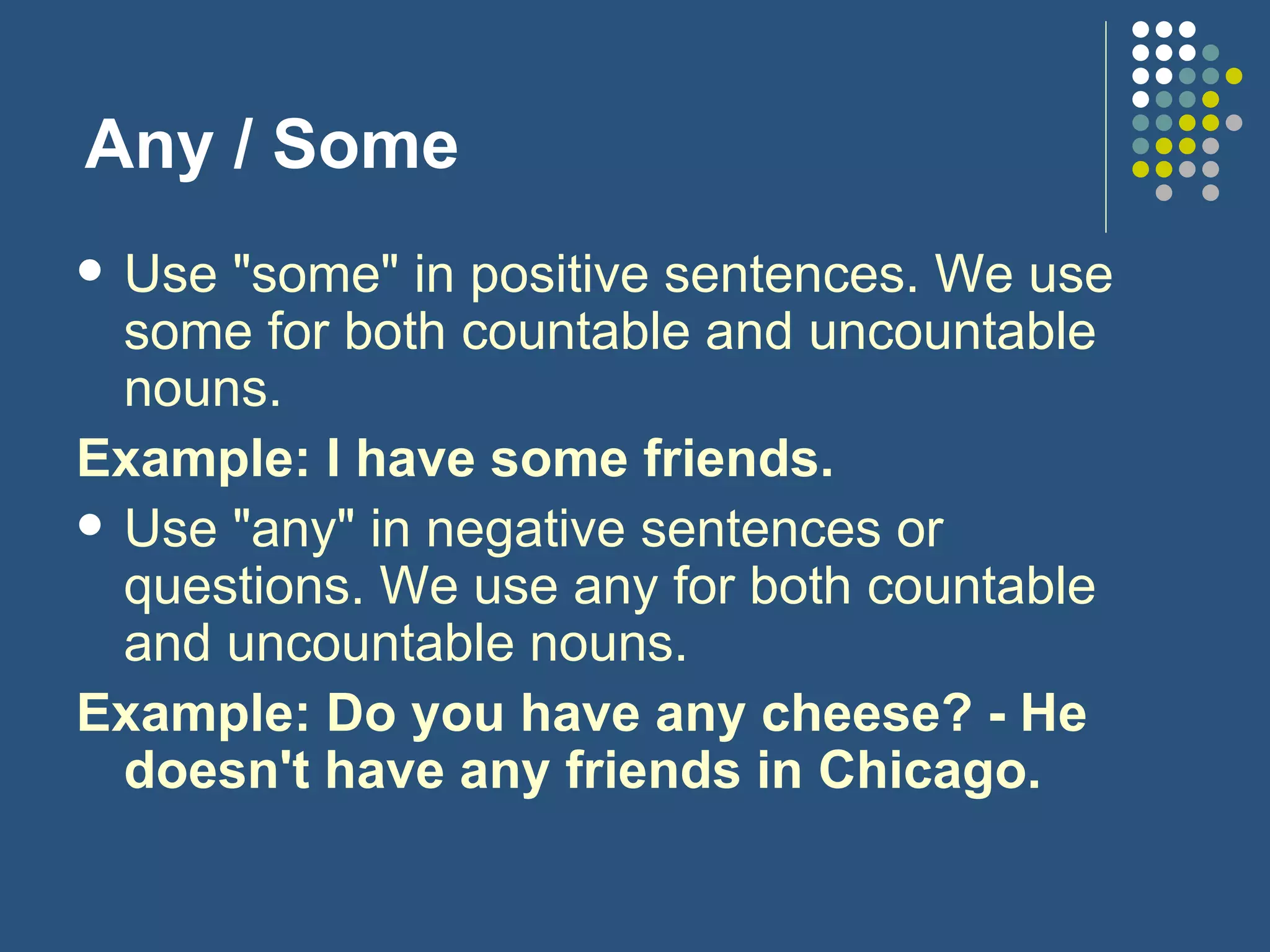
Any / Some Use "some" in positive sentences. We use some for both countable and uncountable nouns. Example: I have some friends. Use "any" in negative sentences or questions. We use any for both countable and uncountable nouns. Example: Do you have any cheese? - He doesn't have any friends in Chicago.
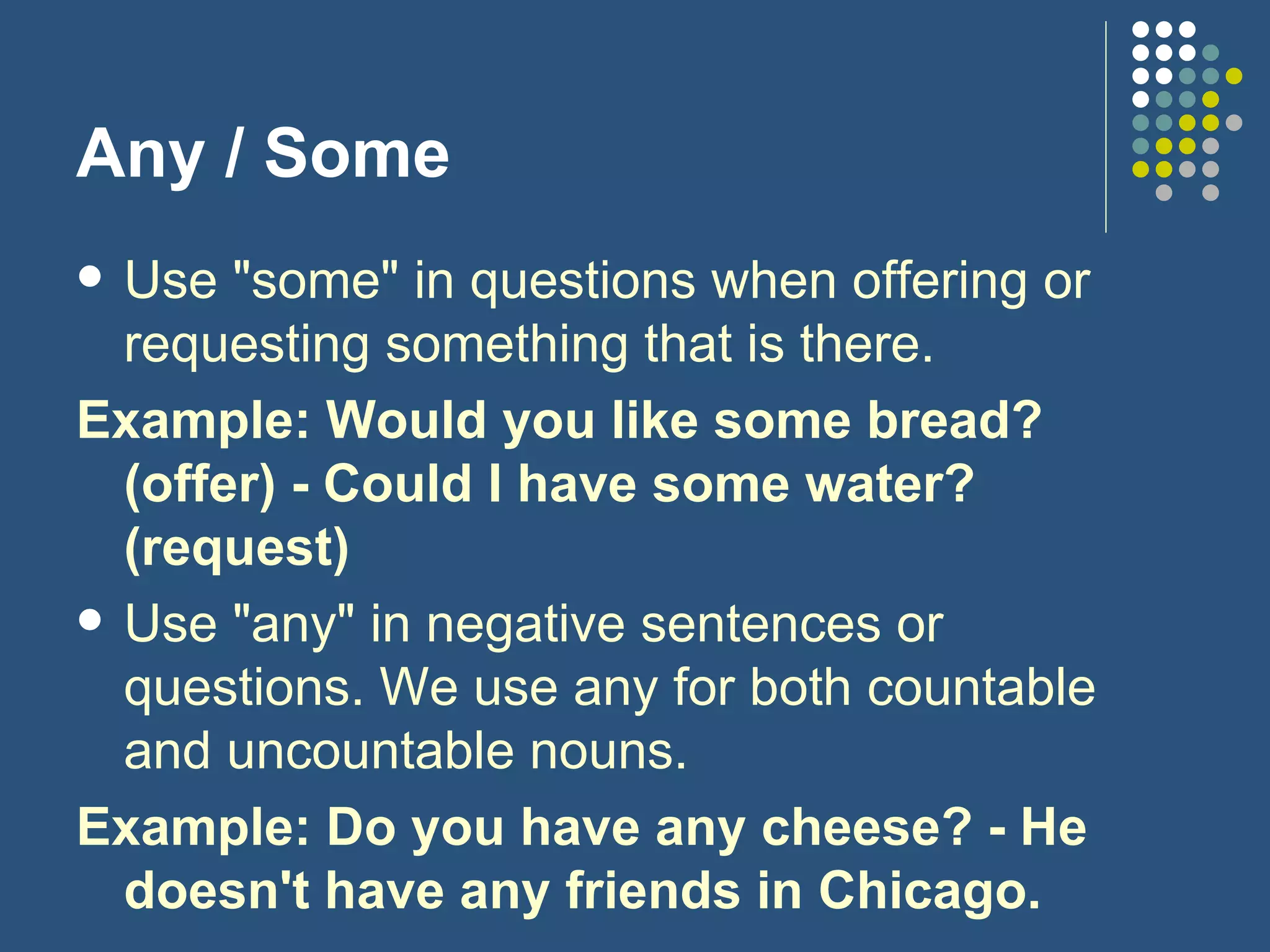
Any / Some Use "some" in questions when offering or requesting something that is there. Example: Would you like some bread? (offer) - Could I have some water? (request) Use "any" in negative sentences or questions. We use any for both countable and uncountable nouns. Example: Do you have any cheese? - He doesn't have any friends in Chicago.
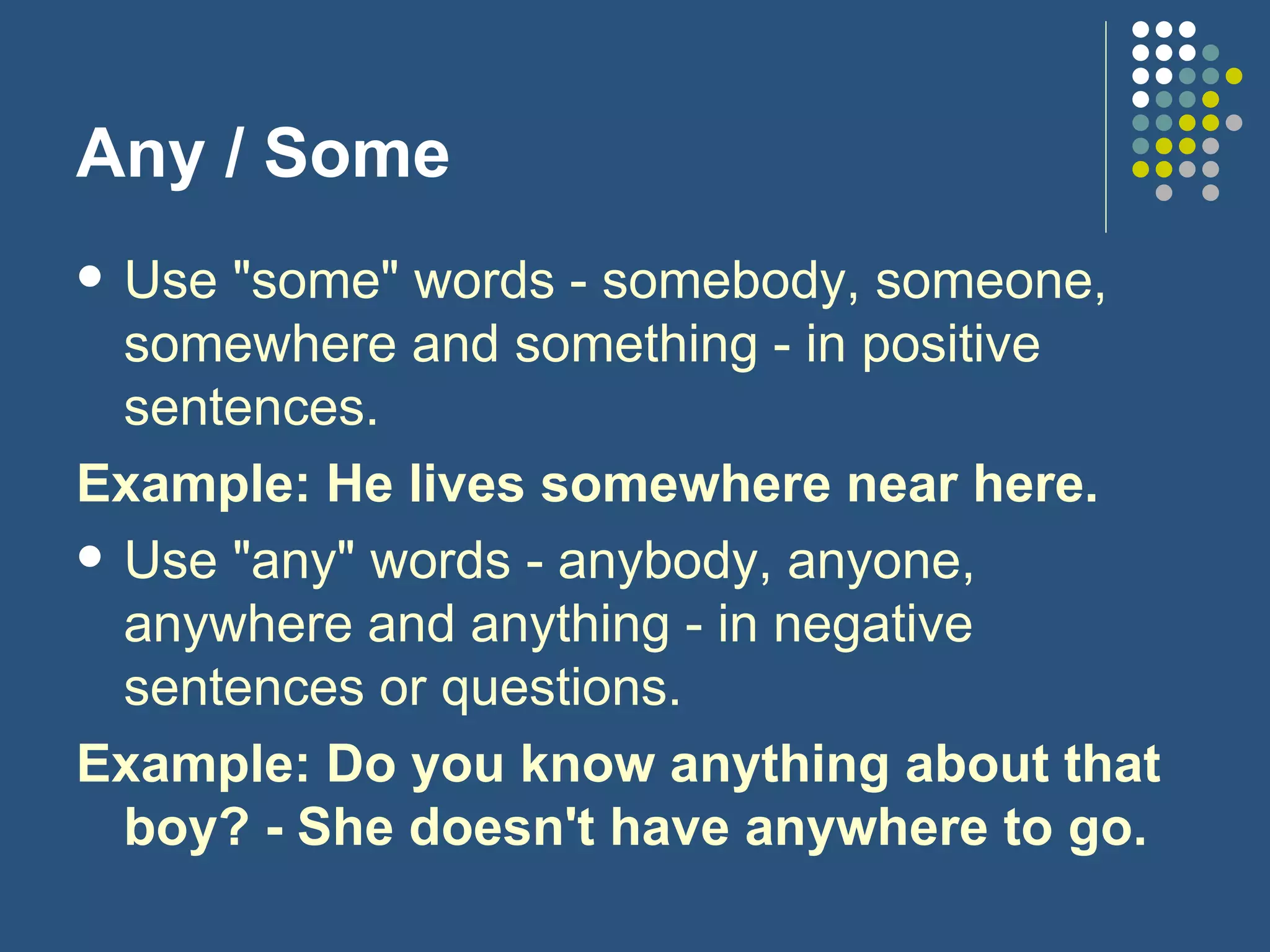
Any / Some Use "some" words - somebody, someone, somewhere and something - in positive sentences. Example: He lives somewhere near here. Use "any" words - anybody, anyone, anywhere and anything - in negative sentences or questions. Example: Do you know anything about that boy? - She doesn't have anywhere to go.
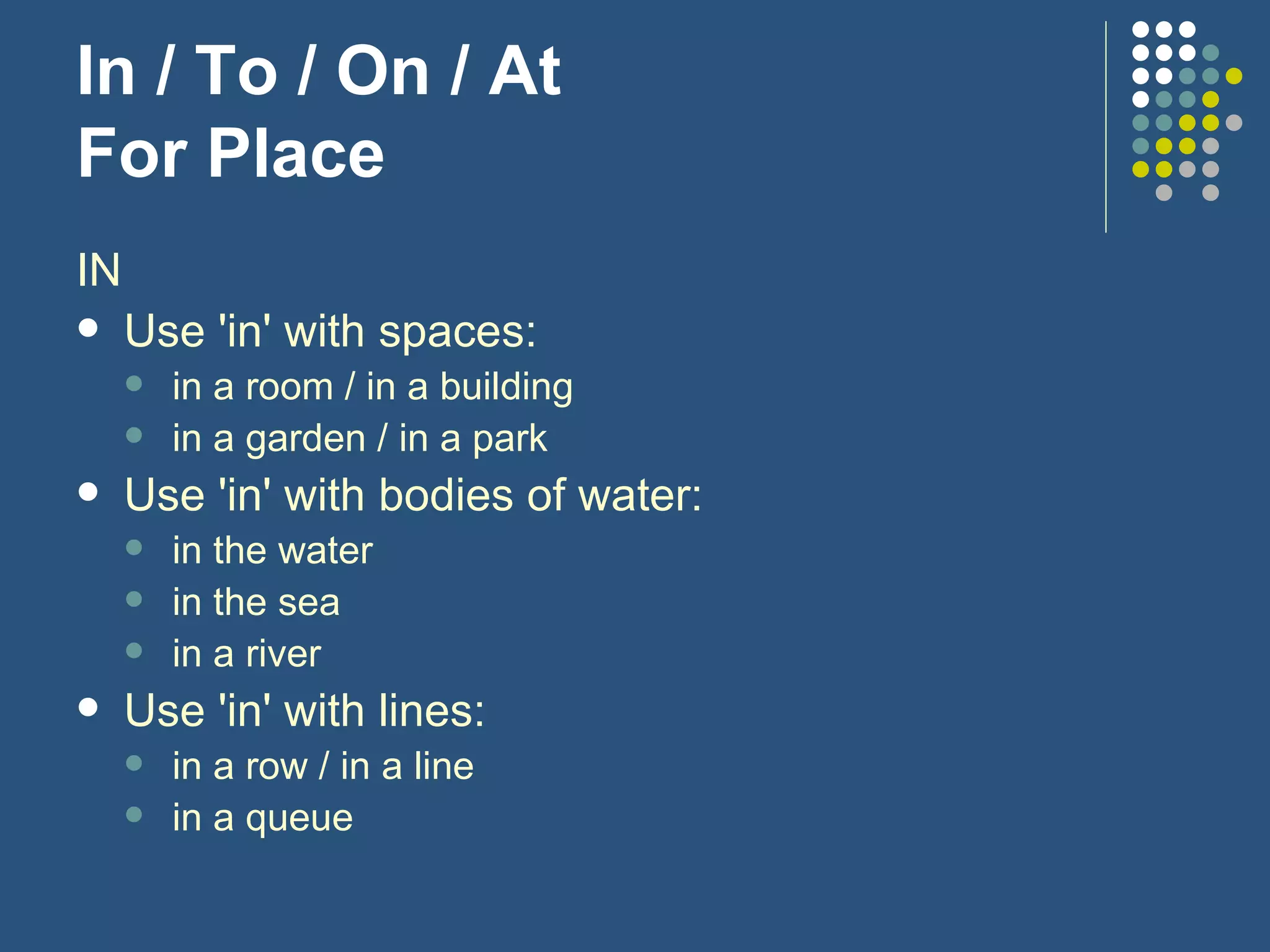
In / To / On / At For Place IN Use 'in' with spaces: in a room / in a building in a garden / in a park Use 'in' with bodies of water: in the water in the sea in a river Use 'in' with lines: in a row / in a line in a queue
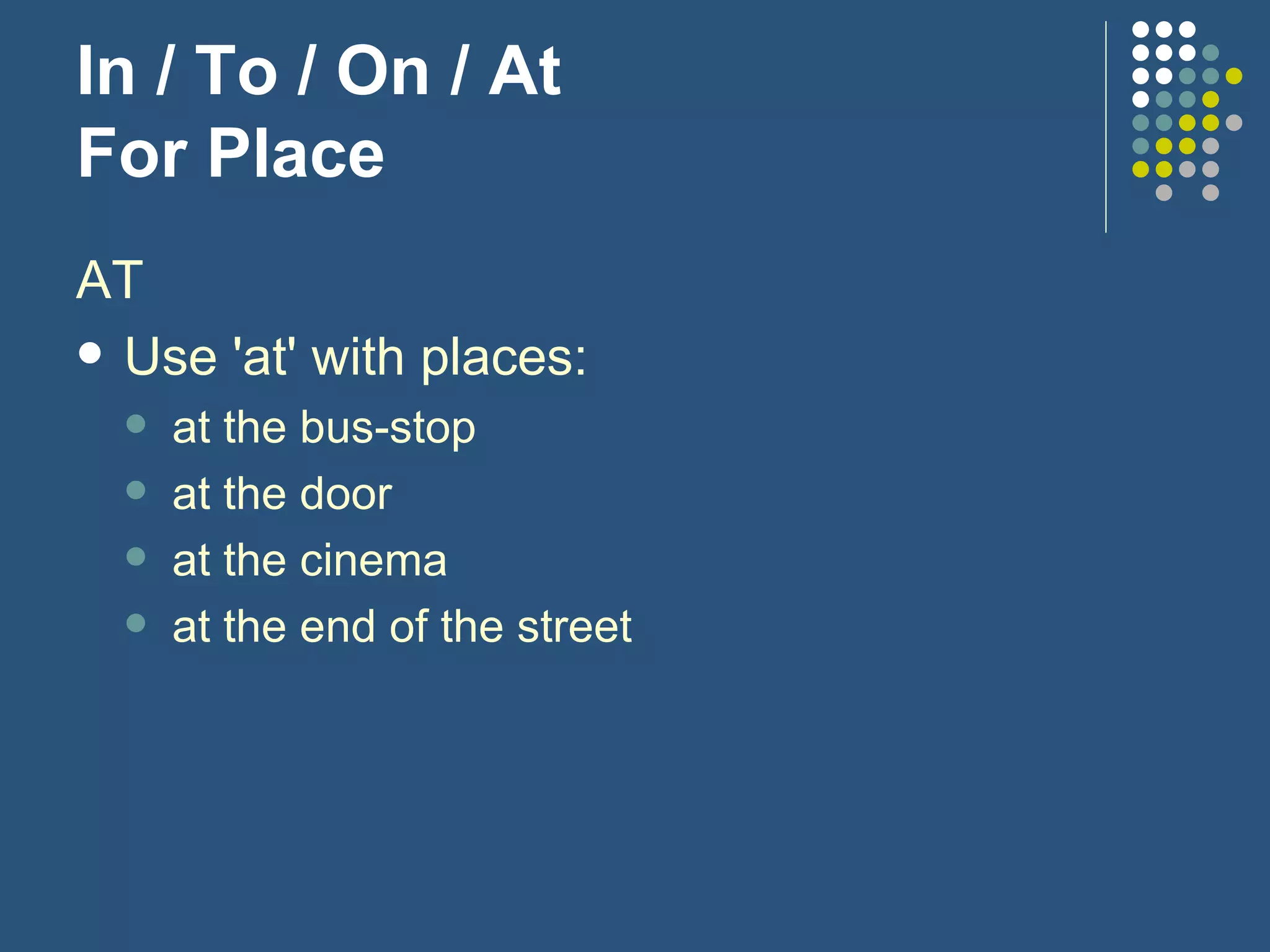
In / To / On / At For Place AT Use 'at' with places: at the bus-stop at the door at the cinema at the end of the street
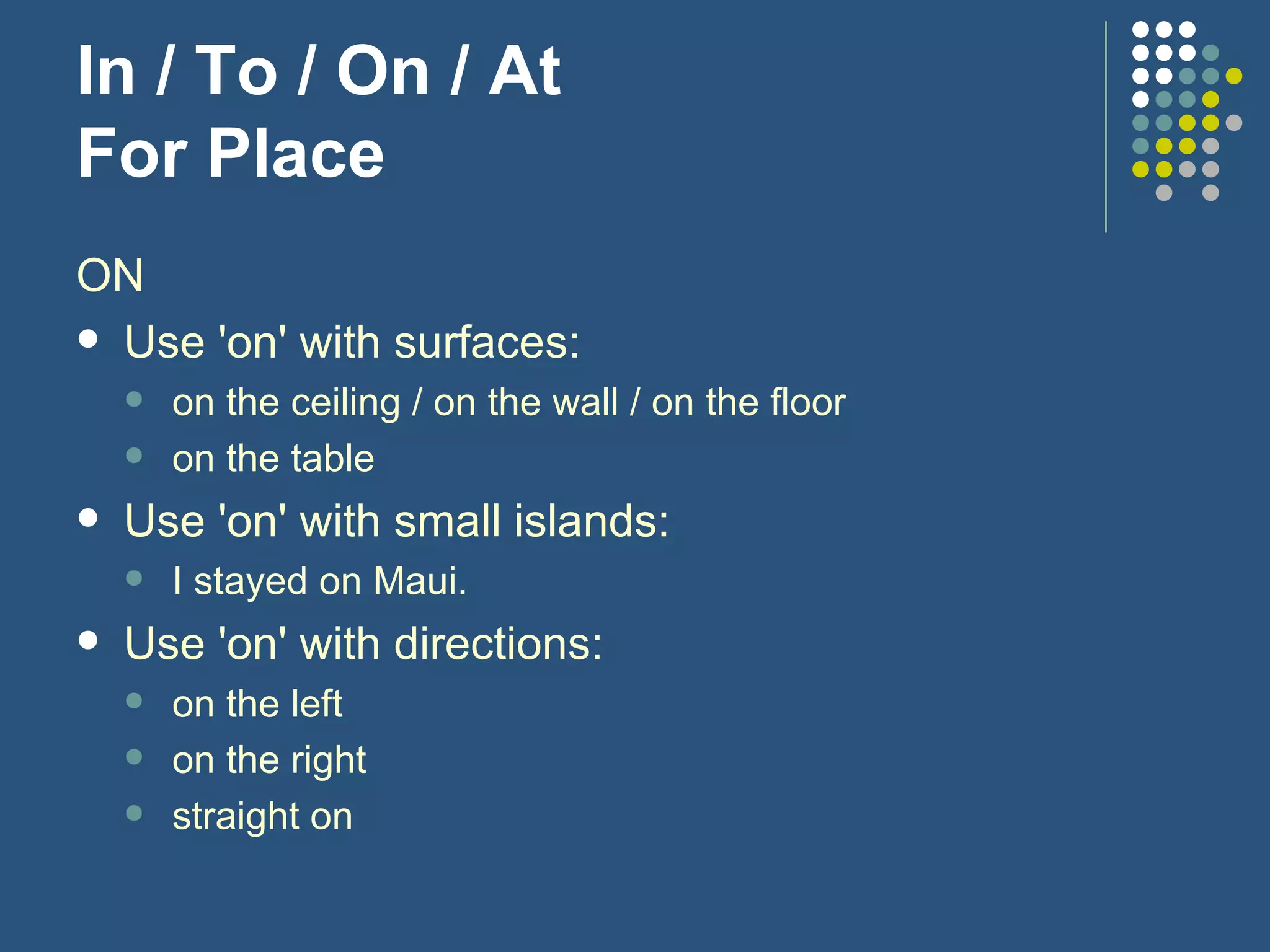
In / To / On / At For Place ON Use 'on' with surfaces: on the ceiling / on the wall / on the floor on the table Use 'on' with small islands: I stayed on Maui. Use 'on' with directions: on the left on the right straight on
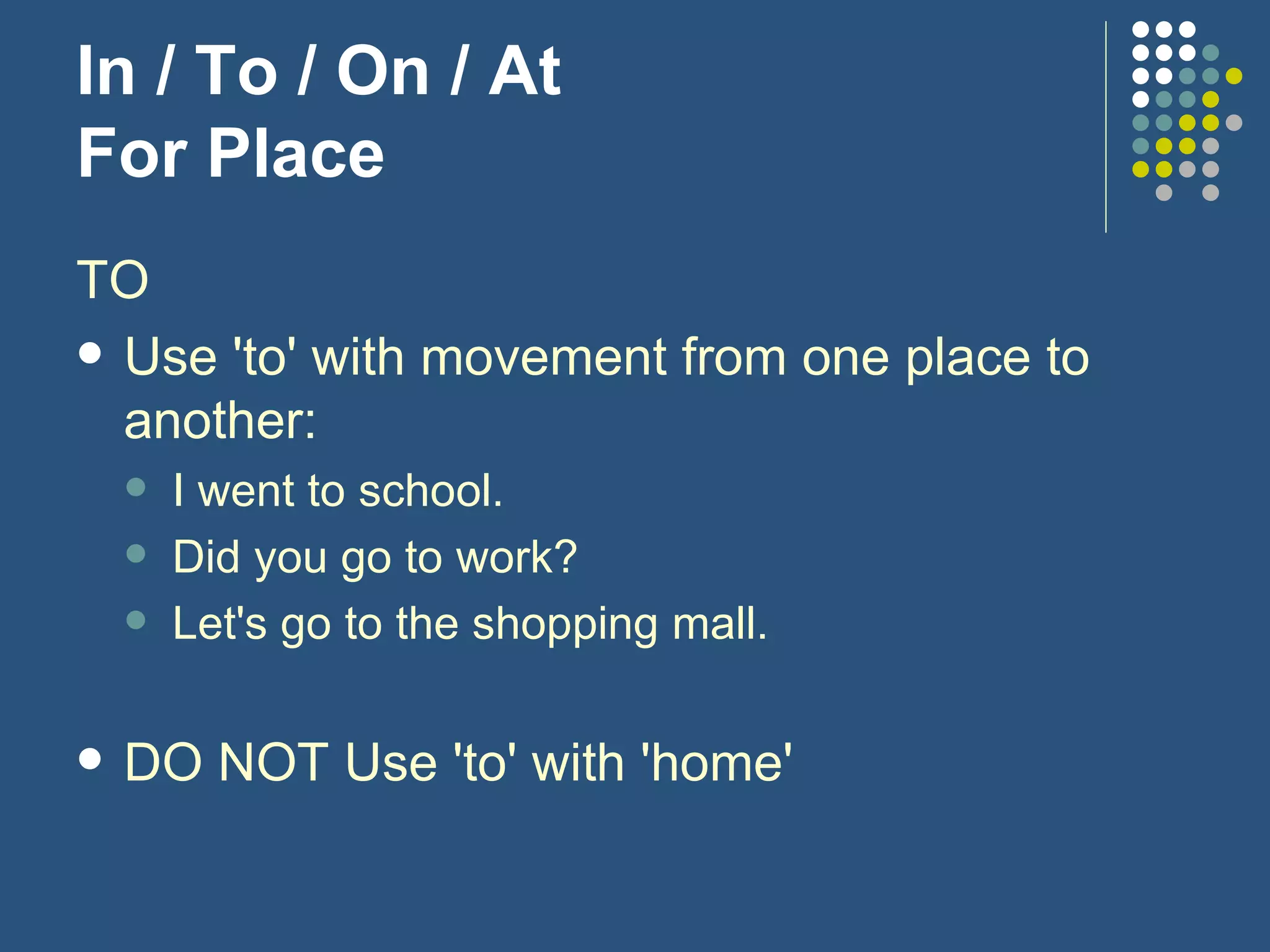
In / To / On / At For Place TO Use 'to' with movement from one place to another: I went to school. Did you go to work? Let's go to the shopping mall. DO NOT Use 'to' with 'home'
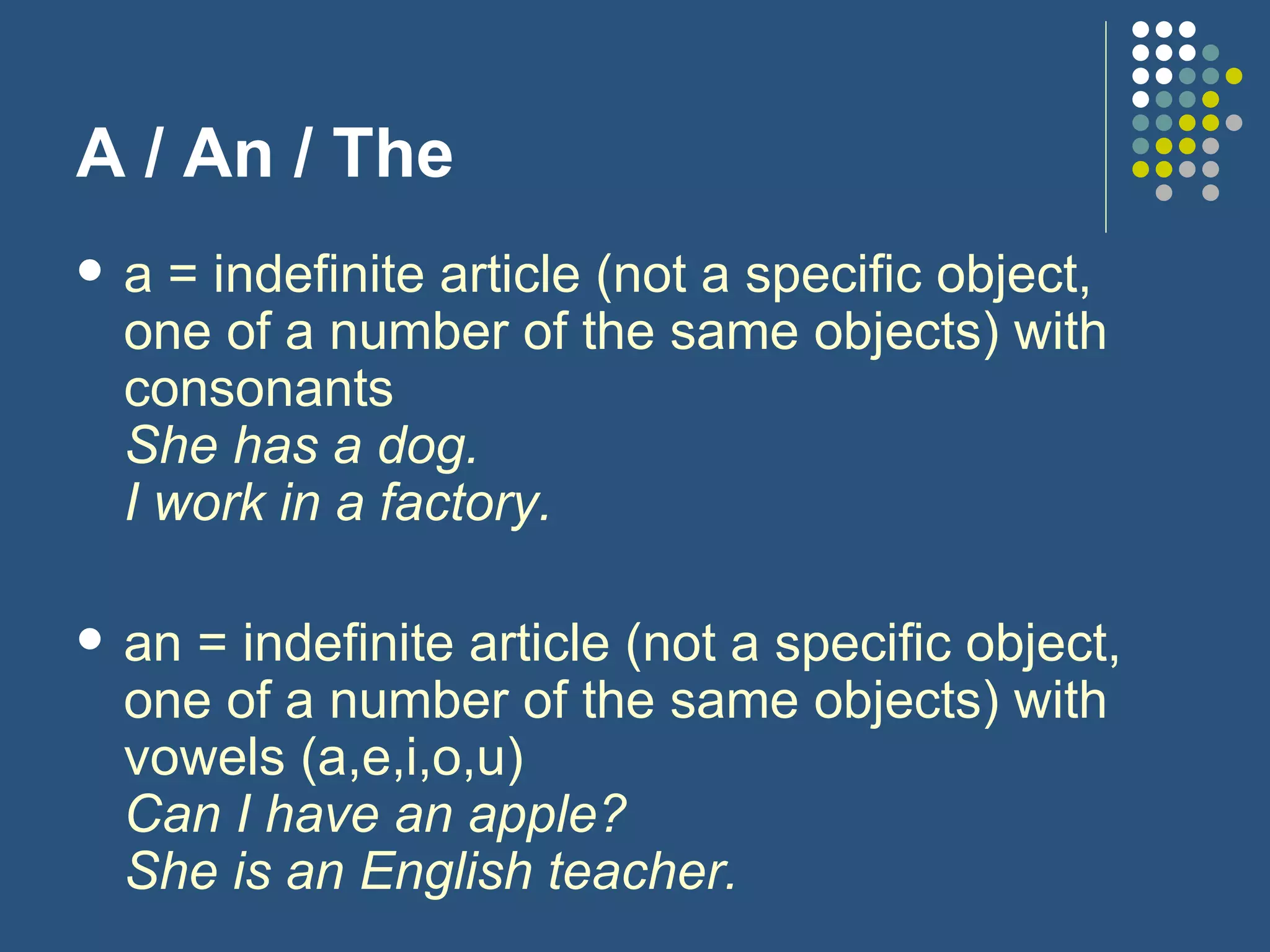
A / An / The a = indefinite article (not a specific object, one of a number of the same objects) with consonants She has a dog. I work in a factory. an = indefinite article (not a specific object, one of a number of the same objects) with vowels (a,e,i,o,u) Can I have an apple? She is an English teacher.
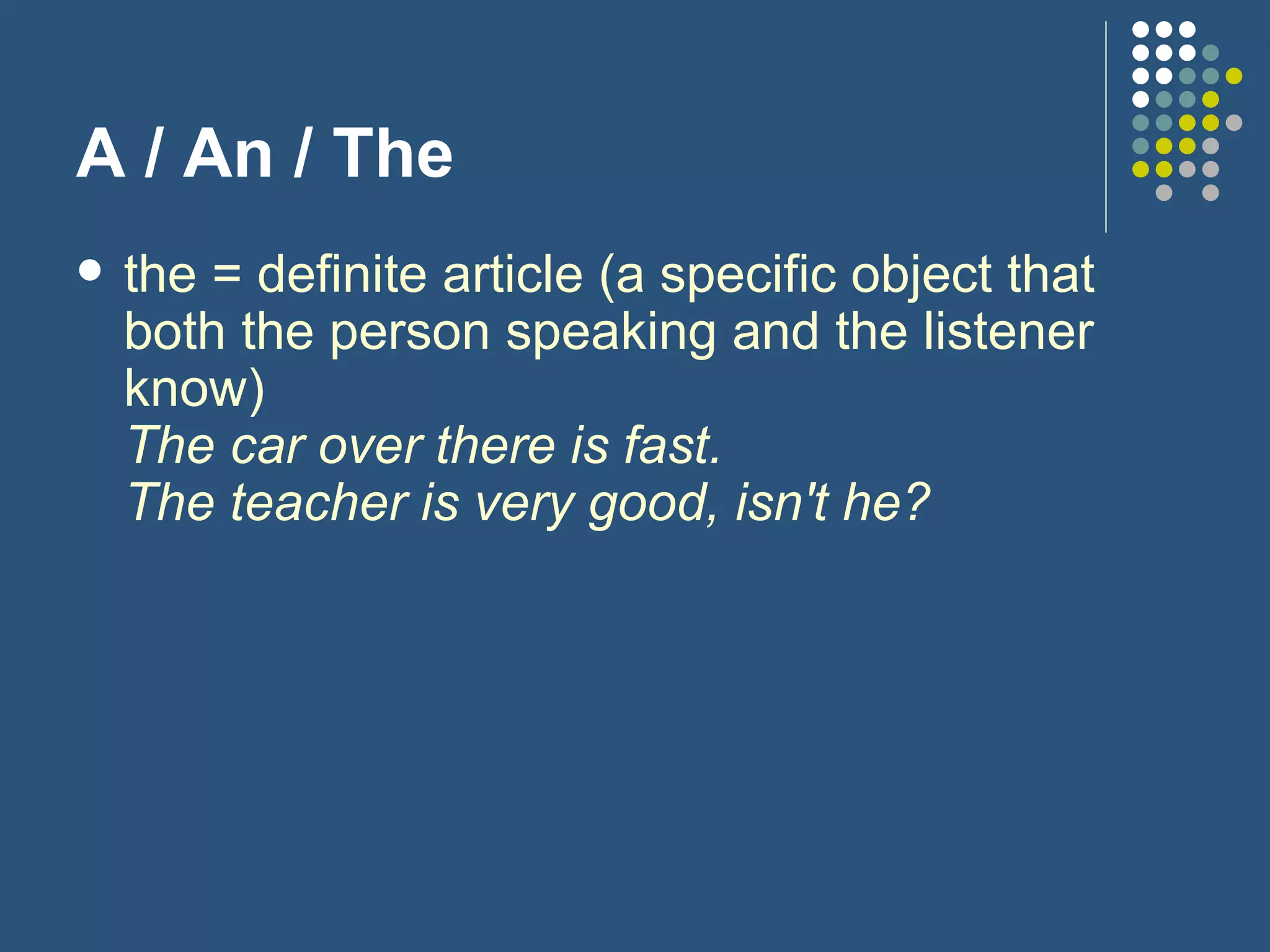
A / An / The the = definite article (a specific object that both the person speaking and the listener know) The car over there is fast. The teacher is very good, isn't he?
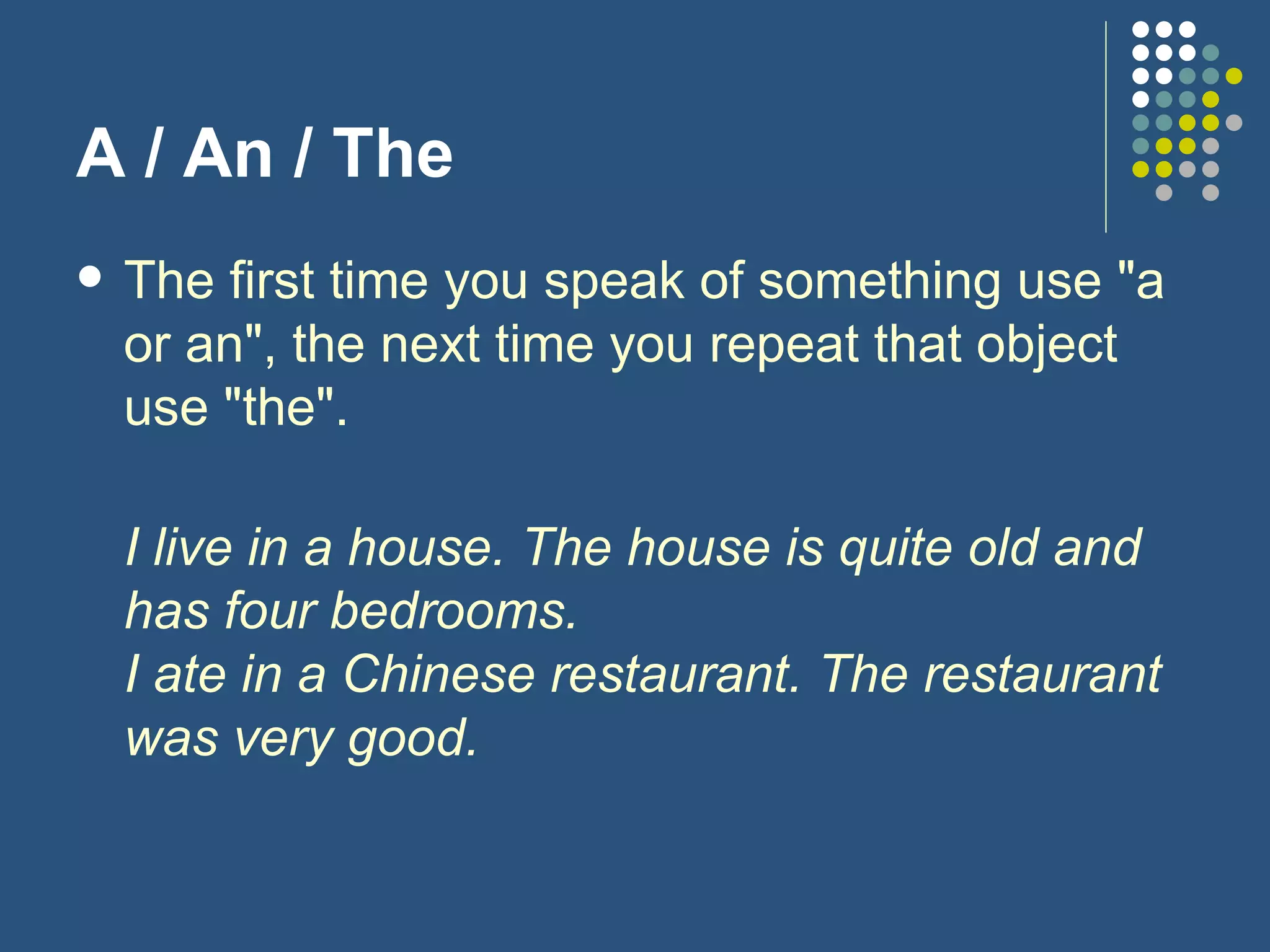
A / An / The The first time you speak of something use "a or an", the next time you repeat that object use "the".  I live in a house. The house is quite old and has four bedrooms. I ate in a Chinese restaurant. The restaurant was very good.
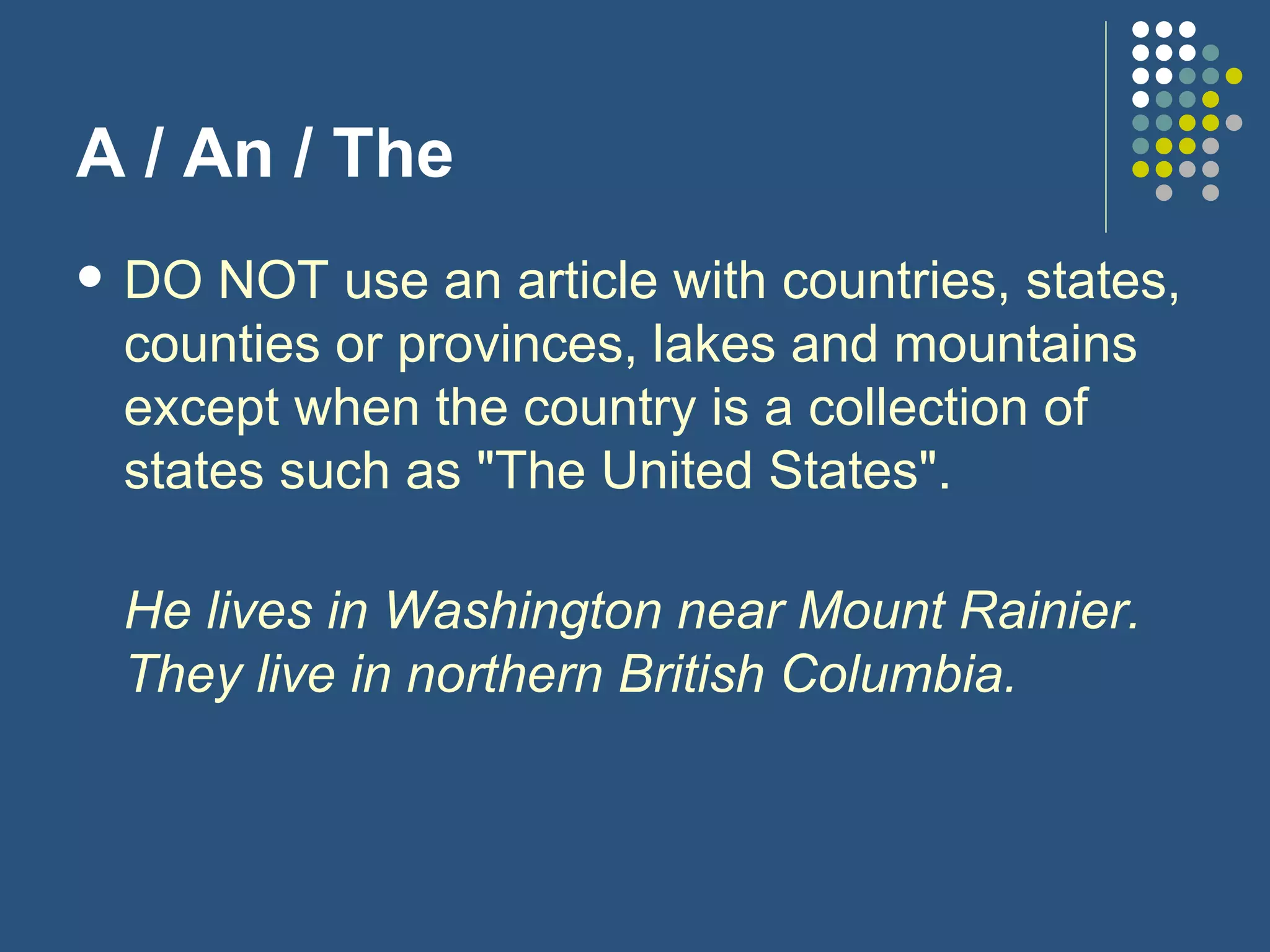
A / An / The DO NOT use an article with countries, states, counties or provinces, lakes and mountains except when the country is a collection of states such as "The United States". He lives in Washington near Mount Rainier. They live in northern British Columbia.
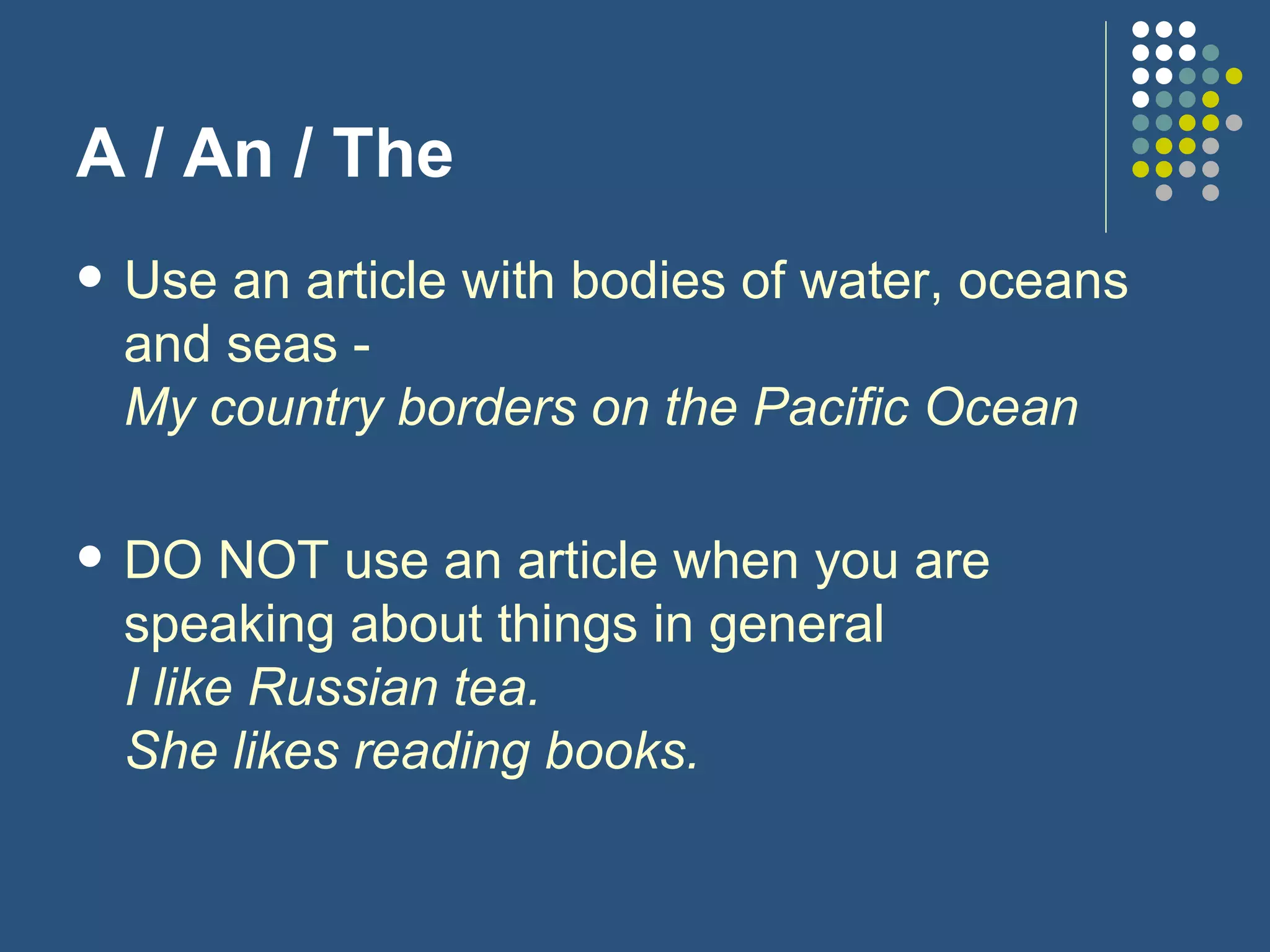
A / An / The Use an article with bodies of water, oceans and seas -  My country borders on the Pacific Ocean DO NOT use an article when you are speaking about things in general  I like Russian tea. She likes reading books.
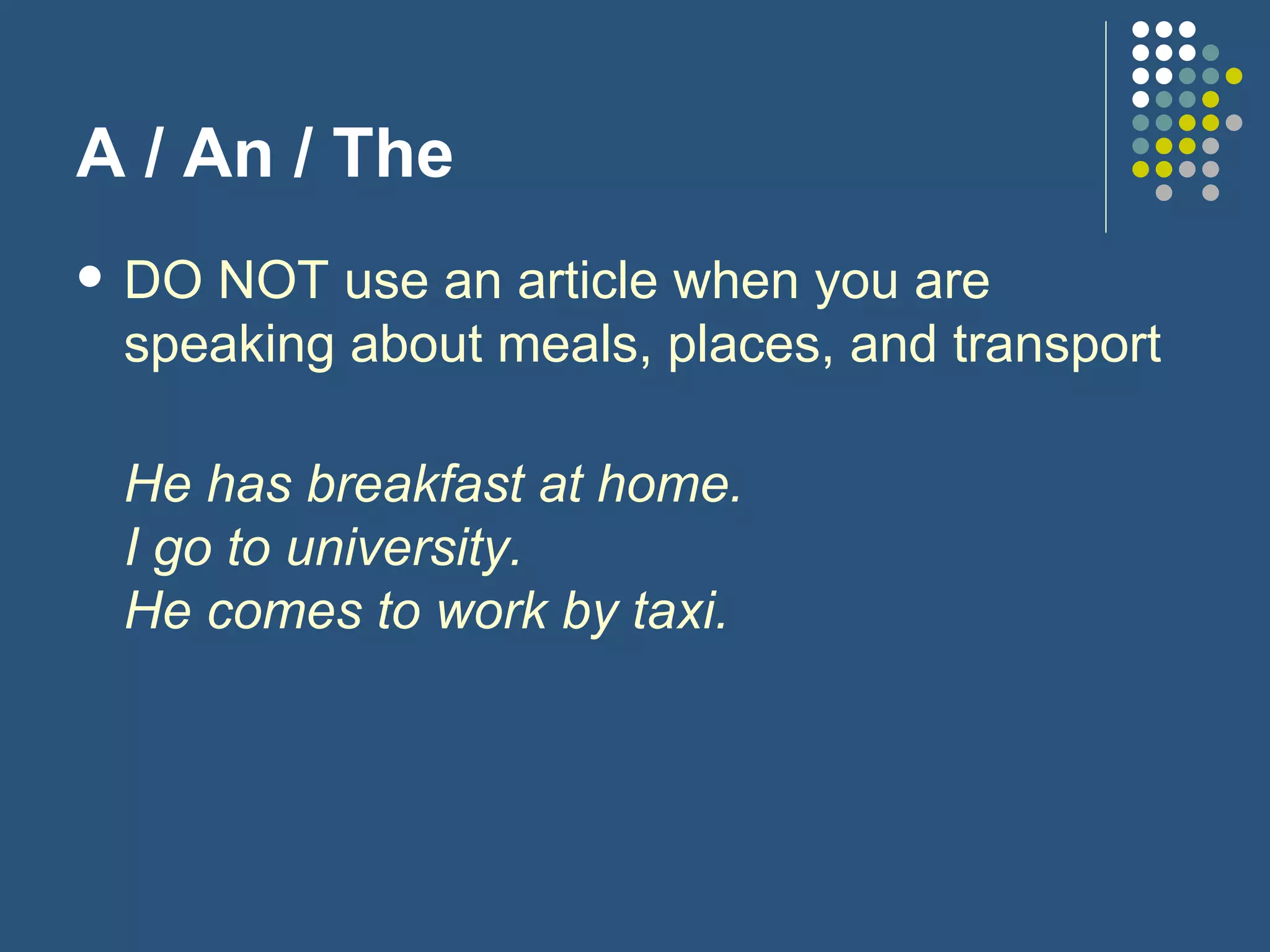
A / An / The DO NOT use an article when you are speaking about meals, places, and transport He has breakfast at home. I go to university. He comes to work by taxi.
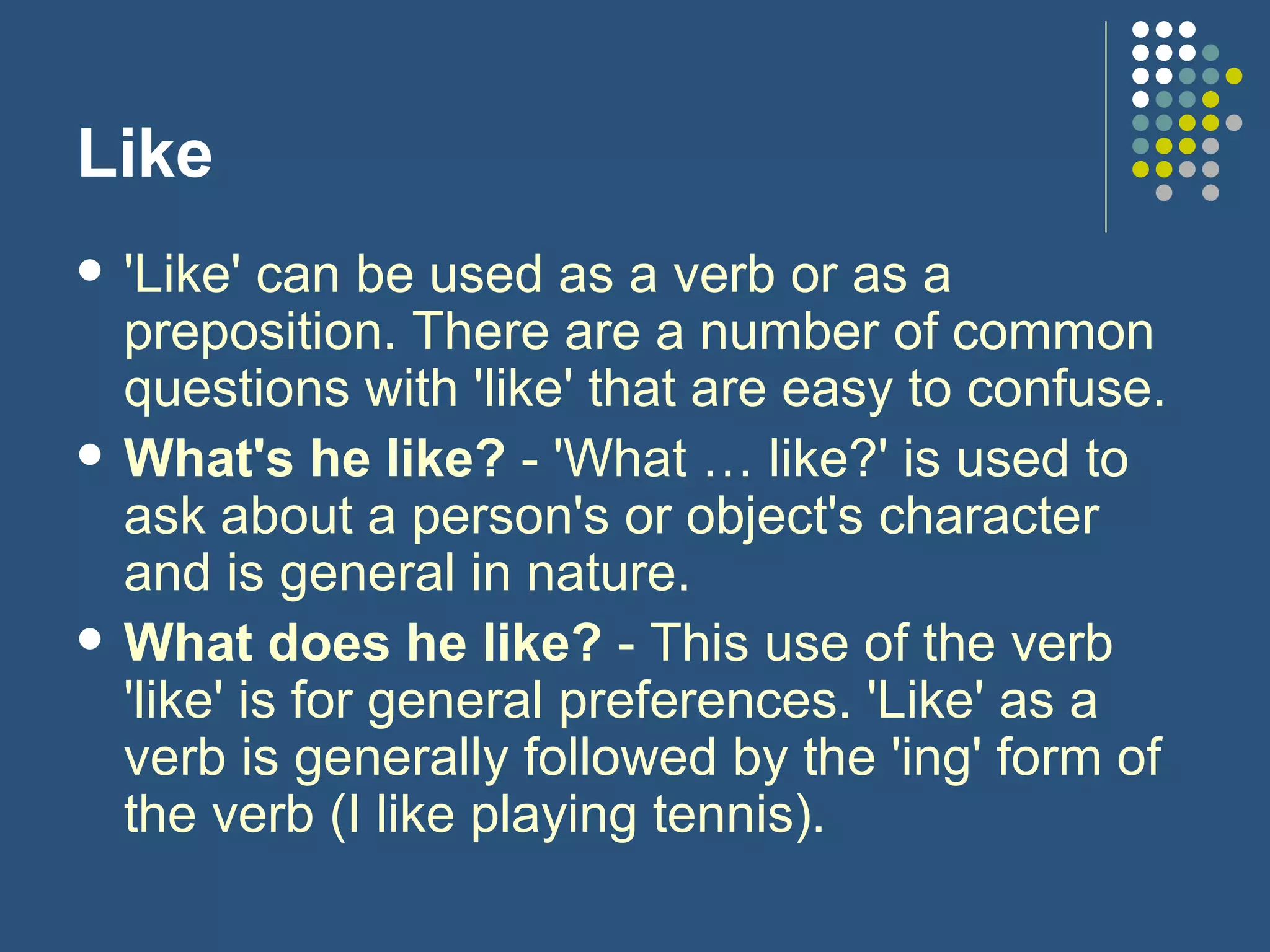
Like 'Like' can be used as a verb or as a preposition. There are a number of common questions with 'like' that are easy to confuse. What's he like?  - 'What … like?' is used to ask about a person's or object's character and is general in nature. What does he like?  - This use of the verb 'like' is for general preferences. 'Like' as a verb is generally followed by the 'ing' form of the verb (I like playing tennis).
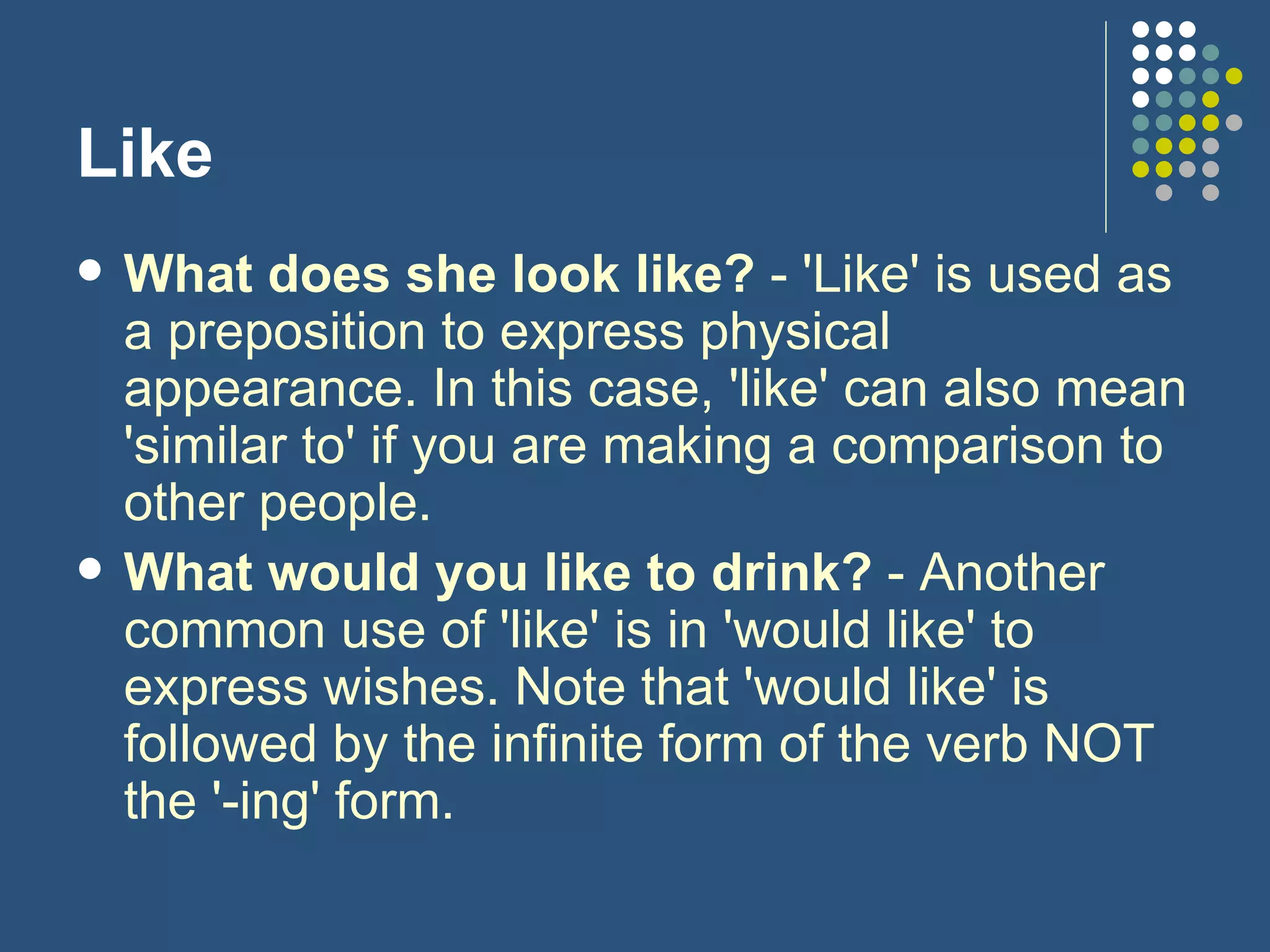
Like What does she look like?  - 'Like' is used as a preposition to express physical appearance. In this case, 'like' can also mean 'similar to' if you are making a comparison to other people. What would you like to drink?  - Another common use of 'like' is in 'would like' to express wishes. Note that 'would like' is followed by the infinite form of the verb NOT the '-ing' form.
Past Tense Irregular Verbs The past form of regular verbs ends in 'ed'. Irregular verbs must be studied individually.  In the following page is a list of past forms of some of the most common irregular verbs.
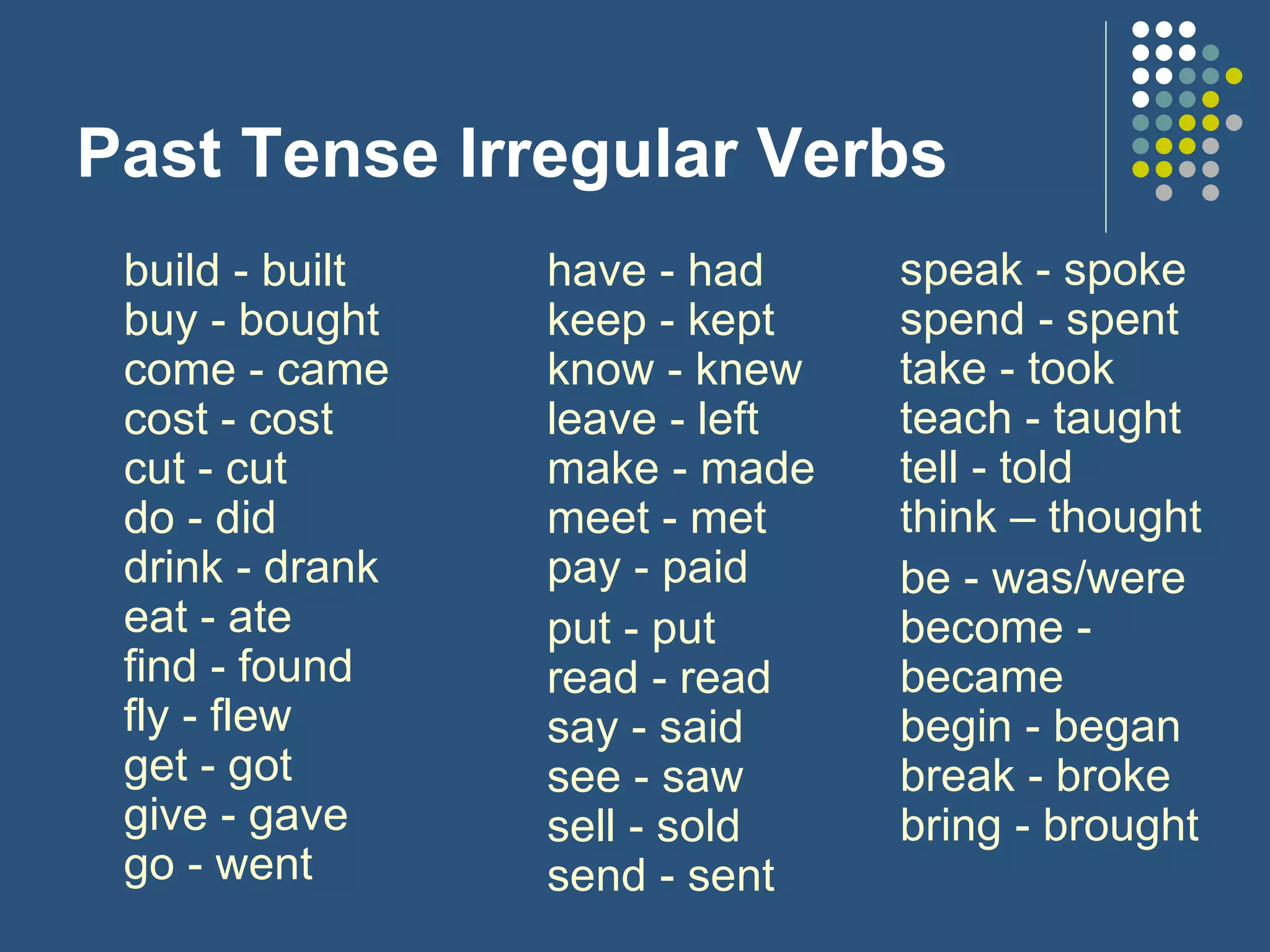
Past Tense Irregular Verbs build - built buy - bought  come - came  cost - cost  cut - cut  do - did  drink - drank  eat - ate  find - found  fly - flew  get - got  give - gave  go - went  have - had  keep - kept  know - knew  leave - left  make - made  meet - met  pay - paid  put - put  read - read  say - said  see - saw  sell - sold  send - sent  speak - spoke  spend - spent  take - took  teach - taught  tell - told  think – thought be - was/were become - became begin - began break - broke bring - brought  
Pronouns – He, Him, Their, Ours, etc. There are four types of pronouns: Subject Pronouns, Object Pronouns, Possessive Pronouns and Demonstrative Pronouns.  The next page shows a list and explanation showing the different types of pronouns:
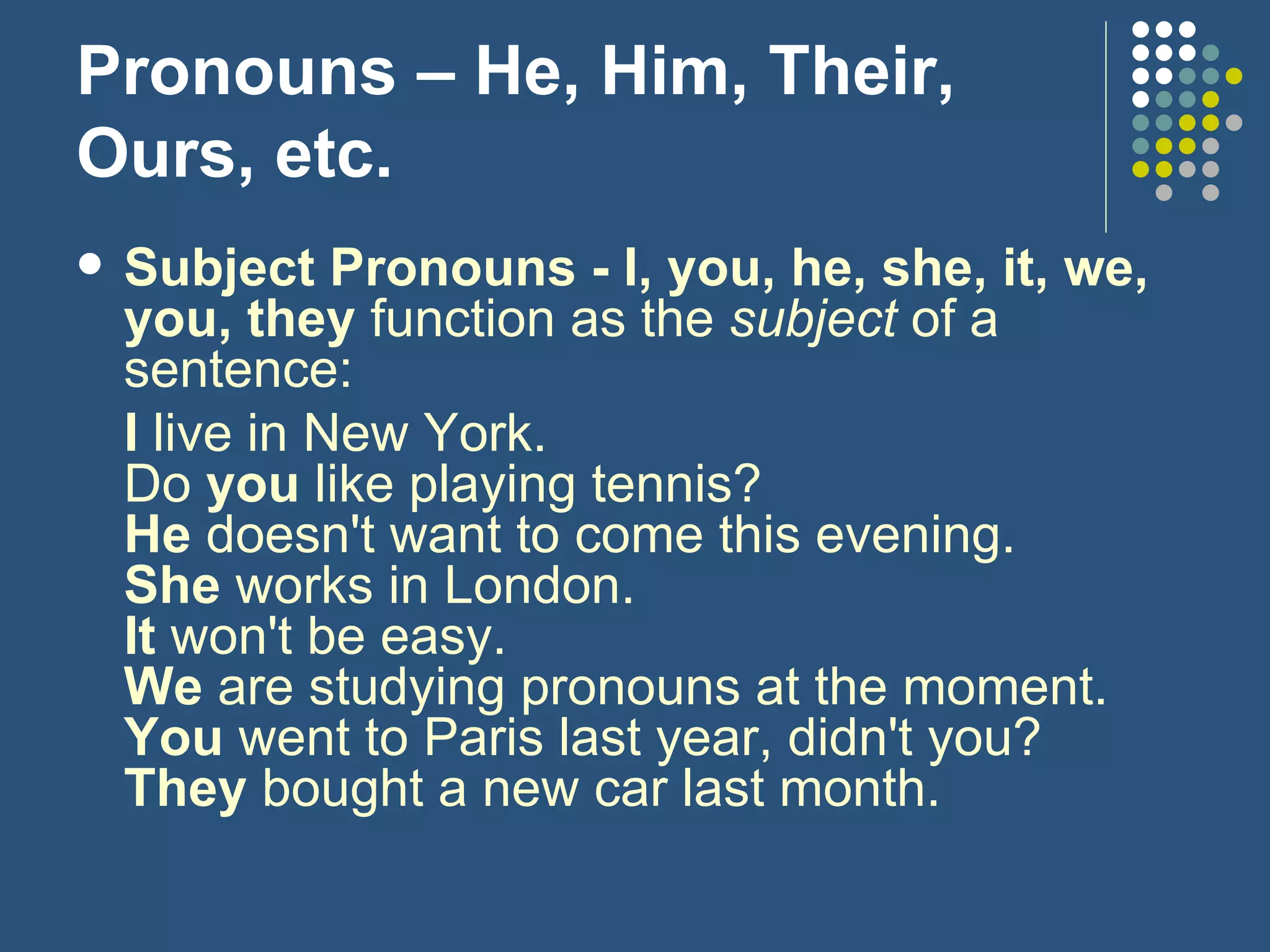
Pronouns – He, Him, Their, Ours, etc. Subject Pronouns - I, you, he, she, it, we, you, they  function as the  subject  of a sentence: I  live in New York. Do  you  like playing tennis? He  doesn't want to come this evening. She  works in London. It  won't be easy. We  are studying pronouns at the moment. You  went to Paris last year, didn't you? They  bought a new car last month.
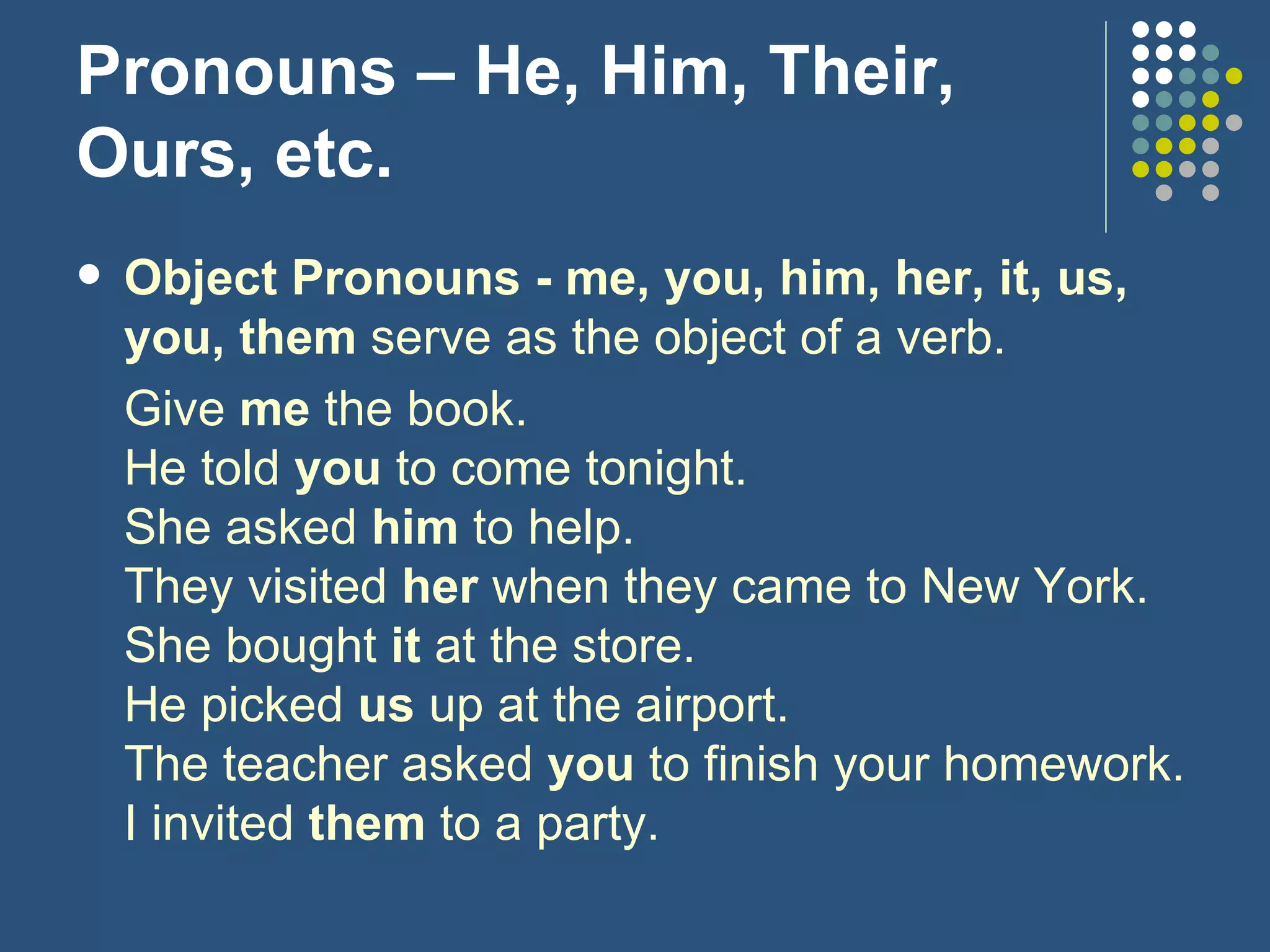
Pronouns – He, Him, Their, Ours, etc. Object Pronouns - me, you, him, her, it, us, you, them  serve as the object of a verb. Give  me  the book. He told  you  to come tonight. She asked  him  to help. They visited  her  when they came to New York. She bought  it  at the store. He picked  us  up at the airport. The teacher asked  you  to finish your homework. I invited  them  to a party.
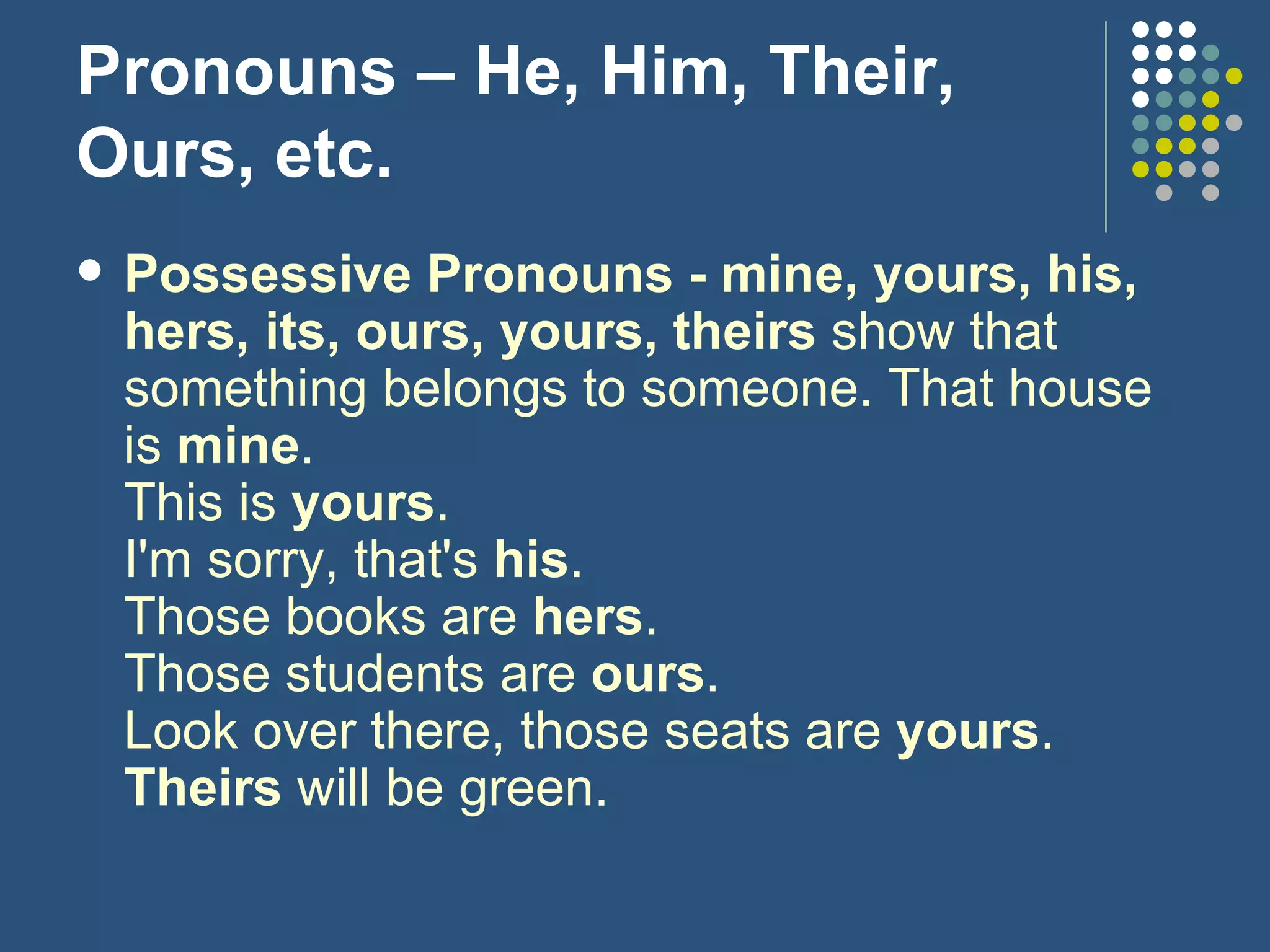
Pronouns – He, Him, Their, Ours, etc. Possessive Pronouns - mine, yours, his, hers, its, ours, yours, theirs  show that something belongs to someone. That house is  mine .  This is  yours . I'm sorry, that's  his . Those books are  hers . Those students are  ours . Look over there, those seats are  yours . Theirs  will be green.
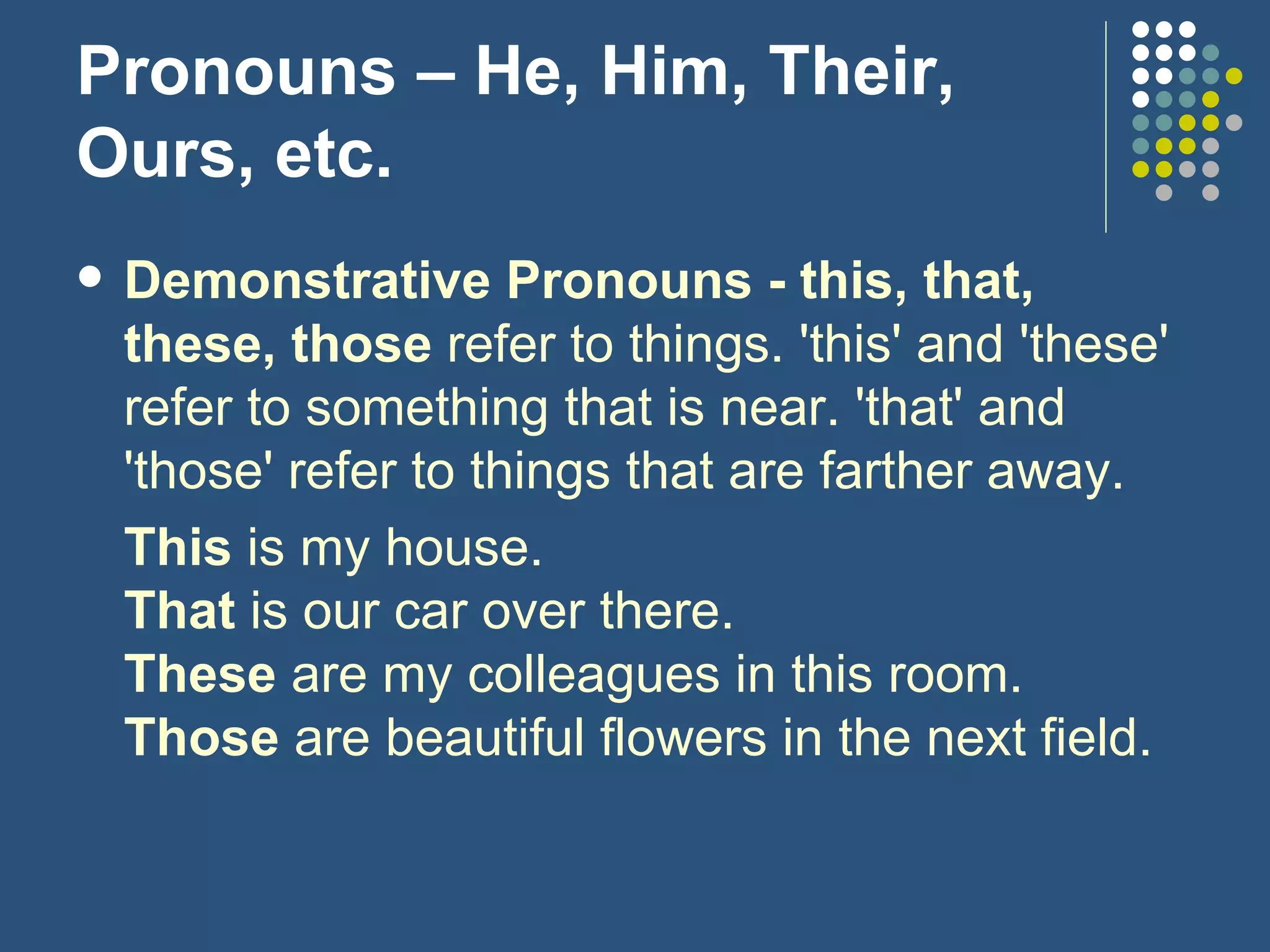
Pronouns – He, Him, Their, Ours, etc. Demonstrative Pronouns - this, that, these, those  refer to things. 'this' and 'these' refer to something that is near. 'that' and 'those' refer to things that are farther away. This  is my house. That  is our car over there. These  are my colleagues in this room. Those  are beautiful flowers in the next field.
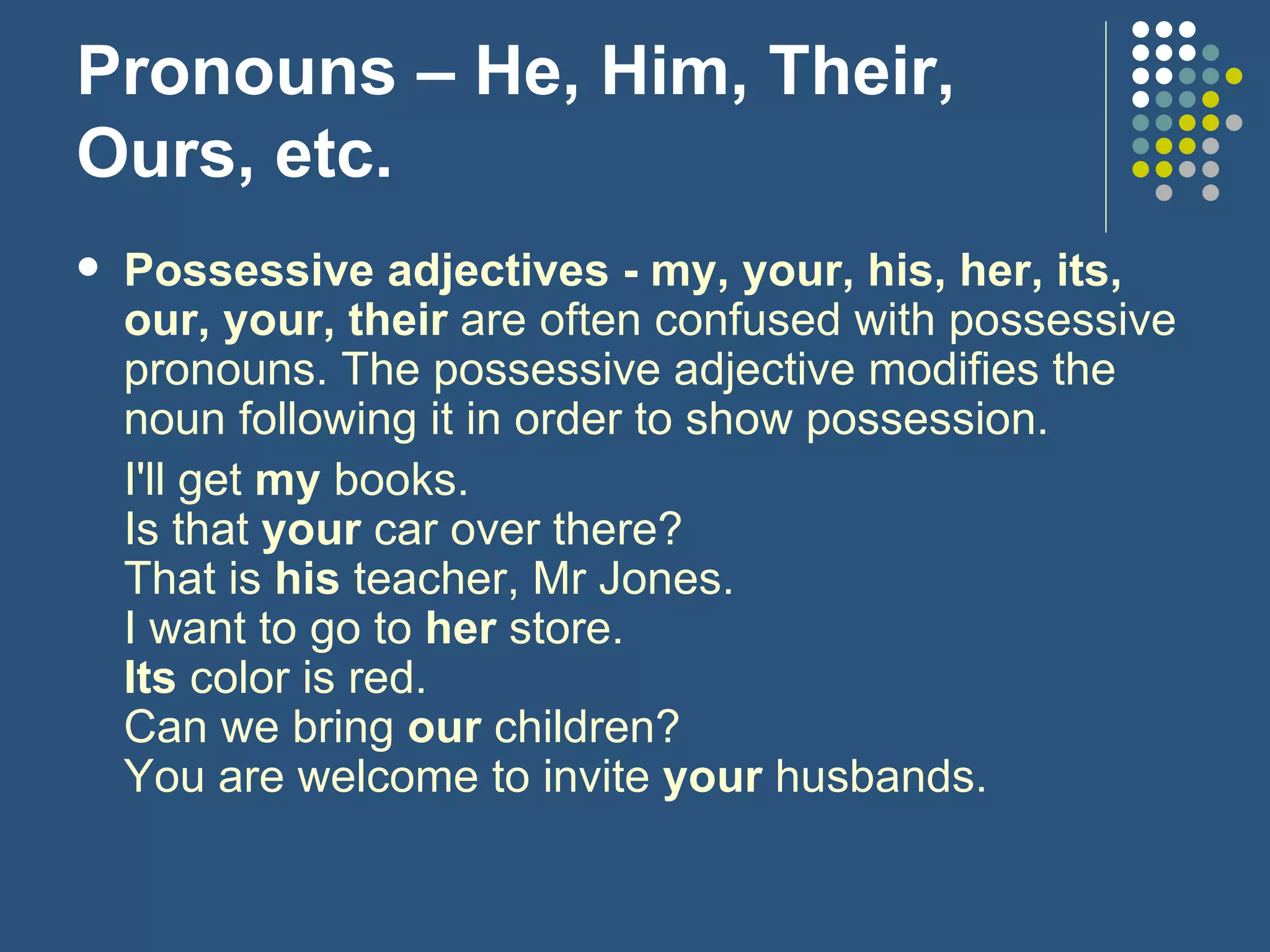
Pronouns – He, Him, Their, Ours, etc. Possessive adjectives - my, your, his, her, its, our, your, their  are often confused with possessive pronouns. The possessive adjective modifies the noun following it in order to show possession. I'll get  my  books. Is that  your  car over there? That is  his  teacher, Mr Jones. I want to go to  her  store. Its  color is red. Can we bring  our  children? You are welcome to invite  your  husbands.

Intermediate level Grammar Review

  • 1.
    Intermediate Level Grammar Review
  • 2.
    References http:// esl.about.com/od/beginningenglish/ig/Basic-English/ http:// esl.about.com/od/beginningenglish/ig/Basic -English/ http://esl.about.com/od/beginningenglish/ig/Basic-English/Prepositions-of-Place.htm http://esl.about.com/od/beginningenglish/ig/Basic-English/Articles.htm http://esl.about.com/od/beginningenglish/ig/Basic-English/Like.htm http://esl.about.com/od/beginningenglish/ig/Basic-English/Irregular-Verbs.htm http://esl.about.com/od/beginningenglish/ig/Basic-English/Pronouns.htm
  • 3.
    Any / SomeUse "some" in positive sentences. We use some for both countable and uncountable nouns. Example: I have some friends. Use "any" in negative sentences or questions. We use any for both countable and uncountable nouns. Example: Do you have any cheese? - He doesn't have any friends in Chicago.
  • 4.
    Any / SomeUse "some" in questions when offering or requesting something that is there. Example: Would you like some bread? (offer) - Could I have some water? (request) Use "any" in negative sentences or questions. We use any for both countable and uncountable nouns. Example: Do you have any cheese? - He doesn't have any friends in Chicago.
  • 5.
    Any / SomeUse "some" words - somebody, someone, somewhere and something - in positive sentences. Example: He lives somewhere near here. Use "any" words - anybody, anyone, anywhere and anything - in negative sentences or questions. Example: Do you know anything about that boy? - She doesn't have anywhere to go.
  • 6.
    In / To/ On / At For Place IN Use 'in' with spaces: in a room / in a building in a garden / in a park Use 'in' with bodies of water: in the water in the sea in a river Use 'in' with lines: in a row / in a line in a queue
  • 7.
    In / To/ On / At For Place AT Use 'at' with places: at the bus-stop at the door at the cinema at the end of the street
  • 8.
    In / To/ On / At For Place ON Use 'on' with surfaces: on the ceiling / on the wall / on the floor on the table Use 'on' with small islands: I stayed on Maui. Use 'on' with directions: on the left on the right straight on
  • 9.
    In / To/ On / At For Place TO Use 'to' with movement from one place to another: I went to school. Did you go to work? Let's go to the shopping mall. DO NOT Use 'to' with 'home'
  • 10.
    A / An/ The a = indefinite article (not a specific object, one of a number of the same objects) with consonants She has a dog. I work in a factory. an = indefinite article (not a specific object, one of a number of the same objects) with vowels (a,e,i,o,u) Can I have an apple? She is an English teacher.
  • 11.
    A / An/ The the = definite article (a specific object that both the person speaking and the listener know) The car over there is fast. The teacher is very good, isn't he?
  • 12.
    A / An/ The The first time you speak of something use "a or an", the next time you repeat that object use "the".  I live in a house. The house is quite old and has four bedrooms. I ate in a Chinese restaurant. The restaurant was very good.
  • 13.
    A / An/ The DO NOT use an article with countries, states, counties or provinces, lakes and mountains except when the country is a collection of states such as "The United States". He lives in Washington near Mount Rainier. They live in northern British Columbia.
  • 14.
    A / An/ The Use an article with bodies of water, oceans and seas -  My country borders on the Pacific Ocean DO NOT use an article when you are speaking about things in general  I like Russian tea. She likes reading books.
  • 15.
    A / An/ The DO NOT use an article when you are speaking about meals, places, and transport He has breakfast at home. I go to university. He comes to work by taxi.
  • 16.
    Like 'Like' canbe used as a verb or as a preposition. There are a number of common questions with 'like' that are easy to confuse. What's he like?  - 'What … like?' is used to ask about a person's or object's character and is general in nature. What does he like?  - This use of the verb 'like' is for general preferences. 'Like' as a verb is generally followed by the 'ing' form of the verb (I like playing tennis).
  • 17.
    Like What doesshe look like?  - 'Like' is used as a preposition to express physical appearance. In this case, 'like' can also mean 'similar to' if you are making a comparison to other people. What would you like to drink?  - Another common use of 'like' is in 'would like' to express wishes. Note that 'would like' is followed by the infinite form of the verb NOT the '-ing' form.
  • 18.
    Past Tense IrregularVerbs The past form of regular verbs ends in 'ed'. Irregular verbs must be studied individually. In the following page is a list of past forms of some of the most common irregular verbs.
  • 19.
    Past Tense IrregularVerbs build - built buy - bought  come - came  cost - cost  cut - cut  do - did  drink - drank  eat - ate  find - found  fly - flew  get - got  give - gave  go - went  have - had  keep - kept  know - knew  leave - left  make - made  meet - met  pay - paid  put - put  read - read  say - said  see - saw  sell - sold  send - sent  speak - spoke  spend - spent  take - took  teach - taught  tell - told  think – thought be - was/were become - became begin - began break - broke bring - brought  
  • 20.
    Pronouns – He,Him, Their, Ours, etc. There are four types of pronouns: Subject Pronouns, Object Pronouns, Possessive Pronouns and Demonstrative Pronouns. The next page shows a list and explanation showing the different types of pronouns:
  • 21.
    Pronouns – He,Him, Their, Ours, etc. Subject Pronouns - I, you, he, she, it, we, you, they  function as the  subject  of a sentence: I  live in New York. Do  you  like playing tennis? He  doesn't want to come this evening. She  works in London. It  won't be easy. We  are studying pronouns at the moment. You  went to Paris last year, didn't you? They  bought a new car last month.
  • 22.
    Pronouns – He,Him, Their, Ours, etc. Object Pronouns - me, you, him, her, it, us, you, them  serve as the object of a verb. Give  me  the book. He told  you  to come tonight. She asked  him  to help. They visited  her  when they came to New York. She bought  it  at the store. He picked  us  up at the airport. The teacher asked  you  to finish your homework. I invited  them  to a party.
  • 23.
    Pronouns – He,Him, Their, Ours, etc. Possessive Pronouns - mine, yours, his, hers, its, ours, yours, theirs  show that something belongs to someone. That house is  mine .  This is  yours . I'm sorry, that's  his . Those books are  hers . Those students are  ours . Look over there, those seats are  yours . Theirs  will be green.
  • 24.
    Pronouns – He,Him, Their, Ours, etc. Demonstrative Pronouns - this, that, these, those  refer to things. 'this' and 'these' refer to something that is near. 'that' and 'those' refer to things that are farther away. This  is my house. That  is our car over there. These  are my colleagues in this room. Those  are beautiful flowers in the next field.
  • 25.
    Pronouns – He,Him, Their, Ours, etc. Possessive adjectives - my, your, his, her, its, our, your, their  are often confused with possessive pronouns. The possessive adjective modifies the noun following it in order to show possession. I'll get  my  books. Is that  your  car over there? That is  his  teacher, Mr Jones. I want to go to  her  store. Its  color is red. Can we bring  our  children? You are welcome to invite  your  husbands.