Homonyms
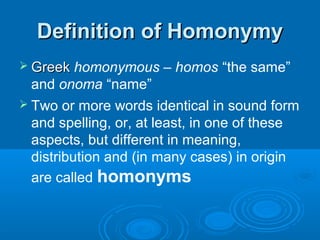
Definition of HomonymyDefinition of Homonymy
 GreekGreek homonymous – homos “the same”
and onoma “name”
 Two or more words identical in sound form
and spelling, or, at least, in one of these
aspects, but different in meaning,
distribution and (in many cases) in origin
are called homonyms
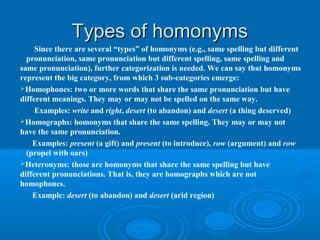
Types of homonymsTypes of homonyms
Since there are several “types” of homonyms (e.g., same spelling but different
pronunciation, same pronunciation but different spelling, same spelling and
same pronunciation), further categorization is needed. We can say that homonyms
represent the big category, from which 3 sub-categories emerge:
Homophones: two or more words that share the same pronunciation but have
different meanings. They may or may not be spelled on the same way.
Examples: write and right, desert (to abandon) and desert (a thing deserved)
Homographs: homonyms that share the same spelling. They may or may not
have the same pronunciation.
Examples: present (a gift) and present (to introduce), row (argument) and row
(propel with oars)
Heteronyms: those are homonyms that share the same spelling but have
different pronunciations. That is, they are homographs which are not
homophones.
Example: desert (to abandon) and desert (arid region)
Sources of Homonymy
1.1. Convergent development ofConvergent development of
sound formsound form
2.2. Divergent meaningDivergent meaning
developmentdevelopment
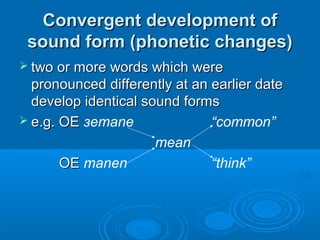
Convergent development ofConvergent development of
sound form (phonetic changes)sound form (phonetic changes)
 two or more words which weretwo or more words which were
pronounced differently at an earlier datepronounced differently at an earlier date
develop identical sound formsdevelop identical sound forms
 e.g. OEe.g. OE зemane “common”
mean
OEOE manen “think”
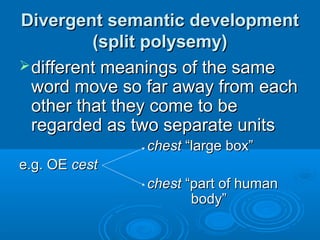
Divergent semantic developmentDivergent semantic development
(split polysemy)(split polysemy)
different meanings of the samedifferent meanings of the same
word move so far away from eachword move so far away from each
other that they come to beother that they come to be
regarded as two separate unitsregarded as two separate units
chestchest “large box”“large box”
e.g. OEe.g. OE cestcest
chestchest “part of human“part of human
body”body”
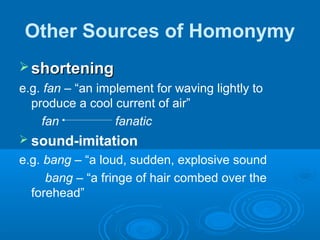
Other Sources of Homonymy
 shorteningshortening
e.g. fan – “an implement for waving lightly to
produce a cool current of air”
fan fanatic
 sound-imitation
e.g. bang – “a loud, sudden, explosive sound
bang – “a fringe of hair combed over the
forehead”
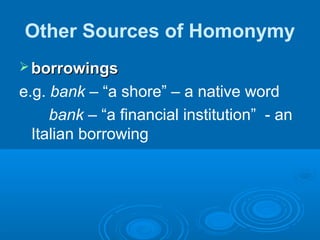
Other Sources of Homonymy
 borrowingsborrowings
e.g. bank – “a shore” – a native word
bank – “a financial institution” - an
Italian borrowing
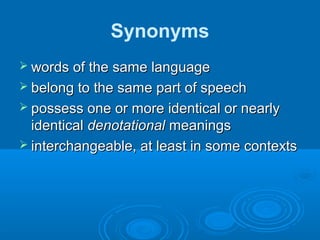
Synonyms
 words of the same languagewords of the same language
 belong to the same part of speechbelong to the same part of speech
 possess one or more identical or nearlypossess one or more identical or nearly
identicalidentical denotationaldenotational meaningsmeanings
 interchangeable, at least in some contextsinterchangeable, at least in some contexts
Sources of Synonyms
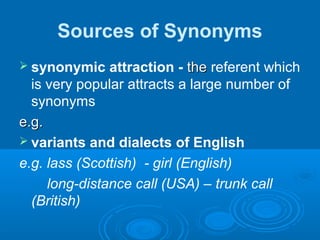
 synonymic attraction - thethe referent which
is very popular attracts a large number of
synonyms
e.g.e.g.
 variants and dialects of English
e.g. lass (Scottish) - girl (English)
long-distance call (USA) – trunk call
(British)
Sources of Synonyms
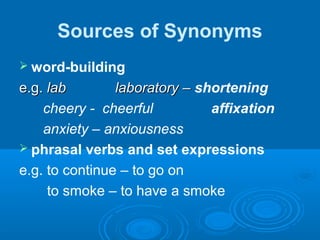
 word-building
e.g.e.g. lablab laboratorylaboratory –– shortening
cheery - cheerful affixation
anxiety – anxiousness
 phrasal verbs and set expressions
e.g. to continue – to go on
to smoke – to have a smoke
Sources of Synonyms
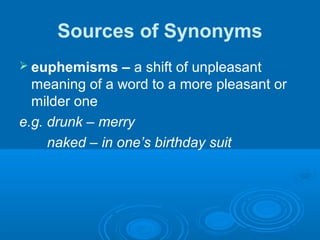
 euphemisms – a shift of unpleasant
meaning of a word to a more pleasant or
milder one
e.g. drunk – merry
naked – in one’s birthday suit
Antonyms
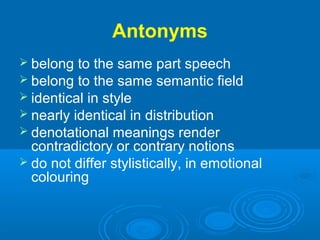
 belong to the same part speech
 belong to the same semantic field
 identical in style
 nearly identical in distribution
 denotational meanings render
contradictory or contrary notions
 do not differ stylistically, in emotional
colouring
Classification of Antonyms
1. absolute or root antonyms (contrary
notions)
e.g. to love – to hate
2. derivational antonyms (express
contradictory notions)
 formed with negative prefixes (un-, non-,
dis-)
e.g. to please – to displease
 antonymous suffixes –ful and –less
e.g. painful - painless

Homonyms

  • 1.
  • 2.
    Definition of HomonymyDefinitionof Homonymy  GreekGreek homonymous – homos “the same” and onoma “name”  Two or more words identical in sound form and spelling, or, at least, in one of these aspects, but different in meaning, distribution and (in many cases) in origin are called homonyms
  • 3.
    Types of homonymsTypesof homonyms Since there are several “types” of homonyms (e.g., same spelling but different pronunciation, same pronunciation but different spelling, same spelling and same pronunciation), further categorization is needed. We can say that homonyms represent the big category, from which 3 sub-categories emerge: Homophones: two or more words that share the same pronunciation but have different meanings. They may or may not be spelled on the same way. Examples: write and right, desert (to abandon) and desert (a thing deserved) Homographs: homonyms that share the same spelling. They may or may not have the same pronunciation. Examples: present (a gift) and present (to introduce), row (argument) and row (propel with oars) Heteronyms: those are homonyms that share the same spelling but have different pronunciations. That is, they are homographs which are not homophones. Example: desert (to abandon) and desert (arid region)
  • 4.
    Sources of Homonymy 1.1.Convergent development ofConvergent development of sound formsound form 2.2. Divergent meaningDivergent meaning developmentdevelopment
  • 5.
    Convergent development ofConvergentdevelopment of sound form (phonetic changes)sound form (phonetic changes)  two or more words which weretwo or more words which were pronounced differently at an earlier datepronounced differently at an earlier date develop identical sound formsdevelop identical sound forms  e.g. OEe.g. OE зemane “common” mean OEOE manen “think”
  • 6.
    Divergent semantic developmentDivergentsemantic development (split polysemy)(split polysemy) different meanings of the samedifferent meanings of the same word move so far away from eachword move so far away from each other that they come to beother that they come to be regarded as two separate unitsregarded as two separate units chestchest “large box”“large box” e.g. OEe.g. OE cestcest chestchest “part of human“part of human body”body”
  • 7.
    Other Sources ofHomonymy  shorteningshortening e.g. fan – “an implement for waving lightly to produce a cool current of air” fan fanatic  sound-imitation e.g. bang – “a loud, sudden, explosive sound bang – “a fringe of hair combed over the forehead”
  • 8.
    Other Sources ofHomonymy  borrowingsborrowings e.g. bank – “a shore” – a native word bank – “a financial institution” - an Italian borrowing
  • 9.
    Synonyms  words ofthe same languagewords of the same language  belong to the same part of speechbelong to the same part of speech  possess one or more identical or nearlypossess one or more identical or nearly identicalidentical denotationaldenotational meaningsmeanings  interchangeable, at least in some contextsinterchangeable, at least in some contexts
  • 10.
    Sources of Synonyms synonymic attraction - thethe referent which is very popular attracts a large number of synonyms e.g.e.g.  variants and dialects of English e.g. lass (Scottish) - girl (English) long-distance call (USA) – trunk call (British)
  • 11.
    Sources of Synonyms word-building e.g.e.g. lablab laboratorylaboratory –– shortening cheery - cheerful affixation anxiety – anxiousness  phrasal verbs and set expressions e.g. to continue – to go on to smoke – to have a smoke
  • 12.
    Sources of Synonyms euphemisms – a shift of unpleasant meaning of a word to a more pleasant or milder one e.g. drunk – merry naked – in one’s birthday suit
  • 13.
    Antonyms  belong tothe same part speech  belong to the same semantic field  identical in style  nearly identical in distribution  denotational meanings render contradictory or contrary notions  do not differ stylistically, in emotional colouring
  • 14.
    Classification of Antonyms 1.absolute or root antonyms (contrary notions) e.g. to love – to hate 2. derivational antonyms (express contradictory notions)  formed with negative prefixes (un-, non-, dis-) e.g. to please – to displease  antonymous suffixes –ful and –less e.g. painful - painless