121
5 Morphology and Word Formation
key concepts
Words and morphemes
Root, derivational, inflectional morphemes
Morphemes, allomorphs, morphs
Words
English inflectional morphology
English derivational morphology
Compounding
Other sources of words
Registers and words
Internal structure of complex words
Classifying words by their morphology
introduction
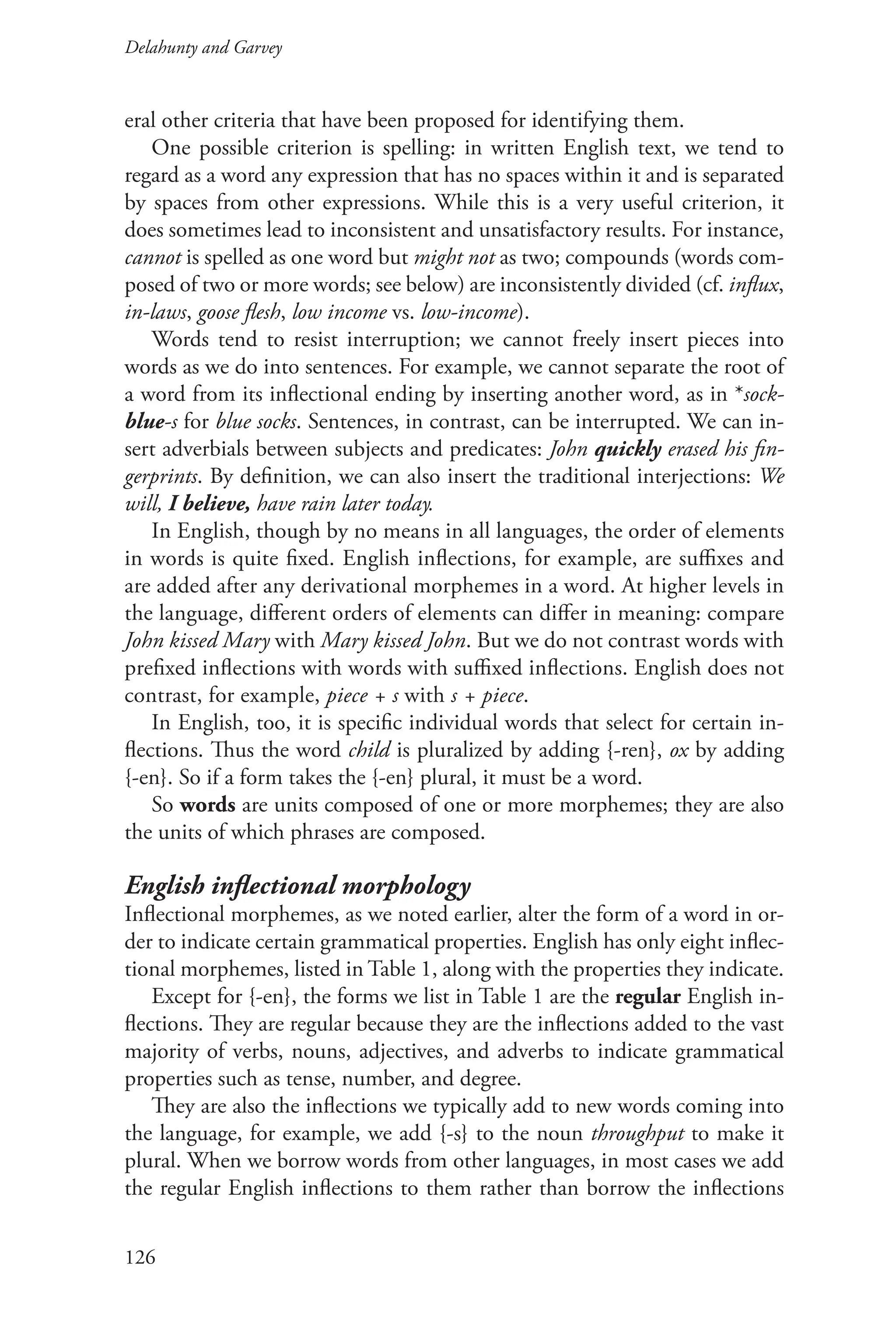
This chapter is about words—their relationships, their constituent parts,
and their internal organization. We believe that this information will be of
value to anyone interested in words, for whatever reason; to anyone inter-
ested in dictionaries and how they represent the aspects of words we deal
with here; to anyone involved in developing the vocabularies of native and
non-native speakers of English; to anyone teaching writing across the curric-
ulum who must teach the characteristics of words specific to their discipline;
to anyone teaching writing who must deal with the usage issues created by
the fact that different communities of English speakers use different word
forms, only one of which may be regarded as standard.
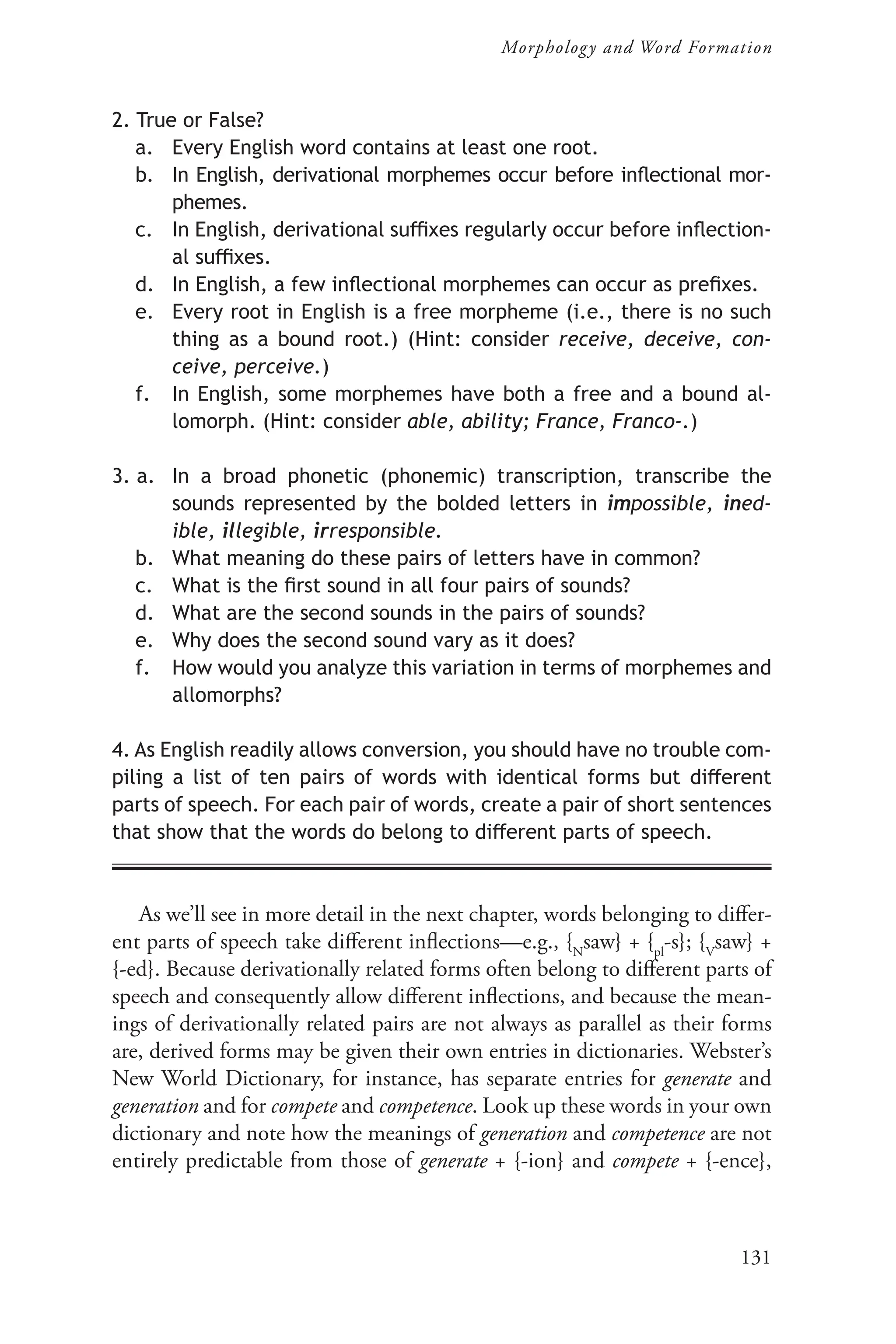
Exercise
1. Divide each of the following words into their smallest meaningful
parts:landholder, smoke-jumper, demagnetizability.
2. Each of the following sentences contains an error made by a non-
native speaker of English. In each, identify and correct the incorrect
word.
a. I am very relax here.
b. I am very boring with this game.
c. I am very satisfactory with my life.
d. Some flowers are very attracting to some insects.
e. Many people have very strong believes.
Delahunty and Garvey		
122
f. My culture is very difference from yours.
g. His grades proof that he is a hard worker.
h. The T-shirt that China drawing. (from a T-shirt package from
China)
In general terms, briefly discuss what English language learners must
learn in order to avoid such errors.
3. Some native speakers of English use forms such as seen instead
of saw, come instead of came, aks instead of ask, clumb instead of
climbed, drug instead of dragged, growed instead of grew. Are these
errors? If they are, are they the same kinds of errors made by the non-
native speakers of English listed in Exercise 2? If not, what are they?
words and morphemes
In traditional grammar, words are the basic units of analysis. Grammarians
classify words according to their parts of speech and identify and list the
forms that words can show up in. Although the matter is really very com-
plex, for the sake of simplicity we will begin with the assumption that we are
all generally able to distinguish words from other linguistic units. It will be
sufficient for our initial purposes if we assume that words are the main units
used for entries in dictionaries. In a later section, we will briefly describe
some of their distinctive characteristics.
Words are potentially complex units, composed of even more basic units,
called morphemes. A morpheme is the smallest part of a word that has
grammatical function or meaning (NB not the smallest unit of meaning);
we will designate them in braces—{ }. For example, sawed, sawn, sawing,
and saws can all be analyzed into the morphemes {saw} + {‑ed}, {‑n}, {‑ing},
and {‑s}, respectively. None of these last four can be further divided into
meaningful units and each occurs in many other words, such as looked,
mown, coughing, bakes.
{Saw} can occur on its own as a word; it does not have to be attached
to another morpheme. It is a free morpheme. However, none of the other
morphemes listed just above is free. Each must be affixed (attached) to some
other unit; each can only occur as a part of a word. Morphemes that must
be attached as word parts are said to be bound.
Exercise
1. Identify the free morphemes in the following words:
123
Morphology and Word Formation
kissed, freedom, stronger, follow, awe, goodness, talkative, teacher,
actor.
2. Use the words above (and any other words that you think are rel-
evant) to answer the following questions:
a. Can a morpheme be represented by a single phoneme? Give ex-
amples. By more than one phoneme? Give examples.
b. Can a free morpheme be more than one syllable in length? Give
examples. Can a bound morpheme? Give examples.
c. Does the same letter or phoneme—or sequence of letters or pho-
nemes—always represent the same morpheme? Why or why not?
(Hint: you must refer to the definition of morpheme to be able to
answer this.)
d. Can the same morpheme be spelled differently? Give examples.
e. Can different morphemes be pronounced identically? Give examples.
f. A morpheme is basically the same as:
i. a letter
ii. a sound
iii. a group of sounds
iv. none of the above
3. The words district and discipline show that the sequence of letters
d-i-s does not always constitute a morpheme. (Analogous examples are
mission, missile, begin, and retrofit.) List five more sequences of let-
ters that are sometimes a morpheme and sometimes not.
4. Just for fun, find some other pairs like disgruntled / *gruntled and
disgusted / *gusted, where one member of the pair is an actual English
word and the other should be a word, but isn’t.
Affixes are classified according to whether they are attached before or
after the form to which they are added. Prefixes are attached before and
suffixes after. The bound morphemes listed earlier are all suffixes; the {re‑}
of resaw is a prefix. Further examples of prefixes and suffixes are presented in
Appendix A at the end of this chapter.
Root, derivational, and inflectional morphemes
Besides being bound or free, morphemes can also be classified as root, deri-
vational, or inflectional. A root morpheme is the basic form to which other
Delahunty and Garvey		
124
morphemes are attached. It provides the basic meaning of the word.The
morpheme {saw} is the root of sawers. Derivational morphemes are added
to forms to create separate words: {‑er} is a derivational suffix whose ad-
dition turns a verb into a noun, usually meaning the person or thing that
performs the action denoted by the verb. For example, {paint}+{-er} creates
painter, one of whose meanings is “someone who paints.”
Inflectional morphemes do not create separate words. They merely
modify the word in which they occur in order to indicate grammatical prop-
erties such as plurality, as the {-s} of magazines does, or past tense, as the {ed}
of babecued does. English has eight inflectional morphemes, which we will
describe below.
We can regard the root of a word as the morpheme left over when all
the derivational and inflectional morphemes have been removed. For example,
in immovability, {im-}, {-abil}, and {-ity} are all derivational morphemes, and
when we remove them we are left with {move}, which cannot be further di-
vided into meaningful pieces, and so must be the word’s root.
We must distinguish between a word’s root and the forms to which af-
fixes are attached. In moveable, {-able} is attached to {move}, which we’ve
determined is the word’s root. However, {im-} is attached to moveable, not
to {move} (there is no word immove), but moveable is not a root. Expressions
to which affixes are attached are called bases. While roots may be bases,
bases are not always roots.
Exercise
1. Can an English word have more than one prefix? Give examples. More
than one suffix? For example? More than one of each? Give examples.
Divide the examples you collected into their root, derivational, and
inflectional morphemes.
2. Check your dictionary to see how it deals with inflected and derived
word forms. Does it list all the inflections of regular inflected words?
Just irregular ones? Does it accord derived forms their own entries or
include them in the entries of the forms from which they are derived?
3. Does your dictionary list bound morphemes? Which kinds?
morphemes, allomorphs, and morphs
The English plural morpheme {-s} can be expressed by three different but
125
Morphology and Word Formation
clearly related phonemic forms /z/ or /z/, /z/, and /s/. These three have
in common not only their meaning, but also the fact that each contains an
alveolar fricative phoneme, either /s/ or /z/. The three forms are in comple-
mentary distribution, because each occurs where the others cannot, and it is
possible to predict just where each occurs: /z/ after sibilants (/s, z, , , t,
d/), /z/ after voiced segments, and /s/ everywhere else. Given the semantic
and phonological similarities between the three forms and the fact that they
are in complementary distribution, it is reasonable to view them as contex-
tual pronunciation variants of a single entity. In parallel with phonology,
we will refer to the entity of which the three are variant representations as a
morpheme, and the variant forms of a given morpheme as its allomorphs.
When we wish to refer to a minimal grammatical form merely as a form,
we will use the term morph. Compare these terms and the concepts behind
them with phoneme, allophone, and phone. (Hint: note the use of / /, [ ],
and { }.)
Exercise
Consult the glossary in the chapter on Phonetics and Phonology and
try to determine the meanings of the morphemes {phone}, {allo-}, and
{-eme}.
(1)			/phoneme/
[allophone] [allophone] [allophone] etc.
(2)			{morpheme}
/allomorph/ /allomorph/ /allomorph/ etc.
words
Words are notoriously difficult entities to define, both in universal and in
language specific terms. Like most linguistic entities, they look in two direc-
tions—upward toward larger units of which they are parts (toward phrases),
and downward toward their constituent morphemes. This, however, only
helps us understand words if we already understand how they are combined
into larger units or divided into smaller ones, so we will briefly discuss sev-
Delahunty and Garvey		
126
eral other criteria that have been proposed for identifying them.
One possible criterion is spelling: in written English text, we tend to
regard as a word any expression that has no spaces within it and is separated
by spaces from other expressions. While this is a very useful criterion, it
does sometimes lead to inconsistent and unsatisfactory results. For instance,
cannot is spelled as one word but might not as two; compounds (words com-
posed of two or more words; see below) are inconsistently divided (cf. influx,
in-laws, goose flesh, low income vs. low-income).
Words tend to resist interruption; we cannot freely insert pieces into
words as we do into sentences. For example, we cannot separate the root of
a word from its inflectional ending by inserting another word, as in *sock-
blue‑s for blue socks. Sentences, in contrast, can be interrupted. We can in-
sert adverbials between subjects and predicates: John quickly erased his fin-
gerprints. By definition, we can also insert the traditional interjections: We
will, I believe, have rain later today.
In English, though by no means in all languages, the order of elements
in words is quite fixed. English inflections, for example, are suffixes and
are added after any derivational morphemes in a word. At higher levels in
the language, different orders of elements can differ in meaning: compare
John kissed Mary with Mary kissed John. But we do not contrast words with
prefixed inflections with words with suffixed inflections. English does not
contrast, for example, piece + s with s + piece.
In English, too, it is specific individual words that select for certain in-
flections. Thus the word child is pluralized by adding {‑ren}, ox by adding
{‑en}. So if a form takes the {-en} plural, it must be a word.
So words are units composed of one or more morphemes; they are also
the units of which phrases are composed.
English inflectional morphology
Inflectional morphemes, as we noted earlier, alter the form of a word in or-
der to indicate certain grammatical properties. English has only eight inflec-
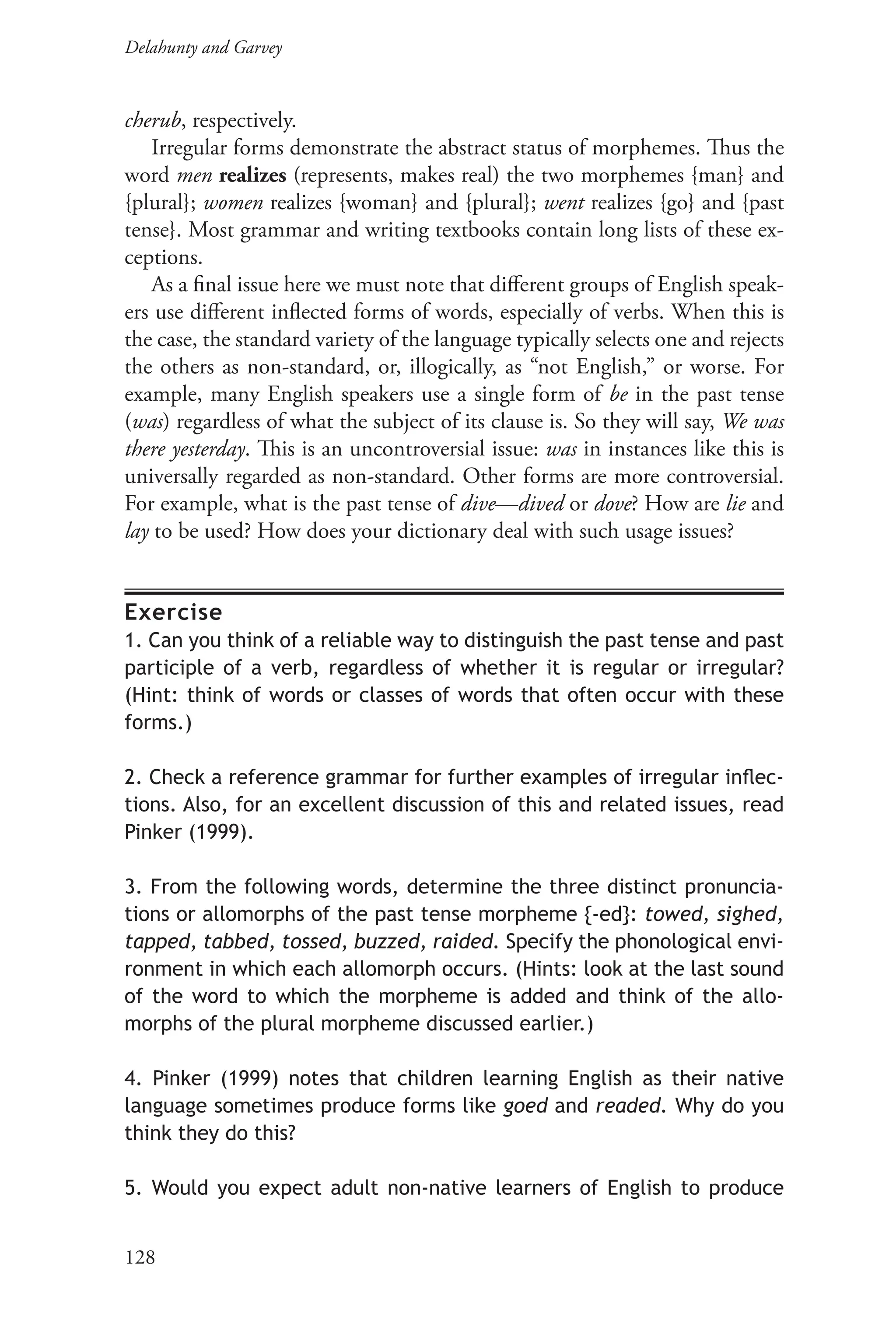
tional morphemes, listed in Table 1, along with the properties they indicate.
Except for {-en}, the forms we list in Table 1 are the regular English in-
flections. They are regular because they are the inflections added to the vast
majority of verbs, nouns, adjectives, and adverbs to indicate grammatical
properties such as tense, number, and degree.
They are also the inflections we typically add to new words coming into
the language, for example, we add {-s} to the noun throughput to make it
plural. When we borrow words from other languages, in most cases we add
the regular English inflections to them rather than borrow the inflections
127
Morphology and Word Formation
they had in their home languages; for example, we pluralize operetta as oper-
ettas rather than as operette as Italian does; similarly, we sing oratorios rather
than oratori. [Thanks to Paula Malpezzi-Price for help with these examples.]
The regular inflections are the default inflections that learners tend to use
when they don’t know the correct ones (for example, growed rather than
grew).
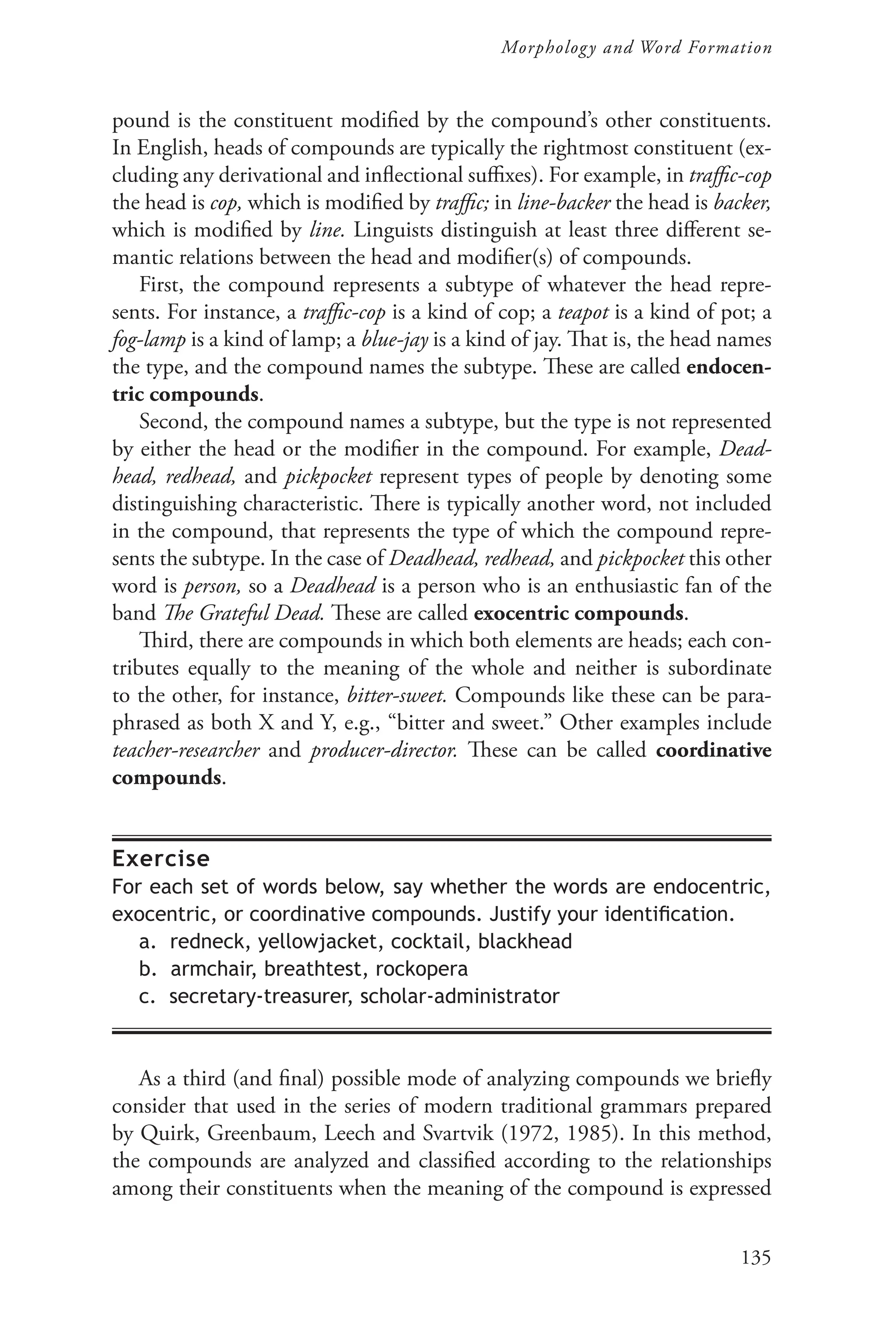
nouns:			{-s} plural			(the birds)
noun phrases:		 {-s} genitive/possessive (the bird’s song)
adjectives/adverbs: {-er} comparative		 (faster)
				{-est} superlative		 (fastest)
verbs: {-s} 3rd person singular present tense		 (proves)
		 {-ed} past tense				(proved)
		 {-ing} progressive/present participle		 (is proving)
		 {-en} past participle				(has proven)
								(was proven)
table 1: the eight english inflectional morphemes
[Note: the regular past participle morpheme is {-ed}, identical to the
past tense form {-ed}. We use the irregular past participle form {-en} to
distinguish the two.]
However, because of its long and complex history, English (like all lan-
guages) has many irregular forms, which may be irregular in a variety of
ways. First, irregular words may use different inflections than regular ones:
for example, the modern past participle inflection of a regular verb is {-ed},
but the past participle of freeze is frozen and the past participle of break
is broken. Second, irregular forms may involve internal vowel changes, as
in man/men, woman/women, grow/grew, ring/rang/rung. Third, some forms
derive from historically unrelated forms: went, the past tense of go, histori-
cally was the past tense of a different verb, wend. This sort of realignment
is known as suppletion. Other examples of suppletion include good, better,
and best, and bad, worse, and worst. (As an exercise, you might look up be,
am, and is in a dictionary that provides etymological information, such as
the American Heritage.) Fourth, some words show no inflectional change:
sheep is both singular and plural; hit is both present and past tense, as well
as past participle. Fifth, many borrowed words, especially nouns, have ir-
regular inflected forms: alumnae and cherubim are the plurals of alumna and
Delahunty and Garvey		
128
cherub, respectively.
Irregular forms demonstrate the abstract status of morphemes. Thus the
word men realizes (represents, makes real) the two morphemes {man} and
{plural}; women realizes {woman} and {plural}; went realizes {go} and {past
tense}. Most grammar and writing textbooks contain long lists of these ex-
ceptions.
As a final issue here we must note that different groups of English speak-
ers use different inflected forms of words, especially of verbs. When this is
the case, the standard variety of the language typically selects one and rejects
the others as non-standard, or, illogically, as “not English,” or worse. For
example, many English speakers use a single form of be in the past tense
(was) regardless of what the subject of its clause is. So they will say, We was
there yesterday. This is an uncontroversial issue: was in instances like this is
universally regarded as non-standard. Other forms are more controversial.
For example, what is the past tense of dive—dived or dove? How are lie and
lay to be used? How does your dictionary deal with such usage issues?
Exercise
1. Can you think of a reliable way to distinguish the past tense and past
participle of a verb, regardless of whether it is regular or irregular?
(Hint: think of words or classes of words that often occur with these
forms.)
2. Check a reference grammar for further examples of irregular inflec-
tions. Also, for an excellent discussion of this and related issues, read
Pinker (1999).
3. From the following words, determine the three distinct pronuncia-
tions or allomorphs of the past tense morpheme {-ed}: towed, sighed,
tapped, tabbed, tossed, buzzed, raided. Specify the phonological envi-
ronment in which each allomorph occurs. (Hints: look at the last sound
of the word to which the morpheme is added and think of the allo-
morphs of the plural morpheme discussed earlier.)
4. Pinker (1999) notes that children learning English as their native
language sometimes produce forms like goed and readed. Why do you
think they do this?
5. Would you expect adult non-native learners of English to produce
129
Morphology and Word Formation
forms similar to those of native speaking children? What further dif-
ficulties might non-native speakers have that native English-speaking
children might not have? (Hints: think of the frequency of irregular
forms in English and think of your own experience in learning a second
language.)
English derivational morphology
Derivation is the process of creating separate but morphologically related
words. Typically, but not always, it involves one or more changes in form. It
can involve prefixing, as in resaw, and suffixing, as in sawing, sawer, sawable.
Another type of derivation, while not visible, is at least audible. It in-
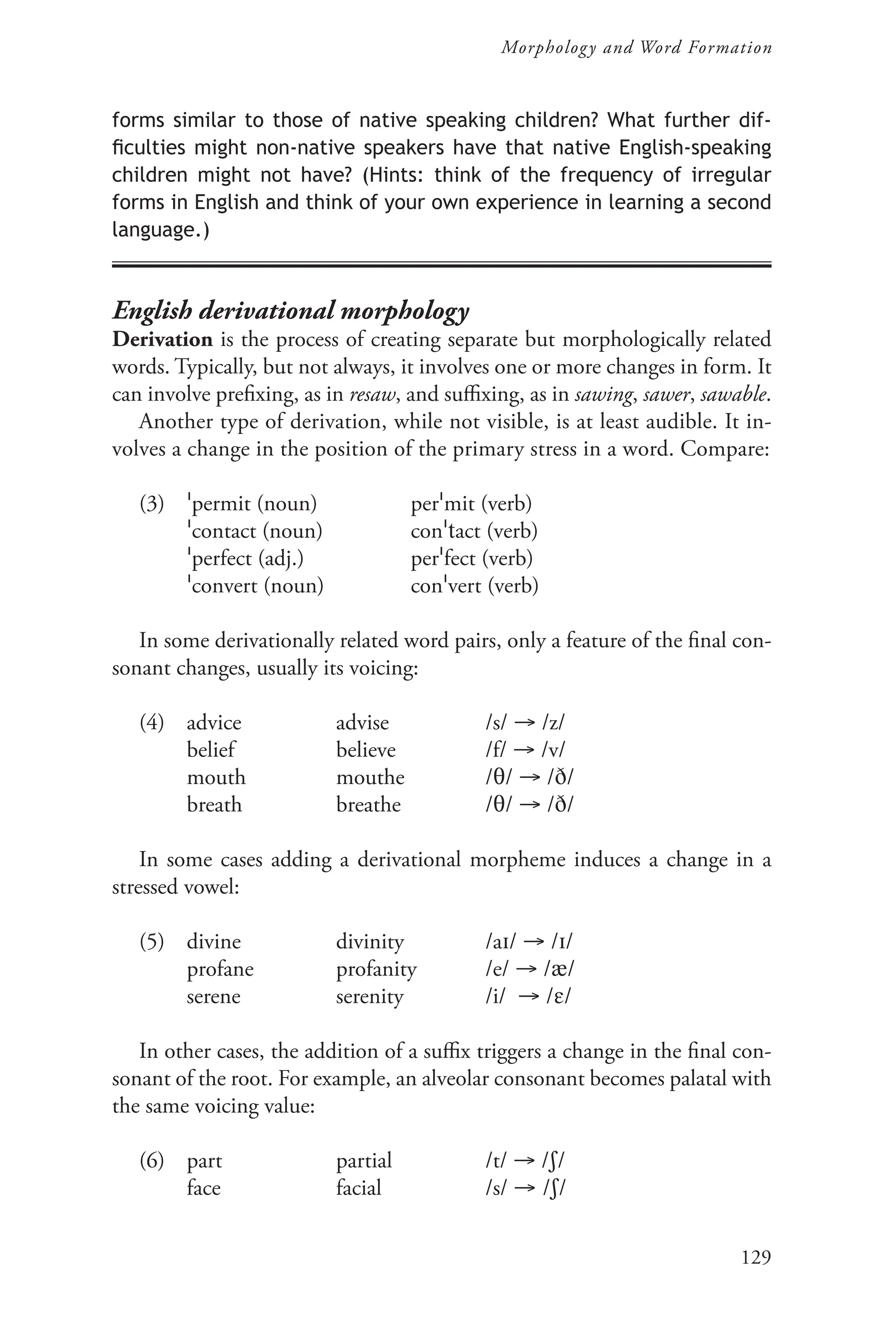
volves a change in the position of the primary stress in a word. Compare:
(3) permit (noun)		 permit (verb)
		 contact (noun)		 contact (verb)
		 perfect (adj.)		 perfect (verb)
		 convert (noun)		 convert (verb)
In some derivationally related word pairs, only a feature of the final con-
sonant changes, usually its voicing:
(4) advice		advise		/s/  /z/
		 belief believe		 /f/  /v/
		
mouth		mouthe		//  //
		 breath breathe		 //  //
In some cases adding a derivational morpheme induces a change in a
stressed vowel:
(5) divine		divinity		/a/  //
		 profane		 profanity /e/  //
		 serene 		 serenity		 /i/  //
In other cases, the addition of a suffix triggers a change in the final con-
sonant of the root. For example, an alveolar consonant becomes palatal with
the same voicing value:
(6) part		partial		/t/  //
		 face		facial		/s/  //
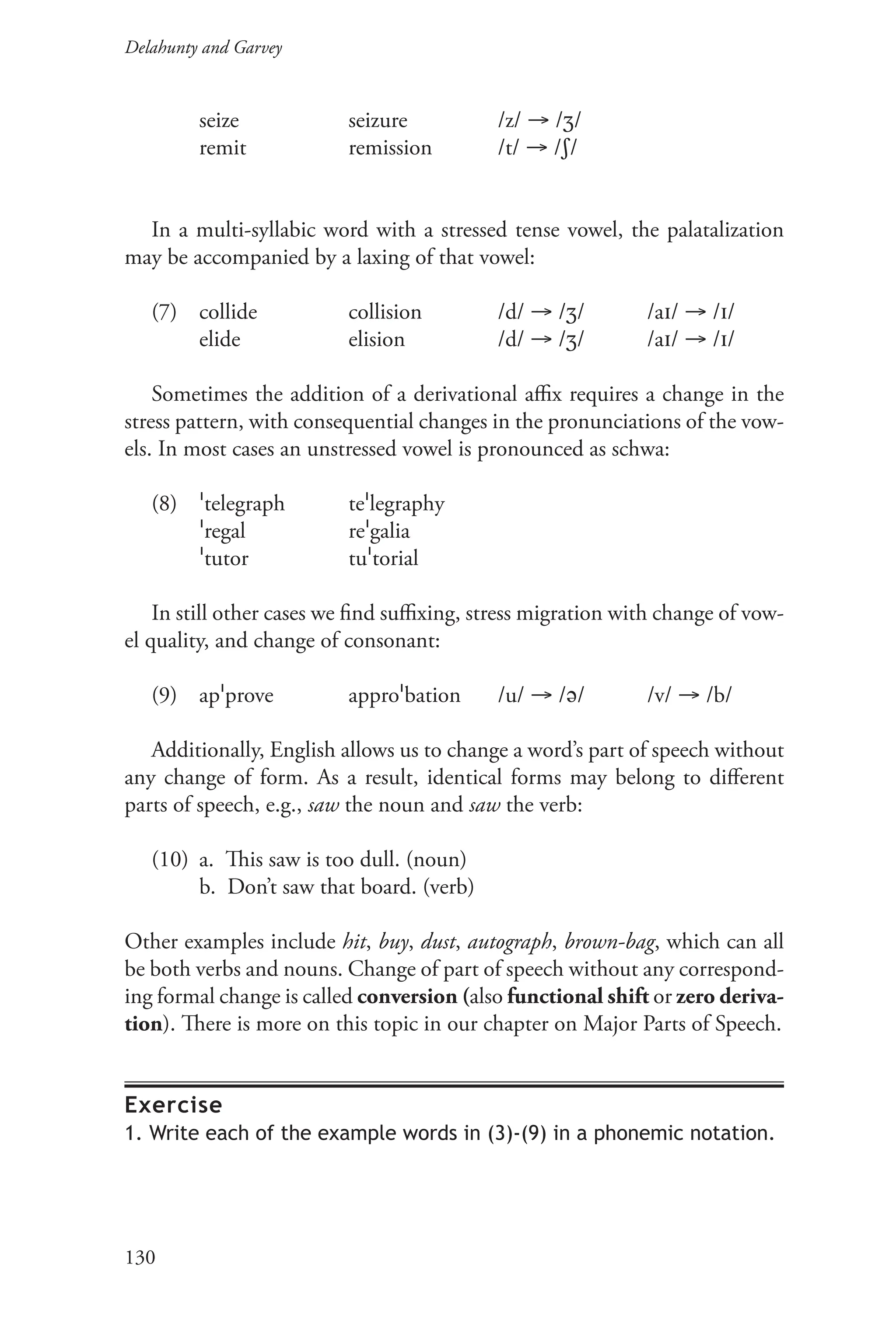
Delahunty and Garvey		
130
		
seize		seizure		/z/  //
		 remit		 remission /t/  //
In a multi-syllabic word with a stressed tense vowel, the palatalization
may be accompanied by a laxing of that vowel:
(7) collide		collision		/d/  // /a/  //
		
elide		elision		/d/  // /a/  //
Sometimes the addition of a derivational affix requires a change in the
stress pattern, with consequential changes in the pronunciations of the vow-
els. In most cases an unstressed vowel is pronounced as schwa:
(8) telegraph telegraphy
regal		 regalia
		 tutor		 tutorial
In still other cases we find suffixing, stress migration with change of vow-
el quality, and change of consonant:
(9) approve		 approbation /u/  // /v/  /b/
Additionally, English allows us to change a word’s part of speech without
any change of form. As a result, identical forms may belong to different
parts of speech, e.g., saw the noun and saw the verb:
(10) a. This saw is too dull. (noun)
		 b. Don’t saw that board. (verb)
Other examples include hit, buy, dust, autograph, brown-bag, which can all
be both verbs and nouns. Change of part of speech without any correspond-
ing formal change is called conversion (also functional shift or zero deriva-
tion). There is more on this topic in our chapter on Major Parts of Speech.
Exercise
1. Write each of the example words in (3)-(9) in a phonemic notation.
131
Morphology and Word Formation
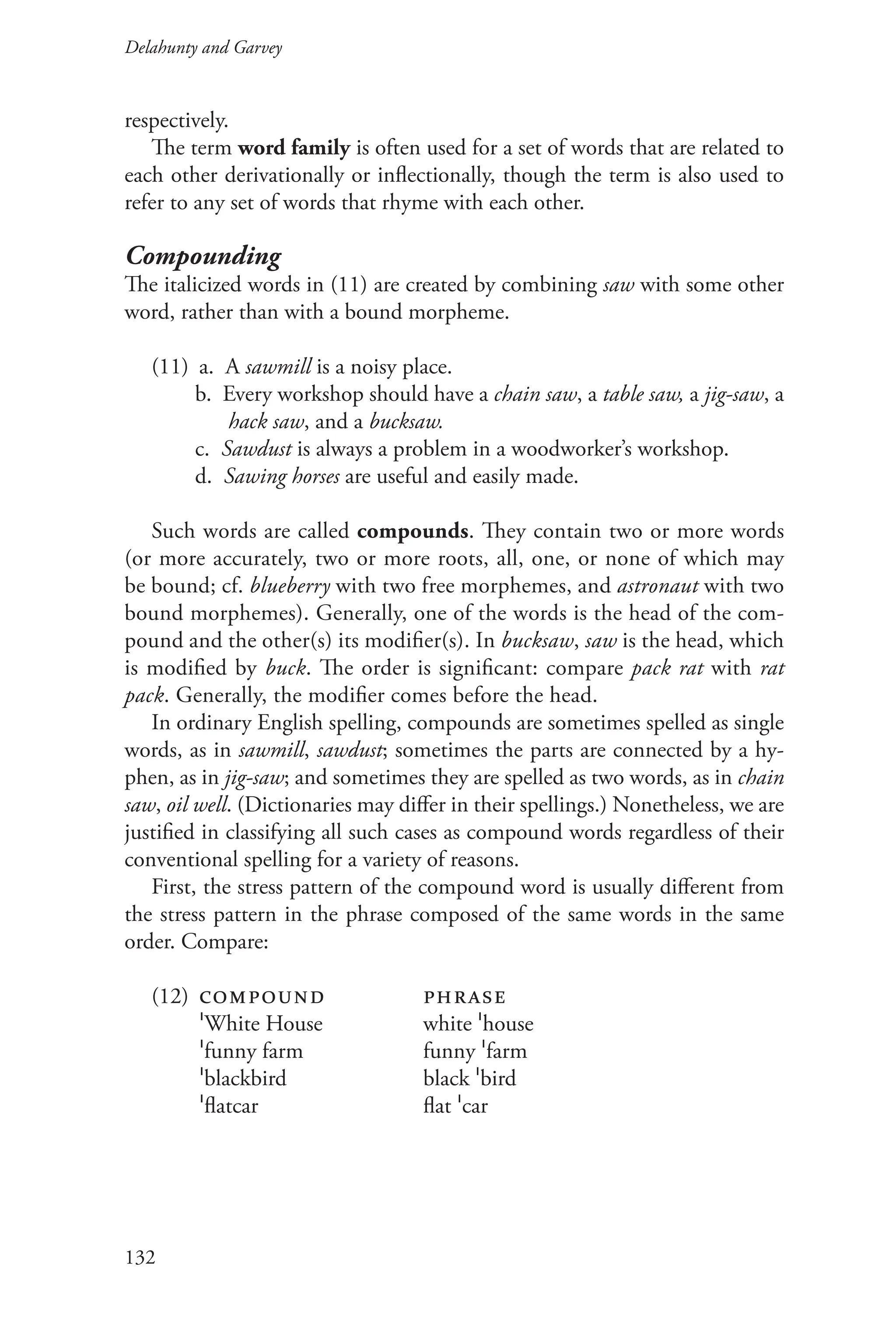
2. True or False?
a. Every English word contains at least one root.
b. In English, derivational morphemes occur before inflectional mor-
phemes.
c. In English, derivational suffixes regularly occur before inflection-
al suffixes.
d. In English, a few inflectional morphemes can occur as prefixes.
e. Every root in English is a free morpheme (i.e., there is no such
thing as a bound root.) (Hint: consider receive, deceive, con-
ceive, perceive.)
f. In English, some morphemes have both a free and a bound al-
lomorph. (Hint: consider able, ability; France, Franco-.)
3. a. In a broad phonetic (phonemic) transcription, transcribe the
sounds represented by the bolded letters in impossible, ined-
ible, illegible, irresponsible.
b. What meaning do these pairs of letters have in common?
c. What is the first sound in all four pairs of sounds?
d. What are the second sounds in the pairs of sounds?
e. Why does the second sound vary as it does?
f. How would you analyze this variation in terms of morphemes and
allomorphs?
4. As English readily allows conversion, you should have no trouble com-
piling a list of ten pairs of words with identical forms but different
parts of speech. For each pair of words, create a pair of short sentences
that show that the words do belong to different parts of speech.
As we’ll see in more detail in the next chapter, words belonging to differ-
ent parts of speech take different inflections—e.g., {N
saw} + {pl
-s}; {V
saw} +
{-ed}. Because derivationally related forms often belong to different parts of
speech and consequently allow different inflections, and because the mean-
ings of derivationally related pairs are not always as parallel as their forms
are, derived forms may be given their own entries in dictionaries. Webster’s
New World Dictionary, for instance, has separate entries for generate and
generation and for compete and competence. Look up these words in your own
dictionary and note how the meanings of generation and competence are not
entirely predictable from those of generate + {-ion} and compete + {-ence},
Delahunty and Garvey		
132
respectively.
The term word family is often used for a set of words that are related to
each other derivationally or inflectionally, though the term is also used to
refer to any set of words that rhyme with each other.
Compounding
The italicized words in (11) are created by combining saw with some other
word, rather than with a bound morpheme.
(11) a. A sawmill is a noisy place.
b. Every workshop should have a chain saw, a table saw, a jig-saw, a
hack saw, and a bucksaw.
c. Sawdust is always a problem in a woodworker’s workshop.
d. Sawing horses are useful and easily made.
Such words are called compounds. They contain two or more words
(or more accurately, two or more roots, all, one, or none of which may
be bound; cf. blueberry with two free morphemes, and astronaut with two
bound morphemes). Generally, one of the words is the head of the com-
pound and the other(s) its modifier(s). In bucksaw, saw is the head, which
is modified by buck. The order is significant: compare pack rat with rat
pack. Generally, the modifier comes before the head.
In ordinary English spelling, compounds are sometimes spelled as single
words, as in sawmill, sawdust; sometimes the parts are connected by a hy-
phen, as in jig‑saw; and sometimes they are spelled as two words, as in chain
saw, oil well. (Dictionaries may differ in their spellings.) Nonetheless, we are
justified in classifying all such cases as compound words regardless of their
conventional spelling for a variety of reasons.
First, the stress pattern of the compound word is usually different from
the stress pattern in the phrase composed of the same words in the same
order. Compare:
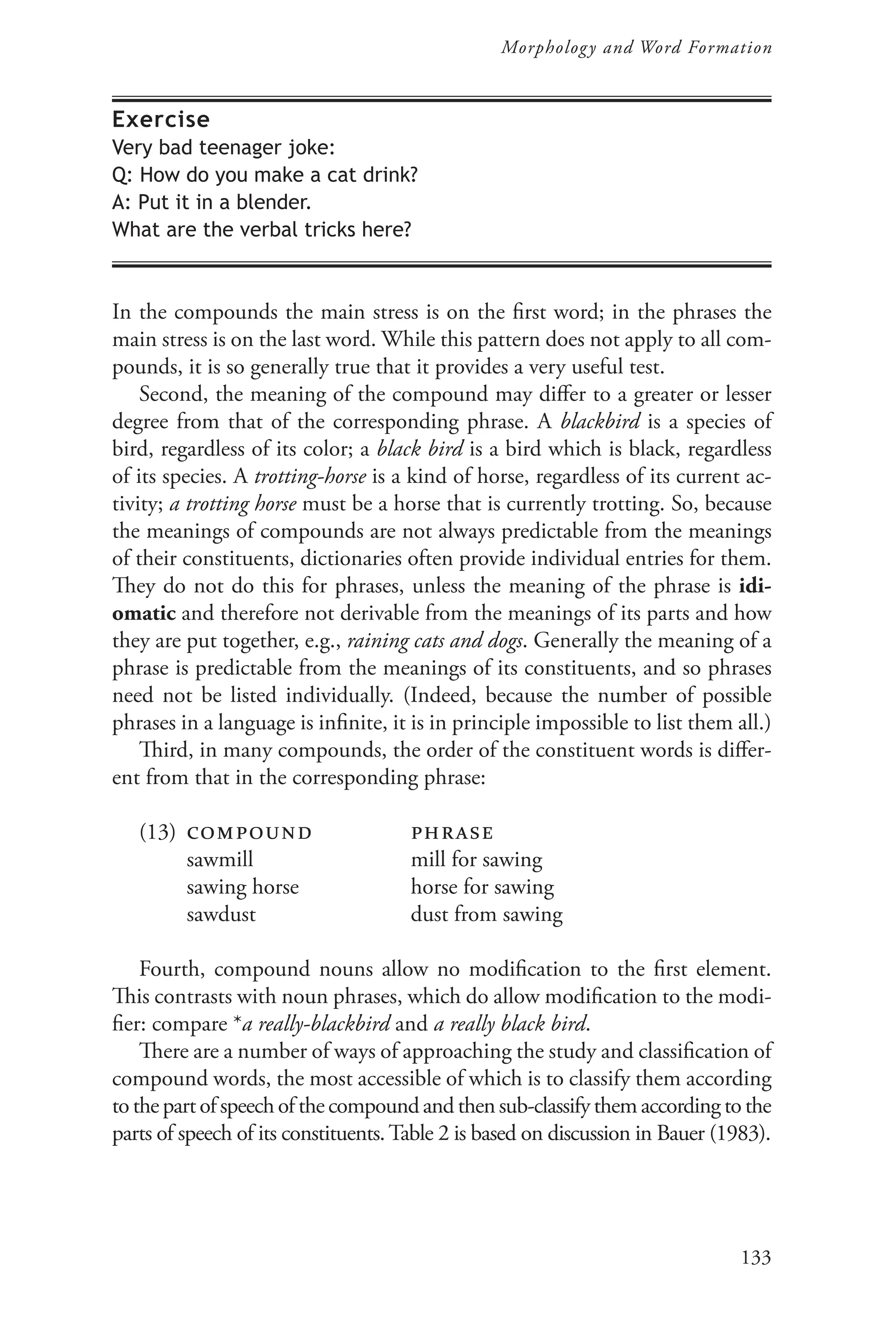
(12) compound phrase
		 White House		 white house
		 funny farm		 funny farm
		 blackbird		 black bird
		 flatcar			flat car
133
Morphology and Word Formation
Exercise
Very bad teenager joke:
Q: How do you make a cat drink?
A: Put it in a blender.
What are the verbal tricks here?
In the compounds the main stress is on the first word; in the phrases the
main stress is on the last word. While this pattern does not apply to all com-
pounds, it is so generally true that it provides a very useful test.
Second, the meaning of the compound may differ to a greater or lesser
degree from that of the corresponding phrase. A blackbird is a species of
bird, regardless of its color; a black bird is a bird which is black, regardless
of its species. A trotting-horse is a kind of horse, regardless of its current ac-
tivity; a trotting horse must be a horse that is currently trotting. So, because
the meanings of compounds are not always predictable from the meanings
of their constituents, dictionaries often provide individual entries for them.
They do not do this for phrases, unless the meaning of the phrase is idi-
omatic and therefore not derivable from the meanings of its parts and how
they are put together, e.g., raining cats and dogs. Generally the meaning of a
phrase is predictable from the meanings of its constituents, and so phrases
need not be listed individually. (Indeed, because the number of possible
phrases in a language is infinite, it is in principle impossible to list them all.)
Third, in many compounds, the order of the constituent words is differ-
ent from that in the corresponding phrase:
(13) compound phrase
		 sawmill 			 mill for sawing
		 sawing horse		 horse for sawing
		 sawdust			 dust from sawing
Fourth, compound nouns allow no modification to the first element.
This contrasts with noun phrases, which do allow modification to the modi-
fier: compare *a really-blackbird and a really black bird.
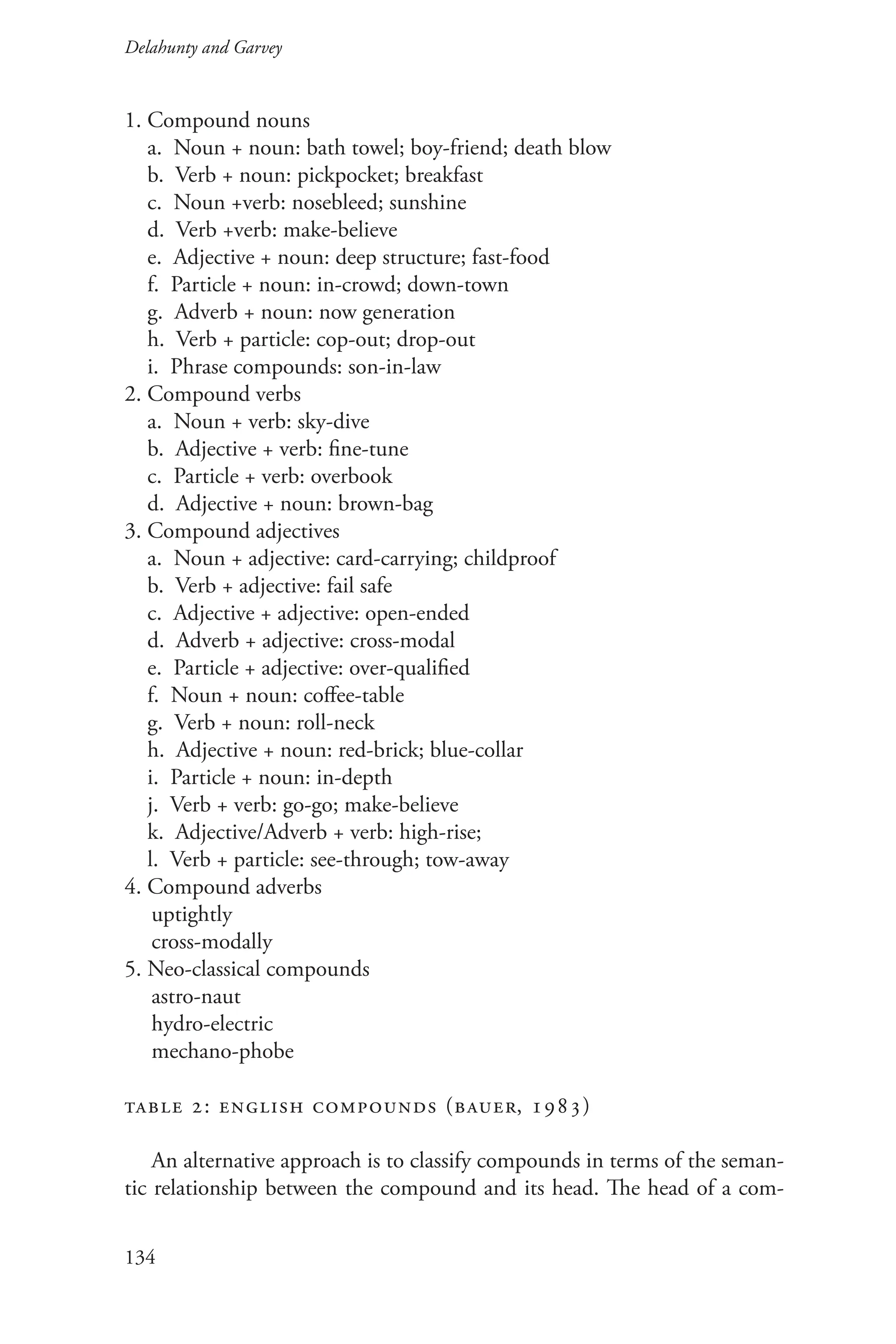
There are a number of ways of approaching the study and classification of
compound words, the most accessible of which is to classify them according
tothe partofspeechofthecompoundandthensub-classify them according to the
parts of speech of its constituents.Table 2 is based on discussion in Bauer (1983).
Delahunty and Garvey		
134
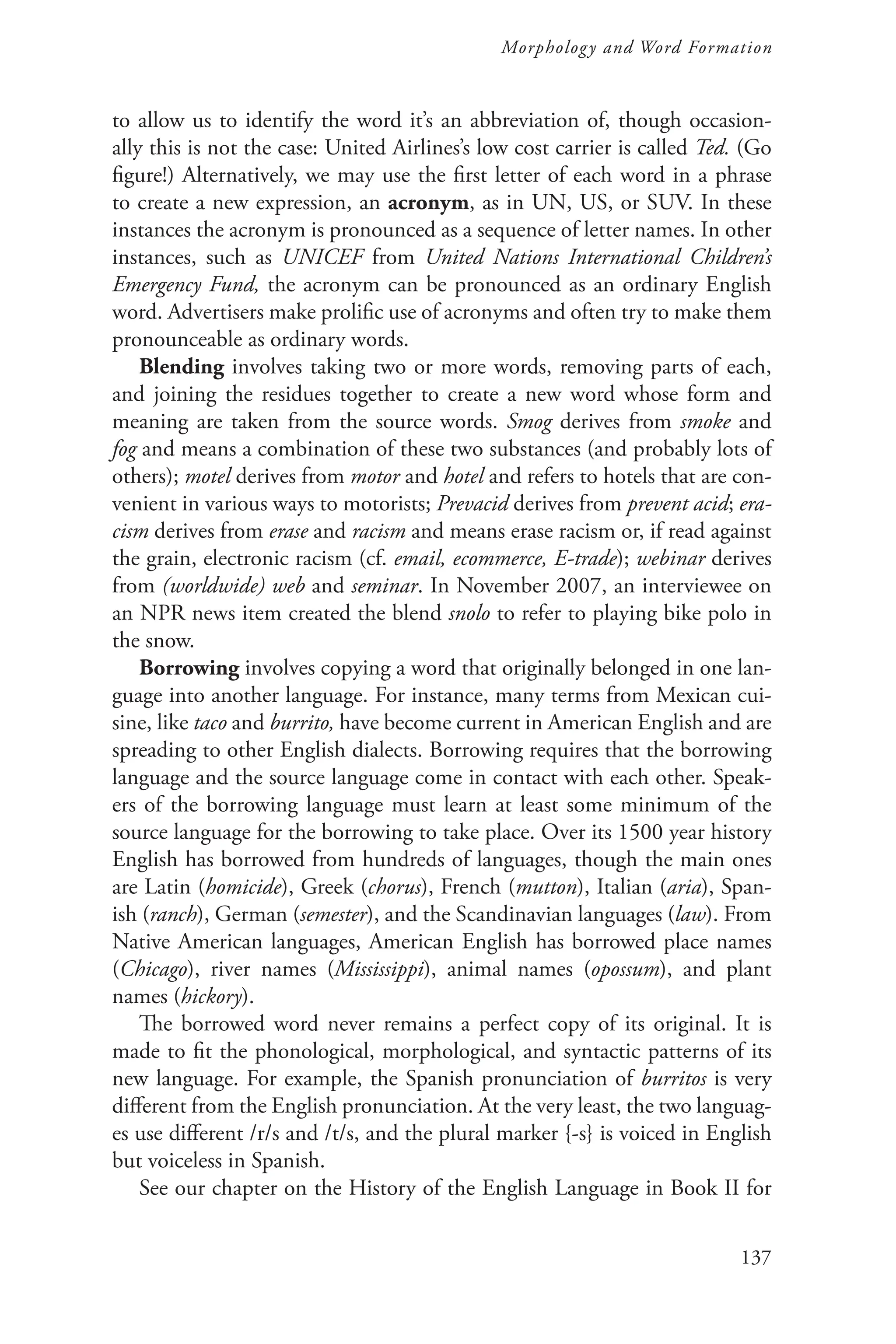
1. Compound nouns
a. Noun + noun: bath towel; boy-friend; death blow
b. Verb + noun: pickpocket; breakfast
c. Noun +verb: nosebleed; sunshine
d. Verb +verb: make-believe
e. Adjective + noun: deep structure; fast-food
f. Particle + noun: in-crowd; down-town
g. Adverb + noun: now generation
h. Verb + particle: cop-out; drop-out
i. Phrase compounds: son-in-law
2. Compound verbs
a. Noun + verb: sky-dive
b. Adjective + verb: fine-tune
c. Particle + verb: overbook
d. Adjective + noun: brown-bag
3. Compound adjectives
a. Noun + adjective: card-carrying; childproof
b. Verb + adjective: fail safe
c. Adjective + adjective: open-ended
d. Adverb + adjective: cross-modal
e. Particle + adjective: over-qualified
f. Noun + noun: coffee-table
g. Verb + noun: roll-neck
h. Adjective + noun: red-brick; blue-collar
i. Particle + noun: in-depth
j. Verb + verb: go-go; make-believe
k. Adjective/Adverb + verb: high-rise;
l. Verb + particle: see-through; tow-away
4. Compound adverbs
uptightly
cross-modally
5. Neo-classical compounds
astro-naut
hydro-electric
mechano-phobe
table 2: english compounds (bauer, 1983)
An alternative approach is to classify compounds in terms of the seman-
tic relationship between the compound and its head. The head of a com-
135
Morphology and Word Formation
pound is the constituent modified by the compound’s other constituents.
In English, heads of compounds are typically the rightmost constituent (ex-
cluding any derivational and inflectional suffixes). For example, in traffic-cop
the head is cop, which is modified by traffic; in line-backer the head is backer,
which is modified by line. Linguists distinguish at least three different se-
mantic relations between the head and modifier(s) of compounds.
First, the compound represents a subtype of whatever the head repre-
sents. For instance, a traffic-cop is a kind of cop; a teapot is a kind of pot; a
fog-lamp is a kind of lamp; a blue-jay is a kind of jay. That is, the head names
the type, and the compound names the subtype. These are called endocen-
tric compounds.
Second, the compound names a subtype, but the type is not represented
by either the head or the modifier in the compound. For example, Dead-
head, redhead, and pickpocket represent types of people by denoting some
distinguishing characteristic. There is typically another word, not included
in the compound, that represents the type of which the compound repre-
sents the subtype. In the case of Deadhead, redhead, and pickpocket this other
word is person, so a Deadhead is a person who is an enthusiastic fan of the
band The Grateful Dead. These are called exocentric compounds.
Third, there are compounds in which both elements are heads; each con-
tributes equally to the meaning of the whole and neither is subordinate
to the other, for instance, bitter-sweet. Compounds like these can be para-
phrased as both X and Y, e.g., “bitter and sweet.” Other examples include
teacher-researcher and producer-director. These can be called coordinative
compounds.
Exercise
For each set of words below, say whether the words are endocentric,
exocentric, or coordinative compounds. Justify your identification.
a. redneck, yellowjacket, cocktail, blackhead
b. armchair, breathtest, rockopera
c. secretary-treasurer, scholar-administrator
As a third (and final) possible mode of analyzing compounds we briefly
consider that used in the series of modern traditional grammars prepared
by Quirk, Greenbaum, Leech and Svartvik (1972, 1985). In this method,
the compounds are analyzed and classified according to the relationships
among their constituents when the meaning of the compound is expressed
Delahunty and Garvey		
136
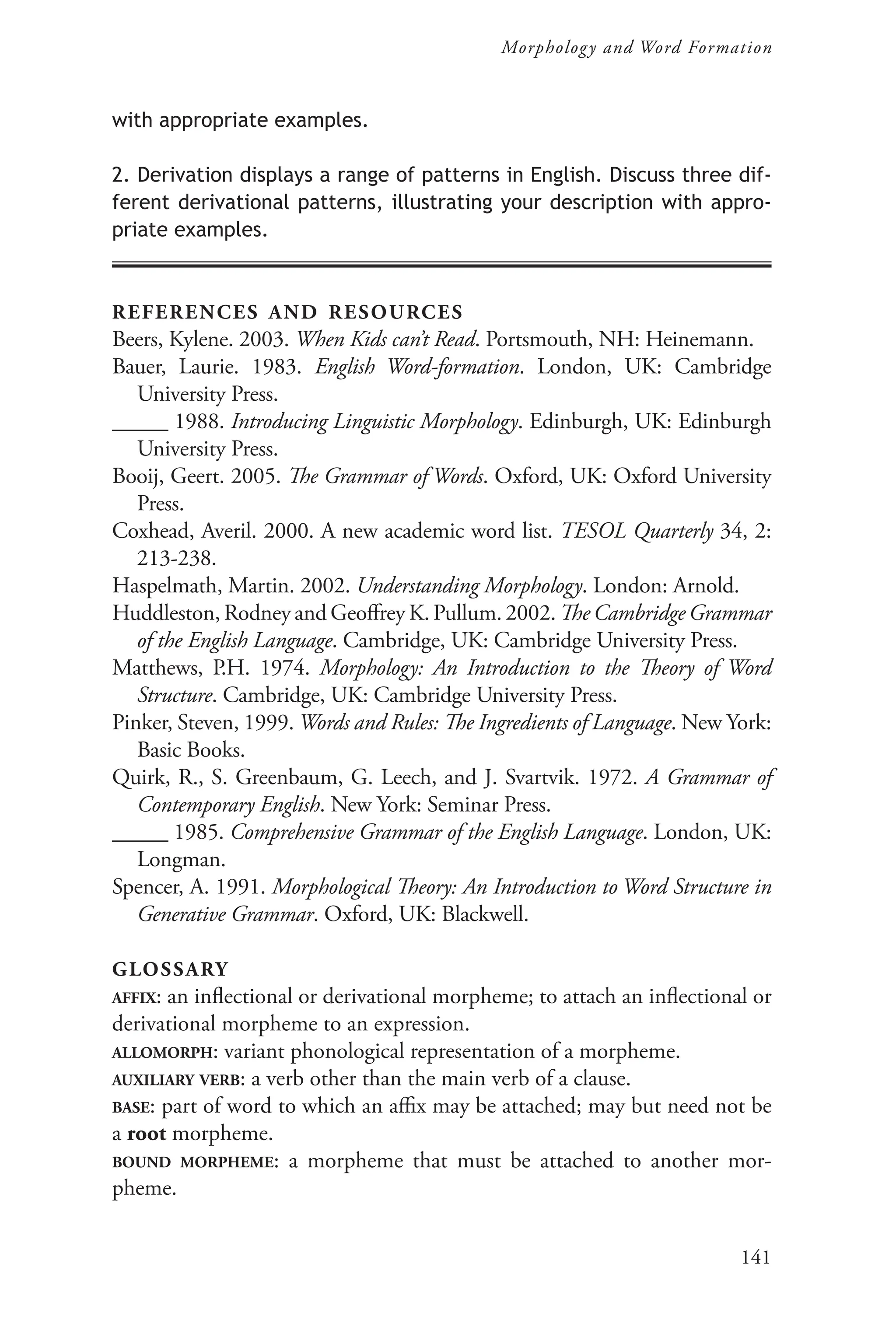
as a phrase or clause. For example:
phrases
bee-sting		 a sting by a bee
blood-test		 a test of blood
swimming pool a pool for swimming
adding machine a machine for adding
girlfriend		 a friend who is a girl
killer shark		 a shark which is a killer
windmill		 a mill powered by wind
motorcycle		 a cycle powered by a motor
self-control		 someone able to control self
clauses
sunrise		 when the sun rises
table 3: underlying syntactic/semantic analysis of english
compounds
Exercise
Paraphrase each of the following compounds according to at least one
of the patterns in Table 3.
babysitter, catfish, cry-baby, story-teller, dancing girl, darkroom,
doorknob, taxpayer, security officer, sleepwalking
Other sources of words
Besides derivation and compounding, languages make use of coining, ab-
breviating, blending, and borrowing to create new words.
Coining is the creation of new words without reference to the existing
morphological resources of the language, that is, solely out of the sounds
of the language. Coining is very rare, but googol [note the spelling] is an
attested example, meaning 10100
. This word was invented in 1940 by the
nine-year-old nephew of a mathematician (see Compact Edition of the Ox-
ford English Dictionary Vol. III Supplement to the OED Vols. I-IV: 1987
p. 317).
Abbreviation involves the shortening of existing words to create other
words, usually informal versions of the originals. There are several ways to
abbreviate. We may simply lop off one or more syllables, as in prof for profes-
sor, doc for doctor. Usually the syllable left over provides enough information
137
Morphology and Word Formation
to allow us to identify the word it’s an abbreviation of, though occasion-
ally this is not the case: United Airlines’s low cost carrier is called Ted. (Go
figure!) Alternatively, we may use the first letter of each word in a phrase
to create a new expression, an acronym, as in UN, US, or SUV. In these
instances the acronym is pronounced as a sequence of letter names. In other
instances, such as UNICEF from United Nations International Children’s
Emergency Fund, the acronym can be pronounced as an ordinary English
word. Advertisers make prolific use of acronyms and often try to make them
pronounceable as ordinary words.
Blending involves taking two or more words, removing parts of each,
and joining the residues together to create a new word whose form and
meaning are taken from the source words. Smog derives from smoke and
fog and means a combination of these two substances (and probably lots of
others); motel derives from motor and hotel and refers to hotels that are con-
venient in various ways to motorists; Prevacid derives from prevent acid; era-
cism derives from erase and racism and means erase racism or, if read against
the grain, electronic racism (cf. email, ecommerce, E-trade); webinar derives
from (worldwide) web and seminar. In November 2007, an interviewee on
an NPR news item created the blend snolo to refer to playing bike polo in
the snow.
Borrowing involves copying a word that originally belonged in one lan-
guage into another language. For instance, many terms from Mexican cui-
sine, like taco and burrito, have become current in American English and are
spreading to other English dialects. Borrowing requires that the borrowing
language and the source language come in contact with each other. Speak-
ers of the borrowing language must learn at least some minimum of the
source language for the borrowing to take place. Over its 1500 year history
English has borrowed from hundreds of languages, though the main ones
are Latin (homicide), Greek (chorus), French (mutton), Italian (aria), Span-
ish (ranch), German (semester), and the Scandinavian languages (law). From
Native American languages, American English has borrowed place names
(Chicago), river names (Mississippi), animal names (opossum), and plant
names (hickory).
The borrowed word never remains a perfect copy of its original. It is
made to fit the phonological, morphological, and syntactic patterns of its
new language. For example, the Spanish pronunciation of burritos is very
different from the English pronunciation. At the very least, the two languag-
es use different /r/s and /t/s, and the plural marker {-s} is voiced in English
but voiceless in Spanish.
See our chapter on the History of the English Language in Book II for
Delahunty and Garvey		
138
more on borrowing.
registers and words
Although most of the words we use every day can be used in almost any
context, many words of the language are restricted to uses in certain fields,
disciplines, professions, or activities, i.e., registers. For example, the word
phoneme is restricted to the linguistic domain. Interestingly, some words
may be used in several domains with a different meaning in each, though
these meanings may be a specific version of a more general meaning. For ex-
ample, the word morphology is used in linguistics to refer to the study of the
internal structure of words and their derivational relationships; in botany
to refer to the forms of plants; in geology to refer to rock formations. The
general, abstract meaning underlying these specific meanings is the study
of form.
Besides words that may be used in almost any context and those that are
technical or discipline specific, there are words that play important roles
in academic discourses generally, for example, accuracy; basis; concept and
its related forms, conception, conceptual, conceptualize; decrease; effect; fac-
tor; indicate and its related forms, indication, indicative; and result. As such
words are used across disciplines, generally without local idiosyncrasies of
meaning, they are important words for English learners, both native and
non-native speakers. For a useful overview of the attempts to create lists of
such academic (or subtechnical) words and a new list of them, see Cox-
head (2000) and the references therein (another academic word).
the internal structure of complex words
Complex words (those composed of more than one morpheme) are not
merely unstructured sequences of morphemes. For example, the plural {‑s}
suffix on dropouts must be added to the entire compound dropout, not to out
to which drop is then added. The reason for this is that the plural suffix may
be attached to nouns, but not to verbs or particles. Drop and out constitute
a noun only after they have been brought together in the compound.
We can use brackets with subscripts to represent these relations:
[N
[N
[V
drop][Prt
out]]s]. Alternatively, and equivalently, we can use tree dia-
grams to indicate the parts (constituents) of complex words and their struc-
tural relations:
139
Morphology and Word Formation
(14) 		 N
		 N Pl
V Prt
drop out s
Consider another example: unreadability. We analyze this word as
[N
[Adj
un1
[Adj
[V
read]abil]]ity], represented by the following tree:
(15) 			 N
		 Adj		 Suffix
Prefix 		 Adj
V Suffix
			 un1
read abil ity
Let’s consider this analysis more closely. The suffix {‑able} attaches to verbs
to create adjectives. Besides readable we have the adjectives doable, manage-
able, and attachable, which are derived from the verbs read, do, manage, and
attach, respectively. We can represent this part of the word as: [Adj
[V
read]
able].
The prefix {un1
-} attaches to adjectives, meaning “not” or “the converse
of.” Compare unwise, unfair, ungrateful, uncomfortable, unmanageable with
unreadable. All can be glossed as not having the quality denoted by the
adjective to which they are attached: “not comfortable,” “not fair,” etc. This
morpheme must be distinguished from the prefix {un2
-} meaning “to reverse
the action,” which can be attached only to verbs (e.g., untie).
{Un1
‑} cannot attach to the verb read; although there is the word unread,
pronounced [@nrEd], not [@nrid], an adjective meaning “not read” and de-
rived from the past participle of read. Consequently, in unreadable, {-able}
must be attached to {read} to create the adjective readable. {Un1
‑} may then
be attached to readable to create unreadable. We will represent this part of
the word as: [Adj
un1
[Adj
[V
read]able]].
The suffix {‑ity} attaches to adjectives to create abstract nouns. Conse-
quently it must be attached to the adjective unreadable. The structure of
Delahunty and Garvey		
140
the entire word therefore must be: [N
[Adj
un1
[Adj
[V
read]able]]ity], as specified
above. In pronunciation the morpheme {-able} will be assigned its allo-
morph /@bIl/ (spelled <abil>, the same allomorph that appears in ability).
Exercise
Provide an analysis tree for each of the following words: retry, sink-
able, thoughtless, meaningfulness, microorganisms.
classifying words by their morphological
properties
Once the morphemes of a language have been identified, their allomorphs
determined, and their distributions specified, we can use our analysis to as-
sign the words of a language to parts of speech. For many words, inflections
provide the main basis of this assignment. Refer to Table 1 for the list of
English inflections.
Nouns can be identified as those words that can be inflected for plural.
Verbs are words that can be inflected for 3rd person singular present
tense, past tense, past participle, and progressive. These forms are often re-
ferred to as the principal parts of the verb.
Short adjectives and adverbs are words that can be inflected for compara-
tive and superlative.
Derivational regularities can also be used to classify words. We can, for
example, classify as adverbs words derived from adjectives by the addition of
the suffix {‑ly}, e.g., quickly.
Classifying words on the basis of their internal morphological structure
works only up to a point. There are lots of words that are not internally com-
plex and so cannot be classified without recourse to other types of criteria.
For example, the preposition to has no internal morphological structure and
so cannot be assigned to a grammatical class on that basis. Likewise, adverbs
such as hard or fast lack the characteristic {‑ly} ending. It becomes necessary
to use other criteria to classify these and many other words. We consider in
detail the principles which have been proposed for assigning words to parts
of speech in the chapters on Major and Minor Parts of Speech in this book.
Exercise
1. Discuss two relatively reliable criteria (don’t use spelling) for distin-
guishing words from morphemes and phrases. Illustrate your discussion
141
Morphology and Word Formation
with appropriate examples.
2. Derivation displays a range of patterns in English. Discuss three dif-
ferent derivational patterns, illustrating your description with appro-
priate examples.
references and resources
Beers, Kylene. 2003. When Kids can’t Read. Portsmouth, NH: Heinemann.
Bauer, Laurie. 1983. English Word-formation. London, UK: Cambridge
University Press.
_____ 1988. Introducing Linguistic Morphology. Edinburgh, UK: Edinburgh
University Press.
Booij, Geert. 2005. The Grammar of Words. Oxford, UK: Oxford University
Press.
Coxhead, Averil. 2000. A new academic word list. TESOL Quarterly 34, 2:
213-238.
Haspelmath, Martin. 2002. Understanding Morphology. London: Arnold.
Huddleston, Rodney and Geoffrey K. Pullum. 2002. The Cambridge Grammar
of the English Language. Cambridge, UK: Cambridge University Press.
Matthews, P.H. 1974. Morphology: An Introduction to the Theory of Word
Structure. Cambridge, UK: Cambridge University Press.
Pinker, Steven, 1999. Words and Rules: The Ingredients of Language. New York:
Basic Books.
Quirk, R., S. Greenbaum, G. Leech, and J. Svartvik. 1972. A Grammar of
Contemporary English. New York: Seminar Press.
_____ 1985. Comprehensive Grammar of the English Language. London, UK:
Longman.
Spencer, A. 1991. Morphological Theory: An Introduction to Word Structure in
Generative Grammar. Oxford, UK: Blackwell.
glossary
affix: an inflectional or derivational morpheme; to attach an inflectional or
derivational morpheme to an expression.
allomorph: variant phonological representation of a morpheme.
auxiliary verb: a verb other than the main verb of a clause.
base: part of word to which an affix may be attached; may but need not be
a root morpheme.
bound morpheme: a morpheme that must be attached to another mor-
pheme.
Delahunty and Garvey		
142
constituent: a unified part of a construction (e.g., of a word, phrase, or
sentence).
conversion: derivational relationship between two words of different parts
of speech but without any formal marking of the difference.
coordinative compound: a compound word that denotes an entity or
property to which both constituents contribute equally; e.g., bittersweet re-
fers to a quality which is both bitter and sweet.
derivation: process of changing a word from one part of speech to another
or from one subclass to another, typically by making some change in form.
endocentric compound: a compound word that denotes a subtype of
whatever is denoted by the head. Armchair represents a type of chair; breath-
test represents a kind of test.
exocentric compound: a compound word that denotes a subtype of a cate-
gory that is not mentioned within the compound; e.g., pickpocket represents
a kind of person, not a kind of pocket nor a kind of pick.
free morpheme: a morpheme that need not be attached to another mor-
pheme, but can constitute a word on its own.
head: the main constituent of a compound, which may be modified by the
compound’s other constituents.
inflectional morpheme: a bound morpheme that signals a grammatical
function and meaning in a specific sentence, e.g., plural {-s}, past tense
{-ed}, comparative {-er}, superlative {-est}.
morph: a minimal meaningful form, regardless of whether it is a morpheme
or allomorph.
morpheme: the smallest part of a word that has meaning or grammatical
function.
prefix: a bound morpheme attached before a root.
realization: the representation of one or more abstract elements (e.g., mor-
phemes) by concrete elements (e.g., sounds); e.g., women represents the
morphemes {woman} + {plural}.
root: the basic constituent of a word, to which other morphemes are at-
tached.
suffix: a bound morpheme attached after a root.
suppletion: irregular inflectional forms of a word resulting from the combi-
nation of historically different sources; e.g., go/went.
appendix a: some english derivational
morphemes
(See Beers 2003: Appendixes D and E for other lists of roots and deriva-
tional affixes.)
143
Morphology and Word Formation
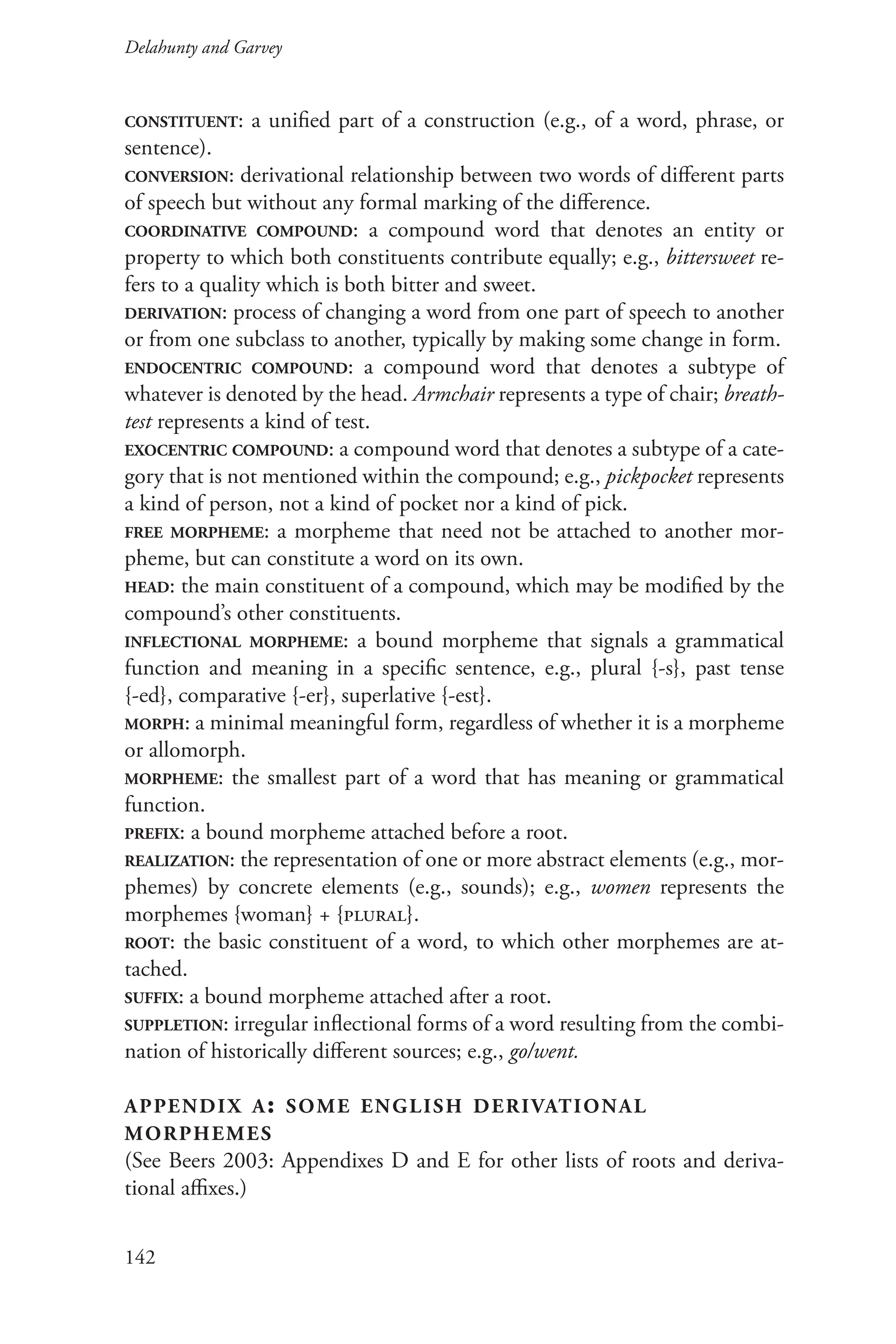
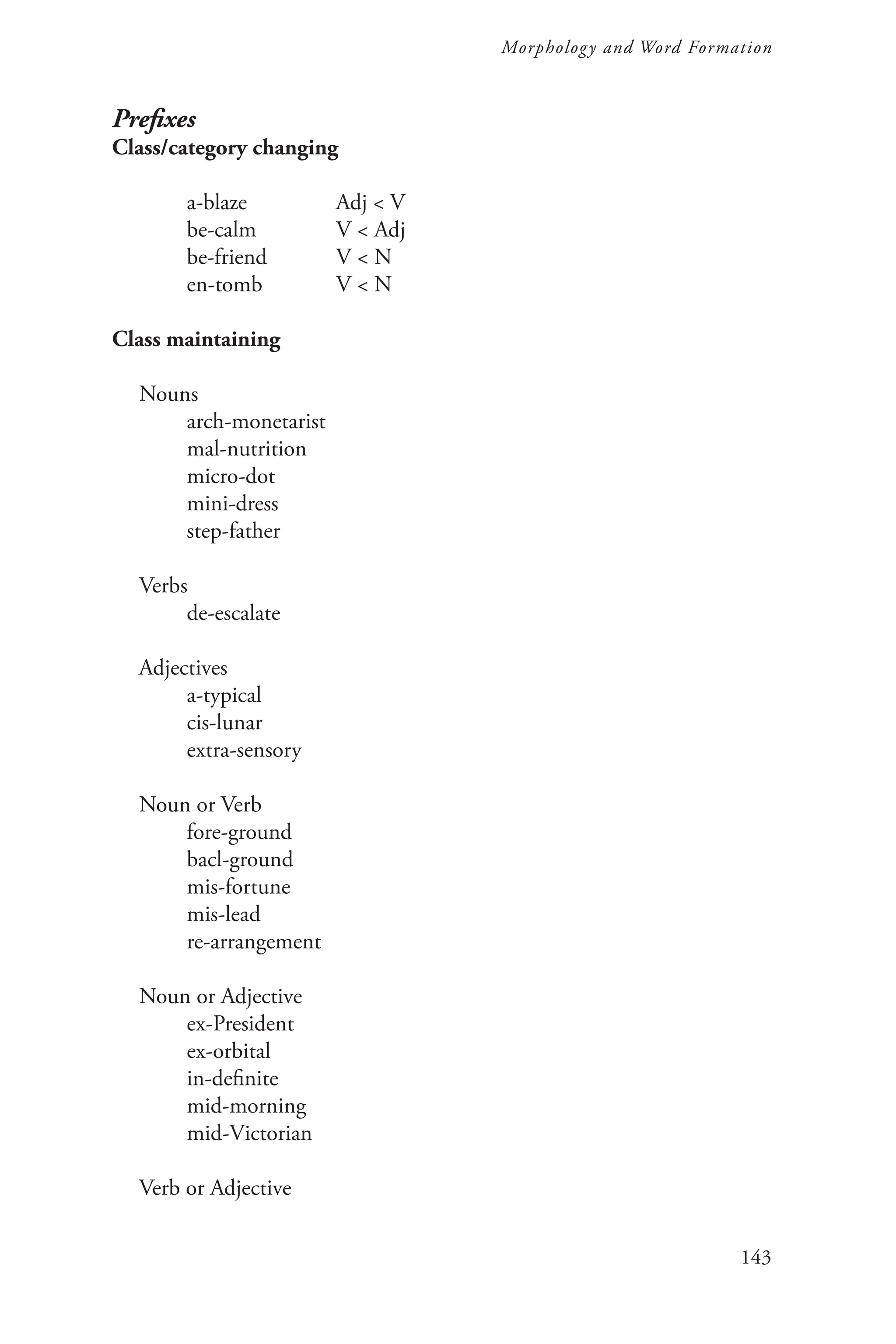
Prefixes
Class/category changing
		 a‑blaze		 Adj < V
		 be‑calm		 V < Adj
		 be‑friend V < N
		 en‑tomb V < N
Class maintaining
Nouns
		 arch‑monetarist
		 mal‑nutrition
		 micro-dot
		 mini‑dress
		 step‑father
				
Verbs
		 de‑escalate
			
Adjectives
		 a‑typical
		 cis‑lunar
		 extra‑sensory
Noun or Verb
		 fore‑ground
		 bacl-ground
		 mis‑fortune
		 mis‑lead
		 re‑arrangement
Noun or Adjective
		 ex‑President
		 ex‑orbital
		 in‑definite
		 mid‑morning
		 mid‑Victorian
		
Verb or Adjective
Delahunty and Garvey		
144
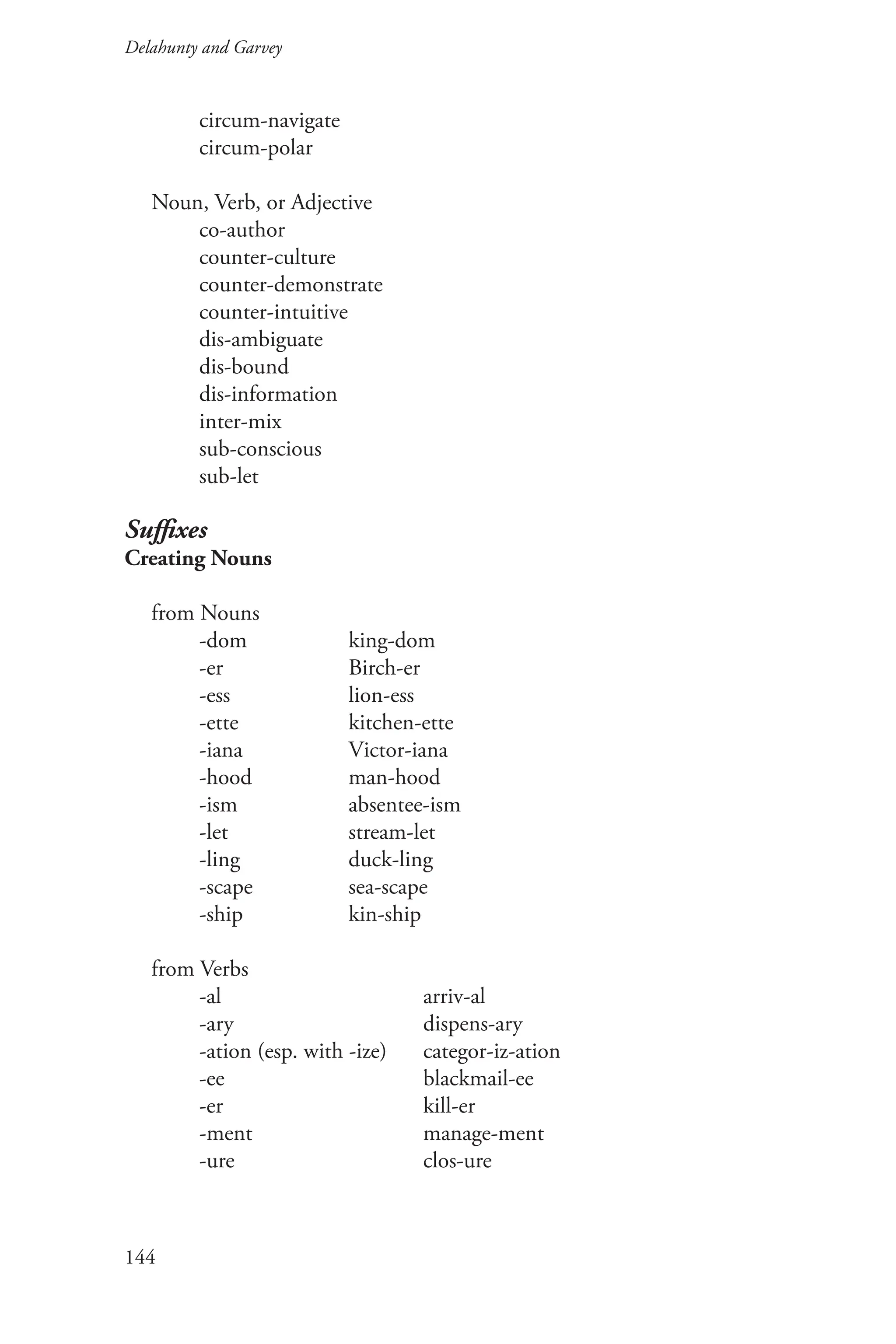
		 circum‑navigate
		 circum‑polar
Noun, Verb, or Adjective
		 co‑author
		 counter‑culture
		 counter‑demonstrate
		 counter‑intuitive
		 dis‑ambiguate
		 dis‑bound
		 dis‑information
		 inter‑mix
		 sub‑conscious
		 sub‑let
		
Suffixes
Creating Nouns
from Nouns
		‑dom		 king‑dom
		‑er		 Birch‑er
		‑ess		 lion‑ess
		‑ette		 kitchen‑ette
		‑iana		 Victor‑iana
		‑hood		 man‑hood
		‑ism		 absentee‑ism
		‑let		 stream‑let
		‑ling		 duck‑ling
		‑scape		 sea‑scape
		‑ship		 kin‑ship
from Verbs
		‑al			arriv‑al
		‑ary			dispens‑ary
		‑ation (esp. with ‑ize) categor‑iz‑ation
		‑ee			blackmail‑ee
		‑er			kill‑er
		‑ment			manage‑ment
		‑ure			clos‑ure
145
Morphology and Word Formation
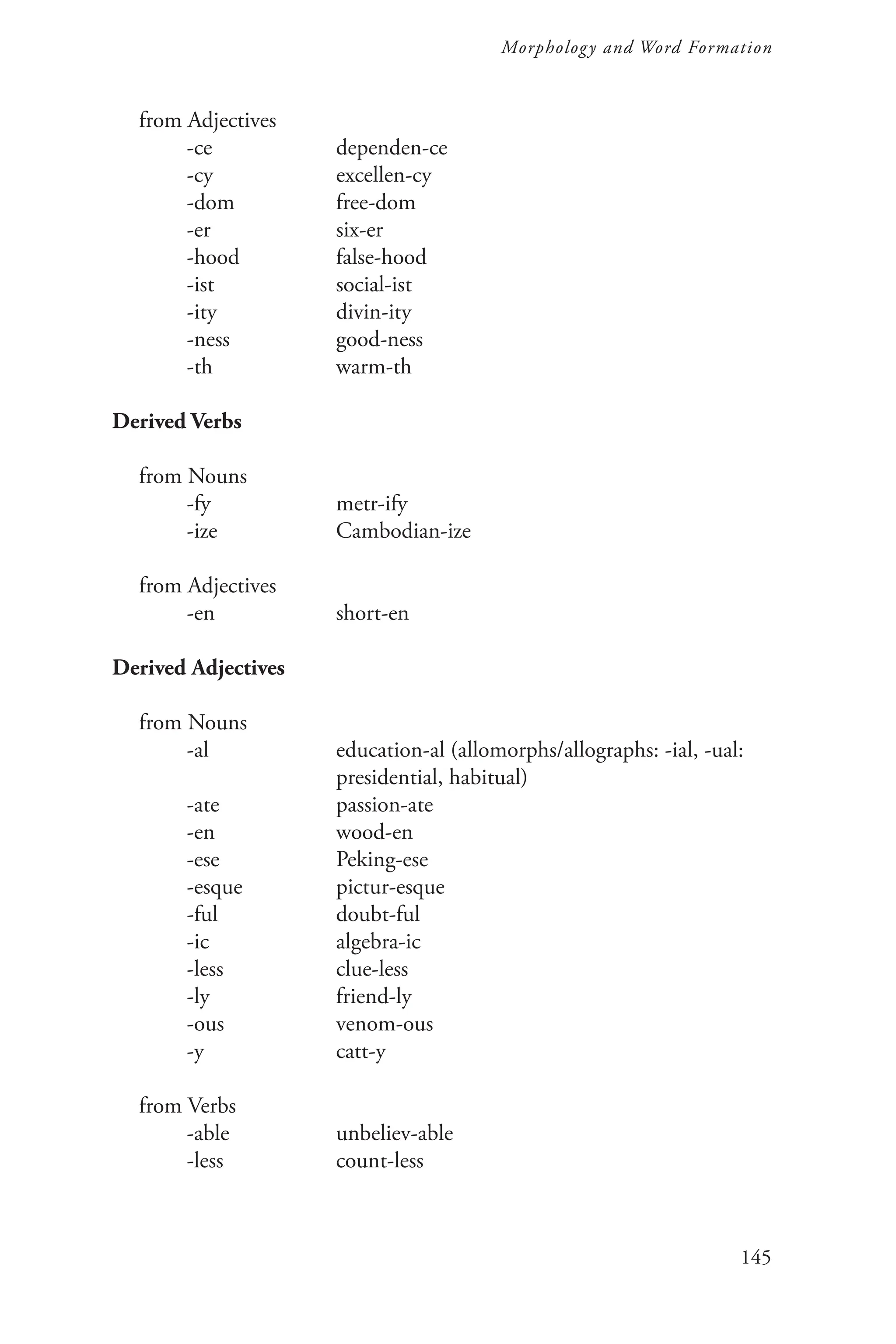
from Adjectives
		‑ce		 dependen‑ce
		‑cy		 excellen‑cy
		‑dom		 free‑dom
		‑er		 six‑er
		‑hood		 false‑hood
		‑ist		 social‑ist
		‑ity		 divin‑ity
		‑ness		 good‑ness
		‑th		 warm‑th
Derived Verbs
from Nouns
		‑fy		 metr‑ify
		‑ize		 Cambodian‑ize
from Adjectives
		‑en		 short‑en
Derived Adjectives
from Nouns
		‑al		 education‑al (allomorphs/allographs: ‑ial, ‑ual:
			 presidential, habitual)
		‑ate		 passion‑ate
		‑en		 wood‑en
		‑ese		 Peking‑ese
		‑esque		 pictur‑esque
		‑ful		 doubt‑ful
		‑ic		 algebra-ic
		‑less		 clue‑less
		‑ly		 friend‑ly
		‑ous		 venom‑ous
		‑y		 catt‑y
from Verbs
		‑able		 unbeliev‑able
		‑less		 count‑less
Delahunty and Garvey		
146
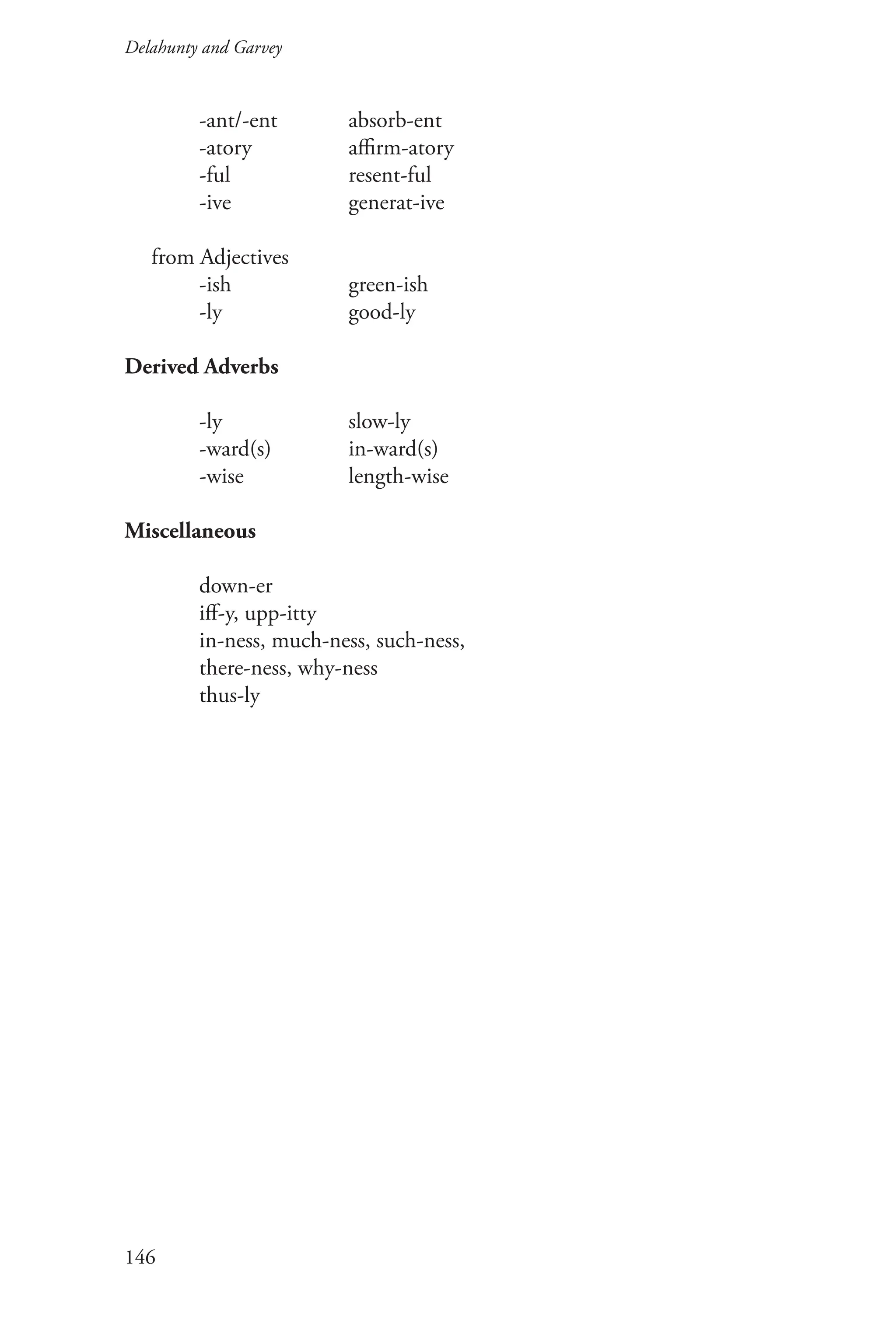
		‑ant/‑ent absorb‑ent
		‑atory		 affirm‑atory
		‑ful		 resent‑ful
		‑ive		 generat‑ive
from Adjectives
		‑ish		 green‑ish
		‑ly		 good‑ly
Derived Adverbs
		‑ly		 slow‑ly
		‑ward(s)		 in‑ward(s)
		‑wise		 length‑wise
Miscellaneous
		 down‑er
		 iff‑y, upp‑itty
		 in‑ness, much‑ness, such‑ness,
		 there‑ness, why‑ness
		 thus-ly

Morphology and Word Formation in English

  • 1.
    121 5 Morphology andWord Formation key concepts Words and morphemes Root, derivational, inflectional morphemes Morphemes, allomorphs, morphs Words English inflectional morphology English derivational morphology Compounding Other sources of words Registers and words Internal structure of complex words Classifying words by their morphology introduction This chapter is about words—their relationships, their constituent parts, and their internal organization. We believe that this information will be of value to anyone interested in words, for whatever reason; to anyone inter- ested in dictionaries and how they represent the aspects of words we deal with here; to anyone involved in developing the vocabularies of native and non-native speakers of English; to anyone teaching writing across the curric- ulum who must teach the characteristics of words specific to their discipline; to anyone teaching writing who must deal with the usage issues created by the fact that different communities of English speakers use different word forms, only one of which may be regarded as standard. Exercise 1. Divide each of the following words into their smallest meaningful parts:landholder, smoke-jumper, demagnetizability. 2. Each of the following sentences contains an error made by a non- native speaker of English. In each, identify and correct the incorrect word. a. I am very relax here. b. I am very boring with this game. c. I am very satisfactory with my life. d. Some flowers are very attracting to some insects. e. Many people have very strong believes.
  • 2.
    Delahunty and Garvey 122 f.My culture is very difference from yours. g. His grades proof that he is a hard worker. h. The T-shirt that China drawing. (from a T-shirt package from China) In general terms, briefly discuss what English language learners must learn in order to avoid such errors. 3. Some native speakers of English use forms such as seen instead of saw, come instead of came, aks instead of ask, clumb instead of climbed, drug instead of dragged, growed instead of grew. Are these errors? If they are, are they the same kinds of errors made by the non- native speakers of English listed in Exercise 2? If not, what are they? words and morphemes In traditional grammar, words are the basic units of analysis. Grammarians classify words according to their parts of speech and identify and list the forms that words can show up in. Although the matter is really very com- plex, for the sake of simplicity we will begin with the assumption that we are all generally able to distinguish words from other linguistic units. It will be sufficient for our initial purposes if we assume that words are the main units used for entries in dictionaries. In a later section, we will briefly describe some of their distinctive characteristics. Words are potentially complex units, composed of even more basic units, called morphemes. A morpheme is the smallest part of a word that has grammatical function or meaning (NB not the smallest unit of meaning); we will designate them in braces—{ }. For example, sawed, sawn, sawing, and saws can all be analyzed into the morphemes {saw} + {‑ed}, {‑n}, {‑ing}, and {‑s}, respectively. None of these last four can be further divided into meaningful units and each occurs in many other words, such as looked, mown, coughing, bakes. {Saw} can occur on its own as a word; it does not have to be attached to another morpheme. It is a free morpheme. However, none of the other morphemes listed just above is free. Each must be affixed (attached) to some other unit; each can only occur as a part of a word. Morphemes that must be attached as word parts are said to be bound. Exercise 1. Identify the free morphemes in the following words:
  • 3.
    123 Morphology and WordFormation kissed, freedom, stronger, follow, awe, goodness, talkative, teacher, actor. 2. Use the words above (and any other words that you think are rel- evant) to answer the following questions: a. Can a morpheme be represented by a single phoneme? Give ex- amples. By more than one phoneme? Give examples. b. Can a free morpheme be more than one syllable in length? Give examples. Can a bound morpheme? Give examples. c. Does the same letter or phoneme—or sequence of letters or pho- nemes—always represent the same morpheme? Why or why not? (Hint: you must refer to the definition of morpheme to be able to answer this.) d. Can the same morpheme be spelled differently? Give examples. e. Can different morphemes be pronounced identically? Give examples. f. A morpheme is basically the same as: i. a letter ii. a sound iii. a group of sounds iv. none of the above 3. The words district and discipline show that the sequence of letters d-i-s does not always constitute a morpheme. (Analogous examples are mission, missile, begin, and retrofit.) List five more sequences of let- ters that are sometimes a morpheme and sometimes not. 4. Just for fun, find some other pairs like disgruntled / *gruntled and disgusted / *gusted, where one member of the pair is an actual English word and the other should be a word, but isn’t. Affixes are classified according to whether they are attached before or after the form to which they are added. Prefixes are attached before and suffixes after. The bound morphemes listed earlier are all suffixes; the {re‑} of resaw is a prefix. Further examples of prefixes and suffixes are presented in Appendix A at the end of this chapter. Root, derivational, and inflectional morphemes Besides being bound or free, morphemes can also be classified as root, deri- vational, or inflectional. A root morpheme is the basic form to which other
  • 4.
    Delahunty and Garvey 124 morphemesare attached. It provides the basic meaning of the word.The morpheme {saw} is the root of sawers. Derivational morphemes are added to forms to create separate words: {‑er} is a derivational suffix whose ad- dition turns a verb into a noun, usually meaning the person or thing that performs the action denoted by the verb. For example, {paint}+{-er} creates painter, one of whose meanings is “someone who paints.” Inflectional morphemes do not create separate words. They merely modify the word in which they occur in order to indicate grammatical prop- erties such as plurality, as the {-s} of magazines does, or past tense, as the {ed} of babecued does. English has eight inflectional morphemes, which we will describe below. We can regard the root of a word as the morpheme left over when all the derivational and inflectional morphemes have been removed. For example, in immovability, {im-}, {-abil}, and {-ity} are all derivational morphemes, and when we remove them we are left with {move}, which cannot be further di- vided into meaningful pieces, and so must be the word’s root. We must distinguish between a word’s root and the forms to which af- fixes are attached. In moveable, {-able} is attached to {move}, which we’ve determined is the word’s root. However, {im-} is attached to moveable, not to {move} (there is no word immove), but moveable is not a root. Expressions to which affixes are attached are called bases. While roots may be bases, bases are not always roots. Exercise 1. Can an English word have more than one prefix? Give examples. More than one suffix? For example? More than one of each? Give examples. Divide the examples you collected into their root, derivational, and inflectional morphemes. 2. Check your dictionary to see how it deals with inflected and derived word forms. Does it list all the inflections of regular inflected words? Just irregular ones? Does it accord derived forms their own entries or include them in the entries of the forms from which they are derived? 3. Does your dictionary list bound morphemes? Which kinds? morphemes, allomorphs, and morphs The English plural morpheme {-s} can be expressed by three different but
  • 5.
    125 Morphology and WordFormation clearly related phonemic forms /z/ or /z/, /z/, and /s/. These three have in common not only their meaning, but also the fact that each contains an alveolar fricative phoneme, either /s/ or /z/. The three forms are in comple- mentary distribution, because each occurs where the others cannot, and it is possible to predict just where each occurs: /z/ after sibilants (/s, z, , , t, d/), /z/ after voiced segments, and /s/ everywhere else. Given the semantic and phonological similarities between the three forms and the fact that they are in complementary distribution, it is reasonable to view them as contex- tual pronunciation variants of a single entity. In parallel with phonology, we will refer to the entity of which the three are variant representations as a morpheme, and the variant forms of a given morpheme as its allomorphs. When we wish to refer to a minimal grammatical form merely as a form, we will use the term morph. Compare these terms and the concepts behind them with phoneme, allophone, and phone. (Hint: note the use of / /, [ ], and { }.) Exercise Consult the glossary in the chapter on Phonetics and Phonology and try to determine the meanings of the morphemes {phone}, {allo-}, and {-eme}. (1) /phoneme/ [allophone] [allophone] [allophone] etc. (2) {morpheme} /allomorph/ /allomorph/ /allomorph/ etc. words Words are notoriously difficult entities to define, both in universal and in language specific terms. Like most linguistic entities, they look in two direc- tions—upward toward larger units of which they are parts (toward phrases), and downward toward their constituent morphemes. This, however, only helps us understand words if we already understand how they are combined into larger units or divided into smaller ones, so we will briefly discuss sev-
  • 6.
    Delahunty and Garvey 126 eralother criteria that have been proposed for identifying them. One possible criterion is spelling: in written English text, we tend to regard as a word any expression that has no spaces within it and is separated by spaces from other expressions. While this is a very useful criterion, it does sometimes lead to inconsistent and unsatisfactory results. For instance, cannot is spelled as one word but might not as two; compounds (words com- posed of two or more words; see below) are inconsistently divided (cf. influx, in-laws, goose flesh, low income vs. low-income). Words tend to resist interruption; we cannot freely insert pieces into words as we do into sentences. For example, we cannot separate the root of a word from its inflectional ending by inserting another word, as in *sock- blue‑s for blue socks. Sentences, in contrast, can be interrupted. We can in- sert adverbials between subjects and predicates: John quickly erased his fin- gerprints. By definition, we can also insert the traditional interjections: We will, I believe, have rain later today. In English, though by no means in all languages, the order of elements in words is quite fixed. English inflections, for example, are suffixes and are added after any derivational morphemes in a word. At higher levels in the language, different orders of elements can differ in meaning: compare John kissed Mary with Mary kissed John. But we do not contrast words with prefixed inflections with words with suffixed inflections. English does not contrast, for example, piece + s with s + piece. In English, too, it is specific individual words that select for certain in- flections. Thus the word child is pluralized by adding {‑ren}, ox by adding {‑en}. So if a form takes the {-en} plural, it must be a word. So words are units composed of one or more morphemes; they are also the units of which phrases are composed. English inflectional morphology Inflectional morphemes, as we noted earlier, alter the form of a word in or- der to indicate certain grammatical properties. English has only eight inflec- tional morphemes, listed in Table 1, along with the properties they indicate. Except for {-en}, the forms we list in Table 1 are the regular English in- flections. They are regular because they are the inflections added to the vast majority of verbs, nouns, adjectives, and adverbs to indicate grammatical properties such as tense, number, and degree. They are also the inflections we typically add to new words coming into the language, for example, we add {-s} to the noun throughput to make it plural. When we borrow words from other languages, in most cases we add the regular English inflections to them rather than borrow the inflections
  • 7.
    127 Morphology and WordFormation they had in their home languages; for example, we pluralize operetta as oper- ettas rather than as operette as Italian does; similarly, we sing oratorios rather than oratori. [Thanks to Paula Malpezzi-Price for help with these examples.] The regular inflections are the default inflections that learners tend to use when they don’t know the correct ones (for example, growed rather than grew). nouns: {-s} plural (the birds) noun phrases: {-s} genitive/possessive (the bird’s song) adjectives/adverbs: {-er} comparative (faster) {-est} superlative (fastest) verbs: {-s} 3rd person singular present tense (proves) {-ed} past tense (proved) {-ing} progressive/present participle (is proving) {-en} past participle (has proven) (was proven) table 1: the eight english inflectional morphemes [Note: the regular past participle morpheme is {-ed}, identical to the past tense form {-ed}. We use the irregular past participle form {-en} to distinguish the two.] However, because of its long and complex history, English (like all lan- guages) has many irregular forms, which may be irregular in a variety of ways. First, irregular words may use different inflections than regular ones: for example, the modern past participle inflection of a regular verb is {-ed}, but the past participle of freeze is frozen and the past participle of break is broken. Second, irregular forms may involve internal vowel changes, as in man/men, woman/women, grow/grew, ring/rang/rung. Third, some forms derive from historically unrelated forms: went, the past tense of go, histori- cally was the past tense of a different verb, wend. This sort of realignment is known as suppletion. Other examples of suppletion include good, better, and best, and bad, worse, and worst. (As an exercise, you might look up be, am, and is in a dictionary that provides etymological information, such as the American Heritage.) Fourth, some words show no inflectional change: sheep is both singular and plural; hit is both present and past tense, as well as past participle. Fifth, many borrowed words, especially nouns, have ir- regular inflected forms: alumnae and cherubim are the plurals of alumna and
  • 8.
    Delahunty and Garvey 128 cherub,respectively. Irregular forms demonstrate the abstract status of morphemes. Thus the word men realizes (represents, makes real) the two morphemes {man} and {plural}; women realizes {woman} and {plural}; went realizes {go} and {past tense}. Most grammar and writing textbooks contain long lists of these ex- ceptions. As a final issue here we must note that different groups of English speak- ers use different inflected forms of words, especially of verbs. When this is the case, the standard variety of the language typically selects one and rejects the others as non-standard, or, illogically, as “not English,” or worse. For example, many English speakers use a single form of be in the past tense (was) regardless of what the subject of its clause is. So they will say, We was there yesterday. This is an uncontroversial issue: was in instances like this is universally regarded as non-standard. Other forms are more controversial. For example, what is the past tense of dive—dived or dove? How are lie and lay to be used? How does your dictionary deal with such usage issues? Exercise 1. Can you think of a reliable way to distinguish the past tense and past participle of a verb, regardless of whether it is regular or irregular? (Hint: think of words or classes of words that often occur with these forms.) 2. Check a reference grammar for further examples of irregular inflec- tions. Also, for an excellent discussion of this and related issues, read Pinker (1999). 3. From the following words, determine the three distinct pronuncia- tions or allomorphs of the past tense morpheme {-ed}: towed, sighed, tapped, tabbed, tossed, buzzed, raided. Specify the phonological envi- ronment in which each allomorph occurs. (Hints: look at the last sound of the word to which the morpheme is added and think of the allo- morphs of the plural morpheme discussed earlier.) 4. Pinker (1999) notes that children learning English as their native language sometimes produce forms like goed and readed. Why do you think they do this? 5. Would you expect adult non-native learners of English to produce
  • 9.
    129 Morphology and WordFormation forms similar to those of native speaking children? What further dif- ficulties might non-native speakers have that native English-speaking children might not have? (Hints: think of the frequency of irregular forms in English and think of your own experience in learning a second language.) English derivational morphology Derivation is the process of creating separate but morphologically related words. Typically, but not always, it involves one or more changes in form. It can involve prefixing, as in resaw, and suffixing, as in sawing, sawer, sawable. Another type of derivation, while not visible, is at least audible. It in- volves a change in the position of the primary stress in a word. Compare: (3) permit (noun) permit (verb) contact (noun) contact (verb) perfect (adj.) perfect (verb) convert (noun) convert (verb) In some derivationally related word pairs, only a feature of the final con- sonant changes, usually its voicing: (4) advice advise /s/  /z/ belief believe /f/  /v/ mouth mouthe //  // breath breathe //  // In some cases adding a derivational morpheme induces a change in a stressed vowel: (5) divine divinity /a/  // profane profanity /e/  // serene serenity /i/  // In other cases, the addition of a suffix triggers a change in the final con- sonant of the root. For example, an alveolar consonant becomes palatal with the same voicing value: (6) part partial /t/  // face facial /s/  //
  • 10.
    Delahunty and Garvey 130 seize seizure /z/ // remit remission /t/  // In a multi-syllabic word with a stressed tense vowel, the palatalization may be accompanied by a laxing of that vowel: (7) collide collision /d/  // /a/  // elide elision /d/  // /a/  // Sometimes the addition of a derivational affix requires a change in the stress pattern, with consequential changes in the pronunciations of the vow- els. In most cases an unstressed vowel is pronounced as schwa: (8) telegraph telegraphy regal regalia tutor tutorial In still other cases we find suffixing, stress migration with change of vow- el quality, and change of consonant: (9) approve approbation /u/  // /v/  /b/ Additionally, English allows us to change a word’s part of speech without any change of form. As a result, identical forms may belong to different parts of speech, e.g., saw the noun and saw the verb: (10) a. This saw is too dull. (noun) b. Don’t saw that board. (verb) Other examples include hit, buy, dust, autograph, brown-bag, which can all be both verbs and nouns. Change of part of speech without any correspond- ing formal change is called conversion (also functional shift or zero deriva- tion). There is more on this topic in our chapter on Major Parts of Speech. Exercise 1. Write each of the example words in (3)-(9) in a phonemic notation.
  • 11.
    131 Morphology and WordFormation 2. True or False? a. Every English word contains at least one root. b. In English, derivational morphemes occur before inflectional mor- phemes. c. In English, derivational suffixes regularly occur before inflection- al suffixes. d. In English, a few inflectional morphemes can occur as prefixes. e. Every root in English is a free morpheme (i.e., there is no such thing as a bound root.) (Hint: consider receive, deceive, con- ceive, perceive.) f. In English, some morphemes have both a free and a bound al- lomorph. (Hint: consider able, ability; France, Franco-.) 3. a. In a broad phonetic (phonemic) transcription, transcribe the sounds represented by the bolded letters in impossible, ined- ible, illegible, irresponsible. b. What meaning do these pairs of letters have in common? c. What is the first sound in all four pairs of sounds? d. What are the second sounds in the pairs of sounds? e. Why does the second sound vary as it does? f. How would you analyze this variation in terms of morphemes and allomorphs? 4. As English readily allows conversion, you should have no trouble com- piling a list of ten pairs of words with identical forms but different parts of speech. For each pair of words, create a pair of short sentences that show that the words do belong to different parts of speech. As we’ll see in more detail in the next chapter, words belonging to differ- ent parts of speech take different inflections—e.g., {N saw} + {pl -s}; {V saw} + {-ed}. Because derivationally related forms often belong to different parts of speech and consequently allow different inflections, and because the mean- ings of derivationally related pairs are not always as parallel as their forms are, derived forms may be given their own entries in dictionaries. Webster’s New World Dictionary, for instance, has separate entries for generate and generation and for compete and competence. Look up these words in your own dictionary and note how the meanings of generation and competence are not entirely predictable from those of generate + {-ion} and compete + {-ence},
  • 12.
    Delahunty and Garvey 132 respectively. Theterm word family is often used for a set of words that are related to each other derivationally or inflectionally, though the term is also used to refer to any set of words that rhyme with each other. Compounding The italicized words in (11) are created by combining saw with some other word, rather than with a bound morpheme. (11) a. A sawmill is a noisy place. b. Every workshop should have a chain saw, a table saw, a jig-saw, a hack saw, and a bucksaw. c. Sawdust is always a problem in a woodworker’s workshop. d. Sawing horses are useful and easily made. Such words are called compounds. They contain two or more words (or more accurately, two or more roots, all, one, or none of which may be bound; cf. blueberry with two free morphemes, and astronaut with two bound morphemes). Generally, one of the words is the head of the com- pound and the other(s) its modifier(s). In bucksaw, saw is the head, which is modified by buck. The order is significant: compare pack rat with rat pack. Generally, the modifier comes before the head. In ordinary English spelling, compounds are sometimes spelled as single words, as in sawmill, sawdust; sometimes the parts are connected by a hy- phen, as in jig‑saw; and sometimes they are spelled as two words, as in chain saw, oil well. (Dictionaries may differ in their spellings.) Nonetheless, we are justified in classifying all such cases as compound words regardless of their conventional spelling for a variety of reasons. First, the stress pattern of the compound word is usually different from the stress pattern in the phrase composed of the same words in the same order. Compare: (12) compound phrase White House white house funny farm funny farm blackbird black bird flatcar flat car
  • 13.
    133 Morphology and WordFormation Exercise Very bad teenager joke: Q: How do you make a cat drink? A: Put it in a blender. What are the verbal tricks here? In the compounds the main stress is on the first word; in the phrases the main stress is on the last word. While this pattern does not apply to all com- pounds, it is so generally true that it provides a very useful test. Second, the meaning of the compound may differ to a greater or lesser degree from that of the corresponding phrase. A blackbird is a species of bird, regardless of its color; a black bird is a bird which is black, regardless of its species. A trotting-horse is a kind of horse, regardless of its current ac- tivity; a trotting horse must be a horse that is currently trotting. So, because the meanings of compounds are not always predictable from the meanings of their constituents, dictionaries often provide individual entries for them. They do not do this for phrases, unless the meaning of the phrase is idi- omatic and therefore not derivable from the meanings of its parts and how they are put together, e.g., raining cats and dogs. Generally the meaning of a phrase is predictable from the meanings of its constituents, and so phrases need not be listed individually. (Indeed, because the number of possible phrases in a language is infinite, it is in principle impossible to list them all.) Third, in many compounds, the order of the constituent words is differ- ent from that in the corresponding phrase: (13) compound phrase sawmill mill for sawing sawing horse horse for sawing sawdust dust from sawing Fourth, compound nouns allow no modification to the first element. This contrasts with noun phrases, which do allow modification to the modi- fier: compare *a really-blackbird and a really black bird. There are a number of ways of approaching the study and classification of compound words, the most accessible of which is to classify them according tothe partofspeechofthecompoundandthensub-classify them according to the parts of speech of its constituents.Table 2 is based on discussion in Bauer (1983).
  • 14.
    Delahunty and Garvey 134 1.Compound nouns a. Noun + noun: bath towel; boy-friend; death blow b. Verb + noun: pickpocket; breakfast c. Noun +verb: nosebleed; sunshine d. Verb +verb: make-believe e. Adjective + noun: deep structure; fast-food f. Particle + noun: in-crowd; down-town g. Adverb + noun: now generation h. Verb + particle: cop-out; drop-out i. Phrase compounds: son-in-law 2. Compound verbs a. Noun + verb: sky-dive b. Adjective + verb: fine-tune c. Particle + verb: overbook d. Adjective + noun: brown-bag 3. Compound adjectives a. Noun + adjective: card-carrying; childproof b. Verb + adjective: fail safe c. Adjective + adjective: open-ended d. Adverb + adjective: cross-modal e. Particle + adjective: over-qualified f. Noun + noun: coffee-table g. Verb + noun: roll-neck h. Adjective + noun: red-brick; blue-collar i. Particle + noun: in-depth j. Verb + verb: go-go; make-believe k. Adjective/Adverb + verb: high-rise; l. Verb + particle: see-through; tow-away 4. Compound adverbs uptightly cross-modally 5. Neo-classical compounds astro-naut hydro-electric mechano-phobe table 2: english compounds (bauer, 1983) An alternative approach is to classify compounds in terms of the seman- tic relationship between the compound and its head. The head of a com-
  • 15.
    135 Morphology and WordFormation pound is the constituent modified by the compound’s other constituents. In English, heads of compounds are typically the rightmost constituent (ex- cluding any derivational and inflectional suffixes). For example, in traffic-cop the head is cop, which is modified by traffic; in line-backer the head is backer, which is modified by line. Linguists distinguish at least three different se- mantic relations between the head and modifier(s) of compounds. First, the compound represents a subtype of whatever the head repre- sents. For instance, a traffic-cop is a kind of cop; a teapot is a kind of pot; a fog-lamp is a kind of lamp; a blue-jay is a kind of jay. That is, the head names the type, and the compound names the subtype. These are called endocen- tric compounds. Second, the compound names a subtype, but the type is not represented by either the head or the modifier in the compound. For example, Dead- head, redhead, and pickpocket represent types of people by denoting some distinguishing characteristic. There is typically another word, not included in the compound, that represents the type of which the compound repre- sents the subtype. In the case of Deadhead, redhead, and pickpocket this other word is person, so a Deadhead is a person who is an enthusiastic fan of the band The Grateful Dead. These are called exocentric compounds. Third, there are compounds in which both elements are heads; each con- tributes equally to the meaning of the whole and neither is subordinate to the other, for instance, bitter-sweet. Compounds like these can be para- phrased as both X and Y, e.g., “bitter and sweet.” Other examples include teacher-researcher and producer-director. These can be called coordinative compounds. Exercise For each set of words below, say whether the words are endocentric, exocentric, or coordinative compounds. Justify your identification. a. redneck, yellowjacket, cocktail, blackhead b. armchair, breathtest, rockopera c. secretary-treasurer, scholar-administrator As a third (and final) possible mode of analyzing compounds we briefly consider that used in the series of modern traditional grammars prepared by Quirk, Greenbaum, Leech and Svartvik (1972, 1985). In this method, the compounds are analyzed and classified according to the relationships among their constituents when the meaning of the compound is expressed
  • 16.
    Delahunty and Garvey 136 asa phrase or clause. For example: phrases bee-sting a sting by a bee blood-test a test of blood swimming pool a pool for swimming adding machine a machine for adding girlfriend a friend who is a girl killer shark a shark which is a killer windmill a mill powered by wind motorcycle a cycle powered by a motor self-control someone able to control self clauses sunrise when the sun rises table 3: underlying syntactic/semantic analysis of english compounds Exercise Paraphrase each of the following compounds according to at least one of the patterns in Table 3. babysitter, catfish, cry-baby, story-teller, dancing girl, darkroom, doorknob, taxpayer, security officer, sleepwalking Other sources of words Besides derivation and compounding, languages make use of coining, ab- breviating, blending, and borrowing to create new words. Coining is the creation of new words without reference to the existing morphological resources of the language, that is, solely out of the sounds of the language. Coining is very rare, but googol [note the spelling] is an attested example, meaning 10100 . This word was invented in 1940 by the nine-year-old nephew of a mathematician (see Compact Edition of the Ox- ford English Dictionary Vol. III Supplement to the OED Vols. I-IV: 1987 p. 317). Abbreviation involves the shortening of existing words to create other words, usually informal versions of the originals. There are several ways to abbreviate. We may simply lop off one or more syllables, as in prof for profes- sor, doc for doctor. Usually the syllable left over provides enough information
  • 17.
    137 Morphology and WordFormation to allow us to identify the word it’s an abbreviation of, though occasion- ally this is not the case: United Airlines’s low cost carrier is called Ted. (Go figure!) Alternatively, we may use the first letter of each word in a phrase to create a new expression, an acronym, as in UN, US, or SUV. In these instances the acronym is pronounced as a sequence of letter names. In other instances, such as UNICEF from United Nations International Children’s Emergency Fund, the acronym can be pronounced as an ordinary English word. Advertisers make prolific use of acronyms and often try to make them pronounceable as ordinary words. Blending involves taking two or more words, removing parts of each, and joining the residues together to create a new word whose form and meaning are taken from the source words. Smog derives from smoke and fog and means a combination of these two substances (and probably lots of others); motel derives from motor and hotel and refers to hotels that are con- venient in various ways to motorists; Prevacid derives from prevent acid; era- cism derives from erase and racism and means erase racism or, if read against the grain, electronic racism (cf. email, ecommerce, E-trade); webinar derives from (worldwide) web and seminar. In November 2007, an interviewee on an NPR news item created the blend snolo to refer to playing bike polo in the snow. Borrowing involves copying a word that originally belonged in one lan- guage into another language. For instance, many terms from Mexican cui- sine, like taco and burrito, have become current in American English and are spreading to other English dialects. Borrowing requires that the borrowing language and the source language come in contact with each other. Speak- ers of the borrowing language must learn at least some minimum of the source language for the borrowing to take place. Over its 1500 year history English has borrowed from hundreds of languages, though the main ones are Latin (homicide), Greek (chorus), French (mutton), Italian (aria), Span- ish (ranch), German (semester), and the Scandinavian languages (law). From Native American languages, American English has borrowed place names (Chicago), river names (Mississippi), animal names (opossum), and plant names (hickory). The borrowed word never remains a perfect copy of its original. It is made to fit the phonological, morphological, and syntactic patterns of its new language. For example, the Spanish pronunciation of burritos is very different from the English pronunciation. At the very least, the two languag- es use different /r/s and /t/s, and the plural marker {-s} is voiced in English but voiceless in Spanish. See our chapter on the History of the English Language in Book II for
  • 18.
    Delahunty and Garvey 138 moreon borrowing. registers and words Although most of the words we use every day can be used in almost any context, many words of the language are restricted to uses in certain fields, disciplines, professions, or activities, i.e., registers. For example, the word phoneme is restricted to the linguistic domain. Interestingly, some words may be used in several domains with a different meaning in each, though these meanings may be a specific version of a more general meaning. For ex- ample, the word morphology is used in linguistics to refer to the study of the internal structure of words and their derivational relationships; in botany to refer to the forms of plants; in geology to refer to rock formations. The general, abstract meaning underlying these specific meanings is the study of form. Besides words that may be used in almost any context and those that are technical or discipline specific, there are words that play important roles in academic discourses generally, for example, accuracy; basis; concept and its related forms, conception, conceptual, conceptualize; decrease; effect; fac- tor; indicate and its related forms, indication, indicative; and result. As such words are used across disciplines, generally without local idiosyncrasies of meaning, they are important words for English learners, both native and non-native speakers. For a useful overview of the attempts to create lists of such academic (or subtechnical) words and a new list of them, see Cox- head (2000) and the references therein (another academic word). the internal structure of complex words Complex words (those composed of more than one morpheme) are not merely unstructured sequences of morphemes. For example, the plural {‑s} suffix on dropouts must be added to the entire compound dropout, not to out to which drop is then added. The reason for this is that the plural suffix may be attached to nouns, but not to verbs or particles. Drop and out constitute a noun only after they have been brought together in the compound. We can use brackets with subscripts to represent these relations: [N [N [V drop][Prt out]]s]. Alternatively, and equivalently, we can use tree dia- grams to indicate the parts (constituents) of complex words and their struc- tural relations:
  • 19.
    139 Morphology and WordFormation (14) N N Pl V Prt drop out s Consider another example: unreadability. We analyze this word as [N [Adj un1 [Adj [V read]abil]]ity], represented by the following tree: (15) N Adj Suffix Prefix Adj V Suffix un1 read abil ity Let’s consider this analysis more closely. The suffix {‑able} attaches to verbs to create adjectives. Besides readable we have the adjectives doable, manage- able, and attachable, which are derived from the verbs read, do, manage, and attach, respectively. We can represent this part of the word as: [Adj [V read] able]. The prefix {un1 -} attaches to adjectives, meaning “not” or “the converse of.” Compare unwise, unfair, ungrateful, uncomfortable, unmanageable with unreadable. All can be glossed as not having the quality denoted by the adjective to which they are attached: “not comfortable,” “not fair,” etc. This morpheme must be distinguished from the prefix {un2 -} meaning “to reverse the action,” which can be attached only to verbs (e.g., untie). {Un1 ‑} cannot attach to the verb read; although there is the word unread, pronounced [@nrEd], not [@nrid], an adjective meaning “not read” and de- rived from the past participle of read. Consequently, in unreadable, {-able} must be attached to {read} to create the adjective readable. {Un1 ‑} may then be attached to readable to create unreadable. We will represent this part of the word as: [Adj un1 [Adj [V read]able]]. The suffix {‑ity} attaches to adjectives to create abstract nouns. Conse- quently it must be attached to the adjective unreadable. The structure of
  • 20.
    Delahunty and Garvey 140 theentire word therefore must be: [N [Adj un1 [Adj [V read]able]]ity], as specified above. In pronunciation the morpheme {-able} will be assigned its allo- morph /@bIl/ (spelled <abil>, the same allomorph that appears in ability). Exercise Provide an analysis tree for each of the following words: retry, sink- able, thoughtless, meaningfulness, microorganisms. classifying words by their morphological properties Once the morphemes of a language have been identified, their allomorphs determined, and their distributions specified, we can use our analysis to as- sign the words of a language to parts of speech. For many words, inflections provide the main basis of this assignment. Refer to Table 1 for the list of English inflections. Nouns can be identified as those words that can be inflected for plural. Verbs are words that can be inflected for 3rd person singular present tense, past tense, past participle, and progressive. These forms are often re- ferred to as the principal parts of the verb. Short adjectives and adverbs are words that can be inflected for compara- tive and superlative. Derivational regularities can also be used to classify words. We can, for example, classify as adverbs words derived from adjectives by the addition of the suffix {‑ly}, e.g., quickly. Classifying words on the basis of their internal morphological structure works only up to a point. There are lots of words that are not internally com- plex and so cannot be classified without recourse to other types of criteria. For example, the preposition to has no internal morphological structure and so cannot be assigned to a grammatical class on that basis. Likewise, adverbs such as hard or fast lack the characteristic {‑ly} ending. It becomes necessary to use other criteria to classify these and many other words. We consider in detail the principles which have been proposed for assigning words to parts of speech in the chapters on Major and Minor Parts of Speech in this book. Exercise 1. Discuss two relatively reliable criteria (don’t use spelling) for distin- guishing words from morphemes and phrases. Illustrate your discussion
  • 21.
    141 Morphology and WordFormation with appropriate examples. 2. Derivation displays a range of patterns in English. Discuss three dif- ferent derivational patterns, illustrating your description with appro- priate examples. references and resources Beers, Kylene. 2003. When Kids can’t Read. Portsmouth, NH: Heinemann. Bauer, Laurie. 1983. English Word-formation. London, UK: Cambridge University Press. _____ 1988. Introducing Linguistic Morphology. Edinburgh, UK: Edinburgh University Press. Booij, Geert. 2005. The Grammar of Words. Oxford, UK: Oxford University Press. Coxhead, Averil. 2000. A new academic word list. TESOL Quarterly 34, 2: 213-238. Haspelmath, Martin. 2002. Understanding Morphology. London: Arnold. Huddleston, Rodney and Geoffrey K. Pullum. 2002. The Cambridge Grammar of the English Language. Cambridge, UK: Cambridge University Press. Matthews, P.H. 1974. Morphology: An Introduction to the Theory of Word Structure. Cambridge, UK: Cambridge University Press. Pinker, Steven, 1999. Words and Rules: The Ingredients of Language. New York: Basic Books. Quirk, R., S. Greenbaum, G. Leech, and J. Svartvik. 1972. A Grammar of Contemporary English. New York: Seminar Press. _____ 1985. Comprehensive Grammar of the English Language. London, UK: Longman. Spencer, A. 1991. Morphological Theory: An Introduction to Word Structure in Generative Grammar. Oxford, UK: Blackwell. glossary affix: an inflectional or derivational morpheme; to attach an inflectional or derivational morpheme to an expression. allomorph: variant phonological representation of a morpheme. auxiliary verb: a verb other than the main verb of a clause. base: part of word to which an affix may be attached; may but need not be a root morpheme. bound morpheme: a morpheme that must be attached to another mor- pheme.
  • 22.
    Delahunty and Garvey 142 constituent:a unified part of a construction (e.g., of a word, phrase, or sentence). conversion: derivational relationship between two words of different parts of speech but without any formal marking of the difference. coordinative compound: a compound word that denotes an entity or property to which both constituents contribute equally; e.g., bittersweet re- fers to a quality which is both bitter and sweet. derivation: process of changing a word from one part of speech to another or from one subclass to another, typically by making some change in form. endocentric compound: a compound word that denotes a subtype of whatever is denoted by the head. Armchair represents a type of chair; breath- test represents a kind of test. exocentric compound: a compound word that denotes a subtype of a cate- gory that is not mentioned within the compound; e.g., pickpocket represents a kind of person, not a kind of pocket nor a kind of pick. free morpheme: a morpheme that need not be attached to another mor- pheme, but can constitute a word on its own. head: the main constituent of a compound, which may be modified by the compound’s other constituents. inflectional morpheme: a bound morpheme that signals a grammatical function and meaning in a specific sentence, e.g., plural {-s}, past tense {-ed}, comparative {-er}, superlative {-est}. morph: a minimal meaningful form, regardless of whether it is a morpheme or allomorph. morpheme: the smallest part of a word that has meaning or grammatical function. prefix: a bound morpheme attached before a root. realization: the representation of one or more abstract elements (e.g., mor- phemes) by concrete elements (e.g., sounds); e.g., women represents the morphemes {woman} + {plural}. root: the basic constituent of a word, to which other morphemes are at- tached. suffix: a bound morpheme attached after a root. suppletion: irregular inflectional forms of a word resulting from the combi- nation of historically different sources; e.g., go/went. appendix a: some english derivational morphemes (See Beers 2003: Appendixes D and E for other lists of roots and deriva- tional affixes.)
  • 23.
    143 Morphology and WordFormation Prefixes Class/category changing a‑blaze Adj < V be‑calm V < Adj be‑friend V < N en‑tomb V < N Class maintaining Nouns arch‑monetarist mal‑nutrition micro-dot mini‑dress step‑father Verbs de‑escalate Adjectives a‑typical cis‑lunar extra‑sensory Noun or Verb fore‑ground bacl-ground mis‑fortune mis‑lead re‑arrangement Noun or Adjective ex‑President ex‑orbital in‑definite mid‑morning mid‑Victorian Verb or Adjective
  • 24.
    Delahunty and Garvey 144 circum‑navigate circum‑polar Noun, Verb, or Adjective co‑author counter‑culture counter‑demonstrate counter‑intuitive dis‑ambiguate dis‑bound dis‑information inter‑mix sub‑conscious sub‑let Suffixes Creating Nouns from Nouns ‑dom king‑dom ‑er Birch‑er ‑ess lion‑ess ‑ette kitchen‑ette ‑iana Victor‑iana ‑hood man‑hood ‑ism absentee‑ism ‑let stream‑let ‑ling duck‑ling ‑scape sea‑scape ‑ship kin‑ship from Verbs ‑al arriv‑al ‑ary dispens‑ary ‑ation (esp. with ‑ize) categor‑iz‑ation ‑ee blackmail‑ee ‑er kill‑er ‑ment manage‑ment ‑ure clos‑ure
  • 25.
    145 Morphology and WordFormation from Adjectives ‑ce dependen‑ce ‑cy excellen‑cy ‑dom free‑dom ‑er six‑er ‑hood false‑hood ‑ist social‑ist ‑ity divin‑ity ‑ness good‑ness ‑th warm‑th Derived Verbs from Nouns ‑fy metr‑ify ‑ize Cambodian‑ize from Adjectives ‑en short‑en Derived Adjectives from Nouns ‑al education‑al (allomorphs/allographs: ‑ial, ‑ual: presidential, habitual) ‑ate passion‑ate ‑en wood‑en ‑ese Peking‑ese ‑esque pictur‑esque ‑ful doubt‑ful ‑ic algebra-ic ‑less clue‑less ‑ly friend‑ly ‑ous venom‑ous ‑y catt‑y from Verbs ‑able unbeliev‑able ‑less count‑less
  • 26.
    Delahunty and Garvey 146 ‑ant/‑entabsorb‑ent ‑atory affirm‑atory ‑ful resent‑ful ‑ive generat‑ive from Adjectives ‑ish green‑ish ‑ly good‑ly Derived Adverbs ‑ly slow‑ly ‑ward(s) in‑ward(s) ‑wise length‑wise Miscellaneous down‑er iff‑y, upp‑itty in‑ness, much‑ness, such‑ness, there‑ness, why‑ness thus-ly