•
•
•
•

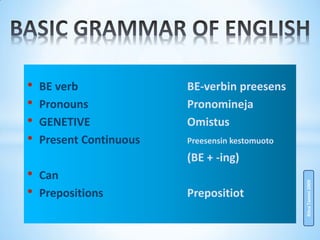
BE verb
Pronouns
GENETIVE
Present Continuous

BE-verbin preesens
Pronomineja
Omistus
Preesensin kestomuoto

•
•

Can
Prepositions

Prepositiot

Ritva Tammi 2009

(BE + -ing)
BE-verb - PRESENT tense
BE-verbillä on kolme nykyajan verbimuotoa:

AM, IS, ARE
Muoto valitaan subjektin/pronominin mukaisesti.
TO BE

I am a teacher.

substantiivi
adjektiivi
This is the classroom.
These are skyscrapers. The rose is red.
TOTEAMUS-(väite)LAUSEET
Subjekti

Verbimuoto

Esimerkki

I

AM

I am a teacher.

You

ARE

You are a student.

He

IS

He is in the lab.

She

IS

She is my sister.

It

IS

It is a city.

We

ARE

We are friends.

They

ARE

They are doctors.
KIELTEISET LAUSEET

Kielteisissä lauseissa lisäät
perään (am, are, is)

She is not sad

NOT olla-verbin preesensmuotojen

They are not at school
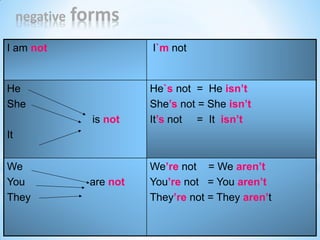
negative

forms

I am not

I`m not

He
She

He`s not = He isn’t
She’s not = She isn’t
It’s not = It isn’t

is not
It
We
You
They

are not

We’re not = We aren’t
You’re not = You aren’t
They’re not = They aren’t
Englannin kielessä on kahdenlaisia kysymyksiä:
1)

Kysymyssanalla muodostettavat kysymykset
Alkavat WH-sanoilla: WHO, WHERE, WHAT, WHICH, WHEN (ja HOW!)
Where do you live?
Who’s your idol?

2)

Yes/No –kysymykset

-> I live in Kitee.
-> I don’t have any particular idols.

(-> vastaus alkaa aina ‘kyllä’ tai ‘ei)

Muista vastatessasi Yes/No –kysymykseen kiinnittää huomiota subjektiin!
Do you like indie music?
Does he enjoy reading?

-> Yes, I do.
-> No, he doesn’t.
Toteamus(väitelause):
Yes / No –kysymys:
Lyhyet vastaukset:

Antti and Eeva are students.
Are Antti and Eeva students?
Are they? - Yes, they are / No, they aren’t

Täydelliset vastaukset:

Yes, they are students.
/No, they are not students.

Toteamus(väitelause):
Yes / No –kysymys:
Lyhyet vastaukset:
Täydelliset vastaukset:

Ann is tall and thin.
Is Ann tall and thin?
Yes, she is / No, she isn’t
Yes, she is tall and thin.
/No, she is not tall and thin
WH –kysymyksillä haetaan vastausta siihen, mitä kysymyssanalla kysytään.

What...?

-> kysytään ASIAA, ESINETTÄ, OLIOTA
What do you want for your birthday?

Which flower? <- kysytään tarkemmin

-> A flower.
-> A rose.

Where...?

-> kysytään PAIKKAA

When...?

-> kysytään AIKAA

Who...?

-> kysytään HENKILÖÄ

-> This is my cousin.

Whose...?

-> kysytään OMISTAJAA

-> It’s my friend’s /...mine.

How...?

-> kysytään TAPAA

-> You do it so well /quickly.

Niillä haetaan siis

-> He lives in Joensuu.
-> We’ll meet at ten /tomorrow.

informaatiota

vastaus on toteamuslause = tieto kysymyssanan kysymästä asiasta.
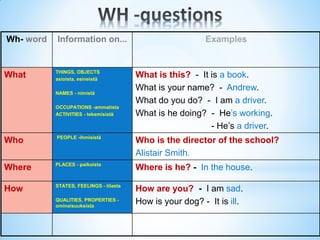
Wh- word

What

Information on...

THINGS, OBJECTS
asioista, esineistä
NAMES - nimistä
OCCUPATIONS -ammatista
ACTIVITIES - tekemisistä

Examples

What is this? - It is a book.
What is your name? - Andrew.
What do you do? - I am a driver.
What is he doing? - He’s working.
- He’s a driver.

Who

PEOPLE -ihmisistä

Who is the director of the school?
Alistair Smith.

Where

PLACES - paikoista

Where is he? - In the house.

How

STATES, FEELINGS - tilasta

How are you? - I am sad.
How is your dog? - It is ill.

QUALITIES, PROPERTIES ominaisuuksista
REVIEW

- kertaus

Toteamus

Kielto

Yes/No -kysymys

Lyhyt vastaus

I am a teacher.

I am not a teacher.

Am I a teacher?

Yes, you are / No, you are not

You are a student.

You are not a student.

Are you a student?

Yes, I am / No, I am not

He is in the lab.

He is not in the lab.

Is he in the lab?

Yes, he is / No, he is not

She is my sister.

She is not my sister.

Is she my sister?

Yes, she is / No, she is not

It is a city.

It is not a city.

Is it a city?

Yes, it is / No, it is not

We are friends.

We are not friends.

Are we friends?

Yes, we are / No, we are not

They are doctors.

They are not doctors.

Are they doctors?

Yes, they are / No they are not
What is

that?

That is an airplane.
Is that a bird?
No, it is an airplane.

What are

those?

Those are books.

Are those books?
Yes, they are (books).
Demonstratives
Käytämme pronomineja

THIS / THESE

(‘tämä’/’nämä’),

kun asiat, esineet tai ajankohta ovat puhujaa lähellä.

This is an apple.

THIS + yksi

These are pencils.

THESE + monta
Demonstratives
Käytämme pronomineja THAT / THOSE (‘tuo’/’nuo’)

kun asiat, ajankohta tai ihmiset ovat kaukana puhujasta.

That is a lake.
Those are
mountains
THAT + ‘yksi’
THOSE + ‘monta’
-s
Noun ending

PLURAL

Forming the
plural

s, x, ch or sh

+ -es

consonant + y

y -> i
then
+ –es

most others

+ -s

Examples

boss - bosses
tax - taxes
bush - bushes
fly - flies
try - tries
curry – curries
cat - cats
face - faces
day – days
– epäsäännölliset monikot

ends –fe
loppuu - fe

ends –f

ends - o

(PLURAL form)

Examples

monikon muodostus

(NOUN) substantiivi

esimerkkejä

f -> v
->
+ –s

knife - knives
life - lives
wife - wives

f -> v
->
+ –es

half - halves
wolf - wolves
loaf - loaves

+ –es

potato - potatoes
tomato - tomatoes
volcano - volcanoes
IRREGULAR PLURALS

Ei muutu

Plural form

Examples

Muuta vokaali
tai
Muuta sana
tai
Lisää toinen pääte

NOUN

man - men
foot - feet
child - children
person - people
tooth - teeth
mouse - mice

Yksikkö ja monikko
samanlaiset

sheep
deer
fish (sometimes)
Possessive Pronouns
persoonapronominien omistusmuodot

PERUSMUOTO

OMISTUSMUOTO

I

my

you

your

he

his

she

her

it

its

we

our

they

their

+

NOUN (SUBSTANTIIVI)
(asia, esine)
Possessives

His shirt is new
Her pants are white

This is our house

This is her cat
GENIVITE

My grandparents’ car is fast.

Julia’s husband is John.
John is her husband.

The Child’s mother is happy
IN

In the house
In a room
In a car

in a shop
in a town
in a garden

ON

On a shelf
On a plate
On a balcony

on a wall
on the table
on a door

AT

At the bus station at home
At the door
at the top
At work
at the end of
- kuvaa tapahtumia, jotka
tapahtuvat parhaillaan

- kestomuodot = prosesseja
- sovitut ‘kalenteri’ tapahtumat
lähitulevaisuudessa

- Parturi, lääkäri, treffit

Subject

BE

-ING
FORM

I

Am

Singing

Is

Singing

Are

Singing

He
She
It
John
We
You
They
She’s cutting the grass
The man is driving a car

They are dancing
He’s dreaming

The girl is baking
The cow and the bird are
talking

He’s cleaning the window

She’s reading
Verb ending in...

How to make the -ING form

Examples

1 vokaali + 1
konsonantti

Kahdenna konsonantti
->
+ -ING

swim - swimming
hit - hitting
get - getting

1 vokaali + 1
konsonantti + E

Poista -E
->
+e

come - coming
lose - losing
live - living

[anything else]

+ - ING

say - saying
go - going
walk - walking
Can is used to show ability – kyky, taito

They can dance

He can’t play the piano

He can play
football

CAN / CAN’T

He can swim

He can skate
AFFIRMATIVE
toteamus

NEGATIVE
kielto

YES/NO
QUESTIONS
-> vastaus alkaa
YES/NO

I can cook

I can not cook

Can I cook?

Yes, you can / No,you can´t

You can dance

You can not dance

Can you dance?

Yes I can / No I can’t

He can play

He can not play

Can he play?

Yes, he can / No, he can`t

She can swim

She can not swim

Can she swim?

Yes, she can / No, she can’t

It can run

It can not run

Can it run?

Yes, it can / No, it can’t

We can sing

We can not sing

Can we sing?

Yes, we can / No, we can’t

SHORT ANSWERS
lyhyet vastaukset

Basic grammar

  • 1.
    • • • • BE verb Pronouns GENETIVE Present Continuous BE-verbinpreesens Pronomineja Omistus Preesensin kestomuoto • • Can Prepositions Prepositiot Ritva Tammi 2009 (BE + -ing)
  • 2.
    BE-verb - PRESENTtense BE-verbillä on kolme nykyajan verbimuotoa: AM, IS, ARE Muoto valitaan subjektin/pronominin mukaisesti. TO BE I am a teacher. substantiivi adjektiivi This is the classroom. These are skyscrapers. The rose is red.
  • 3.
    TOTEAMUS-(väite)LAUSEET Subjekti Verbimuoto Esimerkki I AM I am ateacher. You ARE You are a student. He IS He is in the lab. She IS She is my sister. It IS It is a city. We ARE We are friends. They ARE They are doctors.
  • 4.
    KIELTEISET LAUSEET Kielteisissä lauseissalisäät perään (am, are, is) She is not sad NOT olla-verbin preesensmuotojen They are not at school
  • 5.
    negative forms I am not I`mnot He She He`s not = He isn’t She’s not = She isn’t It’s not = It isn’t is not It We You They are not We’re not = We aren’t You’re not = You aren’t They’re not = They aren’t
  • 6.
    Englannin kielessä onkahdenlaisia kysymyksiä: 1) Kysymyssanalla muodostettavat kysymykset Alkavat WH-sanoilla: WHO, WHERE, WHAT, WHICH, WHEN (ja HOW!) Where do you live? Who’s your idol? 2) Yes/No –kysymykset -> I live in Kitee. -> I don’t have any particular idols. (-> vastaus alkaa aina ‘kyllä’ tai ‘ei) Muista vastatessasi Yes/No –kysymykseen kiinnittää huomiota subjektiin! Do you like indie music? Does he enjoy reading? -> Yes, I do. -> No, he doesn’t.
  • 7.
    Toteamus(väitelause): Yes / No–kysymys: Lyhyet vastaukset: Antti and Eeva are students. Are Antti and Eeva students? Are they? - Yes, they are / No, they aren’t Täydelliset vastaukset: Yes, they are students. /No, they are not students. Toteamus(väitelause): Yes / No –kysymys: Lyhyet vastaukset: Täydelliset vastaukset: Ann is tall and thin. Is Ann tall and thin? Yes, she is / No, she isn’t Yes, she is tall and thin. /No, she is not tall and thin
  • 8.
    WH –kysymyksillä haetaanvastausta siihen, mitä kysymyssanalla kysytään. What...? -> kysytään ASIAA, ESINETTÄ, OLIOTA What do you want for your birthday? Which flower? <- kysytään tarkemmin -> A flower. -> A rose. Where...? -> kysytään PAIKKAA When...? -> kysytään AIKAA Who...? -> kysytään HENKILÖÄ -> This is my cousin. Whose...? -> kysytään OMISTAJAA -> It’s my friend’s /...mine. How...? -> kysytään TAPAA -> You do it so well /quickly. Niillä haetaan siis -> He lives in Joensuu. -> We’ll meet at ten /tomorrow. informaatiota vastaus on toteamuslause = tieto kysymyssanan kysymästä asiasta.
  • 9.
    Wh- word What Information on... THINGS,OBJECTS asioista, esineistä NAMES - nimistä OCCUPATIONS -ammatista ACTIVITIES - tekemisistä Examples What is this? - It is a book. What is your name? - Andrew. What do you do? - I am a driver. What is he doing? - He’s working. - He’s a driver. Who PEOPLE -ihmisistä Who is the director of the school? Alistair Smith. Where PLACES - paikoista Where is he? - In the house. How STATES, FEELINGS - tilasta How are you? - I am sad. How is your dog? - It is ill. QUALITIES, PROPERTIES ominaisuuksista
  • 10.
    REVIEW - kertaus Toteamus Kielto Yes/No -kysymys Lyhytvastaus I am a teacher. I am not a teacher. Am I a teacher? Yes, you are / No, you are not You are a student. You are not a student. Are you a student? Yes, I am / No, I am not He is in the lab. He is not in the lab. Is he in the lab? Yes, he is / No, he is not She is my sister. She is not my sister. Is she my sister? Yes, she is / No, she is not It is a city. It is not a city. Is it a city? Yes, it is / No, it is not We are friends. We are not friends. Are we friends? Yes, we are / No, we are not They are doctors. They are not doctors. Are they doctors? Yes, they are / No they are not
  • 11.
    What is that? That isan airplane. Is that a bird? No, it is an airplane. What are those? Those are books. Are those books? Yes, they are (books).
  • 12.
    Demonstratives Käytämme pronomineja THIS /THESE (‘tämä’/’nämä’), kun asiat, esineet tai ajankohta ovat puhujaa lähellä. This is an apple. THIS + yksi These are pencils. THESE + monta
  • 13.
    Demonstratives Käytämme pronomineja THAT/ THOSE (‘tuo’/’nuo’) kun asiat, ajankohta tai ihmiset ovat kaukana puhujasta. That is a lake. Those are mountains THAT + ‘yksi’ THOSE + ‘monta’
  • 14.
    -s Noun ending PLURAL Forming the plural s,x, ch or sh + -es consonant + y y -> i then + –es most others + -s Examples boss - bosses tax - taxes bush - bushes fly - flies try - tries curry – curries cat - cats face - faces day – days
  • 15.
    – epäsäännölliset monikot ends–fe loppuu - fe ends –f ends - o (PLURAL form) Examples monikon muodostus (NOUN) substantiivi esimerkkejä f -> v -> + –s knife - knives life - lives wife - wives f -> v -> + –es half - halves wolf - wolves loaf - loaves + –es potato - potatoes tomato - tomatoes volcano - volcanoes
  • 16.
    IRREGULAR PLURALS Ei muutu Pluralform Examples Muuta vokaali tai Muuta sana tai Lisää toinen pääte NOUN man - men foot - feet child - children person - people tooth - teeth mouse - mice Yksikkö ja monikko samanlaiset sheep deer fish (sometimes)
  • 17.
  • 18.
    Possessives His shirt isnew Her pants are white This is our house This is her cat
  • 19.
    GENIVITE My grandparents’ caris fast. Julia’s husband is John. John is her husband. The Child’s mother is happy
  • 20.
    IN In the house Ina room In a car in a shop in a town in a garden ON On a shelf On a plate On a balcony on a wall on the table on a door AT At the bus station at home At the door at the top At work at the end of
  • 21.
    - kuvaa tapahtumia,jotka tapahtuvat parhaillaan - kestomuodot = prosesseja - sovitut ‘kalenteri’ tapahtumat lähitulevaisuudessa - Parturi, lääkäri, treffit Subject BE -ING FORM I Am Singing Is Singing Are Singing He She It John We You They
  • 22.
    She’s cutting thegrass The man is driving a car They are dancing He’s dreaming The girl is baking The cow and the bird are talking He’s cleaning the window She’s reading
  • 23.
    Verb ending in... Howto make the -ING form Examples 1 vokaali + 1 konsonantti Kahdenna konsonantti -> + -ING swim - swimming hit - hitting get - getting 1 vokaali + 1 konsonantti + E Poista -E -> +e come - coming lose - losing live - living [anything else] + - ING say - saying go - going walk - walking
  • 24.
    Can is usedto show ability – kyky, taito They can dance He can’t play the piano He can play football CAN / CAN’T He can swim He can skate
  • 25.
    AFFIRMATIVE toteamus NEGATIVE kielto YES/NO QUESTIONS -> vastaus alkaa YES/NO Ican cook I can not cook Can I cook? Yes, you can / No,you can´t You can dance You can not dance Can you dance? Yes I can / No I can’t He can play He can not play Can he play? Yes, he can / No, he can`t She can swim She can not swim Can she swim? Yes, she can / No, she can’t It can run It can not run Can it run? Yes, it can / No, it can’t We can sing We can not sing Can we sing? Yes, we can / No, we can’t SHORT ANSWERS lyhyet vastaukset