WHAT IS A ROOT?
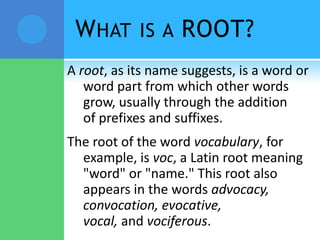
A root, as its name suggests, is a word or
word part from which other words
grow, usually through the addition
of prefixes and suffixes.
The root of the word vocabulary, for
example, is voc, a Latin root meaning
"word" or "name." This root also
appears in the words advocacy,
convocation, evocative,
vocal, and vociferous.
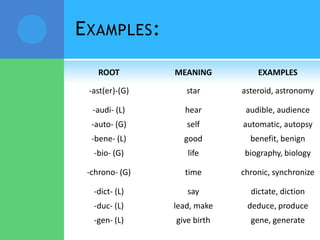
EXAMPLES:
ROOT MEANING EXAMPLES
-ast(er)-(G) star asteroid, astronomy
-audi- (L) hear audible, audience
-auto- (G) self automatic, autopsy
-bene- (L) good benefit, benign
-bio- (G) life biography, biology
-chrono- (G) time chronic, synchronize
-dict- (L) say dictate, diction
-duc- (L) lead, make deduce, produce
-gen- (L) give birth gene, generate
MAIN TYPES OF
WHAT ARE ?
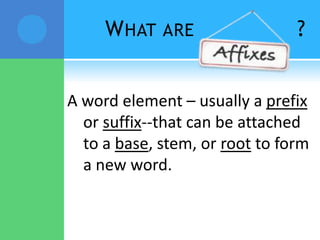
A word element – usually a prefix
or suffix--that can be attached
to a base, stem, or root to form
a new word.
WHAT ARE ?
Etymology:
From the Latin Figere, "fasten"
PREFIX
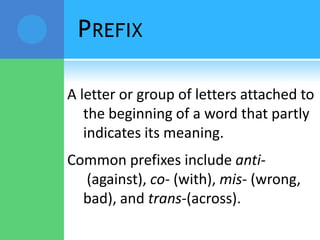
A letter or group of letters attached to
the beginning of a word that partly
indicates its meaning.
Common prefixes include anti-
(against), co- (with), mis- (wrong,
bad), and trans-(across).
TYPES OF
Derivational prefixes do not
normally alter the word class of
the base word; that is, a prefix is
added to a noun to form a new
noun with a different meaning.
PREFIX
Etymology:
 From the Latin Praefixum, "to
fasten in front"
PREFIX
During the 1980s, 'mini-' gave way to
'micro-,' which has yielded to 'nano-.'
In the new millennium, companies
such as Nanometrics, Nanogen and
NanoPierce Technologies have all
embraced the prefix, despite
complaints their products were hardly
nano-scale (a billionth of a meter or
smaller).
(Alex Boese, "Electrocybertronics," Smithsonian, March 2008)
COMMON PREFIXES
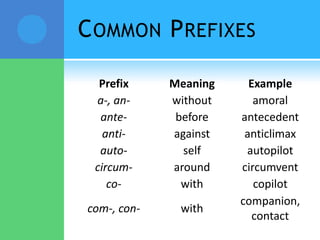
Prefix Meaning Example
a-, an- without amoral
ante- before antecedent
anti- against anticlimax
auto- self autopilot
circum- around circumvent
co- with copilot
com-, con- with
companion,
contact
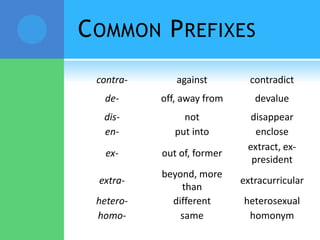
COMMON PREFIXES
contra- against contradict
de- off, away from devalue
dis- not disappear
en- put into enclose
ex- out of, former
extract, ex-
president
extra-
beyond, more
than
extracurricular
hetero- different heterosexual
homo- same homonym
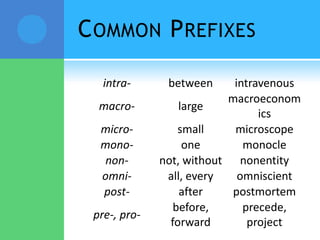
COMMON PREFIXES
intra- between intravenous
macro- large
macroeconom
ics
micro- small microscope
mono- one monocle
non- not, without nonentity
omni- all, every omniscient
post- after postmortem
pre-, pro-
before,
forward
precede,
project
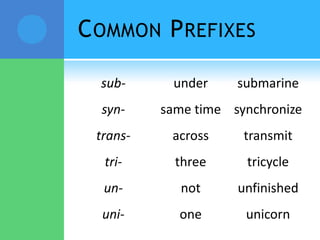
COMMON PREFIXES
sub- under submarine
syn- same time synchronize
trans- across transmit
tri- three tricycle
un- not unfinished
uni- one unicorn
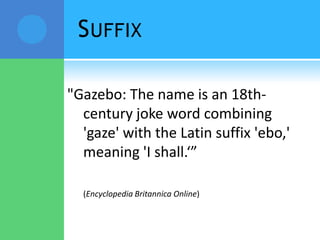
SUFFIX
"Gazebo: The name is an 18th-
century joke word combining
'gaze' with the Latin suffix 'ebo,'
meaning 'I shall.‘”
(Encyclopedia Britannica Online)
TYPES OF
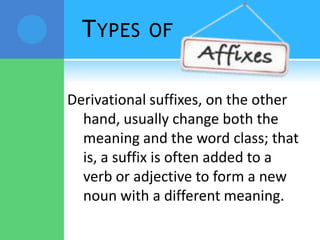
Derivational suffixes, on the other
hand, usually change both the
meaning and the word class; that
is, a suffix is often added to a
verb or adjective to form a new
noun with a different meaning.
EXAMPLE:
adjective: dark / suffixed
noun: darkness
verb: agree / suffixed noun: agreement
noun: friend / suffixed noun: friendship
(Douglas Biber, Susan Conrad, and Geoffrey Leech, Longman Student Grammar
of Spoken English, Longman, 2002)
SUFFIX
A letter or group of letters added to
the end of a word or stem (i.e.,
a base form), serving to form a new
word or functioning as
an inflectional ending.
SUFFIX
Etymology:
 From the Latin Suffixum, “to
fasten underneath”
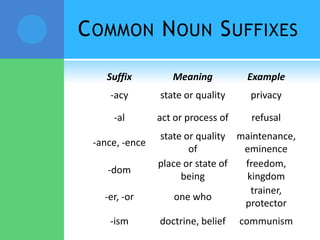
COMMON NOUN SUFFIXES
Suffix Meaning Example
-acy state or quality privacy
-al act or process of refusal
-ance, -ence
state or quality
of
maintenance,
eminence
-dom
place or state of
being
freedom,
kingdom
-er, -or one who
trainer,
protector
-ism doctrine, belief communism
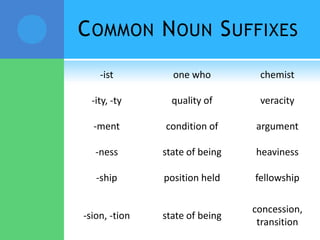
COMMON NOUN SUFFIXES
-ist one who chemist
-ity, -ty quality of veracity
-ment condition of argument
-ness state of being heaviness
-ship position held fellowship
-sion, -tion state of being
concession,
transition
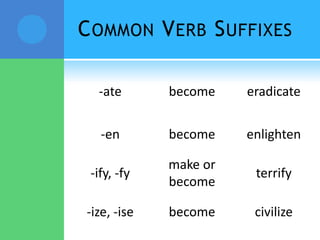
COMMON VERB SUFFIXES
-ate become eradicate
-en become enlighten
-ify, -fy
make or
become
terrify
-ize, -ise become civilize
COMMON ADJECTIVE SUFFIXES
-able, -ible capable of being edible, presentable
-al pertaining to regional
-esque reminiscent of picturesque
-ful notable for fanciful
-ic, -ical pertaining to musical, mythic
-ious, -ous characterized by nutritious, portentous
-ish having the quality of fiendish
-ive having the nature of creative
-less without endless
-y characterized by sleazy

Affixes

  • 2.
    WHAT IS AROOT? A root, as its name suggests, is a word or word part from which other words grow, usually through the addition of prefixes and suffixes. The root of the word vocabulary, for example, is voc, a Latin root meaning "word" or "name." This root also appears in the words advocacy, convocation, evocative, vocal, and vociferous.
  • 3.
    EXAMPLES: ROOT MEANING EXAMPLES -ast(er)-(G)star asteroid, astronomy -audi- (L) hear audible, audience -auto- (G) self automatic, autopsy -bene- (L) good benefit, benign -bio- (G) life biography, biology -chrono- (G) time chronic, synchronize -dict- (L) say dictate, diction -duc- (L) lead, make deduce, produce -gen- (L) give birth gene, generate
  • 4.
  • 5.
    WHAT ARE ? Aword element – usually a prefix or suffix--that can be attached to a base, stem, or root to form a new word.
  • 6.
    WHAT ARE ? Etymology: Fromthe Latin Figere, "fasten"
  • 7.
    PREFIX A letter orgroup of letters attached to the beginning of a word that partly indicates its meaning. Common prefixes include anti- (against), co- (with), mis- (wrong, bad), and trans-(across).
  • 8.
    TYPES OF Derivational prefixesdo not normally alter the word class of the base word; that is, a prefix is added to a noun to form a new noun with a different meaning.
  • 9.
    PREFIX Etymology:  From theLatin Praefixum, "to fasten in front"
  • 10.
    PREFIX During the 1980s,'mini-' gave way to 'micro-,' which has yielded to 'nano-.' In the new millennium, companies such as Nanometrics, Nanogen and NanoPierce Technologies have all embraced the prefix, despite complaints their products were hardly nano-scale (a billionth of a meter or smaller). (Alex Boese, "Electrocybertronics," Smithsonian, March 2008)
  • 11.
    COMMON PREFIXES Prefix MeaningExample a-, an- without amoral ante- before antecedent anti- against anticlimax auto- self autopilot circum- around circumvent co- with copilot com-, con- with companion, contact
  • 12.
    COMMON PREFIXES contra- againstcontradict de- off, away from devalue dis- not disappear en- put into enclose ex- out of, former extract, ex- president extra- beyond, more than extracurricular hetero- different heterosexual homo- same homonym
  • 13.
    COMMON PREFIXES intra- betweenintravenous macro- large macroeconom ics micro- small microscope mono- one monocle non- not, without nonentity omni- all, every omniscient post- after postmortem pre-, pro- before, forward precede, project
  • 14.
    COMMON PREFIXES sub- undersubmarine syn- same time synchronize trans- across transmit tri- three tricycle un- not unfinished uni- one unicorn
  • 15.
    SUFFIX "Gazebo: The nameis an 18th- century joke word combining 'gaze' with the Latin suffix 'ebo,' meaning 'I shall.‘” (Encyclopedia Britannica Online)
  • 16.
    TYPES OF Derivational suffixes,on the other hand, usually change both the meaning and the word class; that is, a suffix is often added to a verb or adjective to form a new noun with a different meaning.
  • 17.
    EXAMPLE: adjective: dark /suffixed noun: darkness verb: agree / suffixed noun: agreement noun: friend / suffixed noun: friendship (Douglas Biber, Susan Conrad, and Geoffrey Leech, Longman Student Grammar of Spoken English, Longman, 2002)
  • 18.
    SUFFIX A letter orgroup of letters added to the end of a word or stem (i.e., a base form), serving to form a new word or functioning as an inflectional ending.
  • 19.
    SUFFIX Etymology:  From theLatin Suffixum, “to fasten underneath”
  • 20.
    COMMON NOUN SUFFIXES SuffixMeaning Example -acy state or quality privacy -al act or process of refusal -ance, -ence state or quality of maintenance, eminence -dom place or state of being freedom, kingdom -er, -or one who trainer, protector -ism doctrine, belief communism
  • 21.
    COMMON NOUN SUFFIXES -istone who chemist -ity, -ty quality of veracity -ment condition of argument -ness state of being heaviness -ship position held fellowship -sion, -tion state of being concession, transition
  • 22.
    COMMON VERB SUFFIXES -atebecome eradicate -en become enlighten -ify, -fy make or become terrify -ize, -ise become civilize
  • 23.
    COMMON ADJECTIVE SUFFIXES -able,-ible capable of being edible, presentable -al pertaining to regional -esque reminiscent of picturesque -ful notable for fanciful -ic, -ical pertaining to musical, mythic -ious, -ous characterized by nutritious, portentous -ish having the quality of fiendish -ive having the nature of creative -less without endless -y characterized by sleazy