Jocelyn L Gagalang, Ph D
MW 9-10:30
Structure of
English
To which of the body parts can
you compare syntax with?
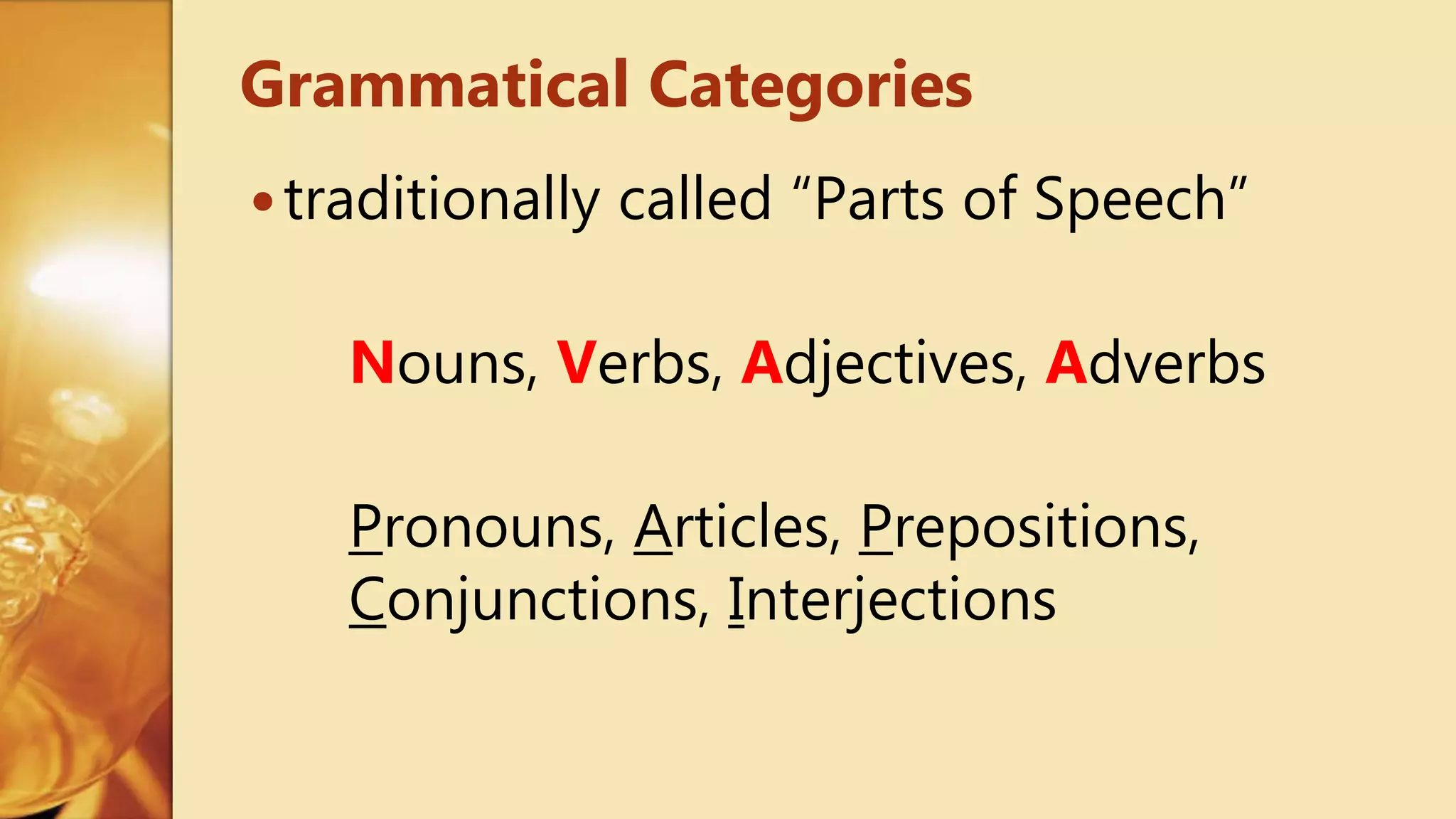
traditionally called “Parts of Speech”
Nouns, Verbs, Adjectives, Adverbs
Pronouns, Articles, Prepositions,
Conjunctions, Interjections
Grammatical Categories
-- open sets and are content words, in that
they have particular semantic referents.
Why are they considered content words?
e.g. get, book, library
Major grammatical categories
-- are closed sets, and are function words,
in that they largely fulfill grammatical
functions and are necessary to make a
sentence that is acceptable in form.
e.g. Get the book from the library.
Minor grammatical categories
Let’s
check
your
group’s
answers
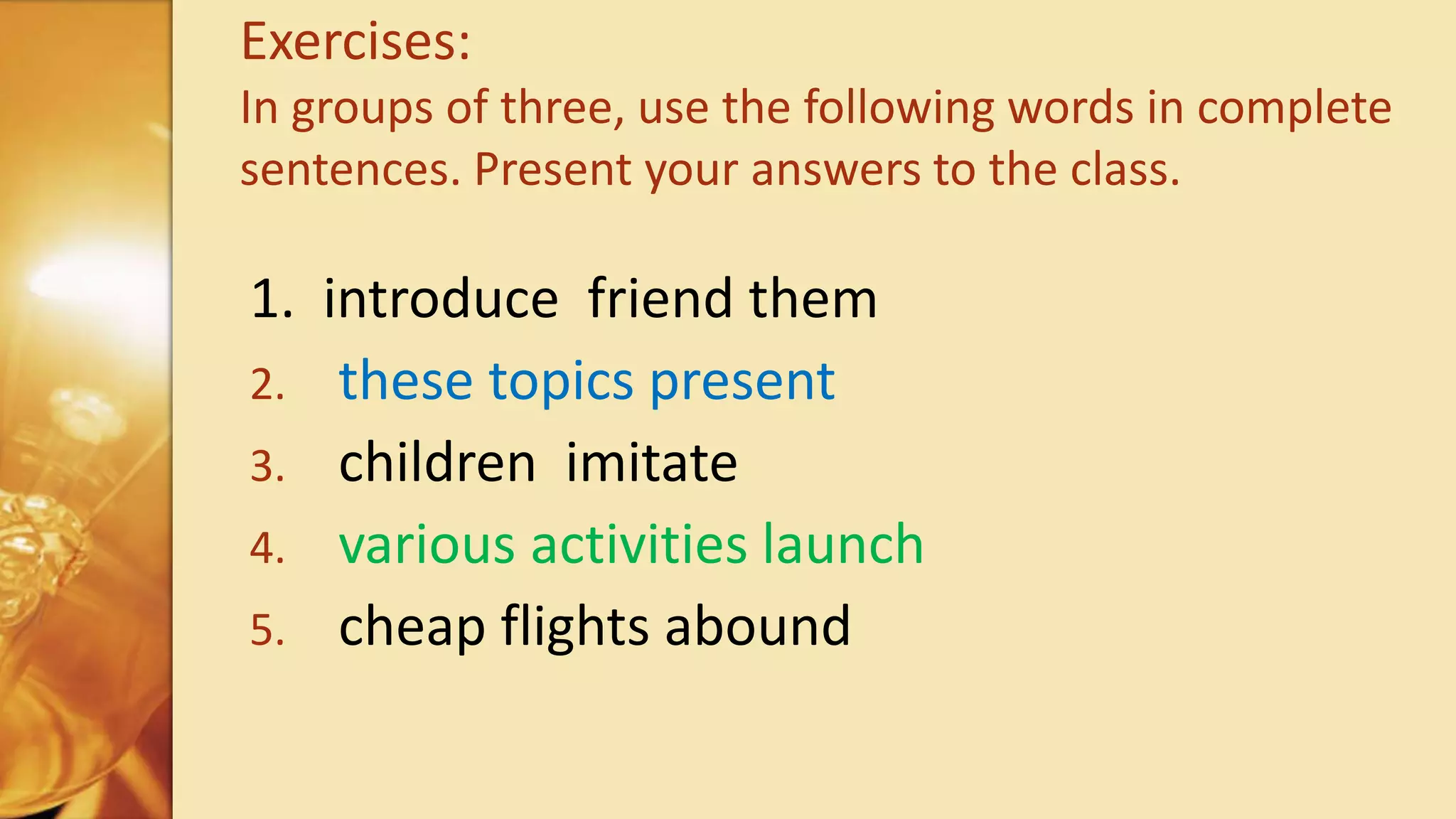
1. introduce friend them
2. these topics present
3. children imitate
4. various activities launch
5. cheap flights abound
Exercises:
In groups of three, use the following words in complete
sentences. Present your answers to the class.
6. body benefits exercise
7. never jeopardize health
8. summer fun all
9. heed parents’ advice
10. rethink cleanliness
Exercises:
In groups of three, use the following words in
complete sentences. Present your answers to
the class.
1. occurs with a determiner before it
except:
proper nouns and some
common nouns
2. has singular and plural forms
3. has a possessive form (‘s or ‘)
NOUNS: Definition and Characteristics
4. may function as:
subject of a verb: Time flies.
object of a transitive verb:
Faith can move mountains.
complement of a transitive verb:
We call them heroes.
complement of a linking verb:
e.g. Destiny is not chance.
object of a preposition:
e.g. Demitasse is after dinner.
nominative of address:
e.g. Buyers beware!
appositive:
e.g. Henning Brendt, the alchemist,
discovered phosphorous in
1669.
Noun Song
specific names and are capitalized
e.g. University of Rizal System
Dior
Samsung
Write down your own five samples.
Proper Nouns
According to grammatical number:
collective nouns: e.g. person (jury,
committee)
may be treated as singular or plural
count nouns: e.g. box, package, cars
have plural forms
Common Nouns
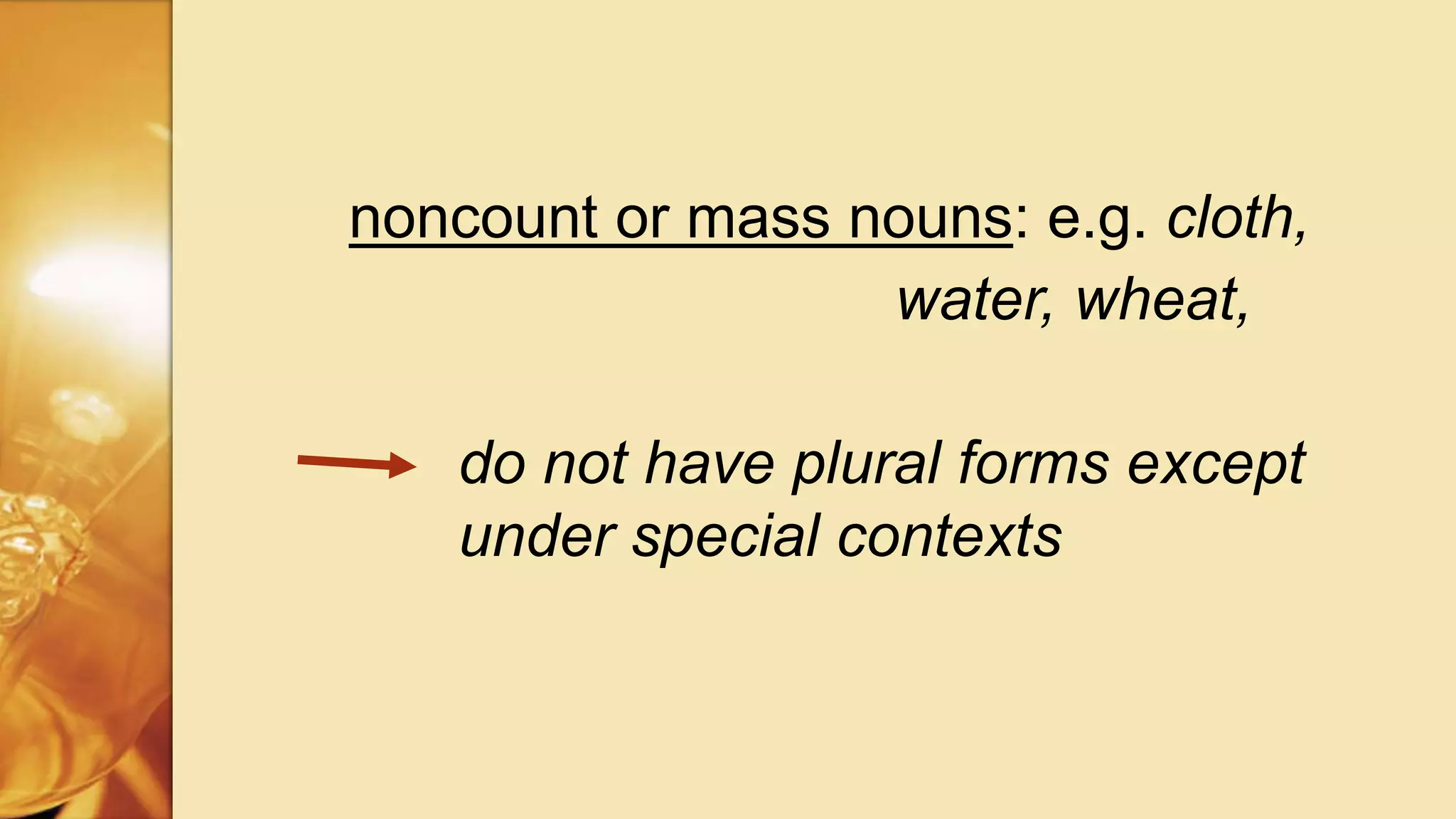
noncount or mass nouns: e.g. cloth,
water, wheat,
do not have plural forms except
under special contexts
 According to reference
abstract nouns: e.g. imagination,
anger, fear, love, honesty
These refer to concepts, emotions, etc.
Common Nouns
concrete nouns: e.g. thunder,
earthquake, fragrance
These refer to phenomena which
can be experienced through the
senses.
Group yourselves into five and on the
allotted space on the board write down
as many nouns as you can think of within
60 seconds.
Explain the type of each noun to the class
with members taking turns.
Noun Activity
Write down a summary of your
favorite TV show, book or movie.
Home Work

Structure of english

  • 1.
    Jocelyn L Gagalang,Ph D MW 9-10:30 Structure of English
  • 2.
    To which ofthe body parts can you compare syntax with?
  • 3.
    traditionally called “Partsof Speech” Nouns, Verbs, Adjectives, Adverbs Pronouns, Articles, Prepositions, Conjunctions, Interjections Grammatical Categories
  • 4.
    -- open setsand are content words, in that they have particular semantic referents. Why are they considered content words? e.g. get, book, library Major grammatical categories
  • 5.
    -- are closedsets, and are function words, in that they largely fulfill grammatical functions and are necessary to make a sentence that is acceptable in form. e.g. Get the book from the library. Minor grammatical categories
  • 6.
  • 7.
    1. introduce friendthem 2. these topics present 3. children imitate 4. various activities launch 5. cheap flights abound Exercises: In groups of three, use the following words in complete sentences. Present your answers to the class.
  • 8.
    6. body benefitsexercise 7. never jeopardize health 8. summer fun all 9. heed parents’ advice 10. rethink cleanliness Exercises: In groups of three, use the following words in complete sentences. Present your answers to the class.
  • 9.
    1. occurs witha determiner before it except: proper nouns and some common nouns 2. has singular and plural forms 3. has a possessive form (‘s or ‘) NOUNS: Definition and Characteristics
  • 10.
    4. may functionas: subject of a verb: Time flies. object of a transitive verb: Faith can move mountains. complement of a transitive verb: We call them heroes.
  • 11.
    complement of alinking verb: e.g. Destiny is not chance. object of a preposition: e.g. Demitasse is after dinner. nominative of address: e.g. Buyers beware!
  • 12.
    appositive: e.g. Henning Brendt,the alchemist, discovered phosphorous in 1669. Noun Song
  • 13.
    specific names andare capitalized e.g. University of Rizal System Dior Samsung Write down your own five samples. Proper Nouns
  • 14.
    According to grammaticalnumber: collective nouns: e.g. person (jury, committee) may be treated as singular or plural count nouns: e.g. box, package, cars have plural forms Common Nouns
  • 15.
    noncount or massnouns: e.g. cloth, water, wheat, do not have plural forms except under special contexts
  • 16.
     According toreference abstract nouns: e.g. imagination, anger, fear, love, honesty These refer to concepts, emotions, etc. Common Nouns
  • 17.
    concrete nouns: e.g.thunder, earthquake, fragrance These refer to phenomena which can be experienced through the senses.
  • 18.
    Group yourselves intofive and on the allotted space on the board write down as many nouns as you can think of within 60 seconds. Explain the type of each noun to the class with members taking turns. Noun Activity
  • 19.
    Write down asummary of your favorite TV show, book or movie. Home Work

Editor's Notes

  • #3 Ask at least 5 students
  • #4 Which of them do you know most?
  • #10 How do we indicate possessive form?