T H E S T R U C T U R E O F W O R D S
5.1 Morphology
W O R D S , L E X E M E S , A N D M O R P H E M E S
Introduction
Breaking down words
 What is a morpheme?
 A morpheme is the smallest unit of meaning in the
structure of a language.
 Examples of morphemes?
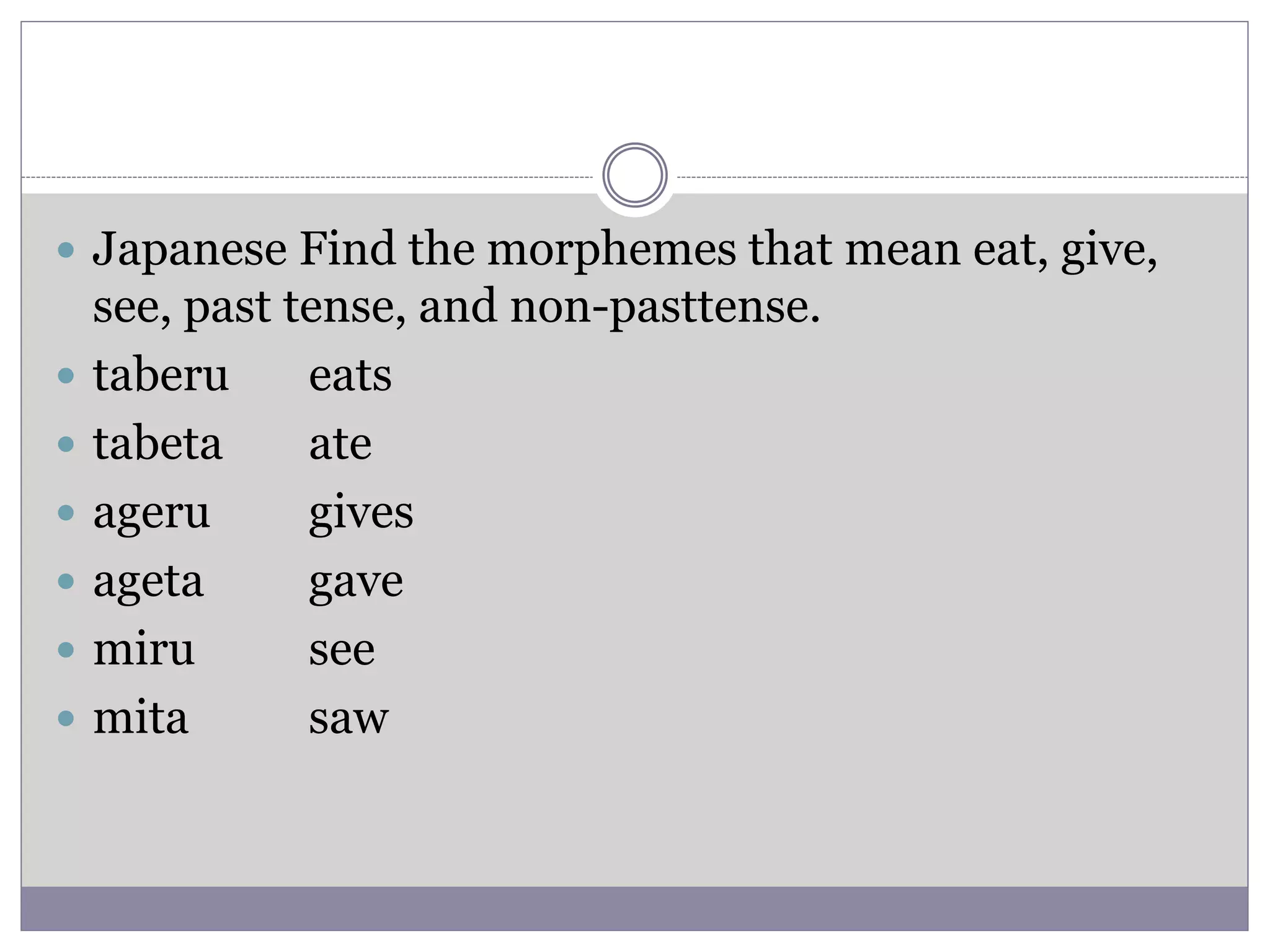
 Japanese Find the morphemes that mean eat, give,
see, past tense, and non-pasttense.
 taberu eats
 tabeta ate
 ageru gives
 ageta gave
 miru see
 mita saw
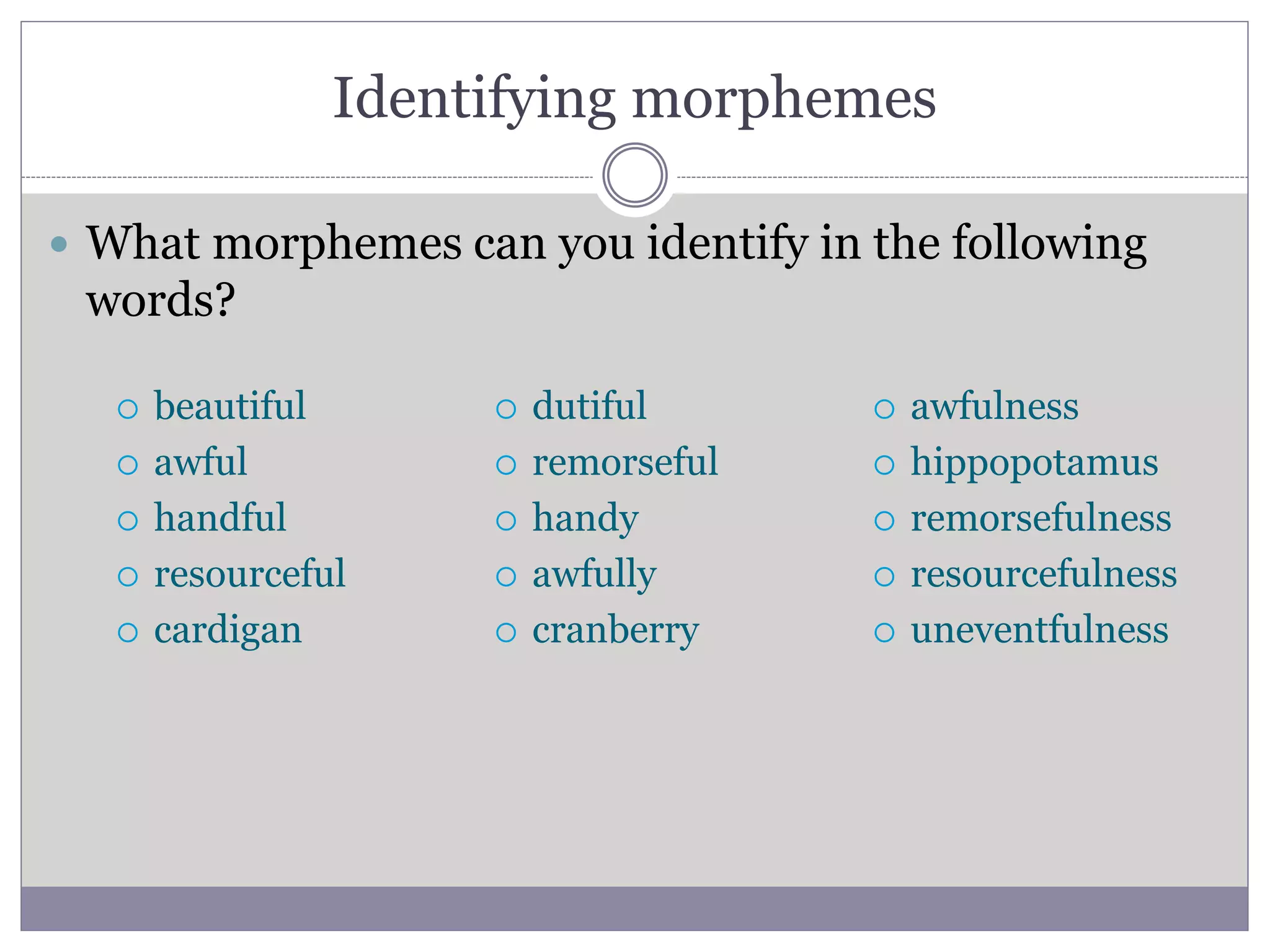
Identifying morphemes
 What morphemes can you identify in the following
words?
 beautiful
 awful
 handful
 resourceful
 cardigan
 dutiful
 remorseful
 handy
 awfully
 cranberry
 awfulness
 hippopotamus
 remorsefulness
 resourcefulness
 uneventfulness
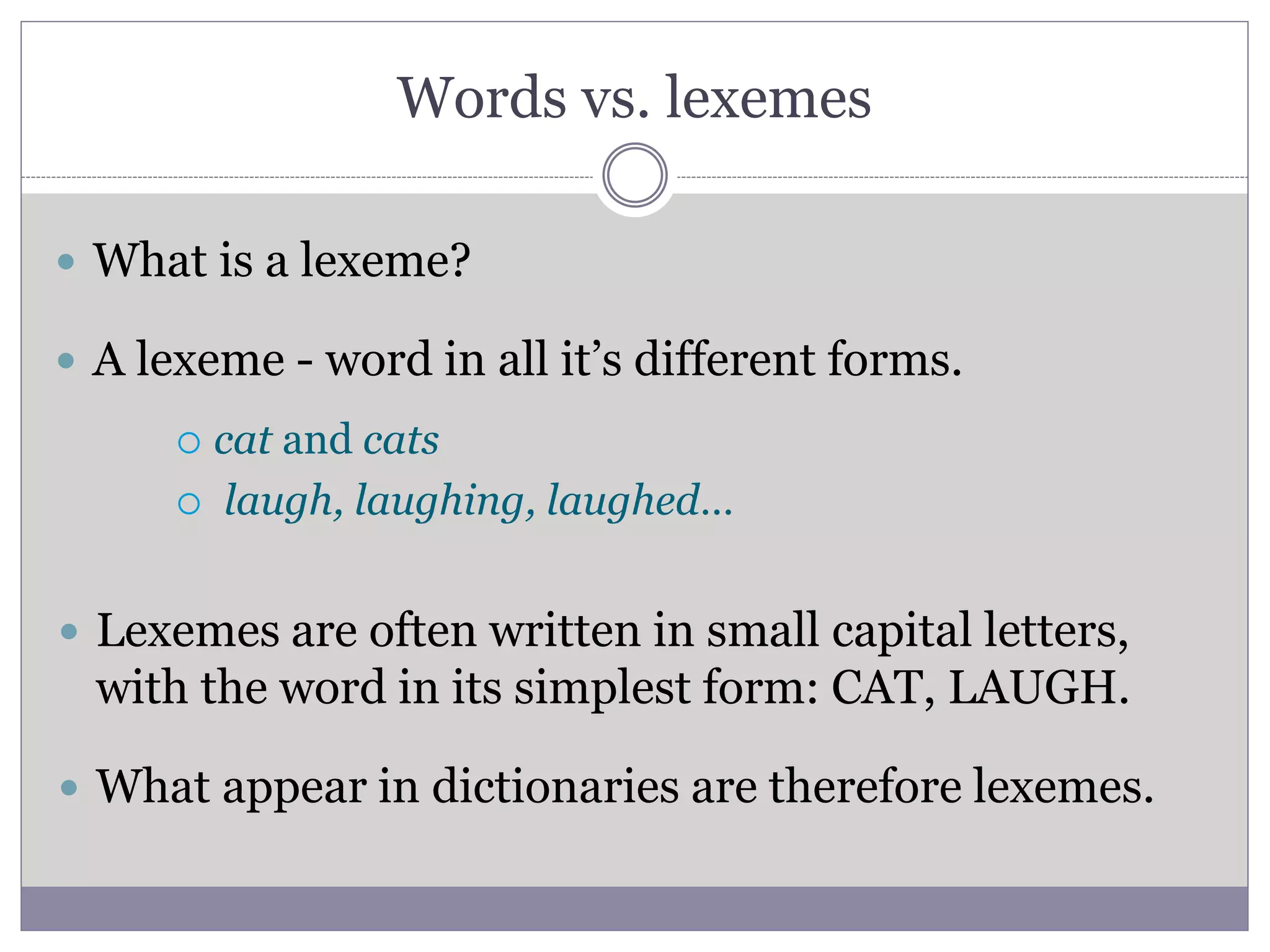
Words vs. lexemes
 What is a lexeme?
 A lexeme - word in all it’s different forms.
 cat and cats
 laugh, laughing, laughed…
 Lexemes are often written in small capital letters,
with the word in its simplest form: CAT, LAUGH.
 What appear in dictionaries are therefore lexemes.
Roots, stems and affixes
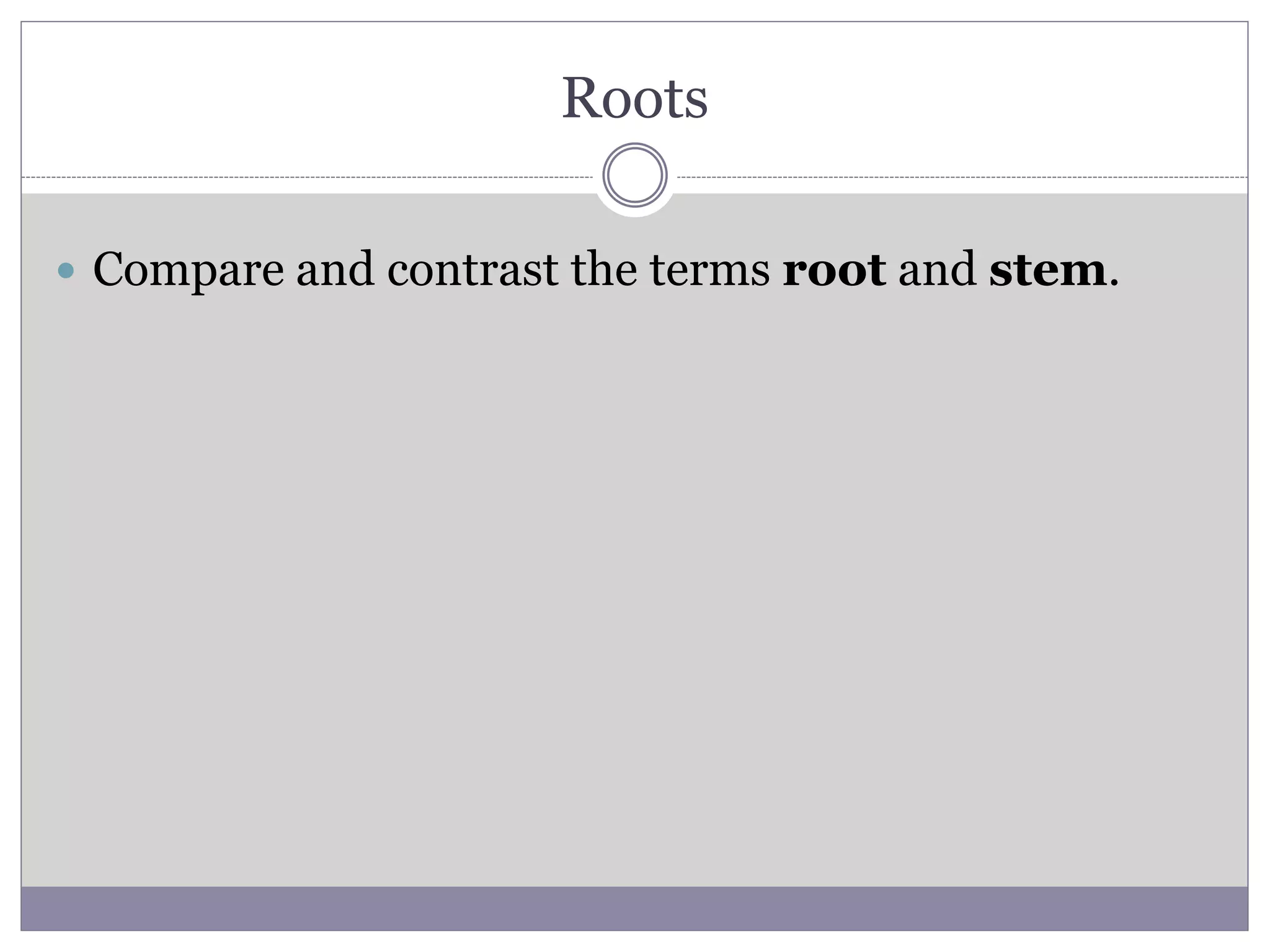
Roots
 Compare and contrast the terms root and stem.
Roots
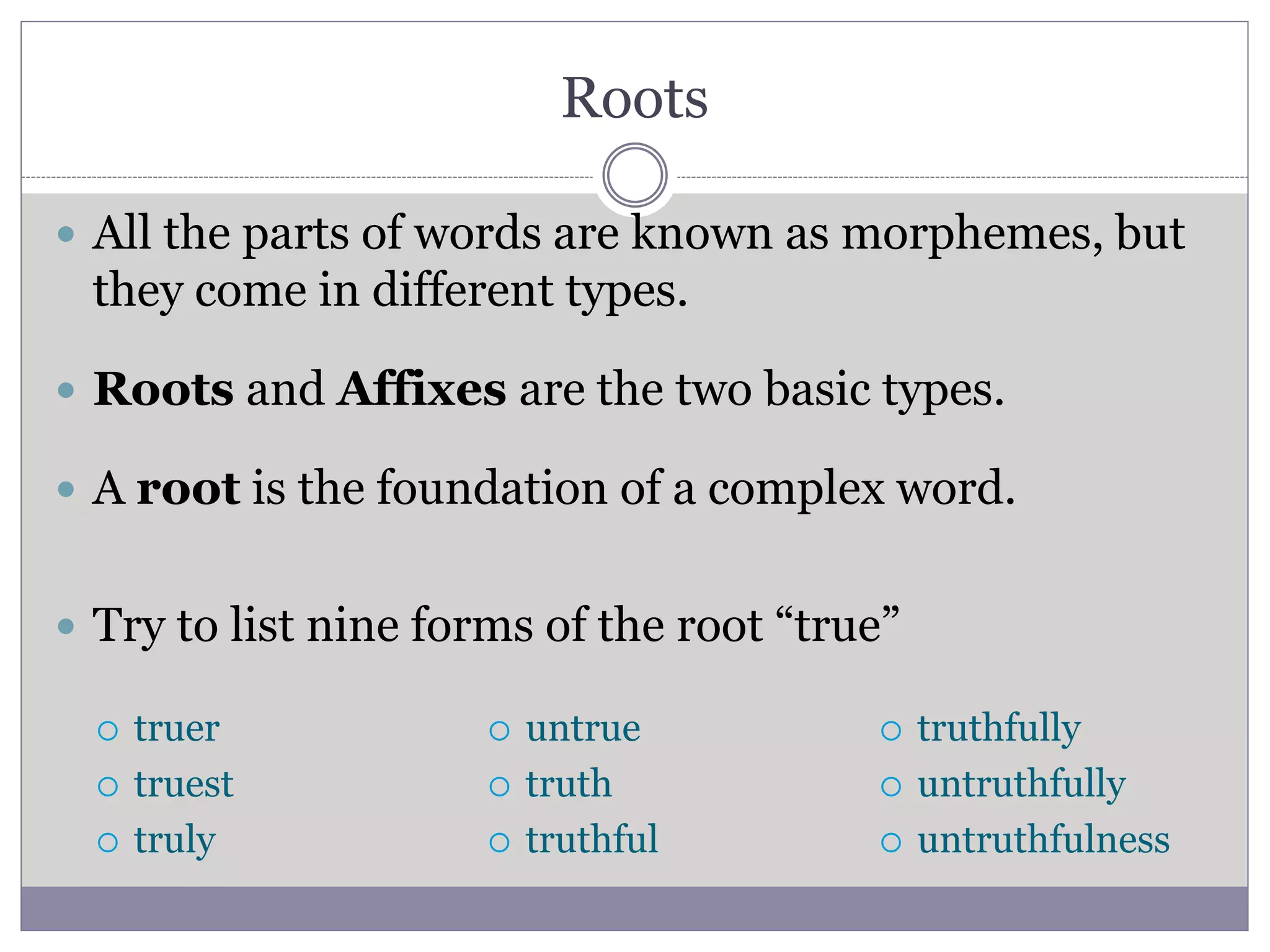
 All the parts of words are known as morphemes, but
they come in different types.
 Roots and Affixes are the two basic types.
 A root is the foundation of a complex word.
 Try to list nine forms of the root “true”
 truer
 truest
 truly
 untrue
 truth
 truthful
 truthfully
 untruthfully
 untruthfulness
Stems
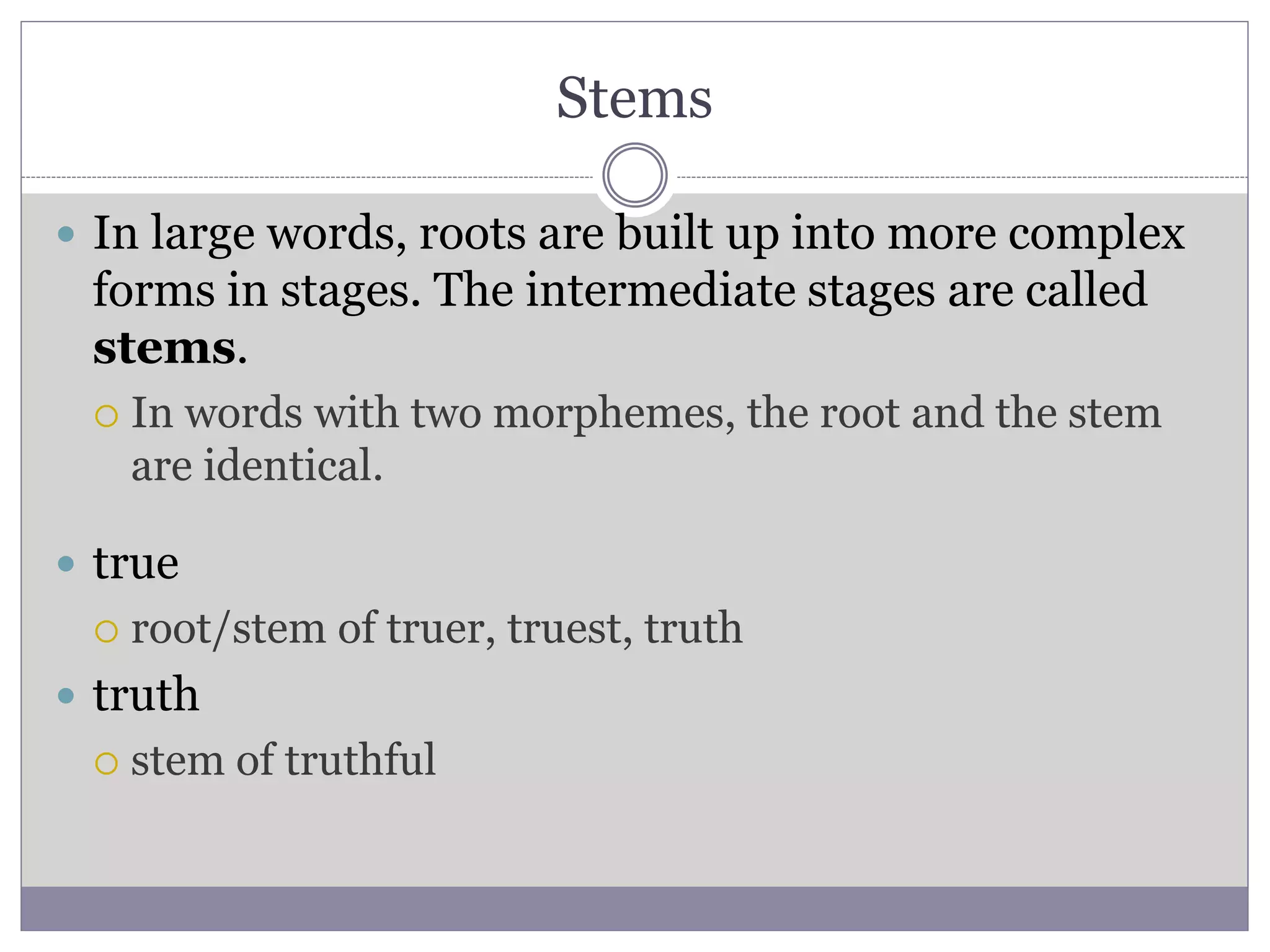
 In large words, roots are built up into more complex
forms in stages. The intermediate stages are called
stems.
 In words with two morphemes, the root and the stem
are identical.
 true
 root/stem of truer, truest, truth
 truth
 stem of truthful
Your turn
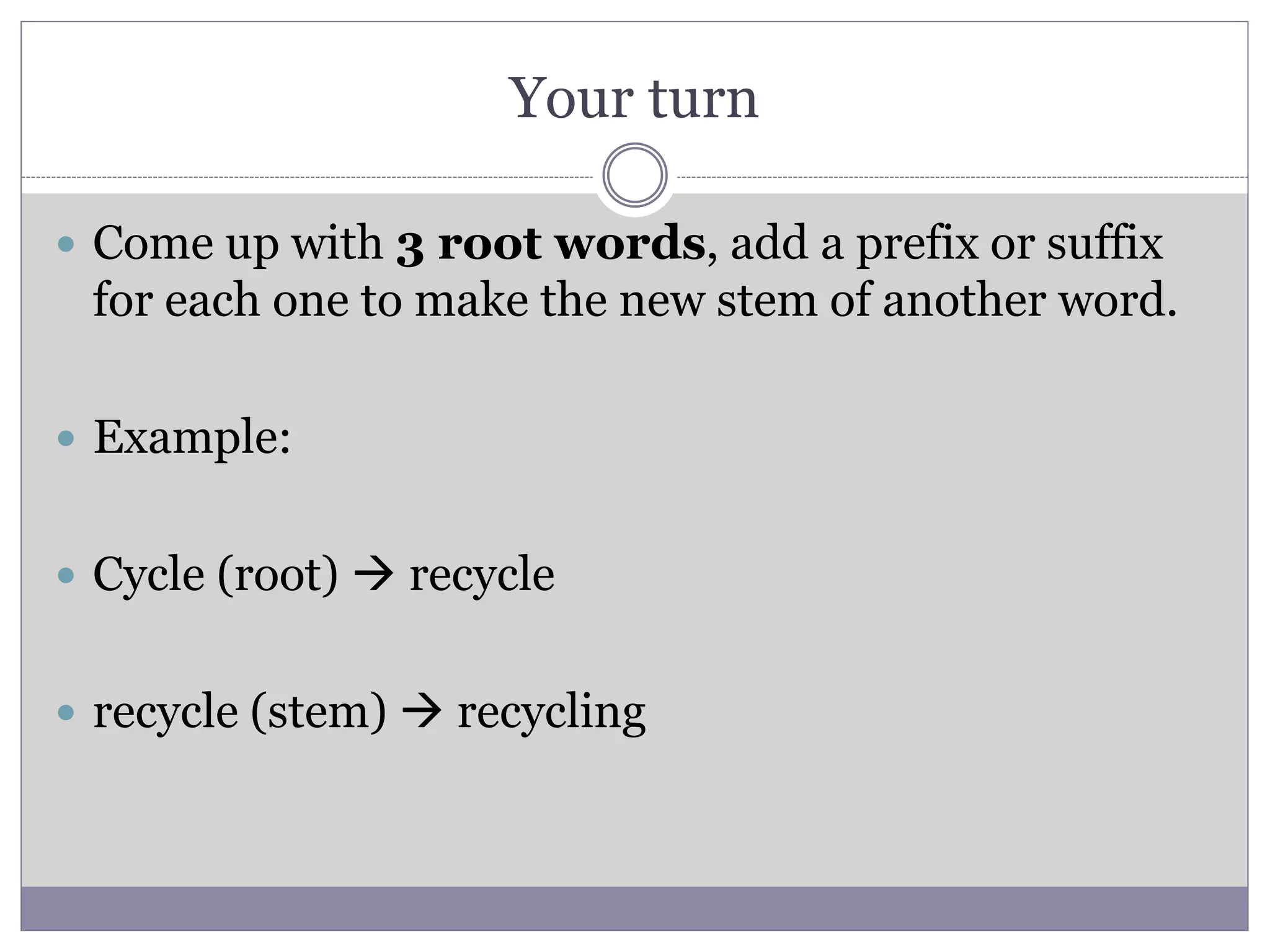
 Come up with 3 root words, add a prefix or suffix
for each one to make the new stem of another word.
 Example:
 Cycle (root)  recycle
 recycle (stem)  recycling
Affixes
 Languages vary in how many morphemes are
available for combining into a word.
 In some languages, entire sentences can be
constructed from one morpheme.
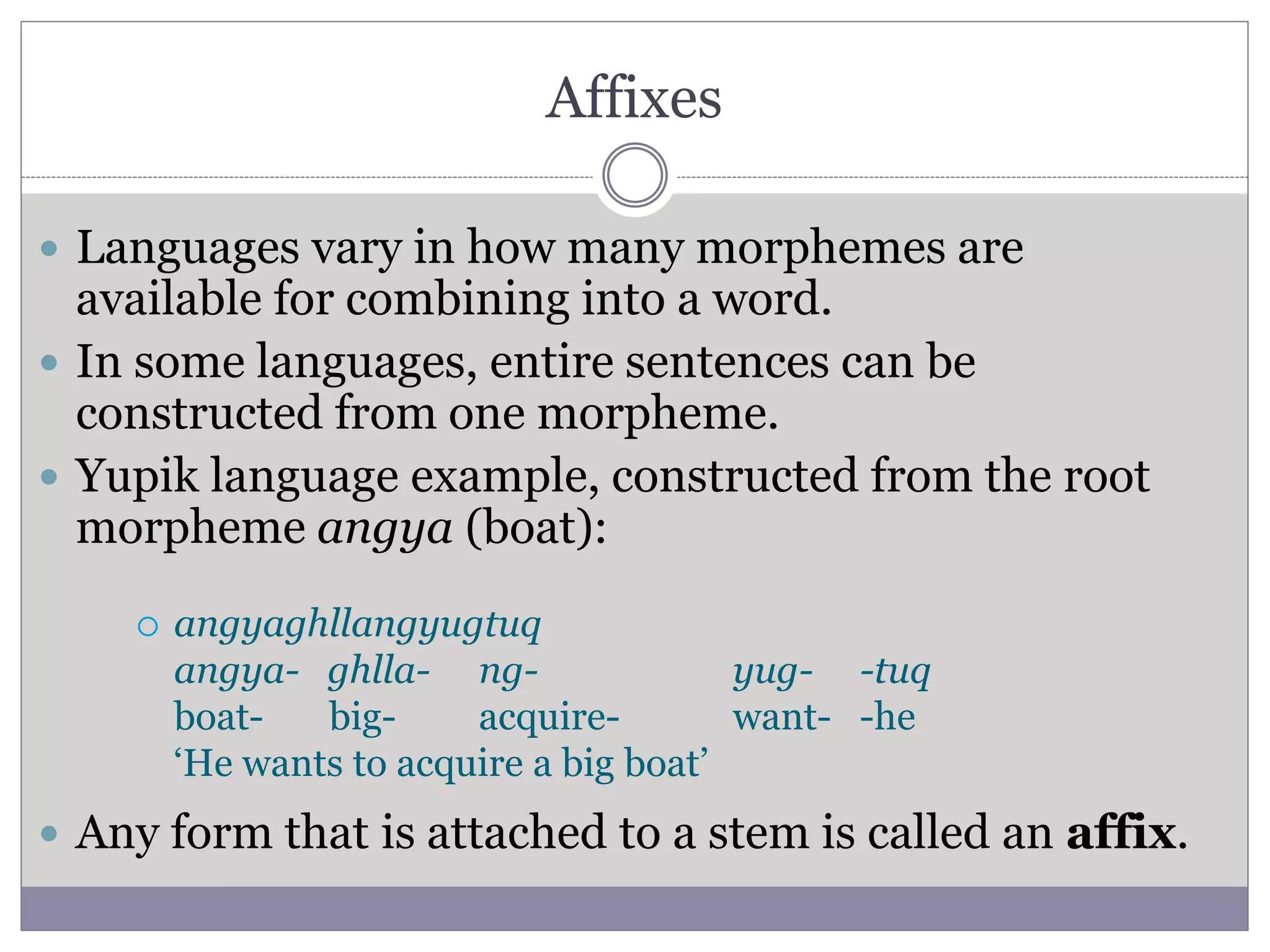
 Yupik language example, constructed from the root
morpheme angya (boat):
 angyaghllangyugtuq
angya- ghlla- ng- yug- -tuq
boat- big- acquire- want- -he
‘He wants to acquire a big boat’
 Any form that is attached to a stem is called an affix.
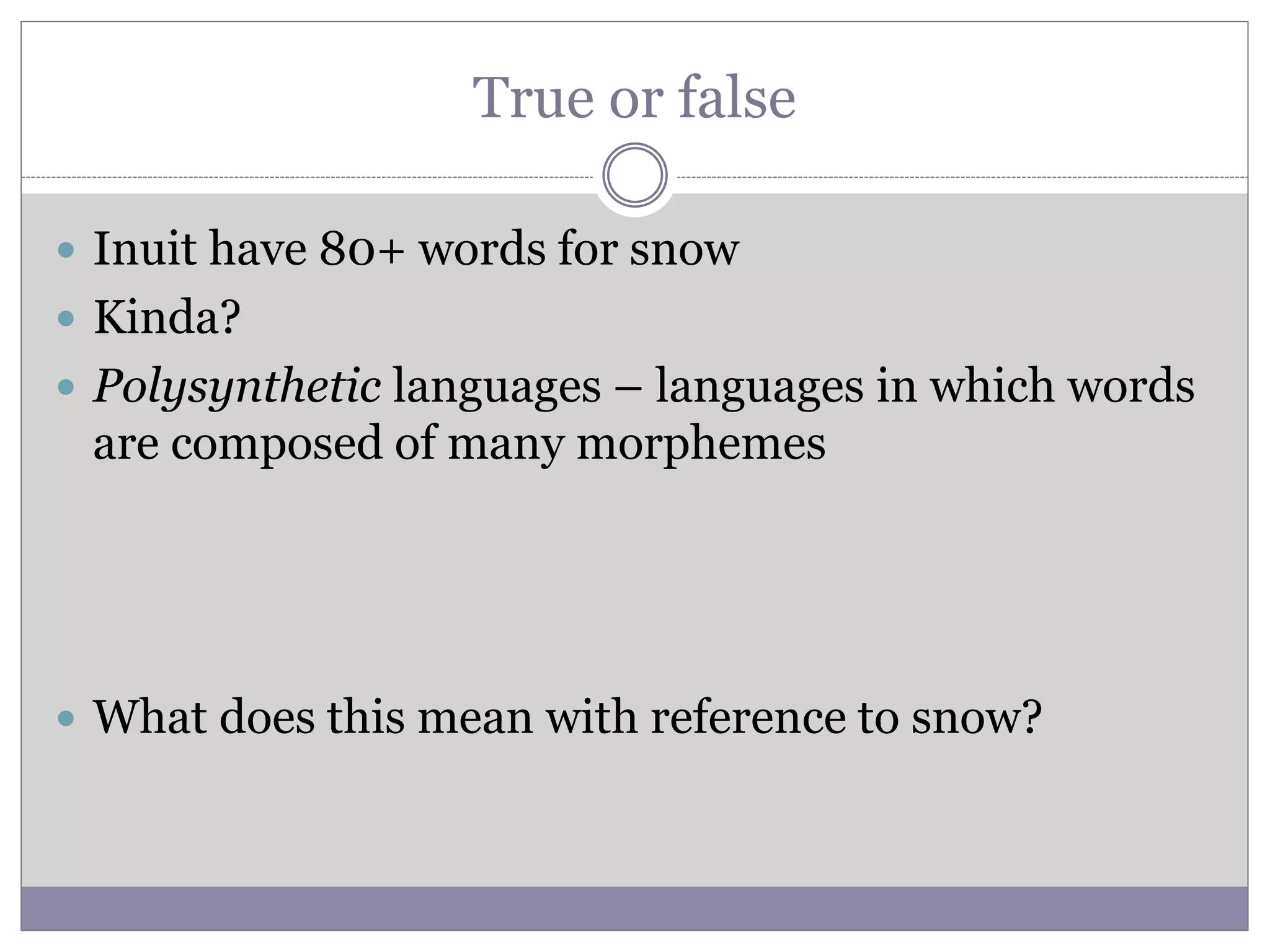
True or false
 Inuit have 80+ words for snow
 Kinda?
 Polysynthetic languages – languages in which words
are composed of many morphemes
 What does this mean with reference to snow?
Types of affixes
 The types of affixes are prefixes, suffixes,
circumfixes, and infixes.
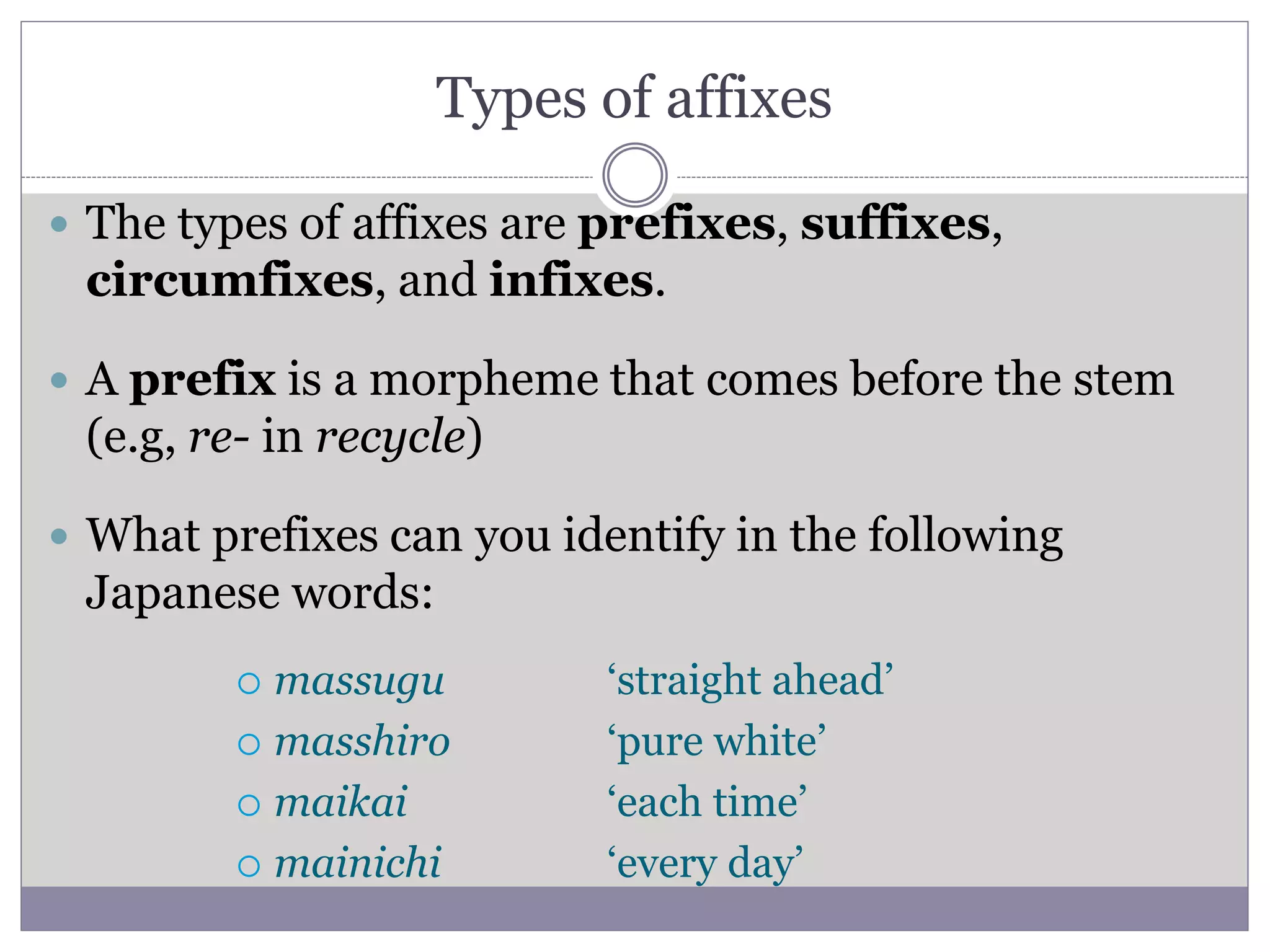
 A prefix is a morpheme that comes before the stem
(e.g, re- in recycle)
 What prefixes can you identify in the following
Japanese words:
 massugu
 masshiro
 maikai
 mainichi
‘straight ahead’
‘pure white’
‘each time’
‘every day’
Explain suffixes, circumfixes, infixes
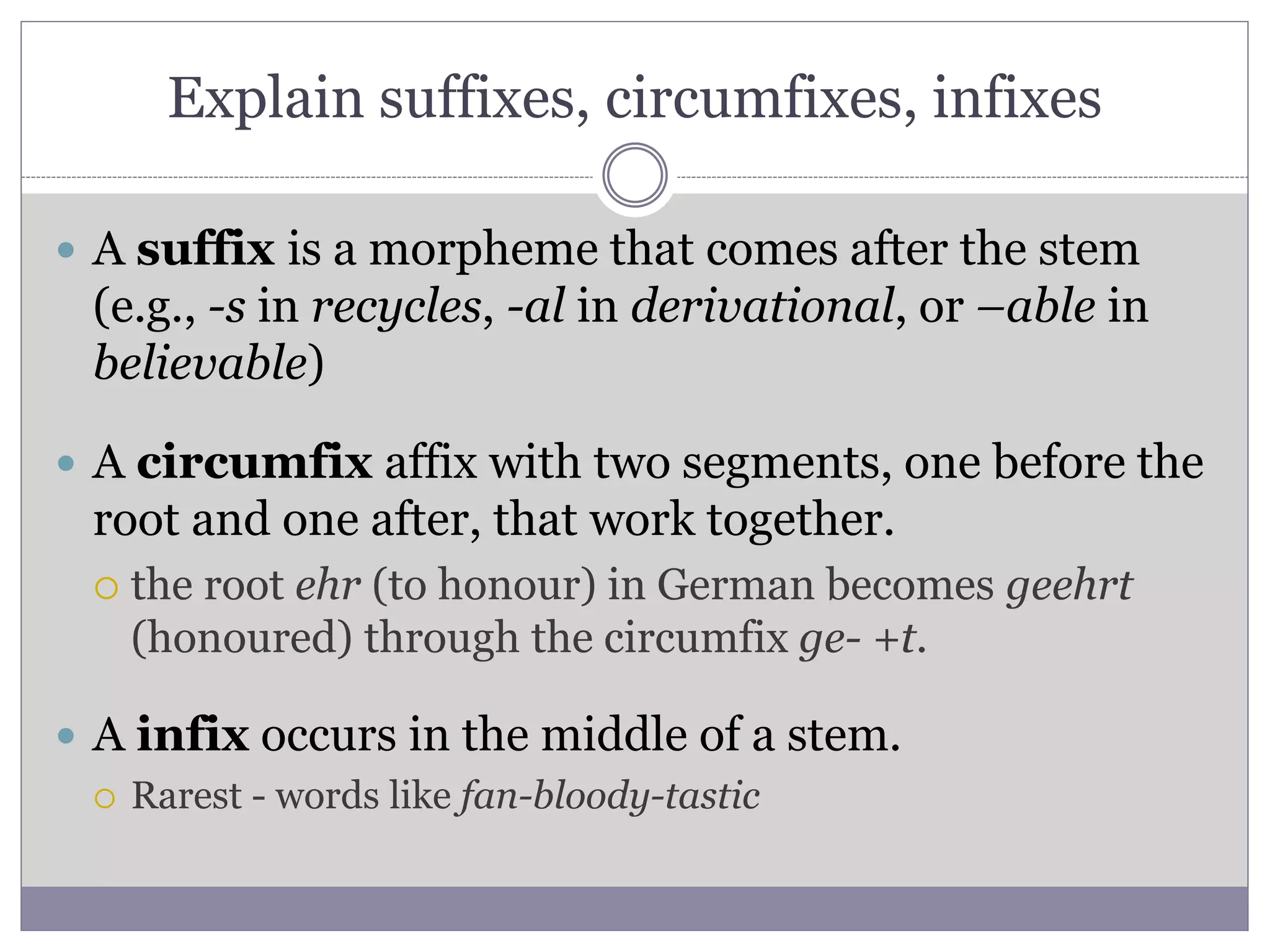
 A suffix is a morpheme that comes after the stem
(e.g., -s in recycles, -al in derivational, or –able in
believable)
 A circumfix affix with two segments, one before the
root and one after, that work together.
 the root ehr (to honour) in German becomes geehrt
(honoured) through the circumfix ge- +t.
 A infix occurs in the middle of a stem.
 Rarest - words like fan-bloody-tastic
Circumflexes in German
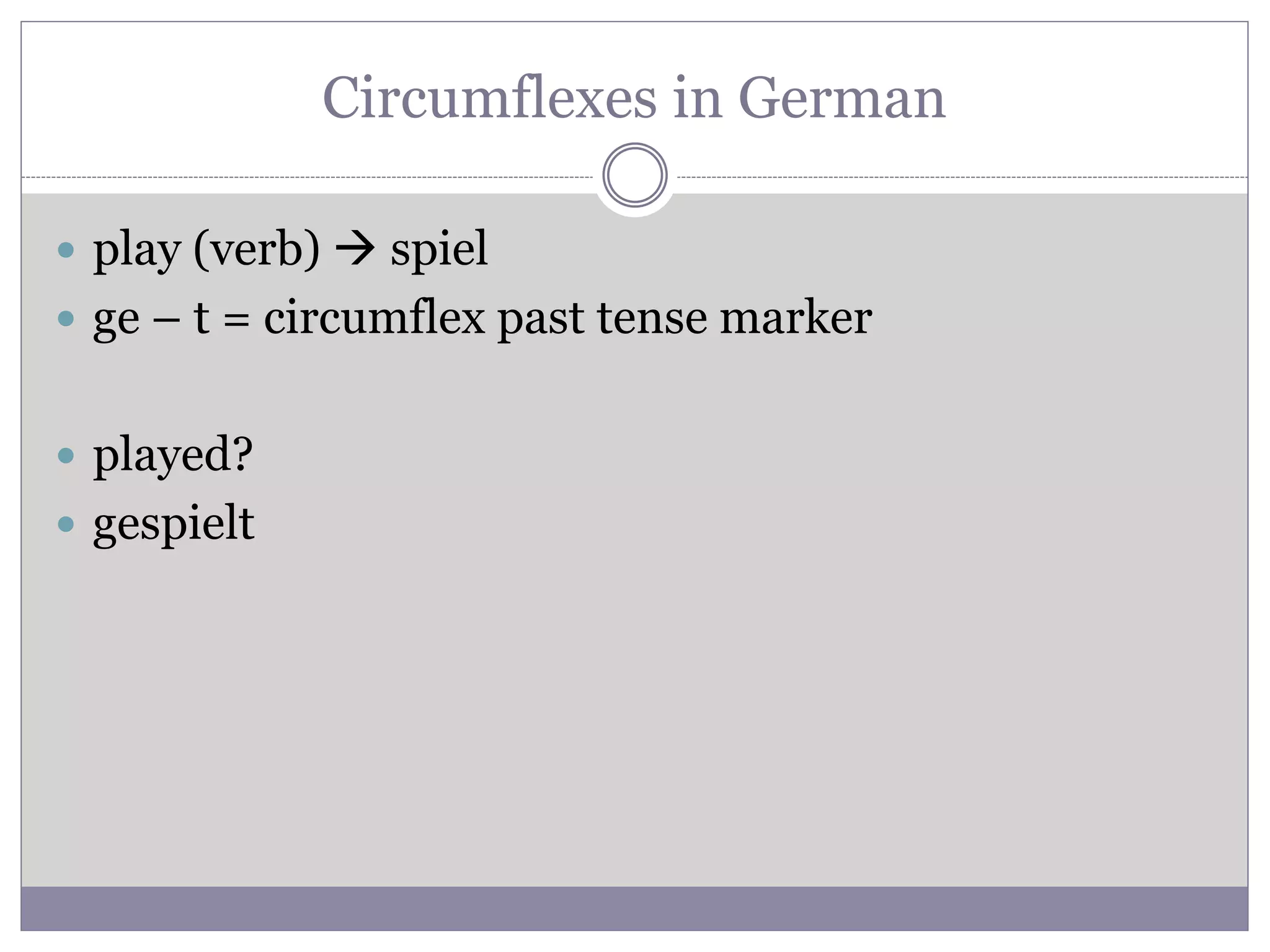
 play (verb)  spiel
 ge – t = circumflex past tense marker
 played?
 gespielt
 Identify four prefixes and suffixes in your LS. What
do they mean/refer to?
Free morphemes and bound morphemes
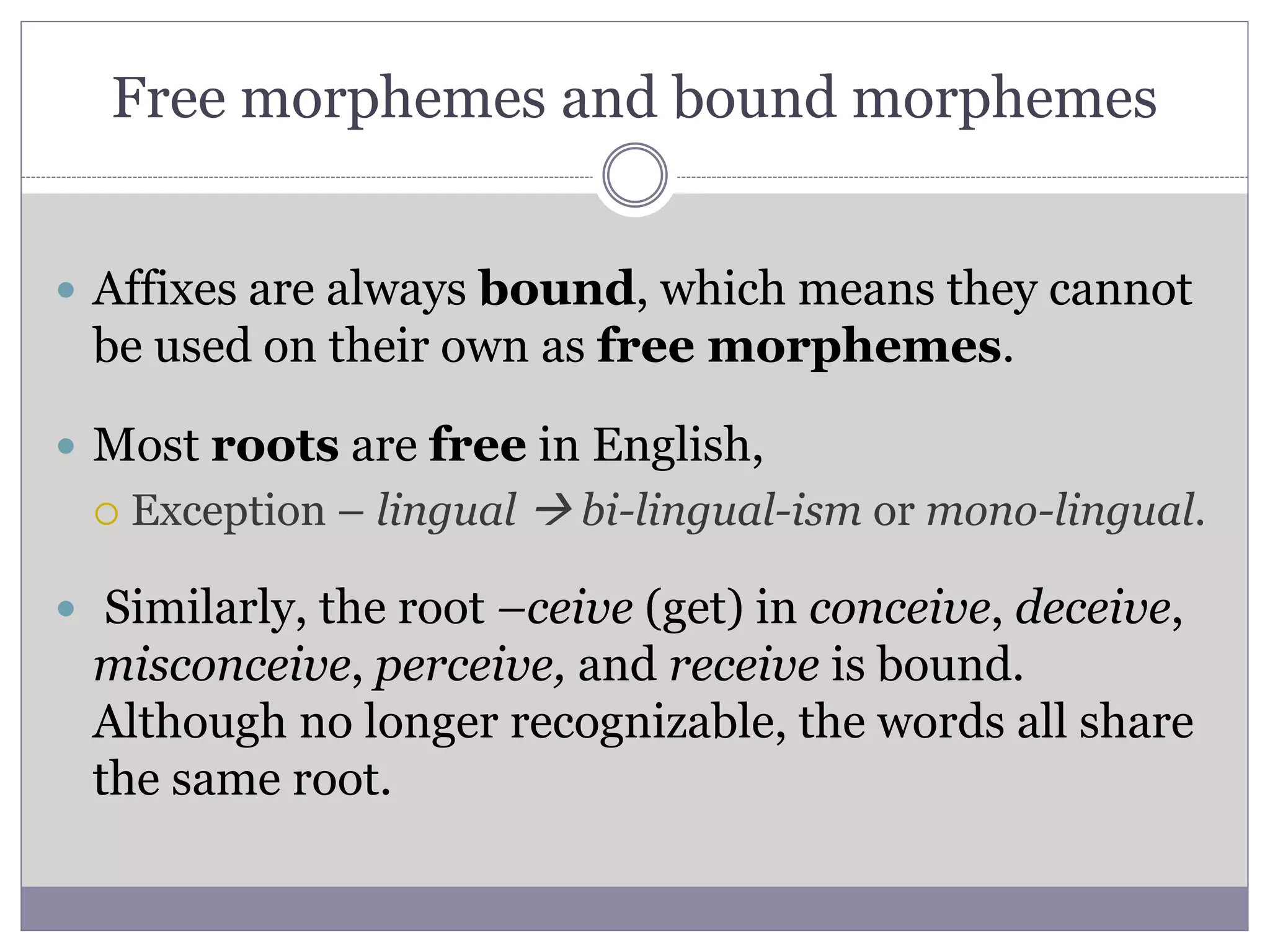
 Affixes are always bound, which means they cannot
be used on their own as free morphemes.
 Most roots are free in English,
 Exception – lingual  bi-lingual-ism or mono-lingual.
 Similarly, the root –ceive (get) in conceive, deceive,
misconceive, perceive, and receive is bound.
Although no longer recognizable, the words all share
the same root.
 What are clitics?
Clitics
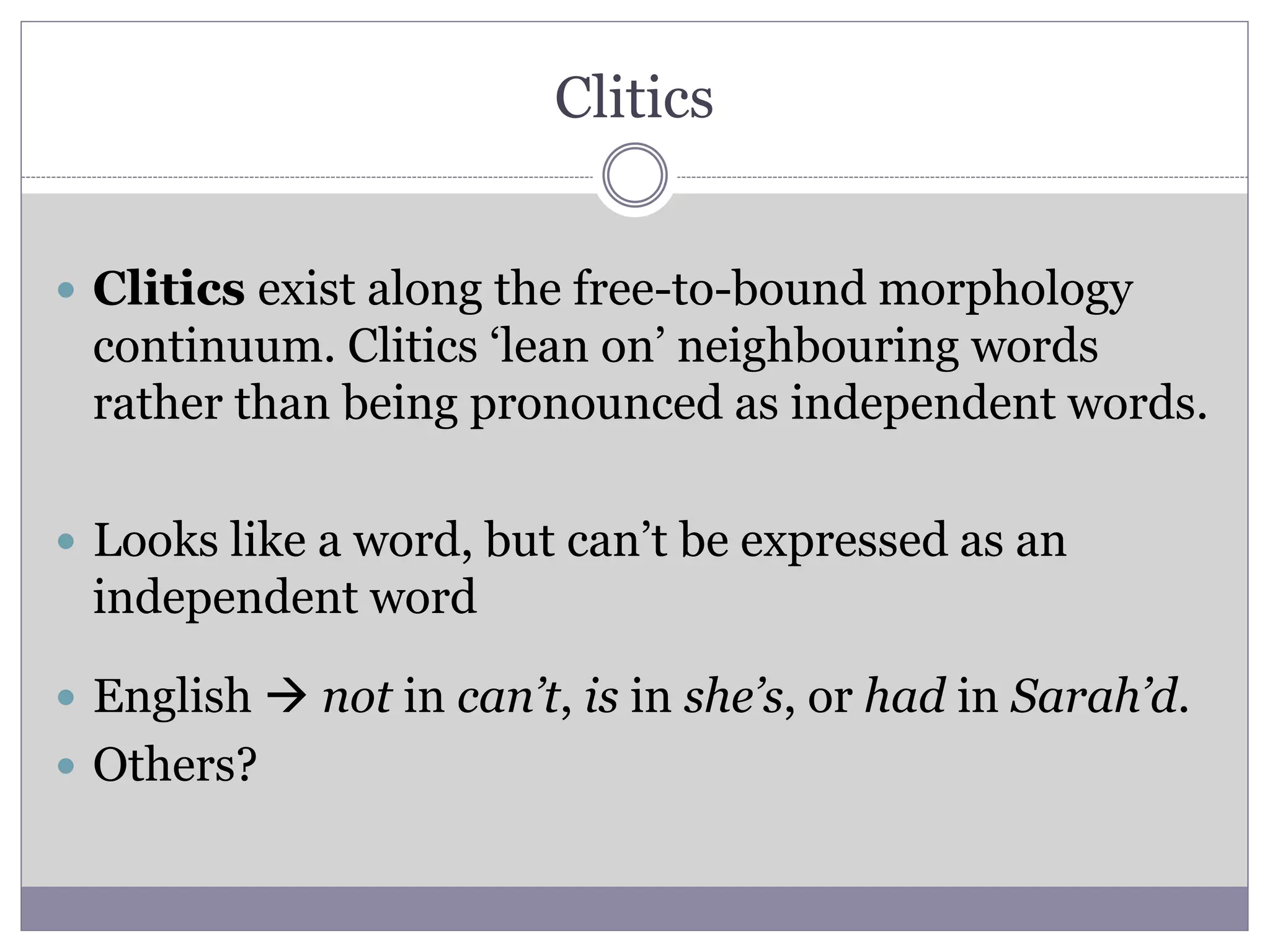
 Clitics exist along the free-to-bound morphology
continuum. Clitics ‘lean on’ neighbouring words
rather than being pronounced as independent words.
 Looks like a word, but can’t be expressed as an
independent word
 English  not in can’t, is in she’s, or had in Sarah’d.
 Others?
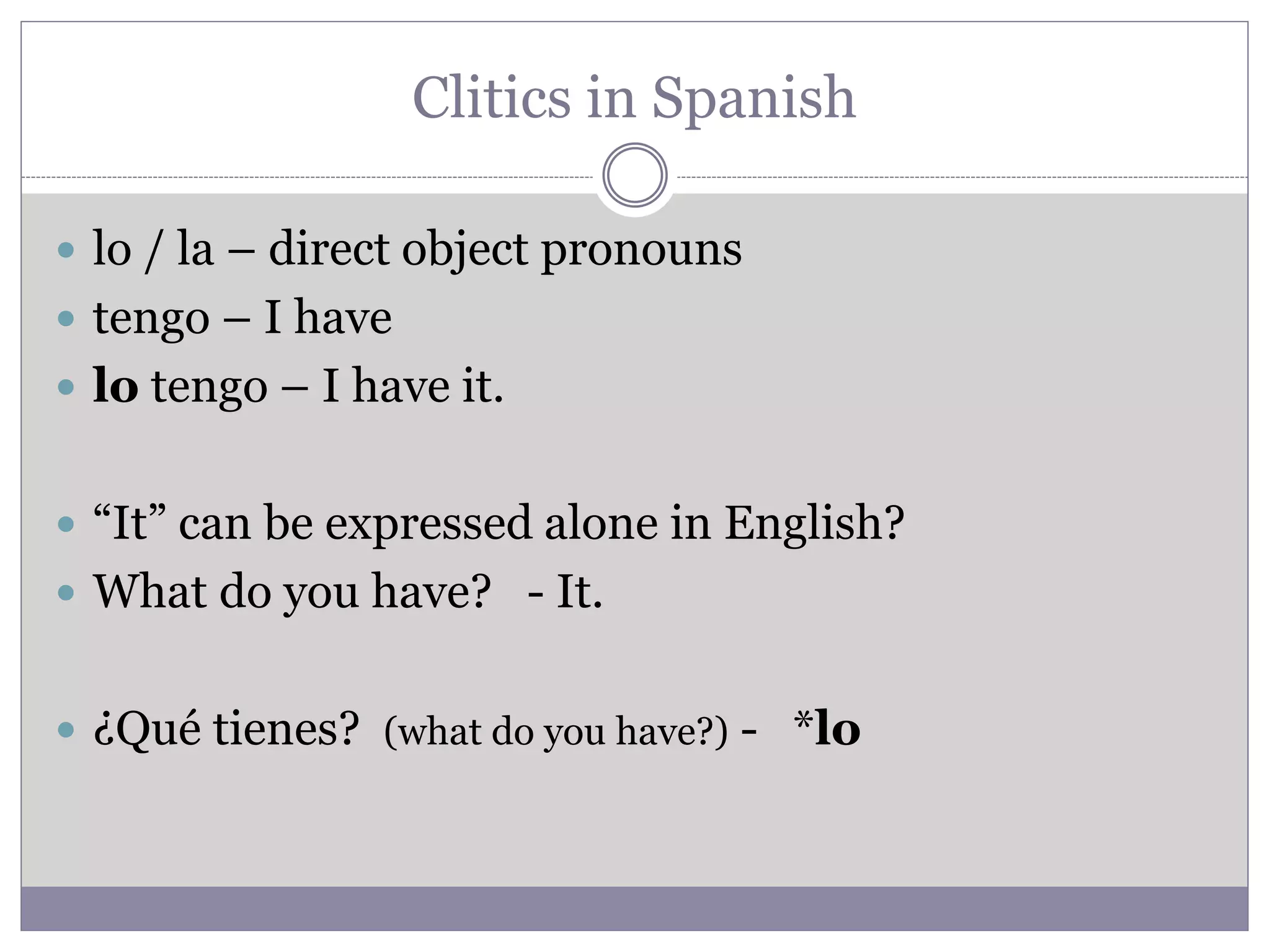
Clitics in Spanish
 lo / la – direct object pronouns
 tengo – I have
 lo tengo – I have it.
 “It” can be expressed alone in English?
 What do you have? - It.
 ¿Qué tienes? (what do you have?) - *lo
T H E F U N C T I O N S O F A F F I X E S
Inflection and derivation
Inflectional morphology
 Explain the terms inflectional morphology and
derivational morphology.
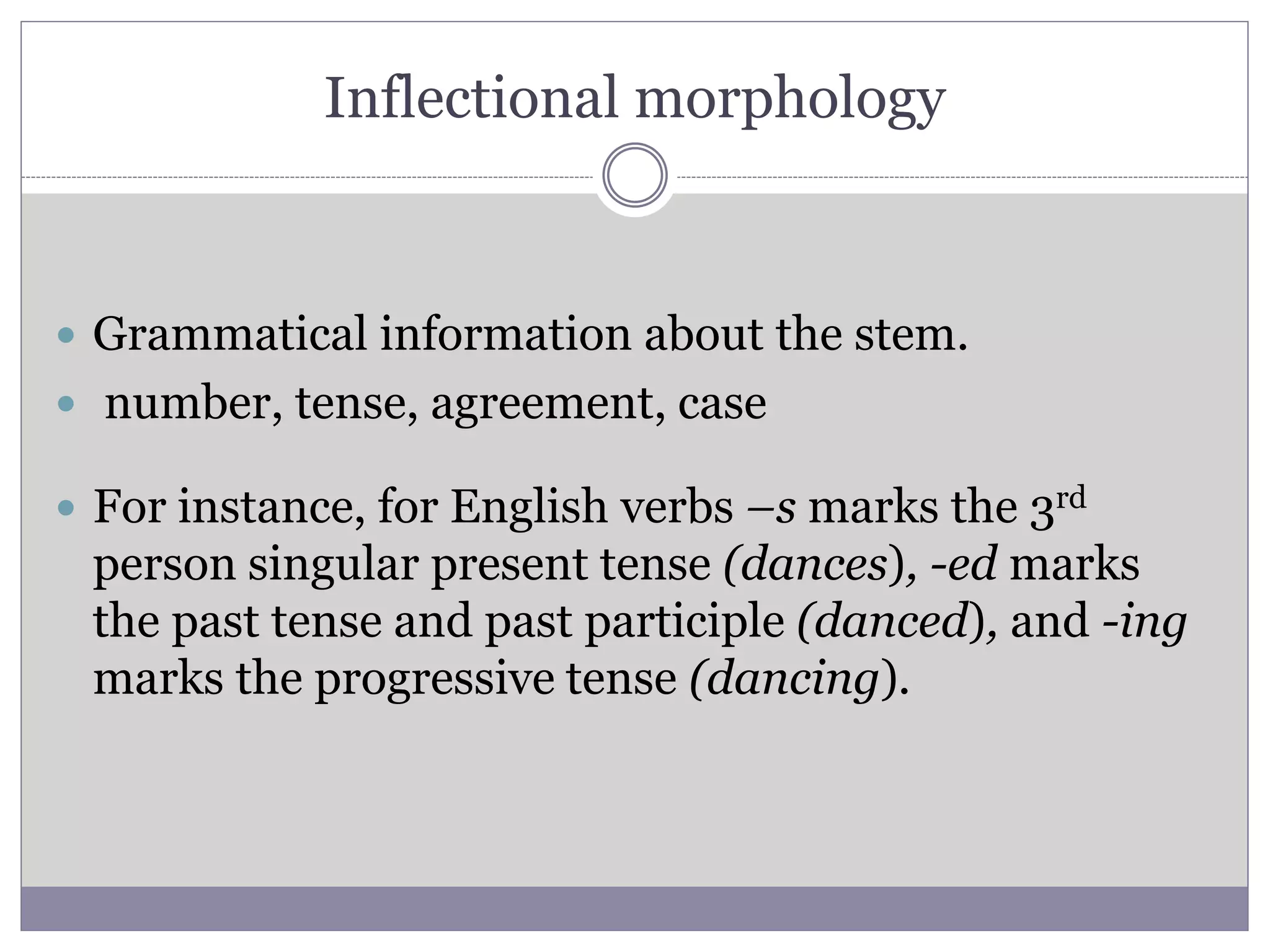
Inflectional morphology
 Grammatical information about the stem.
 number, tense, agreement, case
 For instance, for English verbs –s marks the 3rd
person singular present tense (dances), -ed marks
the past tense and past participle (danced), and -ing
marks the progressive tense (dancing).
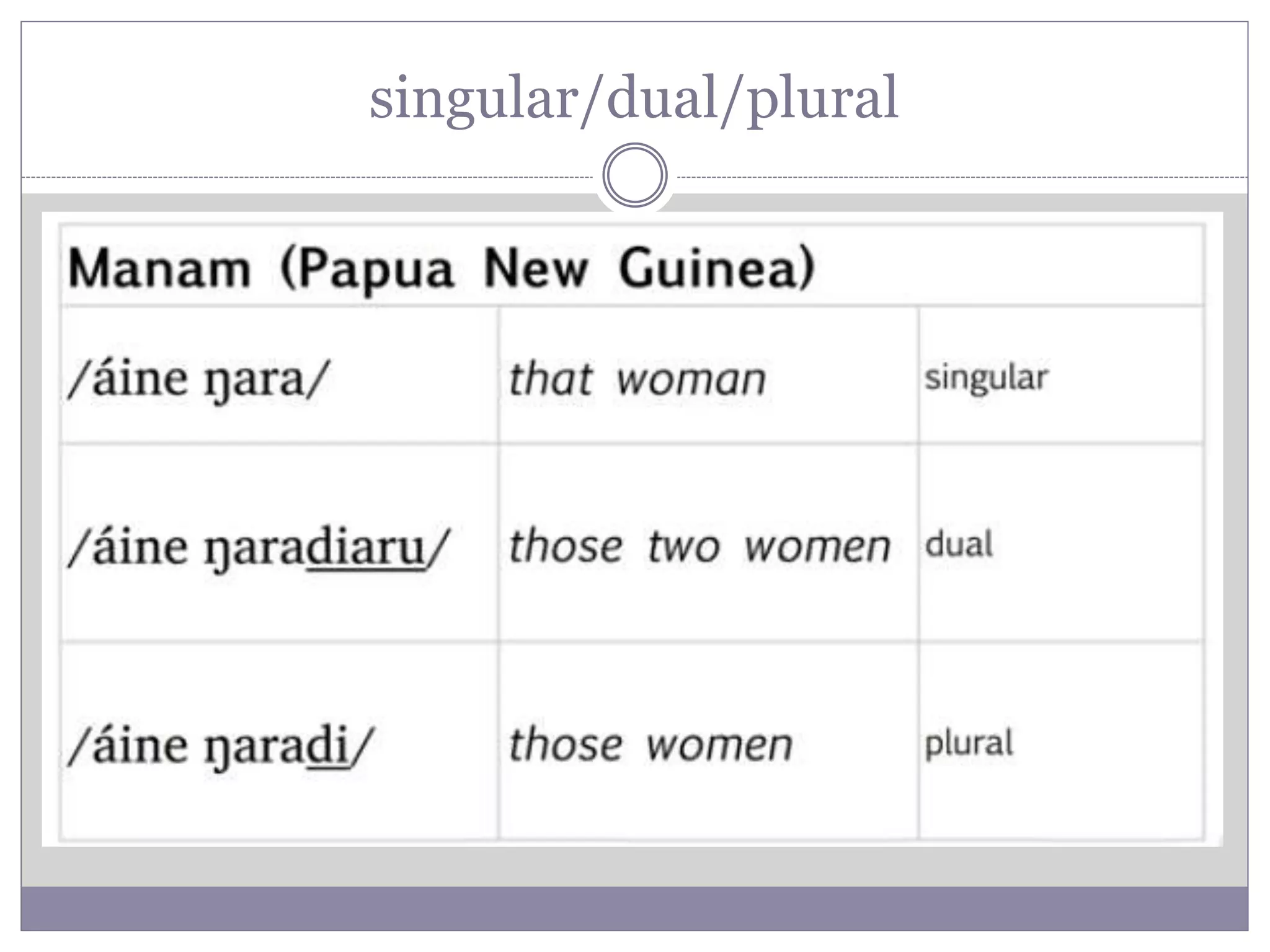
singular/dual/plural
Paradigms
 In languages that use a large amount of inflectional
morphology, there are large sets of inflected forms
for each word. These are known as paradigms.
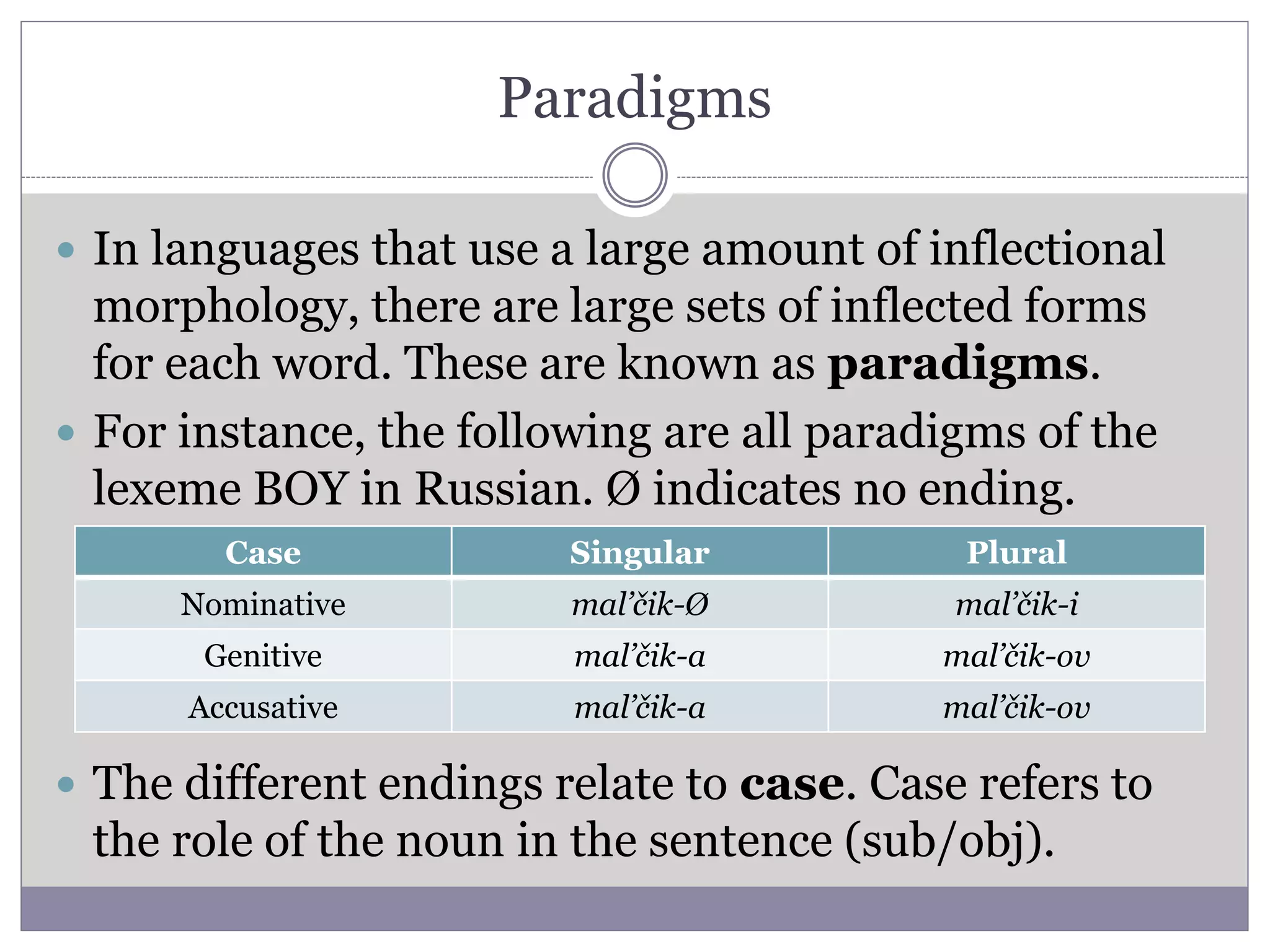
 For instance, the following are all paradigms of the
lexeme BOY in Russian. Ø indicates no ending.
 The different endings relate to case. Case refers to
the role of the noun in the sentence (sub/obj).
Case Singular Plural
Nominative mal’čik-Ø mal’čik-i
Genitive mal’čik-a mal’čik-ov
Accusative mal’čik-a mal’čik-ov
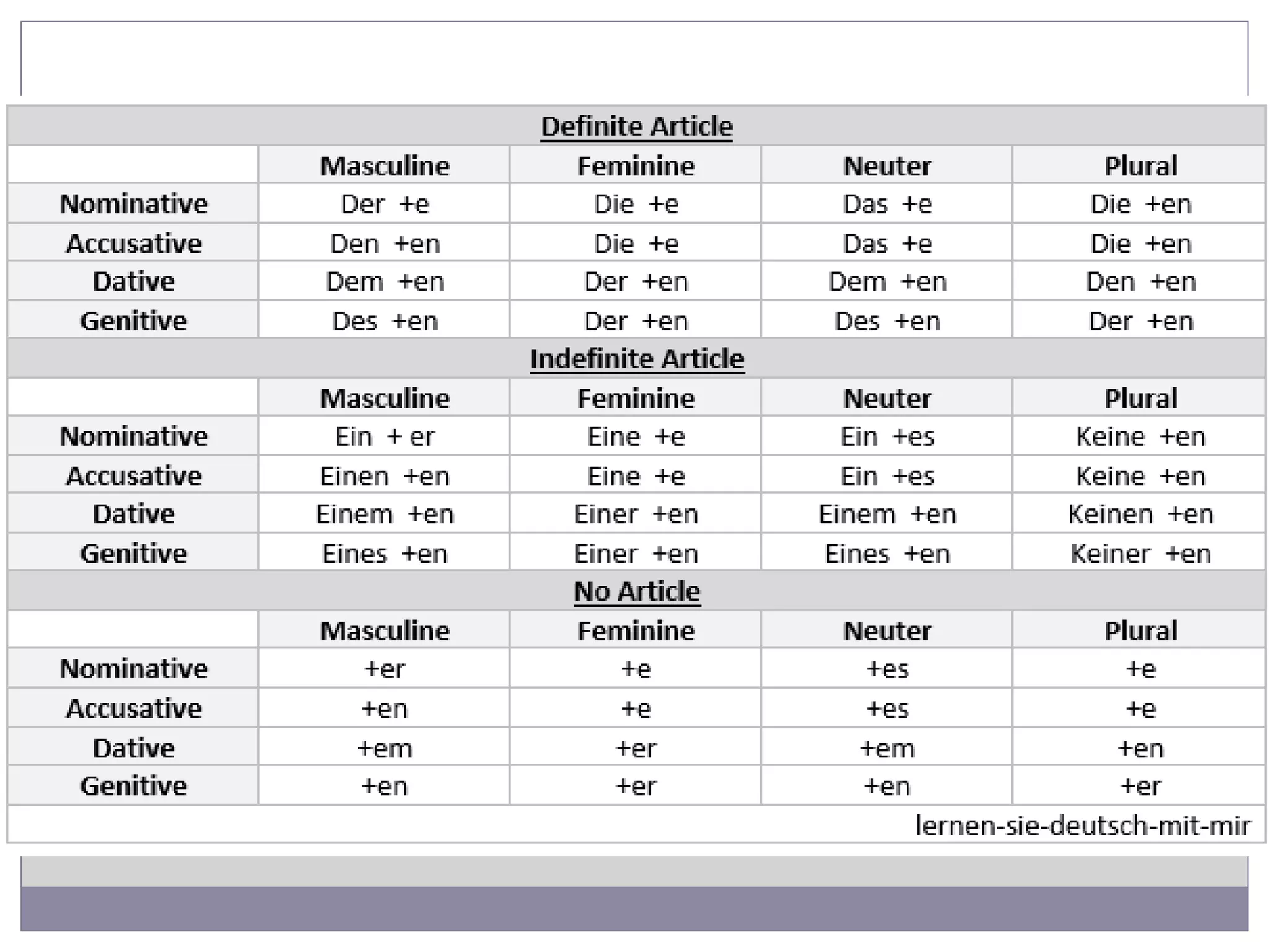
Gender
 While genitive and accusative are the same for BOY,
they change in Russian depending on the gender of
the word. Compare BOY with ORANGE.
Case Singular Plural
Nominative mal’čik-Ø mal’čik-i
Genitive mal’čik-a mal’čik-ov
Accusative mal’čik-a mal’čik-ov
Case Singular Plural
Nominative apel‘sin-Ø apel‘sin-y
Genitive apel‘sin-a apel‘sin-ov
Accusative apel‘sin-Ø apel‘sin-y
Gender (continued)
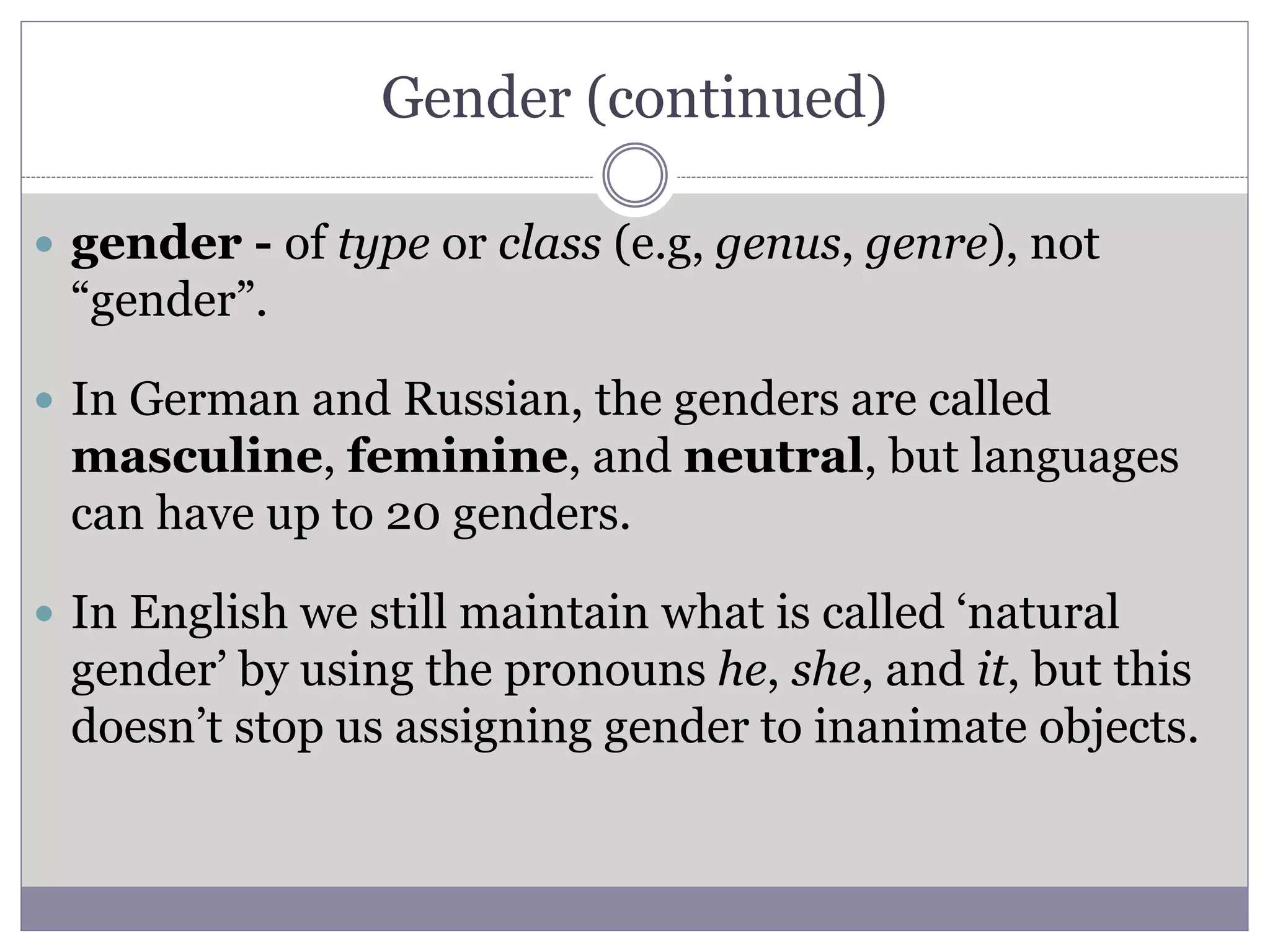
 gender - of type or class (e.g, genus, genre), not
“gender”.
 In German and Russian, the genders are called
masculine, feminine, and neutral, but languages
can have up to 20 genders.
 In English we still maintain what is called ‘natural
gender’ by using the pronouns he, she, and it, but this
doesn’t stop us assigning gender to inanimate objects.
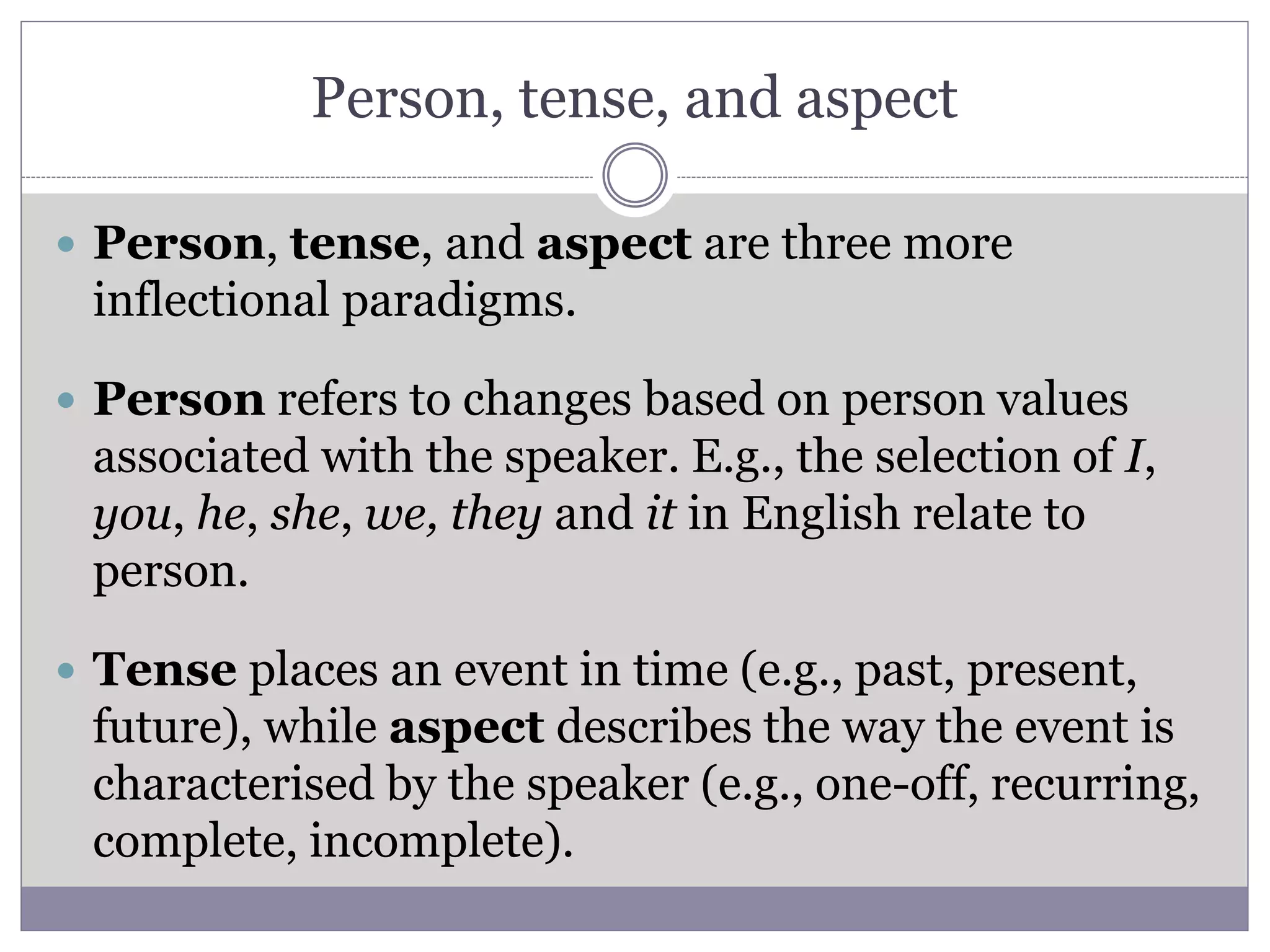
Person, tense, and aspect
 Person, tense, and aspect are three more
inflectional paradigms.
 Person refers to changes based on person values
associated with the speaker. E.g., the selection of I,
you, he, she, we, they and it in English relate to
person.
 Tense places an event in time (e.g., past, present,
future), while aspect describes the way the event is
characterised by the speaker (e.g., one-off, recurring,
complete, incomplete).
 How is plurality expressed in your LS? What are the
morphemes that indicate plurality?
 How about gender?
 How do verbs work in your LS?
 Explain a verb paradigm using morphology.
 What are the morphemes that indicate
number/tense/aspect/mood?
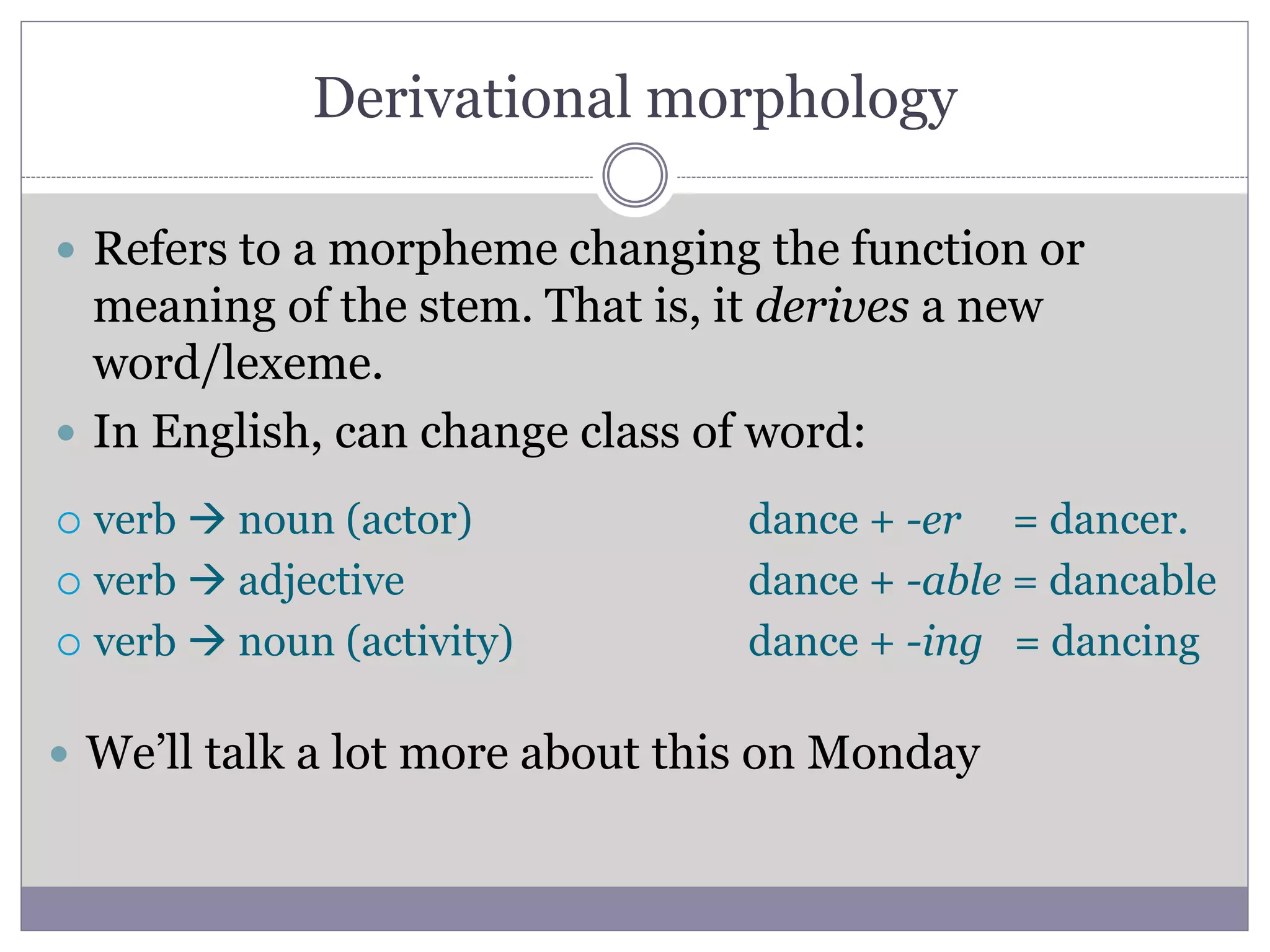
Derivational morphology
 Refers to a morpheme changing the function or
meaning of the stem. That is, it derives a new
word/lexeme.
 In English, can change class of word:
 verb  noun (actor)
 verb  adjective
 verb  noun (activity)
dance + -er = dancer.
dance + -able = dancable
dance + -ing = dancing
 We’ll talk a lot more about this on Monday
Inflexional vs derivational morphology
 Which one indicates singular vs. plural?
 Which one can change the class of the word,
ex. verb  adjective
 Which is more predictable?
 Explain why with examples.
 Which is unpredictable?
P H Y S I C A L F O R M S O F M O R P H E M E S
Morphs and Allomorphs
Morphs and allomorphs
 The actual speech sounds that meanings are attached
to are called morphs.
 Remember signs? a morph is the form of a sign that
denotes a particular meaning.
 Allomorphs are simply variants or alternative
pronunciations (phonetic forms) of morphemes.
Allomorphs
 Cat is the only allomorph of ‘feline quadruped’ in
English, but the indefinite article has two
allomorphs: a and an.
 Allomorphs typically appear because of a
conditioning factor: something in their environment.
 Complementary distribution of allomorphs:
 When do we use a vs an?

Conditioned allomorphs
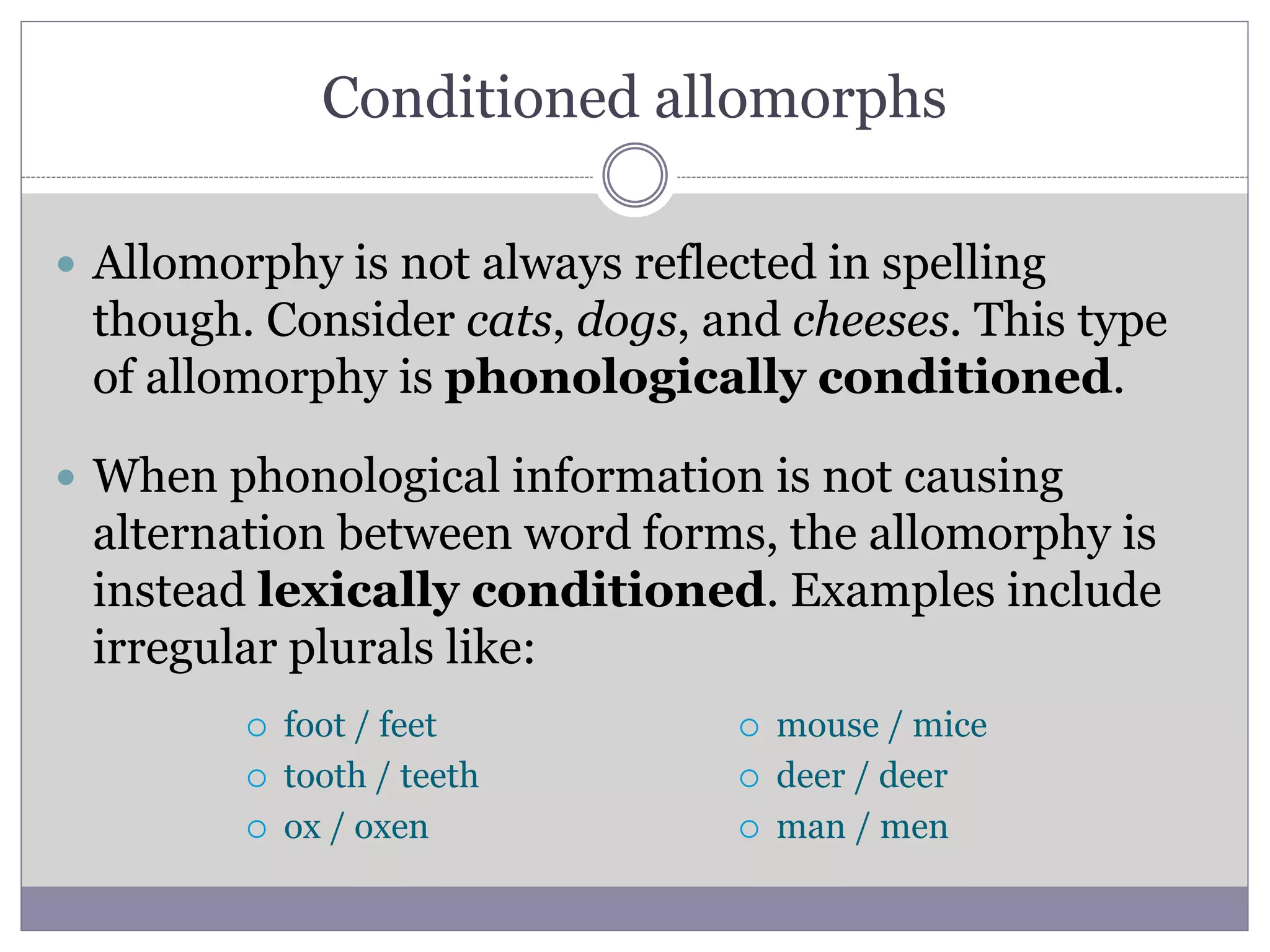
 Allomorphy is not always reflected in spelling
though. Consider cats, dogs, and cheeses. This type
of allomorphy is phonologically conditioned.
 When phonological information is not causing
alternation between word forms, the allomorphy is
instead lexically conditioned. Examples include
irregular plurals like:
 foot / feet
 tooth / teeth
 ox / oxen
 mouse / mice
 deer / deer
 man / men
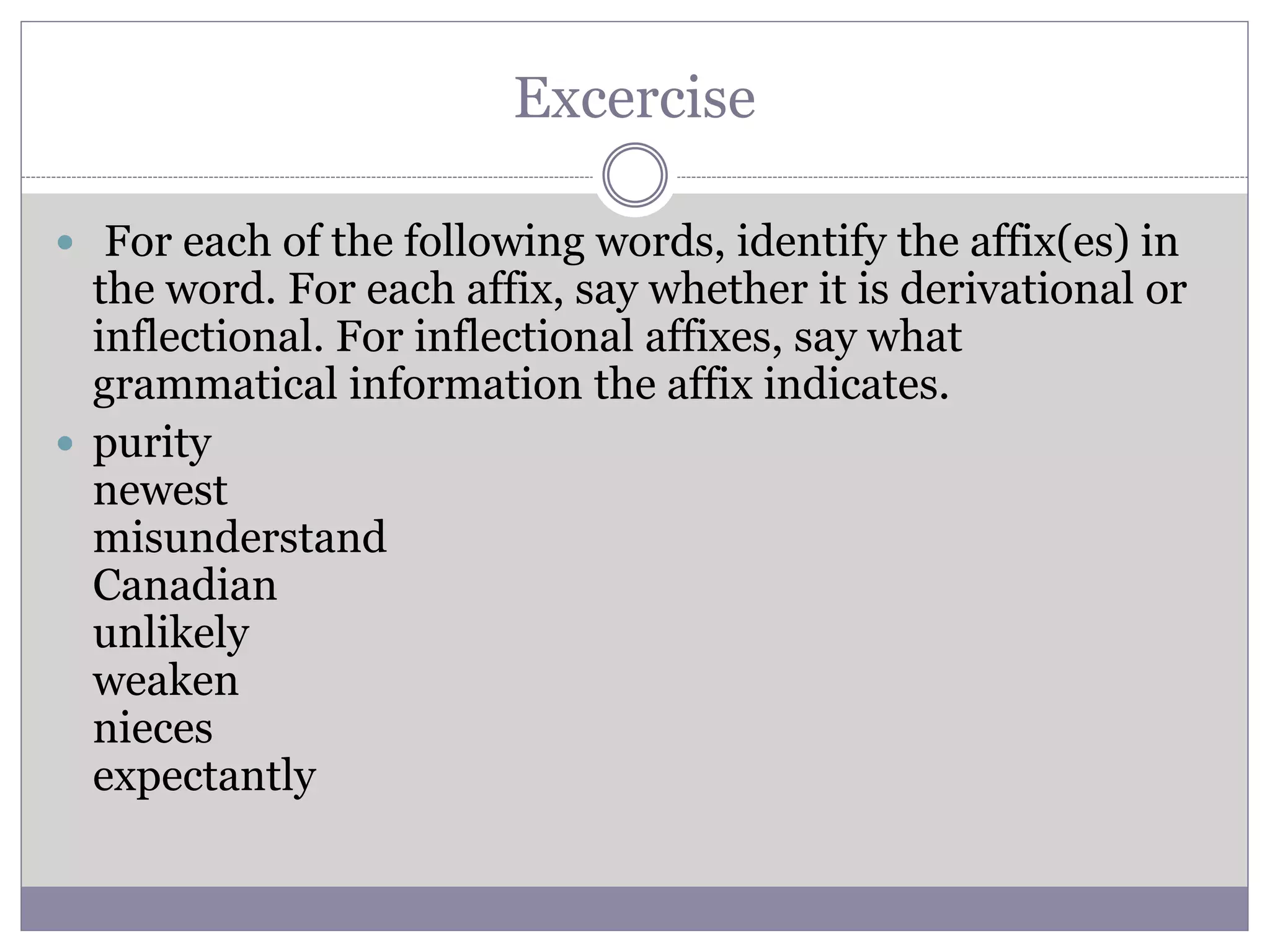
Excercise
 For each of the following words, identify the affix(es) in
the word. For each affix, say whether it is derivational or
inflectional. For inflectional affixes, say what
grammatical information the affix indicates.
 purity
newest
misunderstand
Canadian
unlikely
weaken
nieces
expectantly
Exercise
 The regular English plural morpheme has several
allomorphs, including two different spellings (-s and
-es) and three different pronunciations [s, z, ɨz]. Say
the following words aloud to yourself and determine
which allomorph appears on each word. The form of
the allomorph depends on the final sound in the
base. What is the natural class of sounds that
predicts the appearance of each allomorph?
 books chips buses fans tomatoes wishes cuffs farms
cars judges shirts rainbows quizzes myths gloves flies
grapes caves peas toys clocks beaches dances

Chapter 5.1.pptx

  • 1.
    T H ES T R U C T U R E O F W O R D S 5.1 Morphology
  • 2.
    W O RD S , L E X E M E S , A N D M O R P H E M E S Introduction
  • 3.
    Breaking down words What is a morpheme?  A morpheme is the smallest unit of meaning in the structure of a language.  Examples of morphemes?
  • 4.
     Japanese Findthe morphemes that mean eat, give, see, past tense, and non-pasttense.  taberu eats  tabeta ate  ageru gives  ageta gave  miru see  mita saw
  • 5.
    Identifying morphemes  Whatmorphemes can you identify in the following words?  beautiful  awful  handful  resourceful  cardigan  dutiful  remorseful  handy  awfully  cranberry  awfulness  hippopotamus  remorsefulness  resourcefulness  uneventfulness
  • 6.
    Words vs. lexemes What is a lexeme?  A lexeme - word in all it’s different forms.  cat and cats  laugh, laughing, laughed…  Lexemes are often written in small capital letters, with the word in its simplest form: CAT, LAUGH.  What appear in dictionaries are therefore lexemes.
  • 7.
  • 8.
    Roots  Compare andcontrast the terms root and stem.
  • 9.
    Roots  All theparts of words are known as morphemes, but they come in different types.  Roots and Affixes are the two basic types.  A root is the foundation of a complex word.  Try to list nine forms of the root “true”  truer  truest  truly  untrue  truth  truthful  truthfully  untruthfully  untruthfulness
  • 10.
    Stems  In largewords, roots are built up into more complex forms in stages. The intermediate stages are called stems.  In words with two morphemes, the root and the stem are identical.  true  root/stem of truer, truest, truth  truth  stem of truthful
  • 11.
    Your turn  Comeup with 3 root words, add a prefix or suffix for each one to make the new stem of another word.  Example:  Cycle (root)  recycle  recycle (stem)  recycling
  • 12.
    Affixes  Languages varyin how many morphemes are available for combining into a word.  In some languages, entire sentences can be constructed from one morpheme.  Yupik language example, constructed from the root morpheme angya (boat):  angyaghllangyugtuq angya- ghlla- ng- yug- -tuq boat- big- acquire- want- -he ‘He wants to acquire a big boat’  Any form that is attached to a stem is called an affix.
  • 13.
    True or false Inuit have 80+ words for snow  Kinda?  Polysynthetic languages – languages in which words are composed of many morphemes  What does this mean with reference to snow?
  • 14.
    Types of affixes The types of affixes are prefixes, suffixes, circumfixes, and infixes.  A prefix is a morpheme that comes before the stem (e.g, re- in recycle)  What prefixes can you identify in the following Japanese words:  massugu  masshiro  maikai  mainichi ‘straight ahead’ ‘pure white’ ‘each time’ ‘every day’
  • 15.
    Explain suffixes, circumfixes,infixes  A suffix is a morpheme that comes after the stem (e.g., -s in recycles, -al in derivational, or –able in believable)  A circumfix affix with two segments, one before the root and one after, that work together.  the root ehr (to honour) in German becomes geehrt (honoured) through the circumfix ge- +t.  A infix occurs in the middle of a stem.  Rarest - words like fan-bloody-tastic
  • 16.
    Circumflexes in German play (verb)  spiel  ge – t = circumflex past tense marker  played?  gespielt
  • 17.
     Identify fourprefixes and suffixes in your LS. What do they mean/refer to?
  • 18.
    Free morphemes andbound morphemes  Affixes are always bound, which means they cannot be used on their own as free morphemes.  Most roots are free in English,  Exception – lingual  bi-lingual-ism or mono-lingual.  Similarly, the root –ceive (get) in conceive, deceive, misconceive, perceive, and receive is bound. Although no longer recognizable, the words all share the same root.
  • 19.
     What areclitics?
  • 20.
    Clitics  Clitics existalong the free-to-bound morphology continuum. Clitics ‘lean on’ neighbouring words rather than being pronounced as independent words.  Looks like a word, but can’t be expressed as an independent word  English  not in can’t, is in she’s, or had in Sarah’d.  Others?
  • 21.
    Clitics in Spanish lo / la – direct object pronouns  tengo – I have  lo tengo – I have it.  “It” can be expressed alone in English?  What do you have? - It.  ¿Qué tienes? (what do you have?) - *lo
  • 22.
    T H EF U N C T I O N S O F A F F I X E S Inflection and derivation
  • 24.
    Inflectional morphology  Explainthe terms inflectional morphology and derivational morphology.
  • 25.
    Inflectional morphology  Grammaticalinformation about the stem.  number, tense, agreement, case  For instance, for English verbs –s marks the 3rd person singular present tense (dances), -ed marks the past tense and past participle (danced), and -ing marks the progressive tense (dancing).
  • 26.
  • 28.
    Paradigms  In languagesthat use a large amount of inflectional morphology, there are large sets of inflected forms for each word. These are known as paradigms.  For instance, the following are all paradigms of the lexeme BOY in Russian. Ø indicates no ending.  The different endings relate to case. Case refers to the role of the noun in the sentence (sub/obj). Case Singular Plural Nominative mal’čik-Ø mal’čik-i Genitive mal’čik-a mal’čik-ov Accusative mal’čik-a mal’čik-ov
  • 29.
    Gender  While genitiveand accusative are the same for BOY, they change in Russian depending on the gender of the word. Compare BOY with ORANGE. Case Singular Plural Nominative mal’čik-Ø mal’čik-i Genitive mal’čik-a mal’čik-ov Accusative mal’čik-a mal’čik-ov Case Singular Plural Nominative apel‘sin-Ø apel‘sin-y Genitive apel‘sin-a apel‘sin-ov Accusative apel‘sin-Ø apel‘sin-y
  • 30.
    Gender (continued)  gender- of type or class (e.g, genus, genre), not “gender”.  In German and Russian, the genders are called masculine, feminine, and neutral, but languages can have up to 20 genders.  In English we still maintain what is called ‘natural gender’ by using the pronouns he, she, and it, but this doesn’t stop us assigning gender to inanimate objects.
  • 31.
    Person, tense, andaspect  Person, tense, and aspect are three more inflectional paradigms.  Person refers to changes based on person values associated with the speaker. E.g., the selection of I, you, he, she, we, they and it in English relate to person.  Tense places an event in time (e.g., past, present, future), while aspect describes the way the event is characterised by the speaker (e.g., one-off, recurring, complete, incomplete).
  • 32.
     How isplurality expressed in your LS? What are the morphemes that indicate plurality?  How about gender?  How do verbs work in your LS?  Explain a verb paradigm using morphology.  What are the morphemes that indicate number/tense/aspect/mood?
  • 33.
    Derivational morphology  Refersto a morpheme changing the function or meaning of the stem. That is, it derives a new word/lexeme.  In English, can change class of word:  verb  noun (actor)  verb  adjective  verb  noun (activity) dance + -er = dancer. dance + -able = dancable dance + -ing = dancing  We’ll talk a lot more about this on Monday
  • 34.
    Inflexional vs derivationalmorphology  Which one indicates singular vs. plural?  Which one can change the class of the word, ex. verb  adjective  Which is more predictable?  Explain why with examples.  Which is unpredictable?
  • 35.
    P H YS I C A L F O R M S O F M O R P H E M E S Morphs and Allomorphs
  • 36.
    Morphs and allomorphs The actual speech sounds that meanings are attached to are called morphs.  Remember signs? a morph is the form of a sign that denotes a particular meaning.  Allomorphs are simply variants or alternative pronunciations (phonetic forms) of morphemes.
  • 37.
    Allomorphs  Cat isthe only allomorph of ‘feline quadruped’ in English, but the indefinite article has two allomorphs: a and an.  Allomorphs typically appear because of a conditioning factor: something in their environment.  Complementary distribution of allomorphs:  When do we use a vs an? 
  • 38.
    Conditioned allomorphs  Allomorphyis not always reflected in spelling though. Consider cats, dogs, and cheeses. This type of allomorphy is phonologically conditioned.  When phonological information is not causing alternation between word forms, the allomorphy is instead lexically conditioned. Examples include irregular plurals like:  foot / feet  tooth / teeth  ox / oxen  mouse / mice  deer / deer  man / men
  • 39.
    Excercise  For eachof the following words, identify the affix(es) in the word. For each affix, say whether it is derivational or inflectional. For inflectional affixes, say what grammatical information the affix indicates.  purity newest misunderstand Canadian unlikely weaken nieces expectantly
  • 40.
    Exercise  The regularEnglish plural morpheme has several allomorphs, including two different spellings (-s and -es) and three different pronunciations [s, z, ɨz]. Say the following words aloud to yourself and determine which allomorph appears on each word. The form of the allomorph depends on the final sound in the base. What is the natural class of sounds that predicts the appearance of each allomorph?  books chips buses fans tomatoes wishes cuffs farms cars judges shirts rainbows quizzes myths gloves flies grapes caves peas toys clocks beaches dances