Morphology 
AA wwoorrdd aanndd iittss ppaarrttss:: rroooottss,, 
aaffffiixxeess aanndd tthheeiirr sshhaappeess 
IIkkaa FFiittrrii 
IInnddrriiyyaassttuuttii 
TTaarr..112266000022
Taking Words Apart 
we will focus on these smaller parts of 
words, generally called Morphemes. The 
area of grammar concerned with the 
structure of words and with 
relationships between words involving the 
morpheme that compose them technically 
called morphology and morphemes can be 
thought of as the minimal units of 
morphology.
Kinds of morpheme: bound versus 
free 
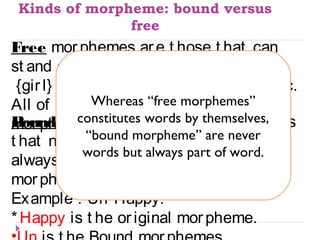
Free mor phemes ar e t hose t hat can 
st and alone as wor ds. For examples: 
{gir l} , {syst em} , {desir e} , {hope} et c. 
All of t hese Whereas mor phems “free morphemes” 
ar e f r ee 
mBoournpdh emmoer constitutes phemes words is aGr by amat themselves, 
ical unit s 
t hat never “bound occur morpheme” s by it self are , but never 
is 
always at t words ached but t o always some part ot her 
of word. 
mor pheme. 
Example : Un-Happy. 
*Happy is t he or iginal mor pheme. 
•Un is t he Bound mor phemes.
Bound Morphemes come into two 
varieties 
“Derivational’ and “Inf lectional” 
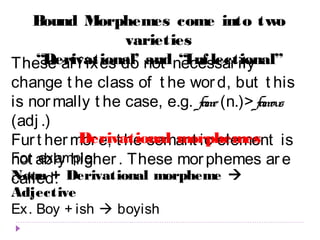
These af f ixes do not necessar ily 
change t he class of t he wor d, but t his 
is normally t he case, e.g. fame (n.)> famous 
(adj .) 
Fur t hermor Derivational e, t he semant morphemes 
ic element is 
not ably higher . These mor phemes ar e 
called: 
For example: 
Noun + Derivational morpheme  
Adjective 
Ex. Boy + ish  boyish
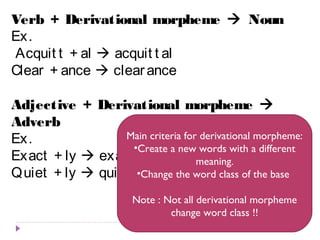
Verb + Derivational morpheme  Noun 
Ex. 
Acquit t + al  acquit t al 
Clear + ance  clear ance 
Adjective + Derivational morpheme  
Adverb 
Ex. 
Exact + ly  exact ly 
Quiet + ly  quiet ly 
Main criteria for derivational morpheme: 
•Create a new words with a different 
meaning. 
•Change the word class of the base 
Note : Not all derivational morpheme 
change word class !!
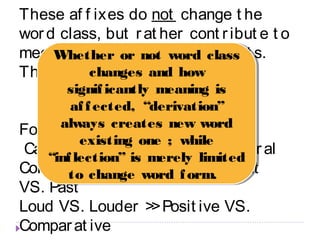
These af f ixes do not change t he 
wor d class, but r at her cont r ibut e t o 
meet Whether Whether ing gr ammat or or not not ical word word const class 
class 
r aint s. 
These ar e changes changes called: 
and and how 
how 
signif icantly meaning is 
af f ected, “derivation” 
always creates new word 
signif icantly meaning is 
af f ected, “derivation” 
always creates new word 
Inf lectional morphemes 
For examples: 
Cat VS. existing existing Cat s >> one Singular one ; ; while 
while 
VS. Plur al 
Collect ““inf inf s lection” lection” VS. Collect is is merely merely limited 
limited 
to to change change word word ed form. 
form. 
>> Pr esent 
VS. Past 
Loud VS. Louder >> Posit ive VS. 
Compar at ive
Kinds of morpheme: root, affix, 
combining form 
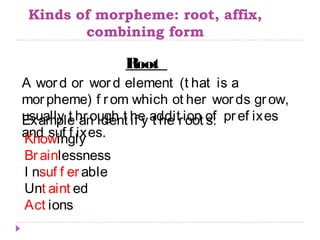
Root 
A wor d or wor d element (t hat is a 
mor pheme) f r om which ot her wor ds gr ow, 
usually t hr ough t he addit ion of pr ef ixes 
and suf f ixes. 
Example an ident if y t he r oot s: 
Knowingly 
Br ainlessness 
I nsuf f er able 
Unt aint ed 
Act ions
Af f ix 
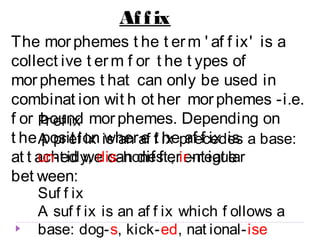
The mor phemes t he t erm ' af f ix' is a 
collect ive t erm f or t he t ypes of 
mor phemes t hat can only be used in 
combinat ion wit h ot her mor phemes -i.e. 
f or bound mor phemes. Depending on 
t he posit ion wher e t he af f ix is 
at t ached we can dif f er ent iat e 
bet ween: 
Pr ef ix 
A pr ef ix is an af f ix pr ecedes a base: 
un-t idy, dis-honest , ir -r egular 
Suf f ix 
A suf f ix is an af f ix which f ollows a 
base: dog-s, kick-ed, nat ional-ise
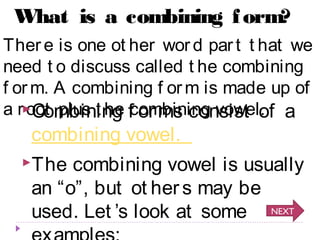
What is a combining form? 
Ther e is one ot her wor d par t t hat we 
need t o discuss called t he combining 
f orm. A combining f orm is made up of 
a r oot plus t Combininhge fcoomrmbisn icnogn vsoiwste lo. f a 
combining vowel. 
The combining vowel is usually 
an “o”, but ot her s may be 
used. Let ’s look at some 
NEXT 
examples:
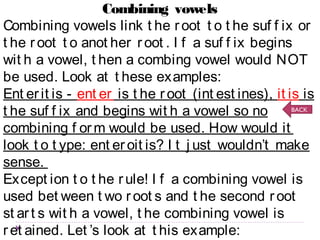
Combining vowels 
Combining vowels link t he r oot t o t he suf f ix or 
t he r oot t o anot her r oot . I f a suf f ix begins 
wit h a vowel, t hen a combing vowel would NOT 
be used. Look at t hese examples: 
Ent er it is - ent er is t he r oot (int est ines), it is is 
t he suf f ix and begins wit h a vowel so no 
BACK 
combining f orm would be used. How would it 
look t o t ype: ent er oit is? I t j ust wouldn’t make 
sense. 
Except ion t o t he r ule! I f a combining vowel is 
used bet ween t wo r oot s and t he second r oot 
st ar t s wit h a vowel, t he combining vowel is 
r et ained. Let ’s look at t his example: 
pneumoencephalogr aphy - pneum is t he r oot
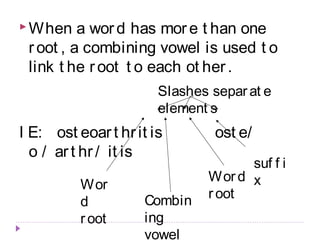
When a wor d has mor e t han one 
r oot , a combining vowel is used t o 
link t he r oot t o each ot her . 
Slashes separ at e 
element s 
I E: ost eoar t hr it is ost e/ 
o / ar t hr / it is 
Wor 
d 
r oot 
Combin 
ing 
vowel 
Wor d 
r oot 
suf f i 
x
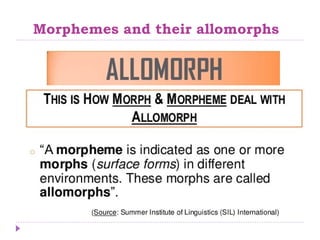
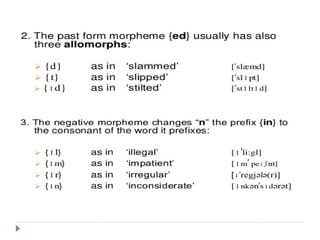
Morphemes and their allomorphs
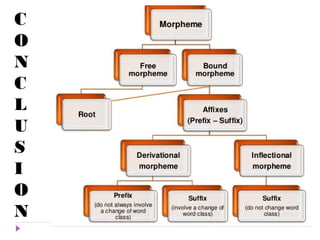
C 
O 
N 
C 
L 
U 
S 
I 
O 
N

Morphology: A WORDS AND ITS APARTS

  • 1.
    Morphology AA wwoorrddaanndd iittss ppaarrttss:: rroooottss,, aaffffiixxeess aanndd tthheeiirr sshhaappeess IIkkaa FFiittrrii IInnddrriiyyaassttuuttii TTaarr..112266000022
  • 2.
    Taking Words Apart we will focus on these smaller parts of words, generally called Morphemes. The area of grammar concerned with the structure of words and with relationships between words involving the morpheme that compose them technically called morphology and morphemes can be thought of as the minimal units of morphology.
  • 3.
    Kinds of morpheme:bound versus free Free mor phemes ar e t hose t hat can st and alone as wor ds. For examples: {gir l} , {syst em} , {desir e} , {hope} et c. All of t hese Whereas mor phems “free morphemes” ar e f r ee mBoournpdh emmoer constitutes phemes words is aGr by amat themselves, ical unit s t hat never “bound occur morpheme” s by it self are , but never is always at t words ached but t o always some part ot her of word. mor pheme. Example : Un-Happy. *Happy is t he or iginal mor pheme. •Un is t he Bound mor phemes.
  • 4.
    Bound Morphemes comeinto two varieties “Derivational’ and “Inf lectional” These af f ixes do not necessar ily change t he class of t he wor d, but t his is normally t he case, e.g. fame (n.)> famous (adj .) Fur t hermor Derivational e, t he semant morphemes ic element is not ably higher . These mor phemes ar e called: For example: Noun + Derivational morpheme  Adjective Ex. Boy + ish  boyish
  • 5.
    Verb + Derivationalmorpheme  Noun Ex. Acquit t + al  acquit t al Clear + ance  clear ance Adjective + Derivational morpheme  Adverb Ex. Exact + ly  exact ly Quiet + ly  quiet ly Main criteria for derivational morpheme: •Create a new words with a different meaning. •Change the word class of the base Note : Not all derivational morpheme change word class !!
  • 6.
    These af fixes do not change t he wor d class, but r at her cont r ibut e t o meet Whether Whether ing gr ammat or or not not ical word word const class class r aint s. These ar e changes changes called: and and how how signif icantly meaning is af f ected, “derivation” always creates new word signif icantly meaning is af f ected, “derivation” always creates new word Inf lectional morphemes For examples: Cat VS. existing existing Cat s >> one Singular one ; ; while while VS. Plur al Collect ““inf inf s lection” lection” VS. Collect is is merely merely limited limited to to change change word word ed form. form. >> Pr esent VS. Past Loud VS. Louder >> Posit ive VS. Compar at ive
  • 7.
    Kinds of morpheme:root, affix, combining form Root A wor d or wor d element (t hat is a mor pheme) f r om which ot her wor ds gr ow, usually t hr ough t he addit ion of pr ef ixes and suf f ixes. Example an ident if y t he r oot s: Knowingly Br ainlessness I nsuf f er able Unt aint ed Act ions
  • 8.
    Af f ix The mor phemes t he t erm ' af f ix' is a collect ive t erm f or t he t ypes of mor phemes t hat can only be used in combinat ion wit h ot her mor phemes -i.e. f or bound mor phemes. Depending on t he posit ion wher e t he af f ix is at t ached we can dif f er ent iat e bet ween: Pr ef ix A pr ef ix is an af f ix pr ecedes a base: un-t idy, dis-honest , ir -r egular Suf f ix A suf f ix is an af f ix which f ollows a base: dog-s, kick-ed, nat ional-ise
  • 9.
    What is acombining form? Ther e is one ot her wor d par t t hat we need t o discuss called t he combining f orm. A combining f orm is made up of a r oot plus t Combininhge fcoomrmbisn icnogn vsoiwste lo. f a combining vowel. The combining vowel is usually an “o”, but ot her s may be used. Let ’s look at some NEXT examples:
  • 10.
    Combining vowels Combiningvowels link t he r oot t o t he suf f ix or t he r oot t o anot her r oot . I f a suf f ix begins wit h a vowel, t hen a combing vowel would NOT be used. Look at t hese examples: Ent er it is - ent er is t he r oot (int est ines), it is is t he suf f ix and begins wit h a vowel so no BACK combining f orm would be used. How would it look t o t ype: ent er oit is? I t j ust wouldn’t make sense. Except ion t o t he r ule! I f a combining vowel is used bet ween t wo r oot s and t he second r oot st ar t s wit h a vowel, t he combining vowel is r et ained. Let ’s look at t his example: pneumoencephalogr aphy - pneum is t he r oot
  • 11.
    When a word has mor e t han one r oot , a combining vowel is used t o link t he r oot t o each ot her . Slashes separ at e element s I E: ost eoar t hr it is ost e/ o / ar t hr / it is Wor d r oot Combin ing vowel Wor d r oot suf f i x
  • 12.
  • 15.
    C O N C L U S I O N