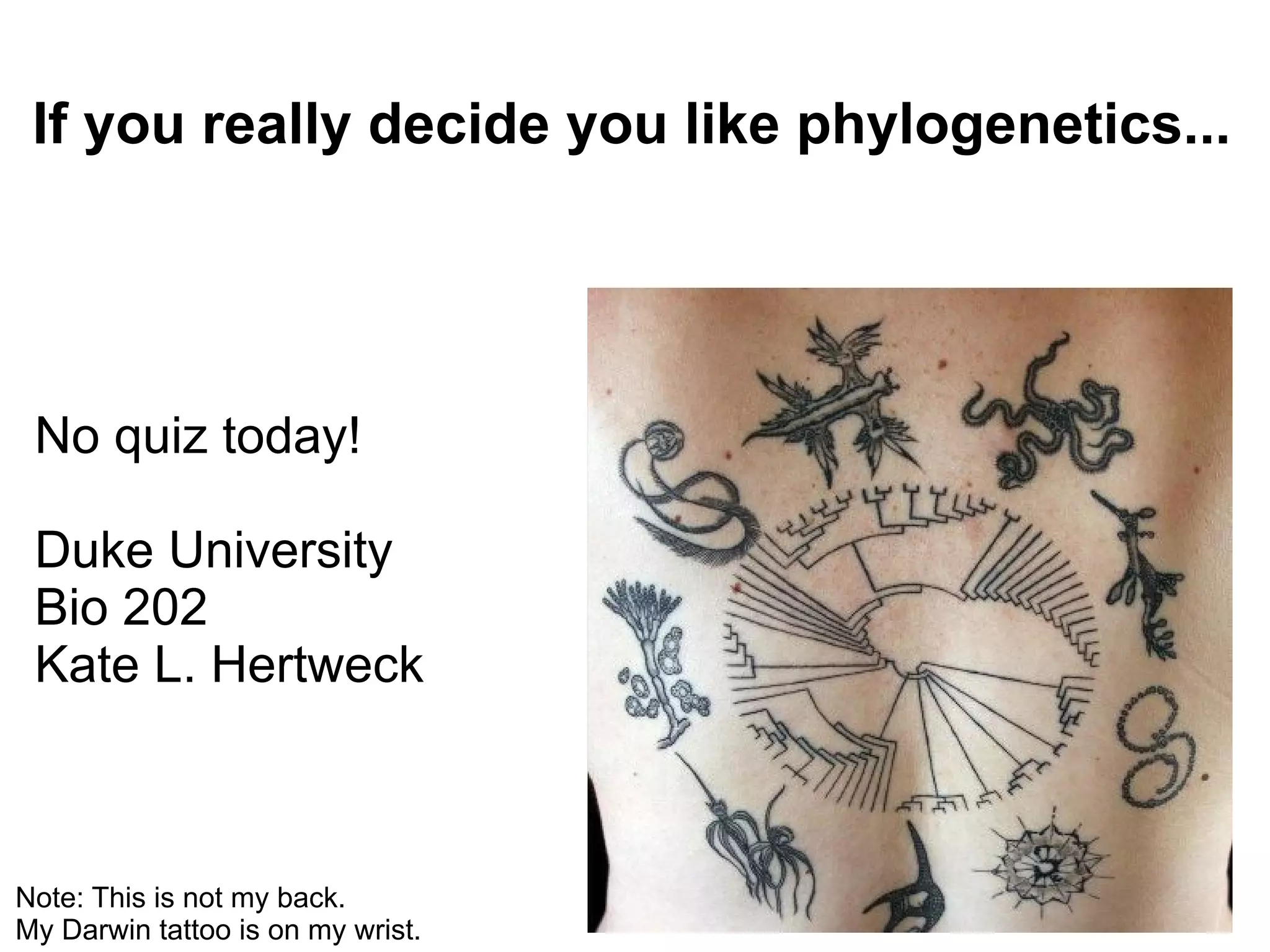
If you really decide you like phylogenetics...


 No quiz today!

 Duke University
 Bio 202
 Kate L. Hertweck


Note: This is not my back.
My Darwin tattoo is on my wrist.
The main idea of phylogenetics
●   A phylogenetic tree (phylogeny) represents evolutionary
    relationships among a group
    –   Hierarchical in nature
    –   Group may consist of species, genes, families, etc
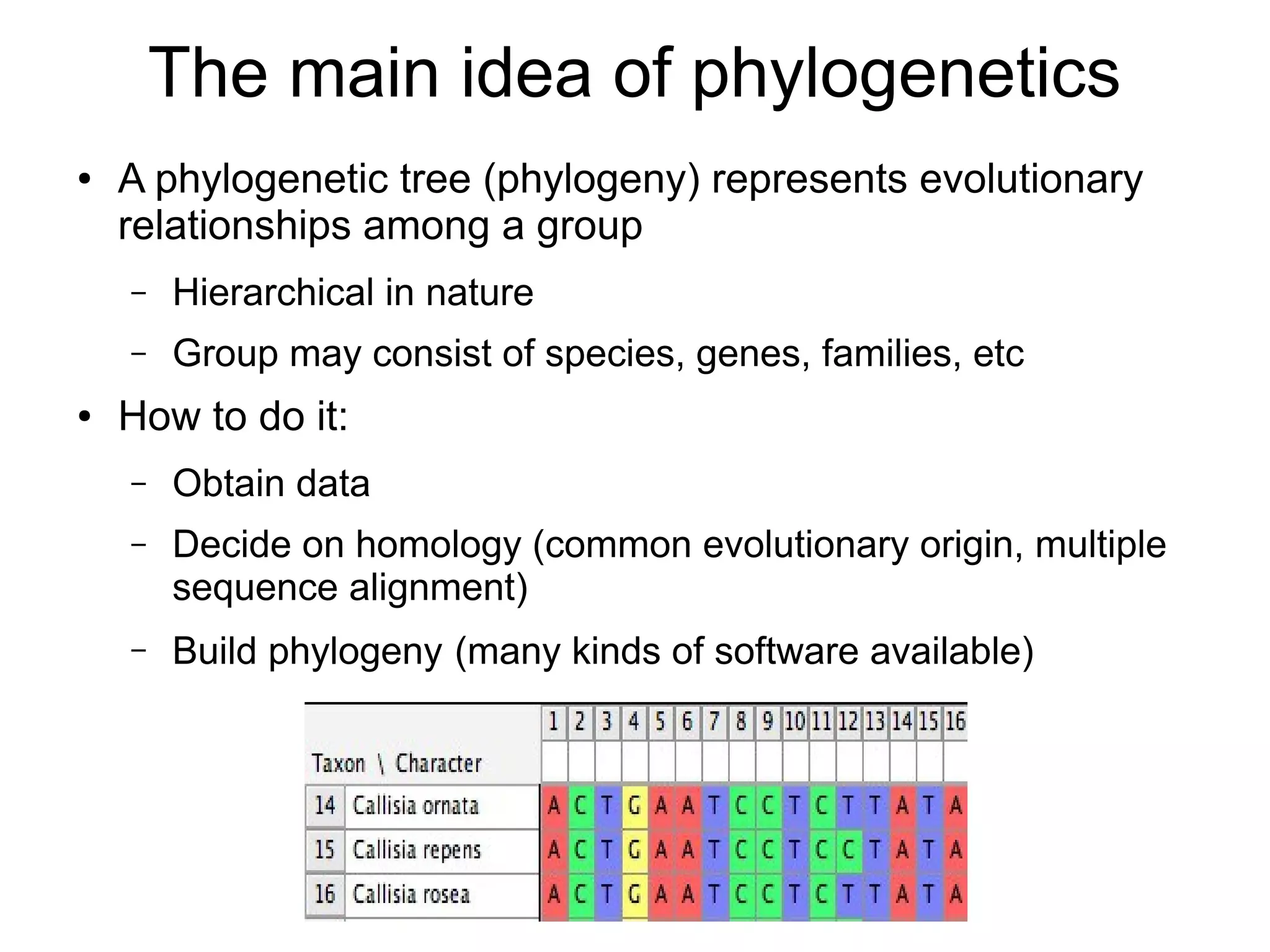
●   How to do it:
    –   Obtain data
    –   Decide on homology (common evolutionary origin, multiple
        sequence alignment)
    –   Build phylogeny (many kinds of software available)
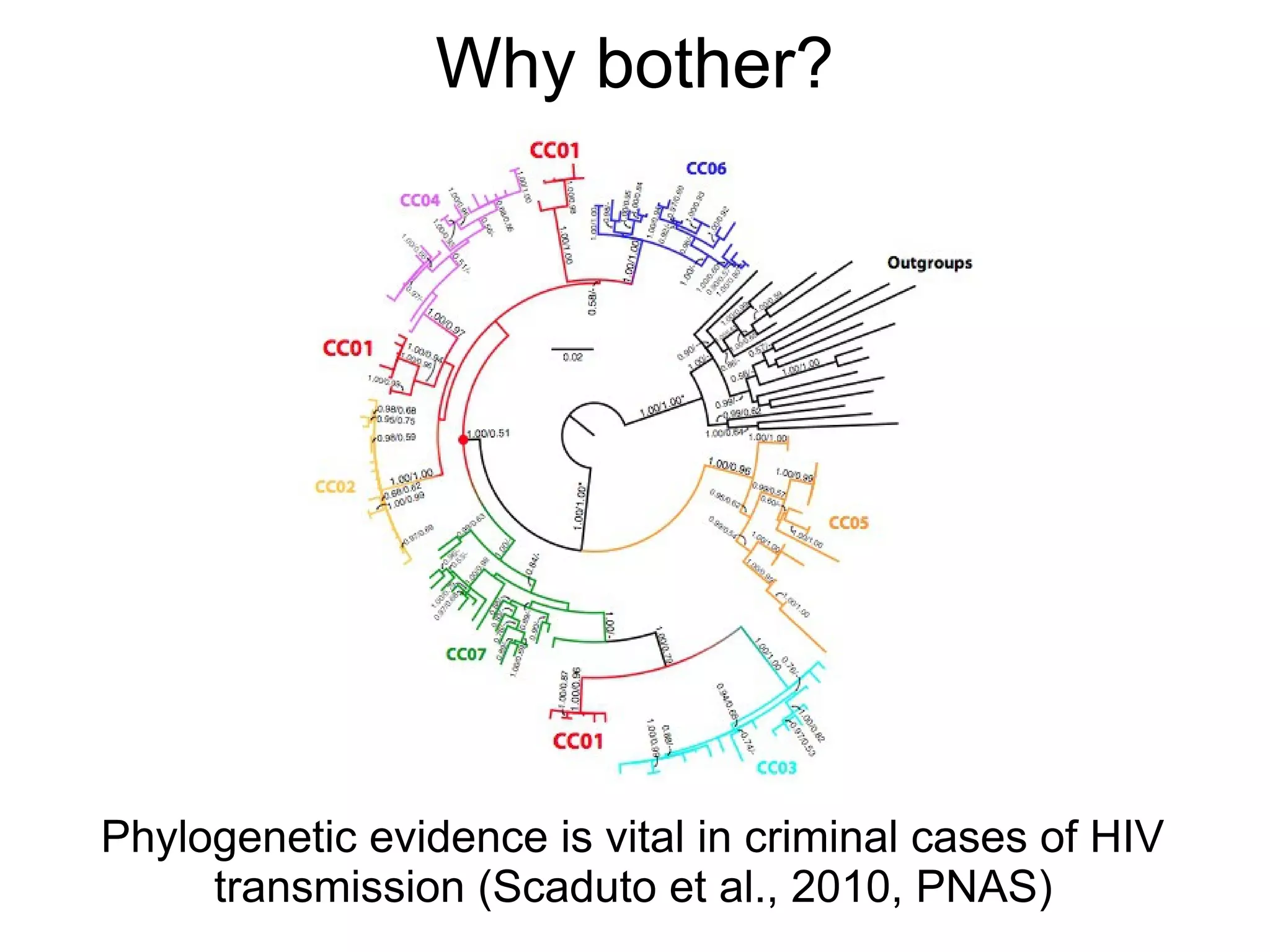
Why bother?


Phylogenetic evidence is vital in criminal cases of HIV
     transmission (Scaduto et al., 2010, PNAS)
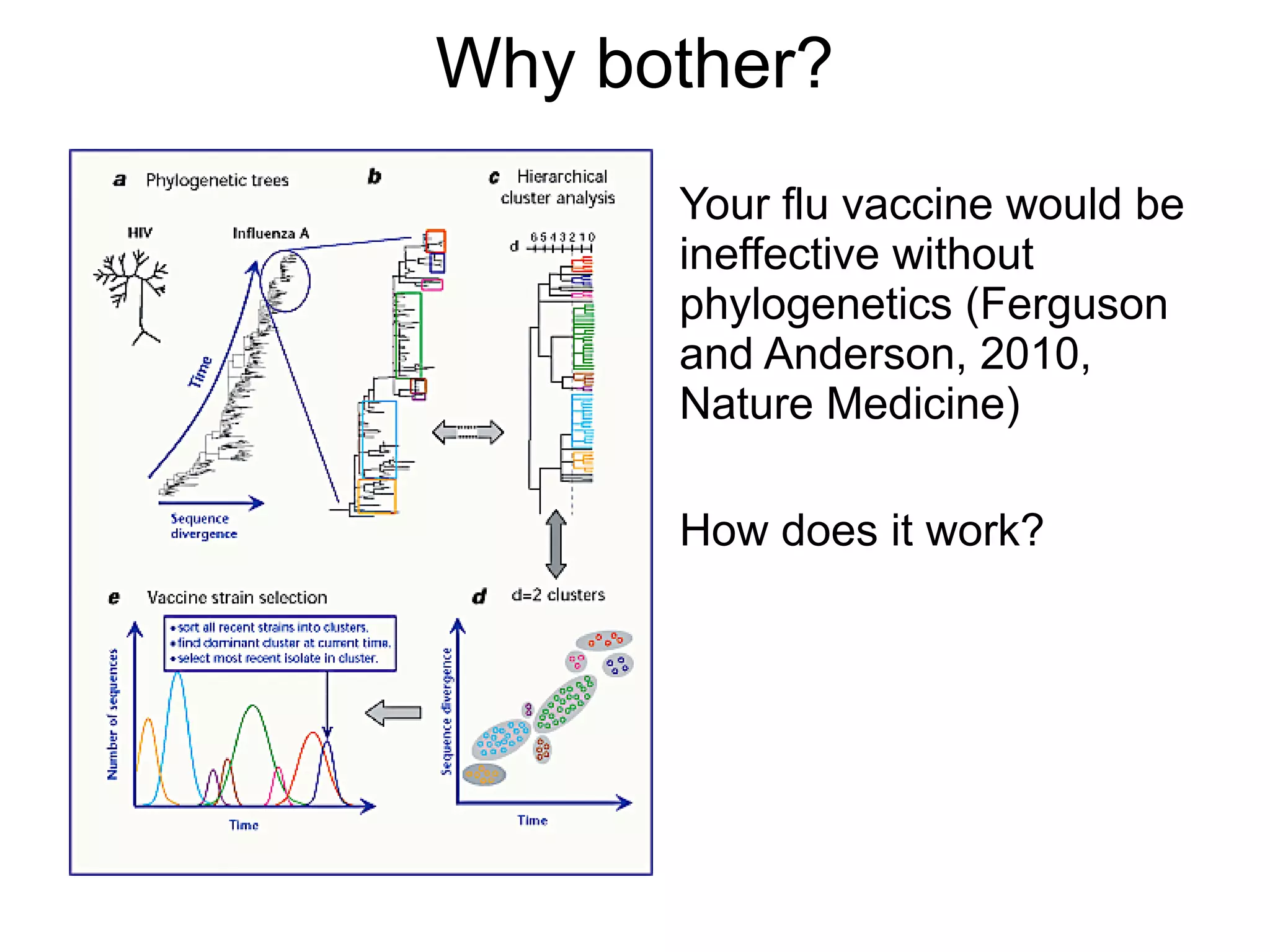
Why bother?
      Your flu vaccine would be
      ineffective without
      phylogenetics (Ferguson
      and Anderson, 2010,
      Nature Medicine)

      How does it work?
Parts of a phylogeny
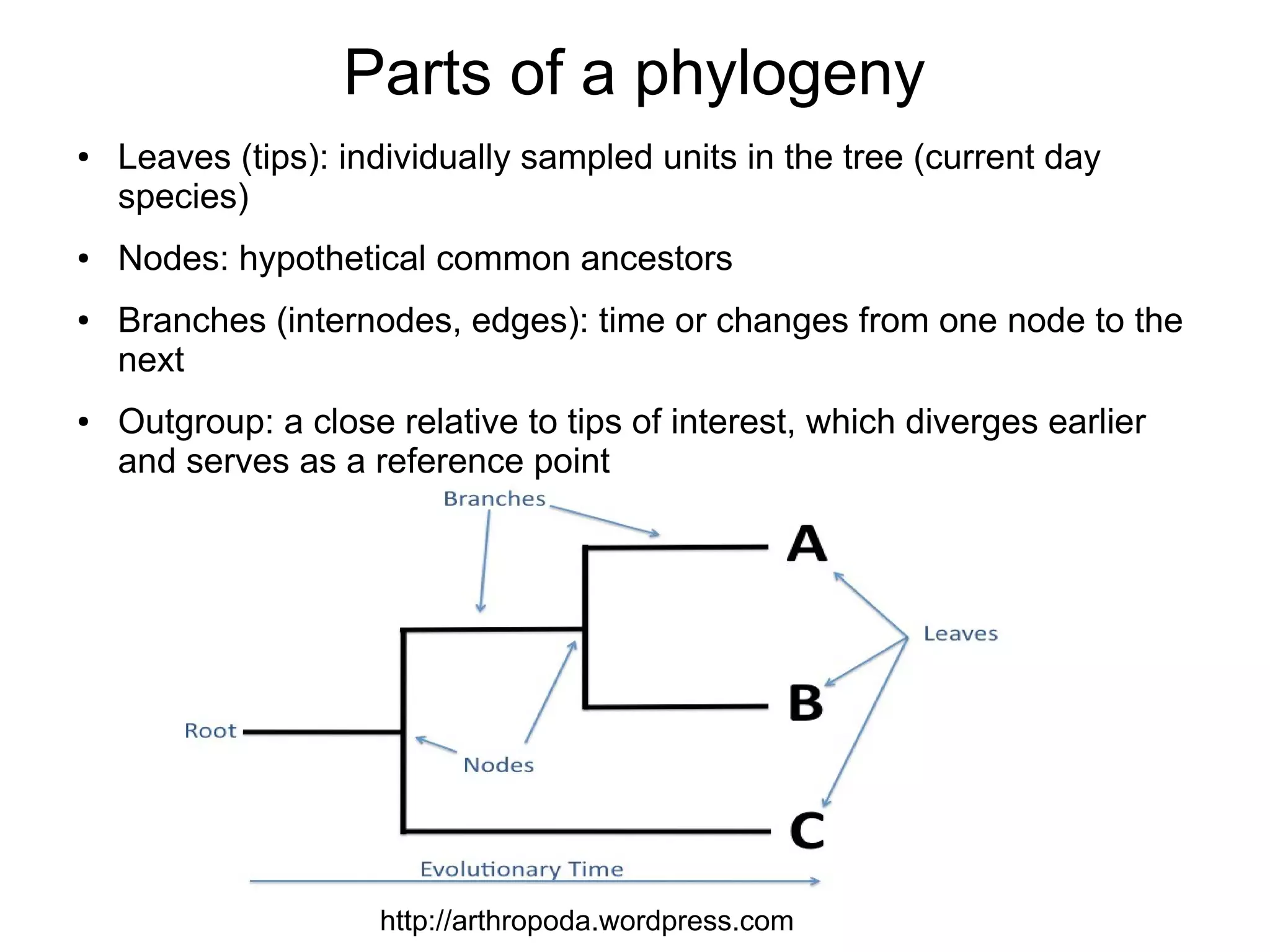
●   Leaves (tips): individually sampled units in the tree (current day
    species)
●   Nodes: hypothetical common ancestors
●   Branches (internodes, edges): time or changes from one node to the
    next
●   Outgroup: a close relative to tips of interest, which diverges earlier
    and serves as a reference point


                     http://arthropoda.wordpress.com
Describing a phylogeny
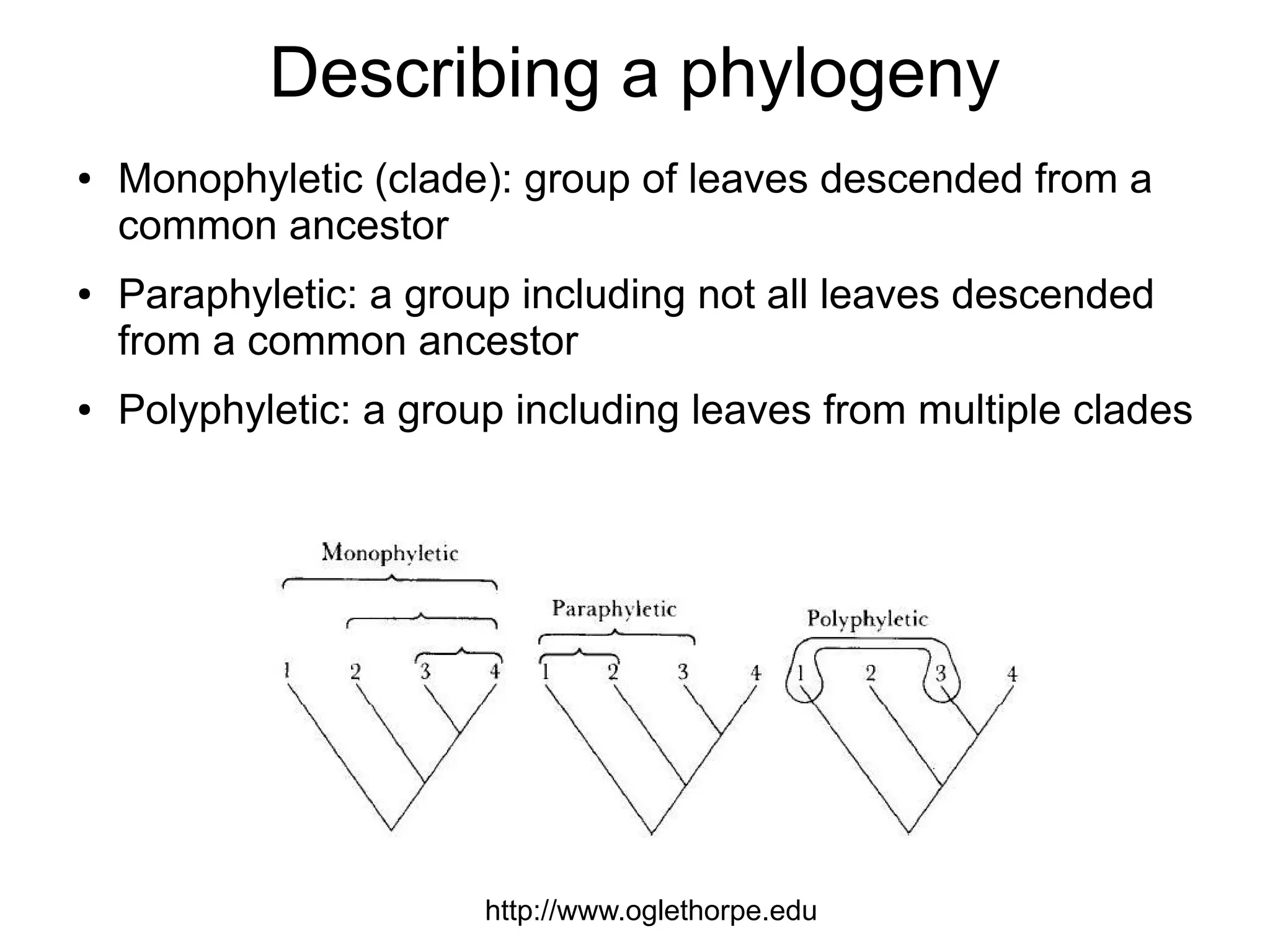
●   Monophyletic (clade): group of leaves descended from a
    common ancestor
●   Paraphyletic: a group including not all leaves descended
    from a common ancestor
●   Polyphyletic: a group including leaves from multiple clades


                        http://www.oglethorpe.edu
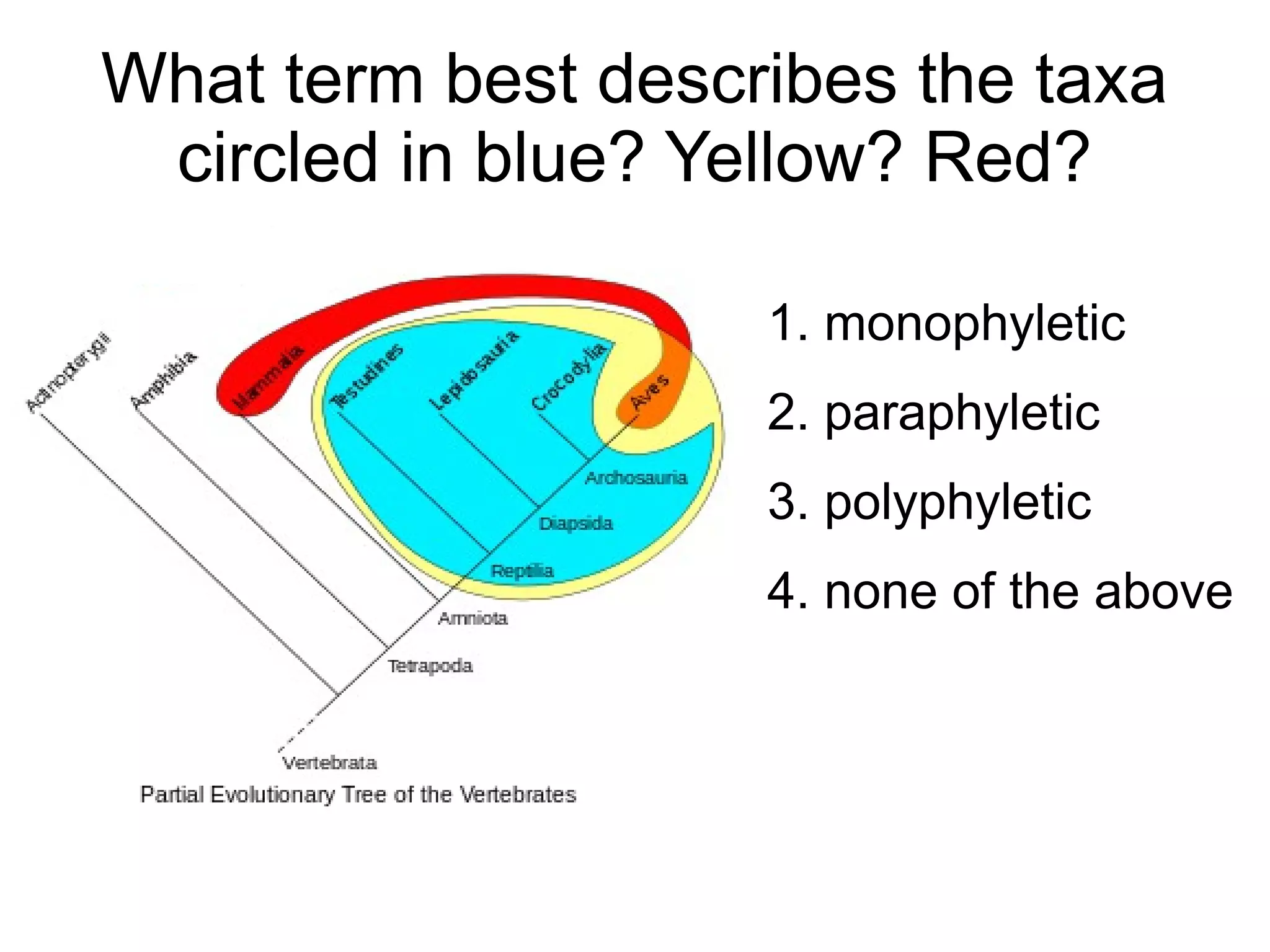
What term best describes the taxa
 circled in blue? Yellow? Red?

                    1. monophyletic
                    2. paraphyletic
                    3. polyphyletic
                    4. none of the above
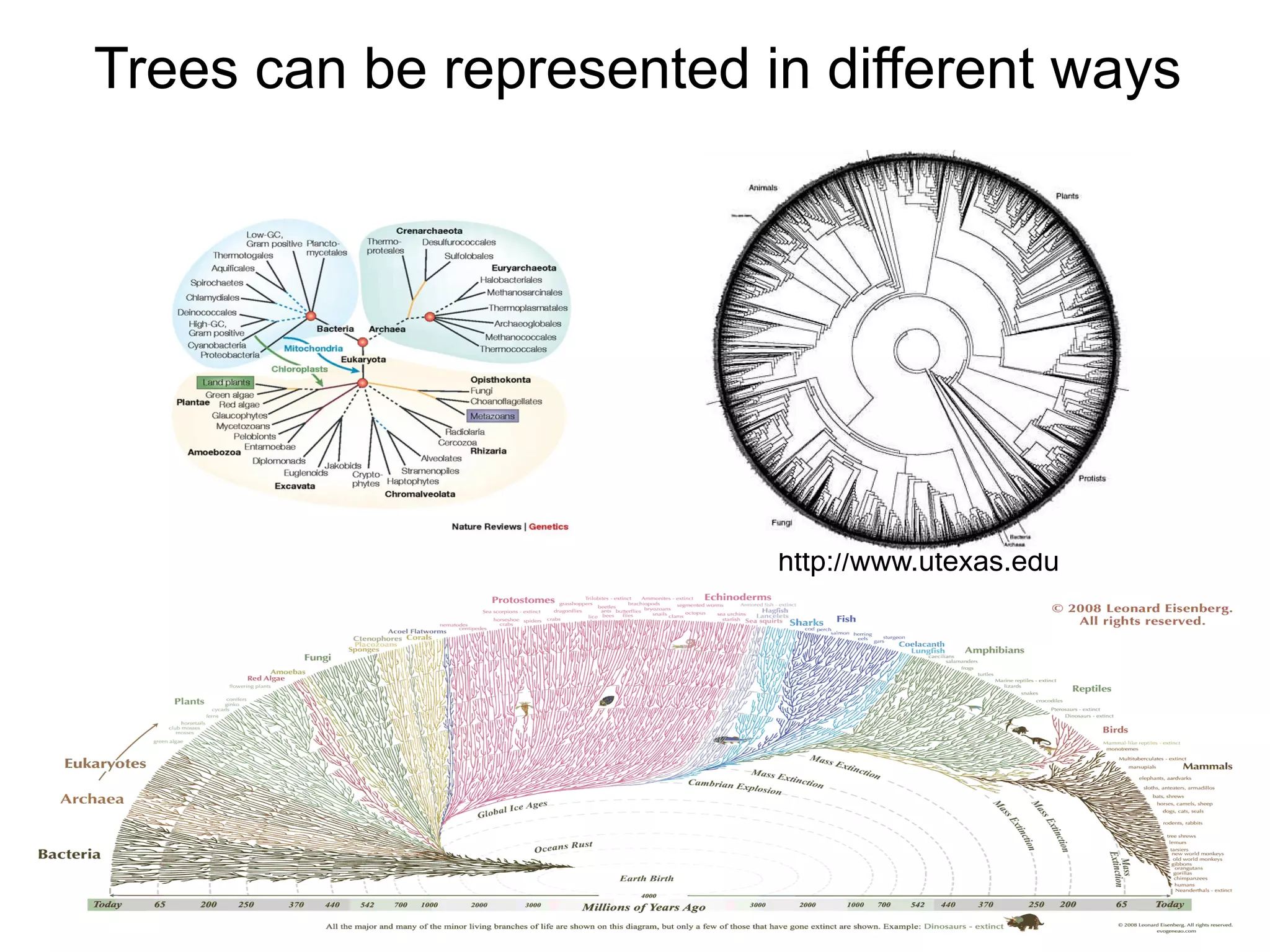
Trees can be represented in different ways


                          http://www.utexas.edu
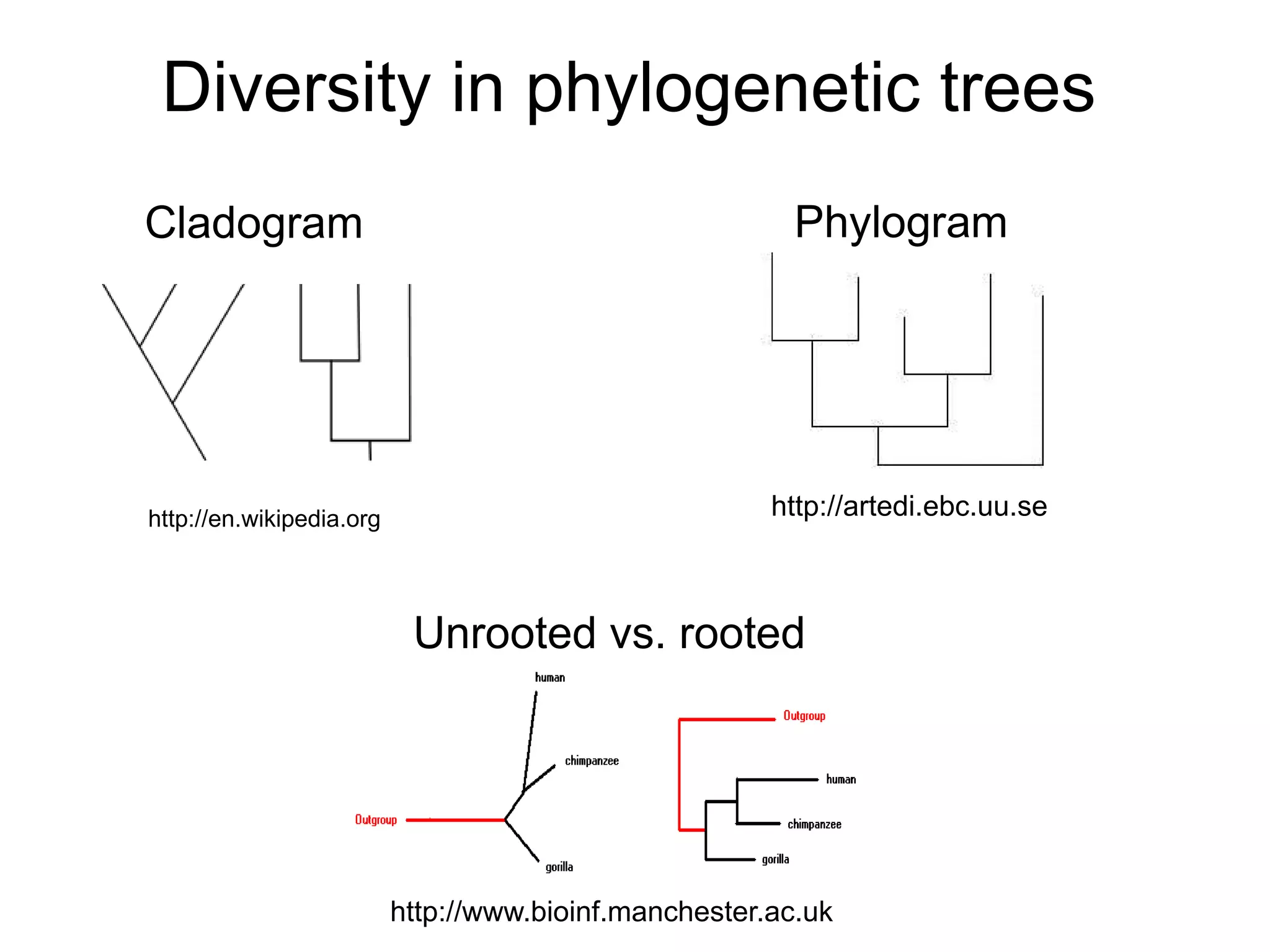
Diversity in phylogenetic trees
Cladogram                                                Phylogram


http://en.wikipedia.org                                http://artedi.ebc.uu.se


                           Unrooted vs. rooted


                          http://www.bioinf.manchester.ac.uk
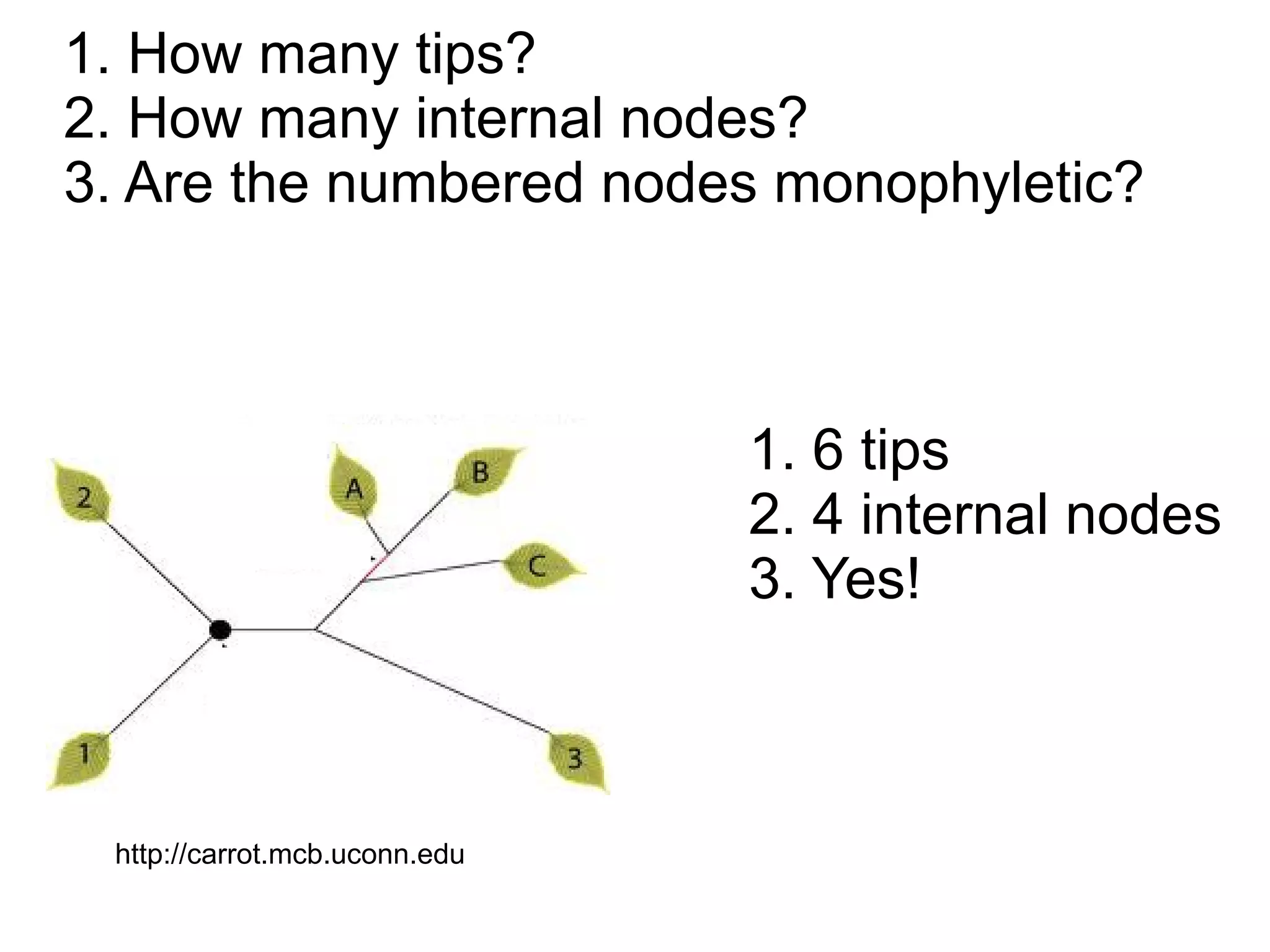
1. How many tips?
2. How many internal nodes?
3. Are the numbered nodes monophyletic?


                               1. 6 tips
                               2. 4 internal nodes
                               3. Yes!


 http://carrot.mcb.uconn.edu
What data are used to build
               phylogenies?
●   Morphology: presence/absence of organism parts,
    number of legs, color, etc. (can include fossils!)
●   Molecules (genetic data): DNA, protein, gene order
    –   Organellar DNA is uniparentally inherited
    –   Nuclear DNA is biparentally inherited
    –   Ancient DNA (from long extinct organisms)
●   Gene trees vs. species trees
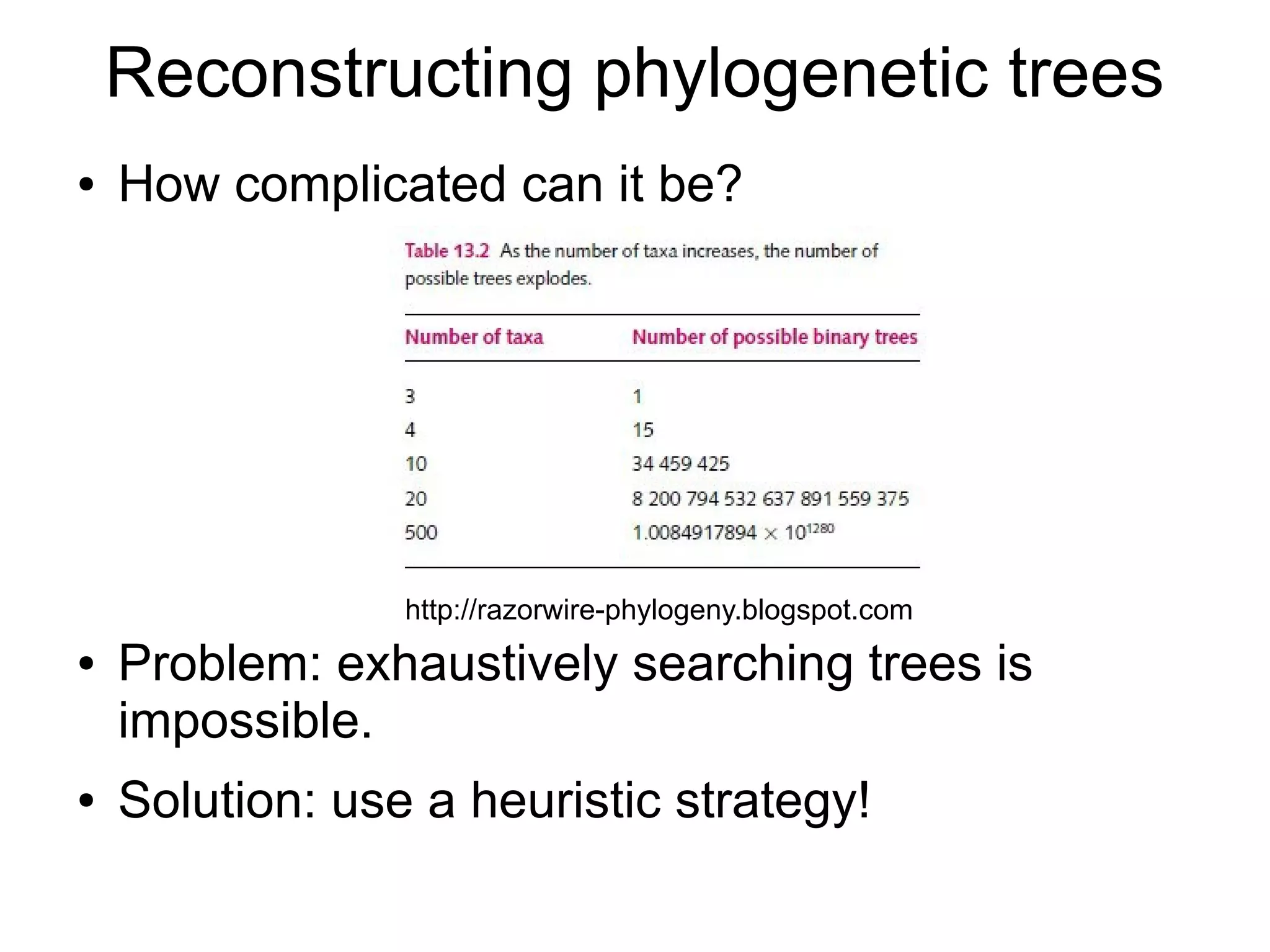
Reconstructing phylogenetic trees
●   How complicated can it be?


                 http://razorwire-phylogeny.blogspot.com
●   Problem: exhaustively searching trees is
    impossible.
●   Solution: use a heuristic strategy!
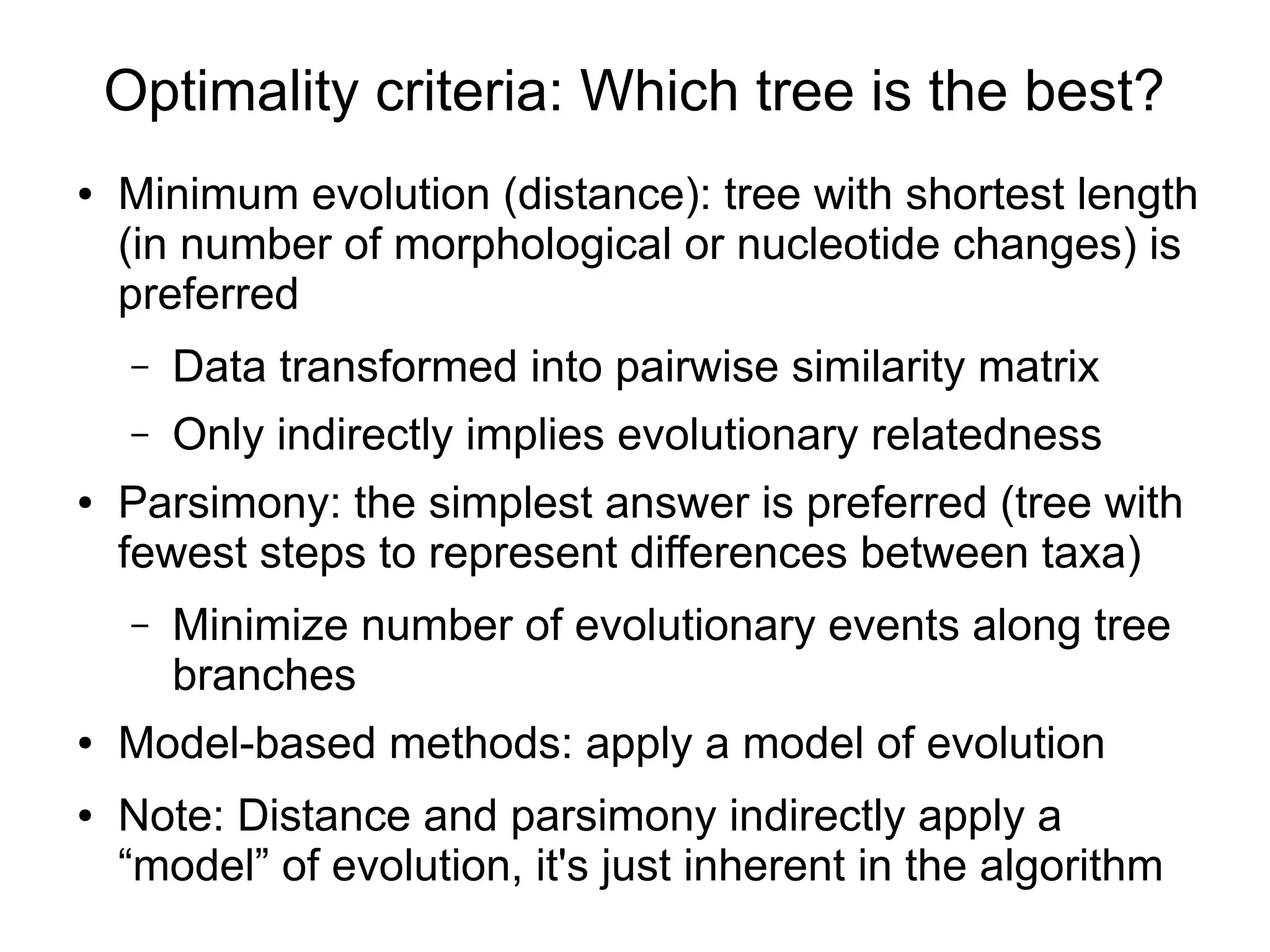
Optimality criteria: Which tree is the best?
●   Minimum evolution (distance): tree with shortest length
    (in number of morphological or nucleotide changes) is
    preferred
     –   Data transformed into pairwise similarity matrix
     –   Only indirectly implies evolutionary relatedness
●   Parsimony: the simplest answer is preferred (tree with
    fewest steps to represent differences between taxa)
     –   Minimize number of evolutionary events along tree
         branches
●   Model-based methods: apply a model of evolution
●   Note: Distance and parsimony indirectly apply a
    “model” of evolution, it's just inherent in the algorithm
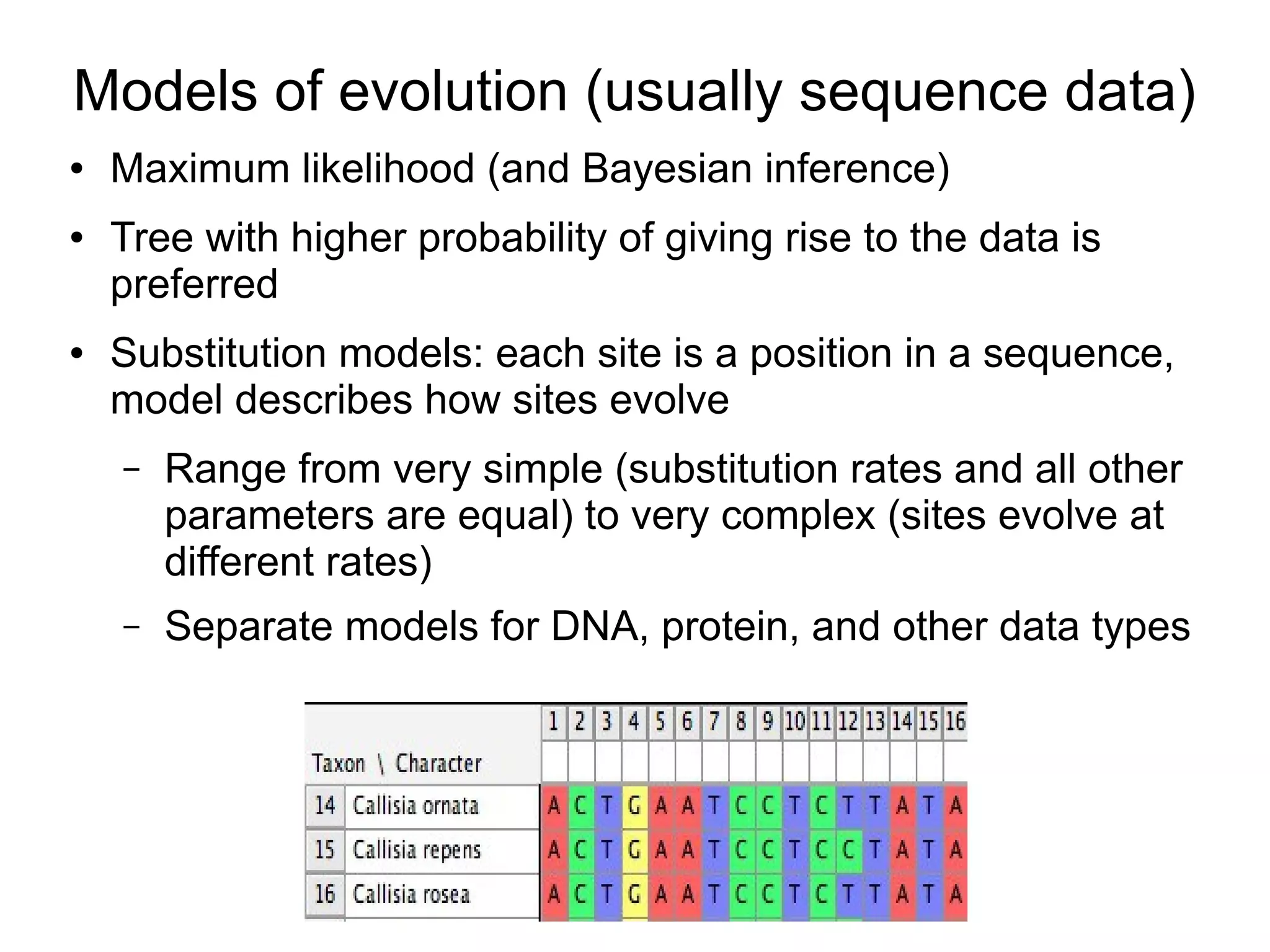
Models of evolution (usually sequence data)
●   Maximum likelihood (and Bayesian inference)
●   Tree with higher probability of giving rise to the data is
    preferred
●   Substitution models: each site is a position in a sequence,
    model describes how sites evolve
    –   Range from very simple (substitution rates and all other
        parameters are equal) to very complex (sites evolve at
        different rates)
    –   Separate models for DNA, protein, and other data types
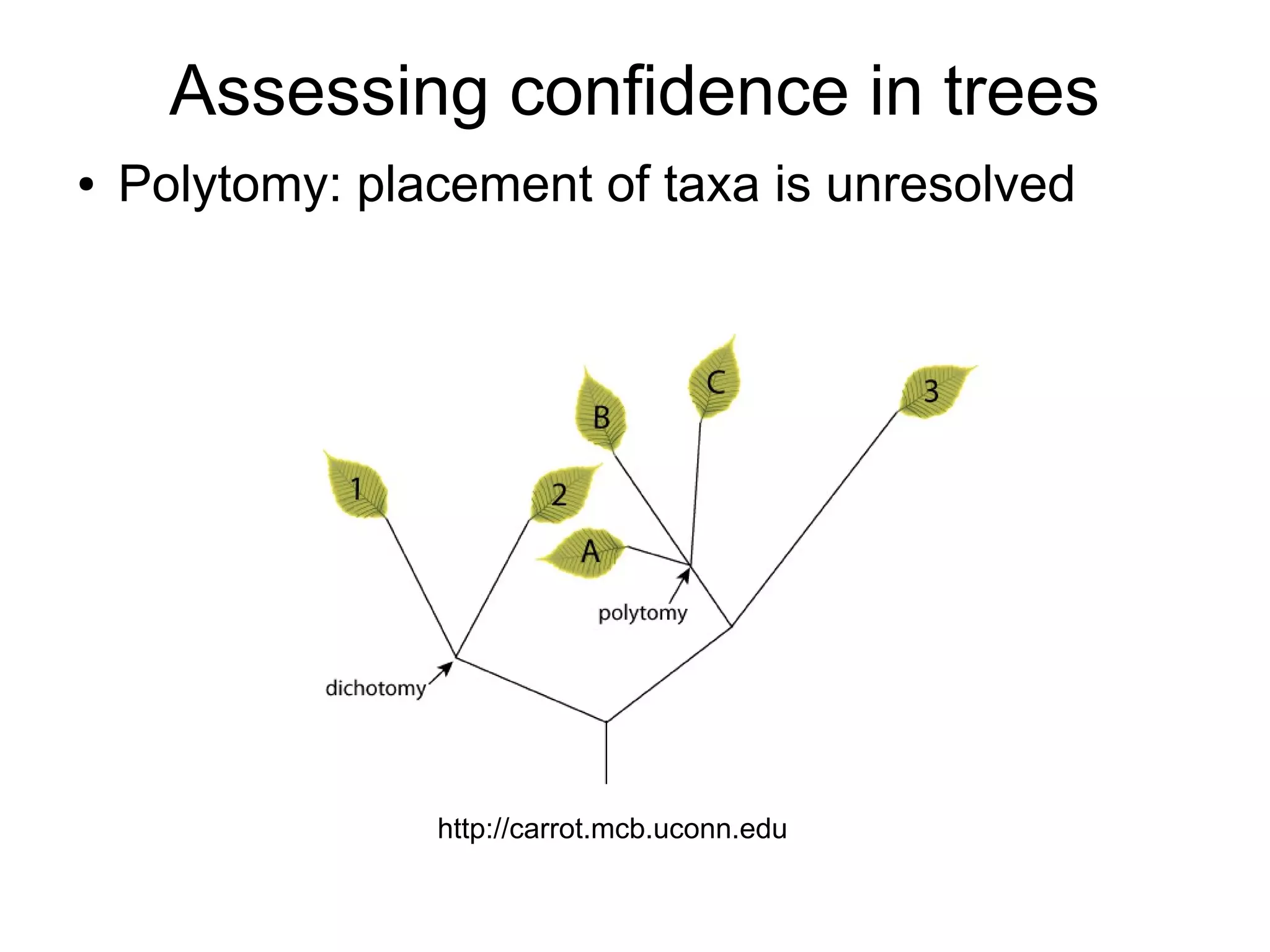
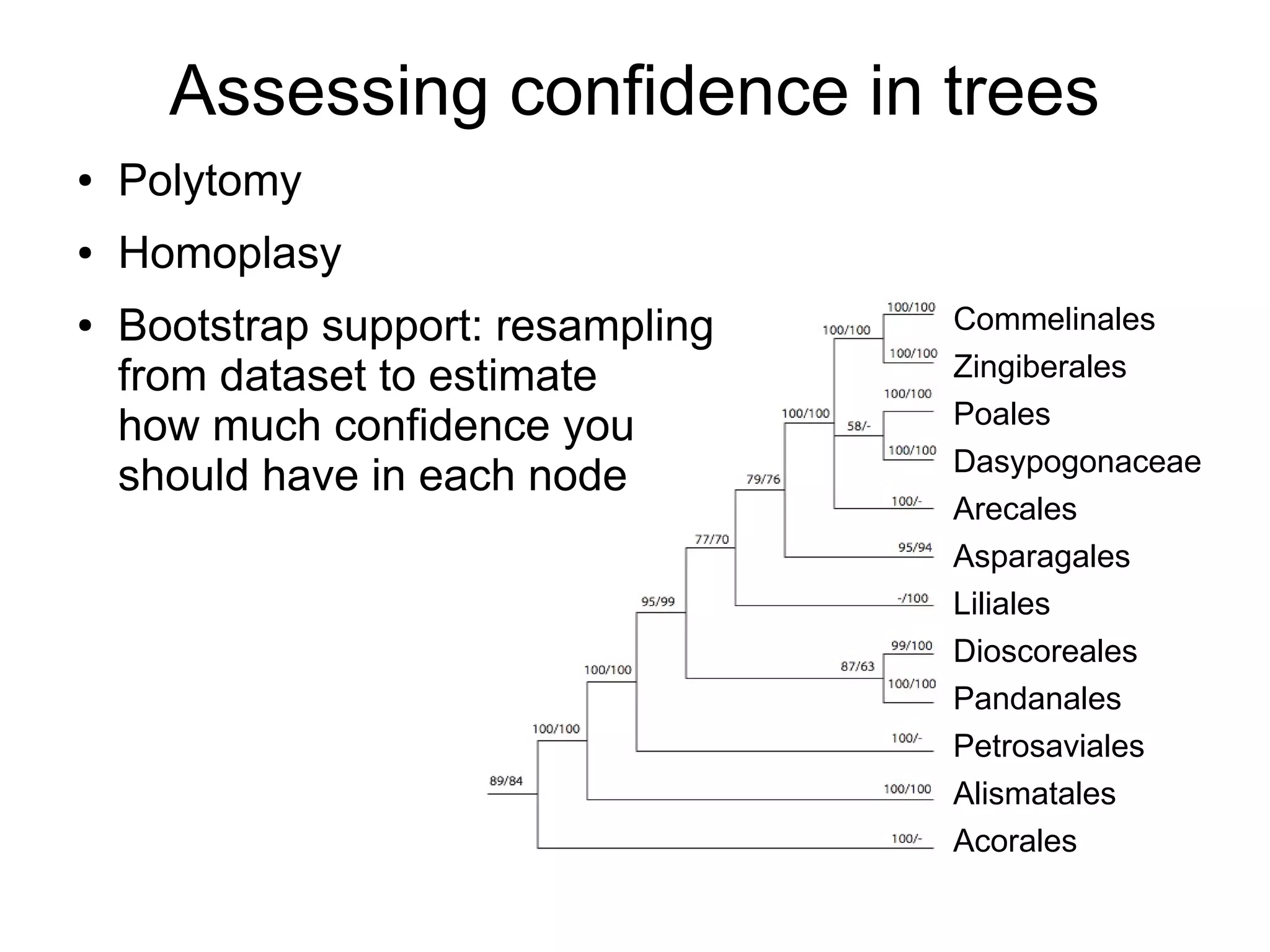
Assessing confidence in trees
●   Polytomy: placement of taxa is unresolved


                 http://carrot.mcb.uconn.edu
Assessing confidence in trees
●   Polytomy
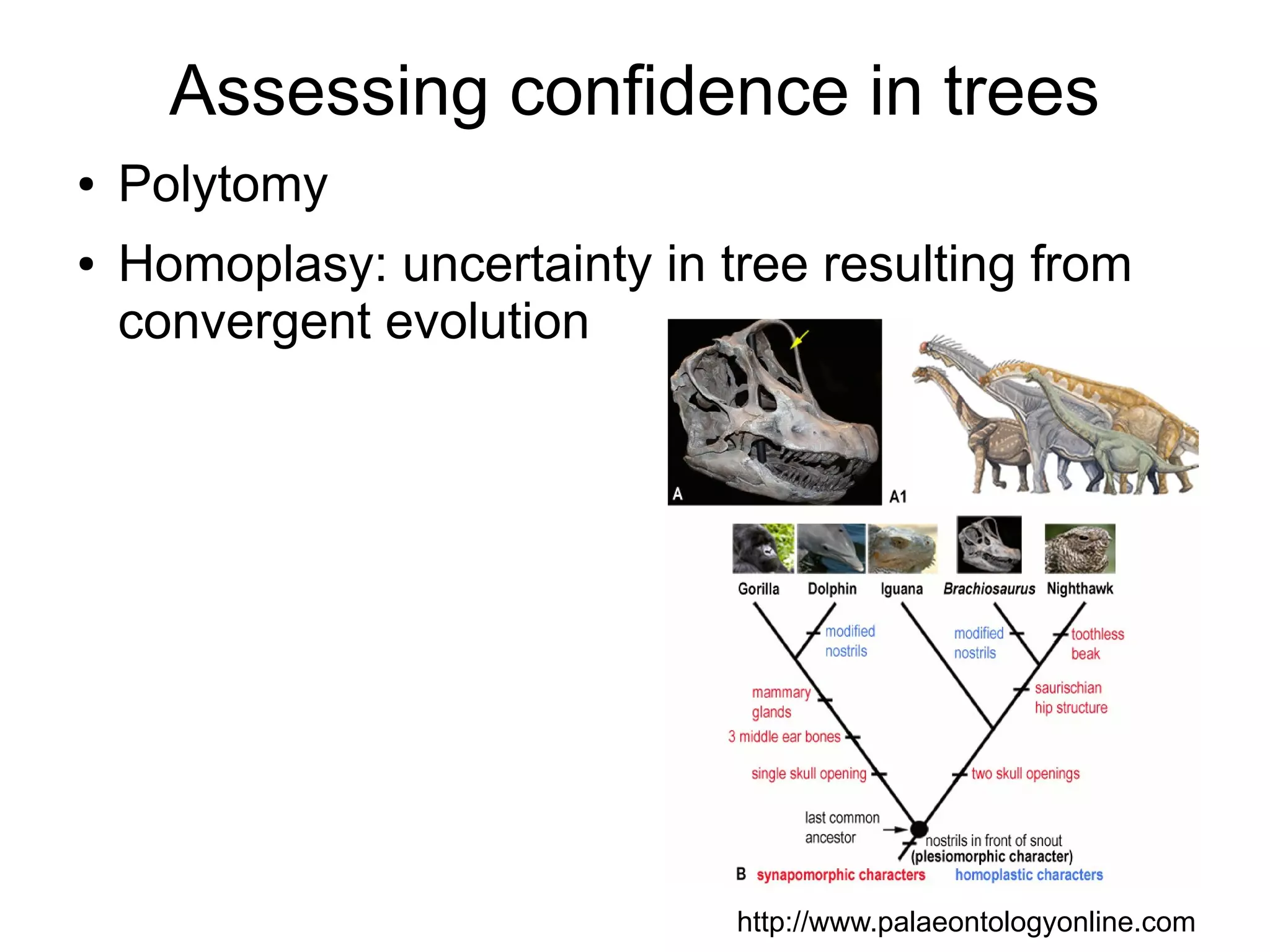
●   Homoplasy: uncertainty in tree resulting from
    convergent evolution


                               http://www.palaeontologyonline.com
Assessing confidence in trees
●   Polytomy
●   Homoplasy
●   Bootstrap support: resampling   Commelinales
    from dataset to estimate        Zingiberales
    how much confidence you         Poales
                                    Dasypogonaceae
    should have in each node
                                    Arecales
                                    Asparagales
                                    Liliales
                                    Dioscoreales
                                    Pandanales
                                    Petrosaviales
                                    Alismatales
                                    Acorales
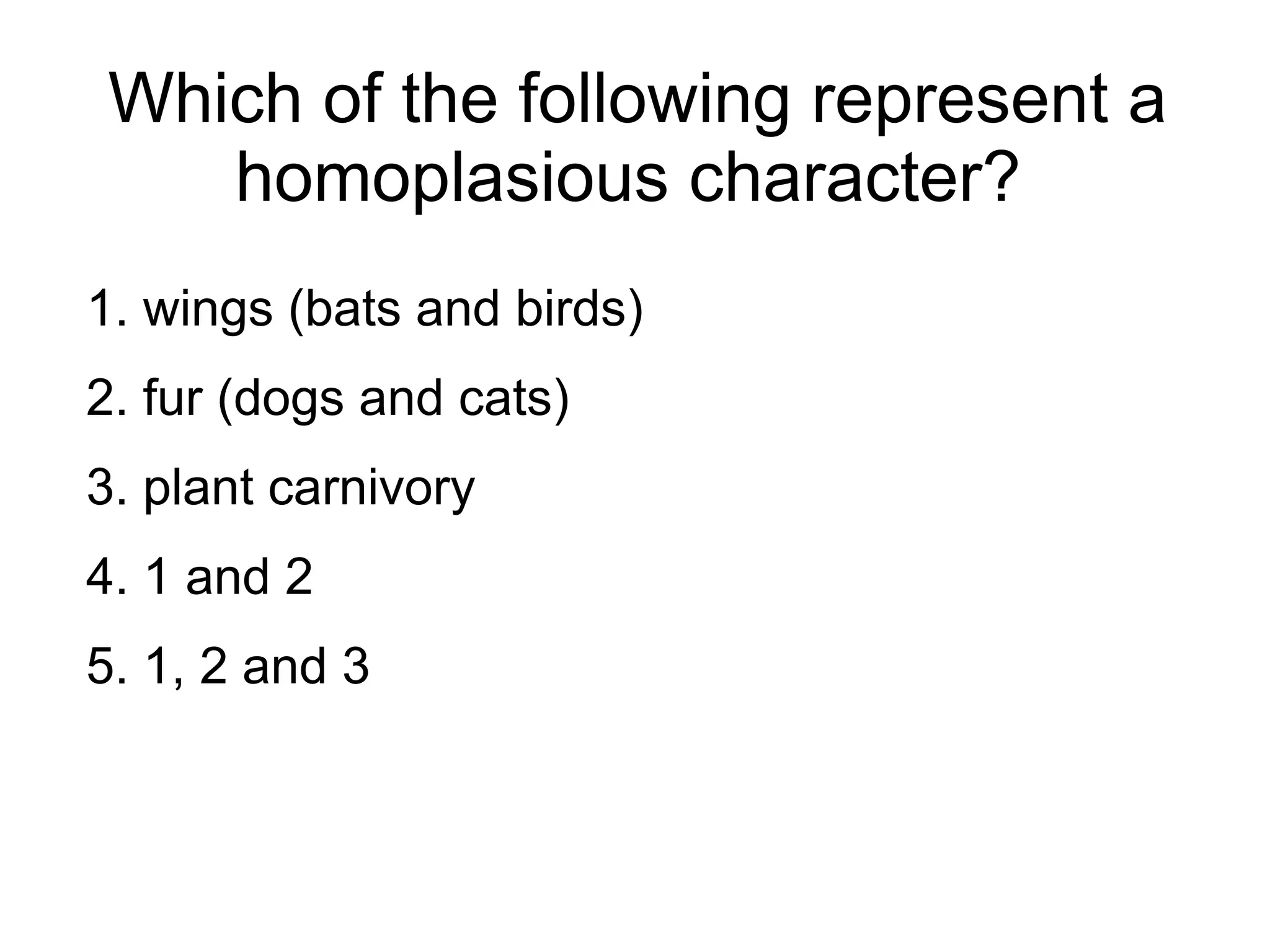
Which of the following represent a
    homoplasious character?
1. wings (bats and birds)
2. fur (dogs and cats)
3. plant carnivory
4. 1 and 2
5. 1, 2 and 3
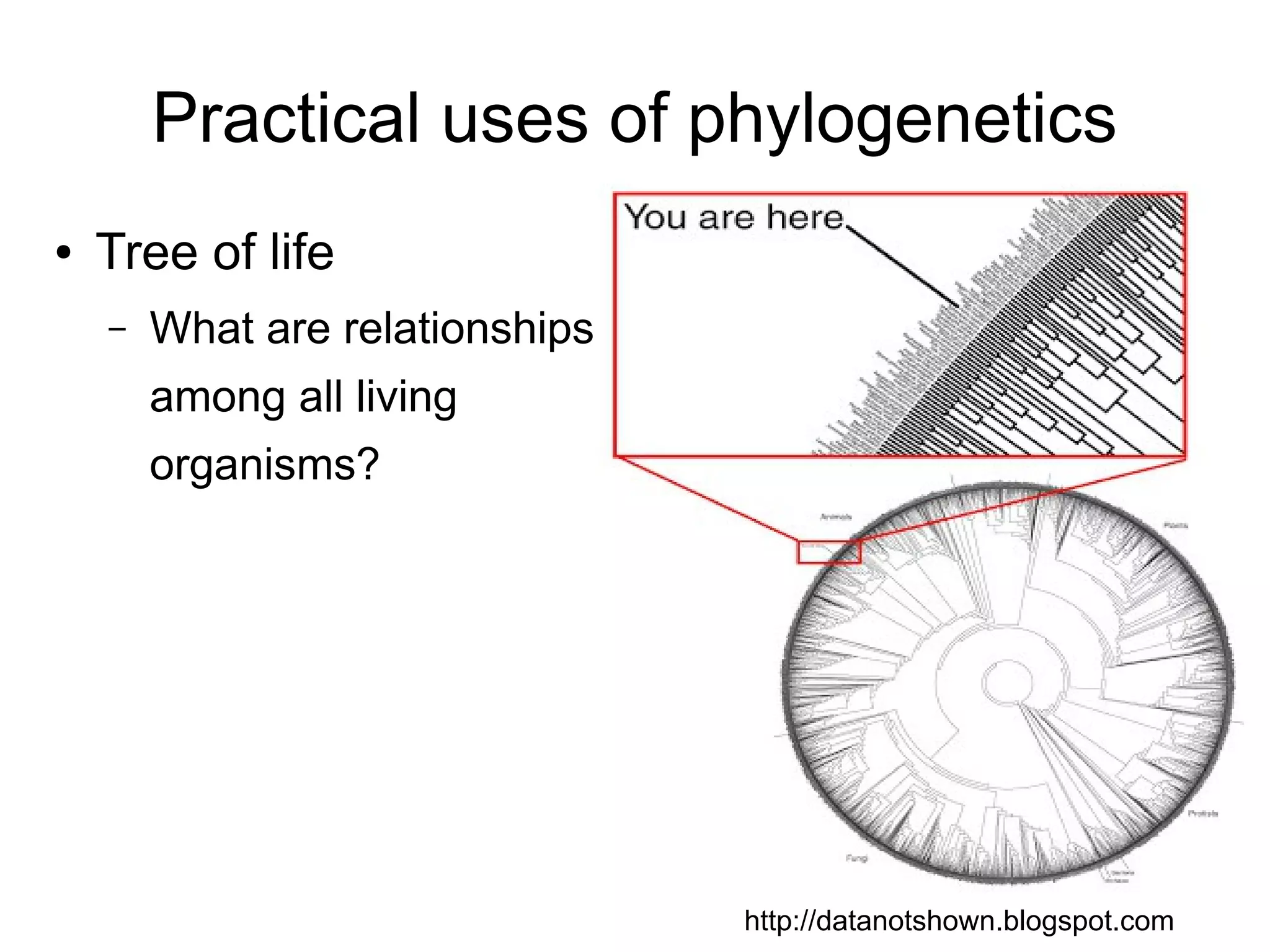
Practical uses of phylogenetics
●   Tree of life
    –   What are relationships
        among all living
        organisms?


                                 http://datanotshown.blogspot.com
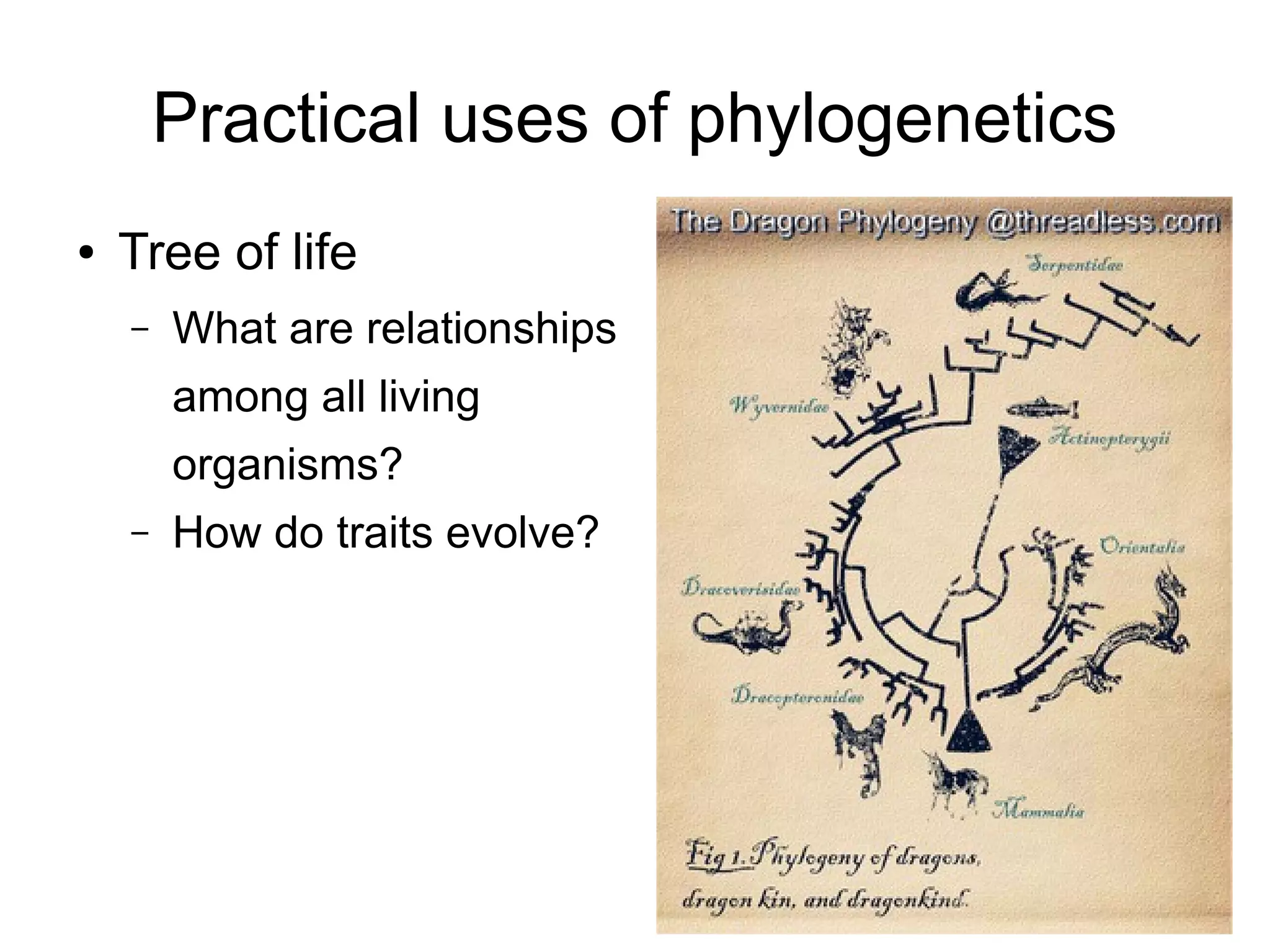
Practical uses of phylogenetics
●   Tree of life
    –   What are relationships
        among all living
        organisms?
    –   How do traits evolve?
Practical uses of phylogenetics
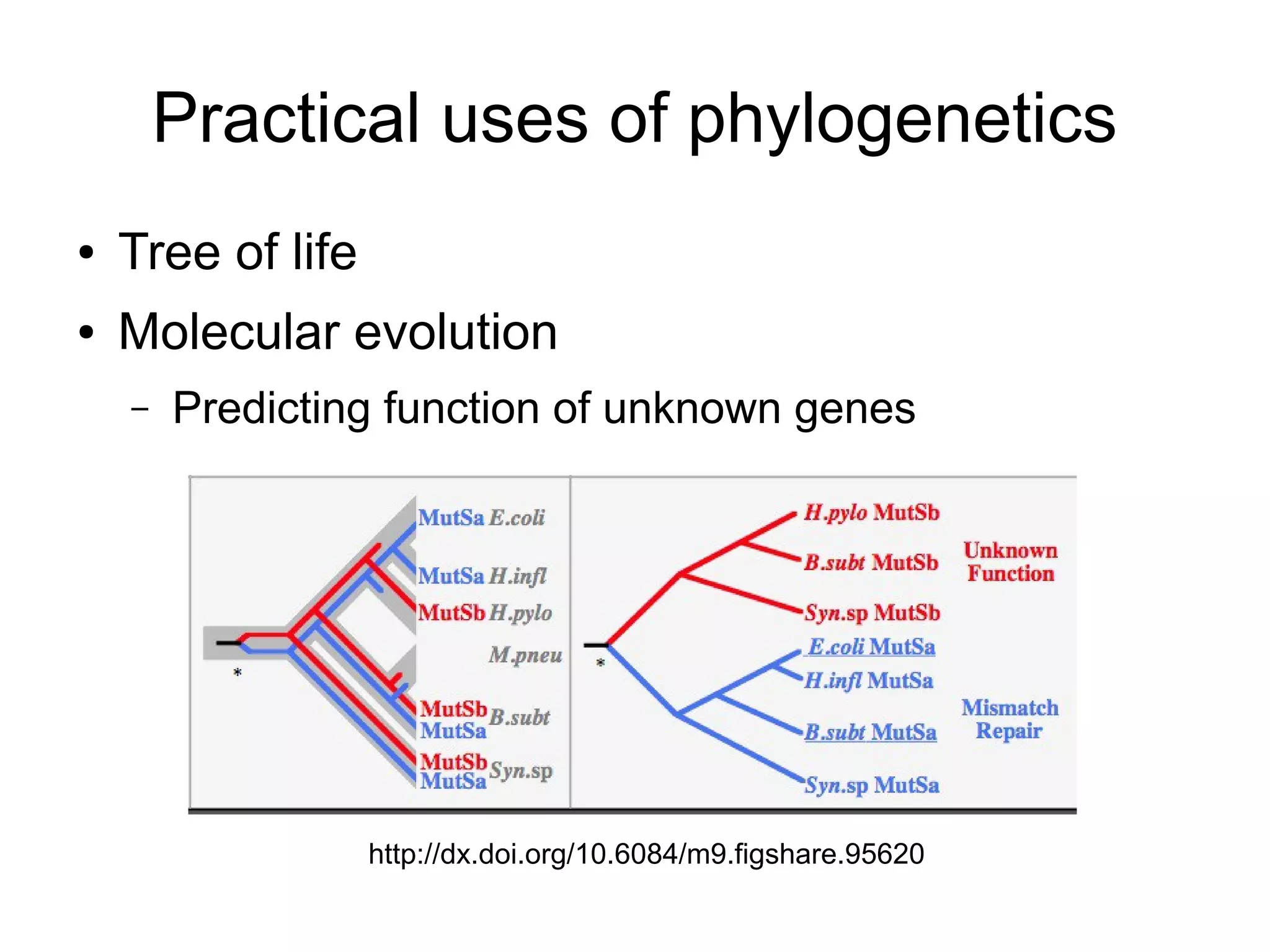
●   Tree of life
●   Molecular evolution
    –   Predicting function of unknown genes


                   http://dx.doi.org/10.6084/m9.figshare.95620
Practical uses of phylogenetics
●   Tree of life
●   Molecular evolution
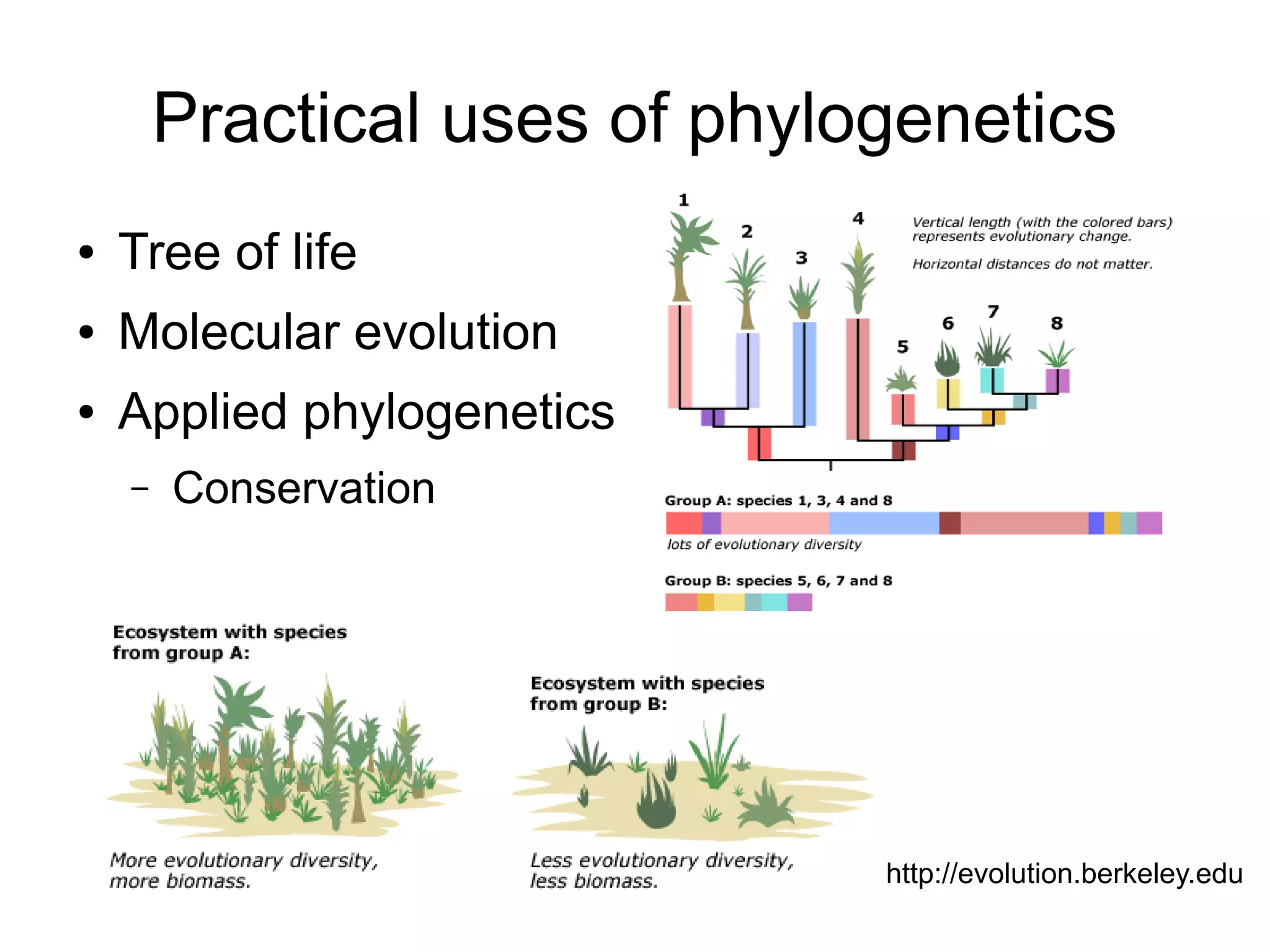
●   Applied phylogenetics
    –   Conservation


                               http://evolution.berkeley.edu
Practical uses of phylogenetics
●   Tree of life
●   Molecular evolution
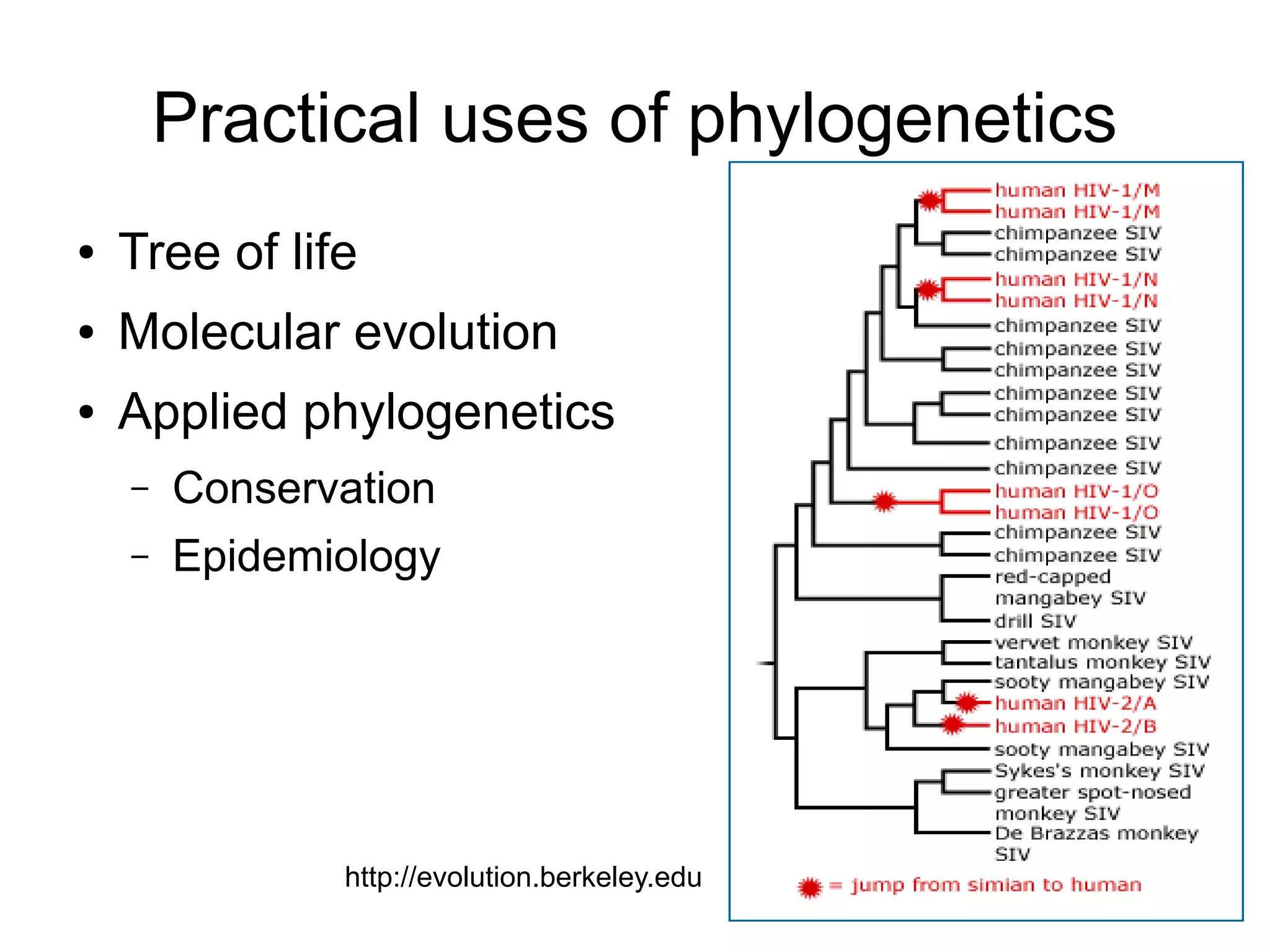
●   Applied phylogenetics
    –   Conservation
    –   Epidemiology


               http://evolution.berkeley.edu
Into the future...
●   Phylogenomics
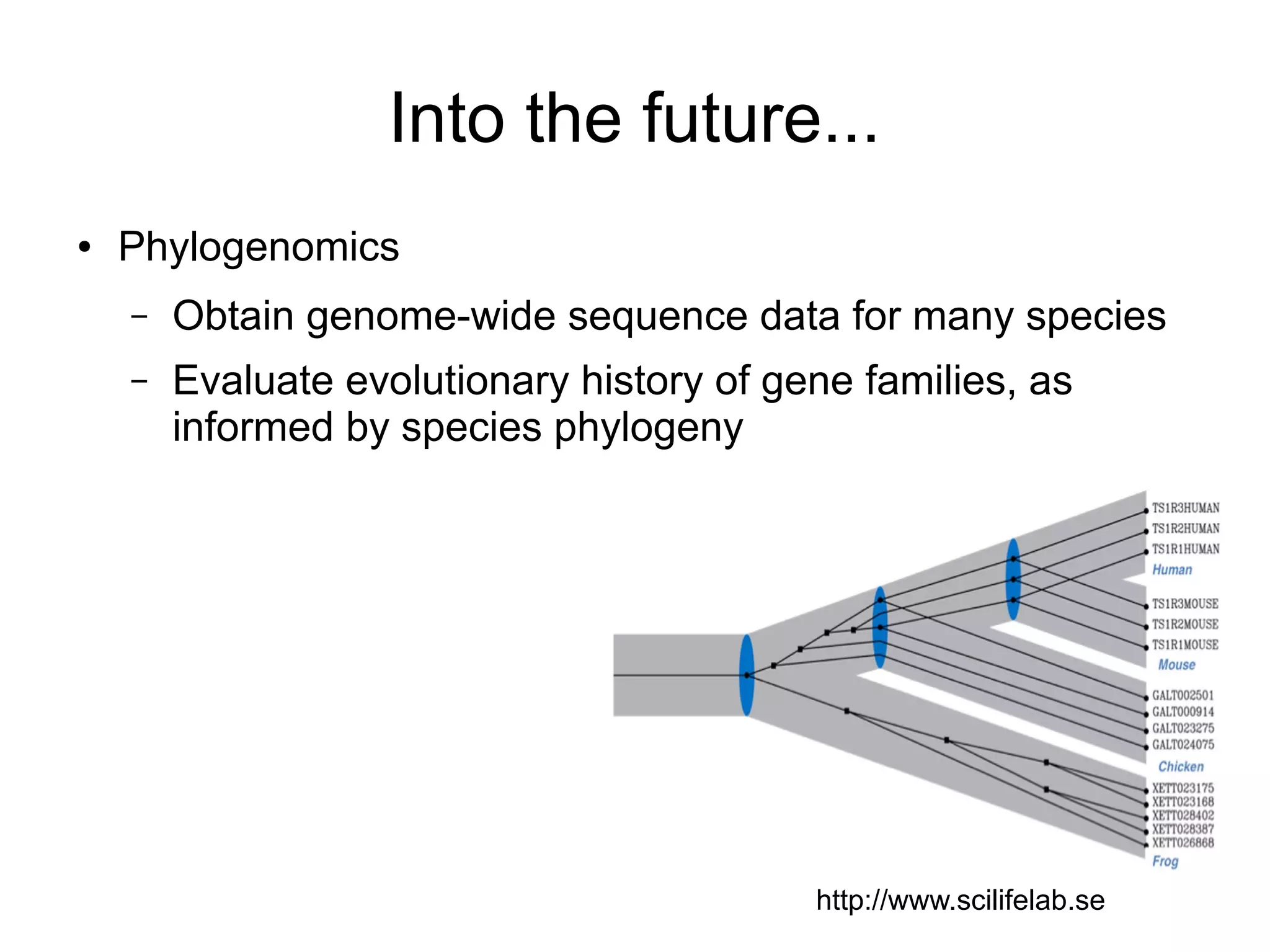
    –   Obtain genome-wide sequence data for many species
    –   Evaluate evolutionary history of gene families, as
        informed by species phylogeny


                                           http://www.scilifelab.se
Into the future...
●   Phylogenomics
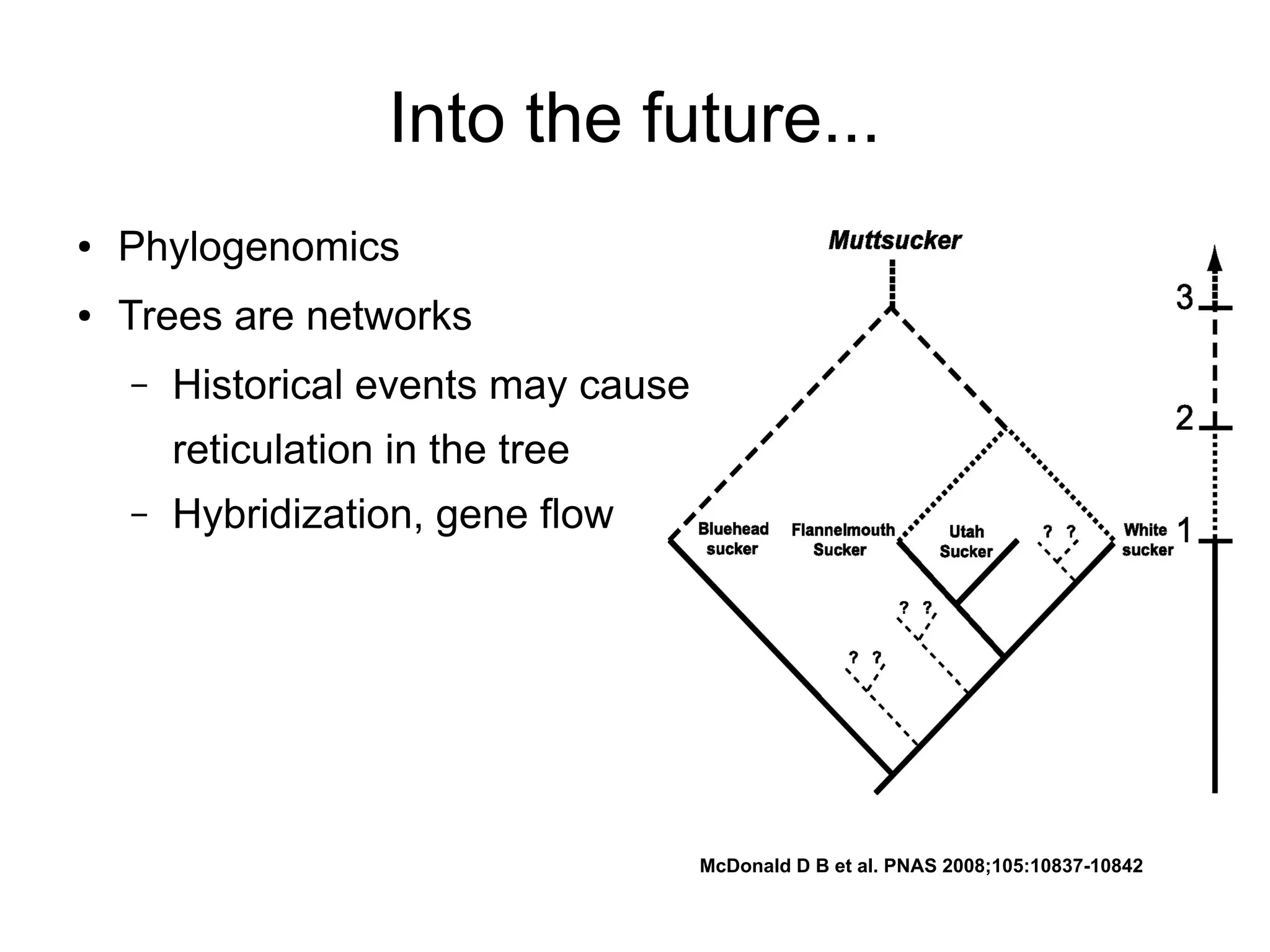
●   Trees are networks
    –   Historical events may cause
        reticulation in the tree
    –   Hybridization, gene flow


                                      McDonald D B et al. PNAS 2008;105:10837-10842
Into the future...
●   Phylogenomics
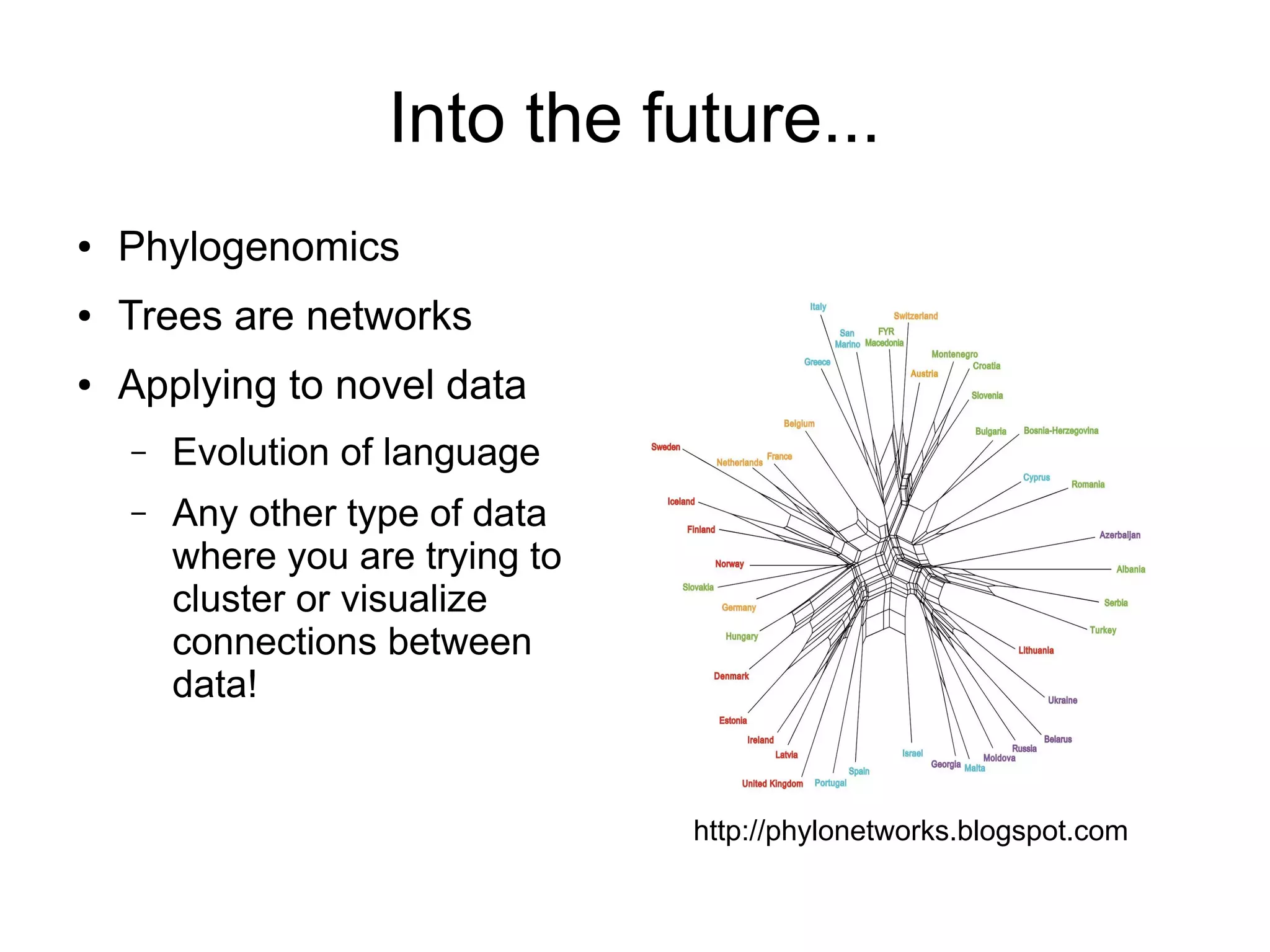
●   Trees are networks
●   Applying to novel data
    –   Evolution of language
    –   Any other type of data
        where you are trying to
        cluster or visualize
        connections between
        data!


                                  http://phylonetworks.blogspot.com
Conclusions
●   Phylogenetics allows us to infer past
    evolutionary events
●   Powerful tool for empirical and applied
    purposes
●   Allows inference of trait evolution, with some
    predictive power
●   Questions?

Phylolecture

  • 1.
    If you reallydecide you like phylogenetics... No quiz today! Duke University Bio 202 Kate L. Hertweck Note: This is not my back. My Darwin tattoo is on my wrist.
  • 2.
    The main ideaof phylogenetics ● A phylogenetic tree (phylogeny) represents evolutionary relationships among a group – Hierarchical in nature – Group may consist of species, genes, families, etc ● How to do it: – Obtain data – Decide on homology (common evolutionary origin, multiple sequence alignment) – Build phylogeny (many kinds of software available)
  • 3.
    Why bother? Phylogenetic evidenceis vital in criminal cases of HIV transmission (Scaduto et al., 2010, PNAS)
  • 4.
    Why bother? Your flu vaccine would be ineffective without phylogenetics (Ferguson and Anderson, 2010, Nature Medicine) How does it work?
  • 5.
    Parts of aphylogeny ● Leaves (tips): individually sampled units in the tree (current day species) ● Nodes: hypothetical common ancestors ● Branches (internodes, edges): time or changes from one node to the next ● Outgroup: a close relative to tips of interest, which diverges earlier and serves as a reference point http://arthropoda.wordpress.com
  • 6.
    Describing a phylogeny ● Monophyletic (clade): group of leaves descended from a common ancestor ● Paraphyletic: a group including not all leaves descended from a common ancestor ● Polyphyletic: a group including leaves from multiple clades http://www.oglethorpe.edu
  • 7.
    What term bestdescribes the taxa circled in blue? Yellow? Red? 1. monophyletic 2. paraphyletic 3. polyphyletic 4. none of the above
  • 8.
    Trees can berepresented in different ways http://www.utexas.edu
  • 9.
    Diversity in phylogenetictrees Cladogram Phylogram http://en.wikipedia.org http://artedi.ebc.uu.se Unrooted vs. rooted http://www.bioinf.manchester.ac.uk
  • 10.
    1. How manytips? 2. How many internal nodes? 3. Are the numbered nodes monophyletic? 1. 6 tips 2. 4 internal nodes 3. Yes! http://carrot.mcb.uconn.edu
  • 11.
    What data areused to build phylogenies? ● Morphology: presence/absence of organism parts, number of legs, color, etc. (can include fossils!) ● Molecules (genetic data): DNA, protein, gene order – Organellar DNA is uniparentally inherited – Nuclear DNA is biparentally inherited – Ancient DNA (from long extinct organisms) ● Gene trees vs. species trees
  • 12.
    Reconstructing phylogenetic trees ● How complicated can it be? http://razorwire-phylogeny.blogspot.com ● Problem: exhaustively searching trees is impossible. ● Solution: use a heuristic strategy!
  • 13.
    Optimality criteria: Whichtree is the best? ● Minimum evolution (distance): tree with shortest length (in number of morphological or nucleotide changes) is preferred – Data transformed into pairwise similarity matrix – Only indirectly implies evolutionary relatedness ● Parsimony: the simplest answer is preferred (tree with fewest steps to represent differences between taxa) – Minimize number of evolutionary events along tree branches ● Model-based methods: apply a model of evolution ● Note: Distance and parsimony indirectly apply a “model” of evolution, it's just inherent in the algorithm
  • 14.
    Models of evolution(usually sequence data) ● Maximum likelihood (and Bayesian inference) ● Tree with higher probability of giving rise to the data is preferred ● Substitution models: each site is a position in a sequence, model describes how sites evolve – Range from very simple (substitution rates and all other parameters are equal) to very complex (sites evolve at different rates) – Separate models for DNA, protein, and other data types
  • 15.
    Assessing confidence intrees ● Polytomy: placement of taxa is unresolved http://carrot.mcb.uconn.edu
  • 16.
    Assessing confidence intrees ● Polytomy ● Homoplasy: uncertainty in tree resulting from convergent evolution http://www.palaeontologyonline.com
  • 17.
    Assessing confidence intrees ● Polytomy ● Homoplasy ● Bootstrap support: resampling Commelinales from dataset to estimate Zingiberales how much confidence you Poales Dasypogonaceae should have in each node Arecales Asparagales Liliales Dioscoreales Pandanales Petrosaviales Alismatales Acorales
  • 18.
    Which of thefollowing represent a homoplasious character? 1. wings (bats and birds) 2. fur (dogs and cats) 3. plant carnivory 4. 1 and 2 5. 1, 2 and 3
  • 19.
    Practical uses ofphylogenetics ● Tree of life – What are relationships among all living organisms? http://datanotshown.blogspot.com
  • 20.
    Practical uses ofphylogenetics ● Tree of life – What are relationships among all living organisms? – How do traits evolve?
  • 21.
    Practical uses ofphylogenetics ● Tree of life ● Molecular evolution – Predicting function of unknown genes http://dx.doi.org/10.6084/m9.figshare.95620
  • 22.
    Practical uses ofphylogenetics ● Tree of life ● Molecular evolution ● Applied phylogenetics – Conservation http://evolution.berkeley.edu
  • 23.
    Practical uses ofphylogenetics ● Tree of life ● Molecular evolution ● Applied phylogenetics – Conservation – Epidemiology http://evolution.berkeley.edu
  • 24.
    Into the future... ● Phylogenomics – Obtain genome-wide sequence data for many species – Evaluate evolutionary history of gene families, as informed by species phylogeny http://www.scilifelab.se
  • 25.
    Into the future... ● Phylogenomics ● Trees are networks – Historical events may cause reticulation in the tree – Hybridization, gene flow McDonald D B et al. PNAS 2008;105:10837-10842
  • 26.
    Into the future... ● Phylogenomics ● Trees are networks ● Applying to novel data – Evolution of language – Any other type of data where you are trying to cluster or visualize connections between data! http://phylonetworks.blogspot.com
  • 27.
    Conclusions ● Phylogenetics allows us to infer past evolutionary events ● Powerful tool for empirical and applied purposes ● Allows inference of trait evolution, with some predictive power ● Questions?