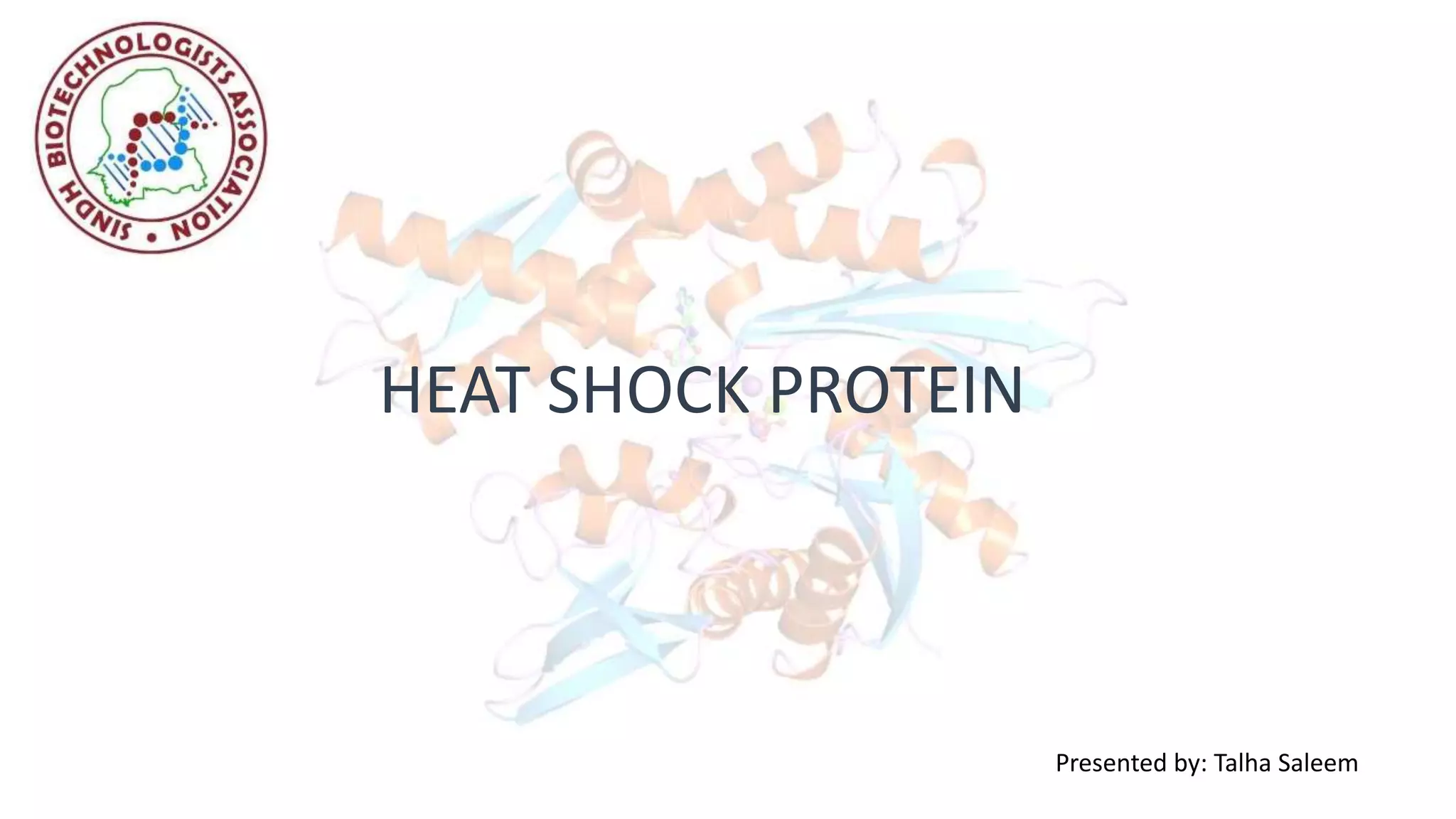
HEAT SHOCK PROTEIN
Presented by: Talha Saleem
PROTEINS
• They are one of the building blocks of human body.
• They serve as fuel source.
• They are macromolecules made up of chains of amino acids.
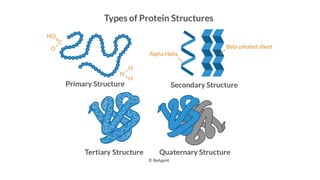
• A linear chain of amino acid residue is called POLYPEPTIDE . A protein
contains at least one long polypeptide.
HEAT SHOCK PROTEIN
• Heat shock protein are a family of proteins that are produced in
response to stressful condition
• They are involved in a wide range of cellular processes such as assisting
protein folding and degradation of misfolded proteins
• They were first described in relation to but are also known to be
expressed during other stresses like cold , UV radiation , healing or
wounding.
DISCOVERY
Heat shock proteins (HSPs) were first
described in the early 1960s in
Drosophila busckii by Ritossa (1962)
CLASSIFICATION OF HEAT SHOCK PROTEINS ON
THE BASIS OF MOLECULAR WEIGHT
• Hsp60 (Chaperons) = molecular weight is 60 kilo Daltons
• Hsp70=molecular weight is 70 kilo Daltons
• Hsp90=molecular weight is 90 kilo Daltons
• Hsp100=molecular weight is 100 kilo Daltons
• The small 8 kilo Dalton protein UBIQUITIN , which marks protein for
degradation , also has a feature of heat shock protein.
• A conserved protein binding domain of approximately 80 amino-acid
alpha crystalline are known as small heat shock proteins (sHSP)
FUNCTIONS :
STRESS RESPONSE:
Production of high level of heat shock protein is triggered by
exposure to different kind of environmental stress conditions , such
as infection , inflammation , UV radiations, nitrogen deficiency (in
plants) .
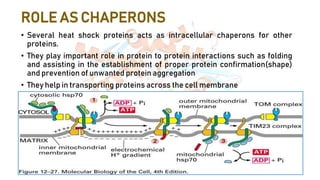
ROLE AS CHAPERONS
• Several heat shock proteins acts as intracellular chaperons for other
proteins.
• They play important role in protein to protein interactions such as folding
and assisting in the establishment of proper protein confirmation(shape)
and prevention of unwanted protein aggregation
• They help in transporting proteins across the cell membrane
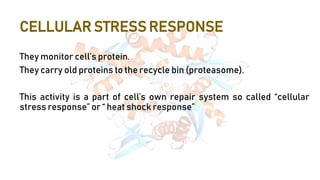
CELLULAR STRESS RESPONSE
They monitor cell’s protein.
They carry old proteins to the recycle bin (proteasome).
This activity is a part of cell’s own repair system so called “cellular
stress response” or “ heat shock response”
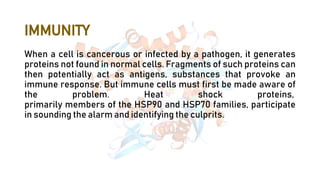
IMMUNITY
When a cell is cancerous or infected by a pathogen, it generates
proteins not found in normal cells. Fragments of such proteins can
then potentially act as antigens, substances that provoke an
immune response. But immune cells must first be made aware of
the problem. Heat shock proteins,
primarily members of the HSP90 and HSP70 families, participate
in sounding the alarm and identifying the culprits.
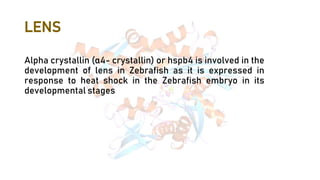
LENS
Alpha crystallin (α4- crystallin) or hspb4 is involved in the
development of lens in Zebrafish as it is expressed in
response to heat shock in the Zebrafish embryo in its
developmental stages
REFERENCES
• https://www.chemicals.co.uk/blog/a-level-chemistry-revision-
organic-chemistry-amino-acids-proteins-DNA
• https://academic.oup.com/jnci/article/92/19/1564/2905948
• https://en.wikipedia.org/wiki/Heat_shock_protein
• https://www.slideshare.net/poorvishah10/heat-shock-proteins
• Could Our Own Proteins Be Used to Help Us Fight Cancer?" printed in
the July 2008 issue of Scientific American
Heat Shock Protein

Heat Shock Protein

  • 1.
  • 2.
    PROTEINS • They areone of the building blocks of human body. • They serve as fuel source. • They are macromolecules made up of chains of amino acids. • A linear chain of amino acid residue is called POLYPEPTIDE . A protein contains at least one long polypeptide.
  • 4.
    HEAT SHOCK PROTEIN •Heat shock protein are a family of proteins that are produced in response to stressful condition • They are involved in a wide range of cellular processes such as assisting protein folding and degradation of misfolded proteins • They were first described in relation to but are also known to be expressed during other stresses like cold , UV radiation , healing or wounding.
  • 5.
    DISCOVERY Heat shock proteins(HSPs) were first described in the early 1960s in Drosophila busckii by Ritossa (1962)
  • 6.
    CLASSIFICATION OF HEATSHOCK PROTEINS ON THE BASIS OF MOLECULAR WEIGHT • Hsp60 (Chaperons) = molecular weight is 60 kilo Daltons • Hsp70=molecular weight is 70 kilo Daltons • Hsp90=molecular weight is 90 kilo Daltons • Hsp100=molecular weight is 100 kilo Daltons • The small 8 kilo Dalton protein UBIQUITIN , which marks protein for degradation , also has a feature of heat shock protein. • A conserved protein binding domain of approximately 80 amino-acid alpha crystalline are known as small heat shock proteins (sHSP)
  • 7.
    FUNCTIONS : STRESS RESPONSE: Productionof high level of heat shock protein is triggered by exposure to different kind of environmental stress conditions , such as infection , inflammation , UV radiations, nitrogen deficiency (in plants) .
  • 8.
    ROLE AS CHAPERONS •Several heat shock proteins acts as intracellular chaperons for other proteins. • They play important role in protein to protein interactions such as folding and assisting in the establishment of proper protein confirmation(shape) and prevention of unwanted protein aggregation • They help in transporting proteins across the cell membrane
  • 9.
    CELLULAR STRESS RESPONSE Theymonitor cell’s protein. They carry old proteins to the recycle bin (proteasome). This activity is a part of cell’s own repair system so called “cellular stress response” or “ heat shock response”
  • 10.
    IMMUNITY When a cellis cancerous or infected by a pathogen, it generates proteins not found in normal cells. Fragments of such proteins can then potentially act as antigens, substances that provoke an immune response. But immune cells must first be made aware of the problem. Heat shock proteins, primarily members of the HSP90 and HSP70 families, participate in sounding the alarm and identifying the culprits.
  • 11.
    LENS Alpha crystallin (α4-crystallin) or hspb4 is involved in the development of lens in Zebrafish as it is expressed in response to heat shock in the Zebrafish embryo in its developmental stages
  • 13.
    REFERENCES • https://www.chemicals.co.uk/blog/a-level-chemistry-revision- organic-chemistry-amino-acids-proteins-DNA • https://academic.oup.com/jnci/article/92/19/1564/2905948 •https://en.wikipedia.org/wiki/Heat_shock_protein • https://www.slideshare.net/poorvishah10/heat-shock-proteins • Could Our Own Proteins Be Used to Help Us Fight Cancer?" printed in the July 2008 issue of Scientific American