MOLECULAR CHAPERONES
Definition:
Molecular Chaperones are proteins that monitor non-native conformations, stabilize proteins and
assist the covalent folding or unfolding and the assembly or disassembly of other
macromolecular structures but are not part of the final native structures. Heat shock can induce
the synthesis of many Chaperones, those are also called heat shock proteins (Hsps).
Location:
Chaperones are found in Prokaryotes and Eukaryotes, in mitochondria and in Endoplasmic
Reticulum (ER).
Protein Folding Using Chaperones:
Most proteins must fold into defined three-dimensional structures to become functional. But in
the cellular environment, newly synthesized proteins are at great risk of aberrant folding and
aggregation. Thus they can form toxic species.
To avoid these dangers, cells invest in a complex network of molecular chaperones, which use
ingenious mechanisms to prevent aggregation and promote efficient folding. Because protein
molecules are highly dynamic, constant chaperone surveillance is required to ensure protein
homeostasis (proteostasis).
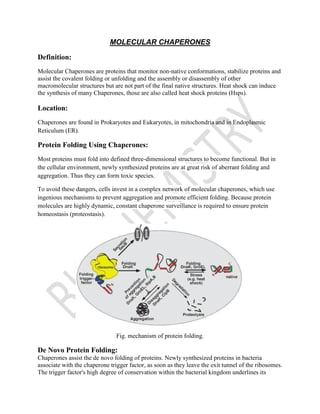
Fig. mechanism of protein folding.
De Novo Protein Folding:
Chaperones assist the de novo folding of proteins. Newly synthesized proteins in bacteria
associate with the chaperone trigger factor, as soon as they leave the exit tunnel of the ribosomes.
The trigger factor's high degree of conservation within the bacterial kingdom underlines its
functional importance. So far the trigger factor has not been found in the cytosol of eukaryotic
cells, but it is assumed that other proteins, like the ribosome-associated protein complex NAC,
can take over trigger factor's function. Exposed hydrophobic side chains of the newly
synthesized polypeptides are most likely protected from wrong interactions by association with
the trigger factor. In addition, the trigger factor may prevent premature folding until a complete
domain has emerged from the ribosomal exit site. It is assumed that after release from the trigger
factor the newly synthesized polypeptide chain can start or continue its folding into the native
state. The speed of the folding process and the yield of correctly folded proteins differ from
protein to protein. Chaperones support folding into the native state by cycles of binding and
release of the protein substrates.
Chaperones Repair Misfolded Proteins:
Stress conditions like a sudden increase in temperature can cause proteins to unfold and
aggregate. Different chaperone systems function in the cell as a protective system to prevent
protein aggregation by binding to the misfolded proteins. Examples of this are the DnaK
(Hsp70) and GroEL (Hsp60) systems, both working together with regulatory co-chaperones, and
the small heat shock proteins IbpAB (sHsps).
Refolding of Aggregated Proteins:
For a long time protein aggregation was thought to be a dead end in the life of proteins,
comparable with a boiled egg that cannot be unboiled again. New studies with the model systems
baker's yeast (Saccharomyces cerevisiae), the bacterium E. coli, and the plant Arabidopsis
thaliana, however, demonstrated that preexisting protein aggregates can be successfully
disaggregated and even refolded to the active conformation. Disaggregation of protein
aggregates was demonstrated in vivo and in the test tube by using thermolabile malate
dehydrogenase (MDH) as a reporter enzyme. Large aggregates of MDH could be resolubilized in
vitro and MDH was refolded afterwards into its native structure.
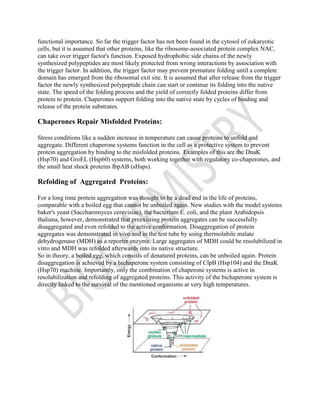
So in theory, a boiled egg, which consists of denatured proteins, can be unboiled again. Protein
disaggregation is achieved by a bichaperone system consisting of ClpB (Hsp104) and the DnaK
(Hsp70) machine. Importantly, only the combination of chaperone systems is active in
resolubilization and refolding of aggregated proteins. This activity of the bichaperone system is
directly linked to the survival of the mentioned organisms at very high temperatures.
Chaperones

Chaperones

  • 1.
    MOLECULAR CHAPERONES Definition: Molecular Chaperonesare proteins that monitor non-native conformations, stabilize proteins and assist the covalent folding or unfolding and the assembly or disassembly of other macromolecular structures but are not part of the final native structures. Heat shock can induce the synthesis of many Chaperones, those are also called heat shock proteins (Hsps). Location: Chaperones are found in Prokaryotes and Eukaryotes, in mitochondria and in Endoplasmic Reticulum (ER). Protein Folding Using Chaperones: Most proteins must fold into defined three-dimensional structures to become functional. But in the cellular environment, newly synthesized proteins are at great risk of aberrant folding and aggregation. Thus they can form toxic species. To avoid these dangers, cells invest in a complex network of molecular chaperones, which use ingenious mechanisms to prevent aggregation and promote efficient folding. Because protein molecules are highly dynamic, constant chaperone surveillance is required to ensure protein homeostasis (proteostasis). Fig. mechanism of protein folding. De Novo Protein Folding: Chaperones assist the de novo folding of proteins. Newly synthesized proteins in bacteria associate with the chaperone trigger factor, as soon as they leave the exit tunnel of the ribosomes. The trigger factor's high degree of conservation within the bacterial kingdom underlines its
  • 2.
    functional importance. Sofar the trigger factor has not been found in the cytosol of eukaryotic cells, but it is assumed that other proteins, like the ribosome-associated protein complex NAC, can take over trigger factor's function. Exposed hydrophobic side chains of the newly synthesized polypeptides are most likely protected from wrong interactions by association with the trigger factor. In addition, the trigger factor may prevent premature folding until a complete domain has emerged from the ribosomal exit site. It is assumed that after release from the trigger factor the newly synthesized polypeptide chain can start or continue its folding into the native state. The speed of the folding process and the yield of correctly folded proteins differ from protein to protein. Chaperones support folding into the native state by cycles of binding and release of the protein substrates. Chaperones Repair Misfolded Proteins: Stress conditions like a sudden increase in temperature can cause proteins to unfold and aggregate. Different chaperone systems function in the cell as a protective system to prevent protein aggregation by binding to the misfolded proteins. Examples of this are the DnaK (Hsp70) and GroEL (Hsp60) systems, both working together with regulatory co-chaperones, and the small heat shock proteins IbpAB (sHsps). Refolding of Aggregated Proteins: For a long time protein aggregation was thought to be a dead end in the life of proteins, comparable with a boiled egg that cannot be unboiled again. New studies with the model systems baker's yeast (Saccharomyces cerevisiae), the bacterium E. coli, and the plant Arabidopsis thaliana, however, demonstrated that preexisting protein aggregates can be successfully disaggregated and even refolded to the active conformation. Disaggregation of protein aggregates was demonstrated in vivo and in the test tube by using thermolabile malate dehydrogenase (MDH) as a reporter enzyme. Large aggregates of MDH could be resolubilized in vitro and MDH was refolded afterwards into its native structure. So in theory, a boiled egg, which consists of denatured proteins, can be unboiled again. Protein disaggregation is achieved by a bichaperone system consisting of ClpB (Hsp104) and the DnaK (Hsp70) machine. Importantly, only the combination of chaperone systems is active in resolubilization and refolding of aggregated proteins. This activity of the bichaperone system is directly linked to the survival of the mentioned organisms at very high temperatures.