HEAT SHOCK PROTIENS
- Purvi Shah
Proteins are the major components of living
organisms and perform a wide range of essential
functions in cells
Proteins regulate metabolic activity, catalyze
biochemical reactions and maintain structural integrity
of cells and organisms
Proteins
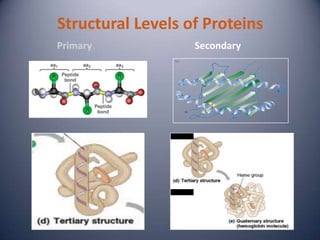
Structural Levels of Proteins
Primary Secondary
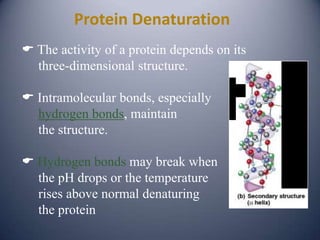
Protein Denaturation
 The activity of a protein depends on its
three-dimensional structure.
 Intramolecular bonds, especially
hydrogen bonds, maintain
the structure.
 Hydrogen bonds may break when
the pH drops or the temperature
rises above normal denaturing
the protein
Protein Denaturation with
extreme pH or Temp.
Temp
environ
Temp
cell
Folded
Proteins
Unfolded
Proteins Aggregates
Loss of Protein
Function
Network
failure
Death
Cell
Interesting story
F. Ritossa –1960 discovered the heat shock (HS)
response while observing the salivary
cells of Drosophila and named them HSP’s
My name is
Chaperone
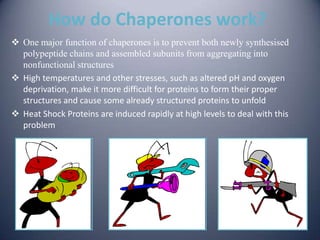
How do Chaperones work?
 One major function of chaperones is to prevent both newly synthesised
polypeptide chains and assembled subunits from aggregating into
nonfunctional structures
 High temperatures and other stresses, such as altered pH and oxygen
deprivation, make it more difficult for proteins to form their proper
structures and cause some already structured proteins to unfold
 Heat Shock Proteins are induced rapidly at high levels to deal with this
problem
Different Types of Heat
Shock Proteins
Heat Shock Proteins are classified by their molecular
weight, size, structure, and function.
They are divided into several families, namely -
1. HSP100
2. HSP90
3. HSP70
4. HSP60 (chaperonin)
5. Small Heat Shock Proteins/ (alpha)-crystalline
proteins
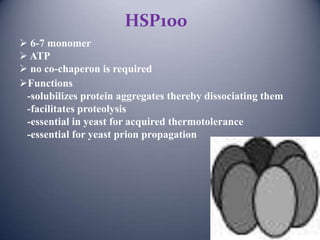
HSP100
Functions
-solubilizes protein aggregates thereby dissociating them
-facilitates proteolysis
-essential in yeast for acquired thermotolerance
-essential for yeast prion propagation
 6-7 monomer
 ATP
 no co-chaperon is required
HSP 90
stabilizes proteins prior to complete folding or activation
forms stable complexes with inactive glucocorticoid receptor and other
transcription factors
most abundant non-ribosomal protein (cytosolic version)
most abundant protein in endoplasmic reticulum (ER version)
 dimer
 ATP
 HoP and p23
HSP90 interacts with HSP40, HSC70/HSP90 organizing protein
(HOP), and co-chaperones to bind and stabilize newly synthesized substrate/client proteins. This ATPregulated
cycle of substrate binding is critical to the activation of many oncogenic signaling molecules.
HSP70
 monomer
 ATP
 DnaJ and GrpE
 assists in protein transport into mitochondria and the endoplasmic
reticulum
 protects proteins under stress
 stabilizes proteins prior to complete folding
 transports across membranes and proteolysis
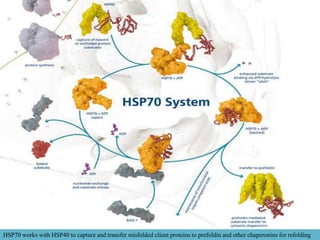
HSP70 works with HSP40 to capture and transfer misfolded client proteins to prefoldin and other chaperonins for refolding
HSP60
 14-16 monomer
 ATP
 GroES and GroEL
 mediate the native folding of proteins through
cooperation of HSP70 and 60
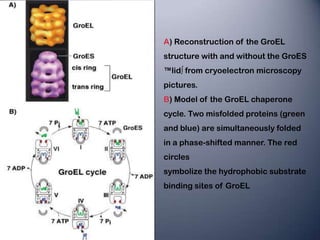
A) Reconstruction of the GroEL
structure with and without the GroES
™lid∫ from cryoelectron microscopy
pictures.
B) Model of the GroEL chaperone
cycle. Two misfolded proteins (green
and blue) are simultaneously folded
in a phase-shifted manner. The red
circles
symbolize the hydrophobic substrate
binding sites of GroEL
sHsp
 8-24 monomer
 exhibit chaperone activity in vitro and thermoprotection in vivo
 produced at significant levels in cells experiencing heat stress
 most are heat inducible, but some are synthesized in unstressed
conditions-such as for cell development
Denatured or unfolded substrates bind to the hydrophilic surface of small HSP complexes and prevent the
substrate from aggregating.The substrate either stays sequestered or is released to be refolded or degraded.
Why Don't Heat Shock Proteins
Denature?
Better Hydrogen Bonds
Better Hydrophobic Internal Packing
Enhanced Secondary Structure
Helix Dipole Stabilization
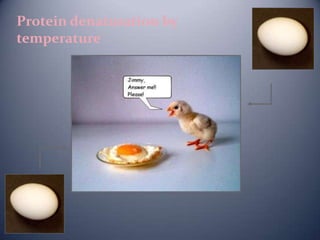
Protein denaturation by
temperature
Heat shock proteins

Heat shock proteins

  • 1.
  • 2.
    Proteins are themajor components of living organisms and perform a wide range of essential functions in cells Proteins regulate metabolic activity, catalyze biochemical reactions and maintain structural integrity of cells and organisms Proteins
  • 3.
    Structural Levels ofProteins Primary Secondary
  • 4.
    Protein Denaturation  Theactivity of a protein depends on its three-dimensional structure.  Intramolecular bonds, especially hydrogen bonds, maintain the structure.  Hydrogen bonds may break when the pH drops or the temperature rises above normal denaturing the protein
  • 5.
  • 6.
  • 7.
    Interesting story F. Ritossa–1960 discovered the heat shock (HS) response while observing the salivary cells of Drosophila and named them HSP’s My name is Chaperone
  • 8.
    How do Chaperoneswork?  One major function of chaperones is to prevent both newly synthesised polypeptide chains and assembled subunits from aggregating into nonfunctional structures  High temperatures and other stresses, such as altered pH and oxygen deprivation, make it more difficult for proteins to form their proper structures and cause some already structured proteins to unfold  Heat Shock Proteins are induced rapidly at high levels to deal with this problem
  • 9.
    Different Types ofHeat Shock Proteins Heat Shock Proteins are classified by their molecular weight, size, structure, and function. They are divided into several families, namely - 1. HSP100 2. HSP90 3. HSP70 4. HSP60 (chaperonin) 5. Small Heat Shock Proteins/ (alpha)-crystalline proteins
  • 10.
    HSP100 Functions -solubilizes protein aggregatesthereby dissociating them -facilitates proteolysis -essential in yeast for acquired thermotolerance -essential for yeast prion propagation  6-7 monomer  ATP  no co-chaperon is required
  • 12.
    HSP 90 stabilizes proteinsprior to complete folding or activation forms stable complexes with inactive glucocorticoid receptor and other transcription factors most abundant non-ribosomal protein (cytosolic version) most abundant protein in endoplasmic reticulum (ER version)  dimer  ATP  HoP and p23
  • 13.
    HSP90 interacts withHSP40, HSC70/HSP90 organizing protein (HOP), and co-chaperones to bind and stabilize newly synthesized substrate/client proteins. This ATPregulated cycle of substrate binding is critical to the activation of many oncogenic signaling molecules.
  • 14.
    HSP70  monomer  ATP DnaJ and GrpE  assists in protein transport into mitochondria and the endoplasmic reticulum  protects proteins under stress  stabilizes proteins prior to complete folding  transports across membranes and proteolysis
  • 15.
    HSP70 works withHSP40 to capture and transfer misfolded client proteins to prefoldin and other chaperonins for refolding
  • 16.
    HSP60  14-16 monomer ATP  GroES and GroEL  mediate the native folding of proteins through cooperation of HSP70 and 60
  • 18.
    A) Reconstruction ofthe GroEL structure with and without the GroES ™lid∫ from cryoelectron microscopy pictures. B) Model of the GroEL chaperone cycle. Two misfolded proteins (green and blue) are simultaneously folded in a phase-shifted manner. The red circles symbolize the hydrophobic substrate binding sites of GroEL
  • 19.
    sHsp  8-24 monomer exhibit chaperone activity in vitro and thermoprotection in vivo  produced at significant levels in cells experiencing heat stress  most are heat inducible, but some are synthesized in unstressed conditions-such as for cell development
  • 20.
    Denatured or unfoldedsubstrates bind to the hydrophilic surface of small HSP complexes and prevent the substrate from aggregating.The substrate either stays sequestered or is released to be refolded or degraded.
  • 21.
    Why Don't HeatShock Proteins Denature? Better Hydrogen Bonds Better Hydrophobic Internal Packing Enhanced Secondary Structure Helix Dipole Stabilization
  • 22.