MOLECULAR TAXONOMY
K.K.Gupta
Department of Zoology
VBU, Hazaribag
• Morphology to molecular character becomes
basis of taxonomy & biosystematics with
respect to advancement in technology.
• In the origin of sp. Micro-changes i.e change in
gene frequency initiates first in the population
and then at macro & other changes into other
higher taxonomic categories
Molecules involved in gene expression is considered for molecular
taxonomy and these molecules changes at microlevel
Definition
• Classification of living organisms based on
molecular evolutionary relationships between
and among different groups of species
i.e
• Similarities and dissimilarities of molecules
based taxonomy is called molecular
taxonomy as the changes in the molecules is
general rule at first level of speciation
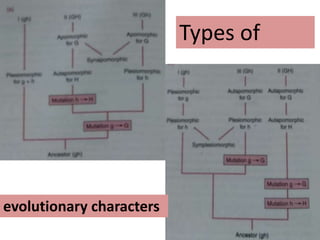
Types of
evolutionary characters
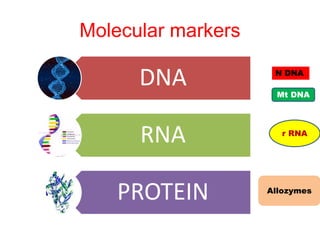
Molecular markers
DNA
RNA
PROTEIN
N DNA
Mt DNA
r RNA
Allozymes
Molecular markers/Parameters of
molecular taxonomy
• Molecular markers can be characterized as
• Type I and Type II markers;
• 1) Type I markers are associated with genes of known
function Examples Allozyme markers are type I
markers as the proteins they encode are associated
with some functions
• COI Cyt b of Mitochondria
• 2) Type II markers are associated with genes of
unknown function. Also called arbitary markers
• . Microsatellites and other neutral markers like RFLP,
RAPD, AFLP etc are type II markers unless they are
associated with genes of some known function.
Arbitrary Nuclear DNA markers
• Arbitrary markers are used when we target a segment of DNA of
unknown function.
• The widely used methods of amplifying unknown regions are
• RAPD (Random Amplified Polymorphic DNA) and
• AFLP (Amplified Fragment Length Polymorphism) DNA.
• Specific Nuclear DNA markers
• VNTR - Variable Number of Tandem Repeat is a segment of DNA
that is repeated tens or even hundreds to thousands of times in
nuclear genome. They repeat in tandem; vary in number in
different loci and differently in individuals.
• Repetitive DNA It is also polymorphic like
• minisatellite DNA referring to genetic loci with repeats of length 9-
65 bp and polymorphic
• microsatellite DNA with repeats of 2-8 bp (1-6) long. Microsatellites
are much more numerous in the genome of vertebrates than mini
satellites.
Molecular Marker
Single Nucleotide Polymorphisms
• Single nucleotide polymorphisms arise due to single
nucleotide substitutions transitions/transversions) or
single nucleotide insertions/deletions.
• These point mutations give rise to different alleles
with alternative bases at a particular nucleotide
position.
• SNP,s are the most abundant polymorphisms in the
genome (coding and non-coding) of any organism.
• These single nucleotide variants can be detected
using PCR, microchip arrays or fluorescence
technology.
Techniques used in Molecular
Taxonomy
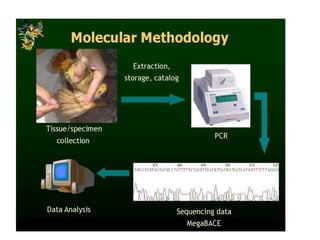
• Isolation of DNA/RNA /Protein
• cDNA preparation
• PCR
• Gel elctrophoresis
• DNA Microarray /DNA chips
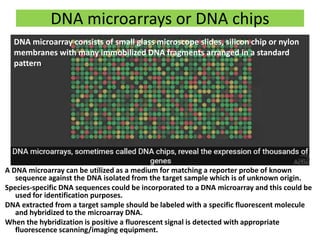
DNA microarrays or DNA chips
A DNA microarray can be utilized as a medium for matching a reporter probe of known
sequence against the DNA isolated from the target sample which is of unknown origin.
Species-specific DNA sequences could be incorporated to a DNA microarray and this could be
used for identification purposes.
DNA extracted from a target sample should be labeled with a specific fluorescent molecule
and hybridized to the microarray DNA.
When the hybridization is positive a fluorescent signal is detected with appropriate
fluorescence scanning/imaging equipment.
DNA microarray consists of small glass microscope slides, silicon chip or nylon
membranes with many immobilized DNA fragments arranged in a standard
pattern.
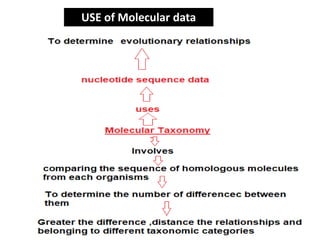
USE of Molecular data
N DNA
• N DNA Based Molecular Marker
–RFLP , AFLP, RAPD
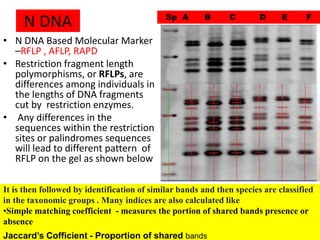
• Restriction fragment length
polymorphisms, or RFLPs, are
differences among individuals in
the lengths of DNA fragments
cut by restriction enzymes.
• Any differences in the
sequences within the restriction
sites or palindromes sequences
will lead to different pattern of
RFLP on the gel as shown below
Sp A B C D E F
It is then followed by identification of similar bands and then species are classified
in the taxonomic groups . Many indices are also calculated like
•Simple matching coefficient - measures the portion of shared bands presence or
absence
Jaccard’s Cofficient - Proportion of shared bands
Example
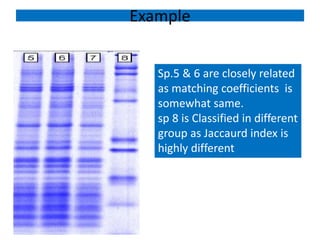
Sp.5 & 6 are closely related
as matching coefficients is
somewhat same.
sp 8 is Classified in different
group as Jaccaurd index is
highly different
Example
• Chromosomal DNA from Aeromonas strains, E. coli, V.
fluvialis, and P. putida were analysed with respect to
many restriction enzymes and classification was done
obtained from an Plasmid DNA (pARO39), the source
of aroA gene
• Twenty nine Phormidium-like strains, obtained from
different culture collections, isolated from different
habitats and geographical localities were analyzed
morphologically as well as using RAPD markers
(random amplified polymorphic DNA) and RFLP
(restriction fragment length polymorphism) of 16S
rRNA sequences.
Mt DNA
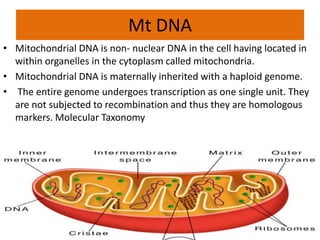
• Mitochondrial DNA is non- nuclear DNA in the cell having located in
within organelles in the cytoplasm called mitochondria.
• Mitochondrial DNA is maternally inherited with a haploid genome.
• The entire genome undergoes transcription as one single unit. They
are not subjected to recombination and thus they are homologous
markers. Molecular Taxonomy
Example
• Raw meat samples of cow, chicken, turkey, sheep, pig,
buffalo, camel and donkey was studied
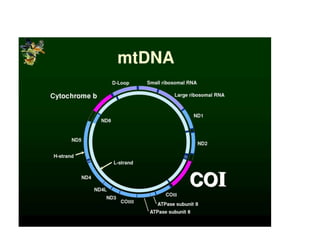
• Using PCR-RFLP of a part of the mitochondrial cytochrome
c oxidase subunit 1 (COI) gene was used for identification
of species.
• PCR yielded a 710-bp fragment in all species. The amplicons
were digested with seven restriction endonucleases (Hind
II, Ava II, Rsa I, Taq I, Hpa II, Tru 1I and Xba I) .
• Different levels of polymorphism were detected among
samples.
• Restriction with Hpa II was sufficient to discriminate all
targeted species.
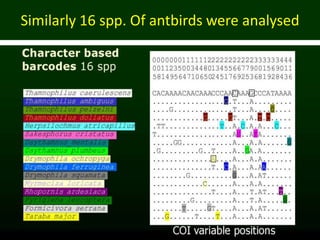
Similarly 16 spp. Of antbirds were analysed
16 s /18srRNA based Taxonomy
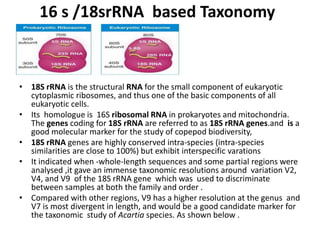
• 18S rRNA is the structural RNA for the small component of eukaryotic
cytoplasmic ribosomes, and thus one of the basic components of all
eukaryotic cells.
• Its homologue is 16S ribosomal RNA in prokaryotes and mitochondria.
The genes coding for 18S rRNA are referred to as 18S rRNA genes.and is a
good molecular marker for the study of copepod biodiversity,
• 18S rRNA genes are highly conserved intra-species (intra-species
similarities are close to 100%) but exhibit interspecific varations
• It indicated when -whole-length sequences and some partial regions were
analysed ,it gave an immense taxonomic resolutions around variation V2,
V4, and V9 of the 18S rRNA gene which was used to discriminate
between samples at both the family and order .
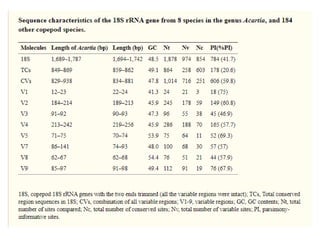
• Compared with other regions, V9 has a higher resolution at the genus and
V7 is most divergent in length, and would be a good candidate marker for
the taxonomic study of Acartia species. As shown below .
Protein based molecular taxonomy
• Isozyme are the good protein based taxonomic marker.
• Isozymes are enzymes that differ in amino acid sequence but
catalyze the same chemical reaction.
• example glucokinase,,Alkaline phosphatase, LDH. ADH ( Alcohal
dehydrogenase) etc They are encoded by the same gene but show
variations in the sequence.
• For examples
• Thirty axenically (the state of a culture in which only a single
species, variety, or strain of organism is present and entirely free of
all other contaminating organisms.)grown reference strains
belonging to 15 different Acanthamoeba spp. were investigated for
isoenzyme patterns by agarose isoelectric focusing for acid
phosphatase, leucine amino peptidase, malate dehydrogenase,
propionyl esterase, glucose phosphate isomerase,
phosphoglucomutase, and alcohol dehydrogenase.
• The results. Acanthamoeba paradivionensis as a synonym of A.
divionensis.
Conclusion
. Thus, the molecular taxonomy is the most
authentic as such markers show less intra-
specific variations but have strong inter-specific
variation to be considered without any doubt
as clear taxonomic maker over others.
Thanks & Take
Care

Mole taxonmy 22

  • 1.
  • 2.
    • Morphology tomolecular character becomes basis of taxonomy & biosystematics with respect to advancement in technology. • In the origin of sp. Micro-changes i.e change in gene frequency initiates first in the population and then at macro & other changes into other higher taxonomic categories Molecules involved in gene expression is considered for molecular taxonomy and these molecules changes at microlevel
  • 3.
    Definition • Classification ofliving organisms based on molecular evolutionary relationships between and among different groups of species i.e • Similarities and dissimilarities of molecules based taxonomy is called molecular taxonomy as the changes in the molecules is general rule at first level of speciation
  • 4.
  • 5.
  • 6.
    Molecular markers/Parameters of moleculartaxonomy • Molecular markers can be characterized as • Type I and Type II markers; • 1) Type I markers are associated with genes of known function Examples Allozyme markers are type I markers as the proteins they encode are associated with some functions • COI Cyt b of Mitochondria • 2) Type II markers are associated with genes of unknown function. Also called arbitary markers • . Microsatellites and other neutral markers like RFLP, RAPD, AFLP etc are type II markers unless they are associated with genes of some known function.
  • 7.
    Arbitrary Nuclear DNAmarkers • Arbitrary markers are used when we target a segment of DNA of unknown function. • The widely used methods of amplifying unknown regions are • RAPD (Random Amplified Polymorphic DNA) and • AFLP (Amplified Fragment Length Polymorphism) DNA. • Specific Nuclear DNA markers • VNTR - Variable Number of Tandem Repeat is a segment of DNA that is repeated tens or even hundreds to thousands of times in nuclear genome. They repeat in tandem; vary in number in different loci and differently in individuals. • Repetitive DNA It is also polymorphic like • minisatellite DNA referring to genetic loci with repeats of length 9- 65 bp and polymorphic • microsatellite DNA with repeats of 2-8 bp (1-6) long. Microsatellites are much more numerous in the genome of vertebrates than mini satellites.
  • 8.
    Molecular Marker Single NucleotidePolymorphisms • Single nucleotide polymorphisms arise due to single nucleotide substitutions transitions/transversions) or single nucleotide insertions/deletions. • These point mutations give rise to different alleles with alternative bases at a particular nucleotide position. • SNP,s are the most abundant polymorphisms in the genome (coding and non-coding) of any organism. • These single nucleotide variants can be detected using PCR, microchip arrays or fluorescence technology.
  • 10.
    Techniques used inMolecular Taxonomy • Isolation of DNA/RNA /Protein • cDNA preparation • PCR • Gel elctrophoresis • DNA Microarray /DNA chips
  • 11.
    DNA microarrays orDNA chips A DNA microarray can be utilized as a medium for matching a reporter probe of known sequence against the DNA isolated from the target sample which is of unknown origin. Species-specific DNA sequences could be incorporated to a DNA microarray and this could be used for identification purposes. DNA extracted from a target sample should be labeled with a specific fluorescent molecule and hybridized to the microarray DNA. When the hybridization is positive a fluorescent signal is detected with appropriate fluorescence scanning/imaging equipment. DNA microarray consists of small glass microscope slides, silicon chip or nylon membranes with many immobilized DNA fragments arranged in a standard pattern.
  • 12.
  • 13.
    N DNA • NDNA Based Molecular Marker –RFLP , AFLP, RAPD • Restriction fragment length polymorphisms, or RFLPs, are differences among individuals in the lengths of DNA fragments cut by restriction enzymes. • Any differences in the sequences within the restriction sites or palindromes sequences will lead to different pattern of RFLP on the gel as shown below Sp A B C D E F It is then followed by identification of similar bands and then species are classified in the taxonomic groups . Many indices are also calculated like •Simple matching coefficient - measures the portion of shared bands presence or absence Jaccard’s Cofficient - Proportion of shared bands
  • 14.
    Example Sp.5 & 6are closely related as matching coefficients is somewhat same. sp 8 is Classified in different group as Jaccaurd index is highly different
  • 15.
    Example • Chromosomal DNAfrom Aeromonas strains, E. coli, V. fluvialis, and P. putida were analysed with respect to many restriction enzymes and classification was done obtained from an Plasmid DNA (pARO39), the source of aroA gene • Twenty nine Phormidium-like strains, obtained from different culture collections, isolated from different habitats and geographical localities were analyzed morphologically as well as using RAPD markers (random amplified polymorphic DNA) and RFLP (restriction fragment length polymorphism) of 16S rRNA sequences.
  • 16.
    Mt DNA • MitochondrialDNA is non- nuclear DNA in the cell having located in within organelles in the cytoplasm called mitochondria. • Mitochondrial DNA is maternally inherited with a haploid genome. • The entire genome undergoes transcription as one single unit. They are not subjected to recombination and thus they are homologous markers. Molecular Taxonomy
  • 18.
    Example • Raw meatsamples of cow, chicken, turkey, sheep, pig, buffalo, camel and donkey was studied • Using PCR-RFLP of a part of the mitochondrial cytochrome c oxidase subunit 1 (COI) gene was used for identification of species. • PCR yielded a 710-bp fragment in all species. The amplicons were digested with seven restriction endonucleases (Hind II, Ava II, Rsa I, Taq I, Hpa II, Tru 1I and Xba I) . • Different levels of polymorphism were detected among samples. • Restriction with Hpa II was sufficient to discriminate all targeted species.
  • 19.
    Similarly 16 spp.Of antbirds were analysed
  • 20.
    16 s /18srRNAbased Taxonomy • 18S rRNA is the structural RNA for the small component of eukaryotic cytoplasmic ribosomes, and thus one of the basic components of all eukaryotic cells. • Its homologue is 16S ribosomal RNA in prokaryotes and mitochondria. The genes coding for 18S rRNA are referred to as 18S rRNA genes.and is a good molecular marker for the study of copepod biodiversity, • 18S rRNA genes are highly conserved intra-species (intra-species similarities are close to 100%) but exhibit interspecific varations • It indicated when -whole-length sequences and some partial regions were analysed ,it gave an immense taxonomic resolutions around variation V2, V4, and V9 of the 18S rRNA gene which was used to discriminate between samples at both the family and order . • Compared with other regions, V9 has a higher resolution at the genus and V7 is most divergent in length, and would be a good candidate marker for the taxonomic study of Acartia species. As shown below .
  • 22.
    Protein based moleculartaxonomy • Isozyme are the good protein based taxonomic marker. • Isozymes are enzymes that differ in amino acid sequence but catalyze the same chemical reaction. • example glucokinase,,Alkaline phosphatase, LDH. ADH ( Alcohal dehydrogenase) etc They are encoded by the same gene but show variations in the sequence. • For examples • Thirty axenically (the state of a culture in which only a single species, variety, or strain of organism is present and entirely free of all other contaminating organisms.)grown reference strains belonging to 15 different Acanthamoeba spp. were investigated for isoenzyme patterns by agarose isoelectric focusing for acid phosphatase, leucine amino peptidase, malate dehydrogenase, propionyl esterase, glucose phosphate isomerase, phosphoglucomutase, and alcohol dehydrogenase. • The results. Acanthamoeba paradivionensis as a synonym of A. divionensis.
  • 23.
    Conclusion . Thus, themolecular taxonomy is the most authentic as such markers show less intra- specific variations but have strong inter-specific variation to be considered without any doubt as clear taxonomic maker over others.
  • 24.