‘
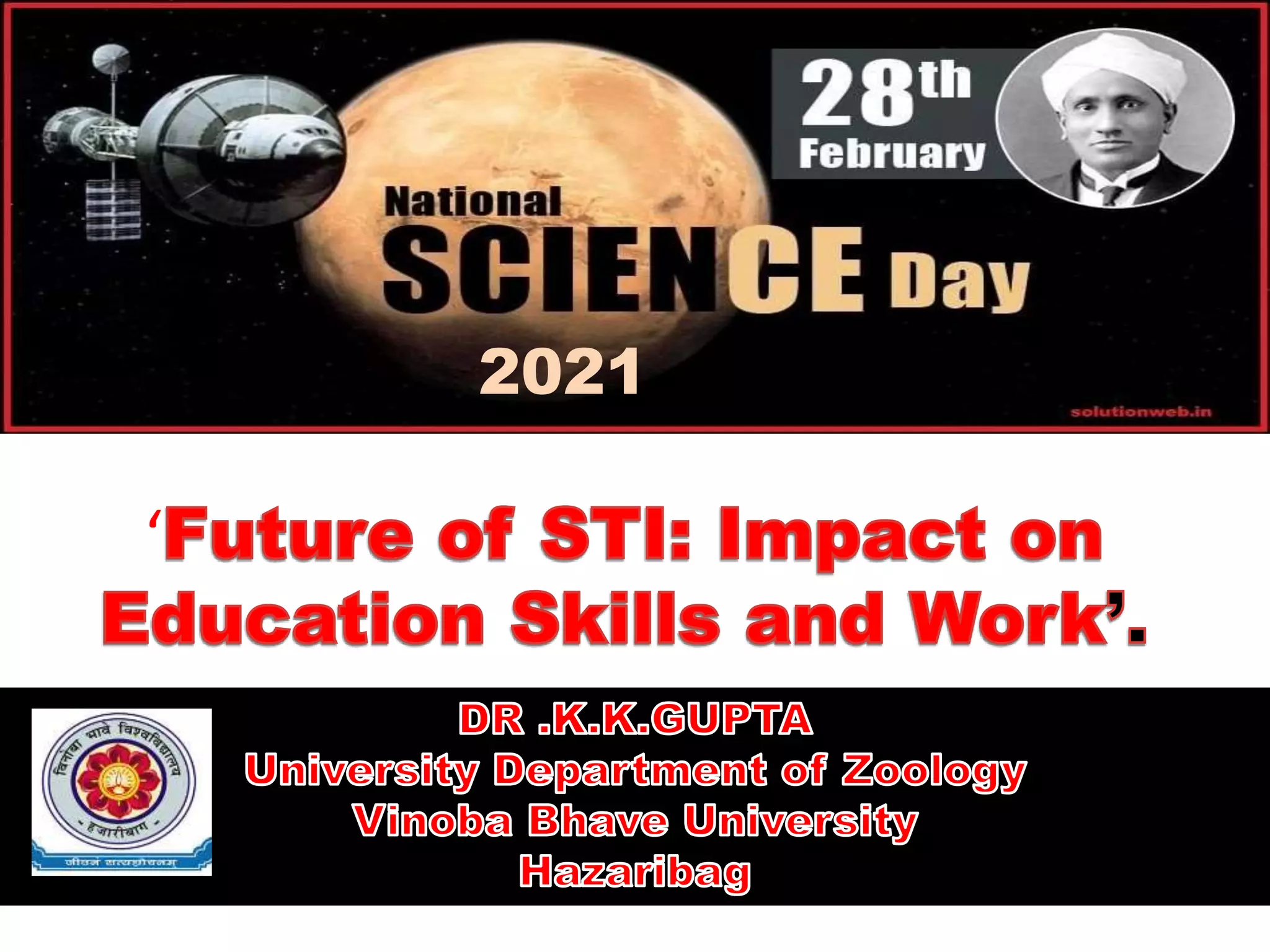
2021
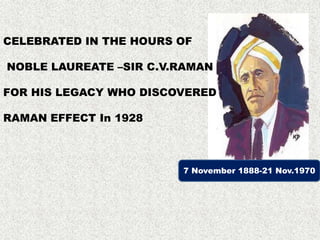
CELEBRATED IN THE HOURS OF
NOBLE LAUREATE –SIR C.V.RAMAN
FOR HIS LEGACY WHO DISCOVERED
RAMAN EFFECT In 1928
7 November 1888-21 Nov.1970
STI Skill, Technology and Innovation
India has
entered in 21st
centaury and
promised to
become the
leading country
among top three
nations- USA
CHINA & RUSSIA
Science, Technology and Innovation
(STI) are the key drivers for economic
growth and human development.
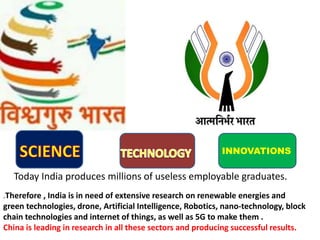
INNOVATIONS
Today India produces millions of useless employable graduates.
.Therefore , India is in need of extensive research on renewable energies and
green technologies, drone, Artificial Intelligence, Robotics, nano-technology, block
chain technologies and internet of things, as well as 5G to make them .
China is leading in research in all these sectors and producing successful results.
WHY?
Objectives
STI for people and people for STI.
It aims to bring all the benefits of
Science, Technology & Innovation
to the national development and
sustainable and more inclusive
growth
The New Education Policy 2020 has proposed major
structural changes into our education system.
A new culture of Atmanirbharta (self-reliance) that includes
Atmavishwas (self-confidence), Atmasamman (self-respect) and
Atmachintan (self-assessment) must be inculcated among students
at all educational levels.
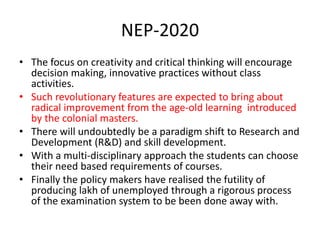
NEP-2020
• The focus on creativity and critical thinking will encourage
decision making, innovative practices without class
activities.
• Such revolutionary features are expected to bring about
radical improvement from the age-old learning introduced
by the colonial masters.
• There will undoubtedly be a paradigm shift to Research and
Development (R&D) and skill development.
• With a multi-disciplinary approach the students can choose
their need based requirements of courses.
• Finally the policy makers have realised the futility of
producing lakh of unemployed through a rigorous process
of the examination system to be been done away with.
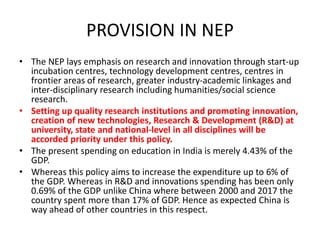
PROVISION IN NEP
• The NEP lays emphasis on research and innovation through start-up
incubation centres, technology development centres, centres in
frontier areas of research, greater industry-academic linkages and
inter-disciplinary research including humanities/social science
research.
• Setting up quality research institutions and promoting innovation,
creation of new technologies, Research & Development (R&D) at
university, state and national-level in all disciplines will be
accorded priority under this policy.
• The present spending on education in India is merely 4.43% of the
GDP.
• Whereas this policy aims to increase the expenditure up to 6% of
the GDP. Whereas in R&D and innovations spending has been only
0.69% of the GDP unlike China where between 2000 and 2017 the
country spent more than 17% of GDP. Hence as expected China is
way ahead of other countries in this respect.
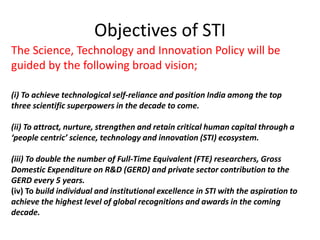
Objectives of STI
The Science, Technology and Innovation Policy will be
guided by the following broad vision;
(i) To achieve technological self-reliance and position India among the top
three scientific superpowers in the decade to come.
(ii) To attract, nurture, strengthen and retain critical human capital through a
‘people centric’ science, technology and innovation (STI) ecosystem.
(iii) To double the number of Full-Time Equivalent (FTE) researchers, Gross
Domestic Expenditure on R&D (GERD) and private sector contribution to the
GERD every 5 years.
(iv) To build individual and institutional excellence in STI with the aspiration to
achieve the highest level of global recognitions and awards in the coming
decade.
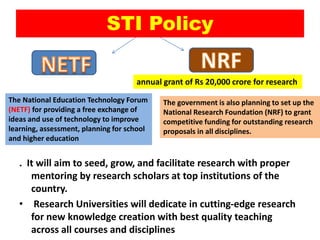
STI Policy
. It will aim to seed, grow, and facilitate research with proper
mentoring by research scholars at top institutions of the
country.
• Research Universities will dedicate in cutting-edge research
for new knowledge creation with best quality teaching
across all courses and disciplines
annual grant of Rs 20,000 crore for research
The National Education Technology Forum
(NETF) for providing a free exchange of
ideas and use of technology to improve
learning, assessment, planning for school
and higher education
The government is also planning to set up the
National Research Foundation (NRF) to grant
competitive funding for outstanding research
proposals in all disciplines.
ATL & MANAK
• Atal Tinkering Labs and Million
Minds Augmenting National
Aspirations and Knowledge
(MANAK)] will be developed
synergistically across schools
for better results.
• Such programmes will be
scaled up with a 10 year future
looking strategy.
• These networked initiatives
should focus upon addressing
different concerns of society.
Innovation and Entrepreneurship Centres
• established starting from the undergraduate level of university
education. Research in innovation practices will be made a
mandatory component of university/college teachers’ professional
development programme;
• The programme will provide faculty development programmes in
Innovation and Design Thinking.
• It will encourage and facilitate university/college teachers for
international research collaborations/exchange programmes in STI.
Continue………
• Creative processes to encourage and engage students
in science and technology education will be designed.
• representation of the ministries of S&T in the working
groups
• A National School and Higher Education Mentorship
Program
• Distance learning programmes will be strengthened
by virtual mode
National research and innovation programme on Assistive
Technologies and Learning Resources to be created Research
Excellence Framework for HEIs in India (REFI)
Transforming existing R&D institutions to research universities. This will foster
better linkages between research and education and also enable effective utilization of
research infrastructure.
In line with the NEP 2020, a mechanism will be created to allow greater academic,
intellectual and functional autonomy to HEIs; one that is linked to accountability and
also strengthens Academia-R&D-Industry collaborations.
Centre and state governments will adopt a coordinated approach for building and
enhancing infrastructure for science laboratories, computer labs, language labs, libraries
etc. This will be achieved through centre-state partnership in order to improve the research
competency.
Transforming existing R&D institutions to research universities. This will foster
better linkages between research and education and also enable effective utilization
of research infrastructure.
Collaborative Research Centres (CRCs) will be established,
that bring together
industries, MSMEs, startups, R&D institutions and HEIs with
the government. This will provide a long term ongoing
collaboration between different STI stakeholders, to
improve industrial research and innovation and enhance
global competitiveness
Higher Education Research Centres (HERCs) will be established in reputed
research-focused universities/institutes in different parts of the country. These centres
should also assess the overall direction of the higher education system in the country, and
provide research inputs to policymakers and higher education leaders.
Increased focus will be put upon skill-building through hands-on training.
For this purpose, academic institutions will be encouraged to create long-term working
relationships with regional MSMEs to address locally relevant issues. Skill development
opportunities will be created in mega-science and related futuristic technology
development engagements.
Teaching-Learning Centres (TLCs) will be created in urban and rural areas for
upskilling of faculty members, to enhance learning experience and engagement, for effective
outcomes.
Vocationally certified workforce will be employed and
recognised by the industry.
My Suggestions
• Think of I for social and national welfare (Atma
Nirbhar
• Apply your innovative mind having (1450 CC) for
the creations and executions in collaborations
with ur institutes .
• Promote and nurture your younger with your
experiences.
• Analyze the fact and fictions.
• Remember Science is not about why rather it is
about why not ?
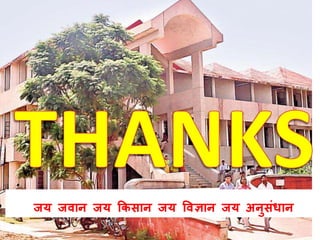
जय जवान जय किसान जय ववज्ञान जय अनुसंधान

National Science Day-2021

  • 1.
  • 2.
    CELEBRATED IN THEHOURS OF NOBLE LAUREATE –SIR C.V.RAMAN FOR HIS LEGACY WHO DISCOVERED RAMAN EFFECT In 1928 7 November 1888-21 Nov.1970
  • 4.
    STI Skill, Technologyand Innovation India has entered in 21st centaury and promised to become the leading country among top three nations- USA CHINA & RUSSIA Science, Technology and Innovation (STI) are the key drivers for economic growth and human development.
  • 5.
    INNOVATIONS Today India producesmillions of useless employable graduates. .Therefore , India is in need of extensive research on renewable energies and green technologies, drone, Artificial Intelligence, Robotics, nano-technology, block chain technologies and internet of things, as well as 5G to make them . China is leading in research in all these sectors and producing successful results.
  • 6.
  • 7.
    Objectives STI for peopleand people for STI. It aims to bring all the benefits of Science, Technology & Innovation to the national development and sustainable and more inclusive growth The New Education Policy 2020 has proposed major structural changes into our education system. A new culture of Atmanirbharta (self-reliance) that includes Atmavishwas (self-confidence), Atmasamman (self-respect) and Atmachintan (self-assessment) must be inculcated among students at all educational levels.
  • 8.
    NEP-2020 • The focuson creativity and critical thinking will encourage decision making, innovative practices without class activities. • Such revolutionary features are expected to bring about radical improvement from the age-old learning introduced by the colonial masters. • There will undoubtedly be a paradigm shift to Research and Development (R&D) and skill development. • With a multi-disciplinary approach the students can choose their need based requirements of courses. • Finally the policy makers have realised the futility of producing lakh of unemployed through a rigorous process of the examination system to be been done away with.
  • 9.
    PROVISION IN NEP •The NEP lays emphasis on research and innovation through start-up incubation centres, technology development centres, centres in frontier areas of research, greater industry-academic linkages and inter-disciplinary research including humanities/social science research. • Setting up quality research institutions and promoting innovation, creation of new technologies, Research & Development (R&D) at university, state and national-level in all disciplines will be accorded priority under this policy. • The present spending on education in India is merely 4.43% of the GDP. • Whereas this policy aims to increase the expenditure up to 6% of the GDP. Whereas in R&D and innovations spending has been only 0.69% of the GDP unlike China where between 2000 and 2017 the country spent more than 17% of GDP. Hence as expected China is way ahead of other countries in this respect.
  • 10.
    Objectives of STI TheScience, Technology and Innovation Policy will be guided by the following broad vision; (i) To achieve technological self-reliance and position India among the top three scientific superpowers in the decade to come. (ii) To attract, nurture, strengthen and retain critical human capital through a ‘people centric’ science, technology and innovation (STI) ecosystem. (iii) To double the number of Full-Time Equivalent (FTE) researchers, Gross Domestic Expenditure on R&D (GERD) and private sector contribution to the GERD every 5 years. (iv) To build individual and institutional excellence in STI with the aspiration to achieve the highest level of global recognitions and awards in the coming decade.
  • 11.
    STI Policy . Itwill aim to seed, grow, and facilitate research with proper mentoring by research scholars at top institutions of the country. • Research Universities will dedicate in cutting-edge research for new knowledge creation with best quality teaching across all courses and disciplines annual grant of Rs 20,000 crore for research The National Education Technology Forum (NETF) for providing a free exchange of ideas and use of technology to improve learning, assessment, planning for school and higher education The government is also planning to set up the National Research Foundation (NRF) to grant competitive funding for outstanding research proposals in all disciplines.
  • 12.
    ATL & MANAK •Atal Tinkering Labs and Million Minds Augmenting National Aspirations and Knowledge (MANAK)] will be developed synergistically across schools for better results. • Such programmes will be scaled up with a 10 year future looking strategy. • These networked initiatives should focus upon addressing different concerns of society.
  • 13.
    Innovation and EntrepreneurshipCentres • established starting from the undergraduate level of university education. Research in innovation practices will be made a mandatory component of university/college teachers’ professional development programme; • The programme will provide faculty development programmes in Innovation and Design Thinking. • It will encourage and facilitate university/college teachers for international research collaborations/exchange programmes in STI.
  • 14.
    Continue……… • Creative processesto encourage and engage students in science and technology education will be designed. • representation of the ministries of S&T in the working groups • A National School and Higher Education Mentorship Program • Distance learning programmes will be strengthened by virtual mode National research and innovation programme on Assistive Technologies and Learning Resources to be created Research Excellence Framework for HEIs in India (REFI)
  • 15.
    Transforming existing R&Dinstitutions to research universities. This will foster better linkages between research and education and also enable effective utilization of research infrastructure. In line with the NEP 2020, a mechanism will be created to allow greater academic, intellectual and functional autonomy to HEIs; one that is linked to accountability and also strengthens Academia-R&D-Industry collaborations. Centre and state governments will adopt a coordinated approach for building and enhancing infrastructure for science laboratories, computer labs, language labs, libraries etc. This will be achieved through centre-state partnership in order to improve the research competency. Transforming existing R&D institutions to research universities. This will foster better linkages between research and education and also enable effective utilization of research infrastructure. Collaborative Research Centres (CRCs) will be established, that bring together industries, MSMEs, startups, R&D institutions and HEIs with the government. This will provide a long term ongoing collaboration between different STI stakeholders, to improve industrial research and innovation and enhance global competitiveness
  • 16.
    Higher Education ResearchCentres (HERCs) will be established in reputed research-focused universities/institutes in different parts of the country. These centres should also assess the overall direction of the higher education system in the country, and provide research inputs to policymakers and higher education leaders. Increased focus will be put upon skill-building through hands-on training. For this purpose, academic institutions will be encouraged to create long-term working relationships with regional MSMEs to address locally relevant issues. Skill development opportunities will be created in mega-science and related futuristic technology development engagements. Teaching-Learning Centres (TLCs) will be created in urban and rural areas for upskilling of faculty members, to enhance learning experience and engagement, for effective outcomes. Vocationally certified workforce will be employed and recognised by the industry.
  • 17.
    My Suggestions • Thinkof I for social and national welfare (Atma Nirbhar • Apply your innovative mind having (1450 CC) for the creations and executions in collaborations with ur institutes . • Promote and nurture your younger with your experiences. • Analyze the fact and fictions. • Remember Science is not about why rather it is about why not ?
  • 18.
    जय जवान जयकिसान जय ववज्ञान जय अनुसंधान