By K. K.Gupta
DNA of interest are cloned in suitable host.
For this the DNA to be cloned are first introduced in
to the suitable vector depending upon the size of genes
Vector bearing genes are then transferred in to host
by several methods
Once transferred in to the host, the inserted gene at
the cloning sites starts amplifying along with host
genome /expresse if expression vector bearing genes.
INTRODUCTION
GeneTransfer
Natural
Transformation
,Transduction ,
Conjugation
Physical Method
Bolistic /Particle
Gun Transfer
Chemical Method
Calcium phosphate
Mediated , Liposome
Mediated
Electrical
Method
Electroporation
Methods of Gene transfer in
Host cell
The process of transferring exogenous gene /DNA in to
bacterial or any single cell viz embryonic cell .stem cell
is called transformation.
It is the direct uptake of exogenous DNA/Vector DNA
from its surroundings and taken up through the cell
membrane .
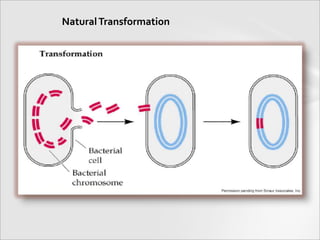
Transformation occurs naturally in some species of
bacteria, but it can also be done by artificial treatment
in other species.
Cells that have undergone this treatment are said to be
competent. The cells with high level of metabolic
activity or cell cycle stage/high DNA repair activity
TRANSFORMATION
TwoTypes
Natural in Bacillus subtilis
Engineered –in E coli the bacterial cells are made competent by certain
treatment
Competency
Bacteria which has ability to uptake the DNA is called
competent which is made by chemical treatment.
Competency is a physiological state which changes the
structure and permeability of cell membrane and then it
allows the entry of the DNA. The concept of the technique
is to render cells competent using CaCl2 to allow for
introduction of plasmid. Plasmids usually contain the
gene(s) of interest in addition to selection and/or antibiotic
resistance markers.
NaturalTransformation
Griffith experiment
Direct DNA uptake by protoplast can be stimulated by using long chain
poly cations viz PEG ,poly lysine ,poly ornithine /DAEA –Dextran with or
without metal ions like Zn, Li, Cs,K,Ca,Mg .
It is applicable to all cells.
PEG is hydrophillic molecules that removes free water when placed in a
solution.Free water molecules interact with charged (Usually ionic )
molecules soluble in water
Under high (15-25% ) of PEG ionic conc. linear macromolecule such as
DNA can no longer stay in solution and get pptd
The protoplast membrane of host bacteria as well as DNA is normally
negatively charged .so repel but high PEG conc. minimise repulsion and
stimulate DNA uptake by endocytosis.
As an alternative now polybrene ( less toxic is used which is more stable.
And trasnsformation efficiency is independent of coiled plasmid.
Poly cation mediated DNA uptake
Poly cation mediated transformation
TRANSDUCTION ( Viral mediated gene transfer
Gene transfer from a donor to a recipient by way of a
bacteriophage..
If the lysogenic cycle is adopted, the phage chromosome
is integrated (by covalent bonds) into the bacterial
chromosome, where it can remain dormant for thousands
of generation
• The lytic cycle leads to the production of new phage
particles which are released by lysis of the host.
•Several types of viruses, including retrovirus, adenovirus, adeno-
associated virus (AAV), and herpes simplex virus, have been
modified in the laboratory for use in gene therapy applications.
Because these vector systems have unique advantages and
Retroviral
methods
Gene are introduced by
replicative defective retrovirus
vector
Effective means of integrating small
piece of transgene of about 8 Kb
Drawbacks as some times entire genome
of the vector gets integrated in the same
nucleus as transgene so transgenic
animal/plant to be used as food is not
recommended
Retrovirus vector
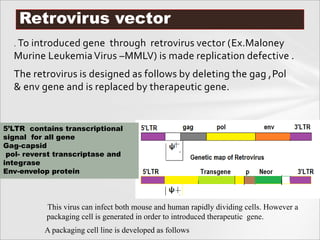
. To introduced gene through retrovirus vector (Ex.Maloney
Murine LeukemiaVirus –MMLV) is made replication defective .
The retrovirus is designed as follows by deleting the gag ,Pol
& env gene and is replaced by therapeutic gene.
This virus can infect both mouse and human rapidly dividing cells. However a
packaging cell is generated in order to introduced therapeutic gene.
A packaging cell line is developed as follows
5’LTR contains transcriptional
signal for all gene
Gag-capsid
pol- reverst transcriptase and
integrase
Env-envelop protein
Construction
Retroviral DNA is cloned
By restriction endo-nuclease and limited exonuclease 3’end of
gag and all pol and env is deleted while 5’end of gag and 5 & 3
; LTR were retained
Transgene expression directed by promoter within 5’LTR
In vito
packaging
of
replicative
defective
retroviral
vector
Production of
packaged
retrovirus
Liposomes are spherical vesicles which are made up of synthetic lipid
bilayers which imitate the structure of biological membranes. DNA to be
transferred is packaged into the liposome in vitro and transferred to the
targeted tissue . The lipid coating helps the DNA to survives in vivo and enters
into the cell by endocytosis. Cationic liposomes, where the positive charge on
liposomes is stabilized by binding of negatively charged DNA, are popular
vehicles for gene transfer in vivo. Inside the cells the cellular lipase breaks the
liposome vesicles and release DNA
Advantage:
The liposomes with the foreign DNA are easy to prepare.
There is no restriction in the size of DNA that is to be transferred.
Disadvantage :
Efficiency of gene transfer is low and transient expression of the foreign gene
is obtained as they are not designed to integrate into the chromosomal DNA.
Liposomes Mediated gene transfer
Lipofection
Neumann in 1982
Electroporation uses electrical pulse of
high field strength (EK) Low field PK)
to produce transient pores in the
plasma membrane thereby allowing
DNA into the cells. It creates
activation of permease. These pores
are known as electropores.
This is done in an equipment called
electroporator
Electroporation has been used for a long time
for transient and integrative transformation of
protoplast.. Further transformability of intact
plant cell or tissues depend upon
pretreatment of cells / tissues to be
transformed either by mechanical wounding
or enzyme containing 0.3% macerozyme
solutions. Such treatment is not required for
animal
The cells are placed in a
solution containing
DNA and subjected to
electrical pulse to cause
holes in the membrane.
The foreign DNA
fragments enter through
holes into the cytoplasm
and then to nucleus.
Process
Low voltage – long pulse method- 300-400volts /cm for 10-50 minutes (
Exponential Decay)-
b.High voltage- short pulse method-1000-1500 volts /cm for 10
microseconds
A cell is given impulse in a chamber called electroporator .. It is a cylindrical
chamber with a distance of 1 cm parallel metallic (steel) electrodes.The
pulse is applied by discharge of a capacitor across the cell. It has been
reported that only linear DNA enters rather circular DNA
A field strength of 1.25 kv/cm and employing PEG can increase protoplast
transformation frequency . PEG is believed to assist the association of DNA
with the membrane .
Continued
Mechanisms
Advantages of Electroporation
1. Method is fast.
2. Less costly.
3. Applied for a number of cell types.
4. Simultaneously a large number of cell can be
treated.
5. High percentage of stable transformants can
be produced
Drawback - its more cumbersome to regenerate
plants from single protoplasts than from the
tissue transformations with Agrobacterium
Particle gun method/particle bombardment/ microprojectile bombardement
/bolistic transformation employs foreign DNA coated with high velocity gold
/tungsten particles(0.2-0.4 micron )to deliver DNA in to the plant cells .Particle
gun accelertaed even penetrates deeply in to the tissue
PDS-1000
First particle gun was developed by Sanford and colleagues in 1987. They
introduced CAT (chloremphenicol acetyl transferase) gene into onion epidermal
cells and detected transient gene activity.
Particle bombardment is the method of choice for chloroplast
transformation.
Gold particles
with DNA
Tungsten particles
with DNA
Method:
1. Precipitate DNA onto small tungsten or gold particles.
2. Accelerate particles to high speeds and aim them at cells or
tissues.
3. Selective growth and regeneration of transgenic plants as
described forAgro-mediated transformation
DNA is bound to the microprojectiles, which impact
the tissue or immobilized cells at high speeds.
J. Sanford & T. Klein, 1988
Original 22-caliber biolistic gun
The Helium Gas Gun – Circa 2000
EngineeredTransformation method Hain et al 1985
Calcium phosphate precipitate( Hanahan methods )
1. DNA preparation to be used is first dissolved in a phosphate
buffer
2. CaCl2 is added to the DNA solution which forms calcium
phosphate
and co-ppt with DNA.
Ca2Po4 is added to the cells to be transformed.
1. The ppt is taken by the cells by the phagocytosis.
2. Only 1-2% is transformed
3. But many cell lines don not uptake the ppt (mammalian cells )
4. An alternative of this DEAE ( Dimethylamino ethyl) –Dextran
Mediated method is used which is water soluble and poly
cationic
5.Possible by negative charge of DNA they interact together and
up taken by endocytosis.
DNA is negatively charged which binds with positively charged Ca and forms a
complex . The complex then under cold condition get attached to negatively
charged phopholipid which is then uptaken by host cells through phagocytosis
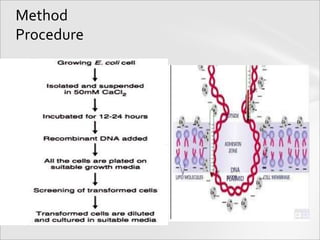
It utilizes CaCl2 and heat shock to promote the entry of DNA. The Bacteria are
incubated with DNA on ice cold salt solution containing 50 mM CaCl2 followed
by brief heat shock at 42 deg, celcius . The CaCl2 cause precipitation of DNA on
the surface of bacterial cells which is then by phagocytosis taken inside the
bacteria.
CaCl2 +H3PO4+ DNA =CaPO4-DNA
The role of calcium ions in the cell suspension is hypothesized to be a cation
bridge between the negative charges on phosphorylated lipid A in
lipopolysaccharide (LPS), and the phosphate
backbone of DNA . The ice-cold CaCl2 solution facilitates binding of DNA to the
surface of the cell, which then enters the cell after a short period of heatshock .
by phagocytosis
Principle- & Procedure
Method
Procedure
Kishore_gupta30@yahoo.com

Gene transfer kkg 21

  • 1.
  • 2.
    DNA of interestare cloned in suitable host. For this the DNA to be cloned are first introduced in to the suitable vector depending upon the size of genes Vector bearing genes are then transferred in to host by several methods Once transferred in to the host, the inserted gene at the cloning sites starts amplifying along with host genome /expresse if expression vector bearing genes. INTRODUCTION
  • 3.
    GeneTransfer Natural Transformation ,Transduction , Conjugation Physical Method Bolistic/Particle Gun Transfer Chemical Method Calcium phosphate Mediated , Liposome Mediated Electrical Method Electroporation Methods of Gene transfer in Host cell
  • 4.
    The process oftransferring exogenous gene /DNA in to bacterial or any single cell viz embryonic cell .stem cell is called transformation. It is the direct uptake of exogenous DNA/Vector DNA from its surroundings and taken up through the cell membrane . Transformation occurs naturally in some species of bacteria, but it can also be done by artificial treatment in other species. Cells that have undergone this treatment are said to be competent. The cells with high level of metabolic activity or cell cycle stage/high DNA repair activity TRANSFORMATION TwoTypes Natural in Bacillus subtilis Engineered –in E coli the bacterial cells are made competent by certain treatment
  • 5.
    Competency Bacteria which hasability to uptake the DNA is called competent which is made by chemical treatment. Competency is a physiological state which changes the structure and permeability of cell membrane and then it allows the entry of the DNA. The concept of the technique is to render cells competent using CaCl2 to allow for introduction of plasmid. Plasmids usually contain the gene(s) of interest in addition to selection and/or antibiotic resistance markers.
  • 6.
  • 7.
  • 8.
    Direct DNA uptakeby protoplast can be stimulated by using long chain poly cations viz PEG ,poly lysine ,poly ornithine /DAEA –Dextran with or without metal ions like Zn, Li, Cs,K,Ca,Mg . It is applicable to all cells. PEG is hydrophillic molecules that removes free water when placed in a solution.Free water molecules interact with charged (Usually ionic ) molecules soluble in water Under high (15-25% ) of PEG ionic conc. linear macromolecule such as DNA can no longer stay in solution and get pptd The protoplast membrane of host bacteria as well as DNA is normally negatively charged .so repel but high PEG conc. minimise repulsion and stimulate DNA uptake by endocytosis. As an alternative now polybrene ( less toxic is used which is more stable. And trasnsformation efficiency is independent of coiled plasmid. Poly cation mediated DNA uptake
  • 9.
    Poly cation mediatedtransformation
  • 10.
    TRANSDUCTION ( Viralmediated gene transfer Gene transfer from a donor to a recipient by way of a bacteriophage.. If the lysogenic cycle is adopted, the phage chromosome is integrated (by covalent bonds) into the bacterial chromosome, where it can remain dormant for thousands of generation • The lytic cycle leads to the production of new phage particles which are released by lysis of the host. •Several types of viruses, including retrovirus, adenovirus, adeno- associated virus (AAV), and herpes simplex virus, have been modified in the laboratory for use in gene therapy applications. Because these vector systems have unique advantages and
  • 12.
    Retroviral methods Gene are introducedby replicative defective retrovirus vector Effective means of integrating small piece of transgene of about 8 Kb Drawbacks as some times entire genome of the vector gets integrated in the same nucleus as transgene so transgenic animal/plant to be used as food is not recommended
  • 13.
    Retrovirus vector . Tointroduced gene through retrovirus vector (Ex.Maloney Murine LeukemiaVirus –MMLV) is made replication defective . The retrovirus is designed as follows by deleting the gag ,Pol & env gene and is replaced by therapeutic gene. This virus can infect both mouse and human rapidly dividing cells. However a packaging cell is generated in order to introduced therapeutic gene. A packaging cell line is developed as follows 5’LTR contains transcriptional signal for all gene Gag-capsid pol- reverst transcriptase and integrase Env-envelop protein
  • 14.
    Construction Retroviral DNA iscloned By restriction endo-nuclease and limited exonuclease 3’end of gag and all pol and env is deleted while 5’end of gag and 5 & 3 ; LTR were retained Transgene expression directed by promoter within 5’LTR
  • 15.
  • 16.
    Liposomes are sphericalvesicles which are made up of synthetic lipid bilayers which imitate the structure of biological membranes. DNA to be transferred is packaged into the liposome in vitro and transferred to the targeted tissue . The lipid coating helps the DNA to survives in vivo and enters into the cell by endocytosis. Cationic liposomes, where the positive charge on liposomes is stabilized by binding of negatively charged DNA, are popular vehicles for gene transfer in vivo. Inside the cells the cellular lipase breaks the liposome vesicles and release DNA Advantage: The liposomes with the foreign DNA are easy to prepare. There is no restriction in the size of DNA that is to be transferred. Disadvantage : Efficiency of gene transfer is low and transient expression of the foreign gene is obtained as they are not designed to integrate into the chromosomal DNA. Liposomes Mediated gene transfer Lipofection
  • 18.
    Neumann in 1982 Electroporationuses electrical pulse of high field strength (EK) Low field PK) to produce transient pores in the plasma membrane thereby allowing DNA into the cells. It creates activation of permease. These pores are known as electropores. This is done in an equipment called electroporator Electroporation has been used for a long time for transient and integrative transformation of protoplast.. Further transformability of intact plant cell or tissues depend upon pretreatment of cells / tissues to be transformed either by mechanical wounding or enzyme containing 0.3% macerozyme solutions. Such treatment is not required for animal
  • 19.
    The cells areplaced in a solution containing DNA and subjected to electrical pulse to cause holes in the membrane. The foreign DNA fragments enter through holes into the cytoplasm and then to nucleus. Process
  • 20.
    Low voltage –long pulse method- 300-400volts /cm for 10-50 minutes ( Exponential Decay)- b.High voltage- short pulse method-1000-1500 volts /cm for 10 microseconds A cell is given impulse in a chamber called electroporator .. It is a cylindrical chamber with a distance of 1 cm parallel metallic (steel) electrodes.The pulse is applied by discharge of a capacitor across the cell. It has been reported that only linear DNA enters rather circular DNA A field strength of 1.25 kv/cm and employing PEG can increase protoplast transformation frequency . PEG is believed to assist the association of DNA with the membrane . Continued
  • 21.
  • 22.
    Advantages of Electroporation 1.Method is fast. 2. Less costly. 3. Applied for a number of cell types. 4. Simultaneously a large number of cell can be treated. 5. High percentage of stable transformants can be produced Drawback - its more cumbersome to regenerate plants from single protoplasts than from the tissue transformations with Agrobacterium
  • 23.
    Particle gun method/particlebombardment/ microprojectile bombardement /bolistic transformation employs foreign DNA coated with high velocity gold /tungsten particles(0.2-0.4 micron )to deliver DNA in to the plant cells .Particle gun accelertaed even penetrates deeply in to the tissue PDS-1000 First particle gun was developed by Sanford and colleagues in 1987. They introduced CAT (chloremphenicol acetyl transferase) gene into onion epidermal cells and detected transient gene activity. Particle bombardment is the method of choice for chloroplast transformation. Gold particles with DNA Tungsten particles with DNA
  • 24.
    Method: 1. Precipitate DNAonto small tungsten or gold particles. 2. Accelerate particles to high speeds and aim them at cells or tissues. 3. Selective growth and regeneration of transgenic plants as described forAgro-mediated transformation
  • 25.
    DNA is boundto the microprojectiles, which impact the tissue or immobilized cells at high speeds. J. Sanford & T. Klein, 1988 Original 22-caliber biolistic gun
  • 26.
    The Helium GasGun – Circa 2000
  • 27.
    EngineeredTransformation method Hainet al 1985 Calcium phosphate precipitate( Hanahan methods ) 1. DNA preparation to be used is first dissolved in a phosphate buffer 2. CaCl2 is added to the DNA solution which forms calcium phosphate and co-ppt with DNA. Ca2Po4 is added to the cells to be transformed. 1. The ppt is taken by the cells by the phagocytosis. 2. Only 1-2% is transformed 3. But many cell lines don not uptake the ppt (mammalian cells ) 4. An alternative of this DEAE ( Dimethylamino ethyl) –Dextran Mediated method is used which is water soluble and poly cationic 5.Possible by negative charge of DNA they interact together and up taken by endocytosis.
  • 28.
    DNA is negativelycharged which binds with positively charged Ca and forms a complex . The complex then under cold condition get attached to negatively charged phopholipid which is then uptaken by host cells through phagocytosis It utilizes CaCl2 and heat shock to promote the entry of DNA. The Bacteria are incubated with DNA on ice cold salt solution containing 50 mM CaCl2 followed by brief heat shock at 42 deg, celcius . The CaCl2 cause precipitation of DNA on the surface of bacterial cells which is then by phagocytosis taken inside the bacteria. CaCl2 +H3PO4+ DNA =CaPO4-DNA The role of calcium ions in the cell suspension is hypothesized to be a cation bridge between the negative charges on phosphorylated lipid A in lipopolysaccharide (LPS), and the phosphate backbone of DNA . The ice-cold CaCl2 solution facilitates binding of DNA to the surface of the cell, which then enters the cell after a short period of heatshock . by phagocytosis Principle- & Procedure
  • 29.
  • 30.

Editor's Notes