RAJ MOHINI DEVI COLLEGE OF
AGRICULTURAL & RESEARCH
STATION,AMBIKAPUR
MASTER'S SEMINAR ON
MOLECULAR MARKERS AND THEIR
UTILIZATION IN CROP IMPROVEMENT
PRESENTED BY
PAVANKUMAR TANGUDU
MSC (G&PB) , PREVIOUS-202021232
OBJECTS :-
• Introduction
• What is a genetic marker?
• Types of markers
• Properties of a ideal DNA markers
• DNA markers
• Techniques used to find out molecular markers
• References
INTRODUCTION :-
• Marker is an entity that marks and distinguish one thing from rest others.
• The characters which can be easily identified are called “marker characters”.
• In biological sense a marker distinguishes the individuals,populations,varieties
and species.
• Generally they don't represent the target genes themselves but acts as
“SIGNS” or ”FLAGS”.
• Genetic markers are located in close proximity to genes ie. (tightly linked)
referred to as “GENE TAGS”.
• The All markers occupy specific genomic positions within the chromosome
K/as “LOCI”.
• Any genetic material (locus,allele,DNA sequence)which can be radially
detected by phenotype,cytological or molecular techniques and used to follow
a chromosome or chromosomal segment during genetic analysis is referred to
as a “marker”.
WHAT IS A GENETIC MARKER?
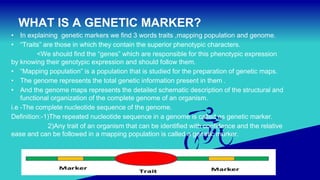
• In explaining genetic markers we find 3 words traits ,mapping population and genome.
• “Traits” are those in which they contain the superior phenotypic characters.
<We should find the “genes” which are responsible for this phenotypic expression
by knowing their genotypic expression and should follow them.
• “Mapping population” is a population that is studied for the preparation of genetic maps.
• The genome represents the total genetic information present in them .
• And the genome maps represents the detailed schematic description of the structural and
functional organization of the complete genome of an organism.
i.e -The complete nucleotide sequence of the genome.
Definition:-1)The repeated nucleotide sequence in a genome is called as genetic marker.
2)Any trait of an organism that can be identified with confidence and the relative
ease and can be followed in a mapping population is called a genetic marker.
TYPES OF MARKERS :-
MARKER
MOLECULAR
BASED ON
NON PCR
RFLP
BASED ON
PCR
AFLP RAPD VNTRs
MICROSATELLITE
OR SSR
MINISATELLITE
ISSR SNP CAPS
BIOCHEMICAL
PROTEIN
BASED
ENZYME
BASED
MORPHOLOGICAL
MORPHOLOGICAL MARKERS :-
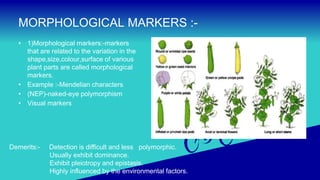
• 1)Morphological markers:-markers
that are related to the variation in the
shape,size,colour,surface of various
plant parts are called morphological
markers.
• Example :-Mendelian characters
• (NEP)-naked-eye polymorphism
• Visual markers
Demerits:- Detection is difficult and less polymorphic.
Usually exhibit dominance.
Exhibit pleiotropy and epistasis.
Highly influenced by the environmental factors.
2)Biochemical:-markers that are related to variations in
proteins and amino acid banding pattern are known as
biochemical markers.
Example:-Isozymes(),and storage proteins.
Any biochemical compound such as an antigen,
antibody, abnormal enzyme, or hormone that is
sufficiently altered in a disease to serve as an aid in
diagnosing or in predicting susceptibility to the
disease.
BIOCHEMICAL MARKER :-
MOLECULAR MARKERS :-
• 3)DNA markers:-DNA markers are the markers
which distinguish individuals based on the DNA
sequences present in them and their location is
known in the genome.
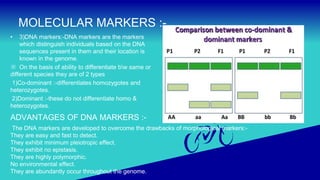
※ On the basis of ability to differentiate bw same or
different species they are of 2 types
1)Co-dominant :-differentiates homozygotes and
heterozygotes.
2)Dominant :-these do not differentiate homo &
heterozygotes.
ADVANTAGES OF DNA MARKERS :-
The DNA markers are developed to overcome the drawbacks of morphological markers:-
They are easy and fast to detect.
They exhibit minimum pleiotropic effect.
They exhibit no epistasis.
They are highly polymorphic.
No environmental effect.
They are abundantly occur throughout the genome.
co-
dominant dominant
PROPERTIES OF IDEAL MOLECULAR MARKER :-
• 1)Polymorphism:-should exhibit high level of poilymorphism.it should demonstrate
measurable differences between trait types and gene of interest.
• 2)Co-dominant:-marker should be co dominent.it helps in identification of heterozygous
from homozygous.
• 3)Multiallelic:-marker should be multiallelic as it is more useful in getting more variability or
polymorphism for a character.
• 4)No epistasis:-there should be absence of epistasis it makes identification of all
phenotypes easily.
• 5)Neutral:-the marker should be neutral.the substitution of alleles at the marker locus
should not alter the phenotype of an individual.
• 6)No effect of the environment:-markers should be insensitive to the environment .this
property is almost found i all DNAs.
TECHNIQUES USED TO FIND THE MOLECULAR
MARKERS :-
Two types of molecular techniques they are :-
1)NON-PCR BASED METHODS :-
In this it includes the process of “HYBRIDIZATION”.
※ The first includes (RFLP) and (VNTRs)
※ Fragments are separated using agarose gel electrophoresis.
※ Polymorphisms are detected by Hybridizing the restriction enzyme digested DNA with
labelled probes.
PROCEDURE FOR HYBRIDIZATION
1)DNA isolation
2)Restriction digestion
3)Gel electrophoresis
4)Transfer to Nitrocellulose membrane.
5)Visualization by using probes.
2) PCR based methods :-
• PCR - (Polymerase chain reaction )
• Amplification of the digested DNA is done by the arbitrary primers.
• It includes (RAPD),(AFLP),(SNP),(CAPS),(ISSR) etc.
• Amplified fragments are visualised by suspending to agarose gel .
• The banding patterns are detected by staining with “Ethidium
bromide”.
PROCEDURE FOR PCR METHODS:-
1) DNA fragmentation with 2 restriction enzymes.
2) Ligation of “ADAPTERS” to the end of each fragment.
3) Primers are designed for the known sequence of adapters.
4) PCR is performed.
5) Visualization on agarose gel with ethidium bromide.
RFLP
• This is a non PCR based technique.
• For doing RFLP we should know the sequence of
dna.
• This is restriction enzyme based approach.
• In this probes are used to screen different
samples.
• Gel electrophoresis is used to visualise the
RFLPs.
• Exploits variation in restriction sites in dna of
different individuals.
Restriction fragment length
polymorphism
pic indicates the process of RFLP
RAPD
• These are PCR based DNA markers.
• They use the primers for the amplification of dna
• Primers amplifies the specific segment of the
target DNA.
• The amplifies the DNA randomly at different
places on the genome.
• The visualisation of these fragments is done by
using gel electrophoresis.
Random Amplified
Polymorphic DNA
pic indicates the process of PCR
amplification in RAPD
pic indicates the
difference in the
banding pattern
in various
samples
AFLP
• This is PCR based technique.
• 1st discovered by VOS.et.al in 1995.
• This technique includes usage of restriction +pcr
methods.
• It include usage of adapters and primers.
Amplified fragment
length polymorphism
pic indicates the digetion of the genome and addition of adapter specific
primers
CAPS • This is a PCR based technique.
• Dependent on RFLP as it is an extension of RFLP
and uses PCR to analyse the results..
• In this the restriction site is damaged by the SNPS
and INDEL so the restriction enzyme can not
detect the target sites.
• It is a co-dominant marker.
CLEAVED AMPLIFIED
POLYMORPHIC
SEQUENCES
pic indicates the process of CAPS
SNP
• The variations which are found at a single
nucleotide positions are known as single
nucleotide polymorphism.
• Variation is resulted due to substitution deletion or
insertion.
• This polymorphism is bi-allilic loci.
single nucleotide
polymorphism
pic indicates the 2 individuals and existing of SNP
SOME FACTS :-
• In human beings 99% bases are same.
• The remaining 1% bases makes a person unique.
example :-how a person looks,diseases in he or she develops.
• These variations can be
Harmless (change in phenotype)
Harmful (cancer,heart disease,diabetes etc.
Latent (susceptibility to lung cancer)
VNTRS :-
• Molecular markers are the repeated
nucleotide sequences present throughout
genome.
• These repeated sequences are useful to
determine the genetic makeup of the
organism.
• This variable repeated units of nucleotide
sequences are used as a genetic
barcoding systems of a individual or in
DNA fingerprinting.
• These genetic markers belongs to the
“variable number tandem repeats” (VNTR)
• Tandem repeats are the constitutive
repeats of nucleic acids.
• This variable sequence present to that individual only so that we can use these in DNA
fingerprinting.
• There are 2 different types of VNTR they are 1)Micro-satellite
2)Mini-satellite
• Micro-satellite:-these are a type of VNTRS and the repeated sequence will be 2-5 base
pairs long.
Example:-SSR (simple sequence repeats)
• Mini-satellites:-these are a type of VNTRS and the repeated sequences are 5-9 base
pairs long or more and these are the longer ones.
Example:-Mini satellites are found in telomeres and centromeres of the human
chromosome.
SSR
• Microsatellites is coined byLitt &Lutty (1989)
• Microsatellite sequences are especially suited to
distinguish closely related genotypes because of
their high degree of variability so they are used in
population studies.
• In Microsatellites the polymorphism can be
detected by southern hybridisation or PCR.
• Visualization is done using gel electrophoresis.
SIMPLE SEQUENCE
REPEATS OR
MICROSATELLITES
fig 2
fig 1
MOLECULAR
MARKER
RFLP RAPD AFLP CAPS SNP VNTRS/SSR
Principle Endonuclease
restriction
Southern blotting
Hybridization
DNA amplification
with random
primers
Endonuclease
restriction
use of adapters
Selective primers
Endonuclease
restriction of PCR
products
DNA chips ,
sequence analysis
Amplification of
SSRs using specific
primers.
No of loci 1-5 1-10 >70 1-4 1 (bi-allilic) 1-3
Inheritance Co-dominant Dominant Dominant Co-dominant Co-dominant Co-dominant
Polymorphism
detected
Base changes,
Deltion
Duplication
Base changes Base changes Base changes Single base
change
Variation in length
of repeats
Reproducibility High Low High High High High
Known
sequence
Yes No No Yes Yes Yes
Difficulty Medium Low Med-High Low Med-High Low
Cost Medium Low High Med-High High Medium
COMPARISION B/W MOST COMMON USED MARKERS
MOLECULAR
MARKER
ADVANTAGES DISADVANTAGES
RFLP
Cheaper and simple technique
Does Not require special instrumentation
They are co-dominant
Highly locus specific
Used in synteny mapping
Several samples can be screened using different probes.
Labour intensive.
Requires large amount of high quality DNA.
Multiplex ratio is low.
Involves use of radioactive chemicals.
RFLP fingerprinting for multi families is difficult
Probes cannot be shared between laboratories.
RAPD
Provides more polymorphism.
Does not require special equipment.
Can be performed using small DNA samples.
Primers are universal and commercially purchased.
They are locus-specific.
Can be easily shared between the laboratories.
Start-up cost is low.
Detection of polymorphism is limited.
It is not applicable in marker assisted breeding problem.
This technique only detects the dominant markers.
As we get many bds they are difficult to analyse.
AFLP
No need of knowing the genomic sequences.
Provide high multiplex ratio.
Highly reproducible across the laboratories.
No special instrumentation needed.
Startup costs are moderately low.
Can be done using a very small DNA samples.
High quality DNA is needed for digestion.
They cannot specify it is a homozygous or heterozygous.
AFLP markers are dominant.
Complicated methodology.
CAPS
They are co-dominant.
They are locus -specific.
No special equipment is needed for performing manual CAPS markers.
Startup costs are ow for manual method.
They can be done using the small dna sequences.
They are easily shared between the laboratories.
To the genes belonging to multigene families the development of assays
is difficult.
The restriction sites are difficult to be detected.
SSR
Since the technique is PCR based low quantities of DNA are required.
They are co-dominant.
They are in genomic abundance.
Reproducibility is very high.
Analysis does not require high quality DNA.
High development costs.
Errors in genotype scoring.
Difficult in interpretation.
PCR errors.
COMPARISION B/W ADVANTAGES AND DISADVANTAGES OF DIFFERENT MARKERS
APPLICATIONS OF A MARKER :-
• Conformation of hybridity.
• Linkage mapping.
• Marker assisted selection.
• Trait based selection.
• Saturated maps.
• Gene tagging / Gene mapping.
• Heterosis breeding.
• DNA fingerprinting for varietal identification.
• Phylogenetic and evolutionary studies.
• Seed testing.
REFERENCES :-
• 1)Phundan singh,2000.Elements of Genetics,Kalyani Publications,Ludhiana.
• 2)Singh,B.D2007,fUNDAMENTALS OF gENETICS,kALYANI PUBLICATIONS,PP 261
• 3)

DNA markers (2).pptx

  • 1.
    RAJ MOHINI DEVICOLLEGE OF AGRICULTURAL & RESEARCH STATION,AMBIKAPUR
  • 2.
    MASTER'S SEMINAR ON MOLECULARMARKERS AND THEIR UTILIZATION IN CROP IMPROVEMENT PRESENTED BY PAVANKUMAR TANGUDU MSC (G&PB) , PREVIOUS-202021232
  • 3.
    OBJECTS :- • Introduction •What is a genetic marker? • Types of markers • Properties of a ideal DNA markers • DNA markers • Techniques used to find out molecular markers • References
  • 4.
    INTRODUCTION :- • Markeris an entity that marks and distinguish one thing from rest others. • The characters which can be easily identified are called “marker characters”. • In biological sense a marker distinguishes the individuals,populations,varieties and species. • Generally they don't represent the target genes themselves but acts as “SIGNS” or ”FLAGS”. • Genetic markers are located in close proximity to genes ie. (tightly linked) referred to as “GENE TAGS”. • The All markers occupy specific genomic positions within the chromosome K/as “LOCI”. • Any genetic material (locus,allele,DNA sequence)which can be radially detected by phenotype,cytological or molecular techniques and used to follow a chromosome or chromosomal segment during genetic analysis is referred to as a “marker”.
  • 5.
    WHAT IS AGENETIC MARKER? • In explaining genetic markers we find 3 words traits ,mapping population and genome. • “Traits” are those in which they contain the superior phenotypic characters. <We should find the “genes” which are responsible for this phenotypic expression by knowing their genotypic expression and should follow them. • “Mapping population” is a population that is studied for the preparation of genetic maps. • The genome represents the total genetic information present in them . • And the genome maps represents the detailed schematic description of the structural and functional organization of the complete genome of an organism. i.e -The complete nucleotide sequence of the genome. Definition:-1)The repeated nucleotide sequence in a genome is called as genetic marker. 2)Any trait of an organism that can be identified with confidence and the relative ease and can be followed in a mapping population is called a genetic marker.
  • 6.
    TYPES OF MARKERS:- MARKER MOLECULAR BASED ON NON PCR RFLP BASED ON PCR AFLP RAPD VNTRs MICROSATELLITE OR SSR MINISATELLITE ISSR SNP CAPS BIOCHEMICAL PROTEIN BASED ENZYME BASED MORPHOLOGICAL
  • 7.
    MORPHOLOGICAL MARKERS :- •1)Morphological markers:-markers that are related to the variation in the shape,size,colour,surface of various plant parts are called morphological markers. • Example :-Mendelian characters • (NEP)-naked-eye polymorphism • Visual markers Demerits:- Detection is difficult and less polymorphic. Usually exhibit dominance. Exhibit pleiotropy and epistasis. Highly influenced by the environmental factors.
  • 8.
    2)Biochemical:-markers that arerelated to variations in proteins and amino acid banding pattern are known as biochemical markers. Example:-Isozymes(),and storage proteins. Any biochemical compound such as an antigen, antibody, abnormal enzyme, or hormone that is sufficiently altered in a disease to serve as an aid in diagnosing or in predicting susceptibility to the disease. BIOCHEMICAL MARKER :-
  • 9.
    MOLECULAR MARKERS :- •3)DNA markers:-DNA markers are the markers which distinguish individuals based on the DNA sequences present in them and their location is known in the genome. ※ On the basis of ability to differentiate bw same or different species they are of 2 types 1)Co-dominant :-differentiates homozygotes and heterozygotes. 2)Dominant :-these do not differentiate homo & heterozygotes. ADVANTAGES OF DNA MARKERS :- The DNA markers are developed to overcome the drawbacks of morphological markers:- They are easy and fast to detect. They exhibit minimum pleiotropic effect. They exhibit no epistasis. They are highly polymorphic. No environmental effect. They are abundantly occur throughout the genome.
  • 10.
  • 11.
    PROPERTIES OF IDEALMOLECULAR MARKER :- • 1)Polymorphism:-should exhibit high level of poilymorphism.it should demonstrate measurable differences between trait types and gene of interest. • 2)Co-dominant:-marker should be co dominent.it helps in identification of heterozygous from homozygous. • 3)Multiallelic:-marker should be multiallelic as it is more useful in getting more variability or polymorphism for a character. • 4)No epistasis:-there should be absence of epistasis it makes identification of all phenotypes easily. • 5)Neutral:-the marker should be neutral.the substitution of alleles at the marker locus should not alter the phenotype of an individual. • 6)No effect of the environment:-markers should be insensitive to the environment .this property is almost found i all DNAs.
  • 12.
    TECHNIQUES USED TOFIND THE MOLECULAR MARKERS :- Two types of molecular techniques they are :- 1)NON-PCR BASED METHODS :- In this it includes the process of “HYBRIDIZATION”. ※ The first includes (RFLP) and (VNTRs) ※ Fragments are separated using agarose gel electrophoresis. ※ Polymorphisms are detected by Hybridizing the restriction enzyme digested DNA with labelled probes. PROCEDURE FOR HYBRIDIZATION 1)DNA isolation 2)Restriction digestion 3)Gel electrophoresis 4)Transfer to Nitrocellulose membrane. 5)Visualization by using probes.
  • 13.
    2) PCR basedmethods :- • PCR - (Polymerase chain reaction ) • Amplification of the digested DNA is done by the arbitrary primers. • It includes (RAPD),(AFLP),(SNP),(CAPS),(ISSR) etc. • Amplified fragments are visualised by suspending to agarose gel . • The banding patterns are detected by staining with “Ethidium bromide”. PROCEDURE FOR PCR METHODS:- 1) DNA fragmentation with 2 restriction enzymes. 2) Ligation of “ADAPTERS” to the end of each fragment. 3) Primers are designed for the known sequence of adapters. 4) PCR is performed. 5) Visualization on agarose gel with ethidium bromide.
  • 14.
    RFLP • This isa non PCR based technique. • For doing RFLP we should know the sequence of dna. • This is restriction enzyme based approach. • In this probes are used to screen different samples. • Gel electrophoresis is used to visualise the RFLPs. • Exploits variation in restriction sites in dna of different individuals. Restriction fragment length polymorphism
  • 15.
    pic indicates theprocess of RFLP
  • 16.
    RAPD • These arePCR based DNA markers. • They use the primers for the amplification of dna • Primers amplifies the specific segment of the target DNA. • The amplifies the DNA randomly at different places on the genome. • The visualisation of these fragments is done by using gel electrophoresis. Random Amplified Polymorphic DNA
  • 17.
    pic indicates theprocess of PCR amplification in RAPD pic indicates the difference in the banding pattern in various samples
  • 18.
    AFLP • This isPCR based technique. • 1st discovered by VOS.et.al in 1995. • This technique includes usage of restriction +pcr methods. • It include usage of adapters and primers. Amplified fragment length polymorphism
  • 19.
    pic indicates thedigetion of the genome and addition of adapter specific primers
  • 20.
    CAPS • Thisis a PCR based technique. • Dependent on RFLP as it is an extension of RFLP and uses PCR to analyse the results.. • In this the restriction site is damaged by the SNPS and INDEL so the restriction enzyme can not detect the target sites. • It is a co-dominant marker. CLEAVED AMPLIFIED POLYMORPHIC SEQUENCES
  • 21.
    pic indicates theprocess of CAPS
  • 22.
    SNP • The variationswhich are found at a single nucleotide positions are known as single nucleotide polymorphism. • Variation is resulted due to substitution deletion or insertion. • This polymorphism is bi-allilic loci. single nucleotide polymorphism
  • 23.
    pic indicates the2 individuals and existing of SNP
  • 24.
    SOME FACTS :- •In human beings 99% bases are same. • The remaining 1% bases makes a person unique. example :-how a person looks,diseases in he or she develops. • These variations can be Harmless (change in phenotype) Harmful (cancer,heart disease,diabetes etc. Latent (susceptibility to lung cancer)
  • 25.
    VNTRS :- • Molecularmarkers are the repeated nucleotide sequences present throughout genome. • These repeated sequences are useful to determine the genetic makeup of the organism. • This variable repeated units of nucleotide sequences are used as a genetic barcoding systems of a individual or in DNA fingerprinting. • These genetic markers belongs to the “variable number tandem repeats” (VNTR) • Tandem repeats are the constitutive repeats of nucleic acids.
  • 26.
    • This variablesequence present to that individual only so that we can use these in DNA fingerprinting. • There are 2 different types of VNTR they are 1)Micro-satellite 2)Mini-satellite • Micro-satellite:-these are a type of VNTRS and the repeated sequence will be 2-5 base pairs long. Example:-SSR (simple sequence repeats) • Mini-satellites:-these are a type of VNTRS and the repeated sequences are 5-9 base pairs long or more and these are the longer ones. Example:-Mini satellites are found in telomeres and centromeres of the human chromosome.
  • 27.
    SSR • Microsatellites iscoined byLitt &Lutty (1989) • Microsatellite sequences are especially suited to distinguish closely related genotypes because of their high degree of variability so they are used in population studies. • In Microsatellites the polymorphism can be detected by southern hybridisation or PCR. • Visualization is done using gel electrophoresis. SIMPLE SEQUENCE REPEATS OR MICROSATELLITES
  • 28.
  • 29.
    MOLECULAR MARKER RFLP RAPD AFLPCAPS SNP VNTRS/SSR Principle Endonuclease restriction Southern blotting Hybridization DNA amplification with random primers Endonuclease restriction use of adapters Selective primers Endonuclease restriction of PCR products DNA chips , sequence analysis Amplification of SSRs using specific primers. No of loci 1-5 1-10 >70 1-4 1 (bi-allilic) 1-3 Inheritance Co-dominant Dominant Dominant Co-dominant Co-dominant Co-dominant Polymorphism detected Base changes, Deltion Duplication Base changes Base changes Base changes Single base change Variation in length of repeats Reproducibility High Low High High High High Known sequence Yes No No Yes Yes Yes Difficulty Medium Low Med-High Low Med-High Low Cost Medium Low High Med-High High Medium COMPARISION B/W MOST COMMON USED MARKERS
  • 30.
    MOLECULAR MARKER ADVANTAGES DISADVANTAGES RFLP Cheaper andsimple technique Does Not require special instrumentation They are co-dominant Highly locus specific Used in synteny mapping Several samples can be screened using different probes. Labour intensive. Requires large amount of high quality DNA. Multiplex ratio is low. Involves use of radioactive chemicals. RFLP fingerprinting for multi families is difficult Probes cannot be shared between laboratories. RAPD Provides more polymorphism. Does not require special equipment. Can be performed using small DNA samples. Primers are universal and commercially purchased. They are locus-specific. Can be easily shared between the laboratories. Start-up cost is low. Detection of polymorphism is limited. It is not applicable in marker assisted breeding problem. This technique only detects the dominant markers. As we get many bds they are difficult to analyse. AFLP No need of knowing the genomic sequences. Provide high multiplex ratio. Highly reproducible across the laboratories. No special instrumentation needed. Startup costs are moderately low. Can be done using a very small DNA samples. High quality DNA is needed for digestion. They cannot specify it is a homozygous or heterozygous. AFLP markers are dominant. Complicated methodology. CAPS They are co-dominant. They are locus -specific. No special equipment is needed for performing manual CAPS markers. Startup costs are ow for manual method. They can be done using the small dna sequences. They are easily shared between the laboratories. To the genes belonging to multigene families the development of assays is difficult. The restriction sites are difficult to be detected. SSR Since the technique is PCR based low quantities of DNA are required. They are co-dominant. They are in genomic abundance. Reproducibility is very high. Analysis does not require high quality DNA. High development costs. Errors in genotype scoring. Difficult in interpretation. PCR errors. COMPARISION B/W ADVANTAGES AND DISADVANTAGES OF DIFFERENT MARKERS
  • 31.
    APPLICATIONS OF AMARKER :- • Conformation of hybridity. • Linkage mapping. • Marker assisted selection. • Trait based selection. • Saturated maps. • Gene tagging / Gene mapping. • Heterosis breeding. • DNA fingerprinting for varietal identification. • Phylogenetic and evolutionary studies. • Seed testing.
  • 32.
    REFERENCES :- • 1)Phundansingh,2000.Elements of Genetics,Kalyani Publications,Ludhiana. • 2)Singh,B.D2007,fUNDAMENTALS OF gENETICS,kALYANI PUBLICATIONS,PP 261 • 3)