Nmap Scanner and Shadow
Security Scanner
What is Port scanner?
A port scanner is a software application designed to 
probe a server or host for open ports. This is often 
used by administrators to verify security policies of 
their networks and by attackers to identify running 
services on a host with the view to compromise it.
The “good way” of doing port scanning
The activity of port scanning can be done as part of
security assessment of one’s own organization seeking to
weed out security holes. It is more of a defensive
approach to seek vulnerabilities and destroy them rather
than reactive approach.
The malicious way of doing port scanning
Hackers or anyone with a malicious intent can do “port
scanning” by systematically probing open ports which
might lead hackers to gain entry into organizations and
steal their private data.
Port Scanning
The process of examining a range of IP addresses to
determine what services are running on a network.
Port-scanning tools can be complex, must learn their
strengths and weaknesses and understanding how and
when you should use these tools.
Conduct Test
Scan all ports when doing a test, not just the well-
known ports. (Ports 1 to 1023)
Many programs use port numbers outside the range
of well-known ports.
If find that port 65301 is open can check the
information at the CVE Web site for a possible
vulnerability in pc Anywhere.
Using Port-Scanning Tools
Hundreds of port-scanning tools are available for
both hackers and security testers.
Not all are accurate, so using more than one port-
scanning tool is recommended.
Nmap
One of the most popular port scanners and adds new
features constantly, such as OS detection and fast
multiple-probe ping scanning.
Nmap also has a GUI front end called Zenmap that
makes working with complex options easier.
Open source
Nmap
Must hide from network devices or IDSs that recognize
an inordinate amount of pings or packets being sent to
their networks.
This ACK scan constituted a DoS attack on the network
Use stealth attacks that are more difficult to detect.
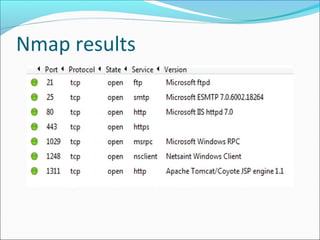
Nmap results
The services supported are: FTP, SSH, Telnet, SMTP, DNS, Finger,
HTTP, POP3, IMAP, NetBIOS, NFS, NNTP, SNMP, Squid (Shadow
Security Scanner is the only scanner to audit proxy servers - other
scanners just verify ports availability), LDAP (Shadow Security
Scanner is the only scanner to audit LDAP servers - other scanners
limit their actions to ports verification), HTTPS, SSL, TCP/IP, UDP,
and Registry services. Because of a fully open (ActiveX-based)
architecture any professional with knowledge of VC++, C++
Builder or Delphi may easily expand the capabilities of the
Scanner. ActiveX technology also enables the system
administrators to integrate Shadow Security Scanner into
practically any ActiveX supporting product.
Shadow Security Scanner
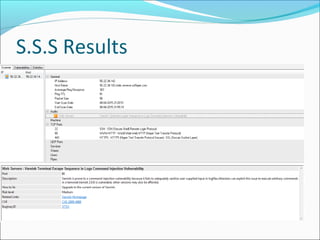
S.S.S Results
Conclusion:
To prevent this type of attack it is essential
therefore that you implement IP spoofing at
the network edge, and also make use of
stateful firewall rules. Since the success of
this type of attack hinges around the
predictability of the IP ID, using systems
that don’t succumb to this (mainly newer
versions of Linux and Solaris) would be best,
although not necessarily possible.
Enable only the traffic you need to access internal hosts
— preferably as far as possible from the hosts you’re
trying to protect — and deny everything else. This goes
for standard ports, such as TCP 80 for HTTP and ICMP for
ping requests.
Configure firewalls to look for potentially malicious
behavior over time and have rules in place to cut off
attacks if a certain threshold is reached, such as 10 port
scans in one minute or 100 consecutive ping (ICMP)
requests.
Most firewalls and IPSs can detect such scanning and cut
it off in real time.
THANK YOU

Port scanning

  • 1.
    Nmap Scanner andShadow Security Scanner
  • 2.
    What is Portscanner? A port scanner is a software application designed to  probe a server or host for open ports. This is often  used by administrators to verify security policies of  their networks and by attackers to identify running  services on a host with the view to compromise it.
  • 3.
    The “good way”of doing port scanning The activity of port scanning can be done as part of security assessment of one’s own organization seeking to weed out security holes. It is more of a defensive approach to seek vulnerabilities and destroy them rather than reactive approach. The malicious way of doing port scanning Hackers or anyone with a malicious intent can do “port scanning” by systematically probing open ports which might lead hackers to gain entry into organizations and steal their private data.
  • 4.
    Port Scanning The processof examining a range of IP addresses to determine what services are running on a network. Port-scanning tools can be complex, must learn their strengths and weaknesses and understanding how and when you should use these tools.
  • 5.
    Conduct Test Scan allports when doing a test, not just the well- known ports. (Ports 1 to 1023) Many programs use port numbers outside the range of well-known ports. If find that port 65301 is open can check the information at the CVE Web site for a possible vulnerability in pc Anywhere.
  • 6.
    Using Port-Scanning Tools Hundredsof port-scanning tools are available for both hackers and security testers. Not all are accurate, so using more than one port- scanning tool is recommended.
  • 7.
    Nmap One of themost popular port scanners and adds new features constantly, such as OS detection and fast multiple-probe ping scanning. Nmap also has a GUI front end called Zenmap that makes working with complex options easier. Open source
  • 8.
    Nmap Must hide fromnetwork devices or IDSs that recognize an inordinate amount of pings or packets being sent to their networks. This ACK scan constituted a DoS attack on the network Use stealth attacks that are more difficult to detect.
  • 9.
  • 10.
    The services supportedare: FTP, SSH, Telnet, SMTP, DNS, Finger, HTTP, POP3, IMAP, NetBIOS, NFS, NNTP, SNMP, Squid (Shadow Security Scanner is the only scanner to audit proxy servers - other scanners just verify ports availability), LDAP (Shadow Security Scanner is the only scanner to audit LDAP servers - other scanners limit their actions to ports verification), HTTPS, SSL, TCP/IP, UDP, and Registry services. Because of a fully open (ActiveX-based) architecture any professional with knowledge of VC++, C++ Builder or Delphi may easily expand the capabilities of the Scanner. ActiveX technology also enables the system administrators to integrate Shadow Security Scanner into practically any ActiveX supporting product. Shadow Security Scanner
  • 11.
  • 12.
    Conclusion: To prevent thistype of attack it is essential therefore that you implement IP spoofing at the network edge, and also make use of stateful firewall rules. Since the success of this type of attack hinges around the predictability of the IP ID, using systems that don’t succumb to this (mainly newer versions of Linux and Solaris) would be best, although not necessarily possible.
  • 13.
    Enable only thetraffic you need to access internal hosts — preferably as far as possible from the hosts you’re trying to protect — and deny everything else. This goes for standard ports, such as TCP 80 for HTTP and ICMP for ping requests. Configure firewalls to look for potentially malicious behavior over time and have rules in place to cut off attacks if a certain threshold is reached, such as 10 port scans in one minute or 100 consecutive ping (ICMP) requests. Most firewalls and IPSs can detect such scanning and cut it off in real time.
  • 14.