This presentation was developed for the
exclusive use of students enrolled in:

             Educational Testing & Grading,
               Professor Gregory E. Stone.


© 2004 Gregory E. Stone. All rights reserved. This presentation may not be
reproduced in any form, in part or as a whole, without the express written permission
of the author.
Essays
   &   other non-objective items
We’ll include:

 Essays, Short answers and
 other items that can fit
 within the general parameters
Mathematical problem solving
         Other partial credit items
Allow for free expression
without artificial restriction
   and without prompting.
Two Fundamental Types:

 Restricted Response
Extended Response
Restricted Response

Limit the ways in which you will
permit the students to answer.
Restricted Response

Limit the ways in which you will
permit the students to answer.
� There ARE correct answers.
� We allow students to express
  the answer in their own words.
Restricted Response
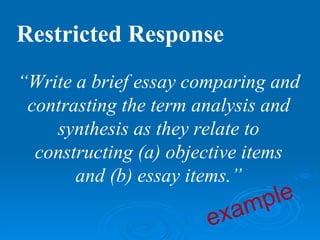
“Write a brief essay comparing and
 contrasting the term analysis and
    synthesis as they relate to
  constructing (a) objective items
       and (b) essay items.”
                         am ple
                       ex
Restricted Response

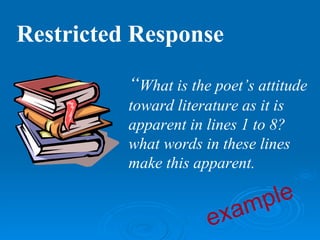
          “What is the poet’s attitude
          toward literature as it is
          apparent in lines 1 to 8?
          what words in these lines
          make this apparent.


                          am ple
                      ex
Short Answer
Restricted Response
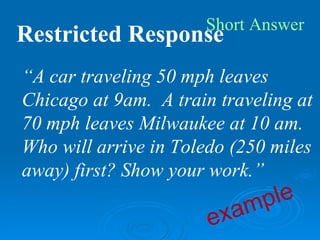
“A car traveling 50 mph leaves
Chicago at 9am. A train traveling at
70 mph leaves Milwaukee at 10 am.
Who will arrive in Toledo (250 miles
away) first? Show your work.”

                          am ple
                       ex
Restricted Response
Predicated on the notion that
students supply the answers rather
than selecting the answer from a
group options.
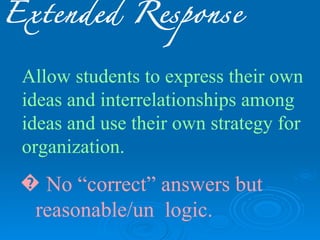
Extended Response


 Allow students to express their own
 ideas and interrelationships among
 ideas and use their own strategy for
 organization.
 � No “correct” answers but
  reasonable/un logic.
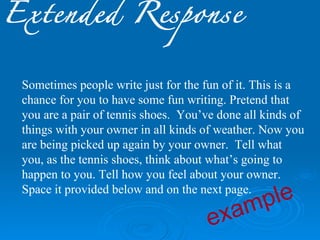
Extended Response


 Sometimes people write just for the fun of it. This is a
 chance for you to have some fun writing. Pretend that
 you are a pair of tennis shoes. You’ve done all kinds of
 things with your owner in all kinds of weather. Now you
 are being picked up again by your owner. Tell what
 you, as the tennis shoes, think about what’s going to
 happen to you. Tell how you feel about your owner.

                                             ple
 Space it provided below and on the next page.

                                      ex  am
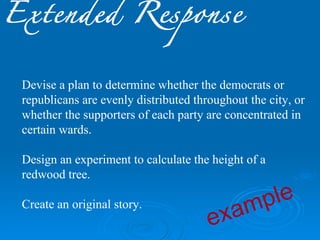
Extended Response


 Devise a plan to determine whether the democrats or
 republicans are evenly distributed throughout the city, or
 whether the supporters of each party are concentrated in
 certain wards.

 Design an experiment to calculate the height of a
 redwood tree.


                                            am ple
                                       ex
 Create an original story.
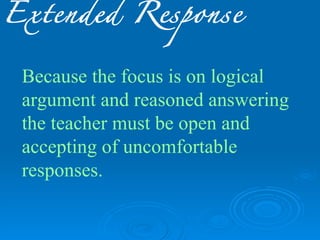
Extended Response


 Because the focus is on logical
 argument and reasoned answering
 the teacher must be open and
 accepting of uncomfortable
 responses.
Extended Response


 Based on the creative process of the
 student - often including reasoning
 and factual presentations.
Essays have a unique ability to assess
 multiple taxonomic levels at once - while
  maintaining a good understanding of
        strengths and weaknesses.

Look at the family photo attached. Describe the
mood or feeling in the photo as well as the body
  language of the people. Use metaphors or
      similes to make these descriptions.

Analysis            Knowledge
                                      Comprehension
Is your essay a good essay?
 Checklist
1. Does the item test an important
  aspect of the learning objective?
Essays should ideally be targeted
at no less than Application!
Is your essay a good essay?
 Checklist
2. Does the item match the
   learning objective in terms of
   performance, emphasis and
   “number of points” (on the
   exam)?
Is your essay a good essay?
 Checklist
3. Does the item require the
   students to apply their
   knowledge and skill to solve a
   new and novel problem?
  Essays should ideally be targeted
  at no less than Application!
Is your essay a good essay?
 Checklist
4. When viewed in relation to the
   other items on the test, does this
   item measure new information
   covering the range of content and
   behavior specified in the learning
   objectives?
Is your essay a good essay?
 Checklist
5. Is the item focused? Does it define
   a task with specific directions,
   rather than leave the assignment
   so broad that almost any answer
   would be acceptable?
Is your essay a good essay?
 Checklist
6. Is the task defined by the item
   within a level of complexity that
   is appropriate for the intellectual
   maturity of the students?
Is your essay a good essay?
 Checklist
7. To get a good grade on the item, is
   the student required to
   demonstrate more than facts,
   ideas, lists, definitions,
   generalizations, etc.
Is your essay a good essay?
 Checklist
8. Is the item worded in a way
   that leads all students to
   interpret the assignment in the
   way you intended.
Is your essay a good essay?
 Checklist
9. Does the wording of the item
   make clear to the students:
   Length, purpose, time needed
   and the basis for evaluation?
Is your essay a good essay?
 Checklist
10. If the essay asks students to state and
  support their opinions on controversial
  matters, does the wording of the item
  make it clear that students’ assessments
  will be based on the logic and evidence
  supporting their arguments, rather
  than on the actual position or opinion?
Creating scoring rubrics

Essential for ensuring fair,
reliable, valid and meaningful
assessments.

 One of the hardest problems!
Rubrics come in 2 varieties:

Holistic (logic of argument)

Analytic (correct answers
provided in the student’s own
words)
Holistic (logic of argument)

Best used for Extended Response
             Essays

Grading essays on how well the
 argument/essay is written in
           general.
Analytic (correct answers)

    Best used for Restricted
       Response Essays

 Grading essays on whether or
not the student has provided the
         correct answer.
Analytic rubrics require the
 student to provide specific
information in their answer
 in order to receive credit.

  No “bluffing” allowed!
To construct a rubric:

(3)Ask - what is your objective?
(4)Ask - what is the taxonomy?
(5)Ask - what pieces of the puzzle
         do I expect the student to
         provide?
Example: Comprehend Vertical Leap

Concepts: Potential/Kinetic energy

Describe the concepts of Potential and
Kinetic energy. Give an example of
each in your description.
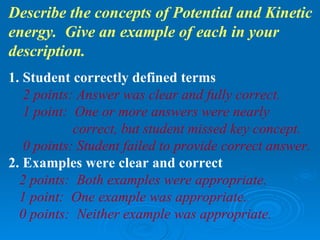
Describe the concepts of Potential and Kinetic
energy. Give an example of each in your
description.
1. Student correctly defined terms
   2 points: Answer was clear and fully correct.
   1 point: One or more answers were nearly
            correct, but student missed key concept.
   0 points: Student failed to provide correct answer.
2. Examples were clear and correct
  2 points: Both examples were appropriate.
  1 point: One example was appropriate.
  0 points: Neither example was appropriate.
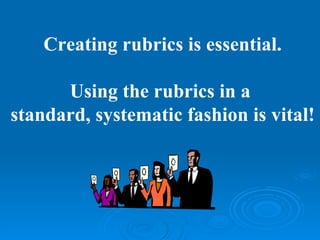
Creating rubrics is essential.

      Using the rubrics in a
standard, systematic fashion is vital!
The loss of reliability and validity
 are the leading causes of essay
            derailment.

May be caused by poorly written
           essays; or
May be caused by poor use of the
        created rubrics.
Inconsistent Standards
  Raters of essays may vary
  greatly. Individuals may grade
  essays differently on one day
  versus the next.

  (Reliability loss)
Rater Drift
  Raters tend to either fail to pay
  attention to criteria or change
  them - midstream - over time.

  (Reliability loss)
Changes in Topic and Prompt
  Raters often grade essays of
  different topics differently.
  (e.g. I like this topic more so
  I’m easier)

  (Validity loss)
Reader Bias
  Halo Effect

  Grading based on non-graded topics.
  (e.g If the student uses good grammar,
  grade the essay higher, even
  if the student doesn’t fully
  answer the item)
Reader Bias
  Carryover Effect

  If question 1 was answered poorly, the
  rater already has a bad feeling about
  the student when they
  begin grading question 2.

  Or vice versa!
Scoring Suggestions!
            You’ve created a rubric, so USE it!

            Score one item at a time.

            Score essays “anonymously”

Score subject-matter correctness separately.

Provide your students with feedback!
Essays
   &   other non-objective items

Essays

  • 1.
    This presentation wasdeveloped for the exclusive use of students enrolled in: Educational Testing & Grading, Professor Gregory E. Stone. © 2004 Gregory E. Stone. All rights reserved. This presentation may not be reproduced in any form, in part or as a whole, without the express written permission of the author.
  • 2.
    Essays & other non-objective items
  • 3.
    We’ll include: Essays,Short answers and other items that can fit within the general parameters Mathematical problem solving Other partial credit items
  • 4.
    Allow for freeexpression without artificial restriction and without prompting.
  • 5.
    Two Fundamental Types: Restricted Response Extended Response
  • 6.
    Restricted Response Limit theways in which you will permit the students to answer.
  • 7.
    Restricted Response Limit theways in which you will permit the students to answer. � There ARE correct answers. � We allow students to express the answer in their own words.
  • 8.
    Restricted Response “Write abrief essay comparing and contrasting the term analysis and synthesis as they relate to constructing (a) objective items and (b) essay items.” am ple ex
  • 9.
    Restricted Response “What is the poet’s attitude toward literature as it is apparent in lines 1 to 8? what words in these lines make this apparent. am ple ex
  • 10.
    Short Answer Restricted Response “Acar traveling 50 mph leaves Chicago at 9am. A train traveling at 70 mph leaves Milwaukee at 10 am. Who will arrive in Toledo (250 miles away) first? Show your work.” am ple ex
  • 11.
    Restricted Response Predicated onthe notion that students supply the answers rather than selecting the answer from a group options.
  • 12.
    Extended Response Allowstudents to express their own ideas and interrelationships among ideas and use their own strategy for organization. � No “correct” answers but reasonable/un logic.
  • 13.
    Extended Response Sometimespeople write just for the fun of it. This is a chance for you to have some fun writing. Pretend that you are a pair of tennis shoes. You’ve done all kinds of things with your owner in all kinds of weather. Now you are being picked up again by your owner. Tell what you, as the tennis shoes, think about what’s going to happen to you. Tell how you feel about your owner. ple Space it provided below and on the next page. ex am
  • 14.
    Extended Response Devisea plan to determine whether the democrats or republicans are evenly distributed throughout the city, or whether the supporters of each party are concentrated in certain wards. Design an experiment to calculate the height of a redwood tree. am ple ex Create an original story.
  • 15.
    Extended Response Becausethe focus is on logical argument and reasoned answering the teacher must be open and accepting of uncomfortable responses.
  • 16.
    Extended Response Basedon the creative process of the student - often including reasoning and factual presentations.
  • 17.
    Essays have aunique ability to assess multiple taxonomic levels at once - while maintaining a good understanding of strengths and weaknesses. Look at the family photo attached. Describe the mood or feeling in the photo as well as the body language of the people. Use metaphors or similes to make these descriptions. Analysis Knowledge Comprehension
  • 18.
    Is your essaya good essay?  Checklist 1. Does the item test an important aspect of the learning objective? Essays should ideally be targeted at no less than Application!
  • 19.
    Is your essaya good essay?  Checklist 2. Does the item match the learning objective in terms of performance, emphasis and “number of points” (on the exam)?
  • 20.
    Is your essaya good essay?  Checklist 3. Does the item require the students to apply their knowledge and skill to solve a new and novel problem? Essays should ideally be targeted at no less than Application!
  • 21.
    Is your essaya good essay?  Checklist 4. When viewed in relation to the other items on the test, does this item measure new information covering the range of content and behavior specified in the learning objectives?
  • 22.
    Is your essaya good essay?  Checklist 5. Is the item focused? Does it define a task with specific directions, rather than leave the assignment so broad that almost any answer would be acceptable?
  • 23.
    Is your essaya good essay?  Checklist 6. Is the task defined by the item within a level of complexity that is appropriate for the intellectual maturity of the students?
  • 24.
    Is your essaya good essay?  Checklist 7. To get a good grade on the item, is the student required to demonstrate more than facts, ideas, lists, definitions, generalizations, etc.
  • 25.
    Is your essaya good essay?  Checklist 8. Is the item worded in a way that leads all students to interpret the assignment in the way you intended.
  • 26.
    Is your essaya good essay?  Checklist 9. Does the wording of the item make clear to the students: Length, purpose, time needed and the basis for evaluation?
  • 27.
    Is your essaya good essay?  Checklist 10. If the essay asks students to state and support their opinions on controversial matters, does the wording of the item make it clear that students’ assessments will be based on the logic and evidence supporting their arguments, rather than on the actual position or opinion?
  • 28.
    Creating scoring rubrics Essentialfor ensuring fair, reliable, valid and meaningful assessments. One of the hardest problems!
  • 29.
    Rubrics come in2 varieties: Holistic (logic of argument) Analytic (correct answers provided in the student’s own words)
  • 30.
    Holistic (logic ofargument) Best used for Extended Response Essays Grading essays on how well the argument/essay is written in general.
  • 31.
    Analytic (correct answers) Best used for Restricted Response Essays Grading essays on whether or not the student has provided the correct answer.
  • 32.
    Analytic rubrics requirethe student to provide specific information in their answer in order to receive credit. No “bluffing” allowed!
  • 33.
    To construct arubric: (3)Ask - what is your objective? (4)Ask - what is the taxonomy? (5)Ask - what pieces of the puzzle do I expect the student to provide?
  • 34.
    Example: Comprehend VerticalLeap Concepts: Potential/Kinetic energy Describe the concepts of Potential and Kinetic energy. Give an example of each in your description.
  • 35.
    Describe the conceptsof Potential and Kinetic energy. Give an example of each in your description. 1. Student correctly defined terms 2 points: Answer was clear and fully correct. 1 point: One or more answers were nearly correct, but student missed key concept. 0 points: Student failed to provide correct answer. 2. Examples were clear and correct 2 points: Both examples were appropriate. 1 point: One example was appropriate. 0 points: Neither example was appropriate.
  • 36.
    Creating rubrics isessential. Using the rubrics in a standard, systematic fashion is vital!
  • 37.
    The loss ofreliability and validity are the leading causes of essay derailment. May be caused by poorly written essays; or May be caused by poor use of the created rubrics.
  • 38.
    Inconsistent Standards Raters of essays may vary greatly. Individuals may grade essays differently on one day versus the next. (Reliability loss)
  • 39.
    Rater Drift Raters tend to either fail to pay attention to criteria or change them - midstream - over time. (Reliability loss)
  • 40.
    Changes in Topicand Prompt Raters often grade essays of different topics differently. (e.g. I like this topic more so I’m easier) (Validity loss)
  • 41.
    Reader Bias Halo Effect Grading based on non-graded topics. (e.g If the student uses good grammar, grade the essay higher, even if the student doesn’t fully answer the item)
  • 42.
    Reader Bias Carryover Effect If question 1 was answered poorly, the rater already has a bad feeling about the student when they begin grading question 2. Or vice versa!
  • 43.
    Scoring Suggestions! You’ve created a rubric, so USE it! Score one item at a time. Score essays “anonymously” Score subject-matter correctness separately. Provide your students with feedback!
  • 44.
    Essays & other non-objective items