The Periodic
Table of The
 Elements
The Periodic Table
l  Arrangement of the known elements
  based on atomic number and chemical
  and physical properties.

l  Dividedinto three basic categories:
     l Metals
     l Nonmetals
     l Metalloids
Basic Organization

The periodic table is organized by:

l  Atomic structure
l  Atomic number
l  Chemical and Physical Properties
Uses of The Periodic Table

The periodic table is useful in predicting:

l  chemical   behavior of the elements
l  trends
l  properties   of the elements
Atomic Structure Review
l  Atoms
        are made of protons,
 electrons, and neutrons.

l  Elements   are atoms of only one type.

l  Elements
          are identified by the atomic
 number (# of protons in nucleus).
Energy Levels Review

l  Electronsare arranged in a region
  around the nucleus called an electron
  cloud. Energy levels are located within
  the cloud.

l  At
     least 1 energy level and as many as
  7 energy levels exist in atoms.
Energy Levels Review

l  Electrons
            in levels farther away from
  the nucleus have more energy.

l  Inner
        levels will fill first before outer
  levels.
Energy Levels & Valence Electrons

 l  Energy
         levels hold a specific amount of
  electrons:

   l  1stlevel = up to 2
   l  2nd level = up to 8
   l  3rd level = up to 8 (first 18 elements only)
Energy Levels & Valence Electrons
l  The
      electrons in the outermost level
  are called valence electrons.

  l  Determine reactivity - how elements will react
      with others to form compounds
  l  Outermost level does not usually fill completely
      with electrons
Using the Table to Identify
        Valence Electrons

l  Elements are grouped into vertical
    columns because they have similar
    properties.
l  These are called groups or families.
l  Groups are numbered 1-18.
Using the Table to Identify
        Valence Electrons

l  Group
        numbers can help you
 determine the number of valence
 electrons:
  l  Group  1 has 1 valence electron.
  l  Group 2 has 2 valence electrons.
  l  Groups 3–12 are transition metals and
      have 1 or 2 valence electrons.
Using the Table to Identify
   Valence Electrons cont.
l  Groups
        13–18 have 10 fewer than the
 group number. For example:

  l  Group 13 has 3 valence electrons.
  l  Group 15 has 5 valence electrons.
  l  Group 18 has 8 valence electrons.
Elements & Reactivity


l  Reactivity
            is a chemical property that
  determines how elements will react
  with others to form compounds.
Elements & Reactivity

l  What   makes an element reactive?
  ●  Number of valence electrons each atom
     has
  ●  When outer levels are full, atoms are
     stable.
  ●  When they are not full, they react:
       ●  gain,   lose, or share 1 or 2 electrons.
Elements & Reactivity
l  The
      most reactive metals are the
  elements in Groups 1 and 2.

  l  Elements in Group 1 need seven more electrons
      to fill their outer level.
  l  Elements in Group 2 need six more electrons to
      fill their outer level.


l  Thesegroups are known as the
  “givers” because they easily give up
  their valence electrons to make a
  compound.
Elements & Reactivity
l  The
      most reactive nonmetals are the
  elements in Groups 6 and 7.

  l  Elements in Group 6 only need two more
      electrons to fill their outer level.
  l  Elements in Group 7 only need one more electron
      to fill their outer level.


l  These
        groups are known as the
  “takers” because they easily receive
  valence electrons to make a
  compound.
Groups
l  Groups   run vertically in the periodic
    table.
l  They are numbered from 1–18.
l  Elements in the same groups have the
    same number of valence electrons in
    the outer energy level.
l  Grouped elements behave chemically
    in similar ways.
Group 1: Alkali Metals
l  Contains: Metals
l  Valence Electrons: 1
l  Reactivity: Very Reactive
l  Properties:
  l  solids
  l  soft
  l  react   violently with water
  l  shiny
  l  low    density
Group 2: Alkaline-Earth Metals
l  Contains: Metals
l  Valence Electrons: 2
l  Reactivity: very reactive, but less
    reactive than alkali metals (Group 1)
l  Properties:
  l  Solids
  l  Silvercolored
  l  More dense than alkali metals
Groups 3-12 Transition
            Metals
l  Contain: Metals
l  Valence electrons: 1 or 2
l  Reactivity: less reactive than alkali and
    alkaline-earth metals
l  Properties:
  l  Higherdensity
  l  Good conductors of heat and electricity
Groups 3-12 Transition Metals
     Below Main Table
l  Contain:   The Lanthanide and Actinide
  Series
  l  These  two rows are pulled out of
      sequence and placed below the main
      table to keep the table from being too
      wide.
  l  Lanthanides are #’s 58–71.
  l  Actinides are #’s 90–103.
Groups 3-12 Rare Earth
       Elements ~ Lanthanides
l  Lanthanides  follow the transition metal
    # 57 Lanthanum in Period 6.
l  Valence electrons: 3
l  Reactivity: Very reactive
l  Properties:
  ●  High luster, but tarnish easily
  ●  High conductivity for electricity
  ●  Very small differences between them
Groups 3-12 Rare Earth
      Elements ~ Actinides
l  Actinides follow the transition metal #
    89 Actinium in Period 7
l  Valence electrons: 3 (but up to 6)
l  Reactivity: unstable
  l  All
        are radioactive
  l  Most made in laboratories
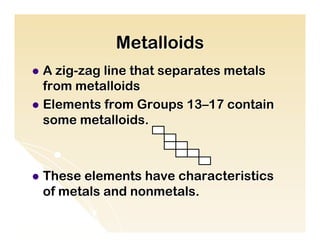
Metalloids
l  A zig-zag line that separates metals
    from metalloids
l  Elements from Groups 13–17 contain
    some metalloids.


l  These
        elements have characteristics
  of metals and nonmetals.
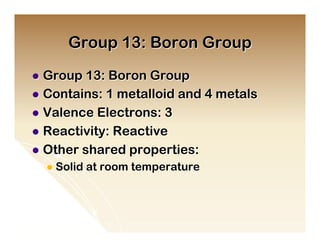
Group 13: Boron Group
l  Group  13: Boron Group
l  Contains: 1 metalloid and 4 metals
l  Valence Electrons: 3
l  Reactivity: Reactive
l  Other shared properties:
  l  Solid   at room temperature
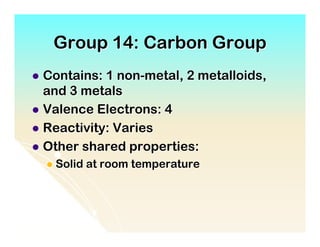
Group 14: Carbon Group
l  Contains: 1 non-metal, 2 metalloids,
    and 3 metals
l  Valence Electrons: 4
l  Reactivity: Varies
l  Other shared properties:
  l  Solid   at room temperature
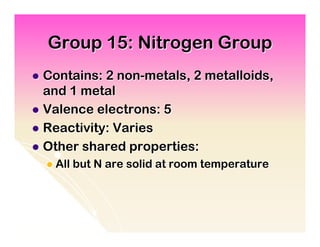
Group 15: Nitrogen Group
l  Contains: 2 non-metals, 2 metalloids,
    and 1 metal
l  Valence electrons: 5
l  Reactivity: Varies
l  Other shared properties:
  l  All   but N are solid at room temperature
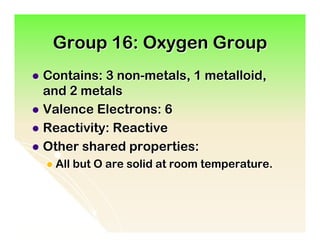
Group 16: Oxygen Group
l  Contains: 3 non-metals, 1 metalloid,
    and 2 metals
l  Valence Electrons: 6
l  Reactivity: Reactive
l  Other shared properties:
  l  All   but O are solid at room temperature.
Groups 17 : Halogens

l  Contain: Nonmetals
l  Valence Electrons: 7
l  Reactivity: Very reactive
l  Other shared properties
  ●  Poor conductors of electric current
  ●  React violently with alkali metals to form
     salts
  ●  Never found uncombined in nature
Group 18 Noble Gases
l  Contains: Nonmetals
l  Valence Electrons: 8 (2 for He)
l  Reactivity: Unreactive (least reactive
    group)
l  Other shared properties:
  l  Colorless,  odorless gases at room
      temperature
  l  Outermost energy level full
  l  All found in atmosphere
Hydrogen Stands Apart
l  H is set apart because its properties
    do not match any single group.
l  Valence electrons: 1
l  Reactivity: very, but loses the 1
    electron easily
l  Properties:
   l  Similar   to those of non-metals rather than
        metals
Periods
l  Periods  run horizontally across the
    Periodic Table
l  Periods are numbered 1–7
l  All the elements in a period will have the
    same number of energy levels, which
    contain electrons. Examples:
  l  Period 1 atoms have 1 energy level.
  l  Period 2 atoms have 2 energy levels.
  l  Period 5 atoms have 5 energy levels.
Periods Continued
l  Movingfrom left to right across a period,
  each element has one more electron in
  the outer shell of its atom than the
  element before it.

l  This
      leads to a fairly regular pattern of
  change in the chemical behavior of the
  elements across a period.

Periodic table ppt cscope

  • 1.
  • 2.
    The Periodic Table l Arrangement of the known elements based on atomic number and chemical and physical properties. l  Dividedinto three basic categories: l Metals l Nonmetals l Metalloids
  • 3.
    Basic Organization The periodictable is organized by: l  Atomic structure l  Atomic number l  Chemical and Physical Properties
  • 4.
    Uses of ThePeriodic Table The periodic table is useful in predicting: l  chemical behavior of the elements l  trends l  properties of the elements
  • 5.
    Atomic Structure Review l Atoms are made of protons, electrons, and neutrons. l  Elements are atoms of only one type. l  Elements are identified by the atomic number (# of protons in nucleus).
  • 6.
    Energy Levels Review l Electronsare arranged in a region around the nucleus called an electron cloud. Energy levels are located within the cloud. l  At least 1 energy level and as many as 7 energy levels exist in atoms.
  • 7.
    Energy Levels Review l Electrons in levels farther away from the nucleus have more energy. l  Inner levels will fill first before outer levels.
  • 8.
    Energy Levels &Valence Electrons l  Energy levels hold a specific amount of electrons: l  1stlevel = up to 2 l  2nd level = up to 8 l  3rd level = up to 8 (first 18 elements only)
  • 9.
    Energy Levels &Valence Electrons l  The electrons in the outermost level are called valence electrons. l  Determine reactivity - how elements will react with others to form compounds l  Outermost level does not usually fill completely with electrons
  • 10.
    Using the Tableto Identify Valence Electrons l  Elements are grouped into vertical columns because they have similar properties. l  These are called groups or families. l  Groups are numbered 1-18.
  • 11.
    Using the Tableto Identify Valence Electrons l  Group numbers can help you determine the number of valence electrons: l  Group 1 has 1 valence electron. l  Group 2 has 2 valence electrons. l  Groups 3–12 are transition metals and have 1 or 2 valence electrons.
  • 12.
    Using the Tableto Identify Valence Electrons cont. l  Groups 13–18 have 10 fewer than the group number. For example: l  Group 13 has 3 valence electrons. l  Group 15 has 5 valence electrons. l  Group 18 has 8 valence electrons.
  • 13.
    Elements & Reactivity l Reactivity is a chemical property that determines how elements will react with others to form compounds.
  • 14.
    Elements & Reactivity l What makes an element reactive? ●  Number of valence electrons each atom has ●  When outer levels are full, atoms are stable. ●  When they are not full, they react: ●  gain, lose, or share 1 or 2 electrons.
  • 15.
    Elements & Reactivity l The most reactive metals are the elements in Groups 1 and 2. l  Elements in Group 1 need seven more electrons to fill their outer level. l  Elements in Group 2 need six more electrons to fill their outer level. l  Thesegroups are known as the “givers” because they easily give up their valence electrons to make a compound.
  • 16.
    Elements & Reactivity l The most reactive nonmetals are the elements in Groups 6 and 7. l  Elements in Group 6 only need two more electrons to fill their outer level. l  Elements in Group 7 only need one more electron to fill their outer level. l  These groups are known as the “takers” because they easily receive valence electrons to make a compound.
  • 17.
    Groups l  Groups run vertically in the periodic table. l  They are numbered from 1–18. l  Elements in the same groups have the same number of valence electrons in the outer energy level. l  Grouped elements behave chemically in similar ways.
  • 18.
    Group 1: AlkaliMetals l  Contains: Metals l  Valence Electrons: 1 l  Reactivity: Very Reactive l  Properties: l  solids l  soft l  react violently with water l  shiny l  low density
  • 19.
    Group 2: Alkaline-EarthMetals l  Contains: Metals l  Valence Electrons: 2 l  Reactivity: very reactive, but less reactive than alkali metals (Group 1) l  Properties: l  Solids l  Silvercolored l  More dense than alkali metals
  • 20.
    Groups 3-12 Transition Metals l  Contain: Metals l  Valence electrons: 1 or 2 l  Reactivity: less reactive than alkali and alkaline-earth metals l  Properties: l  Higherdensity l  Good conductors of heat and electricity
  • 21.
    Groups 3-12 TransitionMetals Below Main Table l  Contain: The Lanthanide and Actinide Series l  These two rows are pulled out of sequence and placed below the main table to keep the table from being too wide. l  Lanthanides are #’s 58–71. l  Actinides are #’s 90–103.
  • 22.
    Groups 3-12 RareEarth Elements ~ Lanthanides l  Lanthanides follow the transition metal # 57 Lanthanum in Period 6. l  Valence electrons: 3 l  Reactivity: Very reactive l  Properties: ●  High luster, but tarnish easily ●  High conductivity for electricity ●  Very small differences between them
  • 23.
    Groups 3-12 RareEarth Elements ~ Actinides l  Actinides follow the transition metal # 89 Actinium in Period 7 l  Valence electrons: 3 (but up to 6) l  Reactivity: unstable l  All are radioactive l  Most made in laboratories
  • 24.
    Metalloids l  A zig-zagline that separates metals from metalloids l  Elements from Groups 13–17 contain some metalloids. l  These elements have characteristics of metals and nonmetals.
  • 25.
    Group 13: BoronGroup l  Group 13: Boron Group l  Contains: 1 metalloid and 4 metals l  Valence Electrons: 3 l  Reactivity: Reactive l  Other shared properties: l  Solid at room temperature
  • 26.
    Group 14: CarbonGroup l  Contains: 1 non-metal, 2 metalloids, and 3 metals l  Valence Electrons: 4 l  Reactivity: Varies l  Other shared properties: l  Solid at room temperature
  • 27.
    Group 15: NitrogenGroup l  Contains: 2 non-metals, 2 metalloids, and 1 metal l  Valence electrons: 5 l  Reactivity: Varies l  Other shared properties: l  All but N are solid at room temperature
  • 28.
    Group 16: OxygenGroup l  Contains: 3 non-metals, 1 metalloid, and 2 metals l  Valence Electrons: 6 l  Reactivity: Reactive l  Other shared properties: l  All but O are solid at room temperature.
  • 29.
    Groups 17 :Halogens l  Contain: Nonmetals l  Valence Electrons: 7 l  Reactivity: Very reactive l  Other shared properties ●  Poor conductors of electric current ●  React violently with alkali metals to form salts ●  Never found uncombined in nature
  • 30.
    Group 18 NobleGases l  Contains: Nonmetals l  Valence Electrons: 8 (2 for He) l  Reactivity: Unreactive (least reactive group) l  Other shared properties: l  Colorless, odorless gases at room temperature l  Outermost energy level full l  All found in atmosphere
  • 31.
    Hydrogen Stands Apart l H is set apart because its properties do not match any single group. l  Valence electrons: 1 l  Reactivity: very, but loses the 1 electron easily l  Properties: l  Similar to those of non-metals rather than metals
  • 32.
    Periods l  Periods run horizontally across the Periodic Table l  Periods are numbered 1–7 l  All the elements in a period will have the same number of energy levels, which contain electrons. Examples: l  Period 1 atoms have 1 energy level. l  Period 2 atoms have 2 energy levels. l  Period 5 atoms have 5 energy levels.
  • 33.
    Periods Continued l  Movingfromleft to right across a period, each element has one more electron in the outer shell of its atom than the element before it. l  This leads to a fairly regular pattern of change in the chemical behavior of the elements across a period.