PERIODIC TABLE 
Genesis of Periodic 
Classification of Elements!
STEPWISE DEVELOPMENT OF PERIODIC 
TABLE 
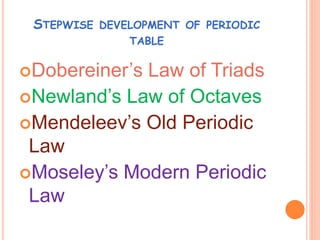
Dobereiner’s Law of Triads 
Newland’s Law of Octaves 
Mendeleev’s Old Periodic 
Law 
Moseley’s Modern Periodic 
Law
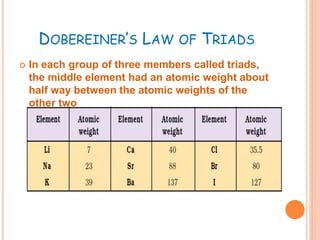
DOBEREINER’S LAW OF TRIADS 
 In each group of three members called triads, 
the middle element had an atomic weight about 
half way between the atomic weights of the 
other two
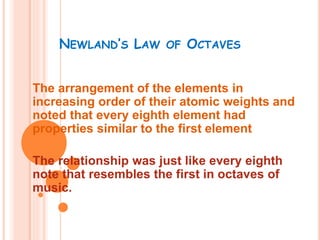
NEWLAND’S LAW OF OCTAVES 
The arrangement of the elements in 
increasing order of their atomic weights and 
noted that every eighth element had 
properties similar to the first element 
The relationship was just like every eighth 
note that resembles the first in octaves of 
music.
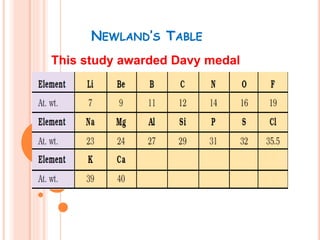
NEWLAND’S TABLE 
This study awarded Davy medal
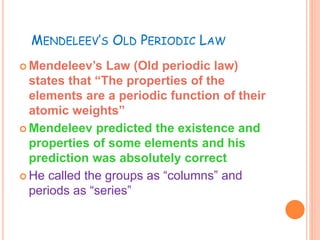
MENDELEEV’S OLD PERIODIC LAW 
 Mendeleev’s Law (Old periodic law) 
states that “The properties of the 
elements are a periodic function of their 
atomic weights” 
 Mendeleev predicted the existence and 
properties of some elements and his 
prediction was absolutely correct 
 He called the groups as “columns” and 
periods as “series”
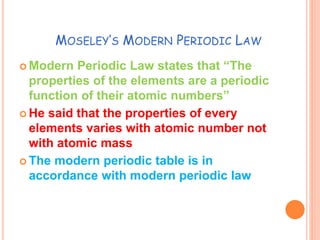
MOSELEY’S MODERN PERIODIC LAW 
 Modern Periodic Law states that “The 
properties of the elements are a periodic 
function of their atomic numbers” 
 He said that the properties of every 
elements varies with atomic number not 
with atomic mass 
 The modern periodic table is in 
accordance with modern periodic law
LONG FORM OF PERIODIC TABLE 
 Periodic table consists of seven periods numbered from 1 
to 7 and the 7th period is still incomplete 
 Periodic table consists of eighteen groups numbered 
from 1 to 18 
 Pure metals are placed on left hand side and non metals 
on the right hand side 
 Hydrogen finds a separate and unique position in the 
periodic table because its property does not match with 
any other elements 
 Periodic table is divided into four main blocks depending 
upon where the last electron enters namely s-, p-, d- or f-blocks 
 The liquid metal present in periodic table is mercury (Hg) 
and the liquid non metal is bromine (Br)
LATIN NAME FOR SOME ELEMENTS 
Sodium – Natrium (Na) 
Potassium – Kalium (K) 
Mercury – Hydrargyrum (Hg) 
Silver – Argentum (Ag) 
Gold – Aurum (Au) 
Tin – Stannum (Sn) 
Lead – Plumbum (Pb)
THE END!
PRESENTED BY 
NITHYA S NAIR 
Physical Science 
Badriya College 
Velichakkala 
Kollam
THANK YOU

Periodic table

  • 1.
    PERIODIC TABLE Genesisof Periodic Classification of Elements!
  • 2.
    STEPWISE DEVELOPMENT OFPERIODIC TABLE Dobereiner’s Law of Triads Newland’s Law of Octaves Mendeleev’s Old Periodic Law Moseley’s Modern Periodic Law
  • 3.
    DOBEREINER’S LAW OFTRIADS  In each group of three members called triads, the middle element had an atomic weight about half way between the atomic weights of the other two
  • 4.
    NEWLAND’S LAW OFOCTAVES The arrangement of the elements in increasing order of their atomic weights and noted that every eighth element had properties similar to the first element The relationship was just like every eighth note that resembles the first in octaves of music.
  • 5.
    NEWLAND’S TABLE Thisstudy awarded Davy medal
  • 6.
    MENDELEEV’S OLD PERIODICLAW  Mendeleev’s Law (Old periodic law) states that “The properties of the elements are a periodic function of their atomic weights”  Mendeleev predicted the existence and properties of some elements and his prediction was absolutely correct  He called the groups as “columns” and periods as “series”
  • 7.
    MOSELEY’S MODERN PERIODICLAW  Modern Periodic Law states that “The properties of the elements are a periodic function of their atomic numbers”  He said that the properties of every elements varies with atomic number not with atomic mass  The modern periodic table is in accordance with modern periodic law
  • 8.
    LONG FORM OFPERIODIC TABLE  Periodic table consists of seven periods numbered from 1 to 7 and the 7th period is still incomplete  Periodic table consists of eighteen groups numbered from 1 to 18  Pure metals are placed on left hand side and non metals on the right hand side  Hydrogen finds a separate and unique position in the periodic table because its property does not match with any other elements  Periodic table is divided into four main blocks depending upon where the last electron enters namely s-, p-, d- or f-blocks  The liquid metal present in periodic table is mercury (Hg) and the liquid non metal is bromine (Br)
  • 9.
    LATIN NAME FORSOME ELEMENTS Sodium – Natrium (Na) Potassium – Kalium (K) Mercury – Hydrargyrum (Hg) Silver – Argentum (Ag) Gold – Aurum (Au) Tin – Stannum (Sn) Lead – Plumbum (Pb)
  • 10.
  • 11.
    PRESENTED BY NITHYAS NAIR Physical Science Badriya College Velichakkala Kollam
  • 12.