Name : Andre Williams and Shemonon Stone
Group: 1F
Collage: St.Josephs’ Teacher’s College
Lecturer : Miss Iron
Date: February 20 , 2014
 John Bowlby (1907 - 1990) was a psychoanalyst
(like Freud) and believed that mental health and behavioral
problems could be attributed to early childhood.
 Bowlby’s evolutionary theory of attachment suggests that
children come into the world biologically pre-programmed
to form attachments with others, because this will help
them to survive.
 Bowlby believed that attachment behaviors
are instinctive and will be activated by any
conditions that seem to threaten the
achievement of proximity, such as separation,
insecurity and fear.
 During the evolution of the human species, it would have
been the babies who stayed close to their mothers who would
have survived to have children of their own and Bowlby
hypothesized that both infants and mothers have evolved a
biological need to stay in contact with each other.
 These attachment behaviors initially function like fixed action
patterns and all share the same function. The infant produces
innate ‘social releaser’ behaviors such as crying and smiling
that stimulate care giving from adults. The determinant of
attachment is not food but care and responsiveness.
 Bowlby suggested that a child would initially form
only one attachment and that the attachment figure
acted as a secure base for exploring the world. The
attachment relationship acts as a prototype for all
future social relationships so disrupting it can have
severe consequences.
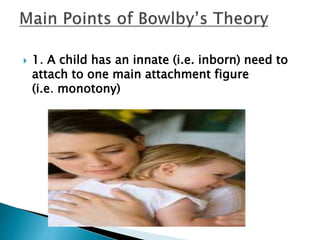
 1. A child has an innate (i.e. inborn) need to
attach to one main attachment figure
(i.e. monotony)
 Although Bowlby did not rule out the possibility of other
attachment figures for a child, he did believe that there
should be a primary bond which was much more important
than any other (usually the mother).
 Bowlby believes that this attachment is different in kind
(qualitatively different) from any subsequent attachments.
Bowlby argues that the relationship with the mother is
somehow different altogether from other relationships
 Bowlby used the term maternal deprivation to refer to the separation or
loss of the mother as well as failure to develop an attachment.
 The underlying assumption of Bowlby’s Maternal Deprivation
Hypothesis is that continual disruption of the attachment between infant
and primary caregiver (i.e. mother) could result in long term cognitive,
social, and emotional difficulties for that infant. The implications of this
are vast – if this is true, should the primary caregiver leave their child in
day care, whilst they continue to work?
 Although Bowlby did not rule out the possibility of other
attachment figures for a child, he did believe that there
should be a primary bond which was much more important
than any other (usually the mother).
 Bowlby believes that this attachment is different in kind
(qualitatively different) from any subsequent attachments.
Bowlby argues that the relationship with the mother is
somehow different altogether from other relationships
 Bowlby (1951) claimed that mothering is almost useless if
delayed until after two and a half to three years and, for most
children, if delayed till after 12 months, i.e. there is a critical
period.
 If the attachment figure is broken or disrupted during the critical
two year period the child will suffer irreversible long-term
consequences of this maternal deprivation. This risks continues
until the age of 5.
 • delinquency,
 • reduced intelligence,
 • increased aggression,
 • depression,
 affectionless psychopathy
 This internal working model is a cognitive framework comprising mental
representations for understanding the world, self and others. A person’s
interaction with others is guided by memories and expectations from their internal
model which influence and help evaluate their contact with others (Bretherton, &
Munholland, 1999).
 Around the age of three these seems to become part of a child’s personality and
thus affects their understanding of the world and future interactions with others
(Schore, 2000). According to Bowlby (1969) the primary caregiver acts as a
prototype for future relationships via the internal working model.
 Affectionless psychopathy is an inability show
affection or concern for others. Such of
individuals act on impulse with little regard for
the consequences of their actions. For example,
showing no guilt for antisocial behavior.
 There are three main features of the internal
working model: (1) a model of others a being
trustworthy, (2) a model of the self as
valuable, and (3) a model of the self as
effective when interacting with others.
 It is this mental representation that guides
future social and emotional behavior as the
child’s internal working model guides the
responsiveness to others in general

Bowlby's attachment theory powerpoint two

  • 1.
    Name : AndreWilliams and Shemonon Stone Group: 1F Collage: St.Josephs’ Teacher’s College Lecturer : Miss Iron Date: February 20 , 2014
  • 2.
     John Bowlby(1907 - 1990) was a psychoanalyst (like Freud) and believed that mental health and behavioral problems could be attributed to early childhood.  Bowlby’s evolutionary theory of attachment suggests that children come into the world biologically pre-programmed to form attachments with others, because this will help them to survive.
  • 3.
     Bowlby believedthat attachment behaviors are instinctive and will be activated by any conditions that seem to threaten the achievement of proximity, such as separation, insecurity and fear.
  • 5.
     During theevolution of the human species, it would have been the babies who stayed close to their mothers who would have survived to have children of their own and Bowlby hypothesized that both infants and mothers have evolved a biological need to stay in contact with each other.  These attachment behaviors initially function like fixed action patterns and all share the same function. The infant produces innate ‘social releaser’ behaviors such as crying and smiling that stimulate care giving from adults. The determinant of attachment is not food but care and responsiveness.
  • 6.
     Bowlby suggestedthat a child would initially form only one attachment and that the attachment figure acted as a secure base for exploring the world. The attachment relationship acts as a prototype for all future social relationships so disrupting it can have severe consequences.
  • 7.
     1. Achild has an innate (i.e. inborn) need to attach to one main attachment figure (i.e. monotony)
  • 8.
     Although Bowlbydid not rule out the possibility of other attachment figures for a child, he did believe that there should be a primary bond which was much more important than any other (usually the mother).  Bowlby believes that this attachment is different in kind (qualitatively different) from any subsequent attachments. Bowlby argues that the relationship with the mother is somehow different altogether from other relationships
  • 9.
     Bowlby usedthe term maternal deprivation to refer to the separation or loss of the mother as well as failure to develop an attachment.  The underlying assumption of Bowlby’s Maternal Deprivation Hypothesis is that continual disruption of the attachment between infant and primary caregiver (i.e. mother) could result in long term cognitive, social, and emotional difficulties for that infant. The implications of this are vast – if this is true, should the primary caregiver leave their child in day care, whilst they continue to work?
  • 10.
     Although Bowlbydid not rule out the possibility of other attachment figures for a child, he did believe that there should be a primary bond which was much more important than any other (usually the mother).  Bowlby believes that this attachment is different in kind (qualitatively different) from any subsequent attachments. Bowlby argues that the relationship with the mother is somehow different altogether from other relationships
  • 11.
     Bowlby (1951)claimed that mothering is almost useless if delayed until after two and a half to three years and, for most children, if delayed till after 12 months, i.e. there is a critical period.  If the attachment figure is broken or disrupted during the critical two year period the child will suffer irreversible long-term consequences of this maternal deprivation. This risks continues until the age of 5.
  • 12.
     • delinquency, • reduced intelligence,  • increased aggression,  • depression,  affectionless psychopathy
  • 13.
     This internalworking model is a cognitive framework comprising mental representations for understanding the world, self and others. A person’s interaction with others is guided by memories and expectations from their internal model which influence and help evaluate their contact with others (Bretherton, & Munholland, 1999).  Around the age of three these seems to become part of a child’s personality and thus affects their understanding of the world and future interactions with others (Schore, 2000). According to Bowlby (1969) the primary caregiver acts as a prototype for future relationships via the internal working model.
  • 14.
     Affectionless psychopathyis an inability show affection or concern for others. Such of individuals act on impulse with little regard for the consequences of their actions. For example, showing no guilt for antisocial behavior.
  • 15.
     There arethree main features of the internal working model: (1) a model of others a being trustworthy, (2) a model of the self as valuable, and (3) a model of the self as effective when interacting with others.  It is this mental representation that guides future social and emotional behavior as the child’s internal working model guides the responsiveness to others in general