Attachment
Use all of the key words below to create a
         definition of attachment

Emotional                  Protecting
Definition:
    •An emotional bond between 2 people
            Endures     bond
   •2 way process that endures over time
•Serves the function of protecting the child
      2 people                   child
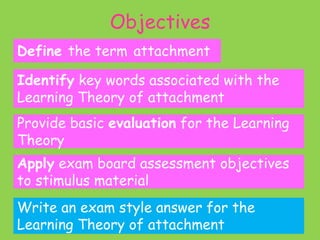
Objectives
Define the term attachment

Identify key words associated with the
Learning Theory of attachment
Provide basic evaluation for the Learning
Theory
Apply exam board assessment objectives
to stimulus material
Write an exam style answer for the
Learning Theory of attachment
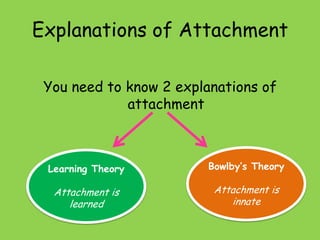
Explanations of Attachment

 You need to know 2 explanations of
             attachment


 Learning Theory         Bowlby’s Theory

  Attachment is           Attachment is
     learned                 innate
A01           The Learning Theory –
                       Miller & Dollard

              Everyone
              is born as
              a blank
              slate


     Behaviour is learned and          Infant becomes
  therefore nurture rather than     attached because they
             nature               ‘learn’ that the caregiver
                                        will meet their
                                      physiological needs
                 Classical                   (food)
Association    conditioning
Classical Conditioning
A01


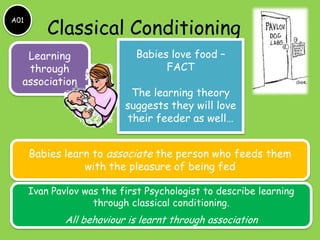
   Learning                  Babies love food –
   through                         FACT
  association
                             The learning theory
                           suggests they will love
                            their feeder as well…


      Babies learn to associate the person who feeds them
                 with the pleasure of being fed

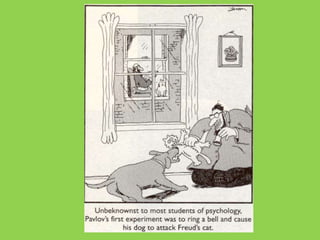
      Ivan Pavlov was the first Psychologist to describe learning
                    through classical conditioning.
              All behaviour is learnt through association
A01
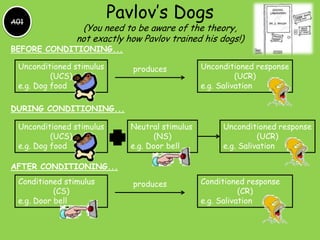
                          Pavlov’s Dogs
                 (You need to be aware of the theory,
                not exactly how Pavlov trained his dogs!)
BEFORE CONDITIONING...

 Unconditioned stimulus      produces           Unconditioned response
          (UCS)                                           (UCR)
 e.g. Dog food                                  e.g. Salivation

DURING CONDITIONING...

 Unconditioned stimulus      Neutral stimulus        Unconditioned response
          (UCS)                     (NS)                       (UCR)
 e.g. Dog food               e.g. Door bell          e.g. Salivation

AFTER CONDITIONING...
 Conditioned stimulus        produces           Conditioned response
           (CS)                                            (CR)
 e.g. Door bell                                 e.g. Salivation
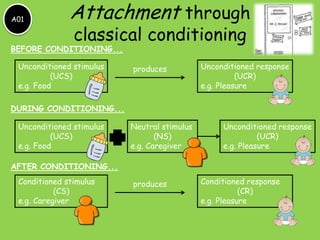
A01           Attachment through
               classical conditioning
BEFORE CONDITIONING...

 Unconditioned stimulus   produces           Unconditioned response
          (UCS)                                        (UCR)
 e.g. Food                                   e.g. Pleasure

DURING CONDITIONING...

 Unconditioned stimulus   Neutral stimulus        Unconditioned response
          (UCS)                  (NS)                       (UCR)
 e.g. Food                e.g. Caregiver          e.g. Pleasure

AFTER CONDITIONING...
 Conditioned stimulus     produces           Conditioned response
           (CS)                                         (CR)
 e.g. Caregiver                              e.g. Pleasure
A02   Learning Theory – Evaluation
                Positive
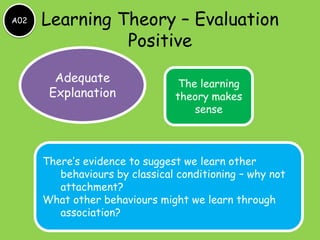
        Adequate                 The learning
       Explanation              theory makes
                                    sense


      There’s evidence to suggest we learn other
         behaviours by classical conditioning – why not
         attachment?
      What other behaviours might we learn through
         association?
A02   Learning Theory – Evaluation
               Negative
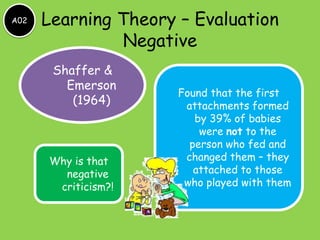
       Shaffer &
         Emerson
                      Found that the first
          (1964)       attachments formed
                         by 39% of babies
                          were not to the
                        person who fed and
      Why is that      changed them – they
        negative         attached to those
       criticism?!     who played with them
Learning Theory – Evaluation Negative


                                        A02
A02    Learning Theory – Evaluation
                Negative
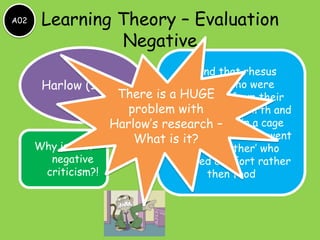
                                  Found that rhesus
       Harlow (1959)              monkey who were
                     There is a separated from their
                                HUGE
                       problem with after birth and
                              mothers
                    Harlow’s research – in a cage
                                were placed
                              with ‘wire’ mothers went
                        What is it?
      Why is that                to the ‘mother’ who
         negative              offered comfort rather
        criticism?!                   then food
Learning Theory – Evaluation Negative


                                        A02
A02   Learning Theory – Evaluation
               Negative

      Lorenz (1952)
                      Lorenz found that newly
                        hatched goose (after
                        seeing Lorenz shortly
                      after hatching) following
                       him everywhere and he
       Why is that    became their ‘imprinted
        Negative               parent’
       criticism?!
Learning Theory – Evaluation
                     (top and tail)
                                  e.g. Harlow found that rhesus
                                   monkey who were separated
  e.g. We acquire many           from their mothers after birth
other behaviours through          and were placed in a cage with
learning, such as phobias           ‘wire’ mothers went to the
                                  ‘mother’ who offered comfort
                                         rather then food


e.g. Shaffer & Emerson found
                                   e.g. Lorenz found that newly
    that the first attachments
                                   hatched goose (after seeing
     formed by 39% of babies
                                 Lorenz shortly after hatching)
       were not to the person
                                  following him everywhere and
     who fed and changed them
                                    he became their ‘imprinted
      – they attached to those
                                              parent’
        who played with them
Exam style questions
Have a go at answering the following
 question –
 Why? So you know how to answer in the
                  exam!

1. Outline the behavioural explanation of
   attachment formation.
                                (4 marks)
Exam style questions
Have a go at marking the following question –
  Why? So you can view the answer from the examiners perspective!

2. Outline two weaknesses of the learning theory explanation of
   attachment.
                                                             (2 + 2 marks)


                                                                            2
   One weakness of the learning theory of attachment is that it doesn’t
   explain why babies attached to people who do not feed them. For
   example, Shaffer and Emerson found that 39% of babies attached
   with those who played with them and not who fed them. This is a
   weakness because it demonstrates that food is not the only reason
   that babies will form an attachment, going against the learning
   theory.


                                                                            0
   A second point is that the theory makes sense. For example, we learn
   lots of behaviours through association so it makes sense that
   children might learn to attach. This is a strength as it adds validity
   to the learning theory explanation of attachment
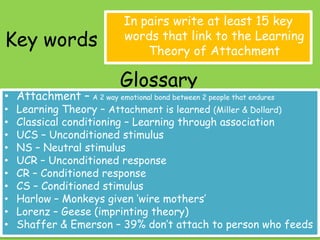
In pairs write at least 15 key
Key words                    words that link to the Learning
                                 Theory of Attachment

                            Glossary
• Attachment – A 2 way emotional bond between 2 people that endures
•   Learning Theory – Attachment is learned (Miller & Dollard)
•   Classical conditioning – Learning through association
•   UCS – Unconditioned stimulus
•   NS – Neutral stimulus
•   UCR – Unconditioned response
•   CR – Conditioned response
•   CS – Conditioned stimulus
•   Harlow – Monkeys given ‘wire mothers’
•   Lorenz – Geese (imprinting theory)
•   Shaffer & Emerson – 39% don’t attach to person who feeds
Objectives
Define the term attachment

Identify key words associated with the
Learning Theory of attachment
Provide basic evaluation for the Learning
Theory
Apply exam board assessment objectives
to stimulus material
Write an exam style answer for the
Learning Theory of attachment
Learning theory

Learning theory

  • 1.
    Attachment Use all ofthe key words below to create a definition of attachment Emotional Protecting Definition: •An emotional bond between 2 people Endures bond •2 way process that endures over time •Serves the function of protecting the child 2 people child
  • 2.
    Objectives Define the termattachment Identify key words associated with the Learning Theory of attachment Provide basic evaluation for the Learning Theory Apply exam board assessment objectives to stimulus material Write an exam style answer for the Learning Theory of attachment
  • 3.
    Explanations of Attachment You need to know 2 explanations of attachment Learning Theory Bowlby’s Theory Attachment is Attachment is learned innate
  • 4.
    A01 The Learning Theory – Miller & Dollard Everyone is born as a blank slate Behaviour is learned and Infant becomes therefore nurture rather than attached because they nature ‘learn’ that the caregiver will meet their physiological needs Classical (food) Association conditioning
  • 5.
    Classical Conditioning A01 Learning Babies love food – through FACT association The learning theory suggests they will love their feeder as well… Babies learn to associate the person who feeds them with the pleasure of being fed Ivan Pavlov was the first Psychologist to describe learning through classical conditioning. All behaviour is learnt through association
  • 6.
    A01 Pavlov’s Dogs (You need to be aware of the theory, not exactly how Pavlov trained his dogs!) BEFORE CONDITIONING... Unconditioned stimulus produces Unconditioned response (UCS) (UCR) e.g. Dog food e.g. Salivation DURING CONDITIONING... Unconditioned stimulus Neutral stimulus Unconditioned response (UCS) (NS) (UCR) e.g. Dog food e.g. Door bell e.g. Salivation AFTER CONDITIONING... Conditioned stimulus produces Conditioned response (CS) (CR) e.g. Door bell e.g. Salivation
  • 7.
    A01 Attachment through classical conditioning BEFORE CONDITIONING... Unconditioned stimulus produces Unconditioned response (UCS) (UCR) e.g. Food e.g. Pleasure DURING CONDITIONING... Unconditioned stimulus Neutral stimulus Unconditioned response (UCS) (NS) (UCR) e.g. Food e.g. Caregiver e.g. Pleasure AFTER CONDITIONING... Conditioned stimulus produces Conditioned response (CS) (CR) e.g. Caregiver e.g. Pleasure
  • 8.
    A02 Learning Theory – Evaluation Positive Adequate The learning Explanation theory makes sense There’s evidence to suggest we learn other behaviours by classical conditioning – why not attachment? What other behaviours might we learn through association?
  • 9.
    A02 Learning Theory – Evaluation Negative Shaffer & Emerson Found that the first (1964) attachments formed by 39% of babies were not to the person who fed and Why is that changed them – they negative attached to those criticism?! who played with them
  • 10.
    Learning Theory –Evaluation Negative A02
  • 11.
    A02 Learning Theory – Evaluation Negative Found that rhesus Harlow (1959) monkey who were There is a separated from their HUGE problem with after birth and mothers Harlow’s research – in a cage were placed with ‘wire’ mothers went What is it? Why is that to the ‘mother’ who negative offered comfort rather criticism?! then food
  • 12.
    Learning Theory –Evaluation Negative A02
  • 13.
    A02 Learning Theory – Evaluation Negative Lorenz (1952) Lorenz found that newly hatched goose (after seeing Lorenz shortly after hatching) following him everywhere and he Why is that became their ‘imprinted Negative parent’ criticism?!
  • 14.
    Learning Theory –Evaluation (top and tail) e.g. Harlow found that rhesus monkey who were separated e.g. We acquire many from their mothers after birth other behaviours through and were placed in a cage with learning, such as phobias ‘wire’ mothers went to the ‘mother’ who offered comfort rather then food e.g. Shaffer & Emerson found e.g. Lorenz found that newly that the first attachments hatched goose (after seeing formed by 39% of babies Lorenz shortly after hatching) were not to the person following him everywhere and who fed and changed them he became their ‘imprinted – they attached to those parent’ who played with them
  • 15.
    Exam style questions Havea go at answering the following question – Why? So you know how to answer in the exam! 1. Outline the behavioural explanation of attachment formation. (4 marks)
  • 16.
    Exam style questions Havea go at marking the following question – Why? So you can view the answer from the examiners perspective! 2. Outline two weaknesses of the learning theory explanation of attachment. (2 + 2 marks) 2 One weakness of the learning theory of attachment is that it doesn’t explain why babies attached to people who do not feed them. For example, Shaffer and Emerson found that 39% of babies attached with those who played with them and not who fed them. This is a weakness because it demonstrates that food is not the only reason that babies will form an attachment, going against the learning theory. 0 A second point is that the theory makes sense. For example, we learn lots of behaviours through association so it makes sense that children might learn to attach. This is a strength as it adds validity to the learning theory explanation of attachment
  • 17.
    In pairs writeat least 15 key Key words words that link to the Learning Theory of Attachment Glossary • Attachment – A 2 way emotional bond between 2 people that endures • Learning Theory – Attachment is learned (Miller & Dollard) • Classical conditioning – Learning through association • UCS – Unconditioned stimulus • NS – Neutral stimulus • UCR – Unconditioned response • CR – Conditioned response • CS – Conditioned stimulus • Harlow – Monkeys given ‘wire mothers’ • Lorenz – Geese (imprinting theory) • Shaffer & Emerson – 39% don’t attach to person who feeds
  • 18.
    Objectives Define the termattachment Identify key words associated with the Learning Theory of attachment Provide basic evaluation for the Learning Theory Apply exam board assessment objectives to stimulus material Write an exam style answer for the Learning Theory of attachment