Memory: specification
• Factors affecting the accuracy of eyewitness
testimony: misleading information,
including leading questions and post-event
discussion; anxiety
Memory: eyewitness testimony
• Without looking do the following:
• Draw a picture of both sides of a 10p coin.
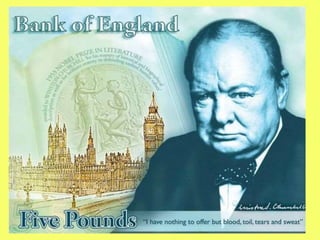
• Write down the name of the person shown on
the back of a new £5 note.
Memory: eyewitness testimony
• We are often unable to accurately recall
details of objects that we use daily.
• This is not a major problem as long as we
recognise a 10 pence coin or £5 pound
note.
• It is a major problem when someone gives
evidence in a court of law about a crime.
Memory: eyewitness testimony
• Eye witness testimony: the evidence
provided in court by a witness of a
crime.
• An area of memory research that
investigates the accuracy of memory
following an accident, crime, or other
significant event.
Memory: eyewitness testimony
• Read the BBC article on
eyewitness testimony.
Memory: eyewitness testimony
• The accuracy of eyewitness memory can be
affected at:
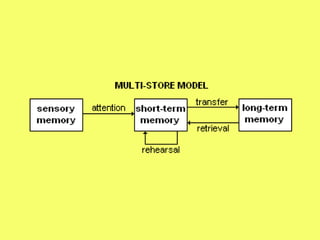
1.The encoding stage: a crime or accident is fast
and unexpected. Not all the details are encoded
and stored in long term memory.
2.The retrieval stage: research has found that
misleading post event information can affect the
accuracy of eyewitness memory.
Memory: eyewitness testimony
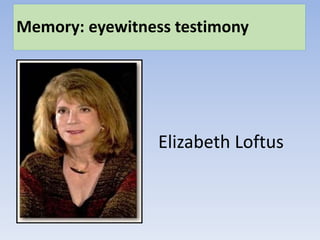
Elizabeth Loftus
Memory: eyewitness testimony
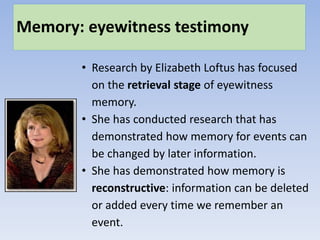
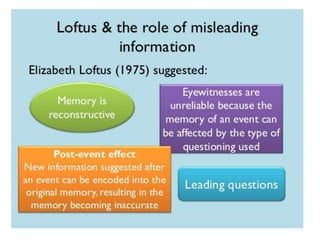
• Research by Elizabeth Loftus has focused
on the retrieval stage of eyewitness
memory.
• She has conducted research that has
demonstrated how memory for events can
be changed by later information.
• She has demonstrated how memory is
reconstructive: information can be deleted
or added every time we remember an
event.
Memory: eyewitness testimony
• Loftus has conducted controlled lab
experiments to investigate the effect
of key factors on the accuracy of
eyewitness testimony:
1.Leading questions
2.Post event-discussion
Eyewitness testimony: leading questions
• Leading questions are questions phrased in such a way
that they prompt a particular answer.
‘How fast was the white car going when it passed the stop
sign?’
‘How fast was the car going when it passed the stop sign?’
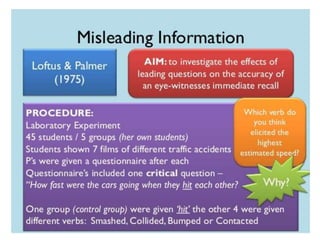
Loftus & Palmer
Eyewitness testimony: leading questions
• Read p.27 & 28 of the memory
booklet and complete the key study
worksheet.
Memory: post-event discussion
• A discussion between witnesses about a
crime or accident after the event.
• This type of discussion may affect the
memory of the witness for the event.
Memory: eyewitness testimony
• Gabbert et al (2003) found evidence that post-
event discussion did affect eyewitness
testimony and led to inaccurate recall of a
crime.
• Read p.28 & 29 of the memory booklet and
complete the key study worksheet.

Mod 6 eyewitness testimony

  • 1.
    Memory: specification • Factorsaffecting the accuracy of eyewitness testimony: misleading information, including leading questions and post-event discussion; anxiety
  • 2.
    Memory: eyewitness testimony •Without looking do the following: • Draw a picture of both sides of a 10p coin. • Write down the name of the person shown on the back of a new £5 note.
  • 5.
    Memory: eyewitness testimony •We are often unable to accurately recall details of objects that we use daily. • This is not a major problem as long as we recognise a 10 pence coin or £5 pound note. • It is a major problem when someone gives evidence in a court of law about a crime.
  • 6.
    Memory: eyewitness testimony •Eye witness testimony: the evidence provided in court by a witness of a crime. • An area of memory research that investigates the accuracy of memory following an accident, crime, or other significant event.
  • 7.
    Memory: eyewitness testimony •Read the BBC article on eyewitness testimony.
  • 9.
    Memory: eyewitness testimony •The accuracy of eyewitness memory can be affected at: 1.The encoding stage: a crime or accident is fast and unexpected. Not all the details are encoded and stored in long term memory. 2.The retrieval stage: research has found that misleading post event information can affect the accuracy of eyewitness memory.
  • 10.
  • 11.
    Memory: eyewitness testimony •Research by Elizabeth Loftus has focused on the retrieval stage of eyewitness memory. • She has conducted research that has demonstrated how memory for events can be changed by later information. • She has demonstrated how memory is reconstructive: information can be deleted or added every time we remember an event.
  • 12.
    Memory: eyewitness testimony •Loftus has conducted controlled lab experiments to investigate the effect of key factors on the accuracy of eyewitness testimony: 1.Leading questions 2.Post event-discussion
  • 14.
    Eyewitness testimony: leadingquestions • Leading questions are questions phrased in such a way that they prompt a particular answer. ‘How fast was the white car going when it passed the stop sign?’ ‘How fast was the car going when it passed the stop sign?’
  • 16.
  • 17.
    Eyewitness testimony: leadingquestions • Read p.27 & 28 of the memory booklet and complete the key study worksheet.
  • 18.
    Memory: post-event discussion •A discussion between witnesses about a crime or accident after the event. • This type of discussion may affect the memory of the witness for the event.
  • 19.
    Memory: eyewitness testimony •Gabbert et al (2003) found evidence that post- event discussion did affect eyewitness testimony and led to inaccurate recall of a crime. • Read p.28 & 29 of the memory booklet and complete the key study worksheet.