ETHOLOGICAL THEORIES
OF HUMAN
DEVELOPMENT
ETHOLOGICAL THEORIES
• The study of the behavior of living organisms can be sometimes problematic because it poses numerous
practical and theoretical questions that can be answered from different perspectives.
 In fact, there have been a lot of theories that attempted to explain behavior yet verifiable and scientific
evaluations remained elusive.
 In contrast to existing theories of behavior, a popular theory formulated by Frisch, Lorenz, and Tinbergen
has succeeded in breaking various stereotypes: the ethological theory.
 ETHOLOGY: The word ethology comes from the Greek word “ethos” meaning character and “logos”
meaning “study of“, and from the Latin word “ethologia” which means “mimicry” or the art of depicting
characters by copying behaviors.
 Ethology involves the study of animal behaviors by observing, describing, and evaluating them in the
natural setting.
 ETHOLOGY: The word ethology comes from the Greek word “ethos” meaning character and “logos”
meaning “study of“, and from the Latin word “ethologia” which means “mimicry” or the art of depicting
characters by copying behaviors.
 Ethology involves the study of animal behaviors by observing, describing, and evaluating them in the
natural setting.
• Ethology, unlike any field that study behavior, ethology does not only consider the environmental factors
that affect behavior but focuses more on the physiological, genetic, and evolutionary factors that affect
these actions.
• The theory of ethology was collectively proposed by three European scientists Karl von Frisch, Konrad
Lorenz, and Nicolaas Tinbergen. The three won the Nobel in 1973 for such scientific contribution
THEORY OF EVOLUTION
- CHARLES DARWIN
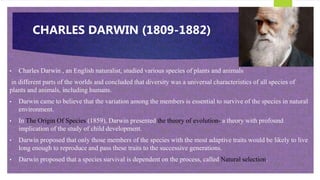
CHARLES DARWIN (1809-1882)
• Charles Darwin , an English naturalist, studied various species of plants and animals
in different parts of the worlds and concluded that diversity was a universal characteristics of all species of
plants and animals, including humans.
• Darwin came to believe that the variation among the members is essential to survive of the species in natural
environment.
• In The Origin Of Species (1859), Darwin presented the theory of evolution- a theory with profound
implication of the study of child development.
• Darwin proposed that only those members of the species with the most adaptive traits would be likely to live
long enough to reproduce and pass these traits to the successive generations.
• Darwin proposed that a species survival is dependent on the process, called Natural selection.
THEORY OF EVOLUTION
- NATURAL SELECTION
• Charles Darwin suggested that any human behaviour had its origin in the past which was essential for the
survival.
• By observing his sons behaviour Darwin kept a record of the growth and behaviour of the child.
• Even though Darwin's theory of evolution is not directly related to child development, Darwin noted that
the stages of evolution of the species largely resemble the stages of development of the child.
• Darwin's most famous and most important theory of evolution, Only process that promotes adaptation.
• The mechanism for adaptation and evolution is called “ Natural selection”.
Natural selection theory states that-
“Those organisms best adapted to their environment have a better chance of surviving and
reproducing.”
THEORY OF EVOLUTION
Darwin had the following ideas regarding the theory of natural selection:
• Species keep on evolving or changing with time. As the environment changes, the requirements of an
organism also change and they adapt to the new environment. This phenomenon of changing over a period of
time as per the natural requirements is called Adaptation.
• As per Darwin’s theory, only the superior changes are naturally selected and the inferior ones are eliminated.
Thus, not all adaptations contribute to progressive evolution. For example, people living in tropical countries
have more melanin in their body to protect them from the sunlight.
• Almost all organisms share common ancestry with some organism. According to Darwin, all organisms had
one common ancestor at some point in time and kept on diverging ever since. His evolutionary theories
support the convergent theory and divergent theory of evolution with examples.
• He also studied that the birds of Galapagos Island (Darwin’s finches) developed different beaks as per the
availability of the food. This proved adaptive radiation. Similarly, he also observed the Australian Marsupials
which showed a number of marsupials emerging from an ancestor.
• According to Charles Darwin, evolution is a very slow and gradual process. He concluded that evolution took
place over a very long period of time. As we talk about the time period in evolution we usually refer to billions
of years. The generation of a species from another takes a long period of time. It is a very steady process as the
changes and adaptation take a long time to stabilize and give rise to a new species.
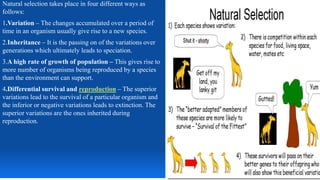
Natural selection takes place in four different ways as
follows:
1.Variation – The changes accumulated over a period of
time in an organism usually give rise to a new species.
2.Inheritance – It is the passing on of the variations over
generations which ultimately leads to speciation.
3.A high rate of growth of population – This gives rise to
more number of organisms being reproduced by a species
than the environment can support.
4.Differential survival and reproduction – The superior
variations lead to the survival of a particular organism and
the inferior or negative variations leads to extinction. The
superior variations are the ones inherited during
reproduction.
CRITIQUES OF THEORY OF EVOLUTION
• The three limitations of Darwin's theory concern the origin of DNA, the irreducible complexity of the cell,
and the paucity of transitional species. Because of these limitations, the author predicts a paradigm shift
away from evolution to an alternative explanation.
• Darwin had put forth his theory not as a proven fact, but as a pro Darwin had put forth his theory not as a
proven fact, but as a probable hypothesis.
• Darwin was unable to explain the mechanism of inheritance of characters
• According to natural selection, only useful organs are favored by natural selection. The existence of vestigial
organs in organisms could not be explained.
• Darwin was unable to explain the source of variations in organisms.
FILIAL IMPRINTINGEXPERIMNT
- Lorenz and Tibergen
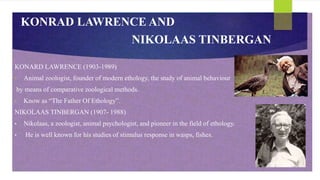
KONRAD LAWRENCE AND
NIKOLAAS TINBERGAN
KONARD LAWRENCE (1903-1989)
• Animal zoologist, founder of modern ethology, the study of animal behaviour
by means of comparative zoological methods.
• Know as “The Father Of Ethology”.
NIKOLAAS TINBERGAN (1907- 1988)
• Nikolaas, a zoologist, animal psychologist, and pioneer in the field of ethology.
• He is well known for his studies of stimulus response in wasps, fishes.
LORENZ’S AND TIBERGEN EXPERIMENT
• During the 1950, the history of the ethological theory can be traced back when Lorenz and Tibergen observed
the egg- rolling response of a greylag goose.
• When a mother goose is incubating and somehow realize an egg near the nest, its attention is stirred and tries
to roll the egg back to the nest. When the egg is recovered the mother goose returns to incubate again.
• The two began to observe that such behaviour is an example of an innate and stereotype pattern of
movement.
• In 1960, the ethological theory was first applied to study the behaviour children. Since then, the theory has
become more influential and ha been applied to research on adults behaviour.
• The most famous example for the ethological theory is so called filial imprinting. Again Lorenz has utilized
the greylag geese as his test subject.
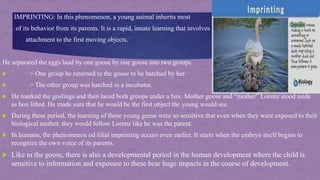
IMPRINTING: In this phenomenon, a young animal inherits most
of its behavior from its parents. It is a rapid, innate learning that involves
attachment to the first moving objects.
He separated the eggs laud by one goose by one goose into two groups.
 > One group he returned to the goose to be hatched by her.
 > The other group was hatched in a incubator.
 He marked the goslings and then laced both groups under a box. Mother goose and “mother” Lorenz stood aside
as box lifted. He made sure that he would be the first object the young would see.
 During these period, the learning of these young geese were so sensitive that even when they were exposed to their
biological mother, they would follow Lorenz like he was the parent.
 In humans, the phenomenon od filial imprinting occurs even earlier. It starts when the embryo itself begins to
recognize the own voice of its parents.
 Like in the goose, there is also a developmental period in the human development where the child is
sensitive to information and exposure to these bear huge impacts in the course of development.
CRITIQUES OF IMPRINTING EXPERIMNET
STRENGTH:
• It has highly ecological validity because it is field experiment.
• The findings are reliable because the experiment has been repeated with same results.
Limitation:
• Lorenz only investigated attachment in one species: geese.
• Other animals and humans may have different attachment process.
• Konard concluded that imprinting was permanent in birds, later research found that was not true
THEORY OF ATTACHMENT
- JOHN BOWLBY
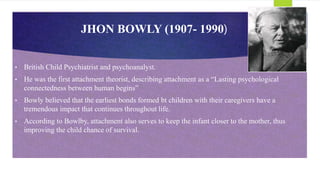
JHON BOWLY (1907- 1990)
• British Child Psychiatrist and psychoanalyst.
• He was the first attachment theorist, describing attachment as a “Lasting psychological
connectedness between human begins”
• Bowly believed that the earliest bonds formed bt children with their caregivers have a
tremendous impact that continues throughout life.
• According to Bowlby, attachment also serves to keep the infant closer to the mother, thus
improving the child chance of survival.
WHAT IS ATTACHMENT?
• Attachment is a strong, affectionate tie we have with special people in our lives that head us to experience
pleasure when we interact with time and to be comforted by nearness in times of stress.
• According to psychoanalytic perspective and behaviouristic perspective feeding was seen an a central
context in which the care giver and babies developed attachment.
BOWLBY’S EHOLOGICAL THEORY
• Ethological theory of attachment recognizes infants emotional tie to the caregiver as an evolved response that
promotes survival.
• Jhon Bowlby applied this idea to infant- caregiver bond.
• He retained the psychoanalyst idea that quality of attachment to caregiver has profound implication for
child’s security and capacity to form trusting relationship. But he said ‘FEEDING IS NOT THE BASIS
FOR ATTACHMENT’.
• The centre theme of attachment theory is that mothers who are available and responsive to their infants needs
establish a sense of security in heir children.
• The infant knows the caregiver is dependable, which creates a secure base for the chid to then explore the
world.
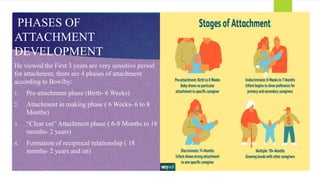
PHASES OF
ATTACHMENT
DEVELOPMENT
He viewed the First 3 years are very sensitive period
for attachment, there are 4 phases of attachment
according to Bowlby:
1. Pre-attachment phase (Birth- 6 Weeks)
2. Attachment in making phase ( 6 Weeks- 6 to 8
Months)
3. “Clear cut” Attachment phase ( 6-8 Months to 18
months- 2 years)
4. Formation of reciprocal relationship ( 18
months- 2 years and on)
CRITIQUES OF ATTACHMENT THEORY
STRENGTH:
• Significance of solid relationship wit h parent or guardian.
• Explains why some children have mental health disorders.
• Main explanation of attachment, easy to understand.
LIMITATIONS:
• The idea that attachment behaviour have evolved to promote child development has good face validity but
evolutionary ideas are very difficult to teat and so, difficult to prove or disprove
• Bowlby’s theory focuses on the role of the mother. There is evidence that in two parent families, the quality
of attachment of the father can also have a big effect on the childs behaviour and development.

Ethological theories.pptx

  • 1.
  • 2.
    ETHOLOGICAL THEORIES • Thestudy of the behavior of living organisms can be sometimes problematic because it poses numerous practical and theoretical questions that can be answered from different perspectives.  In fact, there have been a lot of theories that attempted to explain behavior yet verifiable and scientific evaluations remained elusive.  In contrast to existing theories of behavior, a popular theory formulated by Frisch, Lorenz, and Tinbergen has succeeded in breaking various stereotypes: the ethological theory.  ETHOLOGY: The word ethology comes from the Greek word “ethos” meaning character and “logos” meaning “study of“, and from the Latin word “ethologia” which means “mimicry” or the art of depicting characters by copying behaviors.  Ethology involves the study of animal behaviors by observing, describing, and evaluating them in the natural setting.
  • 3.
     ETHOLOGY: Theword ethology comes from the Greek word “ethos” meaning character and “logos” meaning “study of“, and from the Latin word “ethologia” which means “mimicry” or the art of depicting characters by copying behaviors.  Ethology involves the study of animal behaviors by observing, describing, and evaluating them in the natural setting. • Ethology, unlike any field that study behavior, ethology does not only consider the environmental factors that affect behavior but focuses more on the physiological, genetic, and evolutionary factors that affect these actions. • The theory of ethology was collectively proposed by three European scientists Karl von Frisch, Konrad Lorenz, and Nicolaas Tinbergen. The three won the Nobel in 1973 for such scientific contribution
  • 4.
    THEORY OF EVOLUTION -CHARLES DARWIN
  • 5.
    CHARLES DARWIN (1809-1882) •Charles Darwin , an English naturalist, studied various species of plants and animals in different parts of the worlds and concluded that diversity was a universal characteristics of all species of plants and animals, including humans. • Darwin came to believe that the variation among the members is essential to survive of the species in natural environment. • In The Origin Of Species (1859), Darwin presented the theory of evolution- a theory with profound implication of the study of child development. • Darwin proposed that only those members of the species with the most adaptive traits would be likely to live long enough to reproduce and pass these traits to the successive generations. • Darwin proposed that a species survival is dependent on the process, called Natural selection.
  • 6.
    THEORY OF EVOLUTION -NATURAL SELECTION • Charles Darwin suggested that any human behaviour had its origin in the past which was essential for the survival. • By observing his sons behaviour Darwin kept a record of the growth and behaviour of the child. • Even though Darwin's theory of evolution is not directly related to child development, Darwin noted that the stages of evolution of the species largely resemble the stages of development of the child. • Darwin's most famous and most important theory of evolution, Only process that promotes adaptation. • The mechanism for adaptation and evolution is called “ Natural selection”. Natural selection theory states that- “Those organisms best adapted to their environment have a better chance of surviving and reproducing.”
  • 7.
    THEORY OF EVOLUTION Darwinhad the following ideas regarding the theory of natural selection: • Species keep on evolving or changing with time. As the environment changes, the requirements of an organism also change and they adapt to the new environment. This phenomenon of changing over a period of time as per the natural requirements is called Adaptation. • As per Darwin’s theory, only the superior changes are naturally selected and the inferior ones are eliminated. Thus, not all adaptations contribute to progressive evolution. For example, people living in tropical countries have more melanin in their body to protect them from the sunlight. • Almost all organisms share common ancestry with some organism. According to Darwin, all organisms had one common ancestor at some point in time and kept on diverging ever since. His evolutionary theories support the convergent theory and divergent theory of evolution with examples.
  • 8.
    • He alsostudied that the birds of Galapagos Island (Darwin’s finches) developed different beaks as per the availability of the food. This proved adaptive radiation. Similarly, he also observed the Australian Marsupials which showed a number of marsupials emerging from an ancestor. • According to Charles Darwin, evolution is a very slow and gradual process. He concluded that evolution took place over a very long period of time. As we talk about the time period in evolution we usually refer to billions of years. The generation of a species from another takes a long period of time. It is a very steady process as the changes and adaptation take a long time to stabilize and give rise to a new species.
  • 9.
    Natural selection takesplace in four different ways as follows: 1.Variation – The changes accumulated over a period of time in an organism usually give rise to a new species. 2.Inheritance – It is the passing on of the variations over generations which ultimately leads to speciation. 3.A high rate of growth of population – This gives rise to more number of organisms being reproduced by a species than the environment can support. 4.Differential survival and reproduction – The superior variations lead to the survival of a particular organism and the inferior or negative variations leads to extinction. The superior variations are the ones inherited during reproduction.
  • 10.
    CRITIQUES OF THEORYOF EVOLUTION • The three limitations of Darwin's theory concern the origin of DNA, the irreducible complexity of the cell, and the paucity of transitional species. Because of these limitations, the author predicts a paradigm shift away from evolution to an alternative explanation. • Darwin had put forth his theory not as a proven fact, but as a pro Darwin had put forth his theory not as a proven fact, but as a probable hypothesis. • Darwin was unable to explain the mechanism of inheritance of characters • According to natural selection, only useful organs are favored by natural selection. The existence of vestigial organs in organisms could not be explained. • Darwin was unable to explain the source of variations in organisms.
  • 11.
  • 12.
    KONRAD LAWRENCE AND NIKOLAASTINBERGAN KONARD LAWRENCE (1903-1989) • Animal zoologist, founder of modern ethology, the study of animal behaviour by means of comparative zoological methods. • Know as “The Father Of Ethology”. NIKOLAAS TINBERGAN (1907- 1988) • Nikolaas, a zoologist, animal psychologist, and pioneer in the field of ethology. • He is well known for his studies of stimulus response in wasps, fishes.
  • 13.
    LORENZ’S AND TIBERGENEXPERIMENT • During the 1950, the history of the ethological theory can be traced back when Lorenz and Tibergen observed the egg- rolling response of a greylag goose. • When a mother goose is incubating and somehow realize an egg near the nest, its attention is stirred and tries to roll the egg back to the nest. When the egg is recovered the mother goose returns to incubate again. • The two began to observe that such behaviour is an example of an innate and stereotype pattern of movement. • In 1960, the ethological theory was first applied to study the behaviour children. Since then, the theory has become more influential and ha been applied to research on adults behaviour. • The most famous example for the ethological theory is so called filial imprinting. Again Lorenz has utilized the greylag geese as his test subject.
  • 14.
    IMPRINTING: In thisphenomenon, a young animal inherits most of its behavior from its parents. It is a rapid, innate learning that involves attachment to the first moving objects. He separated the eggs laud by one goose by one goose into two groups.  > One group he returned to the goose to be hatched by her.  > The other group was hatched in a incubator.  He marked the goslings and then laced both groups under a box. Mother goose and “mother” Lorenz stood aside as box lifted. He made sure that he would be the first object the young would see.  During these period, the learning of these young geese were so sensitive that even when they were exposed to their biological mother, they would follow Lorenz like he was the parent.  In humans, the phenomenon od filial imprinting occurs even earlier. It starts when the embryo itself begins to recognize the own voice of its parents.  Like in the goose, there is also a developmental period in the human development where the child is sensitive to information and exposure to these bear huge impacts in the course of development.
  • 15.
    CRITIQUES OF IMPRINTINGEXPERIMNET STRENGTH: • It has highly ecological validity because it is field experiment. • The findings are reliable because the experiment has been repeated with same results. Limitation: • Lorenz only investigated attachment in one species: geese. • Other animals and humans may have different attachment process. • Konard concluded that imprinting was permanent in birds, later research found that was not true
  • 16.
  • 17.
    JHON BOWLY (1907-1990) • British Child Psychiatrist and psychoanalyst. • He was the first attachment theorist, describing attachment as a “Lasting psychological connectedness between human begins” • Bowly believed that the earliest bonds formed bt children with their caregivers have a tremendous impact that continues throughout life. • According to Bowlby, attachment also serves to keep the infant closer to the mother, thus improving the child chance of survival.
  • 18.
    WHAT IS ATTACHMENT? •Attachment is a strong, affectionate tie we have with special people in our lives that head us to experience pleasure when we interact with time and to be comforted by nearness in times of stress. • According to psychoanalytic perspective and behaviouristic perspective feeding was seen an a central context in which the care giver and babies developed attachment.
  • 19.
    BOWLBY’S EHOLOGICAL THEORY •Ethological theory of attachment recognizes infants emotional tie to the caregiver as an evolved response that promotes survival. • Jhon Bowlby applied this idea to infant- caregiver bond. • He retained the psychoanalyst idea that quality of attachment to caregiver has profound implication for child’s security and capacity to form trusting relationship. But he said ‘FEEDING IS NOT THE BASIS FOR ATTACHMENT’. • The centre theme of attachment theory is that mothers who are available and responsive to their infants needs establish a sense of security in heir children. • The infant knows the caregiver is dependable, which creates a secure base for the chid to then explore the world.
  • 20.
    PHASES OF ATTACHMENT DEVELOPMENT He viewedthe First 3 years are very sensitive period for attachment, there are 4 phases of attachment according to Bowlby: 1. Pre-attachment phase (Birth- 6 Weeks) 2. Attachment in making phase ( 6 Weeks- 6 to 8 Months) 3. “Clear cut” Attachment phase ( 6-8 Months to 18 months- 2 years) 4. Formation of reciprocal relationship ( 18 months- 2 years and on)
  • 21.
    CRITIQUES OF ATTACHMENTTHEORY STRENGTH: • Significance of solid relationship wit h parent or guardian. • Explains why some children have mental health disorders. • Main explanation of attachment, easy to understand. LIMITATIONS: • The idea that attachment behaviour have evolved to promote child development has good face validity but evolutionary ideas are very difficult to teat and so, difficult to prove or disprove • Bowlby’s theory focuses on the role of the mother. There is evidence that in two parent families, the quality of attachment of the father can also have a big effect on the childs behaviour and development.