Attachments Revision 
The Essential Guide!!
Name FOUR things about 
Attachment
AAttttaacchhmmeenntt –– WWhhaatt iiss iitt?? 
• 1. An affectional tie between two people or 
animals 
• 2. A two-way process that endures over time 
• 3. Leads to certain behaviours such as: 
Clinging – Proximity seeking – Crying - 
Smiling 
• 4.Serves the function of protecting the infant 
or young animal 
(Mary Ainsworth 1970)
What do we mean by these 
Behaviours? 
• And how are they essential to the 
development of a healthy creature? 
• They are all features of a Secure Attachment 
• PPrrooxxiimmiittyy SSeeeekkiinngg 
• SSeeccuurree BBaassee BBeehhaavviioouurr 
• SSeeppaarraattiioonn AAnnxxiieettyy 
• SSttrraannggeerr AAnnxxiieettyy
Key Terms 
• PPrrooxxiimmiittyy SSeeeekkiinngg – Staying close to the 
attachment figure 
• SSeeccuurree BBaassee BBeehhaavviioouurr – Regularly returning 
to an attachment figure when exploring 
• SSeeppaarraattiioonn AAnnxxiieettyy – Anxiety at being apart 
from an attachment figure 
• SSttrraannggeerr AAnnxxiieettyy – Anxiety in the presence 
of strangers 
• They are all essential for survival!
Why are Psychologists so 
interested in 
Attachment?
Why are Psychologists so 
interested in Attachment? 
• Because ALL psychologist believe that the 
attachment we form with our primary carer 
(usually our mother) forms a TEMPLATE for 
all future relationships - with friends, with 
teachers, and, in the future, with husbands and 
wives and in turn, OUR FUTURE CHILDREN. 
If our attachment with our mother is not good, 
psychologists believe our whole life could be put 
at a disadvantage.
Explain Attachment using the 
Learning Theory
Explanations of Attachments N0. 1 
• LEARNING THEORY 
• All behaviour is learnt rather than inborn 
• Children are born blank slates and everything 
they become is dependent on what they 
experience 
• Learning theory is put forward by 
BEHAVIOURIST psychologists who say that 
all behaviour, including attachment is learnt 
by: 
• Classical and Operant Conditioning.
Classical Conditioning – Learning by Association 
Operant Conditioning – learning by Reward 
(Reinforcement) and Punishment 
• Classical Conditioning – food produces 
pleasure. “Feeder” (mother) becomes associated 
with food/pleasure so baby becomes attached to 
her. 
• Operant Conditioning – food is the primary 
reinforcer, “feeder” becomes the secondary 
reinforcer – both food and mother reduce 
discomfort, and therefore reward the infant and 
so the baby becomes attached to the mother.
Evaluating the Learning Theory 
(Sometimes called the “Cupboard Love” Theory!) 
• Strengths  
• Learning theory suggests that the attachment develops 
between infant and carer because the carer provides food. 
And it’s true – we do learn through association and 
reinforcement. 
• Weaknesses  
 We do learn through association and reinforcement but 
it may not be the food that is the reinforcer, it may be the 
responsiveness and attention of other carer. 
 If the learning theory is true: 
• How come babies often develop strong attachments to 
people who don’t feed them? 
• The Harlow Monkey Experiment.
Name, date and describe Two 
research studies which cast 
doubt on the 
Learning Theory
The Harlow Monkey Experiment 
• Harry Harlow, 1959 conducted research in to learning 
using young rhesus monkeys, kept alone. 
• He created two “mothers”, one with made of wire but a 
full feeding bottle of milk, and the other wrapped in a 
soft cloth but without food. 
• According to the learning theory the young monkeys 
should have become attached to the wire mother. 
• In fact the monkeys spent most of their time with the 
cloth-covered mother and would cling to it, especially 
when frightened.(a proximity-seeking behaviour, 
characteristic of attachment)
Schaffer and Emerson 1964 
• Whilst the Harlow Monkey experiment used animals, 
the above study used human infants. 
• 60 babies (from mainly working-class Glasgow homes) 
were observed for a year. 
• Schaffer & Emerson found that infants were not most 
attached to the person who fed them but became 
attached to the person who was most responsive to them 
and who interacted most with them. 
• This reinforces the Harlow Monkey experiment and 
suggests that “cupboard love” is not likely to be the best 
explanation for attachment, although association and 
reinforcement may be part of the story.
The Evolutionary 
Perspective - Bowlby’s 
Theory of Attachment
Explain Bowlby’s theory of 
Attachment using the following 
terms 
• Survival Value Reproductive Value 
• Innate Drive Imprinting 
• Pre-programmed Social Releasers 
• Adaptive Sensitive Period 
• Monotropy Template 
• Internal Working Model 
• Continuity Hypothesis Responsive Mother
Bowlby’s Theory of Attachment 
• Bowlby’s theory is an Evolutionary theory 
• In his view attachment is a behaviour that has evolved 
because of its survival value and, ultimately, its 
reproductive value. 
• According to Bowlby, children have an innate drive to 
become attached to a caregiver because attachment has 
long-term benefits. He proposed that normal psychological 
development requires the development of a secure 
attachment between a baby and its main carer. 
• He also proposed the concept of imprinting – an innate 
readiness to develop a strong bond with a mother figure.
Pre-programming!! 
• John Bowlby said that babies are pre-programmed 
to behave in ways that encourage 
adult attention 
• He called these behaviours social releasers 
• These include “cute” behaviours such as 
smiling and cooing and are the child’s 
contribution towards an attachment. The 
mother’s contribution is that she must respond 
and react to these behaviours 
• He suggests these instinctive behaviours 
enhance survival and and are protective for the 
infant. He called these behaviours 
ADAPTIVE.
Sensitive Period 
• Bowlby said there is sensitive period from when 
the baby is born to around the age of 2, when the 
baby is programmed to form a special 
attachment. He called this monotropy. If 
something happens to damage or break this 
attachment, the child may develop and insecure 
attachment its development may well be 
damaged. 
• For a secure attachment to take place, the child’s 
main carer (usually the mother) needs to be 
attentive, SENSITIVE and responsive to the 
child’s needs, during this sensitive period.
More about Bowlby’s theory 
• Bowlby said the child develops a model or 
template from the attachment with its mother 
which influences all future relationships and 
future parenting style. It is a prototype of all 
future relationships. He called this the internal 
working model. 
• The internal working model indicates a big link 
between early emotional experiences and later 
relationships. He called this the continuity 
hypothesis – the idea that early experiences 
continue to influence throughout life.
Give some  Strengths of 
Bowlby’s theory of Attachment
Evaluating Bowlby’s theory of 
Attachment - Strengths 
• It is considered the dominant explanation of how 
and why attachment develops. 
 Imprinting is supported by Lorenz’s ducks 
 Bowlby suggests that attachment evolved to as 
an aid to survival. If this is true then attachment 
and caregiving behaviours should be universal, in 
all cultures, despite differences in child-rearing 
practices. There is evidence to support this. 
(Tronick et al 1992)
Give Some Research Evidence 
Supporting Bowlby’s Theory 

Research Evidence for Bowlby’s Theory 
 Schaffer and Emerson, 1964, observed that 
strongly attached infants had mothers who 
responded quickly to their demands and who 
offered the child the most interaction whereas 
weakly attached infants had mothers who failed 
to interact with them. 
 The Minnesota longitudinal study (Sroufe et 
al 2005) followed children from infancy to 
adolescence and found continuity between their 
early attachment styles and their later emotional 
and social behaviour. This supports the 
continuity hypothesis.
And the Harlow Monkey 
Experiment 
 Supports Bowlby’s theory that a 
responsive mother is needed for good, 
lifelong psychological health. The 
monkeys were not only psychologically 
damaged, but proved incapable of 
becoming effective and loving parents, 
themselves.
Give some Weaknesses  of 
Bowlby’s Theory
More Evaluation of Bowlby’s theory 
Weaknesses 
 The idea that attachment behaviours have 
evolved to promote child development has good 
face validity. But evolutionary ideas are very 
difficult to test and so difficult to prove or 
disprove. 
 Bowlby’s theory focuses on the role of the 
mother. There is evidence that in two-parent 
families, the quality of attachment of the father 
can also have a big effect on the child’s 
development. (Grossmann and Grossmann, 
1991)
Give an Alternative Explanation 
for 
Attachment
An Alternative Explanation 
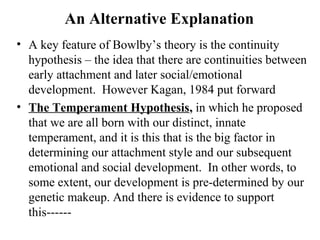
• A key feature of Bowlby’s theory is the continuity 
hypothesis – the idea that there are continuities between 
early attachment and later social/emotional 
development. However Kagan, 1984 put forward 
• The Temperament Hypothesis, in which he proposed 
that we are all born with our distinct, innate 
temperament, and it is this that is the big factor in 
determining our attachment style and our subsequent 
emotional and social development. In other words, to 
some extent, our development is pre-determined by our 
genetic makeup. And there is evidence to support 
this------
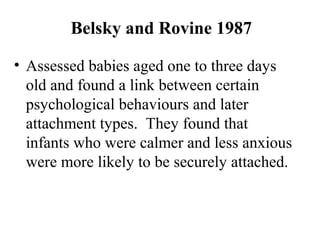
Belsky and Rovine 1987 
• Assessed babies aged one to three days 
old and found a link between certain 
psychological behaviours and later 
attachment types. They found that 
infants who were calmer and less anxious 
were more likely to be securely attached.
Name and date the procedure 
which aimed to test the nature 
of attachment systematically.
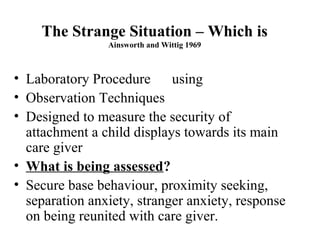
The Strange Situation – Which is 
Ainsworth and Wittig 1969 
• Laboratory Procedure using 
• Observation Techniques 
• Designed to measure the security of 
attachment a child displays towards its main 
care giver 
• What is being assessed? 
• Secure base behaviour, proximity seeking, 
separation anxiety, stranger anxiety, response 
on being reunited with care giver.
What is the Procedure of the 
Strange Situation
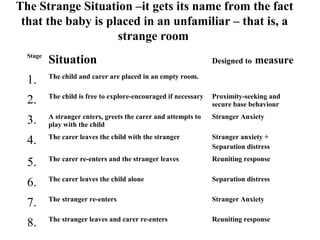
The Strange Situation –it gets its name from the fact 
that the baby is placed in an unfamiliar – that is, a 
strange room 
Stage Situation Designed to measure 
1. The child and carer are placed in an empty room. 
2. The child is free to explore-encouraged if necessary Proximity-seeking and 
secure base behaviour 
3. A stranger enters, greets the carer and attempts to 
play with the child 
Stranger Anxiety 
4. The carer leaves the child with the stranger Stranger anxiety + 
Separation distress 
5. The carer re-enters and the stranger leaves Reuniting response 
6. The carer leaves the child alone Separation distress 
7. The stranger re-enters Stranger Anxiety 
8. The stranger leaves and carer re-enters Reuniting response
What were the findings of the 
Strange Situation
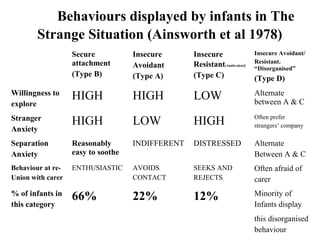
Behaviours displayed by infants in The 
Strange Situation (Ainsworth et al 1978) 
Secure 
attachment 
(Type B) 
Insecure 
Avoidant 
(Type A) 
Insecure 
Resistant(Ambivalent) 
(Type C) 
Insecure Avoidant/ 
Resistant. 
“Disorganised” 
(Type D) 
Willingness to 
explore 
HIGH HIGH LOW Alternate 
between A & C 
Stranger 
Anxiety 
HIGH LOW HIGH Often prefer 
strangers’ company 
Separation 
Anxiety 
Reasonably 
easy to soothe 
INDIFFERENT DISTRESSED Alternate 
Between A & C 
Behaviour at re- 
Union with carer 
ENTHUSIASTIC AVOIDS 
CONTACT 
SEEKS AND 
REJECTS 
Often afraid of 
carer 
% of infants in 
this category 
66% 22% 12% Minority of 
Infants display 
this disorganised 
behaviour
How did Mary Ainsworth 
account for the 
Variations in attachment 
types?
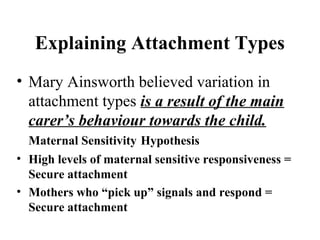
Explaining Attachment Types 
• Mary Ainsworth believed variation in 
attachment types is a result of the main 
carer’s behaviour towards the child. 
Maternal Sensitivity Hypothesis 
• High levels of maternal sensitive responsiveness = 
Secure attachment 
• Mothers who “pick up” signals and respond = 
Secure attachment
What is Secure Attachment? 
What did Ainsworth believe caused 
it?
Secure Attachment 
• This is a strong and contented attachment 
of an infant to its caregiver, which 
develops as a result of sensitive 
responding by the caregiver to the 
infant’s needs. Securely attached infants 
are comfortable with social interaction 
and intimacy. Secure attachment is 
related to healthy subsequent cognitive 
and emotional development.
What is Insecure Attachment? 
What causes it? What can it lead 
to? 
What is the difference in the various 
insecure attachment types?
What is Insecure Attachment? 
• Insecure attachment – This is a form of attachment 
between infant and caregiver that develops as a result of 
the caregiver’s lack of sensitive responding to the infant’s 
needs. It may be associated with poor subsequent 
cognitive and emotional development. 
• Insecure Avoidant Type A– children who avoid social 
interaction and intimacy with others. 
• Insecure Resistant Type C – Children who both seek and 
reject intimacy and social interaction. 
• Insecure Disorganised Type D– Children whose 
behaviour patterns are inconsistent and a mix of types A & 
C.
What Research Methods 
Were Used?
Research Methods used 
• The research room was a novel environment 
• A 9 X 9 foot square marked off in to 16 squares to help 
the recording of the infant’s movements 
• Research methods used were Laboratory procedure 
using covert and controlled observation 
• Using covert observation (One-way mirrors were used to 
prevent participants being aware they were being 
observed). Knowing your behaviour is being observed is 
likely to alter it. 
• It used Controlled observation because it involved structuring the 
behaviour of the participants as well as the observers –the 
participants had to follow 8 episodes and the observers had a 
checklist of 5 behaviours that they had to rate every 15 seconds.
Give 2 Criticisms of the 
Strange Situation
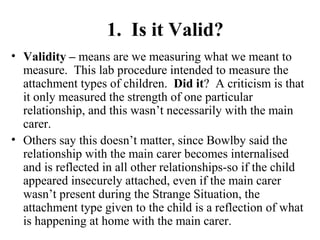
1. Is it Valid? 
• Validity – means are we measuring what we meant to 
measure. This lab procedure intended to measure the 
attachment types of children. Did it? A criticism is that 
it only measured the strength of one particular 
relationship, and this wasn’t necessarily with the main 
carer. 
• Others say this doesn’t matter, since Bowlby said the 
relationship with the main carer becomes internalised 
and is reflected in all other relationships-so if the child 
appeared insecurely attached, even if the main carer 
wasn’t present during the Strange Situation, the 
attachment type given to the child is a reflection of what 
is happening at home with the main carer.
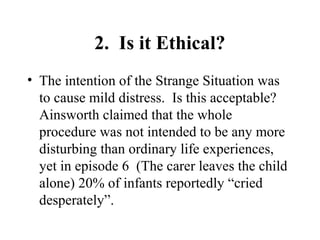
2. Is it Ethical? 
• The intention of the Strange Situation was 
to cause mild distress. Is this acceptable? 
Ainsworth claimed that the whole 
procedure was not intended to be any more 
disturbing than ordinary life experiences, 
yet in episode 6 (The carer leaves the child 
alone) 20% of infants reportedly “cried 
desperately”.
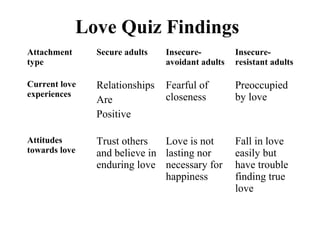
And what did Hazen and Shaver 
1987 find about Adult Romantic 
Relationships in their 
Newspaper Love Quiz?
Love Quiz Findings 
Attachment 
type 
Secure adults Insecure-avoidant 
adults 
Insecure-resistant 
adults 
Current love 
experiences 
Relationships 
Are 
Positive 
Fearful of 
closeness 
Preoccupied 
by love 
Attitudes 
towards love 
Trust others 
and believe in 
enduring love 
Love is not 
lasting nor 
necessary for 
happiness 
Fall in love 
easily but 
have trouble 
finding true 
love
Name and date the Research that 
aimed to study 
Cross-Cultural Attachments 
What were the Aims and 
Procedure?
Cross-cultural patterns of attachment – 
Van Ijzendoorn and Kroonenberg, 
1988 
• Aim – To investigate global attachment 
patterns 
• Procedure - This was a meta-analysis (the 
data from 32 Strange Situation studies from 
eight countries was collated and analysed)
What were 
The Findings?
Findings 
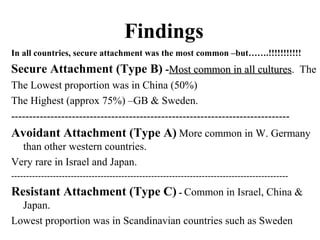
In all countries, secure attachment was the most common –but…….!!!!!!!!!!! 
Secure Attachment (Type B) -MMoosstt ccoommmmoonn iinn aallll ccuullttuurreess. The 
The Lowest proportion was in China (50%) 
The Highest (approx 75%) –GB & Sweden. 
------------------------------------------------------------------------------ 
Avoidant Attachment (Type A) More common in W. Germany 
than other western countries. 
Very rare in Israel and Japan. 
--------------------------------------------------------------------------------------------- 
Resistant Attachment (Type C) - Common in Israel, China & 
Japan. 
Lowest proportion was in Scandinavian countries such as Sweden
What Conclusions 
Can be drawn?
Conclusions 
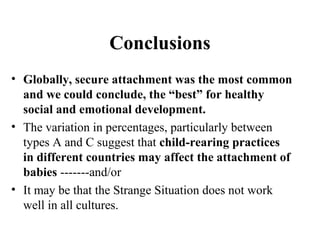
• Globally, secure attachment was the most common 
and we could conclude, the “best” for healthy 
social and emotional development. 
• The variation in percentages, particularly between 
types A and C suggest that child-rearing practices 
in different countries may affect the attachment of 
babies -------and/or 
• It may be that the Strange Situation does not work 
well in all cultures.
Give a Criticism of the 
Cross-cultural Strange Situation
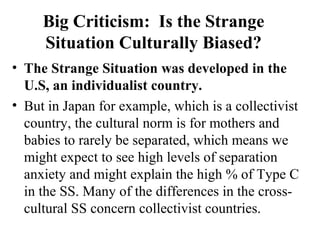
Big Criticism: Is the Strange 
Situation Culturally Biased? 
• The Strange Situation was developed in the 
U.S, an individualist country. 
• But in Japan for example, which is a collectivist 
country, the cultural norm is for mothers and 
babies to rarely be separated, which means we 
might expect to see high levels of separation 
anxiety and might explain the high % of Type C 
in the SS. Many of the differences in the cross-cultural 
SS concern collectivist countries.
More on Culture Bias 
• Rothbaum et al 2000 said that attachment theory and 
research is not relevant to other cultures because it 
is so rooted in American culture. Why did they say 
this? Here are two examples. 
• 1. The Continuity Hypothesis (Ainsworth said that 
those infants who are securely attached grow up to 
be socially and emotionally competent adults)- 
people who are independent and able to express 
their emotions. BUT!! ….. In Japan being a 
socially and emotionally competent adult means 
being group orientated and someone who is able to 
inhibit (not show) their feelings.
We must be so careful when 
interpreting data!! 
• What we call “avoidant” behaviour in the 
UK and USA, might well be called 
“independent” in Germany, an 
individualist country, but where 
independence is very highly valued. And 
just look at the graph and you will see that 
there are a higher proportion of type “As” 
in Germany.
Methodological Issues (can also be used 
for evaluation) 
• 1. Meta-analysis (the results of 32 S.S studies were 
analysed) 
• 2. Substantial study and large sample size (over 
2000 babies) 
• 3. But half of the 32 studies studied were carried 
out in the US, reflecting the dominance of US in 
psychology studies. 
• 27 were carried out in individualistic cultures 
• Only 5 in collectivist cultures, implying that the 
sample was not truly representative.
More Methodological Issues 
• 4. Ainsworth’s Strange Situation was 
developed in the US so we can only 
make valid interpretations in cross-cultural 
studies if we really understand 
the attitudes to child-rearing in that 
culture.
What does all this mean? 
• When looking at attachment behaviours cross-culturally, 
some might question Bowlby and 
Ainsworth’s view, that attachment is a universal 
factor in human development. However, whilst 
there are differences, and to some extent, 
attachment theory is culture-bound, the 
impressive fact is that in in all 8 countries 
involved in the meta-analysis of the Strange 
Situation, secure attachment was the most 
common, by far, and we could conclude, the 
“best” for healthy social and emotional 
development. 
• Certainly research has shown that secure 
attachment is associated with good psychiatric 
health in adulthood.
What is Disruption of the 
Attachment Bond?
Disruption of the Attachment 
Bond 
• Deprivation - temporary or 
permanent disruption of the attachment 
bond. 
• This means there was an attachment to 
start with but it’s been broken in some 
way, perhaps due to hospitalisation or 
death of the mother.
Identify some effects that 
disruption of attachment has on 
A child’s social and emotional 
development 
Provide Research support
Effects of Disruption. 
• Robertson and Robertson observed John and Laura 
sufferering when they experienced physical disruption 
with no substitute emotional care. But Jane, Thomas, 
Lucy and Kate coped well when given substitute 
emotional care at the Robertson’s home . 
• Spitz and Wolf 1946, observed that 100 “normal” 
children placed in an institution became severely 
depressed within a few months. 
• Skeels and Dye 1939, found that the intellectual deficits 
of the institutionalised children recovered when they 
were transferred to a home for mentally retarded adults 
and given lots of T.L.C.
Evaluate the 
Robertson Research
Evaluation of the Robertson 
Research 
• 1.  High validity – films were made of 
John and Laura. These were naturalistic 
observations in a realistic setting. 
• 2.  Low validity – The conclusions were 
based on case studies of only a few 
children, who may not have been typical of 
the majority of children.
So what factors effects whether 
A child will recover from 
Disruption?
Bowlby concluded.. 
• Children cope better and recover better 
from disruption if they were securely 
attached to start with. 
• Bowlby 1956 –: 60 children under the age 
of 4 who had TB 
• They were put in a hospital, no substitute 
emotional care was given. 
• When assessed in adolescence. 63% were 
maladjusted, leaving 37% who were not.
So What is 
Privation?
Privation 
• Privation – when there was 
never any attachment bond to 
begin with. 
• This can be due to extreme abuse 
or Institutional care, or in rare 
cases, children kept in total 
isolation.
Can you describe some real-life 
cases? 
• Genie and the Czech twins, handout N0. 8 
• AlSO it is essential to revise The Affects 
of Privation, Hodges and Tizard, 1989 
also Handout No. 8
What do most of the studies on 
Privation 
Show?
The Findings suggest.. 
• The findings suggest that early privation 
had a negative effect on the ability to form 
relationships even when children were 
given good subsequent care. 
• This supports Bowlby’s view that the 
failure to form attachments during the 
sensitive period has an irreversible effect on 
emotional development.
What are some of the effects of 
Privation and 
Institutionalisation?
The Effects are…. 
• Attachment Disorder – There are two types: 
• Reactive or inhibited – when the child is unable to 
cope in most social situations 
• Disinhibited - Over-friendly and attention seeking to 
people the child hardly knows. 
• Deprivation Dwarfism – Gardner 1972, suggests 
emotional disturbance may effect the production of 
growth hormones which may explain why children in 
institutional care tend to be physically small.
The research suggests that some 
Children are able to 
recover from privation. 
How come?
Evaluation 
• Some research suggests that children who do 
not form an attachment within the sensitive 
period are unable to recover. 
• But this is not true of all children. How come? 
• One reason is because we really don’t know 
enough about the children in the studies. For 
example in the Hodges and Tizard study -Why 
were some adopted and others not? Could it be 
that some were easier children to start with – 
that’s why they were chosen for adoption, so of 
course, their outcomes were better!
1.Why are we interested in day 
care? 
2. What is Day care?
Day Care is - 
• A form of temporary care (not all day and not 
all night) that is not provided by family 
members and takes place outside of the home. 
• Why are we interested in day care? 
• Because day care involves the very thing 
psychologists are interested in – disruption of 
the attachment bond with the primary carer 
which may affect the child’s social and 
emotional development.
What do we mean by 
Social Development?
Social Development 
• The development of sociability, 
learning to relate to others and 
acquiring appropriate 
knowledge & skills of how to 
integrate socially.
You may be asked for research 
evidence on social development 
and aggression in children 
In Day Care. 
Here it is.
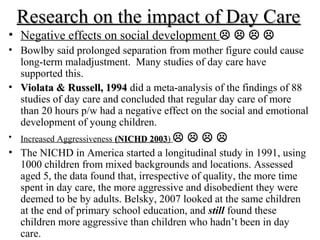
Research oonn tthhee iimmppaacctt ooff DDaayy CCaarree 
• Negative effects on social development     
• Bowlby said prolonged separation from mother figure could cause 
long-term maladjustment. Many studies of day care have 
supported this. 
• VViioollaattaa && RRuusssseellll,, 11999944 did a meta-analysis of the findings of 88 
studies of day care and concluded that regular day care of more 
than 20 hours p/w had a negative effect on the social and emotional 
development of young children. 
• Increased Aggressiveness ((NNIICCHHDD 22000033)     
• The NICHD in America started a longitudinal study in 1991, using 
1000 children from mixed backgrounds and locations. Assessed 
aged 5, the data found that, irrespective of quality, the more time 
spent in day care, the more aggressive and disobedient they were 
deemed to be by adults. Belsky, 2007 looked at the same children 
at the end of primary school education, and still found these 
children more aggressive than children who hadn’t been in day 
care.
OOnn tthhee ootthheerr hhaanndd… 
• This same NICHD study found that a mother’s 
sensitivity to her child is a better indicator of 
whether a child had behavioural problems, than 
was time in child care. Sensitive mothering was 
linked to fewer problem behaviours. Higher 
maternal education and family income also 
predicted lower levels of problem behaviours. 
So this same data suggests that children’s 
development is more strongly affected by factors 
at home, than by day care.
Peer Relationships    
• Bowlby’s theory of attachment and his 
Continuity Hypothesis predicts better peer 
relationships for securely attached children. 
There is evidence that children in day care are 
less securely attached. BBeellsskkyy && RRoovviinnee,, 11998888, 
assessed infants in day care for more than 20 
hours p/w using the Strange Situation. They 
found these children were more likely to be 
insecurely attached than children at home. We 
could hypothesise that their peer relationships 
would also suffer too.
OOnn tthhee ootthheerr hhaanndd…   
• Day care allows children to develop social strategies, 
such as the ability to negotiate and make friends. FFiieelldd,, 
11999911, found the amount of time in full-time day care 
was positively correlated to the number of friends the 
children had once they were at school. 
• However we can’t assume that experiences in day care 
ccaauussee later sociability - there is a lliinnkk;; it could be that 
shy and unsociable children have mothers who are like 
that too (temperament is inherited) and these mothers 
prefer to stay at home to care for their children. The 
outgoing mothers send their outgoing children to day 
care, which explains why they’re more sociable.
MMeeddiiaattiinngg FFaaccttoorrss 
• A mediating factor is something that connects two other 
things, in this case it is intervening between the effects 
of day care and social development. 
• QQuuaalliittyy ooff ccaarree -- A NICHD study (1997) reported that 
low-quality day care was associated with poor social 
development. 
• IInnddiivviidduuaall DDiiffffeerreenncceess –– The above NICHD study 
found that insecurely attached children did less well in 
day care. On the other hand, Egeland & Hiester, 1995, 
found that insecurely attached children did best in day 
care and it was the securely attached ones who became 
aggressive. This might be due to the fact that the 
insecurely attached children needed the care and 
attention that they weren’t getting at home.
MMoorree MMeeddiiaattiinngg FFaaccttoorrss 
• CChhiilldd’’ss aaggee aanndd nnuummbbeerr ooff hhoouurrss 
• Gregg et al, 2005, found that the negative effects 
of day care were more likely to be found in 
children placed in day care before they were 18 
months old. On the other hand, Clarke-Stewart 
et al, 1994, found no difference in attachment 
between spending a lot of time in day care (30 
hours or more a week from 3 months of age).
Implications of research into 
attachment and day care 
• Now we must look at how research translates into the 
practical issues of childcare provision in the UK. What 
advice can be given to governments and to parents? 
• Attachment Research 
• In previous handouts we discovered that James and Joyce 
Robertson (remember little John and Laura in hospital?) found 
that the negative effects of emotional disruption could be avoided 
if substitute eemmoottiioonnaall care was provided. This entailed specific 
adults spending time with the children and responding to their 
needs in a sensitive way in the same way that a primary care 
giver would. TThhee cchhaarraacctteerriissttiiccss ooff qquuaalliittyy ddaayy ccaarree do just 
that and psychologists have identified the following key 
characteristics needed for high-quality day care.
Characteristics of high-quality day care 
• 1. Low child-to-staff ratio – NICHD study 1999, 
identified this was absolutely necessary for high-quality 
care. 
• 2. Minimal staff turnover – Schaffer, 1998, identified 
consistency of care as one of the most important factors in 
high-quality care. 
• 3. Sensitive emotional care – The NICHD study found 
that 23% of infant-care providers give highly sensitive 
care, 50% give moderately sensitive care and 20% are 
emotionally detached from the infants in their care. 
• 4. Qualified Staff – Sylva et al 2003, reported that the 
higher the qualifications of the staff, the better the 
outcome for the children in terms of their social 
development.
What are the most important 
factors to consider 
When looking at Day Care?
The most important factors in day care with regard to the 
welfare of children are: 
• 1. QUALITY of the day care Research indicates positive effects for good 
quality day care but negative effects for poor quality care. Quality 
encompasses having sufficient stimulation, such as toys, sufficient and verbal 
interactions between staff and children and sensitive emotional care to 
provide a substitute for the break in the mother-child relationship. A rapid 
turnover of staff can have a profound effect 
• 2. CHILD-TO-STAFF RATIO This affects results tremendously as it 
determines how much attention each child gets. 
• 3. AGE of the children in care. Research indicates day care can be 
detrimental to very young babies. 
• 4. NUMBER OF HOURS the child is in care This has a big effect on 
whether the bond with the primary care giver is disrupted. 
• 5. The strength of the bond between each child and its primary care giver is 
very important. Securely attached children are less likely to be affected by 
the separation that day care entails. (The Strange Situation study)

Attachments revision

  • 1.
    Attachments Revision TheEssential Guide!!
  • 2.
    Name FOUR thingsabout Attachment
  • 3.
    AAttttaacchhmmeenntt –– WWhhaattiiss iitt?? • 1. An affectional tie between two people or animals • 2. A two-way process that endures over time • 3. Leads to certain behaviours such as: Clinging – Proximity seeking – Crying - Smiling • 4.Serves the function of protecting the infant or young animal (Mary Ainsworth 1970)
  • 4.
    What do wemean by these Behaviours? • And how are they essential to the development of a healthy creature? • They are all features of a Secure Attachment • PPrrooxxiimmiittyy SSeeeekkiinngg • SSeeccuurree BBaassee BBeehhaavviioouurr • SSeeppaarraattiioonn AAnnxxiieettyy • SSttrraannggeerr AAnnxxiieettyy
  • 5.
    Key Terms •PPrrooxxiimmiittyy SSeeeekkiinngg – Staying close to the attachment figure • SSeeccuurree BBaassee BBeehhaavviioouurr – Regularly returning to an attachment figure when exploring • SSeeppaarraattiioonn AAnnxxiieettyy – Anxiety at being apart from an attachment figure • SSttrraannggeerr AAnnxxiieettyy – Anxiety in the presence of strangers • They are all essential for survival!
  • 6.
    Why are Psychologistsso interested in Attachment?
  • 7.
    Why are Psychologistsso interested in Attachment? • Because ALL psychologist believe that the attachment we form with our primary carer (usually our mother) forms a TEMPLATE for all future relationships - with friends, with teachers, and, in the future, with husbands and wives and in turn, OUR FUTURE CHILDREN. If our attachment with our mother is not good, psychologists believe our whole life could be put at a disadvantage.
  • 8.
    Explain Attachment usingthe Learning Theory
  • 9.
    Explanations of AttachmentsN0. 1 • LEARNING THEORY • All behaviour is learnt rather than inborn • Children are born blank slates and everything they become is dependent on what they experience • Learning theory is put forward by BEHAVIOURIST psychologists who say that all behaviour, including attachment is learnt by: • Classical and Operant Conditioning.
  • 10.
    Classical Conditioning –Learning by Association Operant Conditioning – learning by Reward (Reinforcement) and Punishment • Classical Conditioning – food produces pleasure. “Feeder” (mother) becomes associated with food/pleasure so baby becomes attached to her. • Operant Conditioning – food is the primary reinforcer, “feeder” becomes the secondary reinforcer – both food and mother reduce discomfort, and therefore reward the infant and so the baby becomes attached to the mother.
  • 11.
    Evaluating the LearningTheory (Sometimes called the “Cupboard Love” Theory!) • Strengths  • Learning theory suggests that the attachment develops between infant and carer because the carer provides food. And it’s true – we do learn through association and reinforcement. • Weaknesses   We do learn through association and reinforcement but it may not be the food that is the reinforcer, it may be the responsiveness and attention of other carer.  If the learning theory is true: • How come babies often develop strong attachments to people who don’t feed them? • The Harlow Monkey Experiment.
  • 12.
    Name, date anddescribe Two research studies which cast doubt on the Learning Theory
  • 13.
    The Harlow MonkeyExperiment • Harry Harlow, 1959 conducted research in to learning using young rhesus monkeys, kept alone. • He created two “mothers”, one with made of wire but a full feeding bottle of milk, and the other wrapped in a soft cloth but without food. • According to the learning theory the young monkeys should have become attached to the wire mother. • In fact the monkeys spent most of their time with the cloth-covered mother and would cling to it, especially when frightened.(a proximity-seeking behaviour, characteristic of attachment)
  • 14.
    Schaffer and Emerson1964 • Whilst the Harlow Monkey experiment used animals, the above study used human infants. • 60 babies (from mainly working-class Glasgow homes) were observed for a year. • Schaffer & Emerson found that infants were not most attached to the person who fed them but became attached to the person who was most responsive to them and who interacted most with them. • This reinforces the Harlow Monkey experiment and suggests that “cupboard love” is not likely to be the best explanation for attachment, although association and reinforcement may be part of the story.
  • 15.
    The Evolutionary Perspective- Bowlby’s Theory of Attachment
  • 16.
    Explain Bowlby’s theoryof Attachment using the following terms • Survival Value Reproductive Value • Innate Drive Imprinting • Pre-programmed Social Releasers • Adaptive Sensitive Period • Monotropy Template • Internal Working Model • Continuity Hypothesis Responsive Mother
  • 17.
    Bowlby’s Theory ofAttachment • Bowlby’s theory is an Evolutionary theory • In his view attachment is a behaviour that has evolved because of its survival value and, ultimately, its reproductive value. • According to Bowlby, children have an innate drive to become attached to a caregiver because attachment has long-term benefits. He proposed that normal psychological development requires the development of a secure attachment between a baby and its main carer. • He also proposed the concept of imprinting – an innate readiness to develop a strong bond with a mother figure.
  • 18.
    Pre-programming!! • JohnBowlby said that babies are pre-programmed to behave in ways that encourage adult attention • He called these behaviours social releasers • These include “cute” behaviours such as smiling and cooing and are the child’s contribution towards an attachment. The mother’s contribution is that she must respond and react to these behaviours • He suggests these instinctive behaviours enhance survival and and are protective for the infant. He called these behaviours ADAPTIVE.
  • 19.
    Sensitive Period •Bowlby said there is sensitive period from when the baby is born to around the age of 2, when the baby is programmed to form a special attachment. He called this monotropy. If something happens to damage or break this attachment, the child may develop and insecure attachment its development may well be damaged. • For a secure attachment to take place, the child’s main carer (usually the mother) needs to be attentive, SENSITIVE and responsive to the child’s needs, during this sensitive period.
  • 20.
    More about Bowlby’stheory • Bowlby said the child develops a model or template from the attachment with its mother which influences all future relationships and future parenting style. It is a prototype of all future relationships. He called this the internal working model. • The internal working model indicates a big link between early emotional experiences and later relationships. He called this the continuity hypothesis – the idea that early experiences continue to influence throughout life.
  • 21.
    Give some Strengths of Bowlby’s theory of Attachment
  • 22.
    Evaluating Bowlby’s theoryof Attachment - Strengths • It is considered the dominant explanation of how and why attachment develops.  Imprinting is supported by Lorenz’s ducks  Bowlby suggests that attachment evolved to as an aid to survival. If this is true then attachment and caregiving behaviours should be universal, in all cultures, despite differences in child-rearing practices. There is evidence to support this. (Tronick et al 1992)
  • 23.
    Give Some ResearchEvidence Supporting Bowlby’s Theory 
  • 24.
    Research Evidence forBowlby’s Theory  Schaffer and Emerson, 1964, observed that strongly attached infants had mothers who responded quickly to their demands and who offered the child the most interaction whereas weakly attached infants had mothers who failed to interact with them.  The Minnesota longitudinal study (Sroufe et al 2005) followed children from infancy to adolescence and found continuity between their early attachment styles and their later emotional and social behaviour. This supports the continuity hypothesis.
  • 25.
    And the HarlowMonkey Experiment  Supports Bowlby’s theory that a responsive mother is needed for good, lifelong psychological health. The monkeys were not only psychologically damaged, but proved incapable of becoming effective and loving parents, themselves.
  • 26.
    Give some Weaknesses of Bowlby’s Theory
  • 27.
    More Evaluation ofBowlby’s theory Weaknesses  The idea that attachment behaviours have evolved to promote child development has good face validity. But evolutionary ideas are very difficult to test and so difficult to prove or disprove.  Bowlby’s theory focuses on the role of the mother. There is evidence that in two-parent families, the quality of attachment of the father can also have a big effect on the child’s development. (Grossmann and Grossmann, 1991)
  • 28.
    Give an AlternativeExplanation for Attachment
  • 29.
    An Alternative Explanation • A key feature of Bowlby’s theory is the continuity hypothesis – the idea that there are continuities between early attachment and later social/emotional development. However Kagan, 1984 put forward • The Temperament Hypothesis, in which he proposed that we are all born with our distinct, innate temperament, and it is this that is the big factor in determining our attachment style and our subsequent emotional and social development. In other words, to some extent, our development is pre-determined by our genetic makeup. And there is evidence to support this------
  • 30.
    Belsky and Rovine1987 • Assessed babies aged one to three days old and found a link between certain psychological behaviours and later attachment types. They found that infants who were calmer and less anxious were more likely to be securely attached.
  • 31.
    Name and datethe procedure which aimed to test the nature of attachment systematically.
  • 32.
    The Strange Situation– Which is Ainsworth and Wittig 1969 • Laboratory Procedure using • Observation Techniques • Designed to measure the security of attachment a child displays towards its main care giver • What is being assessed? • Secure base behaviour, proximity seeking, separation anxiety, stranger anxiety, response on being reunited with care giver.
  • 33.
    What is theProcedure of the Strange Situation
  • 34.
    The Strange Situation–it gets its name from the fact that the baby is placed in an unfamiliar – that is, a strange room Stage Situation Designed to measure 1. The child and carer are placed in an empty room. 2. The child is free to explore-encouraged if necessary Proximity-seeking and secure base behaviour 3. A stranger enters, greets the carer and attempts to play with the child Stranger Anxiety 4. The carer leaves the child with the stranger Stranger anxiety + Separation distress 5. The carer re-enters and the stranger leaves Reuniting response 6. The carer leaves the child alone Separation distress 7. The stranger re-enters Stranger Anxiety 8. The stranger leaves and carer re-enters Reuniting response
  • 35.
    What were thefindings of the Strange Situation
  • 36.
    Behaviours displayed byinfants in The Strange Situation (Ainsworth et al 1978) Secure attachment (Type B) Insecure Avoidant (Type A) Insecure Resistant(Ambivalent) (Type C) Insecure Avoidant/ Resistant. “Disorganised” (Type D) Willingness to explore HIGH HIGH LOW Alternate between A & C Stranger Anxiety HIGH LOW HIGH Often prefer strangers’ company Separation Anxiety Reasonably easy to soothe INDIFFERENT DISTRESSED Alternate Between A & C Behaviour at re- Union with carer ENTHUSIASTIC AVOIDS CONTACT SEEKS AND REJECTS Often afraid of carer % of infants in this category 66% 22% 12% Minority of Infants display this disorganised behaviour
  • 37.
    How did MaryAinsworth account for the Variations in attachment types?
  • 38.
    Explaining Attachment Types • Mary Ainsworth believed variation in attachment types is a result of the main carer’s behaviour towards the child. Maternal Sensitivity Hypothesis • High levels of maternal sensitive responsiveness = Secure attachment • Mothers who “pick up” signals and respond = Secure attachment
  • 39.
    What is SecureAttachment? What did Ainsworth believe caused it?
  • 40.
    Secure Attachment •This is a strong and contented attachment of an infant to its caregiver, which develops as a result of sensitive responding by the caregiver to the infant’s needs. Securely attached infants are comfortable with social interaction and intimacy. Secure attachment is related to healthy subsequent cognitive and emotional development.
  • 41.
    What is InsecureAttachment? What causes it? What can it lead to? What is the difference in the various insecure attachment types?
  • 42.
    What is InsecureAttachment? • Insecure attachment – This is a form of attachment between infant and caregiver that develops as a result of the caregiver’s lack of sensitive responding to the infant’s needs. It may be associated with poor subsequent cognitive and emotional development. • Insecure Avoidant Type A– children who avoid social interaction and intimacy with others. • Insecure Resistant Type C – Children who both seek and reject intimacy and social interaction. • Insecure Disorganised Type D– Children whose behaviour patterns are inconsistent and a mix of types A & C.
  • 43.
  • 44.
    Research Methods used • The research room was a novel environment • A 9 X 9 foot square marked off in to 16 squares to help the recording of the infant’s movements • Research methods used were Laboratory procedure using covert and controlled observation • Using covert observation (One-way mirrors were used to prevent participants being aware they were being observed). Knowing your behaviour is being observed is likely to alter it. • It used Controlled observation because it involved structuring the behaviour of the participants as well as the observers –the participants had to follow 8 episodes and the observers had a checklist of 5 behaviours that they had to rate every 15 seconds.
  • 45.
    Give 2 Criticismsof the Strange Situation
  • 46.
    1. Is itValid? • Validity – means are we measuring what we meant to measure. This lab procedure intended to measure the attachment types of children. Did it? A criticism is that it only measured the strength of one particular relationship, and this wasn’t necessarily with the main carer. • Others say this doesn’t matter, since Bowlby said the relationship with the main carer becomes internalised and is reflected in all other relationships-so if the child appeared insecurely attached, even if the main carer wasn’t present during the Strange Situation, the attachment type given to the child is a reflection of what is happening at home with the main carer.
  • 47.
    2. Is itEthical? • The intention of the Strange Situation was to cause mild distress. Is this acceptable? Ainsworth claimed that the whole procedure was not intended to be any more disturbing than ordinary life experiences, yet in episode 6 (The carer leaves the child alone) 20% of infants reportedly “cried desperately”.
  • 48.
    And what didHazen and Shaver 1987 find about Adult Romantic Relationships in their Newspaper Love Quiz?
  • 49.
    Love Quiz Findings Attachment type Secure adults Insecure-avoidant adults Insecure-resistant adults Current love experiences Relationships Are Positive Fearful of closeness Preoccupied by love Attitudes towards love Trust others and believe in enduring love Love is not lasting nor necessary for happiness Fall in love easily but have trouble finding true love
  • 50.
    Name and datethe Research that aimed to study Cross-Cultural Attachments What were the Aims and Procedure?
  • 51.
    Cross-cultural patterns ofattachment – Van Ijzendoorn and Kroonenberg, 1988 • Aim – To investigate global attachment patterns • Procedure - This was a meta-analysis (the data from 32 Strange Situation studies from eight countries was collated and analysed)
  • 52.
    What were TheFindings?
  • 53.
    Findings In allcountries, secure attachment was the most common –but…….!!!!!!!!!!! Secure Attachment (Type B) -MMoosstt ccoommmmoonn iinn aallll ccuullttuurreess. The The Lowest proportion was in China (50%) The Highest (approx 75%) –GB & Sweden. ------------------------------------------------------------------------------ Avoidant Attachment (Type A) More common in W. Germany than other western countries. Very rare in Israel and Japan. --------------------------------------------------------------------------------------------- Resistant Attachment (Type C) - Common in Israel, China & Japan. Lowest proportion was in Scandinavian countries such as Sweden
  • 54.
  • 55.
    Conclusions • Globally,secure attachment was the most common and we could conclude, the “best” for healthy social and emotional development. • The variation in percentages, particularly between types A and C suggest that child-rearing practices in different countries may affect the attachment of babies -------and/or • It may be that the Strange Situation does not work well in all cultures.
  • 56.
    Give a Criticismof the Cross-cultural Strange Situation
  • 57.
    Big Criticism: Isthe Strange Situation Culturally Biased? • The Strange Situation was developed in the U.S, an individualist country. • But in Japan for example, which is a collectivist country, the cultural norm is for mothers and babies to rarely be separated, which means we might expect to see high levels of separation anxiety and might explain the high % of Type C in the SS. Many of the differences in the cross-cultural SS concern collectivist countries.
  • 58.
    More on CultureBias • Rothbaum et al 2000 said that attachment theory and research is not relevant to other cultures because it is so rooted in American culture. Why did they say this? Here are two examples. • 1. The Continuity Hypothesis (Ainsworth said that those infants who are securely attached grow up to be socially and emotionally competent adults)- people who are independent and able to express their emotions. BUT!! ….. In Japan being a socially and emotionally competent adult means being group orientated and someone who is able to inhibit (not show) their feelings.

  • 59.
    We must beso careful when interpreting data!! • What we call “avoidant” behaviour in the UK and USA, might well be called “independent” in Germany, an individualist country, but where independence is very highly valued. And just look at the graph and you will see that there are a higher proportion of type “As” in Germany.
  • 60.
    Methodological Issues (canalso be used for evaluation) • 1. Meta-analysis (the results of 32 S.S studies were analysed) • 2. Substantial study and large sample size (over 2000 babies) • 3. But half of the 32 studies studied were carried out in the US, reflecting the dominance of US in psychology studies. • 27 were carried out in individualistic cultures • Only 5 in collectivist cultures, implying that the sample was not truly representative.
  • 61.
    More Methodological Issues • 4. Ainsworth’s Strange Situation was developed in the US so we can only make valid interpretations in cross-cultural studies if we really understand the attitudes to child-rearing in that culture.
  • 62.
    What does allthis mean? • When looking at attachment behaviours cross-culturally, some might question Bowlby and Ainsworth’s view, that attachment is a universal factor in human development. However, whilst there are differences, and to some extent, attachment theory is culture-bound, the impressive fact is that in in all 8 countries involved in the meta-analysis of the Strange Situation, secure attachment was the most common, by far, and we could conclude, the “best” for healthy social and emotional development. • Certainly research has shown that secure attachment is associated with good psychiatric health in adulthood.
  • 63.
    What is Disruptionof the Attachment Bond?
  • 64.
    Disruption of theAttachment Bond • Deprivation - temporary or permanent disruption of the attachment bond. • This means there was an attachment to start with but it’s been broken in some way, perhaps due to hospitalisation or death of the mother.
  • 65.
    Identify some effectsthat disruption of attachment has on A child’s social and emotional development Provide Research support
  • 66.
    Effects of Disruption. • Robertson and Robertson observed John and Laura sufferering when they experienced physical disruption with no substitute emotional care. But Jane, Thomas, Lucy and Kate coped well when given substitute emotional care at the Robertson’s home . • Spitz and Wolf 1946, observed that 100 “normal” children placed in an institution became severely depressed within a few months. • Skeels and Dye 1939, found that the intellectual deficits of the institutionalised children recovered when they were transferred to a home for mentally retarded adults and given lots of T.L.C.
  • 67.
  • 68.
    Evaluation of theRobertson Research • 1.  High validity – films were made of John and Laura. These were naturalistic observations in a realistic setting. • 2.  Low validity – The conclusions were based on case studies of only a few children, who may not have been typical of the majority of children.
  • 69.
    So what factorseffects whether A child will recover from Disruption?
  • 70.
    Bowlby concluded.. •Children cope better and recover better from disruption if they were securely attached to start with. • Bowlby 1956 –: 60 children under the age of 4 who had TB • They were put in a hospital, no substitute emotional care was given. • When assessed in adolescence. 63% were maladjusted, leaving 37% who were not.
  • 71.
    So What is Privation?
  • 72.
    Privation • Privation– when there was never any attachment bond to begin with. • This can be due to extreme abuse or Institutional care, or in rare cases, children kept in total isolation.
  • 73.
    Can you describesome real-life cases? • Genie and the Czech twins, handout N0. 8 • AlSO it is essential to revise The Affects of Privation, Hodges and Tizard, 1989 also Handout No. 8
  • 74.
    What do mostof the studies on Privation Show?
  • 75.
    The Findings suggest.. • The findings suggest that early privation had a negative effect on the ability to form relationships even when children were given good subsequent care. • This supports Bowlby’s view that the failure to form attachments during the sensitive period has an irreversible effect on emotional development.
  • 76.
    What are someof the effects of Privation and Institutionalisation?
  • 77.
    The Effects are…. • Attachment Disorder – There are two types: • Reactive or inhibited – when the child is unable to cope in most social situations • Disinhibited - Over-friendly and attention seeking to people the child hardly knows. • Deprivation Dwarfism – Gardner 1972, suggests emotional disturbance may effect the production of growth hormones which may explain why children in institutional care tend to be physically small.
  • 78.
    The research suggeststhat some Children are able to recover from privation. How come?
  • 79.
    Evaluation • Someresearch suggests that children who do not form an attachment within the sensitive period are unable to recover. • But this is not true of all children. How come? • One reason is because we really don’t know enough about the children in the studies. For example in the Hodges and Tizard study -Why were some adopted and others not? Could it be that some were easier children to start with – that’s why they were chosen for adoption, so of course, their outcomes were better!
  • 80.
    1.Why are weinterested in day care? 2. What is Day care?
  • 81.
    Day Care is- • A form of temporary care (not all day and not all night) that is not provided by family members and takes place outside of the home. • Why are we interested in day care? • Because day care involves the very thing psychologists are interested in – disruption of the attachment bond with the primary carer which may affect the child’s social and emotional development.
  • 82.
    What do wemean by Social Development?
  • 83.
    Social Development •The development of sociability, learning to relate to others and acquiring appropriate knowledge & skills of how to integrate socially.
  • 84.
    You may beasked for research evidence on social development and aggression in children In Day Care. Here it is.
  • 85.
    Research oonn tthheeiimmppaacctt ooff DDaayy CCaarree • Negative effects on social development     • Bowlby said prolonged separation from mother figure could cause long-term maladjustment. Many studies of day care have supported this. • VViioollaattaa && RRuusssseellll,, 11999944 did a meta-analysis of the findings of 88 studies of day care and concluded that regular day care of more than 20 hours p/w had a negative effect on the social and emotional development of young children. • Increased Aggressiveness ((NNIICCHHDD 22000033)     • The NICHD in America started a longitudinal study in 1991, using 1000 children from mixed backgrounds and locations. Assessed aged 5, the data found that, irrespective of quality, the more time spent in day care, the more aggressive and disobedient they were deemed to be by adults. Belsky, 2007 looked at the same children at the end of primary school education, and still found these children more aggressive than children who hadn’t been in day care.

  • 86.
    OOnn tthhee ootthheerrhhaanndd… • This same NICHD study found that a mother’s sensitivity to her child is a better indicator of whether a child had behavioural problems, than was time in child care. Sensitive mothering was linked to fewer problem behaviours. Higher maternal education and family income also predicted lower levels of problem behaviours. So this same data suggests that children’s development is more strongly affected by factors at home, than by day care.
  • 87.
    Peer Relationships   • Bowlby’s theory of attachment and his Continuity Hypothesis predicts better peer relationships for securely attached children. There is evidence that children in day care are less securely attached. BBeellsskkyy && RRoovviinnee,, 11998888, assessed infants in day care for more than 20 hours p/w using the Strange Situation. They found these children were more likely to be insecurely attached than children at home. We could hypothesise that their peer relationships would also suffer too.
  • 88.
    OOnn tthhee ootthheerrhhaanndd…   • Day care allows children to develop social strategies, such as the ability to negotiate and make friends. FFiieelldd,, 11999911, found the amount of time in full-time day care was positively correlated to the number of friends the children had once they were at school. • However we can’t assume that experiences in day care ccaauussee later sociability - there is a lliinnkk;; it could be that shy and unsociable children have mothers who are like that too (temperament is inherited) and these mothers prefer to stay at home to care for their children. The outgoing mothers send their outgoing children to day care, which explains why they’re more sociable.
  • 89.
    MMeeddiiaattiinngg FFaaccttoorrss •A mediating factor is something that connects two other things, in this case it is intervening between the effects of day care and social development. • QQuuaalliittyy ooff ccaarree -- A NICHD study (1997) reported that low-quality day care was associated with poor social development. • IInnddiivviidduuaall DDiiffffeerreenncceess –– The above NICHD study found that insecurely attached children did less well in day care. On the other hand, Egeland & Hiester, 1995, found that insecurely attached children did best in day care and it was the securely attached ones who became aggressive. This might be due to the fact that the insecurely attached children needed the care and attention that they weren’t getting at home.
  • 90.
    MMoorree MMeeddiiaattiinngg FFaaccttoorrss • CChhiilldd’’ss aaggee aanndd nnuummbbeerr ooff hhoouurrss • Gregg et al, 2005, found that the negative effects of day care were more likely to be found in children placed in day care before they were 18 months old. On the other hand, Clarke-Stewart et al, 1994, found no difference in attachment between spending a lot of time in day care (30 hours or more a week from 3 months of age).
  • 91.
    Implications of researchinto attachment and day care • Now we must look at how research translates into the practical issues of childcare provision in the UK. What advice can be given to governments and to parents? • Attachment Research • In previous handouts we discovered that James and Joyce Robertson (remember little John and Laura in hospital?) found that the negative effects of emotional disruption could be avoided if substitute eemmoottiioonnaall care was provided. This entailed specific adults spending time with the children and responding to their needs in a sensitive way in the same way that a primary care giver would. TThhee cchhaarraacctteerriissttiiccss ooff qquuaalliittyy ddaayy ccaarree do just that and psychologists have identified the following key characteristics needed for high-quality day care.
  • 92.
    Characteristics of high-qualityday care • 1. Low child-to-staff ratio – NICHD study 1999, identified this was absolutely necessary for high-quality care. • 2. Minimal staff turnover – Schaffer, 1998, identified consistency of care as one of the most important factors in high-quality care. • 3. Sensitive emotional care – The NICHD study found that 23% of infant-care providers give highly sensitive care, 50% give moderately sensitive care and 20% are emotionally detached from the infants in their care. • 4. Qualified Staff – Sylva et al 2003, reported that the higher the qualifications of the staff, the better the outcome for the children in terms of their social development.
  • 93.
    What are themost important factors to consider When looking at Day Care?
  • 94.
    The most importantfactors in day care with regard to the welfare of children are: • 1. QUALITY of the day care Research indicates positive effects for good quality day care but negative effects for poor quality care. Quality encompasses having sufficient stimulation, such as toys, sufficient and verbal interactions between staff and children and sensitive emotional care to provide a substitute for the break in the mother-child relationship. A rapid turnover of staff can have a profound effect • 2. CHILD-TO-STAFF RATIO This affects results tremendously as it determines how much attention each child gets. • 3. AGE of the children in care. Research indicates day care can be detrimental to very young babies. • 4. NUMBER OF HOURS the child is in care This has a big effect on whether the bond with the primary care giver is disrupted. • 5. The strength of the bond between each child and its primary care giver is very important. Securely attached children are less likely to be affected by the separation that day care entails. (The Strange Situation study)