ninth edition
STEPHEN P. ROBBINS MARY COULTER
Motivating
Employees
Part
15
What Is Motivation?
• Motivation
Is the result of an interaction between the person and
a situation; it is not a personal trait.
Is the process by which a person’s efforts are
energized, directed, and sustained towards attaining
a goal.
 Energy: a measure of intensity or drive.
 Direction: toward organizational goals
 Persistence: exerting effort to achieve goals.
Motivation works best when individual needs are
compatible with organizational goals.
• motivasi
Apakah hasil dari interaksi antara orang dan situasi;
itu bukan sifat pribadi.
Adalah proses dimana upaya seseorang diberi
energi, terarah, dan berkelanjutan dalam mencapai
tujuan.
 Energi: ukuran intensitas atau drive.
 Arah: menuju tujuan organisasi
 Kegigihan: mengerahkan upaya untuk mencapai tujuan.
Motivasi bekerja paling baik bila kebutuhan individu
yang kompatibel dengan tujuan organisasi.
Early Theories of Motivation
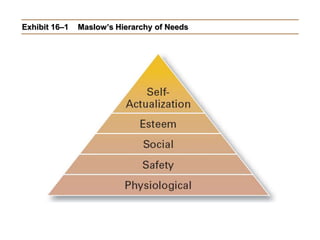
• Maslow’s Hierarchy of Needs Theory
Needs were categorized as five levels of lower- to
higher-order needs.
 Individuals must satisfy lower-order needs before they can
satisfy higher order needs.
 Satisfied needs will no longer motivate.
 Motivating a person depends on knowing at what level that
person is on the hierarchy.
Hierarchy of needs
 Lower-order (external): physiological, safety
 Higher-order (internal): social, esteem, self-actualization
• Hirarki Kebutuhan Maslow Teori
Kebutuhan dikategorikan sebagai lima tingkat rendah
dengan kebutuhan tingkat tinggi.
 Individu harus memenuhi kebutuhan yang lebih rendah-order
sebelum mereka dapat memenuhi kebutuhan yang lebih
tinggi.
 Puas kebutuhan akan lagi memotivasi.
 Memotivasi seseorang tergantung pada mengetahui pada
tingkat apa orang yang ada di hirarki.
Hierarki kebutuhan
 Lebih rendah-order (eksternal): fisiologis, keselamatan
 -Order Tinggi (internal): sosial, harga diri, aktualisasi diri
Exhibit 16–1 Maslow’s Hierarchy of Needs
Early Theories of Motivation (cont’d)
• McGregor’s Theory X and Theory Y
Theory X
 Assumes that workers have little ambition, dislike work, avoid
responsibility, and require close supervision.
Theory Y
 Assumes that workers can exercise self-direction, desire
responsibility, and like to work.
Assumption:
 Motivation is maximized by participative decision making,
interesting jobs, and good group relations.
• McGregor Teori X dan Teori Y
teori X
 Mengasumsikan bahwa pekerja memiliki sedikit ambisi, tidak
menyukai pekerjaan, menghindari tanggung jawab, dan
memerlukan pengawasan yang ketat.
teori Y
 Mengasumsikan bahwa pekerja dapat melakukan self-
direction, keinginan tanggung jawab, dan suka bekerja.
asumsi:
 Motivasi dimaksimalkan oleh pengambilan keputusan
partisipatif, pekerjaan yang menarik, dan hubungan kelompok
yang baik.
Early Theories of Motivation (cont’d)
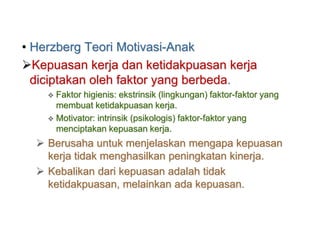
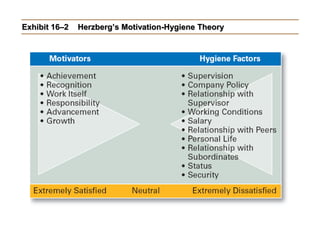
• Herzberg’s Motivation-Hygiene Theory
Job satisfaction and job dissatisfaction are created by
different factors.
 Hygiene factors: extrinsic (environmental) factors that create
job dissatisfaction.
 Motivators: intrinsic (psychological) factors that create job
satisfaction.
Attempted to explain why job satisfaction does not
result in increased performance.
 The opposite of satisfaction is not dissatisfaction, but rather
no satisfaction.
• Herzberg Teori Motivasi-Anak
Kepuasan kerja dan ketidakpuasan kerja
diciptakan oleh faktor yang berbeda.
 Faktor higienis: ekstrinsik (lingkungan) faktor-faktor yang
membuat ketidakpuasan kerja.
 Motivator: intrinsik (psikologis) faktor-faktor yang
menciptakan kepuasan kerja.
 Berusaha untuk menjelaskan mengapa kepuasan
kerja tidak menghasilkan peningkatan kinerja.
 Kebalikan dari kepuasan adalah tidak
ketidakpuasan, melainkan ada kepuasan.
Exhibit 16–2 Herzberg’s Motivation-Hygiene Theory
Motivation and Behavior
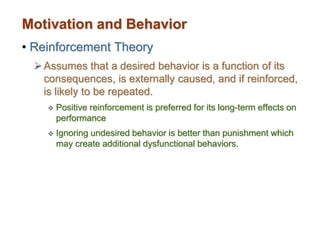
• Reinforcement Theory
Assumes that a desired behavior is a function of its
consequences, is externally caused, and if reinforced,
is likely to be repeated.
 Positive reinforcement is preferred for its long-term effects on
performance
 Ignoring undesired behavior is better than punishment which
may create additional dysfunctional behaviors.
Motivasi dan Perilaku
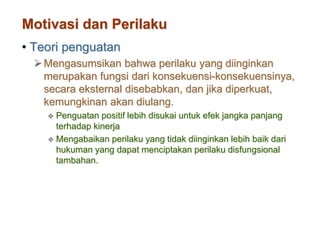
• Teori penguatan
Mengasumsikan bahwa perilaku yang diinginkan
merupakan fungsi dari konsekuensi-konsekuensinya,
secara eksternal disebabkan, dan jika diperkuat,
kemungkinan akan diulang.
 Penguatan positif lebih disukai untuk efek jangka panjang
terhadap kinerja
 Mengabaikan perilaku yang tidak diinginkan lebih baik dari
hukuman yang dapat menciptakan perilaku disfungsional
tambahan.
Designing Motivating Jobs
• Job Design
The way into which tasks can be combined to form
complete jobs.
Factors influencing job design:
 Changing organizational environment/structure
 The organization’s technology
 Employees’ skill, abilities, and preferences
Job enlargement
 Increasing the job’s scope (number and frequency of tasks)
Job enrichment
 Increasing responsibility and autonomy (depth) in a job.
• Desain pekerjaan
Cara di mana tugas dapat dikombinasikan untuk
membentuk pekerjaan selesai.
Faktor-faktor yang mempengaruhi desain pekerjaan:
 Mengubah organisasi lingkungan / struktur
 Teknologi organisasi
 Keterampilan, kemampuan, dan preferensi Karyawan
perluasan kerja
 Meningkatnya cakupan pekerjaan itu (jumlah dan frekuensi
tugas)
pengayaan pekerjaan
 Meningkatkan tanggung jawab dan otonomi (kedalaman)
dalam pekerjaan.
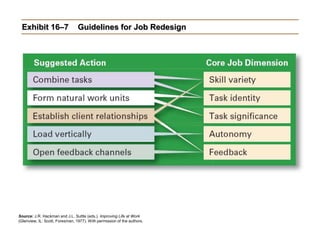
Exhibit 16–7 Guidelines for Job Redesign
Source: J.R. Hackman and J.L. Suttle (eds.). Improving Life at Work
(Glenview, IL: Scott, Foresman, 1977). With permission of the authors.
Motivation and Perception
• Equity Theory
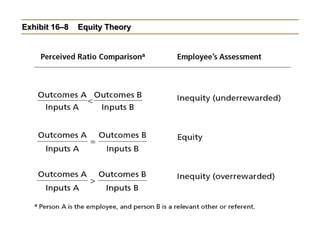
Proposes that employees perceive what they get from
a job situation (outcomes) in relation to what they put
in (inputs) and then compare their inputs-outcomes
ratio with the inputs-outcomes ratios of relevant
others.
 If the ratios are perceived as equal then a state of equity
(fairness) exists.
 If the ratios are perceived as unequal, inequity exists and the
person feels under- or over-rewarded.
 When inequities occur, employees will attempt to do
something to rebalance the ratios (seek justice).
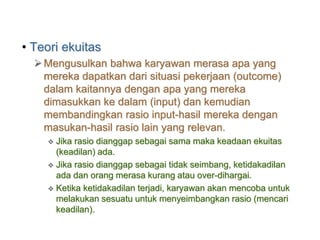
• Teori ekuitas
Mengusulkan bahwa karyawan merasa apa yang
mereka dapatkan dari situasi pekerjaan (outcome)
dalam kaitannya dengan apa yang mereka
dimasukkan ke dalam (input) dan kemudian
membandingkan rasio input-hasil mereka dengan
masukan-hasil rasio lain yang relevan.
 Jika rasio dianggap sebagai sama maka keadaan ekuitas
(keadilan) ada.
 Jika rasio dianggap sebagai tidak seimbang, ketidakadilan
ada dan orang merasa kurang atau over-dihargai.
 Ketika ketidakadilan terjadi, karyawan akan mencoba untuk
melakukan sesuatu untuk menyeimbangkan rasio (mencari
keadilan).
Motivation and Perception (cont’d)
• Equity Theory (cont’d)
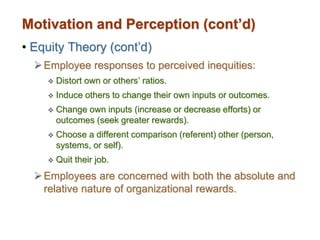
Employee responses to perceived inequities:
 Distort own or others’ ratios.
 Induce others to change their own inputs or outcomes.
 Change own inputs (increase or decrease efforts) or
outcomes (seek greater rewards).
 Choose a different comparison (referent) other (person,
systems, or self).
 Quit their job.
Employees are concerned with both the absolute and
relative nature of organizational rewards.
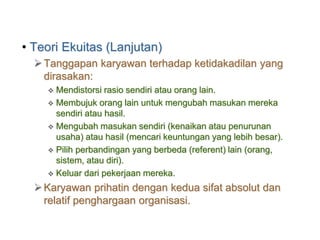
• Teori Ekuitas (Lanjutan)
Tanggapan karyawan terhadap ketidakadilan yang
dirasakan:
 Mendistorsi rasio sendiri atau orang lain.
 Membujuk orang lain untuk mengubah masukan mereka
sendiri atau hasil.
 Mengubah masukan sendiri (kenaikan atau penurunan
usaha) atau hasil (mencari keuntungan yang lebih besar).
 Pilih perbandingan yang berbeda (referent) lain (orang,
sistem, atau diri).
 Keluar dari pekerjaan mereka.
Karyawan prihatin dengan kedua sifat absolut dan
relatif penghargaan organisasi.
Exhibit 16–8 Equity Theory
Motivation and Perception (cont’d)
• Equity Theory (cont’d)
Distributive justice
 The perceived fairness of the amount and allocation of
rewards among individuals (i.e., who received what).
– Influences an employee’s satisfaction.
Procedural justice
 The perceived fairness of the process use to determine the
distribution of rewards (i.e., how who received what).
– Affects an employee’s organizational commitment.
• Teori Ekuitas (Lanjutan)
keadilan distributif
 Keadilan yang dirasakan dari jumlah dan alokasi
penghargaan antara individu-individu (yaitu, yang menerima
apa).
– Pengaruh suatu kepuasan karyawan.
keadilan prosedural
 Keadilan yang dirasakan dari penggunaan proses untuk
menentukan pembagian hadiah (yaitu, bagaimana yang
menerima apa).
– Mempengaruhi komitmen organisasi karyawan.
Motivation and Behavior
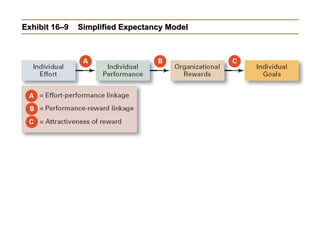
• Expectancy Theory (Vroom)
States that an individual tends to act in a certain way
based on the expectation that the act will be followed
by a given outcome and on the attractiveness of that
outcome to the individual.
Key to the theory is understanding and managing
employee goals and the linkages among and
between effort, performance and rewards.
 Effort: employee abilities and training/development
 Performance: valid appraisal systems
 Rewards (goals): understanding employee needs
• Teori Harapan (Vroom)
Menyatakan bahwa seorang individu cenderung
untuk bertindak dengan cara tertentu yang
didasarkan pada harapan bahwa tindakan akan
diikuti oleh hasil yang diberikan dan daya tarik hasil
bahwa untuk individu.
Kunci teori adalah memahami dan mengelola tujuan
karyawan dan hubungan antara dan di antara usaha,
kinerja dan penghargaan.
 Upaya: kemampuan karyawan dan pelatihan /
pengembangan
 Kinerja: sistem penilaian yang valid
 Hadiah (tujuan): kebutuhan karyawan pemahaman
Exhibit 16–9 Simplified Expectancy Model
Motivation and Behavior (cont’d)
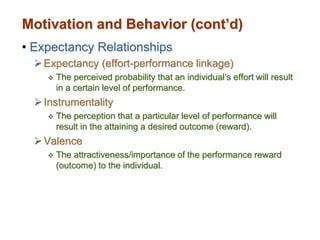
• Expectancy Relationships
Expectancy (effort-performance linkage)
 The perceived probability that an individual’s effort will result
in a certain level of performance.
Instrumentality
 The perception that a particular level of performance will
result in the attaining a desired outcome (reward).
Valence
 The attractiveness/importance of the performance reward
(outcome) to the individual.
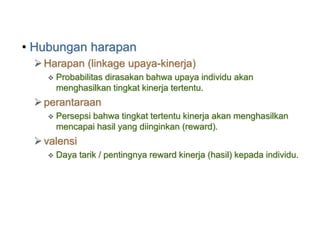
• Hubungan harapan
Harapan (linkage upaya-kinerja)
 Probabilitas dirasakan bahwa upaya individu akan
menghasilkan tingkat kinerja tertentu.
perantaraan
 Persepsi bahwa tingkat tertentu kinerja akan menghasilkan
mencapai hasil yang diinginkan (reward).
valensi
 Daya tarik / pentingnya reward kinerja (hasil) kepada individu.

Mnagement Chap 15 motivating employees

  • 1.
    ninth edition STEPHEN P.ROBBINS MARY COULTER Motivating Employees Part 15
  • 2.
    What Is Motivation? •Motivation Is the result of an interaction between the person and a situation; it is not a personal trait. Is the process by which a person’s efforts are energized, directed, and sustained towards attaining a goal.  Energy: a measure of intensity or drive.  Direction: toward organizational goals  Persistence: exerting effort to achieve goals. Motivation works best when individual needs are compatible with organizational goals.
  • 3.
    • motivasi Apakah hasildari interaksi antara orang dan situasi; itu bukan sifat pribadi. Adalah proses dimana upaya seseorang diberi energi, terarah, dan berkelanjutan dalam mencapai tujuan.  Energi: ukuran intensitas atau drive.  Arah: menuju tujuan organisasi  Kegigihan: mengerahkan upaya untuk mencapai tujuan. Motivasi bekerja paling baik bila kebutuhan individu yang kompatibel dengan tujuan organisasi.
  • 4.
    Early Theories ofMotivation • Maslow’s Hierarchy of Needs Theory Needs were categorized as five levels of lower- to higher-order needs.  Individuals must satisfy lower-order needs before they can satisfy higher order needs.  Satisfied needs will no longer motivate.  Motivating a person depends on knowing at what level that person is on the hierarchy. Hierarchy of needs  Lower-order (external): physiological, safety  Higher-order (internal): social, esteem, self-actualization
  • 5.
    • Hirarki KebutuhanMaslow Teori Kebutuhan dikategorikan sebagai lima tingkat rendah dengan kebutuhan tingkat tinggi.  Individu harus memenuhi kebutuhan yang lebih rendah-order sebelum mereka dapat memenuhi kebutuhan yang lebih tinggi.  Puas kebutuhan akan lagi memotivasi.  Memotivasi seseorang tergantung pada mengetahui pada tingkat apa orang yang ada di hirarki. Hierarki kebutuhan  Lebih rendah-order (eksternal): fisiologis, keselamatan  -Order Tinggi (internal): sosial, harga diri, aktualisasi diri
  • 6.
    Exhibit 16–1 Maslow’sHierarchy of Needs
  • 7.
    Early Theories ofMotivation (cont’d) • McGregor’s Theory X and Theory Y Theory X  Assumes that workers have little ambition, dislike work, avoid responsibility, and require close supervision. Theory Y  Assumes that workers can exercise self-direction, desire responsibility, and like to work. Assumption:  Motivation is maximized by participative decision making, interesting jobs, and good group relations.
  • 8.
    • McGregor TeoriX dan Teori Y teori X  Mengasumsikan bahwa pekerja memiliki sedikit ambisi, tidak menyukai pekerjaan, menghindari tanggung jawab, dan memerlukan pengawasan yang ketat. teori Y  Mengasumsikan bahwa pekerja dapat melakukan self- direction, keinginan tanggung jawab, dan suka bekerja. asumsi:  Motivasi dimaksimalkan oleh pengambilan keputusan partisipatif, pekerjaan yang menarik, dan hubungan kelompok yang baik.
  • 9.
    Early Theories ofMotivation (cont’d) • Herzberg’s Motivation-Hygiene Theory Job satisfaction and job dissatisfaction are created by different factors.  Hygiene factors: extrinsic (environmental) factors that create job dissatisfaction.  Motivators: intrinsic (psychological) factors that create job satisfaction. Attempted to explain why job satisfaction does not result in increased performance.  The opposite of satisfaction is not dissatisfaction, but rather no satisfaction.
  • 10.
    • Herzberg TeoriMotivasi-Anak Kepuasan kerja dan ketidakpuasan kerja diciptakan oleh faktor yang berbeda.  Faktor higienis: ekstrinsik (lingkungan) faktor-faktor yang membuat ketidakpuasan kerja.  Motivator: intrinsik (psikologis) faktor-faktor yang menciptakan kepuasan kerja.  Berusaha untuk menjelaskan mengapa kepuasan kerja tidak menghasilkan peningkatan kinerja.  Kebalikan dari kepuasan adalah tidak ketidakpuasan, melainkan ada kepuasan.
  • 11.
    Exhibit 16–2 Herzberg’sMotivation-Hygiene Theory
  • 12.
    Motivation and Behavior •Reinforcement Theory Assumes that a desired behavior is a function of its consequences, is externally caused, and if reinforced, is likely to be repeated.  Positive reinforcement is preferred for its long-term effects on performance  Ignoring undesired behavior is better than punishment which may create additional dysfunctional behaviors.
  • 13.
    Motivasi dan Perilaku •Teori penguatan Mengasumsikan bahwa perilaku yang diinginkan merupakan fungsi dari konsekuensi-konsekuensinya, secara eksternal disebabkan, dan jika diperkuat, kemungkinan akan diulang.  Penguatan positif lebih disukai untuk efek jangka panjang terhadap kinerja  Mengabaikan perilaku yang tidak diinginkan lebih baik dari hukuman yang dapat menciptakan perilaku disfungsional tambahan.
  • 14.
    Designing Motivating Jobs •Job Design The way into which tasks can be combined to form complete jobs. Factors influencing job design:  Changing organizational environment/structure  The organization’s technology  Employees’ skill, abilities, and preferences Job enlargement  Increasing the job’s scope (number and frequency of tasks) Job enrichment  Increasing responsibility and autonomy (depth) in a job.
  • 15.
    • Desain pekerjaan Caradi mana tugas dapat dikombinasikan untuk membentuk pekerjaan selesai. Faktor-faktor yang mempengaruhi desain pekerjaan:  Mengubah organisasi lingkungan / struktur  Teknologi organisasi  Keterampilan, kemampuan, dan preferensi Karyawan perluasan kerja  Meningkatnya cakupan pekerjaan itu (jumlah dan frekuensi tugas) pengayaan pekerjaan  Meningkatkan tanggung jawab dan otonomi (kedalaman) dalam pekerjaan.
  • 16.
    Exhibit 16–7 Guidelinesfor Job Redesign Source: J.R. Hackman and J.L. Suttle (eds.). Improving Life at Work (Glenview, IL: Scott, Foresman, 1977). With permission of the authors.
  • 17.
    Motivation and Perception •Equity Theory Proposes that employees perceive what they get from a job situation (outcomes) in relation to what they put in (inputs) and then compare their inputs-outcomes ratio with the inputs-outcomes ratios of relevant others.  If the ratios are perceived as equal then a state of equity (fairness) exists.  If the ratios are perceived as unequal, inequity exists and the person feels under- or over-rewarded.  When inequities occur, employees will attempt to do something to rebalance the ratios (seek justice).
  • 18.
    • Teori ekuitas Mengusulkanbahwa karyawan merasa apa yang mereka dapatkan dari situasi pekerjaan (outcome) dalam kaitannya dengan apa yang mereka dimasukkan ke dalam (input) dan kemudian membandingkan rasio input-hasil mereka dengan masukan-hasil rasio lain yang relevan.  Jika rasio dianggap sebagai sama maka keadaan ekuitas (keadilan) ada.  Jika rasio dianggap sebagai tidak seimbang, ketidakadilan ada dan orang merasa kurang atau over-dihargai.  Ketika ketidakadilan terjadi, karyawan akan mencoba untuk melakukan sesuatu untuk menyeimbangkan rasio (mencari keadilan).
  • 19.
    Motivation and Perception(cont’d) • Equity Theory (cont’d) Employee responses to perceived inequities:  Distort own or others’ ratios.  Induce others to change their own inputs or outcomes.  Change own inputs (increase or decrease efforts) or outcomes (seek greater rewards).  Choose a different comparison (referent) other (person, systems, or self).  Quit their job. Employees are concerned with both the absolute and relative nature of organizational rewards.
  • 20.
    • Teori Ekuitas(Lanjutan) Tanggapan karyawan terhadap ketidakadilan yang dirasakan:  Mendistorsi rasio sendiri atau orang lain.  Membujuk orang lain untuk mengubah masukan mereka sendiri atau hasil.  Mengubah masukan sendiri (kenaikan atau penurunan usaha) atau hasil (mencari keuntungan yang lebih besar).  Pilih perbandingan yang berbeda (referent) lain (orang, sistem, atau diri).  Keluar dari pekerjaan mereka. Karyawan prihatin dengan kedua sifat absolut dan relatif penghargaan organisasi.
  • 21.
  • 22.
    Motivation and Perception(cont’d) • Equity Theory (cont’d) Distributive justice  The perceived fairness of the amount and allocation of rewards among individuals (i.e., who received what). – Influences an employee’s satisfaction. Procedural justice  The perceived fairness of the process use to determine the distribution of rewards (i.e., how who received what). – Affects an employee’s organizational commitment.
  • 23.
    • Teori Ekuitas(Lanjutan) keadilan distributif  Keadilan yang dirasakan dari jumlah dan alokasi penghargaan antara individu-individu (yaitu, yang menerima apa). – Pengaruh suatu kepuasan karyawan. keadilan prosedural  Keadilan yang dirasakan dari penggunaan proses untuk menentukan pembagian hadiah (yaitu, bagaimana yang menerima apa). – Mempengaruhi komitmen organisasi karyawan.
  • 24.
    Motivation and Behavior •Expectancy Theory (Vroom) States that an individual tends to act in a certain way based on the expectation that the act will be followed by a given outcome and on the attractiveness of that outcome to the individual. Key to the theory is understanding and managing employee goals and the linkages among and between effort, performance and rewards.  Effort: employee abilities and training/development  Performance: valid appraisal systems  Rewards (goals): understanding employee needs
  • 25.
    • Teori Harapan(Vroom) Menyatakan bahwa seorang individu cenderung untuk bertindak dengan cara tertentu yang didasarkan pada harapan bahwa tindakan akan diikuti oleh hasil yang diberikan dan daya tarik hasil bahwa untuk individu. Kunci teori adalah memahami dan mengelola tujuan karyawan dan hubungan antara dan di antara usaha, kinerja dan penghargaan.  Upaya: kemampuan karyawan dan pelatihan / pengembangan  Kinerja: sistem penilaian yang valid  Hadiah (tujuan): kebutuhan karyawan pemahaman
  • 26.
    Exhibit 16–9 SimplifiedExpectancy Model
  • 27.
    Motivation and Behavior(cont’d) • Expectancy Relationships Expectancy (effort-performance linkage)  The perceived probability that an individual’s effort will result in a certain level of performance. Instrumentality  The perception that a particular level of performance will result in the attaining a desired outcome (reward). Valence  The attractiveness/importance of the performance reward (outcome) to the individual.
  • 28.
    • Hubungan harapan Harapan(linkage upaya-kinerja)  Probabilitas dirasakan bahwa upaya individu akan menghasilkan tingkat kinerja tertentu. perantaraan  Persepsi bahwa tingkat tertentu kinerja akan menghasilkan mencapai hasil yang diinginkan (reward). valensi  Daya tarik / pentingnya reward kinerja (hasil) kepada individu.