Measles, Mumps and Rubella
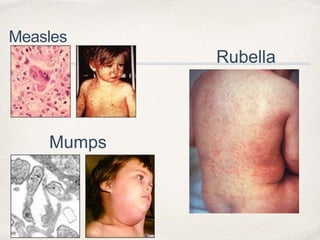
Measles 
Mumps 
Rubella
Measles 
•Highly contagious viral illness 
•First described in 7th century 
•Near universal infection of childhood in prevaccination 
era 
•Remains the leading cause of vaccine-preventable 
death in children 
•Paramyxovirus (RNA) 
•Rapidly inactivated by heat and light
Measles 
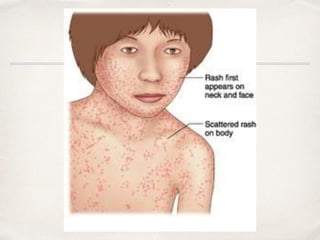
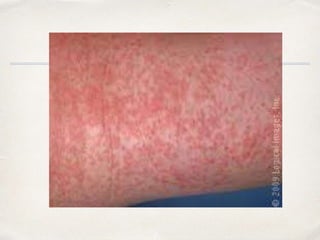
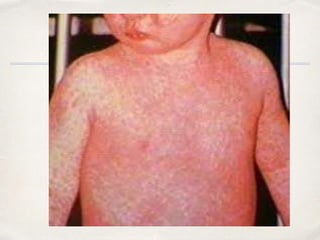
It is an acute viral infection characterized by a final 
stage with a maculopapular rash erupting 
successively over the neck and face, trunk, arms, 
and legs, and accompanied by a high fever.
Measles 
✤ 14-day incubation period for respiratory-acquired 
infections 
✤ 6-10 days if acquired parenterally 
✤ remains the leading cause of vaccine-preventable 
death in children
Measles Pathogenesis and Clinical Features 
• Respiratory transmission of virus 
• Replication in nasopharynx and regional lymph nodes 
• Primary viremia 2-3 days after exposure 
• Secondary viremia 5-7 days after exposure with spread to tissues 
• Incubation period 10-12 days 
• Stepwise increase in fever to 103°F or higher 
• Cough, coryza, conjunctivitis 
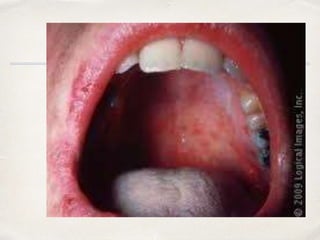
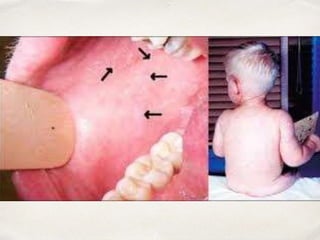
• Koplik spots 
• 2-4 days after prodrome, 14 days after exposure 
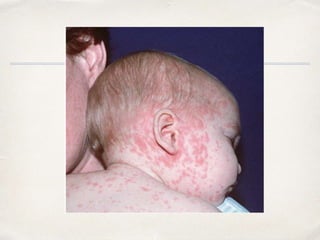
• Maculopapular, becomes confluent 
• Begins on face and head 
• Persists 5-6 days 
• Fades in order of appearance
Clinical Manifestations 
✤ Measles has three clinical stages: 
1. an incubation stage 
2. a prodromal stage with an enanthem (Koplik spots) 
and mild symptoms 
3. a final stage with a maculopapular rash accompanied 
by high fever.
Measles (cont.) 
✤ Symptom 
✤ Bloodshot eyes 
✤ Cough 
✤ Fever 
✤ Sensitivity to light 
✤ Muscle Pain 
✤ Rash (itchy, red areas that spread together) 
✤ Redness and/or irritation of the eyes 
✤ Runny nose 
✤ Sore throat 
✤ White spots in the mouth (Koplik’s spots)
Measles (cont.) 
✤ Prevention 
✤ Routine immunization 
✤ serum immune globulin 6 days after exposure 
✤ Complications 
✤ Bronchitis 
✤ Encephalitis 
✤ Ear infection 
✤ Pneumonia
Measles (cont.) 
✤ diagnosis 
✤ Serology for measles 
✤ Treatment 
✤ No specific treatment 
✤ vit A 
✤ Acetaminophen 
✤ Bed rest 
✤ Humid air 
✤ Fluid and nutrition
Mumps Virus 
• Paramyxovirus 
• RNA virus 
• Rapidly inactivated by chemical agents, heat, and 
ultraviolet light
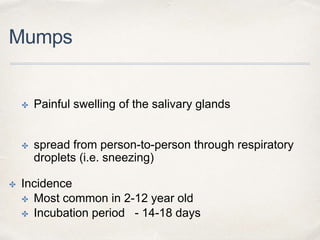
Mumps 
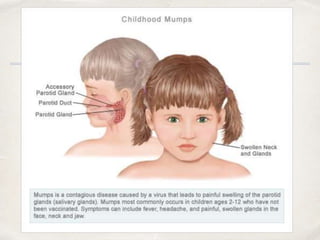
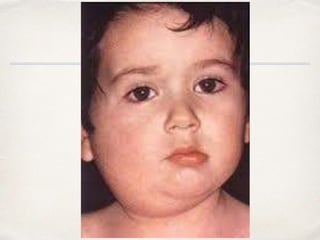
✤ Painful swelling of the salivary glands 
✤ spread from person-to-person through respiratory 
droplets (i.e. sneezing) 
✤ Incidence 
✤ Most common in 2-12 year old 
✤ Incubation period - 14-18 days
Mumps (cont.) 
✤ Symptoms 
✤ Pain in the face 
✤ Fever 
✤ Headache 
✤ Sore throat 
✤ Swelling of the salivary glands 
✤ Swelling of the jaw 
✤ Specific to men: 
✤ Testicle pain or lump 
✤ Swelling of the scrotum
Mumps Pathogenesis 
• Respiratory transmission of virus 
• Replication in nasopharynx and regional lymph nodes 
• Viremia 12-25 days after exposure with spread to 
tissues 
• Multiple tissues infected during viremia
Mumps Pathogenesis 
✤ Viremia common, leading to organ involvement 
✤ salivary glands (parotitis), 
✤ meningitis, 
✤ orchitis, 
✤ endolymph infection leading to deafness 
✤ A major cause of permanent, bilateral, sensorineural 
deafness in children 
✤ Virus shed in saliva and urine for long periods after infection
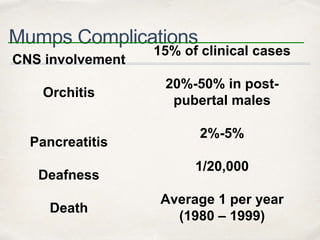
Mumps Complications 
CNS involvement 
Orchitis 
Pancreatitis 
Deafness 
Death 
15% of clinical cases 
20%-50% in post-pubertal 
males 
2%-5% 
1/20,000 
Average 1 per year 
(1980 – 1999)
Mumps (cont.) 
✤ Prevention 
✤ MMR immunization between the age of: 
✤ 12-15 months 
✤ Again between 4-6 years 
✤ Again between 11-12 years
Mumps (cont.) 
✤ Test 
✤ Physically examining the salivary glands for swelling 
(not test) 
✤ Treatment 
✤ No specific treatment 
✤ Ice or heat packs and acetaminophen for pain
Rubella Virus 
• Togavirus 
• RNA virus 
• Rapidly inactivated by chemical agents, ultraviolet 
light, low pH, and heat
Rubella 
✤ Also known as German measles or three-day 
measles 
✤ Rubella is a virus spread from person-to-person 
through air or close contact 
✤ Incidence 
✤ The virus is spread from 1 week before the rash 
begins, to 1-2 weeks after the rash is gone
Rubella Pathogenesis 
• Respiratory transmission of virus 
• Replication in nasopharynx and regional lymph nodes 
• Viremia 5-7 days after exposure with spread to tissues 
• Placenta and fetus infected during viremia
Rubella Clinical Features 
• Incubation period 14 days 
(range 12-23 days) 
• Prodrome of low-grade fever 
• Maculopapular rash 14-17 days after exposure 
• Usually quite mild
Rubella (cont.) 
✤ Symptoms 
✤ bloody red eyes 
✤ Muscle or joint pain 
✤ Bruising is a rare symptom 
✤ Fever (adults) 
✤ Headache (adults) 
✤ Runny nose (adults)
Rubella (cont.) 
✤ Test 
✤ Nasal or throat swab sent for a culture 
✤ Treatment 
✤ No specific treatment 
✤ Acetaminophen for fever
Rubella (cont.) 
✤ Prevention 
✤ rubella vaccination to adult and adolescent female 
✤ MMR immunization between the age of: 
✤ 12-15 months 
✤ Again between 4-6 years
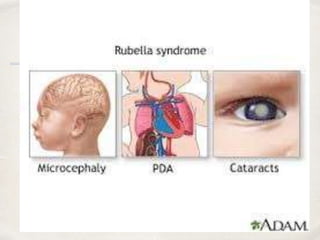
Congenital Rubella Syndrome 
✤ Infection in first trimester most dangerous 
✤ 90% of fetuses likely to have some type of abnormality 
✤ Virus disrupts organogenesis 
✤ plus more destructive on brain, cochlea, lens, etc. 
✤ Virus establishes chronic infection in many cells/organs 
✤ virus secretion may persist for years
Congenital Rubella Syndrome 
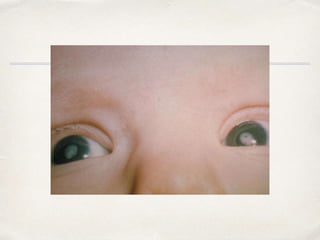
✤ Cataracts 
✤ Deafness 
✤ Heart malformation 
✤ Also: 
✤ microcephaly 
✤ autism 
✤ mental retardation 
✤ Diabetes 
✤ etc.
Measles, Mumps, Rubella 
✤ Common childhood diseases 
✤ May be associated with severe complications/death 
✤ More often in adults 
✤ Measles - pneumonia, encephalitis 
✤ Mumps - aseptic meningitis, deafness, orchitis 
✤ Rubella - congenital rubella syndrome 
✤ Respiratory transmission
Measles Mumps Rubella Vaccine 
• 12 -15 months is the recommended and minimum age 
(more effective at 15 months) 
• MMR given before 12 months should not be counted 
as a valid dose 
• 2nd dose at 4-6 years
MMR Vaccine 
Contraindications and Precautions 
• Severe allergic reaction to vaccine component or 
following prior dose 
• Pregnancy 
• Immunosuppression 
• Moderate or severe acute illness 
• Recent blood product

MMR

  • 1.
  • 2.
  • 3.
    Measles •Highly contagiousviral illness •First described in 7th century •Near universal infection of childhood in prevaccination era •Remains the leading cause of vaccine-preventable death in children •Paramyxovirus (RNA) •Rapidly inactivated by heat and light
  • 4.
    Measles It isan acute viral infection characterized by a final stage with a maculopapular rash erupting successively over the neck and face, trunk, arms, and legs, and accompanied by a high fever.
  • 5.
    Measles ✤ 14-dayincubation period for respiratory-acquired infections ✤ 6-10 days if acquired parenterally ✤ remains the leading cause of vaccine-preventable death in children
  • 6.
    Measles Pathogenesis andClinical Features • Respiratory transmission of virus • Replication in nasopharynx and regional lymph nodes • Primary viremia 2-3 days after exposure • Secondary viremia 5-7 days after exposure with spread to tissues • Incubation period 10-12 days • Stepwise increase in fever to 103°F or higher • Cough, coryza, conjunctivitis • Koplik spots • 2-4 days after prodrome, 14 days after exposure • Maculopapular, becomes confluent • Begins on face and head • Persists 5-6 days • Fades in order of appearance
  • 7.
    Clinical Manifestations ✤Measles has three clinical stages: 1. an incubation stage 2. a prodromal stage with an enanthem (Koplik spots) and mild symptoms 3. a final stage with a maculopapular rash accompanied by high fever.
  • 8.
    Measles (cont.) ✤Symptom ✤ Bloodshot eyes ✤ Cough ✤ Fever ✤ Sensitivity to light ✤ Muscle Pain ✤ Rash (itchy, red areas that spread together) ✤ Redness and/or irritation of the eyes ✤ Runny nose ✤ Sore throat ✤ White spots in the mouth (Koplik’s spots)
  • 15.
    Measles (cont.) ✤Prevention ✤ Routine immunization ✤ serum immune globulin 6 days after exposure ✤ Complications ✤ Bronchitis ✤ Encephalitis ✤ Ear infection ✤ Pneumonia
  • 16.
    Measles (cont.) ✤diagnosis ✤ Serology for measles ✤ Treatment ✤ No specific treatment ✤ vit A ✤ Acetaminophen ✤ Bed rest ✤ Humid air ✤ Fluid and nutrition
  • 17.
    Mumps Virus •Paramyxovirus • RNA virus • Rapidly inactivated by chemical agents, heat, and ultraviolet light
  • 18.
    Mumps ✤ Painfulswelling of the salivary glands ✤ spread from person-to-person through respiratory droplets (i.e. sneezing) ✤ Incidence ✤ Most common in 2-12 year old ✤ Incubation period - 14-18 days
  • 21.
    Mumps (cont.) ✤Symptoms ✤ Pain in the face ✤ Fever ✤ Headache ✤ Sore throat ✤ Swelling of the salivary glands ✤ Swelling of the jaw ✤ Specific to men: ✤ Testicle pain or lump ✤ Swelling of the scrotum
  • 22.
    Mumps Pathogenesis •Respiratory transmission of virus • Replication in nasopharynx and regional lymph nodes • Viremia 12-25 days after exposure with spread to tissues • Multiple tissues infected during viremia
  • 23.
    Mumps Pathogenesis ✤Viremia common, leading to organ involvement ✤ salivary glands (parotitis), ✤ meningitis, ✤ orchitis, ✤ endolymph infection leading to deafness ✤ A major cause of permanent, bilateral, sensorineural deafness in children ✤ Virus shed in saliva and urine for long periods after infection
  • 24.
    Mumps Complications CNSinvolvement Orchitis Pancreatitis Deafness Death 15% of clinical cases 20%-50% in post-pubertal males 2%-5% 1/20,000 Average 1 per year (1980 – 1999)
  • 25.
    Mumps (cont.) ✤Prevention ✤ MMR immunization between the age of: ✤ 12-15 months ✤ Again between 4-6 years ✤ Again between 11-12 years
  • 26.
    Mumps (cont.) ✤Test ✤ Physically examining the salivary glands for swelling (not test) ✤ Treatment ✤ No specific treatment ✤ Ice or heat packs and acetaminophen for pain
  • 27.
    Rubella Virus •Togavirus • RNA virus • Rapidly inactivated by chemical agents, ultraviolet light, low pH, and heat
  • 28.
    Rubella ✤ Alsoknown as German measles or three-day measles ✤ Rubella is a virus spread from person-to-person through air or close contact ✤ Incidence ✤ The virus is spread from 1 week before the rash begins, to 1-2 weeks after the rash is gone
  • 29.
    Rubella Pathogenesis •Respiratory transmission of virus • Replication in nasopharynx and regional lymph nodes • Viremia 5-7 days after exposure with spread to tissues • Placenta and fetus infected during viremia
  • 30.
    Rubella Clinical Features • Incubation period 14 days (range 12-23 days) • Prodrome of low-grade fever • Maculopapular rash 14-17 days after exposure • Usually quite mild
  • 31.
    Rubella (cont.) ✤Symptoms ✤ bloody red eyes ✤ Muscle or joint pain ✤ Bruising is a rare symptom ✤ Fever (adults) ✤ Headache (adults) ✤ Runny nose (adults)
  • 32.
    Rubella (cont.) ✤Test ✤ Nasal or throat swab sent for a culture ✤ Treatment ✤ No specific treatment ✤ Acetaminophen for fever
  • 33.
    Rubella (cont.) ✤Prevention ✤ rubella vaccination to adult and adolescent female ✤ MMR immunization between the age of: ✤ 12-15 months ✤ Again between 4-6 years
  • 34.
    Congenital Rubella Syndrome ✤ Infection in first trimester most dangerous ✤ 90% of fetuses likely to have some type of abnormality ✤ Virus disrupts organogenesis ✤ plus more destructive on brain, cochlea, lens, etc. ✤ Virus establishes chronic infection in many cells/organs ✤ virus secretion may persist for years
  • 35.
    Congenital Rubella Syndrome ✤ Cataracts ✤ Deafness ✤ Heart malformation ✤ Also: ✤ microcephaly ✤ autism ✤ mental retardation ✤ Diabetes ✤ etc.
  • 38.
    Measles, Mumps, Rubella ✤ Common childhood diseases ✤ May be associated with severe complications/death ✤ More often in adults ✤ Measles - pneumonia, encephalitis ✤ Mumps - aseptic meningitis, deafness, orchitis ✤ Rubella - congenital rubella syndrome ✤ Respiratory transmission
  • 39.
    Measles Mumps RubellaVaccine • 12 -15 months is the recommended and minimum age (more effective at 15 months) • MMR given before 12 months should not be counted as a valid dose • 2nd dose at 4-6 years
  • 40.
    MMR Vaccine Contraindicationsand Precautions • Severe allergic reaction to vaccine component or following prior dose • Pregnancy • Immunosuppression • Moderate or severe acute illness • Recent blood product