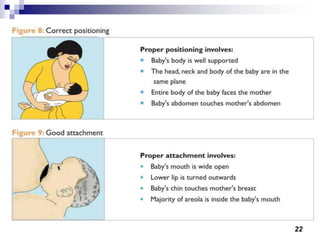
1
BREASTFEEDING
Dr Jyoti Prajapati
Assistant Professor Pediatrics
2
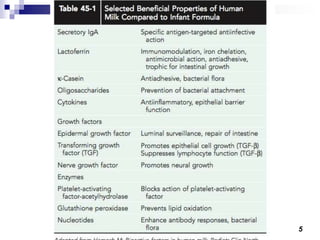
Benefits of breast milk to the baby
■ Breast milk is made for babies
■ Easily digested and well absorbed (60% lactoalbumin ,
lactoglobulin, lipase)
■ high lactose and galactose
■ Contains essential amino acids (taurine ,cysteine)
■ Rich in polyunsaturated essential fatty acids
■ Better bioavailability of iron and calcium
■ vitamine & electrolyte
■ hormones & growth factors
3
Benefits of breast milk (contd.)
■ Protects against infection( IgA, macrophages,
lymphocytes, bifidus factor, lactoferrin, lysozyme,
complement factors, interferon)
■ less diarrhoea and respiratory infections
■ Prevents allergies, asthema
■ Better intelligence
■ Promotes emotional bonding
■ Less heart disease, hypertention, diabetes,
lymphoma& cancer
4
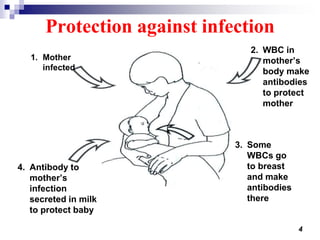
1. Mother
infected
4. Antibody to
mother’s
infection
secreted in milk
to protect baby
2. WBC in
mother’s
body make
antibodies
to protect
mother
3. Some
WBCs go
to breast
and make
antibodies
there
Protection against infection
5
6
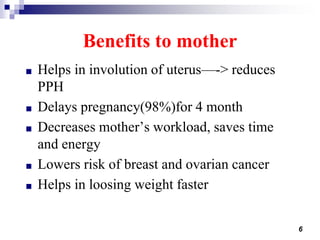
Benefits to mother
■ Helps in involution of uterus—-> reduces
PPH
■ Delays pregnancy(98%)for 4 month
■ Decreases mother’s workload, saves time
and energy
■ Lowers risk of breast and ovarian cancer
■ Helps in loosing weight faster
7
Benefits to family
■ Contributes to child survival
■ Saves money
■ Promotes family planning
■ Environment friendly
8
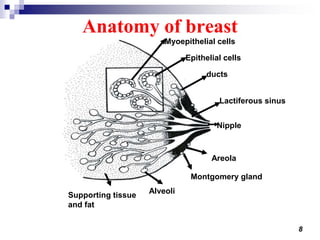
Anatomy of breast
Myoepithelial cells
Epithelial cells
ducts
Lactiferous sinus
Areola
Montgomery gland
Alveoli
Supporting tissue
and fat
Nipple
9
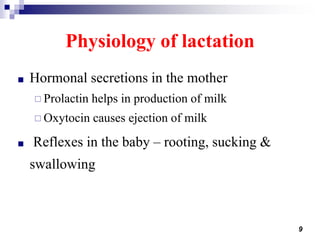
Physiology of lactation
■ Hormonal secretions in the mother
◻Prolactin helps in production of milk
◻Oxytocin causes ejection of milk
■ Reflexes in the baby – rooting, sucking &
swallowing
10
Prolactin production
Enhanced by
■ How early the baby is put to the breast
■ How often and how long baby feeds at breast
■ How well the baby is attached to the breast
■ complete emptying of breast
11
Prolactin reflex
Hindered by
■ Delayed initiation of breastfeeds
■ Prelacteal feeds
■ Making the baby wait for feeds
■ Dummies, pacifiers, bottles
■ Certain medication given to mothers
■ Painful breast conditions
12
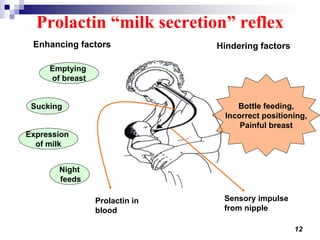
Enhancing factors Hindering factors
Emptying
of breast
Sucking
Expression
of milk
Night
feeds
Bottle feeding,
Incorrect positioning,
Painful breast
Sensory impulse
from nipple
Prolactin in
blood
Prolactin “milk secretion” reflex
13
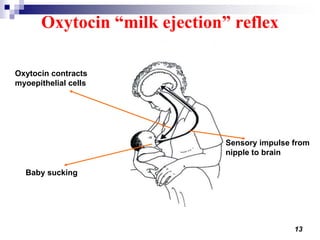
Baby sucking
Sensory impulse from
nipple to brain
Oxytocin contracts
myoepithelial cells
Oxytocin “milk ejection” reflex
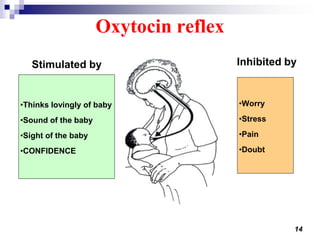
14
•Thinks lovingly of baby
•Sound of the baby
•Sight of the baby
•CONFIDENCE
•Worry
•Stress
•Pain
•Doubt
Stimulated by Inhibited by
Oxytocin reflex
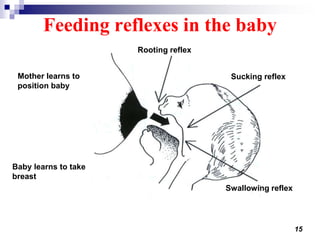
15
Mother learns to
position baby
Baby learns to take
breast
Rooting reflex
Swallowing reflex
Sucking reflex
Feeding reflexes in the baby
16
types of milk
▪ Preterm - more protein and more calories
▪ Term
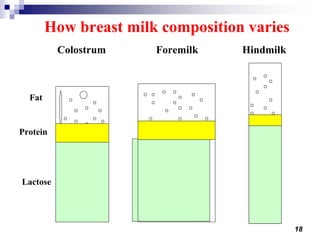
▪ Colostrum- high fat, high protein
,immunoglobins, thick yellow
▪ Transitional- fat & sugar increases, protein
decreases
▪ Mature —-fore milk( watery) , hind milk(fat)
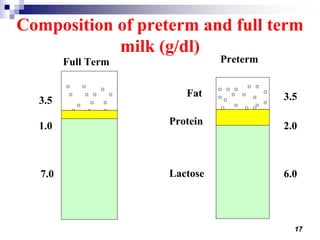
17
Composition of preterm and full term
milk (g/dl)
3.5
1.0
7.0
Fat
Protein
Lactose
3.5
2.0
6.0
Full Term Preterm
18
How breast milk composition varies
Colostrum Foremilk Hindmilk
Fat
Protein
Lactose
19
For successful breastfeeding
■ A willing and motivated mother
■ An active and sucking newborn
■ A motivator who can bring both mother and newborn
together ( health professional or relative )
20
Successful breastfeeding
■ Have a written breastfeeding policy
■ Motivate mother from antenatal period
■ Put to breast within 30 minutes to 4 hrs of birth
■ Promote rooming -in of mother and baby
■ Promote frequent breastfeeding
21
Successful breastfeeding (contd.)
■ Don’t give prelacteal feeds
■ Don’t use bottle to feed
■ Support mother in breastfeeding the baby
■ Arrange mother counselling classes in health facilities
■ Treat breastfeeding problems early
■ Exclusive breastfeeding till 6 months
■ Addition of home-based semisolids after 6 months
22
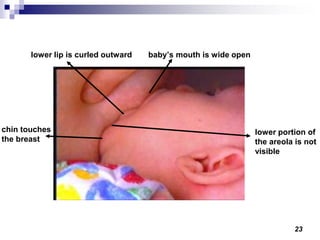
23
baby’s mouth is wide openlower lip is curled outward
lower portion of
the areola is not
visible
chin touches
the breast
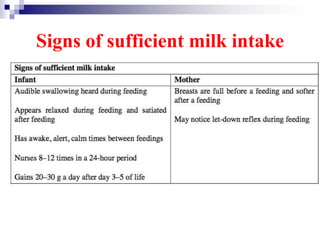
Signs of sufficient milk intake
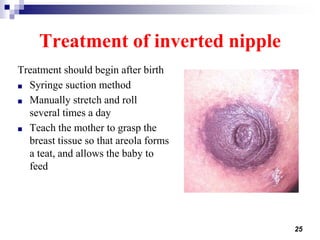
Treatment of inverted nipple
Treatment should begin after birth
■ Syringe suction method
■ Manually stretch and roll
several times a day
■ Teach the mother to grasp the
breast tissue so that areola forms
a teat, and allows the baby to
feed
25
26
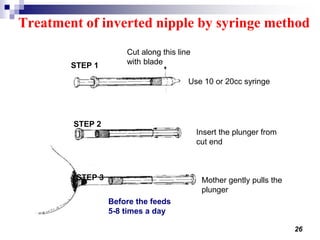
Treatment of inverted nipple by syringe method
STEP 1
STEP 3
STEP 2
Cut along this line
with blade
Mother gently pulls the
plunger
Insert the plunger from
cut end
Use 10 or 20cc syringe
Before the feeds
5-8 times a day
27
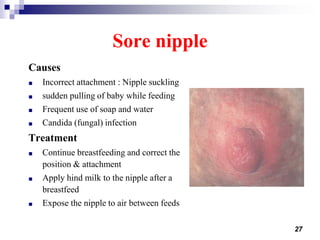
Sore nipple
Causes
■ Incorrect attachment : Nipple suckling
■ sudden pulling of baby while feeding
■ Frequent use of soap and water
■ Candida (fungal) infection
Treatment
■ Continue breastfeeding and correct the
position & attachment
■ Apply hind milk to the nipple after a
breastfeed
■ Expose the nipple to air between feeds
28
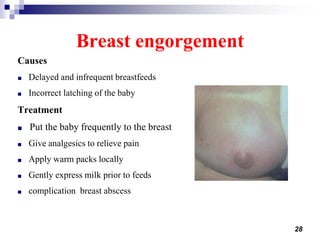
Breast engorgement
Causes
■ Delayed and infrequent breastfeeds
■ Incorrect latching of the baby
Treatment
■ Put the baby frequently to the breast
■ Give analgesics to relieve pain
■ Apply warm packs locally
■ Gently express milk prior to feeds
■ complication breast abscess
29
Causes of “Not enough milk”
■ less frequent breastfeeding
■ Too short or hurried breastfeeding
■ Night feeds stopped early
■ Poor attachment and positioning
■ Poor oxytocin reflex (stress, anxiety, lack of
confidence)
■ Engorgement or mastitis
30
Management of “Not enough milk”
■ Put baby to breast frequently
■ Baby to be correctly attached to breast
■ Build mother’s confidence
■ Use galactogogues (metoclopramide)
judiciously
Adequate weight gain (20-30 gm/day) and urine
frequency 6-8 times a day are reliable signs of enough
milk intake
31
Expressed breast milk
Indications
■ Sick mother, local breast problems
■ Preterm / sick baby
■ Working mother
Storage
■ Clean wide-mouthed container with tight lid
■ At room temperature 8-10 hrs
■ Refrigerator – 24 hours, Freezer - 20° C – for 3
months
32
Ten steps to successful breastfeeding
Every facility providing maternity services and care for
newborn infants should
1. Have a written breastfeeding policy that is routinely
communicated to all health care staff
2. Train all health care staff
3. Inform all pregnant women about the benefits and
management of breastfeeding
33
Ten steps to successful breastfeeding
(contd….)
4. Help mothers initiate breastfeeding within half
hour of birth
5. Demonstrate mothers how to breastfeed, and how
to maintain lactation even if they are separated
from their infants
6. Give no food or drink
7. Practice rooming-in
34
8. Encourage breastfeeding on demand
9. Give no artificial teats or pacifiers
10. Establish breastfeeding support groups and
refer mothers to them on discharge from the
hospital.
Ten steps to successful breastfeeding
(contd….)
35
Conditions that may justify temporary
avoidance of breastfeeding
•Severe illness in mother as sepsis, postpartum psychosis.
• IEM -galactocemea, phenylketonuria, MSUD
• Herpes simplex virus type 1 (HSV-1), chicken pox: direct
contact between lesions on the mother's breasts and the infant's
mouth should be avoided until all active lesions have resolved.
• Maternal medication
o Cytotoxic drugs Cyclophosphamide, Methotrexate and
Doxorubicin
o Radioactive compounds like Gallium 67 (67Ga), Indium 111
36
37

Breastfeeding

  • 1.
  • 2.
    2 Benefits of breastmilk to the baby ■ Breast milk is made for babies ■ Easily digested and well absorbed (60% lactoalbumin , lactoglobulin, lipase) ■ high lactose and galactose ■ Contains essential amino acids (taurine ,cysteine) ■ Rich in polyunsaturated essential fatty acids ■ Better bioavailability of iron and calcium ■ vitamine & electrolyte ■ hormones & growth factors
  • 3.
    3 Benefits of breastmilk (contd.) ■ Protects against infection( IgA, macrophages, lymphocytes, bifidus factor, lactoferrin, lysozyme, complement factors, interferon) ■ less diarrhoea and respiratory infections ■ Prevents allergies, asthema ■ Better intelligence ■ Promotes emotional bonding ■ Less heart disease, hypertention, diabetes, lymphoma& cancer
  • 4.
    4 1. Mother infected 4. Antibodyto mother’s infection secreted in milk to protect baby 2. WBC in mother’s body make antibodies to protect mother 3. Some WBCs go to breast and make antibodies there Protection against infection
  • 5.
  • 6.
    6 Benefits to mother ■Helps in involution of uterus—-> reduces PPH ■ Delays pregnancy(98%)for 4 month ■ Decreases mother’s workload, saves time and energy ■ Lowers risk of breast and ovarian cancer ■ Helps in loosing weight faster
  • 7.
    7 Benefits to family ■Contributes to child survival ■ Saves money ■ Promotes family planning ■ Environment friendly
  • 8.
    8 Anatomy of breast Myoepithelialcells Epithelial cells ducts Lactiferous sinus Areola Montgomery gland Alveoli Supporting tissue and fat Nipple
  • 9.
    9 Physiology of lactation ■Hormonal secretions in the mother ◻Prolactin helps in production of milk ◻Oxytocin causes ejection of milk ■ Reflexes in the baby – rooting, sucking & swallowing
  • 10.
    10 Prolactin production Enhanced by ■How early the baby is put to the breast ■ How often and how long baby feeds at breast ■ How well the baby is attached to the breast ■ complete emptying of breast
  • 11.
    11 Prolactin reflex Hindered by ■Delayed initiation of breastfeeds ■ Prelacteal feeds ■ Making the baby wait for feeds ■ Dummies, pacifiers, bottles ■ Certain medication given to mothers ■ Painful breast conditions
  • 12.
    12 Enhancing factors Hinderingfactors Emptying of breast Sucking Expression of milk Night feeds Bottle feeding, Incorrect positioning, Painful breast Sensory impulse from nipple Prolactin in blood Prolactin “milk secretion” reflex
  • 13.
    13 Baby sucking Sensory impulsefrom nipple to brain Oxytocin contracts myoepithelial cells Oxytocin “milk ejection” reflex
  • 14.
    14 •Thinks lovingly ofbaby •Sound of the baby •Sight of the baby •CONFIDENCE •Worry •Stress •Pain •Doubt Stimulated by Inhibited by Oxytocin reflex
  • 15.
    15 Mother learns to positionbaby Baby learns to take breast Rooting reflex Swallowing reflex Sucking reflex Feeding reflexes in the baby
  • 16.
    16 types of milk ▪Preterm - more protein and more calories ▪ Term ▪ Colostrum- high fat, high protein ,immunoglobins, thick yellow ▪ Transitional- fat & sugar increases, protein decreases ▪ Mature —-fore milk( watery) , hind milk(fat)
  • 17.
    17 Composition of pretermand full term milk (g/dl) 3.5 1.0 7.0 Fat Protein Lactose 3.5 2.0 6.0 Full Term Preterm
  • 18.
    18 How breast milkcomposition varies Colostrum Foremilk Hindmilk Fat Protein Lactose
  • 19.
    19 For successful breastfeeding ■A willing and motivated mother ■ An active and sucking newborn ■ A motivator who can bring both mother and newborn together ( health professional or relative )
  • 20.
    20 Successful breastfeeding ■ Havea written breastfeeding policy ■ Motivate mother from antenatal period ■ Put to breast within 30 minutes to 4 hrs of birth ■ Promote rooming -in of mother and baby ■ Promote frequent breastfeeding
  • 21.
    21 Successful breastfeeding (contd.) ■Don’t give prelacteal feeds ■ Don’t use bottle to feed ■ Support mother in breastfeeding the baby ■ Arrange mother counselling classes in health facilities ■ Treat breastfeeding problems early ■ Exclusive breastfeeding till 6 months ■ Addition of home-based semisolids after 6 months
  • 22.
  • 23.
    23 baby’s mouth iswide openlower lip is curled outward lower portion of the areola is not visible chin touches the breast
  • 24.
  • 25.
    Treatment of invertednipple Treatment should begin after birth ■ Syringe suction method ■ Manually stretch and roll several times a day ■ Teach the mother to grasp the breast tissue so that areola forms a teat, and allows the baby to feed 25
  • 26.
    26 Treatment of invertednipple by syringe method STEP 1 STEP 3 STEP 2 Cut along this line with blade Mother gently pulls the plunger Insert the plunger from cut end Use 10 or 20cc syringe Before the feeds 5-8 times a day
  • 27.
    27 Sore nipple Causes ■ Incorrectattachment : Nipple suckling ■ sudden pulling of baby while feeding ■ Frequent use of soap and water ■ Candida (fungal) infection Treatment ■ Continue breastfeeding and correct the position & attachment ■ Apply hind milk to the nipple after a breastfeed ■ Expose the nipple to air between feeds
  • 28.
    28 Breast engorgement Causes ■ Delayedand infrequent breastfeeds ■ Incorrect latching of the baby Treatment ■ Put the baby frequently to the breast ■ Give analgesics to relieve pain ■ Apply warm packs locally ■ Gently express milk prior to feeds ■ complication breast abscess
  • 29.
    29 Causes of “Notenough milk” ■ less frequent breastfeeding ■ Too short or hurried breastfeeding ■ Night feeds stopped early ■ Poor attachment and positioning ■ Poor oxytocin reflex (stress, anxiety, lack of confidence) ■ Engorgement or mastitis
  • 30.
    30 Management of “Notenough milk” ■ Put baby to breast frequently ■ Baby to be correctly attached to breast ■ Build mother’s confidence ■ Use galactogogues (metoclopramide) judiciously Adequate weight gain (20-30 gm/day) and urine frequency 6-8 times a day are reliable signs of enough milk intake
  • 31.
    31 Expressed breast milk Indications ■Sick mother, local breast problems ■ Preterm / sick baby ■ Working mother Storage ■ Clean wide-mouthed container with tight lid ■ At room temperature 8-10 hrs ■ Refrigerator – 24 hours, Freezer - 20° C – for 3 months
  • 32.
    32 Ten steps tosuccessful breastfeeding Every facility providing maternity services and care for newborn infants should 1. Have a written breastfeeding policy that is routinely communicated to all health care staff 2. Train all health care staff 3. Inform all pregnant women about the benefits and management of breastfeeding
  • 33.
    33 Ten steps tosuccessful breastfeeding (contd….) 4. Help mothers initiate breastfeeding within half hour of birth 5. Demonstrate mothers how to breastfeed, and how to maintain lactation even if they are separated from their infants 6. Give no food or drink 7. Practice rooming-in
  • 34.
    34 8. Encourage breastfeedingon demand 9. Give no artificial teats or pacifiers 10. Establish breastfeeding support groups and refer mothers to them on discharge from the hospital. Ten steps to successful breastfeeding (contd….)
  • 35.
    35 Conditions that mayjustify temporary avoidance of breastfeeding •Severe illness in mother as sepsis, postpartum psychosis. • IEM -galactocemea, phenylketonuria, MSUD • Herpes simplex virus type 1 (HSV-1), chicken pox: direct contact between lesions on the mother's breasts and the infant's mouth should be avoided until all active lesions have resolved. • Maternal medication o Cytotoxic drugs Cyclophosphamide, Methotrexate and Doxorubicin o Radioactive compounds like Gallium 67 (67Ga), Indium 111
  • 36.
  • 37.