Measles
(ENGLIS MEASLES)
Agent
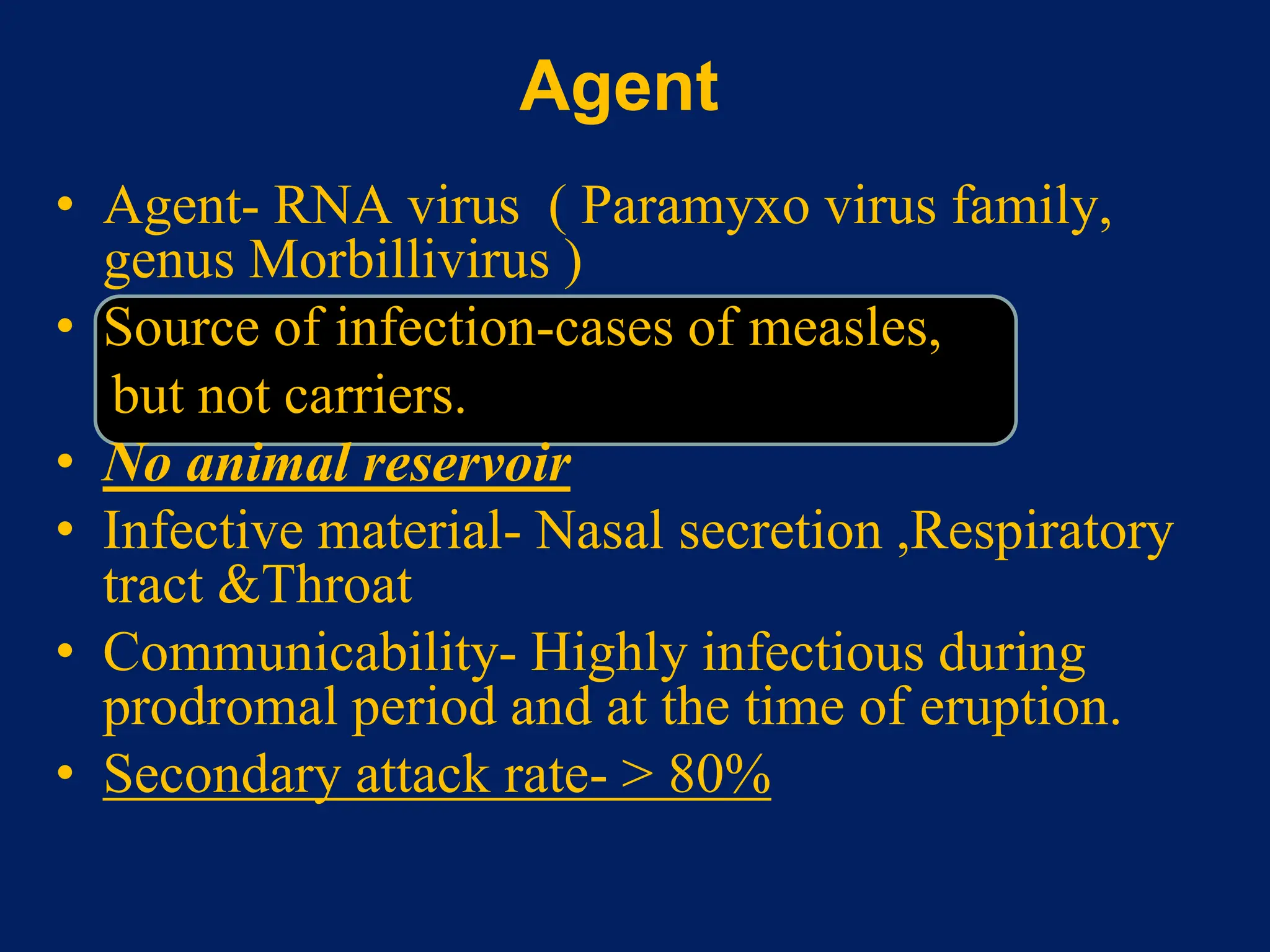
• Agent- RNA virus ( Paramyxo virus family,
genus Morbillivirus )
• Source of infection-cases of measles,
but not carriers.
• No animal reservoir
• Infective material- Nasal secretion ,Respiratory
tract &Throat
• Communicability- Highly infectious during
prodromal period and at the time of eruption.
• Secondary attack rate- > 80%
Host factors
• Age- 6 months to 3 years even up to 10
years
• Incidence equal in both sexes
• Immunity – life long immunity
• Malnourished children are susceptible
Environmental factor
• Winter season, over crowding
• Transmission – Droplet infection
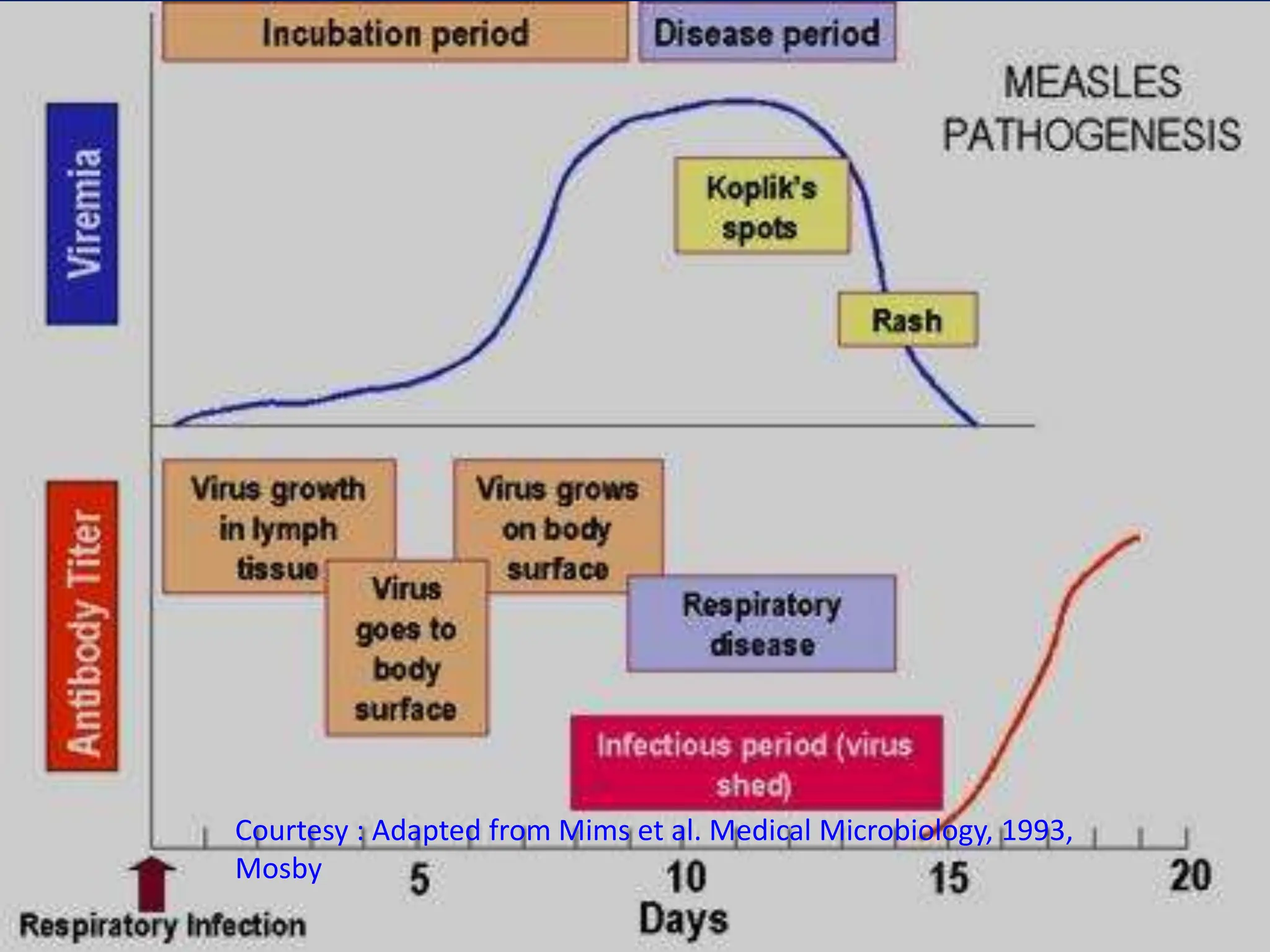
• 4 days before and 4 days after rash
• Incubation period- 7 days
Courtesy : Adapted from Mims et al. Medical Microbiology, 1993,
Mosby
Clinical features
• Prodromal stage
• Eruptive stage
• Post-measles stage
Clinical features
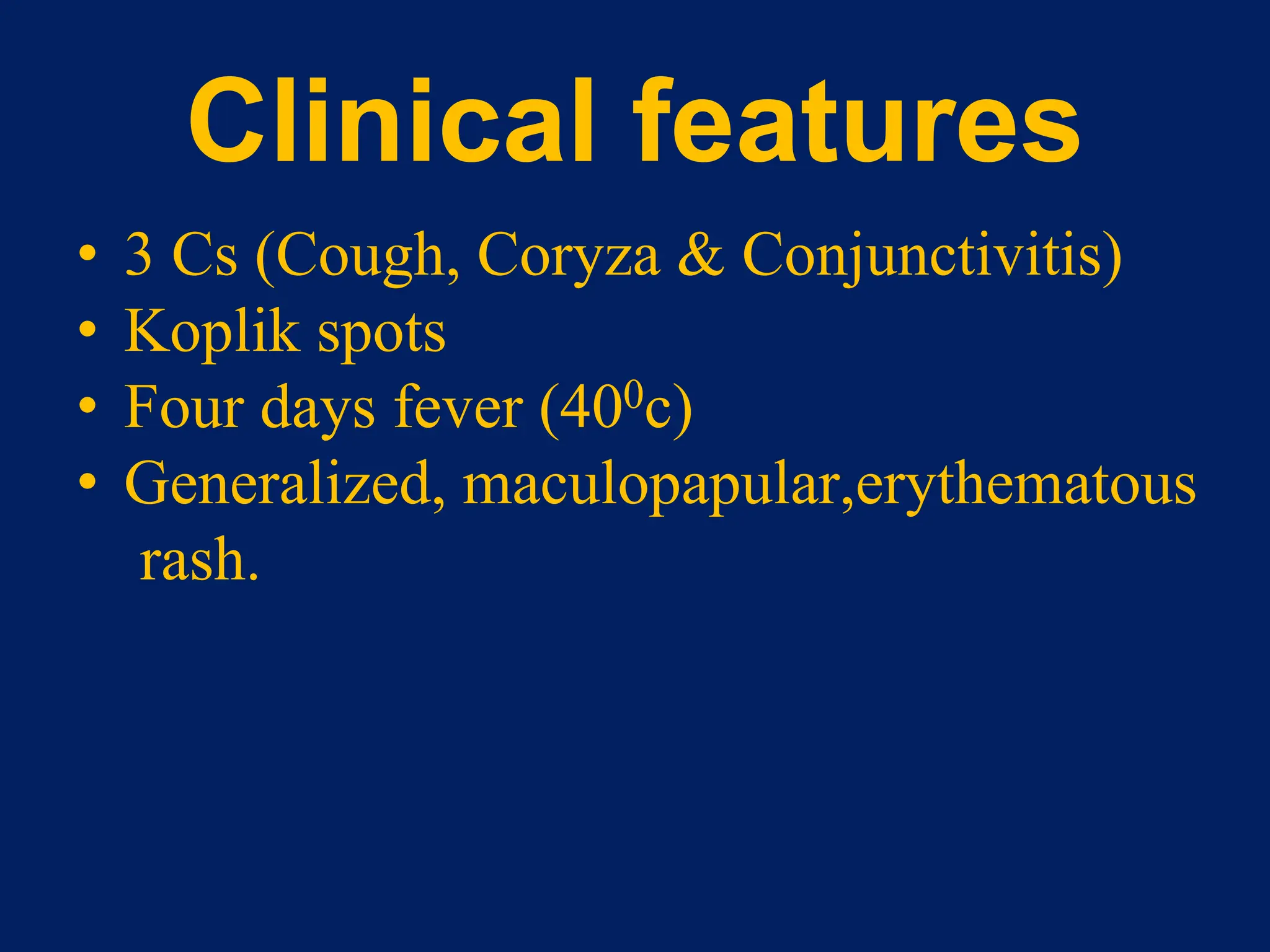
• 3 Cs (Cough, Coryza & Conjunctivitis)
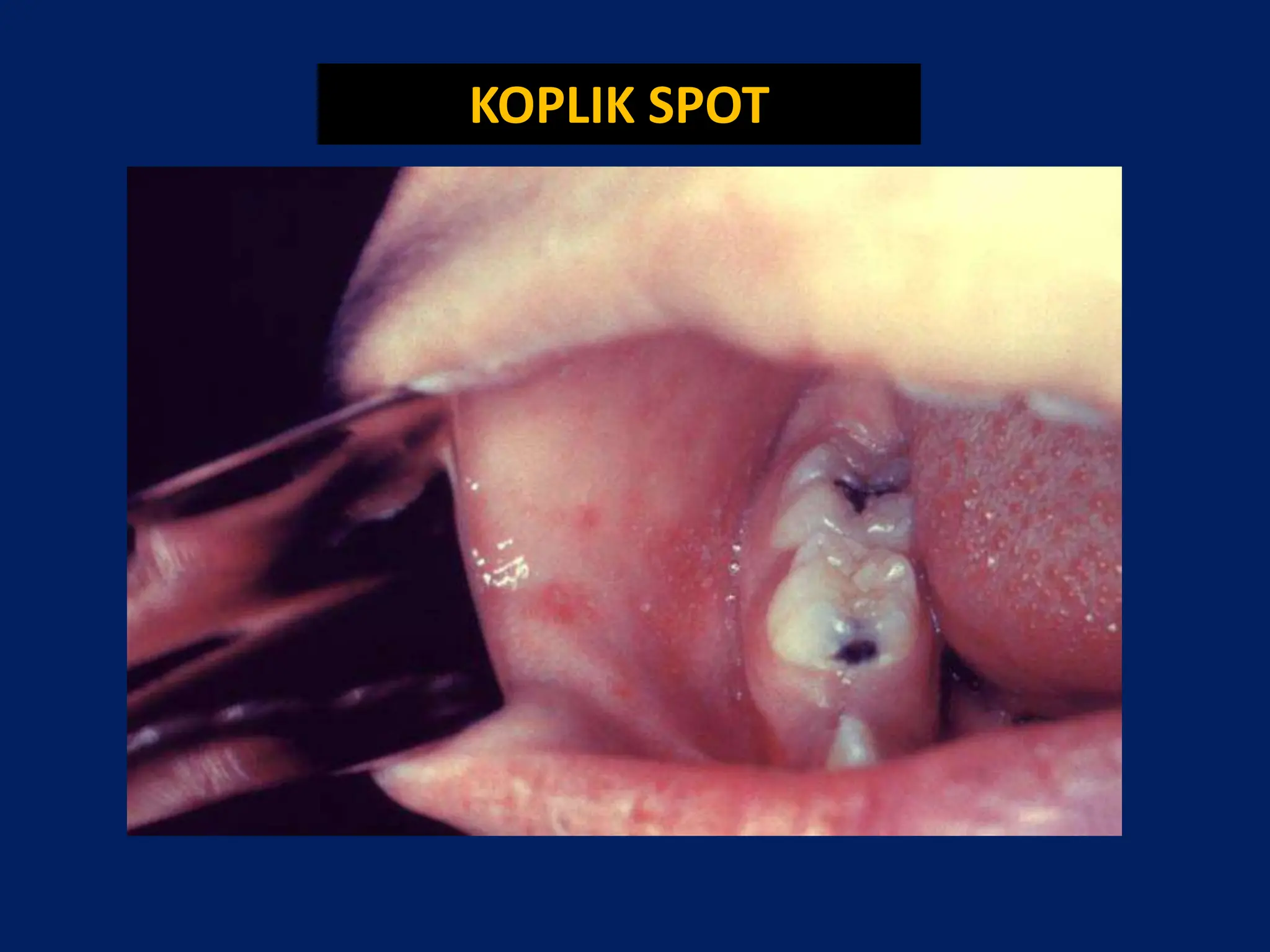
• Koplik spots
• Four days fever (400c)
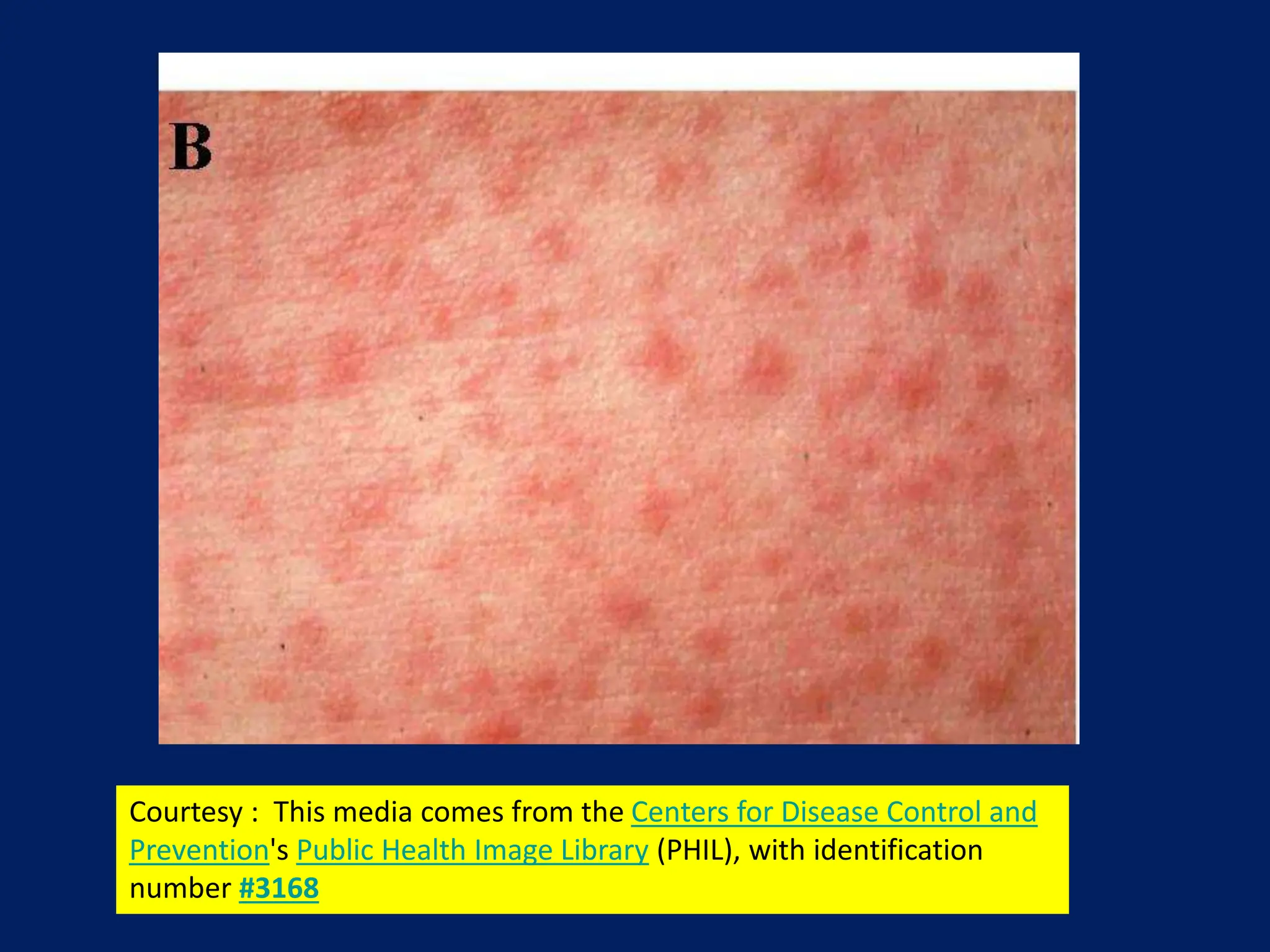
• Generalized, maculopapular,erythematous
rash.
Courtesy : This media comes from the Centers for Disease Control and
Prevention's Public Health Image Library (PHIL), with identification
number #3168
KOPLIK SPOT
Complication
• Diarrhea,
• Pneumonia
• Otitis media
• Convulsions,
• SSPE (sub acute sclerosing
panencephalitis)
WHO strategy for control and
prevention of Measles
1) Catch up
2) Keep up
3) Follow up
Host factors
• Age- 6 months to 3 years even up to 10
years
• Incidence equal in both sexes
• Immunity – life long immunity
• Malnourished children are susceptible
Environmental factor
• Winter season, over crowding
• Transmission – Droplet infection
• 4 days before and 4 days after rash
• Incubation period- 7 days
Courtesy : Adapted from Mims et al. Medical Microbiology, 1993,
Mosby
Clinical features
• Prodromal stage
• Eruptive stage
• Post-measles stage
Clinical features
• 3 Cs (Cough, Coryza & Conjunctivitis)
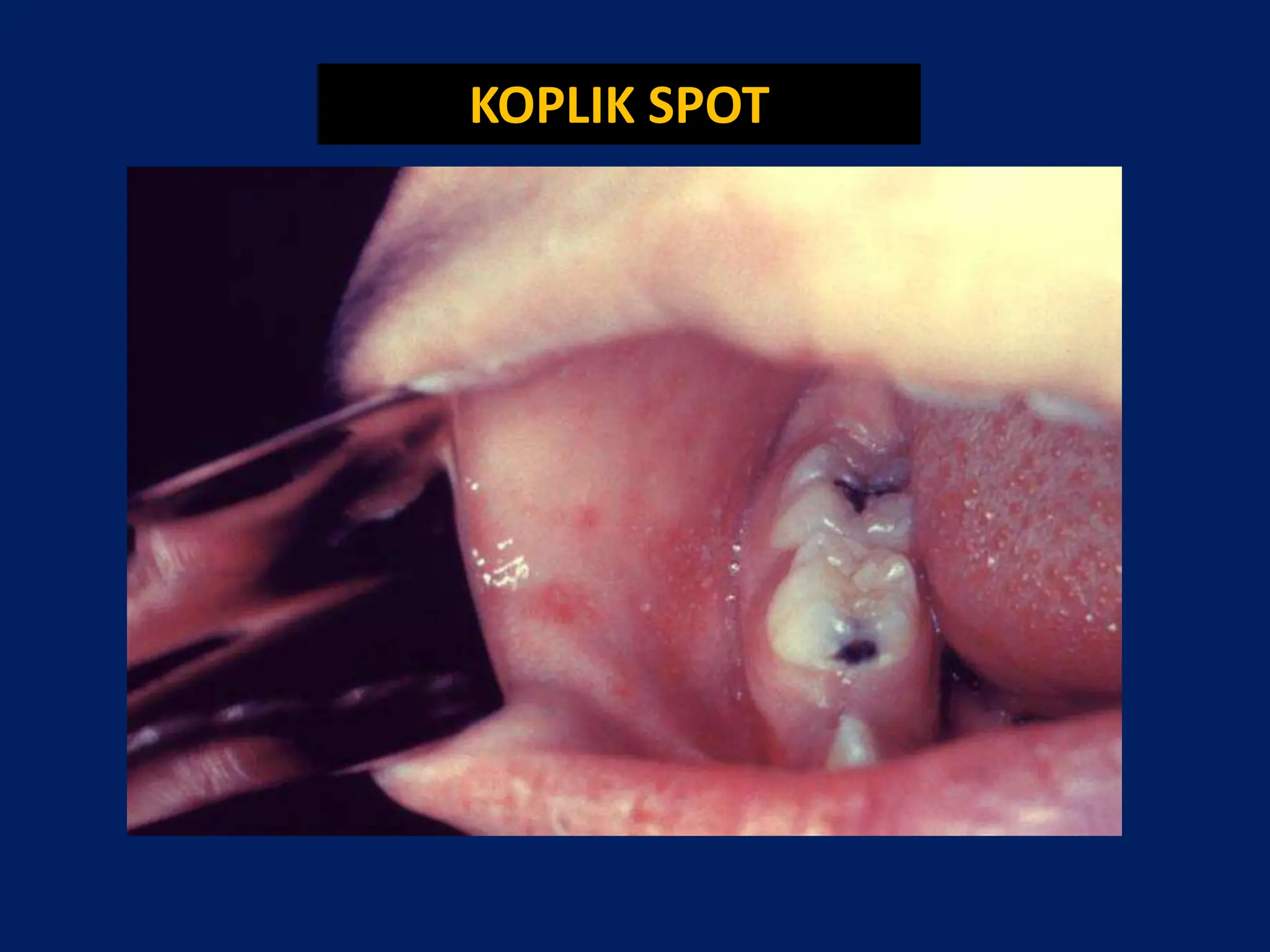
• Koplik spots
• Four days fever (400c)
• Generalized, maculopapular,erythematous
rash.
Courtesy : This media comes from the Centers for Disease Control and
Prevention's Public Health Image Library (PHIL), with identification
number #3168
KOPLIK SPOT
Complication
• Diarrhea,
• Pneumonia
• Otitis media
• Convulsions,
• SSPE (sub acute sclerosing
panencephalitis)
WHO strategy for control and
prevention of Measles
1) Catch up
2) Keep up
3) Follow up
German Measles
(Rubella)
German Measles (Rubella)
German Measles Virus
• Icosahedral
shape
• Contains RNA
German Measles Symptoms
• Rubella comes from
the Latin words for
“little red”
• Creates dense groups
of small skin rash
• Produces swollen
lymph nodes, runny
nose, and fever
German Measles Transmission
• Spread through
respiratory
droplets from
coughing and
sneezing
• Also spread
through body
secretions and
excretions
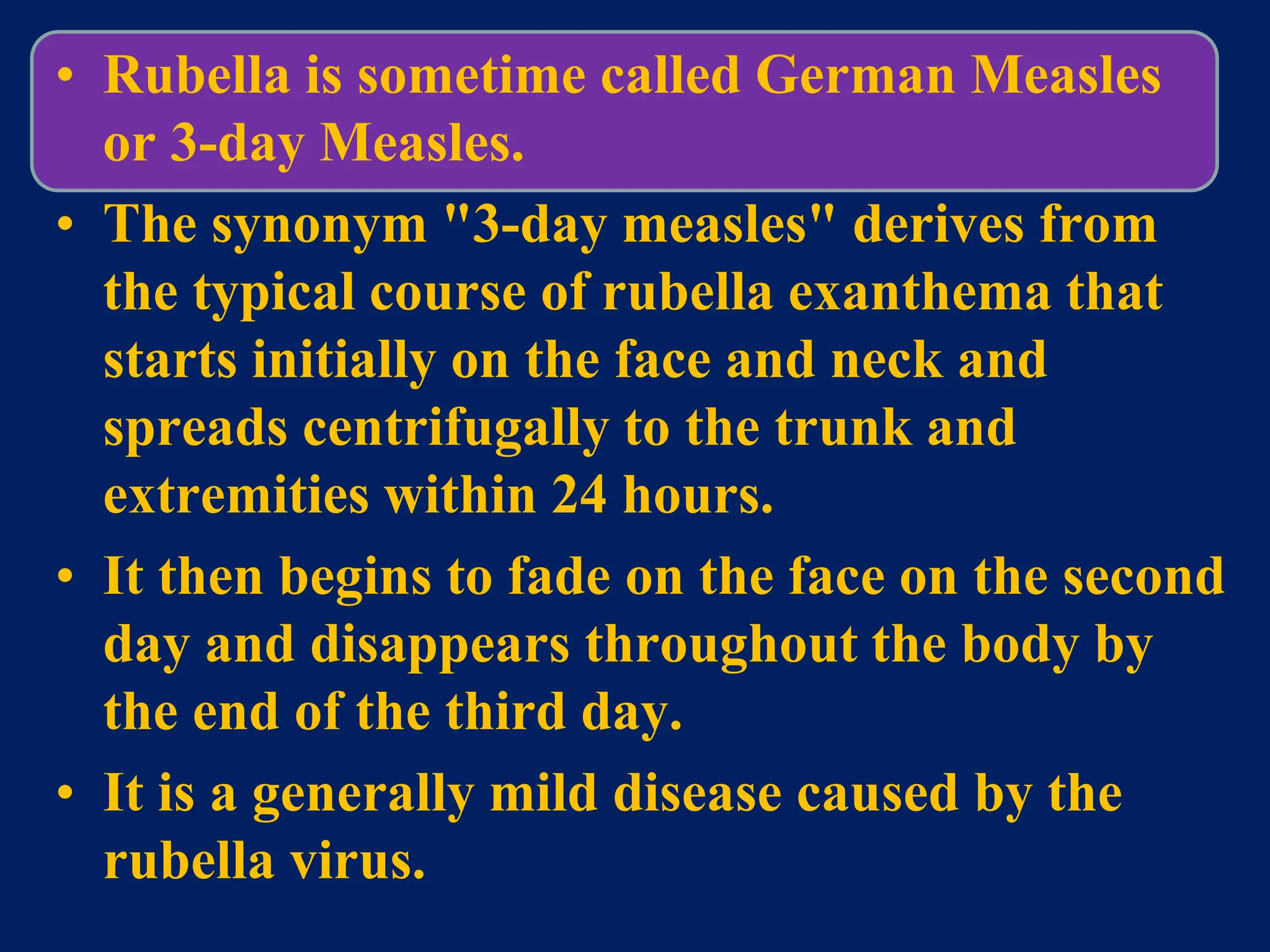
• Rubella is sometime called German Measles
or 3-day Measles.
• The synonym "3-day measles" derives from
the typical course of rubella exanthema that
starts initially on the face and neck and
spreads centrifugally to the trunk and
extremities within 24 hours.
• It then begins to fade on the face on the second
day and disappears throughout the body by
the end of the third day.
• It is a generally mild disease caused by the
rubella virus.
• Agent – RNA virus (Togo virus family),
Genus Rubivirus.
• Source of infection – Respiratory secretion
• Host -3-10 yrs
• Immunity –life long
• Environmental factors –winter and spring
season
• Transmission – droplet, vertical transmission
• I.P – 2-3 weeks average 18 days
• Eye pain on lateral and upward eye
movement (a particularly troublesome
complaint)
• Conjunctivitis
• Sore throat
• Headache
• General body aches
• Low-grade fever
• Chills
• Anorexia
• Nausea
• Tender lymphadenopathy (particularly
posterior auricular and suboccipital lymph
nodes)
• Forchheimer sign (an enanthem observed in
20% of patients with rubella during the
prodromal period; can be during the initial
phase of the exanthem;
consists of pinpoint or larger petechiae
that usually occur on the soft palate)
Temperature
• Fever is usually not higher than 38.5°C
(101.5°F).
Lymph nodes
• Enlarged posterior auricular and suboccipital
lymph nodes are usually found on physical
examination.
Mouth
• The Forchheimer sign may still be present on
the soft palate.
Image in a 4-year-old girl with a 4-day history of low-grade fever,
symptoms of an upper respiratory tract infection, and rash.
Courtesy of Pamela L. Dyne, MD.
– INFECTION DURING PREGNANCY.
• 0–28 days before conception - 43%
chance
• 0–12 weeks after conception - 51%
chance
• 13–26 weeks after conception - 23%
chance
• Infants are not generally affected if
rubella is contracted during the third
trimester
Photo source: U.S. Centers for Disease Control and Prevention
Salt and pepper
retinopathy
Content Providers(s): CDC Creation
Date: 1976
Courtesy
http://phil.cdc.gov/phil_images/2003072
4/28/PHIL_4284_lores.jpg
COMPLICATION ON FETUS
DURING PREGNANCY
• Sensorineural hearing loss – 58%
• Ocular abnormalities including cataract,
infantile glaucoma, Micro ophthalmia
and pigmentary retinopathy occur in
approximately 43%
• Congenital heart disease including patent
ductus arteriosus (PDA) and pulmonary
artery stenosis - 50%
Measles Vaccine
• Composition Live virus
• Efficacy 95% (range, 90%-98%)
• Duration of
Immunity Lifelong
• Schedule 2 doses
• Should be administered with mumps and
rubella as MMR or with mumps, rubella
and varicella as MMRV
Presumptive Evidence of Measles
Immunity
• Documentation of adequate vaccination
– 1 dose of MMR vaccine for preschool-aged
children and for adults not at high risk of
exposure
– 2 doses for school-aged children (i.e., grades K-
12) and for adults at high risk of exposure
• Serologic evidence of immunity
• Birth before 1957
• Documentation of physician-diagnosed measles
Measles Vaccine
Indications for Revaccination
• Vaccinated before the first birthday
• Vaccinated with killed measles vaccine
• Vaccinated prior to 1968 with an
unknown type of vaccine
• Vaccinated with IG in addition to a
further attenuated strain or vaccine of
unknown type
Mumps
(Parotitis)
Mumps Virus
• Helical shape
• RNA virus
Mumps Symptoms
• Infects salivary glands,
especially the parotid
gland
• Primary symptom is
swollen checks
• Can also cause fever,
headache, and malaise
• Testicular inflammation
is common, ovarian
inflammation can
happen but is rare
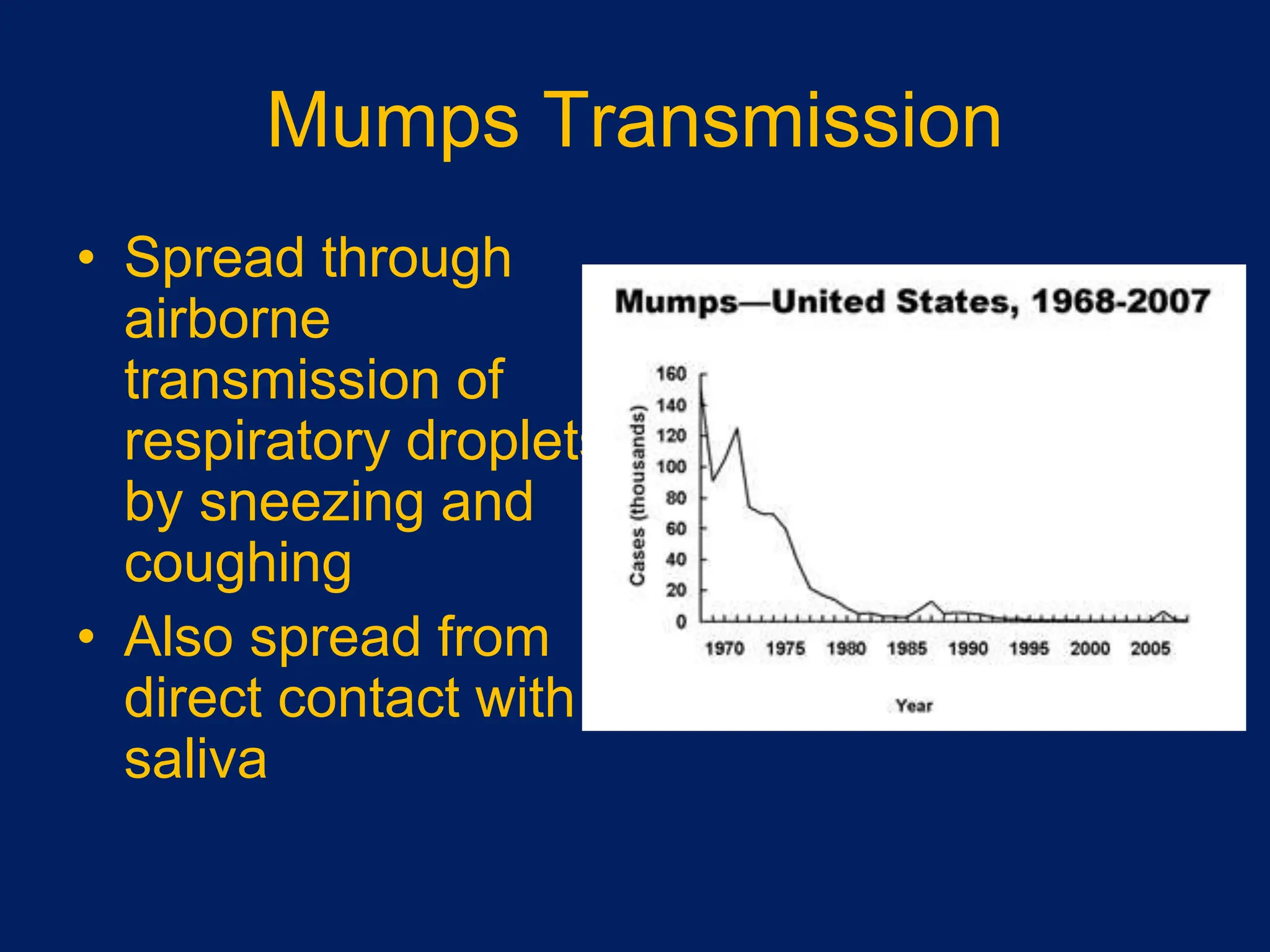
Mumps
Mumps Transmission
• Spread through
airborne
transmission of
respiratory droplets
by sneezing and
coughing
• Also spread from
direct contact with
saliva
Agent
• Myxovirus parotidis –RNA virus
• Source of infection – Respiratory,
milk
• Period of communicability – 4-6 days
of onset of symptoms
• Secondary attack rate – 86%
• Age & sex 5-15 yrs and girls
common
• Immunity - life long
• Environmental factor – winter and
spring season favors
• Mode of transmission – droplet
• I.P - 2 to 3 weeks
Clinical features
• Parotid swelling
• Ovaritis
• Pancreatitis
• Ear ache
• Orchitis
Complications
• Orchitis
• Epididymitis
• Oophoiritis
• Spontaneous abortion
• Sensori neural hearing loss, (uni- or bilateral).
• Mild form of meningitis
• Encephalitis
Mumps Vaccine
• 10 strains of the mumps virus are in use
throughout the world for the preparation of
live attenuated vaccine.
• Jeryl Lynn strain which was named after
the child from whom the virus was
isolated.
• Leningrad-3 strain
• Urabe strain
• Hoshino, Torii and NKM - 46 strains
• L-Zagreb
MMR Vaccine
• Live attenuated strains of Edmonston-Zagreb
Measles virus propagated on human diploid cell
culture,
• L-Zagreb Mumps virus propagated on chick
embryo fibroblast cells
• Wistar RA 27/3 Rubella virus propagated on
human diploid cell culture.
• The reconstituted vaccine contains, in single dose of 0.5
ml. not less than
1000 CCID50 of Measles virus
5000 CCID50 of Mumps virus
1000 CCID50 of Rubella virus.
Diluent : Sterile water for injection.
The vaccine meets the requirements of USP and WHO
when tested by the methods outlined in USP and WHO,
TRS 840 (1994).
• For active immunization in children of 12 months to 12
years of age against Measles, Mumps and Rubella
infections –MMR Vaccine to be given
• For immunisation of susceptible non pregnant,
adolescent and adult females, we have to use Rubella
Vaccine)
• Measles vaccine has to be given at 9 months,
• If Measles vaccine is given ,a 3 months gap is
advisable to give MMR vaccine
• MMR vaccine may be given between 12-15 months of
age.
• If Measles vaccine was missed , MMR dose replaces
it, when given at or after 12 months.
•
• A single dose of 0.5 ml should be administered
by deep subcutaneous injection into the upper
arm.
• If the vaccine is not used immediately then it
should be stored in the dark at 2° - 8°C for no
longer than 8 hours.
MMR Adverse Reactions
• Fever* 5%-15%
• Rash* 5%
• Joint symptoms 25%
• Thrombocytopenia* <1/30,000 doses
• Parotitis rare
• Deafness rare
• Encephalopathy* <1/1,000,000
doses
*reactions usually attributed to the measles component
MMR Vaccine
Contraindications and Precautions
• Severe allergic reaction to vaccine
component or following prior dose
• Pregnancy
• Immunosuppression
• Moderate or severe acute illness
• Recent blood product
MMRV (ProQuad)
• Combination measles, mumps, rubella
and varicella vaccine
• Approved children 12 months through
12 years of age (up to age 13 years)
• Titer of varicella vaccine virus in
MMRV is more than 7 times higher
than standard varicella vaccine
Age Vaccines Note
9 months Measles
Deep subcutaneous injection
into the upper arm.
12-15
months MMR -1
Deep subcutaneous injection
into the upper arm.
5 years MMR -2
Deep subcutaneous injection
into the upper arm.
Smallpox
Mumps
Agent
• Myxovirus parotidis –RNA virus
• Source of infection – Respiratory,
milk
• Period of communicability – 4-6 days
of onset of symptoms
• Secondary attack rate – 86%
• Age & sex 5-15 yrs and girls
common
• Immunity - life long
• Environmental factor – winter and
spring season favors
• Mode of transmission – droplet
• I.P - 2 to 3 weeks
Clinical features
• Parotid swelling
• Ovaritis
• Pancreatitis
• Ear ache
• Orchitis
Complications
• Orchitis
• Epididymitis
• Oophoiritis
• Spontaneous abortion
• Sensori neural hearing loss, (uni- or bilateral).
• Mild form of meningitis
• Encephalitis
Mumps Vaccine
• 10 strains of the mumps virus are in use
throughout the world for the preparation of
live attenuated vaccine.
• Jeryl Lynn strain which was named after
the child from whom the virus was
isolated.
• Leningrad-3 strain
• Urabe strain
• Hoshino, Torii and NKM - 46 strains
• L-Zagreb
MMR Vaccine
• Live attenuated strains of Edmonston-Zagreb
Measles virus propagated on human diploid cell
culture,
• L-Zagreb Mumps virus propagated on chick
embryo fibroblast cells
• Wistar RA 27/3 Rubella virus propagated on
human diploid cell culture.
• The reconstituted vaccine contains, in single dose of 0.5
ml. not less than
1000 CCID50 of Measles virus
5000 CCID50 of Mumps virus
1000 CCID50 of Rubella virus.
Diluent : Sterile water for injection.
The vaccine meets the requirements of USP and WHO
when tested by the methods outlined in USP and WHO,
TRS 840 (1994).
• For active immunization in children of 12 months to 12
years of age against Measles, Mumps and Rubella
infections –MMR Vaccine to be given
• For immunisation of susceptible non pregnant,
adolescent and adult females, we have to use Rubella
Vaccine)
• Measles vaccine has to be given at 9 months,
• If Measles vaccine is given ,a 3 months gap is
advisable to give MMR vaccine
• MMR vaccine may be given between 12-15 months of
age.
• If Measles vaccine was missed , MMR dose replaces
it, when given at or after 12 months.
•
• A single dose of 0.5 ml should be administered
by deep subcutaneous injection into the upper
arm.
• If the vaccine is not used immediately then it
should be stored in the dark at 2° - 8°C for no
longer than 8 hours.
MMR Adverse Reactions
• Fever* 5%-15%
• Rash* 5%
• Joint symptoms 25%
• Thrombocytopenia* <1/30,000 doses
• Parotitis rare
• Deafness rare
• Encephalopathy* <1/1,000,000
doses
*reactions usually attributed to the measles component
MMR Vaccine
Contraindications and Precautions
• Severe allergic reaction to vaccine
component or following prior dose
• Pregnancy
• Immunosuppression
• Moderate or severe acute illness
• Recent blood product
MMRV (ProQuad)
• Combination measles, mumps, rubella
and varicella vaccine
• Approved children 12 months through
12 years of age (up to age 13 years)
• Titer of varicella vaccine virus in
MMRV is more than 7 times higher
than standard varicella vaccine
Age Vaccines Note
9 months Measles
Deep subcutaneous injection
into the upper arm.
12-15
months MMR -1
Deep subcutaneous injection
into the upper arm.
5 years MMR -2
Deep subcutaneous injection
into the upper arm.
Smallpox
Smallpox Virus
• Variola virus
• Contains DNA
Smallpox Symptoms
• Pox comes from the
Latin word for “spotted”
• Extensive rash
• High fever, malaise,
and body-aches
• Elevated, fluid-filled,
cutaneous vesicles
Stages of Smallpox
Rash Distribution
Smallpox
Complications of
smallpox include
bacterial super-
infections of the skin
and organs,
pneumonia, sepsis,
arthritis, keratitis, and
encephalitis.
Chicken Pox
• Varicella is an acute infectious disease. It is caused by
varicella-zoster virus (VZV),
a DNA virus is a member of the herpesvirus group.
• After the primary infection, VZV stays in the body (in
the sensory nerve ganglia) as a latent infection.
• Primary infection with VZV causes varicella.
Reactivation of latent infection causes herpes zoster
(shingles).
Description
Description
• It is very contagious and usually occurs
during childhood (normally 5-9) , but you
can get it at any time in your life.
• Incubation Period
The incubation period is 14 to 16 days after
exposure to a varicella or a herpes zoster
rash, with a range of 10 to 21 days.
• The most common complications :
• bacterial infections of the skin and soft tissues in
children
• pneumonia in adults
• Severe complications
include septicemia,
toxic shock syndrome,
necrotizing fasciitis,
osteomyelitis, bacterial pneumonia, and septic
arthritis.
• cerebellar ataxia, encephalitis, viral pneumonia,
and hemorrhagic conditions.
Background
• Infects about 70% of all children by 18.
• The rash and fever last for about five days.
• Most children handle the chicken pox well
and recover without any problem within a
week.
Background continued
• Infants less than 6 months old are usually
protected from their mother carries the
antibody to this virus.
• A healthy child less then 13 years old
generally has a very mild illness that
insures lifelong immunity .
• It is unusual to have chicken pox more
than once.
Symptoms
• Chicken pox often begins with a small
fever, body aches and loss of appetite.
• Within 1or 2 days, the rash appears,
normally starting on the chest or back.
• At first the rash begins as red spots which
then form blisters and spreads to the rest
of the body.
Symptoms continued
• The blisters open and form a scab within a
few days.
• The rash can continue to break out for 4-5
days as older lesions crust and heal.
• Itching can accompany the rash along with
fever, swollen lymph nodes, sore throat
and general body aches.
Itchy and Scratchy
Prevention
Children between 12 and 18 months should
receive
A dose of chickenpox vaccine,
Varicella-zoster immune globulin.
20 states have passed legislation requiring
the chickenpox vaccine for child care and
school entry.
Healthy children older than 13, and
adults who have no history of
chickenpox and have never been
immunized against the disease,
Autosomal Issue
If a pregnant woman contracts
chickenpox during the first or
second trimester,
is a small risk that her child will be
born with a congenital malformation.
When a pregnant woman contracts
the disease within 5 days of
delivery, there is a high risk of the
Cures and treatments
Cures
• There are no actual cures for it ,can get a vaccine
shot to help prevent it.
Treatments
• Baths with uncooked oatmeal, baking soda, or
cornstarch can help relieve itching.
• Tylenol is used for fever or pain relief.
• (Aspirin should be avoided.)
• Antiviral drugs such as Acyclovir may be prescribed.
• You can put Calamine lotion on the pocks to help
stop the itching.
German-Measles 355588092-German-Measles.ppt

German-Measles 355588092-German-Measles.ppt

  • 1.
  • 2.
    Agent • Agent- RNAvirus ( Paramyxo virus family, genus Morbillivirus ) • Source of infection-cases of measles, but not carriers. • No animal reservoir • Infective material- Nasal secretion ,Respiratory tract &Throat • Communicability- Highly infectious during prodromal period and at the time of eruption. • Secondary attack rate- > 80%
  • 3.
    Host factors • Age-6 months to 3 years even up to 10 years • Incidence equal in both sexes • Immunity – life long immunity • Malnourished children are susceptible
  • 4.
    Environmental factor • Winterseason, over crowding • Transmission – Droplet infection • 4 days before and 4 days after rash • Incubation period- 7 days
  • 5.
    Courtesy : Adaptedfrom Mims et al. Medical Microbiology, 1993, Mosby
  • 6.
    Clinical features • Prodromalstage • Eruptive stage • Post-measles stage
  • 7.
    Clinical features • 3Cs (Cough, Coryza & Conjunctivitis) • Koplik spots • Four days fever (400c) • Generalized, maculopapular,erythematous rash.
  • 8.
    Courtesy : Thismedia comes from the Centers for Disease Control and Prevention's Public Health Image Library (PHIL), with identification number #3168
  • 9.
  • 11.
    Complication • Diarrhea, • Pneumonia •Otitis media • Convulsions, • SSPE (sub acute sclerosing panencephalitis)
  • 12.
    WHO strategy forcontrol and prevention of Measles 1) Catch up 2) Keep up 3) Follow up
  • 13.
    Host factors • Age-6 months to 3 years even up to 10 years • Incidence equal in both sexes • Immunity – life long immunity • Malnourished children are susceptible
  • 14.
    Environmental factor • Winterseason, over crowding • Transmission – Droplet infection • 4 days before and 4 days after rash • Incubation period- 7 days
  • 15.
    Courtesy : Adaptedfrom Mims et al. Medical Microbiology, 1993, Mosby
  • 16.
    Clinical features • Prodromalstage • Eruptive stage • Post-measles stage
  • 17.
    Clinical features • 3Cs (Cough, Coryza & Conjunctivitis) • Koplik spots • Four days fever (400c) • Generalized, maculopapular,erythematous rash.
  • 18.
    Courtesy : Thismedia comes from the Centers for Disease Control and Prevention's Public Health Image Library (PHIL), with identification number #3168
  • 19.
  • 21.
    Complication • Diarrhea, • Pneumonia •Otitis media • Convulsions, • SSPE (sub acute sclerosing panencephalitis)
  • 22.
    WHO strategy forcontrol and prevention of Measles 1) Catch up 2) Keep up 3) Follow up
  • 23.
  • 24.
  • 25.
    German Measles Virus •Icosahedral shape • Contains RNA
  • 26.
    German Measles Symptoms •Rubella comes from the Latin words for “little red” • Creates dense groups of small skin rash • Produces swollen lymph nodes, runny nose, and fever
  • 27.
    German Measles Transmission •Spread through respiratory droplets from coughing and sneezing • Also spread through body secretions and excretions
  • 28.
    • Rubella issometime called German Measles or 3-day Measles. • The synonym "3-day measles" derives from the typical course of rubella exanthema that starts initially on the face and neck and spreads centrifugally to the trunk and extremities within 24 hours. • It then begins to fade on the face on the second day and disappears throughout the body by the end of the third day. • It is a generally mild disease caused by the rubella virus.
  • 29.
    • Agent –RNA virus (Togo virus family), Genus Rubivirus. • Source of infection – Respiratory secretion • Host -3-10 yrs • Immunity –life long • Environmental factors –winter and spring season • Transmission – droplet, vertical transmission • I.P – 2-3 weeks average 18 days
  • 30.
    • Eye painon lateral and upward eye movement (a particularly troublesome complaint) • Conjunctivitis • Sore throat • Headache • General body aches • Low-grade fever • Chills • Anorexia • Nausea
  • 31.
    • Tender lymphadenopathy(particularly posterior auricular and suboccipital lymph nodes) • Forchheimer sign (an enanthem observed in 20% of patients with rubella during the prodromal period; can be during the initial phase of the exanthem; consists of pinpoint or larger petechiae that usually occur on the soft palate)
  • 32.
    Temperature • Fever isusually not higher than 38.5°C (101.5°F). Lymph nodes • Enlarged posterior auricular and suboccipital lymph nodes are usually found on physical examination. Mouth • The Forchheimer sign may still be present on the soft palate.
  • 33.
    Image in a4-year-old girl with a 4-day history of low-grade fever, symptoms of an upper respiratory tract infection, and rash. Courtesy of Pamela L. Dyne, MD.
  • 34.
    – INFECTION DURINGPREGNANCY. • 0–28 days before conception - 43% chance • 0–12 weeks after conception - 51% chance • 13–26 weeks after conception - 23% chance • Infants are not generally affected if rubella is contracted during the third trimester
  • 35.
    Photo source: U.S.Centers for Disease Control and Prevention
  • 36.
    Salt and pepper retinopathy ContentProviders(s): CDC Creation Date: 1976 Courtesy http://phil.cdc.gov/phil_images/2003072 4/28/PHIL_4284_lores.jpg
  • 37.
    COMPLICATION ON FETUS DURINGPREGNANCY • Sensorineural hearing loss – 58% • Ocular abnormalities including cataract, infantile glaucoma, Micro ophthalmia and pigmentary retinopathy occur in approximately 43% • Congenital heart disease including patent ductus arteriosus (PDA) and pulmonary artery stenosis - 50%
  • 39.
    Measles Vaccine • CompositionLive virus • Efficacy 95% (range, 90%-98%) • Duration of Immunity Lifelong • Schedule 2 doses • Should be administered with mumps and rubella as MMR or with mumps, rubella and varicella as MMRV
  • 40.
    Presumptive Evidence ofMeasles Immunity • Documentation of adequate vaccination – 1 dose of MMR vaccine for preschool-aged children and for adults not at high risk of exposure – 2 doses for school-aged children (i.e., grades K- 12) and for adults at high risk of exposure • Serologic evidence of immunity • Birth before 1957 • Documentation of physician-diagnosed measles
  • 41.
    Measles Vaccine Indications forRevaccination • Vaccinated before the first birthday • Vaccinated with killed measles vaccine • Vaccinated prior to 1968 with an unknown type of vaccine • Vaccinated with IG in addition to a further attenuated strain or vaccine of unknown type
  • 42.
  • 43.
    Mumps Virus • Helicalshape • RNA virus
  • 44.
    Mumps Symptoms • Infectssalivary glands, especially the parotid gland • Primary symptom is swollen checks • Can also cause fever, headache, and malaise • Testicular inflammation is common, ovarian inflammation can happen but is rare
  • 45.
  • 46.
    Mumps Transmission • Spreadthrough airborne transmission of respiratory droplets by sneezing and coughing • Also spread from direct contact with saliva
  • 49.
    Agent • Myxovirus parotidis–RNA virus • Source of infection – Respiratory, milk • Period of communicability – 4-6 days of onset of symptoms • Secondary attack rate – 86%
  • 50.
    • Age &sex 5-15 yrs and girls common • Immunity - life long • Environmental factor – winter and spring season favors • Mode of transmission – droplet • I.P - 2 to 3 weeks
  • 51.
    Clinical features • Parotidswelling • Ovaritis • Pancreatitis • Ear ache • Orchitis
  • 53.
    Complications • Orchitis • Epididymitis •Oophoiritis • Spontaneous abortion • Sensori neural hearing loss, (uni- or bilateral). • Mild form of meningitis • Encephalitis
  • 54.
    Mumps Vaccine • 10strains of the mumps virus are in use throughout the world for the preparation of live attenuated vaccine. • Jeryl Lynn strain which was named after the child from whom the virus was isolated. • Leningrad-3 strain • Urabe strain • Hoshino, Torii and NKM - 46 strains • L-Zagreb
  • 55.
    MMR Vaccine • Liveattenuated strains of Edmonston-Zagreb Measles virus propagated on human diploid cell culture, • L-Zagreb Mumps virus propagated on chick embryo fibroblast cells • Wistar RA 27/3 Rubella virus propagated on human diploid cell culture.
  • 56.
    • The reconstitutedvaccine contains, in single dose of 0.5 ml. not less than 1000 CCID50 of Measles virus 5000 CCID50 of Mumps virus 1000 CCID50 of Rubella virus. Diluent : Sterile water for injection. The vaccine meets the requirements of USP and WHO when tested by the methods outlined in USP and WHO, TRS 840 (1994).
  • 57.
    • For activeimmunization in children of 12 months to 12 years of age against Measles, Mumps and Rubella infections –MMR Vaccine to be given • For immunisation of susceptible non pregnant, adolescent and adult females, we have to use Rubella Vaccine) • Measles vaccine has to be given at 9 months, • If Measles vaccine is given ,a 3 months gap is advisable to give MMR vaccine • MMR vaccine may be given between 12-15 months of age. • If Measles vaccine was missed , MMR dose replaces it, when given at or after 12 months. •
  • 58.
    • A singledose of 0.5 ml should be administered by deep subcutaneous injection into the upper arm. • If the vaccine is not used immediately then it should be stored in the dark at 2° - 8°C for no longer than 8 hours.
  • 59.
    MMR Adverse Reactions •Fever* 5%-15% • Rash* 5% • Joint symptoms 25% • Thrombocytopenia* <1/30,000 doses • Parotitis rare • Deafness rare • Encephalopathy* <1/1,000,000 doses *reactions usually attributed to the measles component
  • 60.
    MMR Vaccine Contraindications andPrecautions • Severe allergic reaction to vaccine component or following prior dose • Pregnancy • Immunosuppression • Moderate or severe acute illness • Recent blood product
  • 61.
    MMRV (ProQuad) • Combinationmeasles, mumps, rubella and varicella vaccine • Approved children 12 months through 12 years of age (up to age 13 years) • Titer of varicella vaccine virus in MMRV is more than 7 times higher than standard varicella vaccine
  • 62.
    Age Vaccines Note 9months Measles Deep subcutaneous injection into the upper arm. 12-15 months MMR -1 Deep subcutaneous injection into the upper arm. 5 years MMR -2 Deep subcutaneous injection into the upper arm.
  • 64.
  • 65.
  • 66.
    Agent • Myxovirus parotidis–RNA virus • Source of infection – Respiratory, milk • Period of communicability – 4-6 days of onset of symptoms • Secondary attack rate – 86%
  • 67.
    • Age &sex 5-15 yrs and girls common • Immunity - life long • Environmental factor – winter and spring season favors • Mode of transmission – droplet • I.P - 2 to 3 weeks
  • 68.
    Clinical features • Parotidswelling • Ovaritis • Pancreatitis • Ear ache • Orchitis
  • 70.
    Complications • Orchitis • Epididymitis •Oophoiritis • Spontaneous abortion • Sensori neural hearing loss, (uni- or bilateral). • Mild form of meningitis • Encephalitis
  • 71.
    Mumps Vaccine • 10strains of the mumps virus are in use throughout the world for the preparation of live attenuated vaccine. • Jeryl Lynn strain which was named after the child from whom the virus was isolated. • Leningrad-3 strain • Urabe strain • Hoshino, Torii and NKM - 46 strains • L-Zagreb
  • 72.
    MMR Vaccine • Liveattenuated strains of Edmonston-Zagreb Measles virus propagated on human diploid cell culture, • L-Zagreb Mumps virus propagated on chick embryo fibroblast cells • Wistar RA 27/3 Rubella virus propagated on human diploid cell culture.
  • 73.
    • The reconstitutedvaccine contains, in single dose of 0.5 ml. not less than 1000 CCID50 of Measles virus 5000 CCID50 of Mumps virus 1000 CCID50 of Rubella virus. Diluent : Sterile water for injection. The vaccine meets the requirements of USP and WHO when tested by the methods outlined in USP and WHO, TRS 840 (1994).
  • 74.
    • For activeimmunization in children of 12 months to 12 years of age against Measles, Mumps and Rubella infections –MMR Vaccine to be given • For immunisation of susceptible non pregnant, adolescent and adult females, we have to use Rubella Vaccine) • Measles vaccine has to be given at 9 months, • If Measles vaccine is given ,a 3 months gap is advisable to give MMR vaccine • MMR vaccine may be given between 12-15 months of age. • If Measles vaccine was missed , MMR dose replaces it, when given at or after 12 months. •
  • 75.
    • A singledose of 0.5 ml should be administered by deep subcutaneous injection into the upper arm. • If the vaccine is not used immediately then it should be stored in the dark at 2° - 8°C for no longer than 8 hours.
  • 76.
    MMR Adverse Reactions •Fever* 5%-15% • Rash* 5% • Joint symptoms 25% • Thrombocytopenia* <1/30,000 doses • Parotitis rare • Deafness rare • Encephalopathy* <1/1,000,000 doses *reactions usually attributed to the measles component
  • 77.
    MMR Vaccine Contraindications andPrecautions • Severe allergic reaction to vaccine component or following prior dose • Pregnancy • Immunosuppression • Moderate or severe acute illness • Recent blood product
  • 78.
    MMRV (ProQuad) • Combinationmeasles, mumps, rubella and varicella vaccine • Approved children 12 months through 12 years of age (up to age 13 years) • Titer of varicella vaccine virus in MMRV is more than 7 times higher than standard varicella vaccine
  • 79.
    Age Vaccines Note 9months Measles Deep subcutaneous injection into the upper arm. 12-15 months MMR -1 Deep subcutaneous injection into the upper arm. 5 years MMR -2 Deep subcutaneous injection into the upper arm.
  • 80.
  • 81.
    Smallpox Virus • Variolavirus • Contains DNA
  • 82.
    Smallpox Symptoms • Poxcomes from the Latin word for “spotted” • Extensive rash • High fever, malaise, and body-aches • Elevated, fluid-filled, cutaneous vesicles
  • 83.
  • 84.
  • 85.
    Smallpox Complications of smallpox include bacterialsuper- infections of the skin and organs, pneumonia, sepsis, arthritis, keratitis, and encephalitis.
  • 86.
  • 87.
    • Varicella isan acute infectious disease. It is caused by varicella-zoster virus (VZV), a DNA virus is a member of the herpesvirus group. • After the primary infection, VZV stays in the body (in the sensory nerve ganglia) as a latent infection. • Primary infection with VZV causes varicella. Reactivation of latent infection causes herpes zoster (shingles). Description
  • 88.
    Description • It isvery contagious and usually occurs during childhood (normally 5-9) , but you can get it at any time in your life. • Incubation Period The incubation period is 14 to 16 days after exposure to a varicella or a herpes zoster rash, with a range of 10 to 21 days.
  • 89.
    • The mostcommon complications : • bacterial infections of the skin and soft tissues in children • pneumonia in adults • Severe complications include septicemia, toxic shock syndrome, necrotizing fasciitis, osteomyelitis, bacterial pneumonia, and septic arthritis. • cerebellar ataxia, encephalitis, viral pneumonia, and hemorrhagic conditions.
  • 90.
    Background • Infects about70% of all children by 18. • The rash and fever last for about five days. • Most children handle the chicken pox well and recover without any problem within a week.
  • 91.
    Background continued • Infantsless than 6 months old are usually protected from their mother carries the antibody to this virus. • A healthy child less then 13 years old generally has a very mild illness that insures lifelong immunity . • It is unusual to have chicken pox more than once.
  • 92.
    Symptoms • Chicken poxoften begins with a small fever, body aches and loss of appetite. • Within 1or 2 days, the rash appears, normally starting on the chest or back. • At first the rash begins as red spots which then form blisters and spreads to the rest of the body.
  • 93.
    Symptoms continued • Theblisters open and form a scab within a few days. • The rash can continue to break out for 4-5 days as older lesions crust and heal. • Itching can accompany the rash along with fever, swollen lymph nodes, sore throat and general body aches. Itchy and Scratchy
  • 96.
    Prevention Children between 12and 18 months should receive A dose of chickenpox vaccine, Varicella-zoster immune globulin. 20 states have passed legislation requiring the chickenpox vaccine for child care and school entry. Healthy children older than 13, and adults who have no history of chickenpox and have never been immunized against the disease,
  • 97.
    Autosomal Issue If apregnant woman contracts chickenpox during the first or second trimester, is a small risk that her child will be born with a congenital malformation. When a pregnant woman contracts the disease within 5 days of delivery, there is a high risk of the
  • 98.
    Cures and treatments Cures •There are no actual cures for it ,can get a vaccine shot to help prevent it. Treatments • Baths with uncooked oatmeal, baking soda, or cornstarch can help relieve itching. • Tylenol is used for fever or pain relief. • (Aspirin should be avoided.) • Antiviral drugs such as Acyclovir may be prescribed. • You can put Calamine lotion on the pocks to help stop the itching.