
Mass Media in a Changing World
Second Edition
George
Rodman
Brooklyn College of CUNY
HISTORY
INDUSTRY
CONTROVERSY
Mass Media
Jason Nix
Journalism Instructor and
Program Director
JOURN 110
Spokane Falls Community College
Chapter 12
Public Relations and Politics: The Image
Industries
Chapter Outline
• History
• Industry
• Controversies
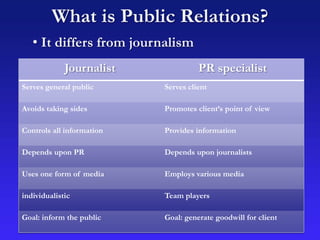
What is Public Relations?
Journalist PR specialist
Serves general public Serves client
Avoids taking sides Promotes client’s point of view
Controls all information Provides information
Depends upon PR Depends upon journalists
Uses one form of media Employs various media
individualistic Team players
Goal: inform the public Goal: generate goodwill for client
• It differs from journalism
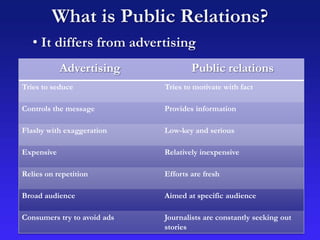
What is Public Relations?
Advertising Public relations
Tries to seduce Tries to motivate with fact
Controls the message Provides information
Flashy with exaggeration Low-key and serious
Expensive Relatively inexpensive
Relies on repetition Efforts are fresh
Broad audience Aimed at specific audience
Consumers try to avoid ads Journalists are constantly seeking out
stories
• It differs from advertising
http://www.youtube.com/watch?v=4HC
3xwlfcFM
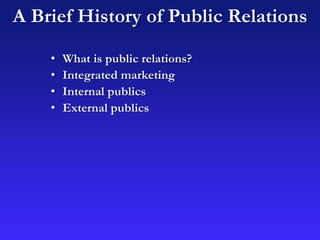
A Brief History of Public Relations
• What is public relations?
• Integrated marketing
• Internal publics
• External publics
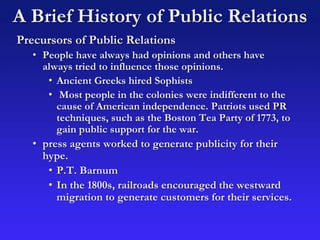
A Brief History of Public Relations
Precursors of Public Relations
• People have always had opinions and others have
always tried to influence those opinions.
• Ancient Greeks hired Sophists
• Most people in the colonies were indifferent to the
cause of American independence. Patriots used PR
techniques, such as the Boston Tea Party of 1773, to
gain public support for the war.
• press agents worked to generate publicity for their
hype.
• P.T. Barnum
• In the 1800s, railroads encouraged the westward
migration to generate customers for their services.
A Brief History of Public Relations
Public Relations As a Profession
• Ivy Ledbetter Lee: the father of the modern public
relations industry.
• Lee believed that the goal of public relations was
not to fool or ignore the public.
• Early presidents used PR:
• Andrew Jackson hired 60 former newspaper reporters to
help push through legislation
• Woodrow Wilson hired PR professionals to encourage
enlistment in the armed forces and the purchase of Liberty
Bonds.
• FDR and the WPA projects
Edward Bernays coined the term “public
relations counsel” in his 1923 book,
Crystallizing Public Opinion.
A Brief History of Public Relations
• The Public Relations Society of America (PRSA) was
founded in 1948 to promote professional standards and
put forth a positive image. PRSA adopted a code of
ethics in 1950.
• By stressing nonviolent forms of protest and enduring
physical and verbal abuse in the 1950s and 1960s, civil
rights organizations such as the National Association for
the Advancement of Colored People (NAACP) won a
public relations war in their fight for Constitutional rights
being denied to minorities by local governments.
• The FBI’s “Ten Most Wanted Fugitives” Program started
off as a reporter’s request to name their most-wanted
fugitives. Subsequent positive publicity after the story
culminated into the “List.”
A Brief History of Public Relations
• Today, countries with expanding economies such as
Korea and some countries of the former Soviet union,
hire public relations firms to improve the perception
that international investors have of them.
• In the wake of the September 11th, 2001 attacks on the
United States, the U.S. government established media
specifically designed to sway anti-U.S. sentiment in the
Arab media:
• “Al Hurra” is a slickly produced Arab-language
cable television network.
• Radio Sawa is an Arab-language radio service.
• Radio Farda is a Farsi-language radio service.
• Hi Magazine is a geared towards Iraqi elites.
A Brief History of Public Relations
• When someone poisoned Tylenol capsules in
1982, the president of Johnson & Johnson and
other company officials sat down for a
teleconference, a news conference in which
newsmakers and reporters are in different
locations but joined by a satellite hookup. This
conference involved 600 reporters in 30 cities and
allowed the company to explain the extraordinary
precautions that Johnson & Johnson was taking to
protect consumers.
• Teleconferences are also known as
videoconferences and satellite media tours.
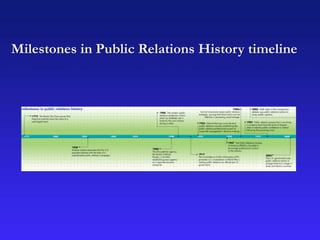
Milestones in Public Relations History timeline
Understanding Today’s Public
Relations Industry
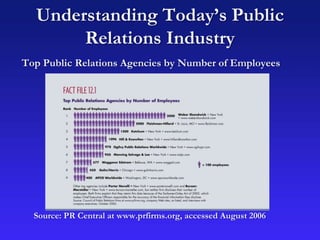
Top Public Relations Agencies by Number of Employees
Source: PR Central at www.prfirms.org, accessed August 2006
Understanding Today’s Public
Relations Industry
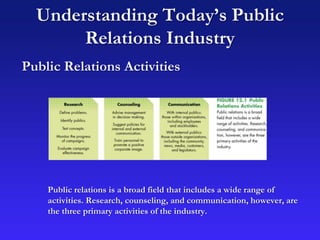
Public Relations Activities
Public relations is a broad field that includes a wide range of
activities. Research, counseling, and communication, however, are
the three primary activities of the industry.
Understanding Today’s Public
Relations Industry
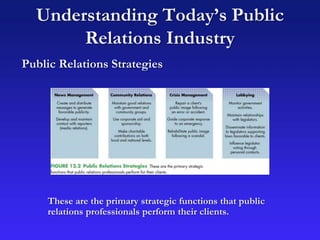
Public Relations Strategies
These are the primary strategic functions that public
relations professionals perform their clients.
Understanding Today’s Public
Relations Industry
PR Activities
• Research that occurs through the public relations process
is used to:
• define problems,
• identify publics,
• test concepts,
• monitor the progress of a campaign,
• evaluate its effectiveness when it is over.
PR practitioners are involved in decision-making and
organizational policy-making of companies and
politicians. This includes coaching clients on how to
behave in an interview, offering grooming advice or
teaching how to avoid answering direct questions.
Understanding Today’s Public
Relations Industry
PR Strategies
• News management techniques include:
• publicity stunts to create human-interest stories,
• creating news hooks to interest media gatekeepers in
the information that clients want to publicize,
• developing media relations, or press relations, that
maintain contact with reporters,
• using leaks and trial balloons to test public reaction to a
major policy,
• granting exclusives to just one news outlet to increase
the impact of publicity.
PR maintains good community relations by giving corporate
aid to schools, charities and nonprofits.
Understanding Today’s Public
Relations Industry
• Crisis management is the action used to repair a client’s
public image following an emergency, such as a major
error, accident, or sabotage.
• Lobbying is any attempt to influence the voting of
legislators. The name comes from the practice of PR
representatives speaking to lawmakers in the lobbies
outside their hearing rooms.
• U.S. companies spend hundreds of millions of
dollars annually in their lobbying efforts.
• Multi-million dollar industry associations are set up
purely for the purpose of influencing how laws are
written.
Understanding Today’s Public
Relations Industry
Some Public Relations Tools
• Press releases, or news releases, are short documents,
written in standard news form, for insertion into news
reports.
• Canned news and editorials are digital files to be
inserted verbatim into feature or editorial sections.
• Audio news releases include interviews and sound
bites ready for insertion into news reports.
• Video news releases (VNRs) are ready-to-broadcast
tapes. For example, a drug company might distribute
a VNR that provides interviews with experts who have
developed and tested a new drug along with satisfied
users.
Understanding Today’s Public
Relations Industry
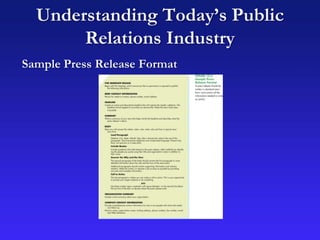
Sample Press Release Format
Understanding Today’s Public
Relations Industry
Some Public Relations Tools
• VNRs have become increasingly
controversial in recent years, and have come
to be called Fake News, when they are used
without attribution.
• A 2006 Center for Media Democracy study
found 36 VNRs that had aired on 77
stations.
Controversies
The Ethics of PR Tactics
• Many PR professionals and journalists have a “love-hate”
relationship. Neither respects the other’s job yet they
need each other. Journalists call PR people “spin doctors
and “flacks,” which derives from the term for WW II anti-
aircraft fire.
• To some, spinning is the practice of twisting the truth so
that what is said puts the best possible face on the facts.
Critics contend that most spinning is a type of lying, or a
half-truth at best.
• “The Big Lie” occurs when people state something they
know to be untrue and stick to it in spite of all evidence in
the hopes that the press and public will become confused
by the issue and forget about it.
Controversies
• Greenwashing is covering up environmental
problems caused by the client by associating that
client with beneficial environmental actions.
• Many critics believe that freebies, including junkets,
meals, and gifts designed to curry favor with
reporters and magazine writers, amount to bribes.
• Much PR operates behind the scenes without
attribution. One survey revealed that almost half of
TV news directors admitted that they did not
identify the source of VNRs on their programs.
• PRSA encourages ethical behavior by issuing
accreditation to experienced members with good
records who pass an extensive written and oral
exam.
Mass Media
Jason Nix
Journalism Instructor and
Program Director
JOURN 110
Spokane Falls Community College

Mm ch 12 pr

  • 1.
    Mass Media ina Changing World Second Edition George Rodman Brooklyn College of CUNY HISTORY INDUSTRY CONTROVERSY
  • 2.
    Mass Media Jason Nix JournalismInstructor and Program Director JOURN 110 Spokane Falls Community College
  • 3.
    Chapter 12 Public Relationsand Politics: The Image Industries Chapter Outline • History • Industry • Controversies
  • 4.
    What is PublicRelations? Journalist PR specialist Serves general public Serves client Avoids taking sides Promotes client’s point of view Controls all information Provides information Depends upon PR Depends upon journalists Uses one form of media Employs various media individualistic Team players Goal: inform the public Goal: generate goodwill for client • It differs from journalism
  • 5.
    What is PublicRelations? Advertising Public relations Tries to seduce Tries to motivate with fact Controls the message Provides information Flashy with exaggeration Low-key and serious Expensive Relatively inexpensive Relies on repetition Efforts are fresh Broad audience Aimed at specific audience Consumers try to avoid ads Journalists are constantly seeking out stories • It differs from advertising
  • 6.
  • 7.
    A Brief Historyof Public Relations • What is public relations? • Integrated marketing • Internal publics • External publics
  • 8.
    A Brief Historyof Public Relations Precursors of Public Relations • People have always had opinions and others have always tried to influence those opinions. • Ancient Greeks hired Sophists • Most people in the colonies were indifferent to the cause of American independence. Patriots used PR techniques, such as the Boston Tea Party of 1773, to gain public support for the war. • press agents worked to generate publicity for their hype. • P.T. Barnum • In the 1800s, railroads encouraged the westward migration to generate customers for their services.
  • 9.
    A Brief Historyof Public Relations Public Relations As a Profession • Ivy Ledbetter Lee: the father of the modern public relations industry. • Lee believed that the goal of public relations was not to fool or ignore the public. • Early presidents used PR: • Andrew Jackson hired 60 former newspaper reporters to help push through legislation • Woodrow Wilson hired PR professionals to encourage enlistment in the armed forces and the purchase of Liberty Bonds. • FDR and the WPA projects Edward Bernays coined the term “public relations counsel” in his 1923 book, Crystallizing Public Opinion.
  • 10.
    A Brief Historyof Public Relations • The Public Relations Society of America (PRSA) was founded in 1948 to promote professional standards and put forth a positive image. PRSA adopted a code of ethics in 1950. • By stressing nonviolent forms of protest and enduring physical and verbal abuse in the 1950s and 1960s, civil rights organizations such as the National Association for the Advancement of Colored People (NAACP) won a public relations war in their fight for Constitutional rights being denied to minorities by local governments. • The FBI’s “Ten Most Wanted Fugitives” Program started off as a reporter’s request to name their most-wanted fugitives. Subsequent positive publicity after the story culminated into the “List.”
  • 11.
    A Brief Historyof Public Relations • Today, countries with expanding economies such as Korea and some countries of the former Soviet union, hire public relations firms to improve the perception that international investors have of them. • In the wake of the September 11th, 2001 attacks on the United States, the U.S. government established media specifically designed to sway anti-U.S. sentiment in the Arab media: • “Al Hurra” is a slickly produced Arab-language cable television network. • Radio Sawa is an Arab-language radio service. • Radio Farda is a Farsi-language radio service. • Hi Magazine is a geared towards Iraqi elites.
  • 12.
    A Brief Historyof Public Relations • When someone poisoned Tylenol capsules in 1982, the president of Johnson & Johnson and other company officials sat down for a teleconference, a news conference in which newsmakers and reporters are in different locations but joined by a satellite hookup. This conference involved 600 reporters in 30 cities and allowed the company to explain the extraordinary precautions that Johnson & Johnson was taking to protect consumers. • Teleconferences are also known as videoconferences and satellite media tours.
  • 13.
    Milestones in PublicRelations History timeline
  • 14.
    Understanding Today’s Public RelationsIndustry Top Public Relations Agencies by Number of Employees Source: PR Central at www.prfirms.org, accessed August 2006
  • 15.
    Understanding Today’s Public RelationsIndustry Public Relations Activities Public relations is a broad field that includes a wide range of activities. Research, counseling, and communication, however, are the three primary activities of the industry.
  • 16.
    Understanding Today’s Public RelationsIndustry Public Relations Strategies These are the primary strategic functions that public relations professionals perform their clients.
  • 17.
    Understanding Today’s Public RelationsIndustry PR Activities • Research that occurs through the public relations process is used to: • define problems, • identify publics, • test concepts, • monitor the progress of a campaign, • evaluate its effectiveness when it is over. PR practitioners are involved in decision-making and organizational policy-making of companies and politicians. This includes coaching clients on how to behave in an interview, offering grooming advice or teaching how to avoid answering direct questions.
  • 18.
    Understanding Today’s Public RelationsIndustry PR Strategies • News management techniques include: • publicity stunts to create human-interest stories, • creating news hooks to interest media gatekeepers in the information that clients want to publicize, • developing media relations, or press relations, that maintain contact with reporters, • using leaks and trial balloons to test public reaction to a major policy, • granting exclusives to just one news outlet to increase the impact of publicity. PR maintains good community relations by giving corporate aid to schools, charities and nonprofits.
  • 19.
    Understanding Today’s Public RelationsIndustry • Crisis management is the action used to repair a client’s public image following an emergency, such as a major error, accident, or sabotage. • Lobbying is any attempt to influence the voting of legislators. The name comes from the practice of PR representatives speaking to lawmakers in the lobbies outside their hearing rooms. • U.S. companies spend hundreds of millions of dollars annually in their lobbying efforts. • Multi-million dollar industry associations are set up purely for the purpose of influencing how laws are written.
  • 20.
    Understanding Today’s Public RelationsIndustry Some Public Relations Tools • Press releases, or news releases, are short documents, written in standard news form, for insertion into news reports. • Canned news and editorials are digital files to be inserted verbatim into feature or editorial sections. • Audio news releases include interviews and sound bites ready for insertion into news reports. • Video news releases (VNRs) are ready-to-broadcast tapes. For example, a drug company might distribute a VNR that provides interviews with experts who have developed and tested a new drug along with satisfied users.
  • 21.
    Understanding Today’s Public RelationsIndustry Sample Press Release Format
  • 22.
    Understanding Today’s Public RelationsIndustry Some Public Relations Tools • VNRs have become increasingly controversial in recent years, and have come to be called Fake News, when they are used without attribution. • A 2006 Center for Media Democracy study found 36 VNRs that had aired on 77 stations.
  • 23.
    Controversies The Ethics ofPR Tactics • Many PR professionals and journalists have a “love-hate” relationship. Neither respects the other’s job yet they need each other. Journalists call PR people “spin doctors and “flacks,” which derives from the term for WW II anti- aircraft fire. • To some, spinning is the practice of twisting the truth so that what is said puts the best possible face on the facts. Critics contend that most spinning is a type of lying, or a half-truth at best. • “The Big Lie” occurs when people state something they know to be untrue and stick to it in spite of all evidence in the hopes that the press and public will become confused by the issue and forget about it.
  • 24.
    Controversies • Greenwashing iscovering up environmental problems caused by the client by associating that client with beneficial environmental actions. • Many critics believe that freebies, including junkets, meals, and gifts designed to curry favor with reporters and magazine writers, amount to bribes. • Much PR operates behind the scenes without attribution. One survey revealed that almost half of TV news directors admitted that they did not identify the source of VNRs on their programs. • PRSA encourages ethical behavior by issuing accreditation to experienced members with good records who pass an extensive written and oral exam.
  • 25.
    Mass Media Jason Nix JournalismInstructor and Program Director JOURN 110 Spokane Falls Community College