Introduction to Public Relation (PR) 
Public relations (PR) is the way organisations , 
companies and individuals communicate with the 
public and media. A PR specialist communicates with 
the target audience directly or indirectly through 
media with an aim to create and maintain a positive 
image and create a strong relationship with the 
audience. Examples include press releases, 
newsletters, public appearances, etc. as well as 
utilisation of the world wide web
History of Public Relations: 
SAMUEL ADAMS: orchestrated public relations for the 
Revolutionary War. He organized the Sons of Liberty, 
developed the symbol of the liberty tree, staged the Boston 
Tea Party, named the Boston Massacre, and developed a 
propaganda campaign that lasted for more than 20 years, 
until the successful conclusion of American independence 
from Britain. 
PHINEAS T. BARNUM: was a 19th Century circus promoter and 
press agent, a showman in every sense of the word. He staged 
bizarre events and generated sensational publicity for his circus. His 
association with public relations lies in his mastery of promotion 
and press agentry, out of which has developed the publicity model 
of public relations. 
HAROLD BURSON: emphasized marketing-oriented public 
relations to build his agency, Burson-Marsteller, which today is one 
of the largest public relations agencies in the world, with offices in 
81 countrie
•GEORGE CREEL : headed the Committee on Public Information 
•(AKA the Creel Committee) during the Wilson administration. The 
committee mobilized public opinion to support the U.S. effect in World 
War One. Creel used public relations techniques to sell Liberty Bonds, 
promote food conservation, and build the Red Cross 
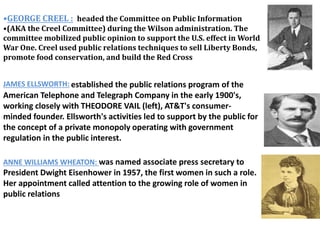
JAMES ELLSWORTH: e stablished the public relations program of the 
American Telephone and Telegraph Company in the early 1900's, 
working closely with THEODORE VAIL (left), AT&T's consumer-minded 
founder. Ellsworth's activities led to support by the public for 
the concept of a private monopoly operating with government 
regulation in the public interest. 
ANNE WILLIAMS WHEATON: was named associate press secretary to 
President Dwight Eisenhower in 1957, the first women in such a role. 
Her appointment called attention to the growing role of women in 
public relations
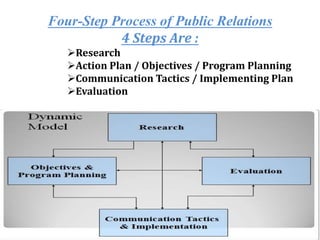
Four-Step Process of Public Relations 
4 Steps Are : 
Research 
Action Plan / Objectives / Program Planning 
Communication Tactics / Implementing Plan 
Evaluation
PR Tools and Techniques 
Creation and maintenance of a good public reputation is a complex and on going 
process. Without an effective PR, it is very difficult to reach the attention of the 
target audience and much less to influence their opinion and decisions. But when 
the relationship with the target group is finally established, it needs to be 
maintained in order to keep it on a high level. The process works similar to the 
interpersonal relationships. When two people lose contact, they pretty much 
disappear from each other lives no matter how close they used to be. And the same 
happens with the target audience if the established relationship is not maintained
Common PR Tools and Techniques 
Attendance at public events: In order to attract public attention and keep it 
engaged with a particular organisation or an individual, PR specialists take an 
advantage of every public event and the opportunity to speak publicly. This enables 
them to directly reach the public attending the event and indirectly, a much larger 
audience. 
Press Releases Information that is communicated as a part of the regular TV 
or/and radio programe, newspapers, magazines and other types of mainstream 
media achieves a much bigger impact than advertisements. This is due to the fact that 
most people consider such information more trustworthy and meaningful than paid 
adds. Press release is therefore one of the oldest and most effective PR tools. 
Newsletters. Sending newsletters – Newsletters are also a common 
marketing strategy but PR specialists use it to share news and general 
information that may be of interest to the target audience rather than merely 
promoting products/services.
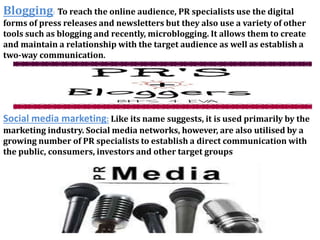
Blogging: To reach the online audience, PR specialists use the digital 
forms of press releases and newsletters but they also use a variety of other 
tools such as blogging and recently, microblogging. It allows them to create 
and maintain a relationship with the target audience as well as establish a 
two-way communication. 
Social media marketing: Like its name suggests, it is used primarily by the 
marketing industry. Social media networks, however, are also utilised by a 
growing number of PR specialists to establish a direct communication with 
the public, consumers, investors and other target groups
ROLE OF PR 
Communication Management 
Issues Management 
Relationship Management 
Reputation or Image Management 
Resource Management 
Risk Management 
Strategic Management 
.
PR in crisis management 
When it comes to crisis management and crisis 
communications, every second counts. Stakeholders 
are demanding new levels of transparency and 
accountability. Every company is or will be in crisis. 
Those that answer the call transform a PR crisis into 
an opportunity. Those that don’t, risk everything.
Crisis Preparedness/Crisis Readiness : 
•Risk assessments 
•Crisis communications strategy development 
•Crisis plans 
•Crisis response manuals 
•Crisis management training and simulations 
•Media training
DIFF. BETWEEN 
PR & MARKETING
INTRODUCTION TO HOUSE JOURNAL 
One of the well established media of public relations is the house 
journal The house journal is one of the oldest forms of public 
relations, with the Americans being pioneers of this medium. As 
early as the 1840s, Charles Dickens referred to a publication for New 
England cotton workers. House journals have been given a variety of 
names, such as newsletters, employee newspapers and company 
newspapers, but, in effect, they carry out the same function .House 
journals are private publications and are therefore discussed 
separately from the commercial press. Over the years they have 
tended to change from pulpits for employers to preach from to 
supporting more open forms of management
TYPES OF HOUSE JOURNAL 
INTERNAL HOUSE 
JOURNAL 
EXTERNAL HOUSE 
JOURNAL 
INTERNAL & EXTERNAL 
HOUSE JOURNAL

Public relation

  • 2.
    Introduction to PublicRelation (PR) Public relations (PR) is the way organisations , companies and individuals communicate with the public and media. A PR specialist communicates with the target audience directly or indirectly through media with an aim to create and maintain a positive image and create a strong relationship with the audience. Examples include press releases, newsletters, public appearances, etc. as well as utilisation of the world wide web
  • 5.
    History of PublicRelations: SAMUEL ADAMS: orchestrated public relations for the Revolutionary War. He organized the Sons of Liberty, developed the symbol of the liberty tree, staged the Boston Tea Party, named the Boston Massacre, and developed a propaganda campaign that lasted for more than 20 years, until the successful conclusion of American independence from Britain. PHINEAS T. BARNUM: was a 19th Century circus promoter and press agent, a showman in every sense of the word. He staged bizarre events and generated sensational publicity for his circus. His association with public relations lies in his mastery of promotion and press agentry, out of which has developed the publicity model of public relations. HAROLD BURSON: emphasized marketing-oriented public relations to build his agency, Burson-Marsteller, which today is one of the largest public relations agencies in the world, with offices in 81 countrie
  • 6.
    •GEORGE CREEL :headed the Committee on Public Information •(AKA the Creel Committee) during the Wilson administration. The committee mobilized public opinion to support the U.S. effect in World War One. Creel used public relations techniques to sell Liberty Bonds, promote food conservation, and build the Red Cross JAMES ELLSWORTH: e stablished the public relations program of the American Telephone and Telegraph Company in the early 1900's, working closely with THEODORE VAIL (left), AT&T's consumer-minded founder. Ellsworth's activities led to support by the public for the concept of a private monopoly operating with government regulation in the public interest. ANNE WILLIAMS WHEATON: was named associate press secretary to President Dwight Eisenhower in 1957, the first women in such a role. Her appointment called attention to the growing role of women in public relations
  • 7.
    Four-Step Process ofPublic Relations 4 Steps Are : Research Action Plan / Objectives / Program Planning Communication Tactics / Implementing Plan Evaluation
  • 12.
    PR Tools andTechniques Creation and maintenance of a good public reputation is a complex and on going process. Without an effective PR, it is very difficult to reach the attention of the target audience and much less to influence their opinion and decisions. But when the relationship with the target group is finally established, it needs to be maintained in order to keep it on a high level. The process works similar to the interpersonal relationships. When two people lose contact, they pretty much disappear from each other lives no matter how close they used to be. And the same happens with the target audience if the established relationship is not maintained
  • 13.
    Common PR Toolsand Techniques Attendance at public events: In order to attract public attention and keep it engaged with a particular organisation or an individual, PR specialists take an advantage of every public event and the opportunity to speak publicly. This enables them to directly reach the public attending the event and indirectly, a much larger audience. Press Releases Information that is communicated as a part of the regular TV or/and radio programe, newspapers, magazines and other types of mainstream media achieves a much bigger impact than advertisements. This is due to the fact that most people consider such information more trustworthy and meaningful than paid adds. Press release is therefore one of the oldest and most effective PR tools. Newsletters. Sending newsletters – Newsletters are also a common marketing strategy but PR specialists use it to share news and general information that may be of interest to the target audience rather than merely promoting products/services.
  • 14.
    Blogging: To reachthe online audience, PR specialists use the digital forms of press releases and newsletters but they also use a variety of other tools such as blogging and recently, microblogging. It allows them to create and maintain a relationship with the target audience as well as establish a two-way communication. Social media marketing: Like its name suggests, it is used primarily by the marketing industry. Social media networks, however, are also utilised by a growing number of PR specialists to establish a direct communication with the public, consumers, investors and other target groups
  • 15.
    ROLE OF PR Communication Management Issues Management Relationship Management Reputation or Image Management Resource Management Risk Management Strategic Management .
  • 16.
    PR in crisismanagement When it comes to crisis management and crisis communications, every second counts. Stakeholders are demanding new levels of transparency and accountability. Every company is or will be in crisis. Those that answer the call transform a PR crisis into an opportunity. Those that don’t, risk everything.
  • 17.
    Crisis Preparedness/Crisis Readiness: •Risk assessments •Crisis communications strategy development •Crisis plans •Crisis response manuals •Crisis management training and simulations •Media training
  • 18.
    DIFF. BETWEEN PR& MARKETING
  • 19.
    INTRODUCTION TO HOUSEJOURNAL One of the well established media of public relations is the house journal The house journal is one of the oldest forms of public relations, with the Americans being pioneers of this medium. As early as the 1840s, Charles Dickens referred to a publication for New England cotton workers. House journals have been given a variety of names, such as newsletters, employee newspapers and company newspapers, but, in effect, they carry out the same function .House journals are private publications and are therefore discussed separately from the commercial press. Over the years they have tended to change from pulpits for employers to preach from to supporting more open forms of management
  • 21.
    TYPES OF HOUSEJOURNAL INTERNAL HOUSE JOURNAL EXTERNAL HOUSE JOURNAL INTERNAL & EXTERNAL HOUSE JOURNAL