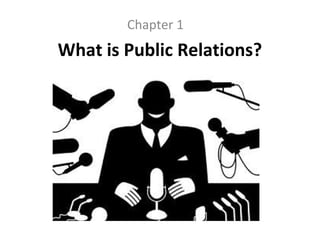
What is Public Relations?
Chapter 1
Many definitions…
• The Random House Unabridged Dictionary
defines public relations as the art, technique,
or profession of promoting goodwill between
an organization or an individual and the public,
employees, customers, etc.
• The American Heritage Dictionary defines it as
"the art or science of establishing and
promoting a favorable relationship with the
public."
Some are just plain wrong:
• Public Relations (or PR) is a field concerned
with maintaining public image for high-profile
people, commercial businesses and
organizations, non-profit associations or
programs.
(It’s not just for politicians, celebrities and
corporations)
My definition
PR is about two things: information and image.
Every organization, big or small, needs to
distribute information: facts about upcoming
events. Details about past accomplishments,
objectives, opinions, philosophies, goals. All that
information ultimately shapes the public’s
perception of that organization – in other words,
it’s image. Information and image – bottom line,
those are the two things PR is about.
Why do you think there are so
many different definitions of
PR? Why can few people agree
on a definition?
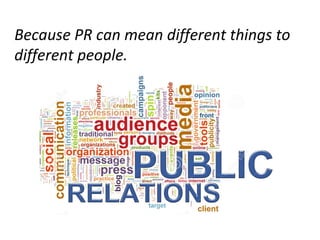
Because PR can mean different things to
different people.
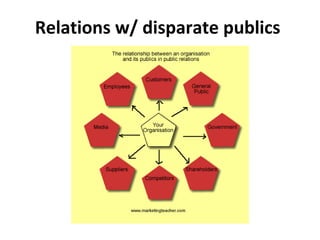
Relations w/ disparate publics
So PR is good?
• The author is very pro PR, of course. He’s very
idealistic about PR as clean/honorable
profession.
• But take what he says with a grain of salt. He
clearly has biases: e.g. see how he
characterizes Ivy Lee & Al Sharpton
• That said, while the textbook is not gospel, it
is spot on 90 percent of time
Or is it bad?
• On other hand, many view PR exactly the
opposite as author. See, e.g.:
– 1. PR = Propaganda (0:45 – 1:42 mark)
http://www.dailymotion.com/video/xyxlxj_the-century-of-the-self-1of4-happiness-machines_shortfilms
– 2. PR = info manipulation
https://www.youtube.com/watch?v=9rPQCPwdwHQ
Why does PR get a bad rep?
•misconceptions: like media, bad apples get
lumped in, anyone can do it, no license required
•misunderstanding of PR’s role, sort of like law,
representing clients, helping them get their side
of story out
Why the bed rep?
• clients/bosses lie or ignore PR ppl or take
others advice like lawyers or advertisers, etc –
but PR ppl get blamed
• sour grapes – not every can afford it
• It’s not just PR. many professions aren’t
respected, unless you’ve walked in someone’s
shoes, don’t judge
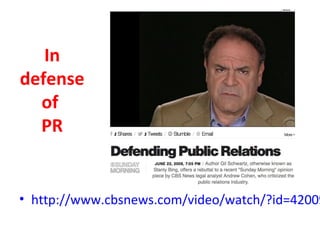
In
defense
of
PR
• http://www.cbsnews.com/video/watch/?id=42009
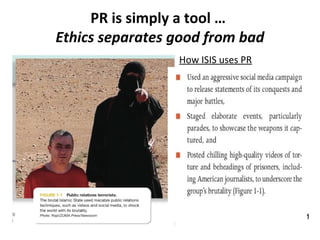
PR is simply a tool …
Ethics separates good from bad
How ISIS uses PR
To conclude
• There is no one generally accepted definition,
but rather many approaches to defining public
relations
• Because of this, PR is often misunderstood
• The power and value of public relations have
never been greater.
• Public relations, stated simply, come down to
doing the right thing.
• Tell the truth, don’t spin.
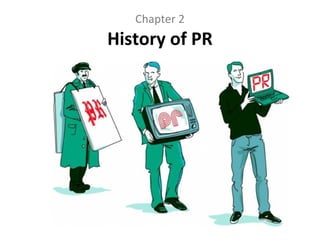
Chapter 2
History of PR
Ancient beginnings
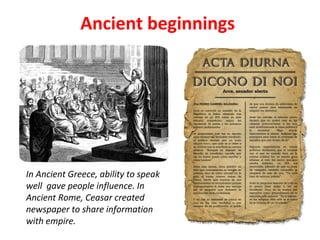
In Ancient Greece, ability to speak
well gave people influence. In
Ancient Rome, Ceasar created
newspaper to share information
with empire.
Ancient Beginnings
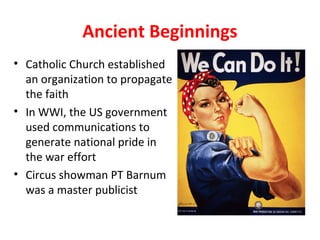
• Catholic Church established
an organization to propagate
the faith
• In WWI, the US government
used communications to
generate national pride in
the war effort
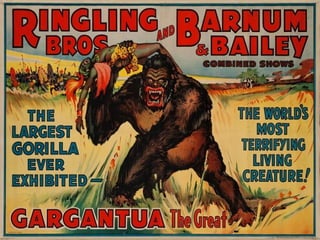
• Circus showman PT Barnum
was a master publicist
https://youtu.be/iOwUkkE2A4c
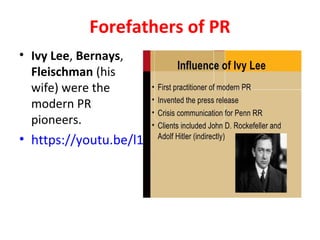
Forefathers of PR
• Ivy Lee, Bernays,
Fleischman (his
wife) were the
modern PR
pioneers.
• https://youtu.be/l1KKlzgU-eM
Modern growth
Spurred by 5 major factors:
– growth of big institutions and their sense of
responsibility to public
– increasing incidence of change, conflict,
confrontation
– heightened awareness of communications
– Increased importance of public opinion &
democracy
– the Internet
1. Big institutions change tone
• “Robber barons” like Vanderbilt had a PR
approach of “The public be damned.”
• But investigative journalists, known as
muckrakers, exposed their bad practices and the
government began to crackdown. Labor unions
formed. The public demanded accountability and
change.
2. Public opinion starts to matter
 Business leaders began to care about public
opinion. They especially needed PR after The
Great Depression
 as Henry Ford said, business can’t just be a
bonanza – i.e. not just about profit (that’s why
the US government is considering regulating
Internet Service Providers more strictly)
3. Corporate social responsibility
• Big issue today. It’s “A self-regulatory mechanism
whereby a business monitors and ensures its
active compliance with the spirit of the law,
ethical standards and international norms.”
• “Corporations that disregard [corporate social
responsibility] risk more than their reputation—
nine-in-10 global citizens say they would boycott if
they learned of irresponsible behavior,” a 2013
study by Cone Communications found.
4. Change & Conflict
• Wars, racial and gender inequality, the
environment, changing demographics, etc. all
created a need for better communication and
understanding.
5. Internet Age
The industry has completely changed due to the
Internet…
•Old days: legacy media with captive audience
•Internet Age: Disruption in the media. So many
choices. Anyone can start a blog. The U.S. president
forgoes press conferences for Twitter.
•Result: Audiences have so many options. Reaching
them and holding their attention can be difficult.
The Internet has also brought new challenges for
companies:
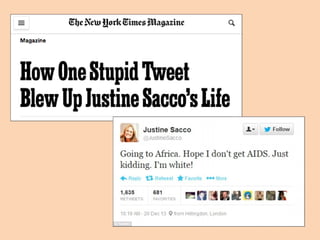
•A controversial post on social media can lead
to a media firestorm.
•Unhappy consumers can post bad reviews on
Yelp and other sites.
•Bad news and misinformation can spread at
the speed of a tweet.
Who needs PR?
Everyone needs PR!
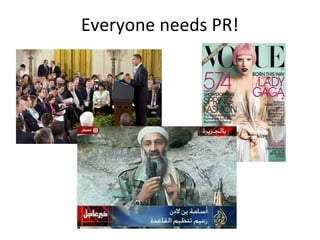
The reality is that almost any organization that has a
stake in how it is portrayed in the public arena
engaged in PR and employs at least one PR manager.
Large organizations may even have dedicated
communications departments. Government agencies,
trade associations, and other non-profit organizations
commonly carry out PR activities.
Also: the little guy
• Not only high profile people and organizations
need PR. PR can also be local and for small
organizations and unknown people. That’s
kind of the point: let the public know who you
are!
• Bill Gates that if he had only a single dollar left
to spend, he’d spend it on PR – ringing
endorsement of PR
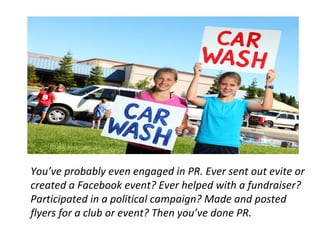
You’ve probably even engaged in PR. Ever sent out evite or
created a Facebook event? Ever helped with a fundraiser?
Participated in a political campaign? Made and posted
flyers for a club or event? Then you’ve done PR.
• Former Jets’ owner and oil tycoon
Leon Hess was famous for this.
• But, today, such views are foolish.
• The NFL, of all organizations,
knows this all too well in light of
recent events.
“I don’t want PR!”
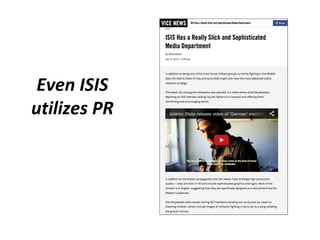
Even ISIS
utilizes PR
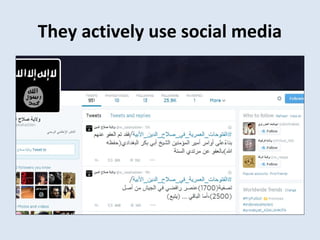
They actively use social media
They have
their own
magazine!
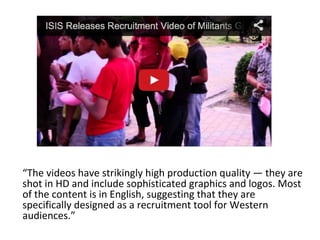
“The videos have strikingly high production quality — they are
shot in HD and include sophisticated graphics and logos. Most
of the content is in English, suggesting that they are
specifically designed as a recruitment tool for Western
audiences.”
Time magazine observes:
“Unfortunately, the media, political analysts and
public officials – really all of us – are unwilling
participants in ISIS’s public relations branding
campaign. Every time we refer to ISIS as the
“Islamic State,” call its members “jihadists” or in
any way grant it the religious legitimacy that it so
desperately seeks, we simultaneously boost its
brand, tarnish the image of Islam and further
marginalize the vast majority of Muslims who are
disgusted by the group’s un-Islamic actions.”
Consequently, many types of PR practitioners and
specialties:
•Big PR agencies
http://fleishmanhillard.com/
• Specialized PR
http://www.chamberlainpr.com/
• Crisis communications
http://levick.com/
• Small general firm
http://www.comsolutions.com/
•In house PR
http://about.adelphi.edu/leadership/administratio
n/public-affairs/
PR Tools
Some standard tools used are; press releases,
press kits, satellite feeds, pod casts, web casts,
wire service distribution of information and
internet placement. Others include
entertainment product placement (television,
events, celebrity), product launches, press
conferences, media seminars, producing events,
speechwriting, establishing partnerships and
more is often required.
Naturally, PR is growing
• Good news: more jobs
• Bad news: more students studying it, so more
competition. Even the best students struggle to
find work.
• It’s hard work. It requires versatile and multi-
talented individuals.
• You need to be the best communicator: writing,
strategic thinking, research, planning,
technology, marketing, counseling, etc.
• Your career success starts now. Do well on
assignments, build a portfolio and parlay that
into a good internship.
To conclude
While public relations antecedents stretch back
over time – as long as individuals tried to
persuade others to adopt their cause – modern
public relations practice is not yet even 100-
years-old. Its history is still being written. Its
leaders, therefore, are those teaching – and
learning – in the practice as we speak. So the
responsibility to help build this field lies with
each of its practitioners and students.
Chapter 3
Communication
More important than ever
Because of the Internet, now that we live in a
time where the power has shifted from those
who report the news to those who make it –
who needs the filter of the media when you can
just broadcast to the world what you’re making,
doing, selling, etc., via the internet, social
media, yadayadayada – PR people are needed to
help our clients raise their voice above this
incredible DIN.
You’re shouting through cupped hands, the
PR guy gives you a megaphone. You got a
megaphone, PR guy gives you a microphone.
You got a microphone, PR guy finds a
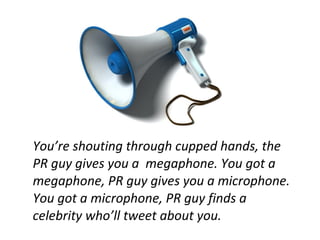
celebrity who’ll tweet about you.
You must be the best communicator
• Just as accountant must know math and
numbers, lawyer must know law. You must
know comm. And that doesn’t just mean
knowing how to create a Facebook page. It
means knowing the fundamentals of comm.
Writing is basis – must know grammar. Must
be effective public speaker. Etc.
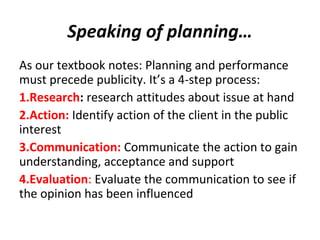
Speaking of planning…
As our textbook notes: Planning and performance
must precede publicity. It’s a 4-step process:
1.Research: research attitudes about issue at hand
2.Action: Identify action of the client in the public
interest
3.Communication: Communicate the action to gain
understanding, acceptance and support
4.Evaluation: Evaluate the communication to see if
the opinion has been influenced
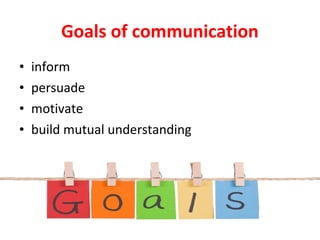
Goals of communication
• inform
• persuade
• motivate
• build mutual understanding
Theories of communication
Many theories exist about the most effective
way for a source to send a message through a
medium to elicit a positive response. See pages
51-53. Probably some truth to all of them. Might
be a test question on them.
Must choose words carefully to
communicate effectively
• always keep audience in mind
• if you convey message but receiver doesn’t
pay attention, understand or care, your effort
was in vain
• the way you communicate with your peers is
different than way you comm. with parents vs
professors vs strangers, etc. Word choice,
tone, assumptions, etc matter
• Words proceed message formation
Delivering the message
• not just what you say
• also who says it –
politicians win on
charisma and not issues
– Both Bush and Obama did
this
• and where they say it
Receiver’s
bias
• stereotypes
• symbols
• semantics
• peer influence
• media: “people base perceptions on what
they read or hear, often without bothering to
dig further to elicit the facts.”
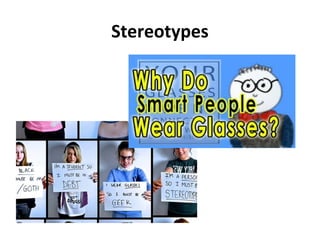
Stereotypes
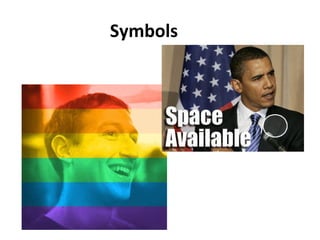
Symbols
Semantics
• US Military & “chink in armor”
https://www.youtube.com/watch?
v=29RBOQJo054
• “Year of Monkey” NBA controversy
http://bit.ly/1SZXrtx
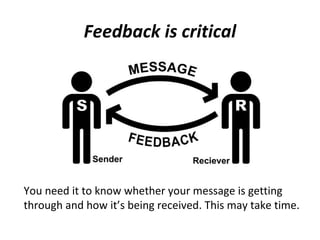
Feedback is critical
You need it to know whether your message is getting
through and how it’s being received. This may take time.
To conclude
PR people must be the most skilled
communicator – the best writer, best speaker,
and the most knowledgeable about the media
and communications theory. In other words,
communications is their trade. It’s what public
relations people do. Students should know it
and be good at it.
PR - chapters 1,2,3

PR - chapters 1,2,3

  • 1.
    What is PublicRelations? Chapter 1
  • 2.
    Many definitions… • TheRandom House Unabridged Dictionary defines public relations as the art, technique, or profession of promoting goodwill between an organization or an individual and the public, employees, customers, etc. • The American Heritage Dictionary defines it as "the art or science of establishing and promoting a favorable relationship with the public."
  • 3.
    Some are justplain wrong: • Public Relations (or PR) is a field concerned with maintaining public image for high-profile people, commercial businesses and organizations, non-profit associations or programs. (It’s not just for politicians, celebrities and corporations)
  • 4.
    My definition PR isabout two things: information and image. Every organization, big or small, needs to distribute information: facts about upcoming events. Details about past accomplishments, objectives, opinions, philosophies, goals. All that information ultimately shapes the public’s perception of that organization – in other words, it’s image. Information and image – bottom line, those are the two things PR is about.
  • 5.
    Why do youthink there are so many different definitions of PR? Why can few people agree on a definition?
  • 6.
    Because PR canmean different things to different people.
  • 7.
  • 8.
    So PR isgood? • The author is very pro PR, of course. He’s very idealistic about PR as clean/honorable profession. • But take what he says with a grain of salt. He clearly has biases: e.g. see how he characterizes Ivy Lee & Al Sharpton • That said, while the textbook is not gospel, it is spot on 90 percent of time
  • 9.
    Or is itbad? • On other hand, many view PR exactly the opposite as author. See, e.g.: – 1. PR = Propaganda (0:45 – 1:42 mark) http://www.dailymotion.com/video/xyxlxj_the-century-of-the-self-1of4-happiness-machines_shortfilms – 2. PR = info manipulation https://www.youtube.com/watch?v=9rPQCPwdwHQ
  • 10.
    Why does PRget a bad rep? •misconceptions: like media, bad apples get lumped in, anyone can do it, no license required •misunderstanding of PR’s role, sort of like law, representing clients, helping them get their side of story out
  • 11.
    Why the bedrep? • clients/bosses lie or ignore PR ppl or take others advice like lawyers or advertisers, etc – but PR ppl get blamed • sour grapes – not every can afford it • It’s not just PR. many professions aren’t respected, unless you’ve walked in someone’s shoes, don’t judge
  • 12.
  • 13.
    PR is simplya tool … Ethics separates good from bad How ISIS uses PR
  • 14.
    To conclude • Thereis no one generally accepted definition, but rather many approaches to defining public relations • Because of this, PR is often misunderstood • The power and value of public relations have never been greater. • Public relations, stated simply, come down to doing the right thing. • Tell the truth, don’t spin.
  • 15.
  • 16.
    Ancient beginnings In AncientGreece, ability to speak well gave people influence. In Ancient Rome, Ceasar created newspaper to share information with empire.
  • 17.
    Ancient Beginnings • CatholicChurch established an organization to propagate the faith • In WWI, the US government used communications to generate national pride in the war effort • Circus showman PT Barnum was a master publicist
  • 19.
  • 20.
    Forefathers of PR •Ivy Lee, Bernays, Fleischman (his wife) were the modern PR pioneers. • https://youtu.be/l1KKlzgU-eM
  • 21.
    Modern growth Spurred by5 major factors: – growth of big institutions and their sense of responsibility to public – increasing incidence of change, conflict, confrontation – heightened awareness of communications – Increased importance of public opinion & democracy – the Internet
  • 22.
    1. Big institutionschange tone • “Robber barons” like Vanderbilt had a PR approach of “The public be damned.” • But investigative journalists, known as muckrakers, exposed their bad practices and the government began to crackdown. Labor unions formed. The public demanded accountability and change.
  • 23.
    2. Public opinionstarts to matter  Business leaders began to care about public opinion. They especially needed PR after The Great Depression  as Henry Ford said, business can’t just be a bonanza – i.e. not just about profit (that’s why the US government is considering regulating Internet Service Providers more strictly)
  • 24.
    3. Corporate socialresponsibility • Big issue today. It’s “A self-regulatory mechanism whereby a business monitors and ensures its active compliance with the spirit of the law, ethical standards and international norms.” • “Corporations that disregard [corporate social responsibility] risk more than their reputation— nine-in-10 global citizens say they would boycott if they learned of irresponsible behavior,” a 2013 study by Cone Communications found.
  • 25.
    4. Change &Conflict • Wars, racial and gender inequality, the environment, changing demographics, etc. all created a need for better communication and understanding.
  • 26.
    5. Internet Age Theindustry has completely changed due to the Internet… •Old days: legacy media with captive audience •Internet Age: Disruption in the media. So many choices. Anyone can start a blog. The U.S. president forgoes press conferences for Twitter. •Result: Audiences have so many options. Reaching them and holding their attention can be difficult.
  • 27.
    The Internet hasalso brought new challenges for companies: •A controversial post on social media can lead to a media firestorm. •Unhappy consumers can post bad reviews on Yelp and other sites. •Bad news and misinformation can spread at the speed of a tweet.
  • 32.
  • 33.
  • 34.
    The reality isthat almost any organization that has a stake in how it is portrayed in the public arena engaged in PR and employs at least one PR manager. Large organizations may even have dedicated communications departments. Government agencies, trade associations, and other non-profit organizations commonly carry out PR activities.
  • 35.
    Also: the littleguy • Not only high profile people and organizations need PR. PR can also be local and for small organizations and unknown people. That’s kind of the point: let the public know who you are! • Bill Gates that if he had only a single dollar left to spend, he’d spend it on PR – ringing endorsement of PR
  • 36.
    You’ve probably evenengaged in PR. Ever sent out evite or created a Facebook event? Ever helped with a fundraiser? Participated in a political campaign? Made and posted flyers for a club or event? Then you’ve done PR.
  • 37.
    • Former Jets’owner and oil tycoon Leon Hess was famous for this. • But, today, such views are foolish. • The NFL, of all organizations, knows this all too well in light of recent events. “I don’t want PR!”
  • 38.
  • 39.
    They actively usesocial media
  • 40.
  • 41.
    “The videos havestrikingly high production quality — they are shot in HD and include sophisticated graphics and logos. Most of the content is in English, suggesting that they are specifically designed as a recruitment tool for Western audiences.”
  • 42.
    Time magazine observes: “Unfortunately,the media, political analysts and public officials – really all of us – are unwilling participants in ISIS’s public relations branding campaign. Every time we refer to ISIS as the “Islamic State,” call its members “jihadists” or in any way grant it the religious legitimacy that it so desperately seeks, we simultaneously boost its brand, tarnish the image of Islam and further marginalize the vast majority of Muslims who are disgusted by the group’s un-Islamic actions.”
  • 43.
    Consequently, many typesof PR practitioners and specialties: •Big PR agencies http://fleishmanhillard.com/ • Specialized PR http://www.chamberlainpr.com/ • Crisis communications http://levick.com/ • Small general firm http://www.comsolutions.com/ •In house PR http://about.adelphi.edu/leadership/administratio n/public-affairs/
  • 44.
    PR Tools Some standardtools used are; press releases, press kits, satellite feeds, pod casts, web casts, wire service distribution of information and internet placement. Others include entertainment product placement (television, events, celebrity), product launches, press conferences, media seminars, producing events, speechwriting, establishing partnerships and more is often required.
  • 45.
    Naturally, PR isgrowing • Good news: more jobs • Bad news: more students studying it, so more competition. Even the best students struggle to find work. • It’s hard work. It requires versatile and multi- talented individuals. • You need to be the best communicator: writing, strategic thinking, research, planning, technology, marketing, counseling, etc. • Your career success starts now. Do well on assignments, build a portfolio and parlay that into a good internship.
  • 46.
    To conclude While publicrelations antecedents stretch back over time – as long as individuals tried to persuade others to adopt their cause – modern public relations practice is not yet even 100- years-old. Its history is still being written. Its leaders, therefore, are those teaching – and learning – in the practice as we speak. So the responsibility to help build this field lies with each of its practitioners and students.
  • 47.
  • 48.
    More important thanever Because of the Internet, now that we live in a time where the power has shifted from those who report the news to those who make it – who needs the filter of the media when you can just broadcast to the world what you’re making, doing, selling, etc., via the internet, social media, yadayadayada – PR people are needed to help our clients raise their voice above this incredible DIN.
  • 49.
    You’re shouting throughcupped hands, the PR guy gives you a megaphone. You got a megaphone, PR guy gives you a microphone. You got a microphone, PR guy finds a celebrity who’ll tweet about you.
  • 50.
    You must bethe best communicator • Just as accountant must know math and numbers, lawyer must know law. You must know comm. And that doesn’t just mean knowing how to create a Facebook page. It means knowing the fundamentals of comm. Writing is basis – must know grammar. Must be effective public speaker. Etc.
  • 51.
    Speaking of planning… Asour textbook notes: Planning and performance must precede publicity. It’s a 4-step process: 1.Research: research attitudes about issue at hand 2.Action: Identify action of the client in the public interest 3.Communication: Communicate the action to gain understanding, acceptance and support 4.Evaluation: Evaluate the communication to see if the opinion has been influenced
  • 52.
    Goals of communication •inform • persuade • motivate • build mutual understanding
  • 53.
    Theories of communication Manytheories exist about the most effective way for a source to send a message through a medium to elicit a positive response. See pages 51-53. Probably some truth to all of them. Might be a test question on them.
  • 54.
    Must choose wordscarefully to communicate effectively • always keep audience in mind • if you convey message but receiver doesn’t pay attention, understand or care, your effort was in vain • the way you communicate with your peers is different than way you comm. with parents vs professors vs strangers, etc. Word choice, tone, assumptions, etc matter • Words proceed message formation
  • 55.
    Delivering the message •not just what you say • also who says it – politicians win on charisma and not issues – Both Bush and Obama did this • and where they say it
  • 56.
    Receiver’s bias • stereotypes • symbols •semantics • peer influence • media: “people base perceptions on what they read or hear, often without bothering to dig further to elicit the facts.”
  • 57.
  • 58.
  • 59.
    Semantics • US Military& “chink in armor” https://www.youtube.com/watch? v=29RBOQJo054 • “Year of Monkey” NBA controversy http://bit.ly/1SZXrtx
  • 60.
    Feedback is critical Youneed it to know whether your message is getting through and how it’s being received. This may take time.
  • 61.
    To conclude PR peoplemust be the most skilled communicator – the best writer, best speaker, and the most knowledgeable about the media and communications theory. In other words, communications is their trade. It’s what public relations people do. Students should know it and be good at it.