Chapter 7
Recordings And The Music Industry:
Copyright Battles, Format Wars
Chapter Outline
• History
• Industry
• Controversies
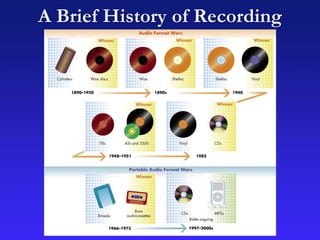
A Brief History of Recording
Music In An Oral Culture
• “classical” music in the 14th Century
Demand for printed music
• Johann Sebastian Bach (1685-1750) wrote a little
music on the side
• Works from Haydn and Mozart become popular
entertainment in parlors around Europe
A Brief History of Recording
Industrial Revolution and high-speed
printers
• Sheet music to play at home becomes big business
• Music is copyrighted in 1831
A Brief History of Recording
Early Recording Technology
• 1877: Thomas Edison makes first recording, calls
invention Phonograph.
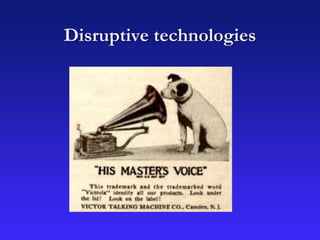
• 1906: Victor Company’s Victrola discs were easier
to produce and less expensive than cylinders.
• Ragtime hits like Scott Joplin’s “ ”
and Tin Pan Alley favorites like “Alexander’s
Ragtime Band” sold well.
• 1914: Music publishers join together and form
ASCAP to fight for strong copyright laws.
A Brief History of Recording
Enter Radio
• 1920s birth of commercial radio
• Radio spurred sales in the beginning.
• Music becomes trendy: Jazz recordings, then big
bands, then country music. Dance crazes sell records.
• 1930s: Live radio and Great Depression cause dip in
record sales
• Japanese invasion of Southeast Asia cuts off supply of
shellac, industry turns to vinyl
• Vinyl makes the LP (and albums) possible
A Brief History of Recording
Stereo and High Fidelity
• 1930s: speaker systems developed with separate
woofers and tweeters
• Multi-track recording becomes possible
• Stereophonic sound
• 1950s: high fidelity (hi-fi) enthusiasts (audiophiles)
compared amps, speaker power, and tuning
capacity just as today’s computer hobbyists
discuss RAM, processor chips, and hard drive size.
A Brief History of Recording
Teenagers reshape the face of pop music
• “All I Want for Christmas is my Two Front Teeth”
(1947)
• “ ?” Patti Page
(early 1950s)
• “ ” Bill Haley (1953)
• In 1954, Haley signed with Decca and released
“ ” and “Rock Around The
Clock.”
Jazz/blues subculture
• Jazz
• Miles Davis
• John Coltrane
• Charles Mingus
• Blues
• Howlin’ Wolf
• Robert Johnson
• Bo Diddley
• John Lee Hooker
Jack Kerouac: On the Road (1957)
Allen Ginsberg
A Brief History of Recording
British Invasion
• Beatles
• Rolling Stones
• Cream
• Yardbirds/ New Yardbirds/ Led Zeppelin
• Pink Floyd
A Brief History of Recording
Rap and Hip-Hop
• Started as street poetry in the early 1970s
• The Sugar Hill Gang
• Erick B and Rakim
• Dana Dane
• RUN-DMC
• Public Enemy
• De La Soul
• N.W.A.
A Brief History of Recording
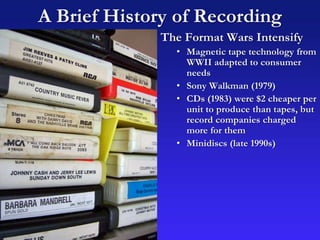
The Format Wars Intensify
• Magnetic tape technology from
WWII adapted to consumer
needs
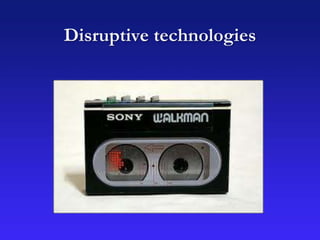
• Sony Walkman (1979)
• CDs (1983) were $2 cheaper per
unit to produce than tapes, but
record companies charged
more for them
• Minidiscs (late 1990s)
A Brief History of Recording
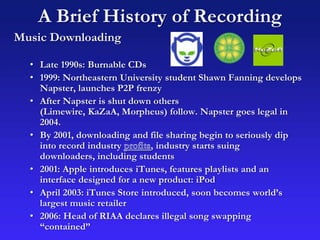
Music Downloading
• Late 1990s: Burnable CDs
• 1999: Northeastern University student Shawn Fanning develops
Napster, launches P2P frenzy
• After Napster is shut down others
(Limewire, KaZaA, Morpheus) follow. Napster goes legal in
2004.
• By 2001, downloading and file sharing begin to seriously dip
into record industry , industry starts suing
downloaders, including students
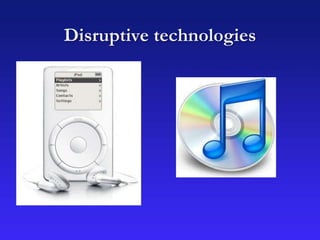
• 2001: Apple introduces iTunes, features playlists and an
interface designed for a new product: iPod
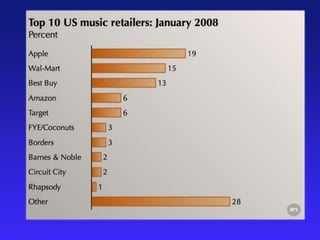
• April 2003: iTunes Store introduced, soon becomes world’s
largest music retailer
• 2006: Head of RIAA declares illegal song swapping
“contained”
A Brief History of Recording
What are the lessons from this?
• For the recording industry?
• About consumer habits?
• For musicians?
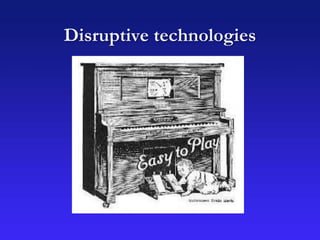
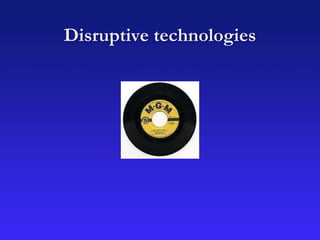
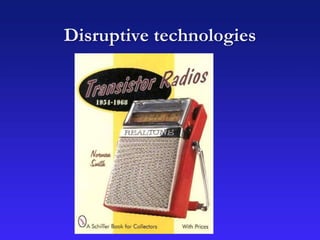
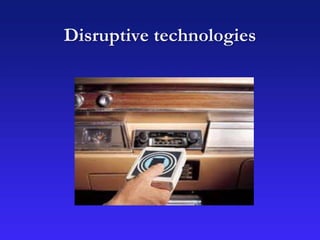
Disruptive technologies
Understanding Today’s Recording
Industry
The Major Labels: Global Goliaths
• Five corporations:
Warner, EMI, Sony, Universal, and
Bertelsmann, collect 80 percent of revenues
• 1980s: major labels get out of the business of
developing new talent, huge sales expected out of
the gate
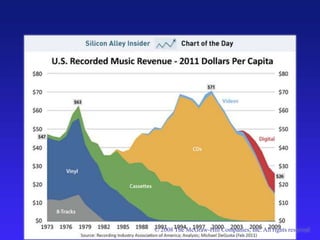
• The Long Tail
© 2008 The McGraw-Hill Companies, Inc. All rights reserved
Understanding Today’s Recording
Industry
Independents: Developing Talent
• Majors acquire successful independents to develop new
ideas and scout new talent
• Many independents specialize: jazz, classical, religious, or
rap.
• Hundreds of independents share the 20 percent of the
market not controlled by the five major labels.
• According to Anderson’s “Long Tail” theory of
marketing, there’s room here for new labels to make a
profit.
Understanding Today’s Recording
Industry
The Players
• A&R (artist and repertoire)
• demos
• Producers
• Arrangers
• Lyricists
• Artists
• Retailers
Understanding Today’s Recording
Industry
Royalties and Performance Rights Organizations
• There are two types of royalties:
1. Recording-artist royalties
2. Songwriter/publisher royalties
• Recording artists earn royalties from the sale of
their recordings on CDs, tapes, vinyl, and legal
downloads.
• No royalties for radio or TV. Internet radio yet to be
settled.
• Songwriters and publishers, however, do earn
royalties on radio play and other public
performances, as well as on recording sales.
Understanding Today’s Recording
Industry
Promotion
• reporting stations
• 1991: Soundscan
• Promoters arrange press coverage, lobby for
awards, feed tidbits to gossip-hungry Web sites, try
to place music videos on MTV, BET, CMT and
VH1, and try to get songs on movie and television
soundtracks, and in television commercials.
Understanding Today’s Recording
Industry
Chris Andersen
Understanding Today’s Recording
Industry
Understanding Today’s Recording
Industry
Distribution and Sales
• Brick-and-mortar
• Online distribution
The Audience
• Customers are fickle, and less loyal to individual
acts
• LP has less influence
• Acts get younger and more transient
Controversies
The Effects
• Powerful-effects model
• Minimal-effects model
• Mixed-effects model
• Cultivation theory
• Cumulative-effects theory
• Agenda-setting theory
• Uses and gratifications theory
• Catharsis theory
Controversies
Censorship
• 1990: industry adopts parental warning labels after
being pressured by the PMRC
• Wal-Mart, the world’s largest brick-and-mortar
retailer of music, has influence over content and will
refuse to sell what it deems inappropriate
• 2003: Clear Channel Communications, the largest
owner of radio stations in the U.S., stops playing the
music of the Dixie Chicks after a member of the
group criticized President George Bush.
Chapter 7
Recordings And The Music Industry:
Copyright Battles, Format Wars
Chapter Outline
• History
• Industry
• Controversies

Mm ch 07music

  • 1.
    Chapter 7 Recordings AndThe Music Industry: Copyright Battles, Format Wars Chapter Outline • History • Industry • Controversies
  • 3.
    A Brief Historyof Recording Music In An Oral Culture • “classical” music in the 14th Century Demand for printed music • Johann Sebastian Bach (1685-1750) wrote a little music on the side • Works from Haydn and Mozart become popular entertainment in parlors around Europe
  • 4.
    A Brief Historyof Recording Industrial Revolution and high-speed printers • Sheet music to play at home becomes big business • Music is copyrighted in 1831
  • 5.
    A Brief Historyof Recording Early Recording Technology • 1877: Thomas Edison makes first recording, calls invention Phonograph. • 1906: Victor Company’s Victrola discs were easier to produce and less expensive than cylinders. • Ragtime hits like Scott Joplin’s “ ” and Tin Pan Alley favorites like “Alexander’s Ragtime Band” sold well. • 1914: Music publishers join together and form ASCAP to fight for strong copyright laws.
  • 6.
    A Brief Historyof Recording Enter Radio • 1920s birth of commercial radio • Radio spurred sales in the beginning. • Music becomes trendy: Jazz recordings, then big bands, then country music. Dance crazes sell records. • 1930s: Live radio and Great Depression cause dip in record sales • Japanese invasion of Southeast Asia cuts off supply of shellac, industry turns to vinyl • Vinyl makes the LP (and albums) possible
  • 7.
    A Brief Historyof Recording Stereo and High Fidelity • 1930s: speaker systems developed with separate woofers and tweeters • Multi-track recording becomes possible • Stereophonic sound • 1950s: high fidelity (hi-fi) enthusiasts (audiophiles) compared amps, speaker power, and tuning capacity just as today’s computer hobbyists discuss RAM, processor chips, and hard drive size.
  • 8.
    A Brief Historyof Recording Teenagers reshape the face of pop music • “All I Want for Christmas is my Two Front Teeth” (1947) • “ ?” Patti Page (early 1950s) • “ ” Bill Haley (1953) • In 1954, Haley signed with Decca and released “ ” and “Rock Around The Clock.”
  • 9.
    Jazz/blues subculture • Jazz •Miles Davis • John Coltrane • Charles Mingus • Blues • Howlin’ Wolf • Robert Johnson • Bo Diddley • John Lee Hooker Jack Kerouac: On the Road (1957) Allen Ginsberg
  • 10.
    A Brief Historyof Recording British Invasion • Beatles • Rolling Stones • Cream • Yardbirds/ New Yardbirds/ Led Zeppelin • Pink Floyd
  • 11.
    A Brief Historyof Recording Rap and Hip-Hop • Started as street poetry in the early 1970s • The Sugar Hill Gang • Erick B and Rakim • Dana Dane • RUN-DMC • Public Enemy • De La Soul • N.W.A.
  • 12.
    A Brief Historyof Recording
  • 13.
    A Brief Historyof Recording
  • 14.
    A Brief Historyof Recording The Format Wars Intensify • Magnetic tape technology from WWII adapted to consumer needs • Sony Walkman (1979) • CDs (1983) were $2 cheaper per unit to produce than tapes, but record companies charged more for them • Minidiscs (late 1990s)
  • 15.
    A Brief Historyof Recording Music Downloading • Late 1990s: Burnable CDs • 1999: Northeastern University student Shawn Fanning develops Napster, launches P2P frenzy • After Napster is shut down others (Limewire, KaZaA, Morpheus) follow. Napster goes legal in 2004. • By 2001, downloading and file sharing begin to seriously dip into record industry , industry starts suing downloaders, including students • 2001: Apple introduces iTunes, features playlists and an interface designed for a new product: iPod • April 2003: iTunes Store introduced, soon becomes world’s largest music retailer • 2006: Head of RIAA declares illegal song swapping “contained”
  • 16.
    A Brief Historyof Recording What are the lessons from this? • For the recording industry? • About consumer habits? • For musicians?
  • 17.
  • 18.
  • 19.
  • 20.
  • 21.
  • 22.
  • 23.
  • 24.
  • 25.
    Understanding Today’s Recording Industry TheMajor Labels: Global Goliaths • Five corporations: Warner, EMI, Sony, Universal, and Bertelsmann, collect 80 percent of revenues • 1980s: major labels get out of the business of developing new talent, huge sales expected out of the gate • The Long Tail
  • 26.
    © 2008 TheMcGraw-Hill Companies, Inc. All rights reserved
  • 27.
    Understanding Today’s Recording Industry Independents:Developing Talent • Majors acquire successful independents to develop new ideas and scout new talent • Many independents specialize: jazz, classical, religious, or rap. • Hundreds of independents share the 20 percent of the market not controlled by the five major labels. • According to Anderson’s “Long Tail” theory of marketing, there’s room here for new labels to make a profit.
  • 28.
    Understanding Today’s Recording Industry ThePlayers • A&R (artist and repertoire) • demos • Producers • Arrangers • Lyricists • Artists • Retailers
  • 29.
    Understanding Today’s Recording Industry Royaltiesand Performance Rights Organizations • There are two types of royalties: 1. Recording-artist royalties 2. Songwriter/publisher royalties • Recording artists earn royalties from the sale of their recordings on CDs, tapes, vinyl, and legal downloads. • No royalties for radio or TV. Internet radio yet to be settled. • Songwriters and publishers, however, do earn royalties on radio play and other public performances, as well as on recording sales.
  • 30.
    Understanding Today’s Recording Industry Promotion •reporting stations • 1991: Soundscan • Promoters arrange press coverage, lobby for awards, feed tidbits to gossip-hungry Web sites, try to place music videos on MTV, BET, CMT and VH1, and try to get songs on movie and television soundtracks, and in television commercials.
  • 31.
  • 32.
  • 33.
    Understanding Today’s Recording Industry Distributionand Sales • Brick-and-mortar • Online distribution The Audience • Customers are fickle, and less loyal to individual acts • LP has less influence • Acts get younger and more transient
  • 34.
    Controversies The Effects • Powerful-effectsmodel • Minimal-effects model • Mixed-effects model • Cultivation theory • Cumulative-effects theory • Agenda-setting theory • Uses and gratifications theory • Catharsis theory
  • 35.
    Controversies Censorship • 1990: industryadopts parental warning labels after being pressured by the PMRC • Wal-Mart, the world’s largest brick-and-mortar retailer of music, has influence over content and will refuse to sell what it deems inappropriate • 2003: Clear Channel Communications, the largest owner of radio stations in the U.S., stops playing the music of the Dixie Chicks after a member of the group criticized President George Bush.
  • 36.
    Chapter 7 Recordings AndThe Music Industry: Copyright Battles, Format Wars Chapter Outline • History • Industry • Controversies